© 2017, IRJET | Impact Factor value: 5.181 | ISO 9001:2008 Certified Journal
| Page 2361
SWARM INTELLIGENCE FOR LOGISTICS CONTROLLING
Sanket Nirmal
1, Amit Pathare
21
Assistant Professor, Department of Electronics & telecommunication, PRMITR, Badnera, Maharashtra, India
2Assistant Professor, Department of Electronics & telecommunication, PRMITR, Badnera
,Maharashtra, India
---***---Abstract -
Swarm robotics technology is inspired bybehaviour of insects how they work collaboratively to accomplish a task. Same concept we are using here to make the logistic management in warehouse efficient. Methodology involved is communication between the subordinates, Communication between the swarm bots and the master station having a central control over each bot, task allocation to each individual and to find best possible way to complete the task. They organize themselves according to priority of task and each individual of swarm can take its own decision with respect to the current status of other members to complete the given task. This system consists of swarm of 'n' robots that works in a centralized way to perform an allotted task to the swarm. Hence each robot in our system will have a trolley based lift and place mechanism. The robot will lift item and take it to the required destination and also can arrange it in required manner keeping the space constrains into consideration. As there is no human intervention in our system eventually the labour effort gets minimized. The whole system leads to the minimization of error and hence increases the reliability.
Key Words:
Swarm Robots, Swarm intelligence,
Cooperative control, Task allocation, Arduino
1. INTRODUCTION
Swarm robotics is currently one of the most important application areas for swarm intelligence. Swarms provide the possibility of enhanced task performance, high reliability (fault tolerance), low unit complexity and decreased cost over traditional robotic systems. They can accomplish some tasks that would be impossible for a single robot to achieve. Swarm robots can be applied to many fields, such as flexible
manufacturing systems, space crafts,
inspection/maintenance, construction, agriculture and medicine work. Swarm robotics is the study of how large number of relatively simple physically embodied agents can be designed such that a desired collective behaviour emerges from the local interactions among agents and between the agents and the environment. It is a novel approach to the coordination of large numbers of robots. It is inspired from the observation of social insects’ ants, termites, wasps and bees which stand as fascinating examples of how a large number of simple individuals can interact to create collectively intelligent systems. Robustness is the ability to cope with the loss of individuals. In social animals,
robustness is promoted by redundancy and the absence of a leader. Scalability is the ability to perform well with different group sizes.
The introduction or removal of individuals does not result in a drastic change of the performance of a swarm. In social animals, scalability is promoted by local sensing and communication. Flexibility is the ability to cope with a broad spectrum of different environments and tasks. In social animals, flexibility is promoted by redundancy, simplicity of the behaviours and mechanisms such as task allocation. To explain how we can benefit from the properties of swarm robotics systems that make them appealing in several potential application domains. Swarm robotics have been involved in many tasks such as the ones demanding miniaturization, like distributed sensing tasks in micro-machinery or the human body; those demanding cheap designs, such as mining task or agricultural foraging task; those requiring large space and time cost, and are dangerous to the human being or the robots themselves, such as post-disaster relief, target searching, military applications, etc. Hence the Swarm Intelligence technology can be the eminent change in the conventional methods of the executing tasks.
2. PROBLEM STATEMENT
Logistics & warehouse management is one of the important process of the industrial flow control. Up till now the goods transport was done manually. The whole process faces problems of:
1. The accuracy of whole process is not, as required that is the goods item may get misplaced.
2. The major issue is of time & efficiency required in the process
3. Cost and the manpower behind process is comparatively high.
4. Possibility of damage is greater due to human error. 5. Technical failure in process may cause setbacks.
6. The logistical concept for future operations, domestic or international, needs to be able to
Support the modular based force concept “from factory to foxhole”.
3. LITERATURE REVIEW
© 2017, IRJET | Impact Factor value: 5.181 | ISO 9001:2008 Certified Journal
| Page 2362
object (Wang et al., 2007; Agassounon, 2004). Graspingincorporates form closure (refer to Fig.1 (b)) and force closure (refer to Fig.1 (a)) techniques. Force closure is a condition that implies that the grasp can resist any external force applied to the object. Form closure can be viewed as the condition guaranteeing force closure, without requiring the contacts to be frictional. In general, robots are the agents that induce contacts with the object, and are the only source of grasp forces. Pushing (Miyata et al., 1997; Yamada & Saito, 2001) on the other hand doesn’t guarantee form closure or force closure, but requires external forces to be applied to the object such as gravity and friction. For this type of object manipulation, conditional closure (refer to Fig.1(c)) is introduced. Pushing behaviours gives an advantage where any objects that can’t be grasped to be moved and to perform pushing to multiple objects as well.
The main difficulty on object manipulation via pushing is that the robots cannot pull the object directly when it needs to slow down or move back the object. Caging (Pereira et al., 2003; Wang & Kumar, 2002; Wang et al., 2004) introduces a bounded movable area for the object. Then, the contact between object and robotics mechanism need not be maintained by robot’s control. This makes motion planning and control of each robotic mechanism become simple and robust. This condition is called object closure (refer to Fig.1 (d)). Caging has been widely used in manipulation of swarm robotics because this makes motion planning and control of each robotic mechanism simple and robust.
A leader-follower type multiple robot system was addressed by Wang et al. (2007) where the proposed system consists of a pushing leader, a robot without grasping mechanisms, and multiple follower robots.
During the object transportation, a desired trajectory is given to the leader robot only, and follower robots estimate the trajectory of the leader based on force/moment from the object. In Behaviour-based Multiple Robot System with Host for Object Manipulation (BeRoSH) (Wang et al., 1996), the unit which processes all common tasks is named the host. The host is incorporated into one of the robots, by giving the robot the ability to organize other robots and generate motivations/goals for the other robots. More papers reporting leader-follower implementations can be found in (GroB et al., 2006; Song & Kumar, 2002).
4. PRAPOSED METHODOLOGY
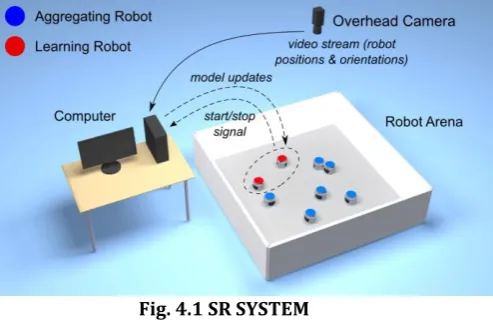
In the SR system the ‘n’ automatic smart robots which can take it on decision assisting coordination in multi-bot system to complete a task. In our system each bot work on the basis of RPS technology with continuous feedback of each robot in swarm. Based on position of each robot in its surrounding, status, etc. It will calculate the best possible way to accomplish the task. Again for organization of load in storage area the basic algorithm according to the arrangement will be assigned to swarm by the monitoring system which consist of vision based and positioning based system. Each
robot will act as a server for the monitoring system. Key technologies used are as follows
1. Separation: Each robot needs to maintain proper spacing between each other. Different types of proximity sensors and SONAR sensor are used to keep intact robots in its surrounding.
2. Wireless communication system: Communication in the system is done with the help of ZigBee module, RF module. 3. Mechanical design: The mechanical components used in each bot is hydraulic system used for lift and place mechanism. Other simple wheel based system is used for the movement of robot.
[image:2.595.311.558.290.450.2]4. Positioning and tracking of robots: The positioning and tracking of each individual in the swarm system can be done by simple motion analysing method with the help of IR sensors, attached to the wheel.
Fig. 4.1 SR SYSTEM
© 2017, IRJET | Impact Factor value: 5.181 | ISO 9001:2008 Certified Journal
| Page 2363
system. Swarming can be seen as one kind of self-organizingsystem. To give a taste of how swarming works, consider the following game.
Take a large number of people and randomly assign a protector and an attacker to each person. Tell them that they must move around so that their protector is between them and their attacker. How will the crowd move? Since one person’s attacker might be another one’s PRMIT & R 4 Protector, the motion of the crowd will be random. Consider the difficulty faced by an observer who enters the room while the crowd moves around and tries to discern the rules governing it. Contrast this to the situation that arises when the rule is changed in a very simple way: each person tries to move so that they are in between their attacker and protector. Now, everybody will try to move to the centre of the crowd.
The system has two main components viz. 1. Swarm bot
[image:3.595.310.556.385.614.2]2. Monitoring station
Fig. 4.2 Robot Mechanism
As shown in the figure each robot has a simple mechanism of lift and place which is able to pick and drop the load a source to a desired location. Each robot will be able to avoid the clusters coming in its vicinity and take the load to the desired destination. An infrared sensor is attached to the wheel of each robot so that the corresponding motion of the wheel of each robot will result in the change in the motion from the desired direction. If the wheel goes forward the IR sensor will count the no. of bits assigned to the motion, for the change in direction the difference between the motions of two wheels will result in the proper change in direction. The robot will continuously be in connected with the master station so that it can update its current status on the master station. According to the priority, the master station will assign the proper task to each of the robot and maintain its service. Another important factor of each bot is interfacing the proximity sensors as it has to avoid the collision between
its subordinates. Then the role of communication between the bots and master station comes.
5. Block Diagram & Hardware Implementation
Fig. 5.1 Block Diagram
The communication is only one directional since the bots only arrange and perform the allotted task as per the instructions by monitoring station.
Fig.5.2 Communication Process
Now the communication between the monitoring station and the swarm bot is done through the ZigBee communication module. There is a ZigBee Trans- receiver connected to both bot as well as master station for the effective communication
between the bot and the monitoring station
.
6. Required Hardware
6.1 SENSORS AND TRANSDUCERS USED
© 2017, IRJET | Impact Factor value: 5.181 | ISO 9001:2008 Certified Journal
| Page 2364
Fig. 6.1 IR SensorsBy using an LED which produces light at the same wavelength as what the sensor is looking for, you can look at the intensity of the received light. When an object is close to the sensor, the light from the LED bounces off the object and into the light sensor. This results in a large jump in the
intensity, which we already know can be detected.
[image:4.595.42.280.346.498.2]6.2 SONAR SENSOR
Fig .6.2 Sonar Sensor
Ultrasonic transducers are transducers that convert ultrasound waves to electrical signals or vice versa. Those that both transmit and receive may also be called ultrasound transceivers; many ultrasound sensors besides being sensors are indeed transceivers because they can both sense and transmit. These devices work on a principle similar to that of transducers used in radar and sonar systems, which evaluate attributes of a target by interpreting the echoes from radio or sound waves, respectively. Active ultrasonic sensors generate high-frequency sound waves and evaluate the echo which is received back by the sensor, measuring the time interval.
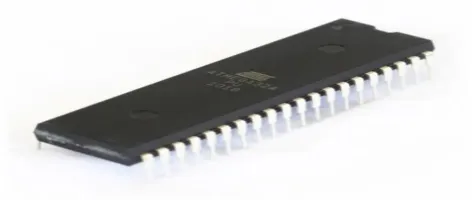
6.3 ARDUINO(IC Atmega32):
Arduino is an open-source platform used for building electronics projects. Arduino consists of both a physical programmable circuit board (often referred to as a microcontroller) and a piece of software, or IDE (Integrated Development Environment) that runs on your computer, used to write and upload computer code to the physical board. The Arduino platform has become quite popular with people just starting out with electronics, and for good reason. Unlike most previous programmable circuit boards, the Arduino does not need a separate piece of hardware (called a
programmer) in order to load new code onto the board – you can simply use a USB cable. Additionally, the Arduino IDE uses a simplified version of C++, making it easier to learn to program
Finally, Arduino provides a standard form factor that breaks out the functions of the micro-controller into a more accessible package. Hence in this way we can implement the swarm robotics technology in simple way to perform the complex task
7. Applications of Swarm & Future Scope
Several potential proposals of swarm robotics which are very suitable are described below.
1. Tasks which cover large area 2. Tasks dangerous to robot
3. Tasks which require scaling population 4. Tasks which require redundancy 5. Post-disaster relief operations 6. Target searching
7. Military application
7.1 FUTURE SCOPE
Swarms of robots performing together to carry out trades could provide new chances for humans to connect the power of machines. The ability to control robot swarms could prove tremendously beneficial in a range of contexts, from military to medical. The robots can also group themselves together into a single cluster after being dispersed across a room, and shape themselves by order of priority. On a larger scale, they could play a part in military, or search and rescue operations, acting together in areas where it would be too dangerous or unrealistic for humans to go. In industry too, robot swarms could be put to use, improving manufacturing processes and workplace safety. The bionic aero vehicles inspired from swarm intelligence technology will become applicable in a few years. It can be foreseen that machine bees or cockroaches with inspection equipment and missiles will possibly show up in future war.
3. CONCLUSIONS
© 2017, IRJET | Impact Factor value: 5.181 | ISO 9001:2008 Certified Journal
| Page 2365
These operations require high level of robustness andadaptation. One way to increase the robustness is constructing a distributed system, in this case using multi-robot with distributed control. The benefit of using distributed system is having less dependency to a failure of a particular part of the whole system. Another important feature of SAR robots is versatility. During a mission robot would face to unpredicted situations and it should be able to manage that situation. One approach to have versatility and adaptation is self-reconfigurable robots. This feature enables the robot to change its structure depend on the environment. Swarm robotics is a new approach for SAR. In this approach each robot is an autonomous agent with some capability and sensors. Individual robots are capable to autonomously and then collaborate with other robots to do more complex tasks such as moving over a hole, transporting object, etc. Swarm-Bot opens up a new research field. The system built here is capable of performing the complex task of logistic management in a easier way. The distribution of the task resulted in dividing the work and finally achieving the result.
REFERENCES
[1] Yogeswaran, M., Ponnambalam, S.: Swarm Robotics: An
Extensive Research Review. Advanced Knowledge Application in Practice, Igor Fuerstner (Ed.) (2010).
[2] Applications and Prototype for System of Systems
Swarm Robotics(Matthew A.Joordens, Member IEEE, Ted Shaneyfelt, Student member IEEE, Kranthimanoj Nagothu, Srujana Eega, Aldo Jaimes and Mo Jamshidi,)
[3] Mamta Gupta 1, Devika, Saxena , Sugandha Kumari,
Dawinder Kaur ISSUES AND APPLICATIONS OF SWARM ROBOTICS International Journal of Research in Engineering, Technology and Science, Volume VI, Special Issue, July 2016
[4] G. Dudek, E. Jenkin, D. Wilkes, “A taxonomy for swarm
robots”, In Proc. 1993 IEEE International Conference
on Intelligent Robots and Systems, pp 441–447, 1993.
BIOGRAPHIES
Sanket Nirmal is currently working as an assistant professor at PRMITR, Badnera and he is having an experience of 5 years in the field of Electronics & Telecomm. Engg. He has done his UG from YCCE & PG from JNTU.