© 2018, IRJET | Impact Factor value: 6.171 | ISO 9001:2008 Certified Journal | Page 4009
Human Resource and Management System Using Face Recognition
1 Shraddha Khobragade, 2
Samiksha
Chavhan,
3Sayali Tembhurne,
4Chitra Kohale,
5Bharti
Fule,
6Uma Thakur
1,2,3,4,5 BE Student, Department Of Computer Science and Engineering, Priyadarshini Institute of Engineering and
Technology Nagpur, Maharashtra, India
6Professor, Department Of Computer Science and Engineering, Priyadarshini Institute of Engineering and
Technology Nagpur, Maharashtra, India
---***---Abstract— Face recognition has been a quickly developing, testing and intriguing region progressively applications. An extensive number of face recognition calculations have been produced in a decade ago. In this paper an endeavour is made to survey an extensive variety of techniques utilized for face recognition exhaustively. This incorporate PCA, LDA, ICA, SVM, Gabor wavelet delicate registering instrument like ANN for recognition and different cross breed blend of this systems. This audit examines every one of these techniques with parameters that difficulties face recognition like illumination, pose variation, facial expressions.
Keywords— Principal Component Analysis (PCA), Linear
Discriminant Analysis (LDA), Face Recognition, Independent Component Analysis (ICA), Artificial Neural Networks (ANN)
I. INTRODUCTION
Face recognition is an essential piece of the ability of human discernment framework and is a standard errand for people, while building a comparable computational model of face recognition. The computational model add to hypothetical bits of knowledge as well as to numerous down to earth applications like mechanized group observation, get to control, outline of human PC interface (HCI), content
based picture database administration, criminal
distinguishing proof et cetera. The soonest chip away at face recognition can be followed back in any event to the 1950s in brain science [1] and to the 1960s in the designing writing [2]. A portion of the soonest examines incorporate work on facial demeanor feelings by Darwin [3]. In any case, inquire about on programmed machine recognition of faces began in the 1970s [4] and after the fundamental work of Kanade [5].
In 1995, an audit paper [6] gave an exhaustive review of face recognition innovation around then [7]. Around then, video-based face recognition was still in a beginning stage. Amid the previous decades, face recognition has gotten expanded consideration and has progressed actually. Numerous business frameworks for still face recognition are presently accessible. As of late, noteworthy research endeavours have been centred on video-based face
displaying/following, recognition and framework
incorporation. New databases have been made and assessments of recognition strategies utilizing these databases have been done. Presently, the face recognition has turned out to be a standout amongst the most dynamic
uses of example recognition, picture examination and comprehension.
II. EXISTING FACE RECOGNITION ALGORITHMS
A. Principal Component Analysis (PCA)
PCA otherwise called Karhunen-Loeve technique is one of the famous strategies for include determination and measurement lessening. Recognition of human faces utilizing PCA was first done by Turk and Pentland [8] and recreation of human faces was finished by Kirby and Sirovich [9]. The recognition technique, known as Eigen face strategy characterizes an element space which lessens the dimensionality of the first information space. This diminished information space is utilized for recognition. In any case, poor separating power inside the class and huge calculation are the outstanding basic issues in PCA technique. This restriction is overwhelmed by Linear Discriminant Analysis (LDA). LDA is the most predominant calculations for highlight choice in appearance based techniques [9].
Be that as it may, numerous LDA based face recognition framework initially utilized PCA to lessen measurements and after that LDA is utilized to boost the separating energy of highlight determination. The reason is that LDA has the little specimen measure issue in which dataset chose ought to have bigger examples per class for good segregating highlights extraction. Accordingly executing LDA straightforwardly brought about poor extraction of separating highlights. In the proposed strategy [10] Gabor channel is utilized to channel frontal face pictures and PCA is utilized to decrease the measurement of separated component vectors and after that LDA is utilized for highlight extraction. The exhibitions of appearance based factual techniques, for example, PCA, LDA and ICA are tried and looked at for the recognition of hued faces pictures in [11]. PCA is superior to LDA and ICA under various illumination variations however LDA is superior to ICA.
© 2018, IRJET | Impact Factor value: 6.171 | ISO 9001:2008 Certified Journal | Page 4010 A recursive calculation for figuring the discriminant
highlights of PCA-LDA method is presented in [14]. This technique focuses on testing issue of figuring separating vectors from an incrementally arriving high dimensional information stream without processing the comparing covariance grid and without knowing the information ahead of time. The proposed incremental PCA-LDA calculation is exceptionally proficient in memory utilization and it is extremely productive in the estimation of first premise vectors. This calculation gives an adequate face recognition achievement rate in correlation with extremely acclaimed face recognition calculations, for example, PCA and LDA. Two appearance– based systems, for example, Modified PCA (MPCA) and Locality Preserving Projections (LPP) are consolidated in [15] to give a high face recognition rate. PCA is utilized as a component extraction strategy in [16]. These component vectors are thought about utilizing Mahalanobis separations for basic leadership. Tensor based Multilinear PCA approach is proposed in [17] which removes highlight specifically from the tensor portrayal as opposed to the vector portrayal. This technique demonstrates a superior execution in correlation with the outstanding strategies in separate changing situations.
PCA can outflank over numerous different systems when the span of database is little. In proposed calculation [18] the database was sub grouped utilizing a few highlights of enthusiasm for faces. Just a single of the acquired subgroups was given by PCA to recognition. Notwithstanding the great aftereffects of PCA, this system has the inconvenience of being computationally costly and complex with the expansion in database estimate, since every one of the pixels in the picture are important to get the portrayal used to coordinate the information picture with all others in the database.
Diverse dimensionality diminishment methods, for example, PCA, Kernel PCA, LDA, Locality safeguarding Projections and Neighbourhood Preserving inserting were chosen and connected so as to decrease the loss of grouping execution due to changes in facial appearance. The execution of recognition while utilizing PCA and in addition LDA for dimensionality diminishment is by all accounts parallel as far as precision. However, it was watched that LDA requires long time for preparing more number of numerous face pictures notwithstanding for little databases. In the event of Locality Preserving Projections (LPP) and NPE techniques, the recognition rate was less if expanding number of face pictures were utilized when contrasted with that of PCA and KPCA strategies. The proposed technique [19] gave significant enhancements on account of illumination variations, PCA and bit PCA are the best entertainers.
Altered PCA calculation for face recognition were proposed in [20], this strategy depended on diminishing the impact of eigenvectors related with the expansive Eigen esteems by normalizing the component vector component by its comparing standard deviation. The re-enactment comes
about demonstrate that the proposed strategy brings about a superior execution than customary PCA and LDA approaches and the computational cost continues as before as that of PCA and significantly less than that of LDA.
Another face recognition technique in light of PCA, LDA and neural system were proposed in [21]. This technique comprises of four stages:
i. Pre-processing
ii. Dimension lessening utilizing PCA
iii. include extraction utilizing LDA
iv. Grouping utilizing neural system.
Blend of PCA and LDA were utilized for enhancing the capacity of LDA when a couple of tests of pictures were accessible and neural classifier was utilized to diminish
number misclassification caused by not-directly
distinguishable classes. The proposed strategy was tried on Yale face database. Exploratory outcomes on this database showed the viability of the proposed technique for face recognition with less misclassification in examination with past strategies.
An alternate approach for face recognition was proposed in [22] which limit calculation time while accomplishing higher discovery precision. PCA was utilized to decrease the measurement separating a component vector. GRNN utilized as a capacity estimate system to identify whether the information picture contains a face or not and if existed then reports about its introduction. The proposed framework had demonstrated that GRNN can perform superior to back propagation calculation and give some answer for better regularization.
B. Support Vector Machine (SVM)
Support Vector Machines (SVM) are a standout amongst the most valuable systems in grouping issues. One clear case is face recognition. Be that as it may, SVM can't be connected when the component vectors characterizing tests have missing sections. A grouping calculation that has effectively been utilized as a part of this structure is the all-known Support Vector Machines (SVM) [23], which can be connected to the first appearance space or a subspace of it acquired in the wake of applying an element extraction technique [24] [25] [26]. The benefit of SVM classifier over customary neural system is that SVMs can accomplish better speculation execution.
C. Independent Component Analysis (ICA)
© 2018, IRJET | Impact Factor value: 6.171 | ISO 9001:2008 Certified Journal | Page 4011 contrasted and existing frameworks [27] [28] [29] . What
recognizes ICA from different strategies is that, it searches for component that is both measurably independent and non-gaussian [27]. The ICA is like visually impaired source detachment issue [30] that comes down to finding a straight portrayal in which the components are measurably independent. The correlation of face recognition utilizing PCA and ICA on FERET database with various classifiers [31] [32] were talked about and discovered that the ICA would be advised to recognition rate as contrasted and PCA with factually independent premise pictures and furthermore with measurably independent coefficients. Face recognition utilizing ICA with extensive revolution edges with poses and variations in illumination conditions was proposed in [33]. A novel subspace technique called successive line segment independent component analysis for face recognition is proposed in [34]. In ICA each face picture is changed into a vector before figuring the independent components. RC_ICA decreases face recognition blunder and dimensionality of recognition subspace ends up noticeably littler. A novel system for face recognition consolidated the independent component analysis (ICA) demonstrate with the optical connection procedure was proposed in [35]. This approach depended on the exhibitions of a firmly segregating optical connection strategy alongside the heartiness of the ICA show. Independent component analysis (ICA) demonstrate had started enthusiasm for looking for a direct change to express an arrangement of arbitrary factors as straight mixes of factually independent source factors [36]. ICA gave a more intense information portrayal than PCA as its objective was that of giving an independent instead of uncorrelated picture deterioration and portrayal. A quick incremental primary non Gaussian headings analysis calculation called IPCA_ICA was proposed in [37].This calculation figures the key components of an arrangement of picture vectors incrementally without evaluating the covariance grid and in the meantime change these important components to the independent bearings that amplify the non-Guassianity of the source. IPCA_ICA is extremely effective in the estimation of the main premise vectors. PCA_ICA makes higher normal progress rate than Eigen face, the Fisher face and Fast ICA strategies.
III. PROPOSED APPROACH
Human Resource Management system gives the data with respect to the employees in the organization. The system encourages great connection/correspondence offices between the employees and HR organization. With the expanding impact of globalization and innovation, different elements of human resource management systems have turned out to be focal in overseeing associations adequately. Subsequently, associations must regard data as some other resource or resource. For data to show quality, it must be sorted out, overseen and dispersed in a compelling way. Human Resource management systems bolster exercises, for example, recognizing potential employees, keeping up records of existing employees. HR systems help senior
management to recognize the labor prerequisites with a specific end goal to meet the association's long haul marketable strategies and key objectives. Center management utilizes human resources systems to screen and investigations the enrollment, assignment and remuneration of employees. Operational management utilizes HR systems to track the enrollment and position of the employees. HRMS can likewise bolster different HR practices, for example, workforce arranging, staffing, pay programs, compensation figures, pay spending plans and work or representative relations. For confront recognition we are utilizing Luxand Face SDK.
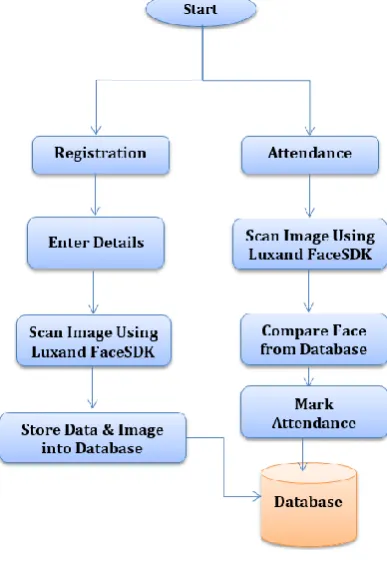
[image:3.595.337.531.430.711.2]The progressive self-learning AI empowers video-based recognizable proof of human subjects with no earlier enrolment. The API consequently perceives all countenances experienced in a video stream, enrolling their entire biometric data caught from the various perspectives and edges, finish with live feelings and articulations. Each subject can be followed consistently and consequently without particular enrolment. Selecting a man is as basic as putting an unofficial ID in a video. This should be possible whenever, and the system will consequently distinguish that subject in all past, present and future recordings. Sans enrolment distinguishing proof is ideal for building CRM systems for enlistment work areas, access and participation control systems, reconnaissance and security applications. Figure 1 shows the block diagram of the system.
Figure 1: Block Diagram
© 2018, IRJET | Impact Factor value: 6.171 | ISO 9001:2008 Certified Journal | Page 4012 preparing. As it were, they dispose of data accessible in the
movement stream, and return to in any case picture acknowledgment. This outline approach requires an arrangement of complex preparatory enlistment systems where the subject's face is caught against plain foundation at different points and postured appearances.
IV. CONCLUSIONS
This paper has endeavored to survey significant number of papers to cover the current advancement in the field of face recognition. Introduce think about uncovers that for upgraded face recognition new calculation needs to advance utilizing half and half strategies for delicate figuring apparatuses, for example, ANN, SVM, SOM may yields better execution. The rundown of references to give more itemized comprehension of the methodologies portrayed is enrolled. We apologize to specialists whose critical commitments may have been neglected.
REFERENCES:
[1] Bruner, I. S. and Tagiuri, R. The perception of people. In Handbook of Social Psychology, Vol. 2, G. Lindzey, Ed., Addison-Wesley, Reading, MA, 634–654.1954
[2] Bledsoe, W. W. The model method in facial recognition. Tech. rep. PRI:15, Panoramic research Inc., Palo Alto, CA.1964
[3] Ekman, P. Ed., Charles Darwins. The Expression of the Emotions in Man and Animals, Third Edition, with Introduction, Afterwards and Commentaries by Paul Ekman. Harper- Collins/Oxford University Press, New York, NY/London, U.K.1998
[4] Kelly, M. D. Visual identification of people by computer. Tech. rep. AI-130, Stanford AI Project, Stanford, CA. 1970
[5] Kanade, T. Computer recognition of human faces. Birkhauser, Basel, Switzerland, and Stuttgart, Germany 1973
[6] Chellapa, R., Wilson, C. L., and Sirohey, S. Human and machine recognition of faces: A survey. Proc. IEEE, 83, 705–740.1995
[7] Samal, A. and Iyengar, P. Automatic recognition and analysis of human faces and facial expressions: A survey. Patt. Recog. 25, 65–77.1992
[8] M. Turk and A. Pentland, "Eigen faces for recognition," J. Cognitive Neuroscience, vol. 3, 71-86., 1991.
[9] D. L. Swets and J. J. Weng, "Using discriminant eigenfeatures for image retrieval", IEEE Trans. PAMI., vol. 18, No. 8, 831-836, 1996.
[10] C.Magesh Kumar, R.Thiyagarajan , S.P. Natarajan, S.Arulselvi, G.Sainarayanan,‖ Gabor features and LDA based Face Recognition with ANN classifier‖, Procedings Of ICETECT 2011
[11] Önsen TOYGAR Adnan ACAN,‖Face recognition using PCA,LDA and ICA approaches on colored images‖, Journal Of Electrical and Electronics Engineering, vol- 13,2003
[12] Y. Cheng, C.L. Wang, Z.Y. Li, Y.K. Hou and C.X. Zhao.‖ Multiscale principal contour direction for varying lighting face recognition‖, Proceedings of IEEE 2010
[13] F. Al-Osaimi·M. Bennamoun · A. Mian,‖ An Expression Deformation Approach to Non-rigid 3D Face Recognition‖, Springer Science+Business Media, LLC 2008
[14] Issam Dagher,‖Incremental PCA-LDA algorithm‖, International Journal of Biometrics and Bioinformatics (IJBB), Volume (4): Issue (2)
[15] J. Shermina, V. Vasudevan,‖An Efficient Face recognition System Based on Fusion of MPCA and LPP‖, American Journal of Scientific Research ISSN 1450-223X Issue 11(2010), pp.6-19
[16] Ishwar S. Jadhav, V. T. Gaikwad, Gajanan U. Patil,‖Human Identification Using Face and Voice Recognition‖, International Journal of Computer Science and Information Technologies, Vol. 2 (3), 2011
[17] Yun-Hee Han, Keun-Chang Kwak,‖ Face Recognition and Representation by Tensor-based MPCA Approach‖, 2010 The 3rd International Conference on Machine Vision (ICMV 2010)
[18] Neerja, Ekta Walia,‖Face Recognition Using Improved Fast PCA Algorithm‖, Proceedings of IEEE 2008
[19] S.Sakthivel, Dr.R.Lakshmipathi,‖Enhancing Face
Recognition using Improved Dimensionality Reduction and feature extraction Algorithms_An Evaluation with ORL database‖, International Journal of Engineering Science and Technology Vol. 2(6), 2010
[20] Lin Luo, M.N.S. Swamy, Eugene I. Plotkin, ―A Modified PCA algorithm for face recognition‖, Proceedings of IEEE 2003
[21] A. Hossein Sahoolizadeh, B. Zargham Heidari, and C. Hamid Dehghani,‖ A New Face Recognition Method using PCA, LDA and Neural Network‖, International Journal of Electrical and Electronics Engineering 2:8 2008
© 2018, IRJET | Impact Factor value: 6.171 | ISO 9001:2008 Certified Journal | Page 4013 using PCA, Generalized Regression Neural network and
Mahalanobis Distance by reducing Search
space‖,Proceedings Of IEEE 2007
[23] Vapnik. Statistical Learning Theory. John Wiley and Sons, New York, 1998.
[24] E. Osuna, R. Freund, and F. Girosit. Training support vector machines: an application to face detection. Proc. of CVPR, pages 130–136, 1997.
[25] B. Heisele, T. Serre, and T. Poggio. A componentbased framework for face detection and identification. IJCV, 74(2):167–181, 2007.
[26] Q. Tao, D. Chu, and J. Wang. Recursive support vector machines for dimensionality reduction. IEEE Trans. NN, 19(1):189–193, 2008.
[27] Marian Stewart Bartlett, Javier R. Movellan, Terrence J. Sejonowski, ―Face Recognition by Independent Component Analysis‖, IEEE Transactions on Neural Networks, vol-13, No- 6,November 2002, PP 1450- 1464.
[28] Pong C.Yuen, J.H.Lai, ―Face representation using independent component analysis‖, Pattern Recognition 35 (2002) 1247-1257.
[29] Tae-Kyun Kim, Hyunwoo Kim, Wonjum Hwang, Josef Kittler, ―Independent component analysis in a local facial residue space for face recognition‖, Pattern Recognition 37 (2004)
[30] Aapo Hyvärinen and Erkki Oja ―Independent Component Analysis: Algorithms and Applications‖ Neural Networks Research Centre Helsinki University of Technology P.O. Box 5400, FIN-02015 HUT, Finland, Neural Networks, 13(4-5):411-430, 2000
[31] Bruce A. Draper, Kyungim Baek, Marian Stewart Bartlett, ―Recognizing faces with PCA and ICA, Computer Vision and Image Understanding 91 (2003) 115-137.
[32] Jian Yang, David Zhang, Jing-yu Yang, ―Is ICA Significantly Better than PCA for Face Recognition, Proceedings of the Tenth IEEE International Conference on Computer Vision (ICCV’05) 1550- 5499/05.
[33] Kailash J. Karande, Sanjay N.Talbar, Face Recognition under Variation of Pose and Illumination using Independent Component Analysis‖, ICGST-GVIP, ISSN 1687-398X, Volume (8), Issue (IV), December 2008
[34] Quanxue Gao , LeiZhang, DavidZhang, Sequential row– column independent component analysis for face recognition‖, Elsevier 2008
[35] A. Alfalou and C. Brosseau,‖ A New Robust and Discriminating Method for Face Recognition Based on Correlation Technique and Independent Component Analysis Model‖, Optics Letters 36 (2011) 645-647
[36] P. Comon, ―Independent component analysis: a new concept? Signal Process. 3, 287-314 (1994).
[37] Issam Dagher and Rabih Nachar, Face Recognition Using IPCA-ICA algorithm‖, IEEE Transactions On Pattern Analysis and Machine Intelligence, VOL. 28, NO. 6, JUNE 2006