© 2017, IRJET | Impact Factor value: 5.181 | ISO 9001:2008 Certified Journal
| Page 438
Deblocking Filter for Reduction of Blocking Artifacts in Video
Achal Gamit
1, Ms. Bhavna Pancholi
21
Post Graduate Student
2
Assitant. Professor, Dept. of Electrical Engineering, Faculty of Technology and Engineering Maharaja Sayajirao
University of Baroda, India
---***---Abstract -Many video coding standards such as H.264/AVC (Advanced Video Coding) uses block based coding techniques for compression of raw video. Here, each block is independently transformed and quantized. Block based motion estimation and motion compensation are used in these coding standards. All such block based operations introduces blocking artifacts and degrades quality of reconstructed video. In order to improve the quality, the post-processing deblocking filter algorithm is proposed. This paper deals with activity based classification of smooth, intermediate or complex region and applying the appropriate filtering algorithm that gives improve results for highly compressed video sequences.
Key Words: Blocking Artifact, Deblocking Filter, Post Filter, Block Based Coding, Video Coding
1. INTRODUCTION
Video is a sequence of frames having successive frames are somewhat similar. In H.264/AVC (Advanced Video Coding) standard, the difference between the two frames are integer transformed and quantized. Here in, block based operations such as motion estimation (ME), motion compensation (MC), integer transform and quantization are used to compress video. Here encoder divides each frame in the blocks of 16X16 block called macroblock (MB), which is divided into 16X8, 8X16, 8X8. And these 8X8 is divided into blocks of 8X4, 4X8, 4X4 [1].
Here, each block is independently transformed and quantized. Different block sizes are used for higher compression ratio [2]. This coding produces blocking artifacts at the block boundary. This artifacts gets accumulated and spread due to motion compensation, across the reconstructed frame [3].
Blocking artifacts are classified into three types as: grid noise, staircase noise and corner outliers. Grid noise in smooth area, staircase noise along the image edges and corner outliers at four cross points of 8X8 blocks [5]. Deblocking filter is applied to such blocking artifacts to improve subjective and objective quality of video. There are two types of filter, which are loop filter within the coding loop and post filter is used outside the coding loop of encoder. So post filter is used as it has less computation complexity to remove blocking artifacts [4].
Algorithm proposed in filter [5] gives poor performance in edge or textured areas. The filter proposed in [6] gives poor PSNR (dB) improvement as less pixels are updated to get good PSNR, which is adverse. This paper focus on finding the different filtering mode decision and applying appropriate filter. Section 2. describes proposed deblocking filter algorithm. Section 3. Illustrates results and performance evaluation. At last section 4. gives conclusion.
2. PROPOSED DEBLOCKING FILTER
2.1 Filtering Mode Decision
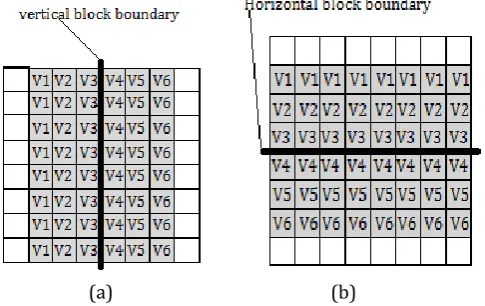
The requirement of the mode decision is for not excessive blurring of the textured and true image edges in the local region and preserving the image quality. Here, the level of blocking effect is measured around the block boundary of adjacent block pixels. As shown in fig. 1(a), one dimensional (1-D) array of pixels at vertical block boundary used to measure the activity of the region using equations as follows
(1)
Where,
(2)
Depending upon (1) and (2) across block boundary, the filtering mode is decided and appropriate filter is applied. Similarly finding activity for next row, finding appropriate filtering mode decision and applying the filter. Similarly, applying the same procedure across horizontal block boundary.
Here, A(v) is compared with two thresholds, and to decide mode of filtering. The value of threshold is set to the small value to decide essentially smooth region and the value of threshold is set to the value to decide complex region. If , then smooth mode
filtering; else if , then
© 2017, IRJET | Impact Factor value: 5.181 | ISO 9001:2008 Certified Journal
| Page 439
(a) (b)
Fig -1: Eight 1-D array of pixels across (a) vertical block boundary (b) horizontal block boundary
2.2 Filtering Algorithm
A) Smooth Region Deblocking Filtering
In human visual system (HVS), there are discontinuities between blocks in smooth region which is due to abrupt change appearing at the block boundaries. Here, by applying strong filter across the block boundary as shown in fig. Updating pixels by following equations as
(a)
(b)
(c)
Fig -2: (a) pixels for filtering in smooth region (b) offset before applying filter (c) offset after applying filter
B) Complex Region Deblocking Filtering
[image:2.595.318.570.100.471.2] [image:2.595.45.288.109.262.2]© 2017, IRJET | Impact Factor value: 5.181 | ISO 9001:2008 Certified Journal
| Page 440
Fig -3: pixels for filtering in complex region
C) Intermediate Region Deblocking Filtering
The decision between two filtering modes may excessively blur or cause insufficient removal of blocking effect. So to improve both the subjective and objective quality of images, intermediate mode filtering is used. A 3 X 3 low pass filter is applied on either side of the block boundary as shown in fig. , preserving the real edges. Filter specifications are as follows
Where, is set according to Quantization parameter ( ). Here, is set if is within intracoded block and is set if is within interceded block and β lies between 8-16 controlling extent of smoothing.
(a)
(b)
Fig -4: (a) a 3 X 3 low pass filter (b) pixels for filtering in intermediate region
D) Results
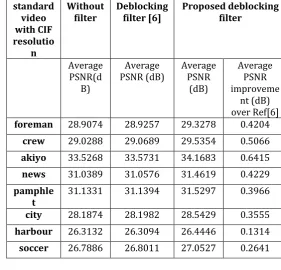
[image:3.595.87.263.100.276.2]Here, video sequences of foreman, crew, akiyo, news, pamphlet, city, harbor and soccer [7] with CIF resolution, 300 frames at frame rate of 30fps are used. All the video sequences are coded with H.264/AVC with quantization parameter [12] QP=38. Here for experiment S=2, and are taken. For performance evaluation of proposed algorithm uses parameters that are peak signal to noise ratio (PSNR (dB)) and structural similarity index (SSIM) of original and filtered images. The value of SSIM range between -1 to 1, where -1 for both images different and 1 for both images same [9].
Table -1: PSNR of video sequences in Deblocking filter
standard video with CIF resolutio
n
Without
filter Deblocking filter [6] Proposed deblocking filter
Average PSNR(d
B)
Average
PSNR (dB) Average PSNR (dB)
Average PSNR improveme
nt (dB) over Ref[6] foreman 28.9074 28.9257 29.3278 0.4204
crew 29.0288 29.0689 29.5354 0.5066 akiyo 33.5268 33.5731 34.1683 0.6415 news 31.0389 31.0576 31.4619 0.4229 pamphle
[image:3.595.353.506.106.266.2] [image:3.595.297.579.502.772.2]© 2017, IRJET | Impact Factor value: 5.181 | ISO 9001:2008 Certified Journal
| Page 441
Table -2: SSIM of video sequences in Deblocking filter
standard video with CIF resolutio
n
Without
filter Deblocking filter [6] deblocking filterProposed
Average
SSIM Average SSIM Average SSIM Average SSIM Improve m-ent over Ref[6] foreman 0.8036 0.8049 0.8270 0.0221
crew 0.7795 0.7814 0.8082 0.0268 akiyo 0.9018 0.9037 0.9262 0.225 news 0.8869 0.8879 0.9071 0.0192 pamphle
t 0.8699 0.8708 0.8902 0.0194
city 0.7703 0.7704 0.7835 0.0131 harbour 0.8329 0.8323 0.8351 0.0028 soccer 0.7370 0.7373 0.7545 0.0172
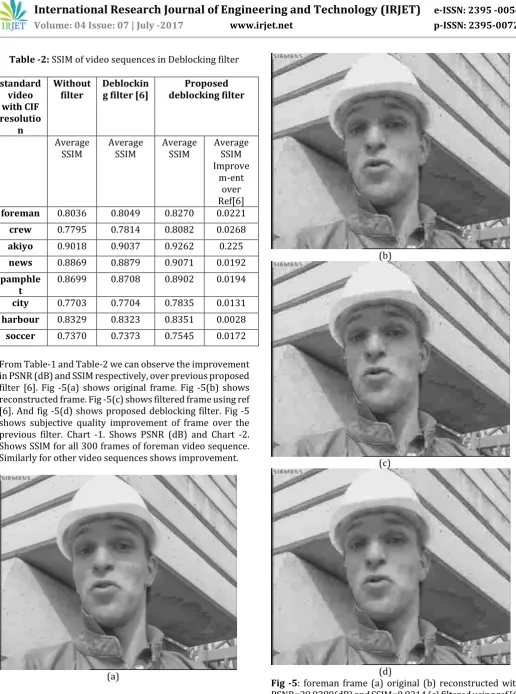
From Table-1 and Table-2 we can observe the improvement in PSNR (dB) and SSIM respectively, over previous proposed filter [6]. Fig -5(a) shows original frame. Fig -5(b) shows reconstructed frame. Fig -5(c) shows filtered frame using ref [6]. And fig -5(d) shows proposed deblocking filter. Fig -5 shows subjective quality improvement of frame over the previous filter. Chart -1. Shows PSNR (dB) and Chart -2. Shows SSIM for all 300 frames of foreman video sequence. Similarly for other video sequences shows improvement.
(a)
(b)
(c)
(d)
[image:4.595.37.277.519.721.2]© 2017, IRJET | Impact Factor value: 5.181 | ISO 9001:2008 Certified Journal
| Page 442
Chart -1: PSNR (dB) for all foreman video sequence
Chart -2: SSIM for all foreman video sequence
3. CONCLUSIONS
From previously proposed post processing deblocking filter less number of pixels are updated to get high value of PSNR but it didn’t worked. Applying the deblocking filter proposed in this paper, we see the improved PSNR and SSIM results. So proposed filter efficiently removes blocking artifact over previous state-of-art.
REFERENCES
[1] T. Wiegand, and G. J. Sullivan, “Overview of the
H.264/AVC Video Coding Standard” IEEE Trans. on Circuits and Systems for video technology, vol. 13, no. 7, pp. 560-576, Jul. 2003.
[2] T. Y. Kuo, and C. H. Chan, “Fast variable block size
Motion Estimation for H.264 using likelihood and correlation of motion field” IEEE Trans. on Circuits and
Systems for video technology, vol. 16, no. 10,pp. 1185-1195, Oct. 2006.
[3] J. Kim and C. B. Sim, “Compression Artifacts removal by
signal adaptive weighted sum technique”, IEEE Trans. on Consumer Electronics, vol. 57, no. 4, pp. 1944-1952, Nov. 2011.
[4] P. List, A. Joch, J. Lainema, G. Bjøntegaard, and
M.Karczewicz,“Adaptive Deblocking filter,” IEEE Trans. on Circuits and Systems forvideo technology, vol.13, no.7, pp. 614-619, Jul. 2003.
[5] Y. Lee, H. Kim, and H. Park, “Blocking effect reduction of
JPEG images by signal adaptive filtering,” IEEE Trans. Image Processing, vol. 7, no. 2, pp. 229-234, Feb. 1998.
[6] S. C. Tai, Y. Y Chen, and S. F. Sheu, “Deblocking Filter for
low bit rate MPEG-4 video”, IEEE Trans. on Circuits and Systems for video technology, vol. 15, no. 6, pp. 733-741, June 2005.
[7] [Online].Available: http://media.xiph.org/video/derf/ [8] I. E. Richardson, “The H.264 Advanced Video
Compression Standard”, 2nd edition , John Wiley, 2010.
[9] Z. Wang, A. C. Bovik, H. R. Sheikh, and E. P. Simoncelli,