REMOTE SENSING IMAGE MATCHING ALGORITHM
BASED ON HARRIS AND SIFT TRANSFORM
JINGYU YANG, SONG WANG, XIAOGANG DU
School of Electronic & Information Engineering, Lanzhou Jiaotong University, Lanzhou 730070, China
ABSTRACT
Image matching is a key part of many remote sensing image processing and image analysis. The traditional gray correlation matching algorithm based on corner point because they do not have the rotational invariance requires manual intervention to roughly match can not be automated. SIFT (Scale invariant feature transform) algorithm to solve the image rotation, scaling and other issues, but for the geometry characteristics clearer, richer texture information in terms of the high-resolution remote sensing images, the algorithm consumes more memory, speed of operation is slow the problem is very prominent. The combinations of two proposed image matching algorithms are based on Harris corner and SIFT descriptor. The experimental results show that, compared to the SIFT algorithm, this algorithm significantly cut computation time, while preserving the rotational invariance of the SIFT descriptor and adaptation to light gray correlation algorithm can not overcome disadvantage of fully automatic, in the high better resolution remote sensing image matching.
Keywords: Harris Corner, SIFT Descriptor, Remote Sensing Image, Reach Texture Information, Image
Matching
1. INTRODUCTION
The high-resolution remote sensing image has the clear feature geometries, and rich texture information currently in the evaluation of urban ecological environment, urban planning, topographic maps updated cadastral survey, precision agriculture has been a huge success [1]. Image registration is a lot of remote sensing image processing and image analysis (such as image fusion, inlaid mosaic, change detection, target identification, etc.).
In image matching registration fields, feature-based registration method does not rely solely on the image intensity, good robustness, the applicability of remote sensing images registration of the existence of large viewing angle difference is greater, and the method focuses on feature extraction and matching.
Early corner feature extraction algorithm, such as Forstner algorithm [2], Harris algorithm [3] tend to use the extracted image characteristics and then search for corresponding features in another image matching method most commonly used is based on the gray correlation coefficient matching. I.e. first in pending extracting corner feature in the image of the alignment, and then remove the corner for the center of the small area, and to remove the corresponding region in the reference image, and
calculating the correlation function of both gray corresponding to the maximum value of the correlation function of the corresponding region of The center point of the corresponding feature point [4]. This matching method does not have the scale and rotation invariance, when the shooting angle and illumination conditions change, can not achieve the automatic matching.
SIFT (Scale invariant feature transform) algorithm proposed by Lowe in 2004 [5] to solve the image rotation, scaling, and affine deformation, viewpoint change, noise, illumination changes, also has strong robustness. SIFT algorithm in the pending match the image and the reference image respectively extracted has scale invariance spots features, and then use the SIFT descriptor matching. Mikolajczyk [6] have proposed SIFT descriptor including a variety of the most representative experiments and performance comparison, the experimental results show that both in different scenes, different illumination change, image geometric distortion, resolution rate differences, rotate, blur, and image compression and other case is still the best overall performance of the SIFT descriptor.
information, high-resolution remote sensing image, this shortcoming is more prominent. Combination of traditional gray matching algorithm and SIFT algorithm using better detection performance algorithm corner Harris algorithm extracts feature points using SIFT descriptors extracted corner described above and matching, greatly reduced the running time , while preserving the SIFT descriptor rotational invariance and adaptation to light, to overcome the shortcomings of the gray correlation algorithm rotation differences. The experimental data applications in high-resolution remote sensing images have to verify the validity of the above advantages of the algorithm.
2. SIFTDESCRIPTOR
SIFT algorithm is divided into two parts of the feature point position detection and the descriptor structure. SIFT descriptor is the focus of this study, including determining feature points around the feature points of the image of the main direction and use information to construct a 128-dimensional descriptor two steps.
The position detection in the SIFT feature points in order to make the feature point having the scale invariance, detection is completed space at multiple scales, the main principle is: on the input image using the Gaussian kernel function of the different
scales (
σ
) for continuous filtering anddown-sampling (sub-sampled), Gaussian pyramid image is formed, then two adjacent scales Gaussian image obtained by subtracting the difference DOG (difference of Gaussians) pyramid image. DOG pyramid each point adjacent levels and the adjacent positions of the points individually comparing the obtained local location is the key point of the location and the corresponding scale. Then, by the method of surface has fitting further precise positioning of key points.
2.1Determine The Main Direction
In order to ensure rotation invariance of the descriptor of the feature point, the partial image information is obtained based on the detected feature points around a direction reference, i.e. the so-called main-direction.
Detecting feature points, using the finite difference calculation to the characteristic point as
the center to a radius of
3 1.5
×
σ
region of imagepixel gradient modulus value of m and an angle of
gradient amplitude of
θ
.( )
(
) (
)
(
) (
)
( )
(
(
) (
) (
)
)
2 21 2
1
2
,
1, 1,
, 1 , 1
, 1 , 1
, arctan
1, 1,
m x y L L
L L x y L x y
L L x y L x y
L x y L x y
x y
L x y L x y
θ
= +
= + − −
= + − −
+ − −
=
+ − −
(1)
Wherein,
L x y
( )
,
can represent the pyramidimage gray-scale of the feature point
( )
x y
,
at thescale [5].
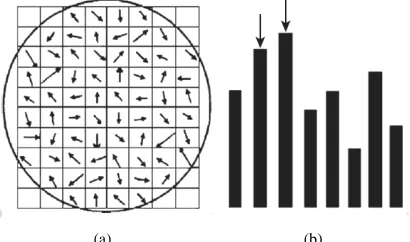
Then use the mode and direction of the gradient of the histogram neighborhood pixels. The horizontal axis of the histogram amplitude angle of the gradient direction, the vertical axis is the accumulated value of the gradient mode corresponding to the angle of the gradient direction. Gradient histogram is divided into 36 columns, in
accordance with the range 0o-360o per 100 as a
column. The peak of the histogram represents the main direction of the gradient of the characteristic point neighborhood image, i.e. the main direction of the point. When the gradient histogram exists another peak is equivalent to 80% of the energy of the main peak, it is in this direction that the auxiliary direction of the feature point, in Figure 1, these are done in order to enhance the robustness of the image matching.
[image:2.612.318.523.448.569.2](a) (b)
Figure 1: Determine The Main Direction Of Feature Points; (A) The Pixels Gradient Of The Field Of Feature
Points; (B) Gradient Histogram
2.2Construction Of SIFT Descriptor
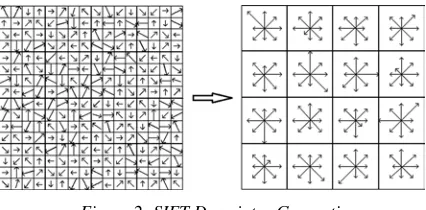
[image:3.612.94.307.258.363.2]The clockwise rotation of the main direction of the local region around a feature point is representative of the angle w, in order to ensure its rotation invariance. Within the region after the rotation will be a feature point as the center of a 16x16 rectangular window evenly divided into 4x4 regions, as shown in Figure 2. Within each sub-regions have to calculated the direction of the gradient histogram eight directions. Likewise, the gradient magnitudes of each pixel require a Gaussian weighting process. So, each of the feature point 128-dimensional feature vector is formed, i.e. the SIFT descriptor.
Figure 2: SIFT Descriptor Generation
After the formation of the feature vector, in order to remove the influence of the illumination change, need to be normalization processing, and then the vector is greater than 0.2 weight unified 0.2, the purpose is to improve the characteristics of the differential resistance.
3. HARRISPOINTSANDSIFT DESCRIPTORMATCHING
Constructed image pyramid SIFT algorithm to detect feature points detection threshold determining step of the position of the key points the computational complexity, time-consuming, consuming memory multiprocessor shortcomings, Harris algorithm instead of SIFT feature point detection, the formation of the Harris corner the SIFT described character combined with fast image matching algorithm.
The concrete steps are as follows:
1) Harris algorithm extracts to be registered image and reference image on the corner feature;
2) To determine the main direction of the Harris corner on the two images. No longer generate the image pyramid, the direct use of gray-scale normalized the SIFT features point where the original image instead of a post before the scale pyramid image, calculating the neighborhood of the corner the gradient modulus values of each pixel and amplitude angle construct gradient histogram
specific, see 2.1. Histogram peak represents the direction of the main direction of the feature point.
3) Constructed two images on the Harris corner SIFT descriptor. On behalf of the angle of the clockwise rotation of the main direction of the local area around the Harris corner, corner to the center
16 16
×
size rectangular windows in the regionafter the rotation, are divided into
4 4
×
sub-regions. Each sub-area according to the eight directions build gradient histogram, thereby
obtained the
4 4 8 128
× × =
-dimensional featurevector, i.e. the SIFT descriptor.
Not build Gaussian pyramid descriptor generated by this method have the same scale, while maintaining rotational invariance to light.
According to the adaptability to change, in the same resolution remote sensing image matching still applies.
4) Using the nearest neighbor/neighbor ratio method match. That treats each feature point image registration, calculate the Euclidean distance of each feature point descriptor on it and reference images, the ratio of the distance of the nearest neighbor (NN) and next nearest neighbor (2ndNN) (NN/2ndNN) as a similarity metrics and set thresholds to determine the candidate matching points.
5) Used the RANSAC [9] algorithms by geometric consistency test eliminate the wrong matching points, matching the results of purification.
4. EXPERIMENTANDANALYSIS
We select two groups of high-resolution remote sensing images as the experimental data to verify the effectiveness of the algorithm: Australia region the GeoEye image and Beijing SPOT5 image. GeoEye panchromatic image resolution of 0.5 meter, multi-spectral image resolution of 2.0 meter, the same to be registered image and reference image acquisition time; two SPOT5 panchromatic image resolution of 2.5 meter, image acquisition time difference a.
correctMatches correct
correspondences
N
R
N
=
(2)4.1SIFT Descriptor Rotation Invariance Verification
In order to verify the SIFT descriptor matches the rotational invariance, the use of traditional gray correlation matching contrast image and reference image registration, that is treated separately Harris algorithm to extract corner features, and then use the SIFT descriptor and gray corner match, the two sets of matching results for comparison.
Select the plain areas GeoEye [10] multi-spectral image and panchromatic image as the experimental data, in order to exclude the influence of the scale, the resolution of the panchromatic image re-sampling 2.0 meter.
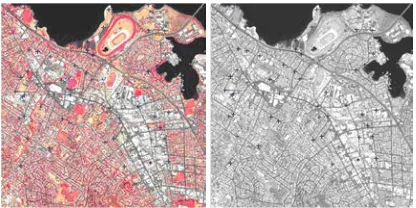
[image:4.612.319.526.282.393.2]When the pending registration image and the reference image does not exist between the rotation, SIFT descriptor matching results shown in Figure 3, gray correlation matching results shown in Figure 4, Figure matching point the expressed crosshairs said.
Figure 3: When There Is No Rotation SIFT Descriptor Matching Results
[image:4.612.95.303.376.485.2]Figure 4: There Is No Rotation Gray Matching Results
Table I : Two Methods Match Results Contrast
Matching Method
The number of matching points
Correct rate
SIFT descriptor matching
Ratio method for the early match
150 74.6
The RANSAC removed the wrong points
112 100
Gray correlation matching
51 100
[image:4.612.319.525.424.534.2]Repeat the above process one degree clockwise rotation of the reference image, SIFT descriptor match the results shown in Figure 5, the gray correlation matching results shown in Figure 6.
Figure 5: SIFT Descriptor Matching Results In The Presence Of Rotation
Figure 6: There Is A Rotation Gray Matching Results
[image:4.612.95.303.516.620.2]Table II : Two Methods Match Results Contrast
Matching Method
The number of matching points
Correct rate
SIFT descriptor matching
Ratio method for the early match
163 74.85
The RANSAC removed the wrong points
122 100
Gray correlation matching
7 100
Thus, the following conclusions as SIFT descriptor match with good rotational invariance, the traditional gray correlation can not be used to match the image rotation relationship exists.
4.2Adaptability Of Matching Algorithm For Remote Sensing Image
We have selected mountainous resolution 0.5 meter of two poor viewing angle GeoEye panchromatic and plains the depiction zone resolution SPOT5 panchromatic image 2.5 meter with a phase difference of the experimental data. Use the same grayscale matched for comparison to manually select a 3-to-point, in order to exclude the effects of rotation between the two images, eliminate rotational relationship before making a gray correlation matching.
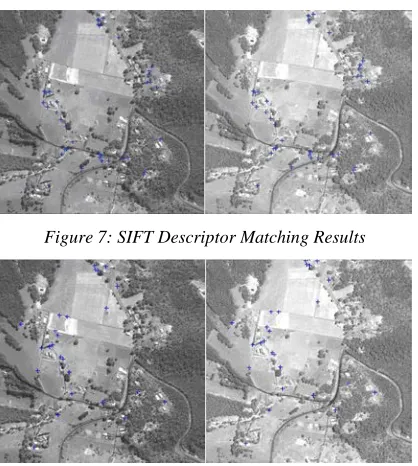
[image:5.612.313.525.404.652.2]Two algorithms have acting on mountain GeoEye Panchromatic matching results shown in Figure 7, as shown in Figure 8.
Figure 7: SIFT Descriptor Matching Results
Figure 8: 3 Point Coarse Matching Gray Correlation Matching Results
Table III : Two Methods Match Results Contrast
Matching Method
The number of matching points
Correct rate
RMS
SIFT descriptor matching
Ratio method for the early match
142 29.5 25.9
The RANSAC removed the wrong points
42 100 1.411
Gray correlation matching
25 96 2.237
It can be seen that they match point distribution in the position of the figure is roughly the same, based on Harris algorithm SIFT descriptor matching point number more local point accuracy rate of more intensive, After RANSAC purification, its match and the matching accuracy also higher.
Beijing urban existence phase difference of the two SPOT5 panchromatic image matches the results shown in Figure 9, Figure 10.The results of the two algorithms differences similar the mountainous Ge0Eye image based on the Harris algorithm of SIFT descriptor matches slightly better than three points after matching gray correlation algorithm.
Figure 9: SIFT Descriptor Matching Results
[image:5.612.96.305.470.703.2]Table IV : Two Methods Match Results Contrast
Matching Method
The number of matching points
Correct rate
RMS
SIFT descriptor matching
Ratio method for the early match
64 79.37 35.5
The RANSAC removed the wrong points
50 100 0.552
Gray correlation matching
40 95 0.542
Can be drawn from the above experiments: either mountain or city high-resolution remote sensing image matching based on the Harris algorithm of SIFT descriptor matching applies, and the match quality is better than the traditional three point rough matching and gray correlation algorithm.
5. CONCLUSION
According to the characteristics of high-resolution remote sensing images, the image matching methods based on a fast the Harris algorithm and SIFT descriptor. The experimental results show that the method does not have the traditional corner-based algorithm gray matching the premise to ensure that the effect of high-resolution remote sensing image matching with rotation invariance.
Meanwhile, the method greatly reduces the time required by the original SIFT algorithm feature point extraction and matching the extracted angle little to facilitate recognition of the human eye may also be supplemented as SIFT spots.
ACKNOWLEDGEMENTS
This work is jointly supported by The National Natural Science Foundation (60962004, 61162016).
REFERENCES:
[1] Li Y L, “Study of mosaicing method in high resolution remote sensing images without geography coordinate”, Beijing: Graduate University of the Chinese Academy of Sciences (Institute of Remote Sensing Applications Chinese Academy of Sciences), 2005, pp. 1-10.
[2] Forstner W, Gulch E, “A fast operator for detection and precise location of distinct points, corners and centers of circular features”,
Proceedings of Inter-commission Conference on Fast Processing of Photogrammetric Data, IEEE Conference Publishing Services, August 25-27, 1987, pp. 287-305.
[3] Harris C, Stephens M, “A combined corner and
edge detector”, Proceedings of the 4th Alvey
Vision Conference, The Plessey Company
Publishing Services, July 27-29, 1988, pp. 147-151.
[4] Zhang J Q, Pan L, Wang S G, “Photogrammetry”, Wuhan: Wuhan University Press, 2003, pp. 97-99.
[5] Lowe D G, “Distinctive image features from
scale-invariant key points”, International
Journal on Computer Vision, Vol. 60, No. 2, 2004, pp. 91-110.
[6] Mikolajczy K, Schmid C, “A performance
evaluation of local descriptors”, IEEE
Transactions on Pattern Analysis and Machine Intelligence, Vol. 27, No. 10, 2005, pp. 1615-1630.
[7] Li X M, Zhen L, Hu Z Y, “SIFT based automatic registration of remotely-sensed imagery”,
Journal of Remote Sensing, Vol. 10, No. 6, 2006, pp. 885-892.
[8] Chen Y, Liu Q Y, “The unmanned aerial vehicles remote sensing image registration based on SIFT algorithm and mahalanobis
distance”, Geomatics and Spatial Information
Technology, Vol. 32, No. 6, 2009, pp. 50-53. [9] Fischler M A, Bolles R C, “Random sample
consensus: a paradigm for model fitting with applications to image analysis and automated
cartography”, Communications of the ACM, Vol.
24, No. 6, 1981, pp. 381-395.
[10] Tu Z W, Chen X, Yuille A, “Image parsing: Unifying segmentation, detection and
recognition”, International Journal of Computer
Vision, Vol. 63, No. 2, 2005, pp. 113-140. [11] Barbu A, Zhu S C, “Generalizing
Swendsen-Wang to sampling arbitrary posterior
probabilities”, IEEE Transactions on Pattern