R E V I E W
Open Access
Allocation techniques for balance at baseline in
cluster randomized trials: a methodological
review
Noah M Ivers
1,2,3,4*, Ilana J Halperin
4,5, Jan Barnsley
4, Jeremy M Grimshaw
6, Baiju R Shah
5,7, Karen Tu
2,3,8,
Ross Upshur
2,3,4,7and Merrick Zwarenstein
3Abstract
Reviews have repeatedly noted important methodological issues in the conduct and reporting of cluster randomized controlled trials (C-RCTs). These reviews usually focus on whether the intracluster correlation was explicitly considered in the design and analysis of the C-RCT. However, another important aspect requiring special attention in C-RCTs is the risk for imbalance of covariates at baseline. Imbalance of important covariates at baseline decreases statistical power and precision of the results. Imbalance also reduces face validity and credibility of the trial results. The risk of imbalance is elevated in C-RCTs compared to trials randomizing individuals because of the difficulties in recruiting clusters and the nested nature of correlated patient-level data. A variety of restricted randomization methods have been proposed as way to minimize risk of imbalance. However, there is little guidance regarding how to best restrict randomization for any given C-RCT. The advantages and limitations of different allocation techniques, including stratification, matching, minimization, and covariate-constrained
randomization are reviewed as they pertain to C-RCTs to provide investigators with guidance for choosing the best allocation technique for their trial.
Keywords:Cluster-randomized trials, Balanced allocation, Restricted randomization
Review
Introduction
Cluster-randomized controlled trials (C-RCTs) allocate intact social units (clusters, such as hospitals, schools, or communities) and collect data from members of those social units (individuals, such as patients, stu-dents, or citizens). Since data from individuals within a cluster cannot be assumed to be independent of each other, C-RCTs require unique methodological consid-erations compared to trials randomizing individuals (I-RCTs) [1]. Unfortunately, reviews have repeatedly noted important methodological issues in the conduct and reporting of cluster randomized trials (C-RCTs) [2-6]. In particular, clustering must be taken into
account when calculating the sample size and conduct-ing analyses in a C-RCT [7]. However, investigators embarking on a C-RCT must consider more than just adaptations to the sample size and the analytic plan when designing their trial. Another criterion that can impact upon judgments regarding the validity of a trial, covariate balance at baseline across treatment groups, also requires added attention in C-RCTs.
The importance of balance at baseline
Balance at baseline in an experiment provides a founda-tion for causal inference by enhancing credibility of asymptotic claims that groups are equal. In an RCT, balance at baseline of measurable covariates similarly provides a theoretical basis to attribute measured effects to the intervention (or reassurance that a null finding is indeed null). Two additional reasons to seek balance at baseline are described below, first for RCTs in general and then for C-RCTs specifically.
* Correspondence:[email protected]
1
Family Practice Health Centre, Women’s College Hospital, 76 Grenville Street, Toronto, ON M5S1B2, Canada
2
Department of Family and Community Medicine, University of Toronto, 500 University Avenue, 5th Floor, Toronto, ON M5G1V7, Canada
Full list of author information is available at the end of the article
The first additional reason to seek baseline balance across covariates is that it increases analytical power and statistical precision [8]. The chance imbalances created by simple randomization will tend to increase the vari-ance of the estimated treatment effect and therefore decrease the efficiency of the trial [9]. Simulation studies show that a trial that uses simple randomization to allo-cate intervention groups risks chance imbalances that can result in a‘loss’of information [10]; the implication may be an important decrease in power and widened confidence intervals around the estimate of effect. Con-versely, improving efficiency by increasing balance may have a non-trivial impact on reducing trial costs. There-fore, measures of imbalance have been used as a criter-ion to compare the efficiency of simple randomizatcriter-ion with other allocation techniques [11]. Other ways to in-crease statistical power in trials include targeted patient selection and use of covariate-adjusted analysis [12], but these approaches are outside the scope of this paper.
The second additional reason to seek baseline balance is to increase the face validity, credibility, and potential impact of the trial. Even whena prioriadjusted analyses are appropriately [13] used to analyze a randomized trial, readers may find such analyses less transparent and thus less trustworthy, especially when adjusted and un-adjusted results are grossly different [9]. Therefore, even when adjusted analysis may increase power in an I-RCT, they may be avoided to simplify presentation of results.
Balance at baseline for C-RCTs
Unfortunately, methodological reviews of C-RCTs con-sistently find that investigators neglect to account for correlated data when projecting the required sample size and subsequently run studies that are underpowered [5]. It is especially important to consider statistical efficiency in C-RCTs, since recruiting clusters is often more diffi-cult than recruiting individuals [14]. Furthermore, vari-ability in cluster size due to challenges with recruiting equal numbers of participants per cluster will exacerbate loss of power [15-17]. Although block-randomization in C-RCTs can improve balance in numbers of clusters, it does not address number of participants within clusters. (This problem may be partially addressed if the cluster size is known in advance by rank-ordering the clusters by size, then applying block-randomization [18] or by stratified participant-level recruitment, if recruitment of participants occurs after recruitment of clusters [19].) Since power in C-RCTs may be limited by the challenges of recruiting both clusters and participants and because power is further limited by variability in the number of participants within clusters, trying to retain power by ensuring balance in the baseline characteristics of both clusters and participants in C-RCTs becomes even more important. Therefore, investigators planning a cluster
trial should consider options for actively balancing base-line covariates in addition to taking precautions to bal-ance the number of participants.
C-RCTs also require special attention with respect to the perceived credibility of results. In general, analyses in C-RCTs are slightly more complex than in I-RCTs to account for clustering. It has been proposed that results based on analysis of C-RCTs from hierarchical models that properly account for both patient-level results and cluster-level data may be less transparent to readers [20]. Therefore, balance at baseline may play an especially im-portant role in C-RCTs by reducing the difference be-tween adjusted and unadjusted results.
Random allocation and balance at baseline in C-RCTs
Small differences at baseline in a properly conducted I-RCT are thought to represent chance findings rather than bias [21]. Given a large enough sample,‘simple’(or complete) randomization is expected to produce balance in C-RCTs across cluster-level covariates because this is the level of allocation. Unfortunately, many C-RCTs do not have enough clusters to create a reasonable expect-ation for cluster-level balance. Consider the review of C-RCTs published between 2000 and 2008 [4], which found that the median number of clusters was 21, but 25% had fewer than 12 and 14% had less than four clus-ters per arm (the fewest recommended to ensure statis-tical validity [22]).
In C-RCTs, baseline balance is needed at the level of the individual as well as the level of the cluster. Since participants in each cluster are likely to share certain characteristics, important participant-level covariate imbalances across treatment arms are possible, even if cluster-level characteristics are fully balanced. In a large C-RCT aiming to improve management of osteoporosis, which used simple randomization to allocate 435 physi-cians (clusters) and 1,973 patients, sufficient balance was achieved across physician characteristics, but not for patient-level characteristics [23]. In particular, the groups had important differences in the proportion of patients with a history of a fracture (a prognostically important covariate). In a separate paper, the authors showed that improved balance at baseline would have been attainable through restricted randomization, leveraging informa-tion available to the investigators in administrative data-bases prior to allocation [24].
recognized that having more single-sex schools in one arm was the cause of this imbalance. Of note, the result of not balancing this important covariate in this case led to op-posite findings between the unadjusted and adjusted results [26]. The third trial in the review noted to have evi-dence of cluster imbalance randomized from 10 pairs that were matched on two covariates. Unfortunately, the matching was ineffective; large differences between inter-vention and control arms existing for a key process vari-able, again resulting in confusing differences between adjusted and unadjusted results [28]. In contrast, of the 18 studies in the review judged to have adequate baseline balance, 13 (72%) used restricted randomization and of the 15 studies in the review judged to have unclear evi-dence of baseline balance, 12 (80%) used restricted randomization [25].
Although simple randomization may frequently be in-adequate to achieve balance in C-RCTs, a review of 300 randomly selected C-RCTs published from 2000 to 2008 found that only 56% used restricted randomization and that this proportion was not increasing over time [4]. Further exploration of data from that review revealed that 19% overall used matching, 32% used stratification, and 4% used other restricted randomization strategies to achieve balance. Given that restricted randomization would be more likely to achieve baseline balance, the large minority of C-RCTs still using simple randomization may represent a gap in methodological best practices.
Allocation techniques for C-RCTs: restricted randomization
The limited uptake of restricted randomization in C-RCTs suggests a need for investigators to become better versed in these options so that they may work with sta-tisticians to consider advantages and limitations for their particular trial. Therefore, the advantages and limitations of some of the major strategies as they relate to C-RCTs are described below and summarized in Table 1. This is not a complete catalogue of allocation techniques, but rather an introduction to the array of options available to investigators. Since most investigators using restricted randomization techniques have relied on stratification and/or matching, emphasis is placed on other allocation strategies that are particularly promising for C-RCTs. Of these, minimization represents the prototypical option for when clusters are recruited and allocated sequen-tially, while covariate-constrained randomization repre-sents an ideal option for when blocks of clusters (or all clusters) are recruited prior to allocation.
Matching
Many investigators conducting community intervention trials believe that matching is a useful mechanism for
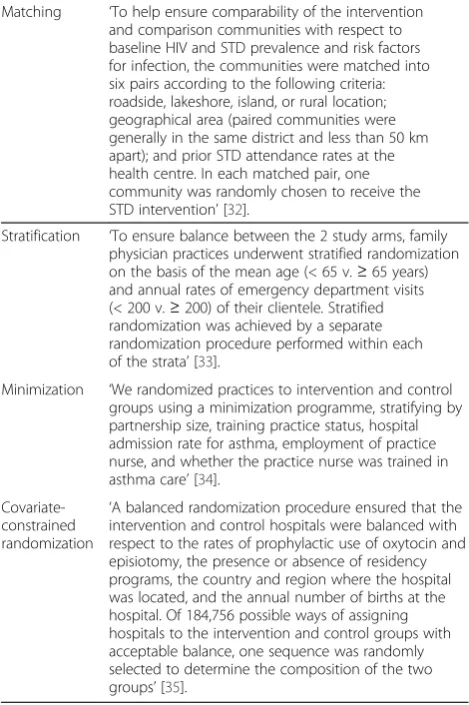
creating comparable groups at baseline [29]. Matching provides‘face validity’regarding balance between alloca-tion arms [30] and is thought to be particularly useful when there are few clusters [31]. For example, one C-RCT matched six pairs of communities by ensuring that they shared geographical characteristics, as well as base-line rates of disease (Table 2) [32].
However, pair-wise matching has a number of chal-lenges in C-RCTs [36,37]. First, loss of follow-up from one cluster removes also its match from analysis - this is also true in I-RCTs, but a loss of a pair of clusters could be catastrophic for a trial with a small number of clus-ters. Furthermore, in C-RCTs, achieving a‘good’ match that increases power is more difficult as the intra-cluster correlation (ICC) decreases (because as the amount of variability between groups decreases, it becomes harder for the matching process to remove substantial variabil-ity) [38]. In the process of developing matches, one cre-ates the important disadvantage in C-RCTs of making it difficult to properly calculate the ICC [30], which should be reported to provide guidance to future investigators planning appropriately powered trials. Relatedly, match-ing may complicate the analysis of the C-RCT, especially when it is desirable to investigate the impact of individual-level factors on the likelihood of the outcome [39]. When the correlation between matched pairs is poor [40], or when there is a desire to determine the im-pact of baseline covariates on the intervention effect, investigators have pursued ‘breaking the matching’ in analysis; this approach may increase risk for type 1 error [37].
Stratification
Note also that balancing for individual-level covariates would require calculating the cluster-level mean (or me-dian) for the variable of interest prior to stratifying. For example, one C-RCT testing an intervention directed at
family physicians aimed to reduce visits to the repeat emergency department by patients (Table 2). It stratified the family physicians by a cluster-level covariate (older versus younger physicians) and by a cluster-level mean of a participant-level covariate (high vs. low rates of emergency department visits) [33]. In some instances, one could imagine stratifying clusters for political or practical reasons (for example, by geographical location). In such a scenario, there may be a need for additional balancing techniques when allocating within strata [44]; this should be planned with careful statistical support.
Minimization
Taves described minimization in 1974 [45] while Pocock and Simon independently reported its potential benefits in 1975 [41]. Scott and colleagues provide an excellent review of minimization discussing the benefits and lim-itations of minimization for I-RCTs [46]. In general, this technique randomly assigns the first participants, then accounts for the covariates of participants previously en-rolled and assigns each new participant to the group that provides better balance. As shown in Table 3, if the sev-enth patient to be allocated to a trial has a high rate at baseline for the outcome of interest (for example, blood pressure) and a moderate rate for a covariate (for ex-ample, age), the computer algorithm will account for the characteristics of the six patients already allocated and assign the seventh patient to the arm that improves overall balance in those covariates.
[image:4.595.58.536.98.281.2]Minimization improves covariate balance compared to both simple randomization and stratification; the differ-ence is greater in smaller trials, but this advantage of minimization has been shown to hold for I-RCTs until the sample exceeds 1,000 patients [46]. Simulations indi-cate that increasing the number of covariates in minimization does not substantially increase imbalance (in comparison to stratification) [47]. The number of Table 1 Allocation techniques for covariate balance in C-RCTs: advantages and limitations
Technique Advantages Limitations
Simple/Complete randomization No need for baseline data; most transparent, accepted
Higher risk for imbalance
Restricted randomization
Matching Improves face validity; May balance
effectively for many covariates (only if a good match is found)
Loss to follow-up is doubled (pair instead of single loss); challenges with analysis; difficult to estimate/report ICC; reduced degrees of freedom limits power
Stratification May be used in combination with other allocation techniques
Can balance for few covariates on its own
Minimization Can balance effectively for many covariates Less transparent, possibly less well-understood by audience; continuous covariates may need to be split into categories; potential for selection bias/predictability
Covariate-constrained randomization Balances most effectively for many covariates; limits risk of selection bias
Requires access to baseline data; possibly less
well-understood by audience; potential for over-constraint; requires additional statistical support; allocation must occur after recruitment
Table 2 Examples of restricted randomization descriptions from C-RCTs published in high impact journals
Matching ‘To help ensure comparability of the intervention and comparison communities with respect to baseline HIV and STD prevalence and risk factors for infection, the communities were matched into six pairs according to the following criteria: roadside, lakeshore, island, or rural location; geographical area (paired communities were generally in the same district and less than 50 km apart); and prior STD attendance rates at the health centre. In each matched pair, one community was randomly chosen to receive the STD intervention’[32].
Stratification ‘To ensure balance between the 2 study arms, family physician practices underwent stratified randomization on the basis of the mean age (< 65 v.≥65 years) and annual rates of emergency department visits (< 200 v.≥200) of their clientele. Stratified randomization was achieved by a separate randomization procedure performed within each of the strata’[33].
Minimization ‘We randomized practices to intervention and control groups using a minimization programme, stratifying by partnership size, training practice status, hospital admission rate for asthma, employment of practice nurse, and whether the practice nurse was trained in asthma care’[34].
Covariate-constrained randomization
[image:4.595.56.291.381.734.2]covariates to be included in the minimization algorithm is primarily limited by statistical concerns since it is recommended that all covariates minimized should be included in statistical analysis [48]. The ability of minimization to balance more covariates has led to the suggestion by some commentators that it is the ‘ plat-inum standard’of allocation techniques [49].
The pharmaceutical industry [50] and other commen-tators [51] warn against the use of minimization mainly due to higher risk of selection bias that comes with pre-dictability of deterministic assignment. The extent of this risk is debated [52] and must be weighed against the advantages of greater covariate balance. A random com-ponent may be added to the minimization procedure so that as imbalance grows the odds of allocation to the arm that reduces imbalance also grow, but are never equal to one [53]. This may have the advantage of redu-cing predictability of allocation. Many authors have sug-gested additional variations on the general minimization approach either to further improve balance or to reduce risk of selection bias [11,54-56]. For instance, Begg and Iglewicz [57] (and later Atkinson [58]) applied optimum design theory (minimizing the variance in the model re-lating the covariates to the outcome) and allowed for balancing of continuous variables obviating the need to categorize continuous covariates as high and low. It is unclear whether the theoretical advantages of these more complex techniques translate into practical benefit in typical trials [59].
Another concern may be that by forcing balance in known prognostic covariates, an investigator could (un-knowingly) cause imbalance in unmeasured factors. However, it has been suggested that the balance for un-measured variables can be no worse due to minimization because whenever the unmeasured factor is correlated
with the minimized covariate, the balance for this factor will actually be improved and whenever the unmeasured factor is not correlated at all with the minimized covari-ate then its distribution would be unaffected [60]. Although it cannot be proven empirically without meas-uring the unmeasurable, this explains why balance of non-targeted variables should not made worse by using minimization [61].
The ability of minimization to balance many covariates within a small trial should make it a particularly good al-location technique for C-RCTs. However, to actively bal-ance numerous covariates requires access to data at the time of recruitment; cluster-level means (or medians) would be used to minimize participant-level covariates, such as the practice-level mean of patient blood pressure values [62]. Fortunately, many C-RCTs take place in the context of medical systems with administrative data or access to historical records [24]. Despite its promising features and the availability of free software to imple-ment it [63], minimization was used in only 2% of 300 randomly selected C-RCTs published from 2000 to 2008 [4]. (Although it is possible that this is an underestimate if minimization is misreported as stratification, this is similar to the estimated overall proportion of trials that use minimization [48].) One C-RCT using minimization was published in theBMJin 2004 (Table 2). It allocated 44 GP practices (clusters) minimizing imbalance across four covariates with 54 total strata [34]. This trial tested a nurse outreach model aiming to support primary care providers in caring for patients with asthma. It was im-portant to achieve balance across multiple cluster and individual level variables that might confound the effect of the intervention on asthma emergency visits. If the investigators had used traditional stratification, the trial would have been at high risk of imbalance due to over-stratification.
Covariate-constrained randomization
[image:5.595.57.290.112.236.2]If data are available for the important cluster and/or individulevel covariates of participants prior to the al-location procedure, more complex techniques may be used to ensure acceptable balance. For example, Moul-ton [64] described a procedure in which a statistical pro-gram could be used to enumerate all the possible allocations of participating clusters when clusters and their covariates are known in advance. Next, the investi-gators would narrow this list of allocations down to the ones that met prespecified criteria for balance across baseline covariates. Finally, the actual allocation would be chosen randomly from this constrained list, thereby achieving an acceptable allocation while retaining ran-domness in the selection process. As seen in Table 4, if there were only four clusters recruited, these could be allocated into two arms in six different ways. In two of Table 3 Example of minimization (adapted fromScott
et al.2002) [46]
Covariate Intervention Control
Baseline rate
High 2 2
Moderate 2 3
Low 1 1
Covariate rate
High 2 3
Moderate 3 1
Low 1 1
Allocation of seventh patient with high baseline rate and moderate covariate rate.
Marginal totals if allocated to intervention group: Baseline: |(2 + 1) - 2| = 1; Covariate: |(3 + 1) - 1| = 3; 1 + 3 = 4. Marginal totals if allocated to control group:
the possible allocations (A, F), the difference in the base-line performance is very large. In a trial with more clus-ters, the possible allocations increases exponentially, and it is possible to remove unacceptable allocations from the list and chose randomly from any remaining alloca-tions with acceptable balance.
This approach has been shown in simulation studies to provide even better balance than minimization result-ing in increased power, especially for trials with few units allocated as is common in C-RCTs [65,66]. This may be partially explained by the fact that covariate-constrained randomization can balance continuous cov-ariates without loss of power from categorization of these variables (for example, high, medium, low) as occurs in minimization. However, when there are very few clusters as in the example illustrated in Table 4, the parameters for assessing balance may need to be widened so that the actual allocation to be utilized can be randomly selected from a larger set. Over-constraint due to strict balancing requirements that result in very few eligible allocations may force certain clusters to-gether. For example, in Table 4, if the caliper for balance in the baseline rate or the confounder rate was set at a mean difference of 10, only two allocations would re-main and both feature the highest and lowest ranking clusters together in one arm. This is not desirable since it means that the allocation is no longer truly random and this situation may invite skepticism regarding active manipulation by the investigator [64]. In addition to re-quiring added statistical support during the process of
recruitment and allocation, the main drawback of this approach is that to acquire the necessary data, recruit-ment of numerous clusters must be completed prior to any cluster allocation. Investigators can allocate blocks of clusters as they are enrolled, though the first block should have at least eight units and the subsequent ones at least six [67].
Covariate-constrained randomization was used in only 2% of 300 randomly selected C-RCTs published from 2000 to 2008 [4]. However, the availability ready-made algorithms to implement this approach [67,68] may make the process more accessible. Like minimization, it is possible to apply more complex formulae when con-ducting this procedure. Rather than setting parameters regarding covariates to be within 10% of each other, investigators can balance with the goal of minimizing variance or decreasing the effects of adjusted analyses in a cluster-trial, as proposed by Raab and Butcher [20]. This particular approach was used in a study published recently in the New England Journal of Medicine [35], indicating the growing acceptability of this allocation technique by editors (and readers).
Choosing an allocation technique
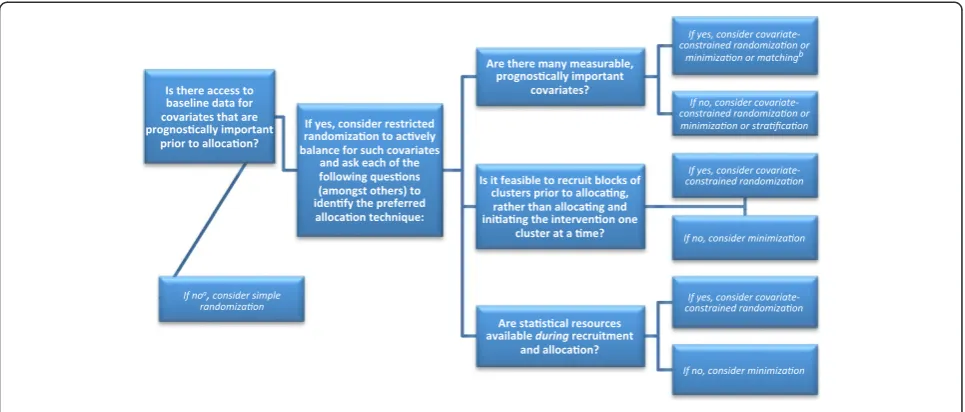
Given the above considerations, investigators planning a C-RCT are encouraged to consider alternatives to simple randomization, especially when there are few total clus-ters (to achieve balance at the cluster-level) and/or many participants per cluster (to achieve balance at the partici-pant level). It is also possible to combine techniques and even to actively balance participants separately from clusters (for example, by using stratified recruitment strategies if recruitment of participants can occur separ-ately from allocation of clusters [19]). Table 1 describes the advantages and limitations various allocation techni-ques with respect to their potential utility for improving balance at baseline. In Figure 1, a series of questions and answers are described that may aid investigators in deter-mining the approach most appropriate for their particu-lar trial. In general, matching has the fewest advantages as compared to other restricted randomization options and covariate-constrained randomization seems the most favorable choice. The input of a statistician should play a key role in determining the risk of imbalance and decid-ing upon an allocation technique, keepdecid-ing in mind that different approaches will have varying requirements for statistical support and may require unique analytic plans.
[image:6.595.55.292.111.334.2]Consider, for example, our C-RCT in which two differ-ent quality improvemdiffer-ent intervdiffer-entions were tested across 14 primary care clinics, aiming to improve man-agement of patients’blood pressure, cholesterol, and gly-cemic control [62]. With only 14 clusters, it seemed probable that the baseline values for the outcomes of interest (patients’mean blood pressure, cholesterol, and Table 4 Example of covariate-constrained randomization
(adapted fromMoulton 2004) [64] Baseline performance
Allocation Intervention Control Difference
A 25 50 60 75 30
B 25 60 50 75 20
C 25 75 50 60 5
D 50 60 25 75 5
E 50 75 25 60 20
F 60 75 25 50 30
Covariate rate
Allocation Intervention Control Difference
A 80 60 75 70 2.5
B 80 75 60 70 12.5
C 80 70 60 75 7.5
D 60 75 80 70 7.5
E 60 70 80 75 12.5
F 75 70 80 60 2.5
glycosylated hemoglobin values) would be imbalanced. In this trial, baseline data were available, meaning that any restricted randomization technique may have been considered. Given that numerous variables were avail-able, including baseline values for the primary outcomes and size, stratification alone was ruled out. Matching was deemed undesirable due to the risk of double-loss to follow up and challenges with analysis. Although covariate-constrained randomization was preferred given its superior ability to achieve balance, [66] it was deemed infeasible because there were outside pressures to pro-vide the interventions immediately upon recruitment, rather than allocating blocks of clusters. As a result, minimization was selected.
In other scenarios, additional factors to consider that may have a bearing on the preferred allocation technique include: desire for a specific allocation ratio (as this would require adaptations to typical allocation techni-ques [56]) desire for stakeholders to witness the alloca-tion process (as was done with one study using covariate-constrained randomization [69]); and prag-matic issues that may arise due to geographical spread of clusters and/or challenges with recruitment [15,19]. Regardless of the choice made, efforts should be made to achieve (and report) allocation concealment to limit selection bias; this is important for all trials, but espe-cially so when deterministic rather than random alloca-tions are used, such as minimization [51,70]. In addition, with simple or complex allocation techniques, the entire trial may be compromised if the computer program is not reliable, as happened with one large study using minimization [71].
Conclusion
Achieving balance at baseline using simple randomization in C-RCTs is less likely than in typical RCTs due to the correlated nature of nested data and is less likely when there are few clusters to be randomized. Therefore, inves-tigators planning C-RCTs should avoid using simple randomization, especially when there are few clusters in the trial. Given the risk of baseline imbalances for C-RCTs , the known limitations of stratification and matching, and the potential benefits of covariate-adaptive allocation tech-niques, investigators should consider use of the latter methods whenever important covariates are measurable prior to group assignment. In particular, when baseline data and statistical support are available and numerous clusters can be recruited prior to allocation, covariate-constrained randomization can offer investigators the chance to remove the risk of baseline imbalance with min-imal risk for bias.
Competing interests
The authors declare that they have no competing interests.
Authors’contributions
NI drafted the manuscript. All authors contributed to the conceptual development of the review. All authors contributed to critically revising the intellectual content of the manuscript. All authors have approved the final version.
Acknowledgements
[image:7.595.57.540.89.295.2]NI is supported by a Fellowship award in Clinical Research from the Canadian Institutes of Health Research (CIHR) and a Research Fellowship from the Department of Family and Community Medicine, University of Toronto. KT is supported by a Fellowship award in Primary Care Research from the Canadian Institutes of Health Research (CIHR). JMG is supported by a Canada Research Chair in Health Knowledge Transfer and Uptake. These funding sources had no role in this project. We would like to thank Marion Figure 1Questions to ask and potential answers when trialists and statisticians work together to consider allocation techniques for balancing covariates in cluster-trials.aOne would expect that in most trials access to some relevant data would become accessible
Campbell and Monica Taljaard who provided helpful comments on earlier drafts of this manuscript.
Author details
1Family Practice Health Centre, Women’s College Hospital, 76 Grenville Street, Toronto, ON M5S1B2, Canada.2Department of Family and Community Medicine, University of Toronto, 500 University Avenue, 5th Floor, Toronto, ON M5G1V7, Canada.3Institute for Clinical Evaluative Sciences, 2075 Bayview Avenue, Toronto, ON M4N3M5, Canada.4Institute of Health Policy
Management and Evaluation, University of Toronto, Health Sciences Building, 155 College Street, Suite 425, Toronto, ON M5T3M6, Canada.5Division of Endocrinology and Metabolism, Department of Medicine, University of Toronto, 200 Elizabeth St, EN12-218, Toronto, ON M5G2C4, Canada.6Clinical Epidemiology Program, Ottawa Health Research Institute, 1053 Carling Avenue, Administration Building, Room 2-017, Ottawa, ON K1Y 4E9, Canada. 7
Sunnybrook Health Sciences Centre, 2075 Bayview Avenue, Toronto, ON M4N 3 M5, Canada.8Toronto Western Hospital Family Health Team, University Health Network, 399 Bathurst Street, West Wing, 2nd Floor, Toronto, ON M5T2S8, Canada.
Received: 23 December 2011 Accepted: 9 July 2012 Published: 1 August 2012
References
1. Donner A, Klar N:Design and Analysis of Cluster Randomization Trials in Health Research. New York, NY: Oxford University Press; 2000.
2. Murray DM, Pals SL, Blitstein JL, Alfano CM, Lehman J:Design and analysis of group-randomized trials in cancer: a review of current practices.J Natl Cancer Inst2008,100:483–491.
3. Varnell SP, Murray DM, Janega JB, Blitstein JL:Design and analysis of group-randomized trials: a review of recent practices.Am J Public Health 2004,94:393–399.
4. Ivers NM, Taljaard M, Dixon S, Bennett C, McRae A, Taleban J, Skea Z, Brehaut JC, Boruch RF, Eccles MP, Grimshaw JM, Weijer C, Zwarenstein M, Donner A:Impact of CONSORT extension for cluster randomised trials on quality of reporting and study methodology: review of random sample of 300 trials, 2000–8.BMJ2011,343:d5886.
5. Eldridge SM, Ashby D, Feder GS, Rudnicka AR, Ukoumunne OC:Lessons for cluster randomized trials in the twenty-first century: a systematic review of trials in primary care.Clin Trials2004,1:80–90.
6. Eldridge S, Ashby D, Bennett C, Wakelin M, Feder G:Internal and external validity of cluster randomised trials: systematic review of recent trials. BMJ2008,336:876–880.
7. Campbell MK, Elbourne DR, Altman DG:CONSORT group: CONSORT statement: extension to cluster randomised trials.BMJ2004,328:702–708. 8. Rosenberger WF:Randomization in clinical trials. New York, NY: Wiley; 2002. 9. Kalish LA, Begg CB:Treatment allocation methods in clinical trials: A
review.Statist Med1985,4:129–144.
10. Atkinson AC:The comparison of designs for sequential clinical trials with covariate information.Journal of the Royal Statistical Society: Series A (Statistics in Society)2002,165:349–373.
11. Heritier S, Gebski V, Pillai A:Dynamic balancing randomization in controlled clinical trials.Stat Med2005,24:3729–3741.
12. Roozenbeek B, Maas AI, Lingsma HF, Butcher I, Lu J, Marmarou A, McHugh GS, Weir J, Murray GD, Steyerberg EW:IMPACT Study Group: Baseline characteristics and statistical power in randomized controlled trials: selection, prognostic targeting, or covariate adjustment?Crit Care Med 2009,37:2683–2690.
13. Senn S:Testing for baseline balance in clinical trials.Stat Med1994, 13:1715–1726.
14. Flynn TN, Whitley E, Peters TJ:Recruitment strategies in a cluster randomized trial-cost implications.Stat Med2002,21:397–405. 15. Carter B:Cluster size variability and imbalance in cluster randomized
controlled trials.Stat Med2010,29:2984–2993.
16. Kerry SM, Bland JM:Unequal cluster sizes for trials in English and Welsh general practice: implications for sample size calculations.Stat Med2001, 20:377–390.
17. Guittet L, Ravaud P, Giraudeau B:Planning a cluster randomized trial with unequal cluster sizes: practical issues involving continuous outcomes. BMC Med Res Methodol2006,6:17.
18. Gattellari M, Leung DY, Ukoumunne OC, Zwar N, Grimshaw J, Worthington JM:Study protocol: the DESPATCH study: Delivering stroke prevention for patients with atrial fibrillation - a cluster randomised controlled trial in primary healthcare.Implement Sci2011,6:48.
19. Kerry SM, Cappuccio FP, Emmett L, Plange-Rhule J, Eastwood JB:Reducing selection bias in a cluster randomized trial in West African villages.Clin Trials2005,2:125–129.
20. Raab GM, Butcher I:Balance in cluster randomized trials.Stat Med2001, 20:351–365.
21. Altman DG, Dore CJ:Randomisation and baseline comparisons in clinical trials.Lancet1990,335:149–153.
22. Donner A, Klar N:Methods for comparing event rates in intervention studies when the unit of allocation is a cluster.Am J Epidemiol1994, 140:279–289. discussion 300–301.
23. Solomon DH, Polinski JM, Stedman M, Truppo C, Breiner L, Egan C, Jan S, Patel M, Weiss TW, Chen YT, Brookhart MA:Improving care of patients at-risk for osteoporosis: a randomized controlled trial.J Gen Intern Med2007, 22:362–367.
24. Glynn RJ, Brookhart MA, Stedman M, Avorn J, Solomon DH:Design of cluster-randomized trials of quality improvement interventions aimed at medical care providers.Med Care2007,Suppl 2:38–43.
25. Puffer S, Torgerson D, Watson J:Evidence for risk of bias in cluster randomised trials: review of recent trials published in three general medical journals.BMJ2003,327:785–789.
26. Shah S, Peat JK, Mazurski EJ, Wang H, Sindhusake D, Bruce C, Henry RL, Gibson PG:Effect of peer led programme for asthma education in adolescents: cluster randomised controlled trial.BMJ2001, 322:583–585.
27. Chapman S, Cornwall J, Righetti J, Sung L:Preventing dog bites in children: randomised controlled trial of an educational intervention.BMJ 2000,320:1512–1513.
28. Carman WF, Elder AG, Wallace LA, McAulay K, Walker A, Murray GD, Stott DJ: Effects of influenza vaccination of health-care workers on mortality of elderly people in long-term care: a randomised controlled trial.Lancet 2000,355:93–97.
29. Campbell MJ, Donner A, Klar N:Developments in cluster randomized trials and Statistics in Medicine.Stat Med2007,26:2–19.
30. Donner A, Klar N:Pitfalls of and controversies in cluster randomization trials.Am J Public Health2004,94:416–422.
31. Martin DC, Diehr P, Perrin EB, Koepsell TD:The effect of matching on the power of randomized community intervention studies.Stat Med1993, 12:329–338.
32. Grosskurth H, Mosha F, Todd J, Mwijarubi E, Klokke A, Senkoro K, Mayaud P, Changalucha J, Nicoll A, ka-Gina G:Impact of improved treatment of sexually transmitted diseases on HIV infection in rural Tanzania: randomised controlled trial.Lancet1995,346:530–536.
33. Lang E, Afilalo M, Vandal AC, Boivin JF, Xue X, Colacone A, Leger R, Shrier I, Rosenthal S:Impact of an electronic link between the emergency department and family physicians: a randomized controlled trial.CMAJ 2006,174:313–318.
34. Griffiths C, Foster G, Barnes N, Eldridge S, Tate H, Begum S, Wiggins M, Dawson C, Livingstone AE, Chambers M, Coats T, Harris R, Feder GS: Specialist nurse intervention to reduce unscheduled asthma care in a deprived multiethnic area: the east London randomised controlled trial for high risk asthma (ELECTRA).BMJ2004,328:144.
35. Althabe F, Buekens P, Bergel E, Belizan JM, Campbell MK, Moss N, Hartwell T, Wright LL:Guidelines Trial Group: A behavioral intervention to improve obstetrical care.N Engl J Med2008,358:1929–1940.
36. Campbell MJ:Cluster randomized trials in general (family) practice research.Stat Methods Med Res2000,9:81–94.
37. Klar N, Donner A:The merits of matching in community intervention trials: a cautionary tale.Stat Med1997,16:1753–1764.
38. Raudenbush SW, Martinez A, Spybrook J:Strategies for Improving Precision in Group-Randomized Experiments.Educational Evaluation and Policy Analysis2007,29:5–29.
39. Donner A, Taljaard M, Klar N:The merits of breaking the matches: a cautionary tale.Statist Med2007,26:2036–2051.
41. Pocock SJ, Simon R:Sequential treatment assignment with balancing for prognostic factors in the controlled clinical trial.Biometrics1975, 31:103–115.
42. Kernan WN, Viscoli CM, Makuch RW, Brass LM, Horwitz RI:Stratified randomization for clinical trials.J Clin Epidemiol1999,52:19–26. 43. Therneau TM:How many stratification factors are“too many”to use in a
randomization plan? Control.Clin Trials1993,14:98–108.
44. Feder G, Davies RA, Baird K, Dunne D, Eldridge S, Griffiths C, Gregory A, Howell A, Johnson M, Ramsay J, Rutterford C, Sharp D:Identification and Referral to Improve Safety (IRIS) of women experiencing domestic violence with a primary care training and support programme: a cluster randomised controlled trial.Lancet2011,378:1788–1795.
45. Taves DR:Minimization: a new method of assigning patients to treatment and control groups.Clin Pharmacol Ther1974,15:443–453. 46. Scott NW, McPherson GC, Ramsay CR, Campbell MK:The method of
minimization for allocation to clinical trials: a review.Control Clin Trials 2002,23:662–674.
47. Wade A, Pan H, Eaton S, Pierro A, Ong E:An investigation of minimisation criteria.BMC Med Res Methodol2006,6:11.
48. Taves DR:The use of minimization in clinical trials.Contemp Clin Trials 2010,31:180–184.
49. Treasure T, MacRae KD:Minimisation: the platinum standard for trials? Randomisation doesn’t guarantee similarity of groups; minimisation does.BMJ1998,317:362–363.
50. Committee for Proprietary Medicinal Products (CPMP):Committee for Proprietary Medicinal Products (CPMP): points to consider on adjustment for baseline covariates.Stat Med2004,23:701–709.
51. Berger VW:Minimization, by its nature, precludes allocation concealment, and invites selection bias.Contemp Clin Trials2010,31:406.
52. Taves DR:Minimization does not by its nature preclude allocation concealment and invite selection bias, as Berger claims.Contemp Clin Trials2011,32:323.
53. Efron B:Forcing a sequential experiment to be balanced.Biometrika1971, 58:403–417.
54. Stigsby B, Taves DR:Rank-Minimization for balanced assignment of subjects in clinical trials.Contemp Clin Trials2010,31:147–150. 55. Hofmeijer J, Anema PC, van der Tweel I:New algorithm for treatment
allocation reduced selection bias and loss of power in small trials.J Clin Epidemiol2008,61:119–124.
56. Han B, Enas NH, McEntegart D:Randomization by minimization for unbalanced treatment allocation.Stat Med2009,28:3329–3346. 57. Begg CB, Iglewicz B:A treatment allocation procedure for sequential
clinical trials.Biometrics1980,36:81–90.
58. Atkinson AC:Optimum biased-coin designs for sequential treatment allocation with covariate information.Stat Med1999,18:1741–1752. discussion 1753–1755.
59. Senn S, Anisimov VV, Fedorov VV:Comparisons of minimization and Atkinson's algorithm.Stat Med2010,29:721–730.
60. Aickin M:Randomization, balance, and the validity and efficiency of design-adaptive allocation methods.Journal of Statistical Planning and Inference2001,94:97–119.
61. Rosenberger WF, Sverdlov O:Handling Covariates in the Design of Clinical Trials.Stat Sci2008,23:404–419.
62. Ivers NM, Tu K, Francis J, Barnsley J, Shah B, Upshur R, Kiss A, Grimshaw JM, Zwarenstein M:Feedback GAP: study protocol for a cluster-randomized trial of goal setting and action plans to increase the effectiveness of audit and feedback interventions in primary care.Implement Sci2010, 5:98.
63. Minim: allocation by minimisation in clinical trials by Stephen Evans, Patrick Royston and Simon Day. http://www-users.york.ac.uk/~mb55/guide/minim. htm.
64. Moulton LH:Covariate-based constrained randomization of group-randomized trials.Clin Trials2004,1:297–305.
65. Perry M, Faes M, Reelick MF, Olde Rikkert MG, Borm GF:Studywise minimization: A treatment allocation method that improves balance among treatment groups and makes allocation unpredictable.J Clin Epidemiol2010,63:1118–1122.
66. Xiao L, Lavori PW, Wilson SR, Ma J:Comparison of dynamic block randomization and minimization in randomized trials: a simulation study.Clin Trials2011,8:59–69.
67. Carter BR, Hood K:Balance algorithm for cluster randomized trials.BMC Med Res Methodol2008,8:65.
68. Chaudhary MA, Moulton LH:A SAS macro for constrained randomization of group-randomized designs.Comput Methods Programs Biomed2006, 83:205–210.
69. Sismanidis C, Moulton LH, Ayles H, Fielding K, Schaap A, Beyers N, Bond G, Godfrey-Faussett P, Hayes R:Restricted randomization of ZAMSTAR: a 2 x 2 factorial cluster randomized trial.Clin Trials2008,5:316–327. 70. Berger VW:A review of methods for ensuring the comparability of
comparison groups in randomized clinical trials.Rev Recent Clin Trials 2006,1:81–86.
71. Comparative Obstetric Mobile Epidural Trial (COMET) Study Group UK: Effect of low-dose mobile versus traditional epidural techniques on mode of delivery: a randomised controlled trial.Lancet2001,358:19–23.
doi:10.1186/1745-6215-13-120
Cite this article as:Iverset al.:Allocation techniques for balance at baseline in cluster randomized trials: a methodological review.Trials
201213:120.
Submit your next manuscript to BioMed Central and take full advantage of:
• Convenient online submission
• Thorough peer review
• No space constraints or color figure charges
• Immediate publication on acceptance
• Inclusion in PubMed, CAS, Scopus and Google Scholar
• Research which is freely available for redistribution
![Table 3 Example of minimization (adapted from Scottet al.2002) [46]](https://thumb-us.123doks.com/thumbv2/123dok_us/8995024.969089/5.595.57.290.112.236/table-example-minimization-adapted-scottet-al.webp)
![Table 4 Example of covariate-constrained randomization(adapted from Moulton 2004) [64]](https://thumb-us.123doks.com/thumbv2/123dok_us/8995024.969089/6.595.55.292.111.334/table-example-covariate-constrained-randomization-adapted-moulton.webp)