Munich Personal RePEc Archive
Beyond Identities: Support for
Decentralisation Across Regions in Spain
Cesena, Marc Guinjoa and Casarramona, Toni Rodon
Universitat Pompeu Fabra, Barcelona, Nuffield College, Oxford
March 2011
Online at
https://mpra.ub.uni-muenchen.de/30554/
Nuffield's Working Papers Series in Politics
Beyond Identities:
Support for decentralisation across regions in Spain
Marc Guinjoan i Cesena
(Universitat Pompeu Fabra, Barcelona)
Email: [email protected]
Toni Rodon i Casarramona
( Nuffield College, Oxford & Universitat Pompeu Fabra, Barcelona)
Email: [email protected]
2
Abstract
After thirty years of the Spanish territorial model being implemented, an important number of citizens in different regions are supporting higher levels of self-government. This article analyses the causal mechanisms put forward by the literature on territorial decentralisation to explain this phenomenon. The Spanish case is employed to quantitatively test the various explanations regarding support for decentralisation. Using a linear hierarchical model we show that, even in those regions without a different sub-national identity, citizens’ evaluation of the regional governments’ public policies is crucial in explaining support for a stronger regional government. In analysing political attitudes towards decentralisation, we highlight the importance of party competition as a crucial determinant, as well as the necessity to consider decentralisation as an endogenous process, in which parties and citizens interact and affect the final territorial model.
3
Introduction
Even though the Spanish Constitution did not establish a clear territorial model, the state's necessity to fulfil the internal demands and adapt to the conditions of the European integration transformed the previously centralised Spanish State into a decentralised one. Thus, at the beginning of the 1980s, Spain implemented a regional system in which seventeen regional governments were established, named Autonomous Communities (ACs)1. Seventeen parliaments and seventeen executives were erected, creating for the first time in modern Spanish history a complex system of multi-level governance.
Since its implementation, each region has its own statute, a Spanish law which establishes its level of self-government, and which allows the region to develop its own public policies in a wide range of areas. Since the 1980s, the Spanish government has been redistributing authority, responsibility and financial resources in order for both the state and regional governments to provide public services.
However, decentralisation has not reached the end. The Catalans, the Basques, and to a lesser extent the Galicians have been leading the call for more autonomy. Moreover, their demands for further decentralisation have not been unique. By 2000 almost all the ACs started a process of reforming their respective statutes of autonomy in order to achieve a higher level of self-government. Catalonia took the lead and was the first to demand expanded levels of home-rule. Other regions decided to follow suit2.
After thirty years of Spain‘s process of decentralisation, demands for autonomy were still very much alive, even in the newly formed regions. Since the last period of statutes‘ reforms, the debate over decentralisation continues, especially among the Catalans and Basques, but also in many other ACs. Important proportions of the population throughout Spain still demand higher levels of self-rule for their ACs.
This article addresses individual preferences for having a strong regional government. We provide evidence which confirms that in Spain an important part of the population – in different regions– still demands higher levels of autonomy. In existing literature, the will to have a strong regional government has been considered to be a substantially stable attitude. To the contrary, we argue that it is rather a political attitude and, as such, is endogenous to the political process.
1
These are Madrid, Cantabria, Asturias, Canarias, Castile La Mancha, Extremadura, La Rioja, Murcia, Galicia, Catalonia, Valencia, Aragon, Balearic Islands, Andalucía and Castile and Leon.
2
4
Our goal is not to focus solely on the support for degrees of home-rule among those individuals who feel more attached to their ACs. We also analyse the support for higher levels of self-government among those who do not have a different sub-national identity. Nonetheless, special attention will be paid to unobserved factors that are able to explain the support for higher self-government and which are related to the functioning and the evolution of the decentralised Spanish model.
In this article we present two research questions: firstly, we question whether those who feel more attached to their ACs are those who support higher levels of self-government for their region.
Q1: are respondents’ demands for more self-government related to their identity towards their respective ACs?
The main subject of this research is then formulated in the second question: we study why individuals, regardless of their national or regional identity, still demand higher levels of autonomy for their ACs.
Q2: controlling for identity feeling towards their own ACs, why do some citizens still demand more self-government for their region?
This second research question is of particular importance, since existing literature has not addressed why many citizens in Spain still demand higher levels of autonomy for their region.
Our argument is that party dynamics as well as institutional design have an impact on how citizens perceive the Spanish territorial model. Addressing these questions has a relevant purpose, both theoretically and empirically. On the one hand, this research helps to understand why some citizens still pursue more home-rule for their territory. There is a vast body of literature that use decentralisation as the main dependent variable. The emphasis in many previous studies has been on normative questions, without consideration for the actual political incentives that affect the relevant actors (Wibbels 2006). We contribute to this literature by analysing the role played by citizens in the decentralisation process.
5
in the other AC no distinctive national feature can be found although support for increasing the powers of the AC is alive as well3.
The article proceeds as follow: in section two we present the general idea, we provide empirical evidence that an important part of Spanish citizens support higher levels of self-government and we raise our theoretical claims. Section three discusses the hypotheses. Section four presents data and the methods employed in the empirical part, which is developed in section five. We conclude in section six by discussing the limitations and implications of our study and suggesting avenues for further research.
A Worldwide Trend towards Decentralisation
Spain has not been an isolated case. Over the recent decades, there has been a worldwide trend towards increasing transfers of power, resources and responsibilities from the national to the subnational levels of government. Both federal and unitary countries, whether industrialised or developing, are moving towards more decentralisation (Sharma 2006). Central governments across the globe are decentralising functions and responsibilities to the lower levels. According to the Regional Authority Index (RAI), in 27 out of 42 countries the level of decentralisation steadily increased during the 1990s (Hooghe, Marks, and Schakel 2010). In the same decade, home-rule guaranteed to the regions decreased in only three countries. Data also confirms that in many countries the downward transfer of powers is still an ongoing trend at the beginning of the 21st century.
Decentralisation in Spain
The Spanish Constitution of 1978 established that the Spanish government had the power to create sub-regional entities. The Carta Magna laid down an opened territorial model without establishing a concrete territorial design or a precise number of regions to create. In fact, the constitution proposed two separate routes to regional autonomy: four ACs were granted a fast track: the Basque country and Catalonia gained autonomy in 1979, and Galicia and Andalusia in 19814. The remaining thirteen regions were required to negotiate the central government for a limited transfer of powers with.
3
Historical nationalities refer to the Basque Country, Catalonia and Galicia (Moreno 2002).
4
6
Powers attributed to each of the regional governments vary at a formal level, reflecting the two-track system that requires separate negotiations with the central government. However, due to the constitutional compromise in the 1980s, the Spanish territorial model is still particularly ambiguous on the decentralisation issue (Colomer 1998). This creates a highly competitive environment over legislative or executive competencies attributed to the regions. Intraparty and interparty struggles make decentralisation policies a matter of political discussion and controversy, especially when national elections are close at hand (Maravall 2008). Political campaigns are often focused solely on this issue (Orte and Wilson 2009), and there remains a lack of consensus among the two major Spanish parties, PP (conservative) and PSOE (socialist), over the suitable level of self-government for the Spanish regions.
Contradictions between national and regional actors about the Spanish territorial model usually come to the forefront. Whereas most national elites advocate for conserving the current decentralisation structure or weakening it5, some regional elites still demand more competences. Thus, the debate between the national and regional actors continues to maintain territorial issues in the public agenda, consequently affecting citizens‘ preferences (Máiz, Beramendi, and Grau 2002), who in turn demand more powers6. Data shows that after more than thirty years of self-rule for all the Spanish ACs, and after the recent process to renew the Statutes of Autonomy some Spaniards are not yet satisfied with the level of decentralisation achieved by their respective regions.
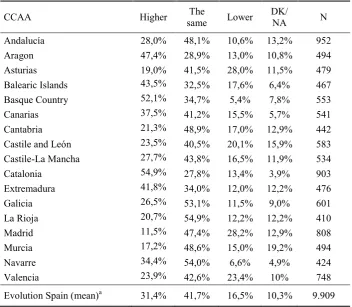
Table 1 summarises the preferences over the desired level of decentralisation by AC7.
5
In very recent times, the debate over re-centralising the state has been reactivated by some national elites.
6
It is important to distinguish the preferred territorial model and the level of desired home-rule. Data in previous studies shows that they are two different dimensions (Uriarte 2002). The current territorial model generates among the Spanish population a great consensus. However, among citizens who are in agreement with the current territorial model (not wanting another model, such as a federal one), some may think that the power of the regional governments should be strengthened.
7 The question is the following: ―Would you support a higher, a lower or the same level of self
7
Table 1 Support for autonomy by autonomous community, 2010
CCAA Higher The
same Lower
DK/
NA N
Andalucía 28,0% 48,1% 10,6% 13,2% 952
Aragon 47,4% 28,9% 13,0% 10,8% 494
Asturias 19,0% 41,5% 28,0% 11,5% 479
Balearic Islands 43,5% 32,5% 17,6% 6,4% 467 Basque Country 52,1% 34,7% 5,4% 7,8% 553
Canarias 37,5% 41,2% 15,5% 5,7% 541
Cantabria 21,3% 48,9% 17,0% 12,9% 442
Castile and León 23,5% 40,5% 20,1% 15,9% 583 Castile-La Mancha 27,7% 43,8% 16,5% 11,9% 534
Catalonia 54,9% 27,8% 13,4% 3,9% 903
Extremadura 41,8% 34,0% 12,0% 12,2% 476
Galicia 26,5% 53,1% 11,5% 9,0% 601
La Rioja 20,7% 54,9% 12,2% 12,2% 410
Madrid 11,5% 47,4% 28,2% 12,9% 808
Murcia 17,2% 48,6% 15,0% 19,2% 494
Navarre 34,4% 54,0% 6,6% 4,9% 424
Valencia 23,9% 42,6% 23,4% 10% 748
Evolution Spain (mean)a 31,4% 41,7% 16,5% 10,3% 9.909
Source: 2010 Autonomic Barometer from the CIS 2829 a
The mean has been calculated weighting the population of each AC on the basis of the 2009 Census from the National Statistics Institute
The results in Table 1 confirm that there is still an important part of the Spanish population that supports higher levels of autonomy for their AC. As expected, in Catalonia and the Basque Country the support to achieve higher levels of autonomy is predominant; in three other regions, Aragon, Balearic Islands and Extremadura, this support is also notoriously high; and in only two of the ACs, Asturias and Madrid, those who want fewer competences for their region represent a higher percentage than those who want more powers.
8
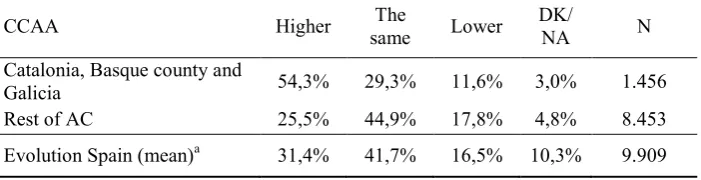
Table 2 Autonomist support between historical and non-historical AC, 2010
CCAA Higher The
same Lower
DK/
NA N
Catalonia, Basque county and
Galicia 54,3% 29,3% 11,6% 3,0% 1.456
Rest of AC 25,5% 44,9% 17,8% 4,8% 8.453
Evolution Spain (mean)a 31,4% 41,7% 16,5% 10,3% 9.909
Source: 2010 Autonomic Barometer from the CIS 2829
Through this aggregate level data we can elucidate that our first research questions –that the demands of more self-government are related to an identity feeling towards your own AC– will probably have a positive answer8. In fact, it is very possible to establish this line of reasoning, since demands for more self-government have been higher in Catalonia, the Basque country and Galicia, compared to the remaining ACs.
Demands for self-government have been the most pronounced in Catalonia and the Basque Country. Their claims for higher levels of self-government had traditionally been related to their desire to manage their resources and to pursue their own public policies. This phenomenon aligns with the argument that the quest for self-government by some communities or regions is strongly related to their identification with a distinct nation (Gourevitch 1979; Coller and Castelló 1999; Martínez-Herrera 2002; Guibernau 2006). Ethnic and cultural diversity has been shown to be a powerful determinant regarding the demands for higher levels of decentralisation worldwide. In this sense, political decentralisation is seen as a functional logic intended to satisfy national heterogeneity within countries (Erk and Swenden 2009).
Yet, demands for self-government have not only arisen in Catalonia and the Basque Country. In the remaining ACs, regardless of whether they have sociolinguistic differences with the rest of Spain (such as in the Balearic Islands, Valencia, Navarre or Galicia), these demands are also important. Again, once controlling for the sub-national identity, why do some citizens still demand a strong regional government? The literature offers some insights, which are presented in the next subsection.
8
9
Decentralisation as a dynamic process
As highlighted, at the turn of the Francoist dictatorship in Spain the claims for the adoption of a decentralised structure came especially from the historical ACs, i.e. Catalonia, the Basque country and Galicia. However, very soon thereafter the remaining regions were awarded with some degree of home-rule. Once the territorial model was implemented, both regional elites and citizens habituated themselves to the new institutional setting.
In line with the literature on decentralisation, this phenomenon can be understood as a dynamic process. Even though the decentralisation claims in the ‗historic regions‘ can be easily attributed to the will of these ACs to be recognised as distinct, in the remaining ACs the claims emerged after the decentralised structure was adopted. In the absence of a sub-national identity, decentralisation can be understood as an outcome derived from party competition and party strategies. As Amat and Falcó (2010) thoroughly point out, this new approach is well justified as it echoes an old but non-answered question raised by Riker (1969): does political decentralisation have an independent effect or is it nothing more than an institutional outcome endogenous to the political preferences of crucial political actors?
According to this approach, decentralisation is understood as a strategic choice made by self-interested politicians, as well as a consequence of the nature of party system and party competition9. Some literature shows that, even in nationally homogeneous states, when a regionalised party system emerges (De Winter and Türsan 1998), decentralisation tends to be enhanced (Keating 1998; Van Houten 2000). However, this is not only a process where regional parties are electorally important. According to Amat et al. (2009), most of the sub-national actors bargain with parties at the national level in order to increase the level of transfers to the regions. Both the leaders of the regional branches from the same party and the leaders of different parties play a
‗leveraging‘ role in national legislatures to strengthen their regional capacities.
One of the most direct consequences of decentralisation for political elites is that parties have to deal with a more complex system. In these cases political parties sometimes end up adopting discourses more directed towards the defence of regional interests (Pallarès
9
10
and Keating 2003; Roller and Van Houten 2003). Both in the regional and the state arena, sub-national leaders may gain more power, increasing their capacity to influence the political agenda (Orte and Wilson 2009). Still, the adoption of more regionalist patterns of behaviour is not limited to the elite level. As Stimson, MacKuen and Erikson (1995) have stressed, since parties change their discourse, they are able to drive
citizens‘ preferences. And preferences over decentralisation are not an exception.
If political parties want to negotiate the appropriate level of decentralisation, they will attempt to seek popular support in order to put forward their demands. In any state, the quest for increasing transfers of powers from central government to regional executives will be better supported if the preferences of the population in the region are aligned
with parties‘ demands. As the European Union case shows, the adoption of competences of the European institutions has had an impact on the way parties behave, which in turn has affected people‘s willingness to transfer specific competences to another level of government (Díez Medrano 2003).
The territorial model as well as party competition tend to have an impact on citizens‘ preferences (Martínez-Herrera 2002; Guibernau 2006): elites and citizens experience a reduction in the visibility of the ‗state frame‘, in favour of the ‗regional frame‘ to the extent that citizens internalise the new institutional setting.
After a certain period, the population gets used to its new regional government and learns to coexist with the central and the regional governments in a dual structure of power. This duality is strengthened when regional governments clash with the statist power, as regions acquire a higher visibility. Even though the plurality of political arenas creates a complex system of political frames that are not always distinguishable (Anderson 2006), the territorial model is eventually internalised. This is especially relevant when regional governments provide certain public services. These governments can often design public policies that generate citizens‘ satisfaction or provide public services more efficiently than the states‘ one.
Therefore, the visibility of the regional authority and its ‗utility‘ progressively increases10. In the end, some citizens develop positive attitudes towards the regional government and evaluate positively the fact that the government is closer to the citizenry.
10
11
Eventually, both elite and individual positions within the decentralisation process interact. This leads to a situation in which the level of support for self-government is, in general terms, widely accepted across the different regions (as Table 1 has shown). Following these two main lines of reasoning, decentralisation as an identity-related process as well as an outcome derived from institutional design and party competition, we develop our hypotheses.
Hypotheses
Data has shown that some citizens want higher levels of self-government. Which is the causal mechanism that explains this attitudinal desire? As stressed in the literature review, both regional identity and the dynamics attached to the process of decentralisation can play an important role in affecting citizens‘ preferences regarding decentralisation policies. These two general hypotheses can be compared simultaneously analysing citizens‘ preferences across the different ACs in Spain.
It is proposed, as a first hypothesis, that those citizens who identify themselves more with their respective AC, rather than with Spain, are more favourable to higher levels of decentralisation for their region.
H1: The higher the identification with their respective ACs, as compared to Spain, the
higher the support respondents will have for a strong regional government.
The following hypotheses address the most important part of the present research, i.e. to explain decentralisation not as a matter of identity, as in H1, but as an outcome derived
from party dynamics and institutional design; that is, as a consequence of the development and the functioning of the process of decentralisation. In this line of reasoning, we test the effect of four variables related to the development of decentralisation policies and the effect of party competition: the satisfaction with the regional government as explicative of the support for higher levels of self-government (H2); the wealth of the region as compare to other regions (H3); the effect of having the
incumbent from the same political party at the regional and the national level (H4); and
finally the effect of having fewer competences than other regions (H5).
12
H2: The higher the satisfaction towards regional government’s policies, the higher the
level of support for regional autonomy.
The third hypothesis proposes that the wealth of regions is of importance when explaining the support for decentralisation. Political parties drive public opinion in order to change redistribution policies (Beramendi and Anderson 2008). Sorens (2008, 331) demonstrates that ‗in regions that would benefit from independence or extensive fiscal autonomy, regionalist parties should come under pressure to radicalise their position, while in regions that stand to lose from fiscal autonomy, secessionist parties will try to moderate their program to increase their vote share.‘ If we apply this principle to the Spanish case, we could argue that those regions which are wealthier will probably demand higher autonomy for their AC as a mechanism to protect their interests.
H3: The higher the economic advantage of a region, the higher the support for
decentralisation.
When the survey used in the present research was carried out, the ruling party in Spain was the Socialist Party (PSOE). The fourth hypothesis addresses whether the coincidence of the same political party in the regional and national arenas has any impact in the desired level of self-government. Through this hypothesis, we test whether the fact of having different parties both in the national and regional governments, ceteris paribus, creates an environment for the regional actors to go against national public policies. If political actors in the regional arena are in the opposition in the national arena, there are higher probabilities that these actors will campaign against national decisions. If it is the case, sub-national actors will seek the support of citizens in their region to legitimise their claims, affecting citizens‘ preferences over decentralisation.
H4: When the regional and central governments are ruled by different parties, the level
of autonomist support increases.
13
H5: When a region has fewer competences than another, the autonomist support is
expected to increase.
Data and Method
Data from the Autonomic Barometer of 200511 are ideal for the present research, containing a large number of questions regarding Spanish territorial organisation and attitudes towards decentralisation, such as citizens‘ perception on increasing competences, its future, and Spanish or regional membership sentiment. As well as having ample samples for each region, the Autonomic Barometer is one of the few surveys in Spain in which questions about the desire for having more autonomy are asked in all the autonomous communities12.
As we rely on contextual and individual data, the statistical techniques used here to carry out our empirical analysis are hierarchical linear models. The use of a multilevel approach allows us to overcome the problems derived from ecological (Seligson 2002; Robinson 2009) and individual fallacies (Lijphart 1980; Landman 2008) as well as to model cross-level interactions. Furthermore, these models are also used to avoid underestimating standard errors and producing type I errors (Bryk and Raudenbush 2002). Most notably, they allow to distinguish between the impact of contextual
variables on the intercept (β0) and on the coefficient or slope (β1j) (Rabe-Hesketh and
Skrondal 2008). A significant part of the variance of the intercepts and the independent variables of interest indicate that a part of the variability of the dependent variable can be attributed to the second level. However, because the number of groups is very small (17 autonomous communities), it is not statistically appropriate to fit a random intercepts/random slopes model. Our model is a random intercepts/fixed slopes model with individual and contextual predictors of autonomist desire, including cross-level interactions13.
The dependent variable to be used here is derived from a factor analysis between two items. The survey includes two questions that refer to the degree of support for
11
It was carried out by the Centro de Investigaciones Sociológicas, (CIS 2610). N=10.371 and 17 AC. Freely available in http://www.cis.es
12
Even though in 2010 another Autonomic Barometer was carried out (CIS 2829), it did not contain any of the items used to create our dependent variable. Hence, it is unfortunately not possible to use this more recent survey for our analysis.
13
14
decentralisation: firstly, ‗Would you be strongly in favour, in favour, neutral, opposed, or strongly opposed to transfer more competences to your regional government?‘; and secondly, ‗Would you be strongly in favour, in favour, neutral, opposed, or strongly opposed if all the important decisions were taken by your regional government?‘. By integrating the two items, we manage to clearly capture the desire to have a stronger regional government; the two variables form a single factor (eigenvalue = 1.66) which explains 0.83 of the factor variance.
As for the independent variables, they allow us to empirically test the different hypotheses presented previously. H1 will be tested using the traditional national/regional
self-identification index. This index is a bipolar scale asking respondents to compare their attachment to the regional community with their attachment to the state community. For example, in the case of Catalonia, the variable ranges from ―I feel
Spanish, not Catalan‖ to ―I feel Catalan, not Spanish‖. The scale has five categories, in which higher values represent a stronger regional identity.
Simultaneously, a second level dummy variable was created to distinguish between historical communities (1) and the rest (0). A cross-level interaction between this latter variable and national/regional scale was measured. Again: we expect national identification to have a significant effect, in the non-historical ACs, on the demands for stronger regional governments, and an even more important effect in the historical ones.
A second group of variables will be used to test H2. The variable ‗assessment of
regional government‘s performance‘ ranges from 0 (those considering that the regional government has performed very badly) to 5 (those considering that it has performed very well). We also include another dummy variable that groups together those who think that regional public services are more effective than state public policies (1), and those who think they are not (0)14.
H3 will be tested by calculating the standardised GDP per capita in each region. Thus, as
explained previously, we expect that citizens in wealthier regions (those above average) will desire a stronger regional government in order to protect their interests15.
14
More specifically, the wording of these two variables is: ‗How would you assess what the regional government has done in the last year?‘; and ‗According to your personal experience, would you say that public services work better or worse than the services managed by the State?‘. Both variables are uncorrelated, thus avoiding collinearity.
15
15
In H4 we test whether having the regional and central governments ruled by different
parties has an impact on the support for more autonomy. The role of parties is considered important as their public discourses can enhance the regionally-oriented support of the citizens. In 2005 the Socialist Party (PSOE) was ruling the national government in Spain. We include a dummy variable to calculate the effect of the difference in government composition in various arenas. This variable distinguishes whether the regional government is ruled by the same party as the central government (coded 0) or by a different party (coded 1). A stress on the effect of party competition in our research is particularly appropriate, since we expect that when the regional and central governments are ruled by different parties, the level of autonomist support increases. If different parties rule different governments, party competition will tend to increase, as there are higher probabilities that parties at the regional level avoid collaborating with the national incumbent and tend to protect their rights to self-government. This variable is included in the second level of the hierarchical model.
However, the difference in government composition does not take into account what citizens in the region think about the territorial model. In this sense, to avoid an ecological fallacy problem, we also include a variable that measures the citizens‘ electoral behaviour. The variable ‗voting behaviour‘ is coded 0 when the respondent voted for the socialists in the regional elections (incumbent in the national arena) and 1 for any other party.
We also include an interaction between voting behaviour (individual level variable) and the GDP per capita (second level effect). As explained previously, inequality is a powerful tool for regional actors to be used as a political strategy for bargaining with parties at the national level over decentralisation policies. Emphasising the economic dualism between regions, parties seek support among the population (at the regional level) to legitimise their claims that a stronger regional government would reduce the amount of resources transferred to the poorer regions (Giordano 2000). We predict that these claims will be more successful if the citizen prefers a different party to the ruling one in the national government.
16
Finally, H5 is tested calculating the number of competences transferred from the
national government to the regional arena until 200516. The fifth hypothesis points out the differences in levels of self-government across regions. As the differences between AC are important this variable has also been standardised. Competences act as a proxy
for the role of political parties. If a region is below average regarding its level of self-government, political parties in the regional arena can use this reality to claim that their region has been ignored by the central government. A certain proportion of citizens in the region will support their politicians in this matter and, as such, will begin to demand a stronger regional government.
However, even though the role of parties is important, we need to consider other factors. We include another interaction term between the assessment of the regional
government‘s performance and the level of self-government of the region. This interaction term attempts to tackle an intuitive mechanism based on a theoretical statement: when citizens perceive their regional government‘s performance as better than that of the national governments, they will demand more powers for their region. This mechanism will apparently work if the regional government has some capacity to develop regional public policies. In other words, the marginal effect of the difference in
citizens‘ opinions on regional government‘s performance should be present when levels of self-government exceed a certain threshold.
As for the control variables, we introduce a wide range of indicators that can account for variation in our dependent variable. First, we consider an indicator that covers the principle of subsidiarity from an individual point of view. This variable ranges from 1 (those who strongly disagree that decentralisation has not been able to bring the management of public services close to citizens) to 5 (those that strongly agree that decentralisation has been able to bring the management of public services close to citizens). Other control variables included are the traditional left-right axis (0, extreme
16
17
left; 10, extreme right); gender (1, men; 0, women); and education (graduate and postgraduate level as the reference category).
Analysis
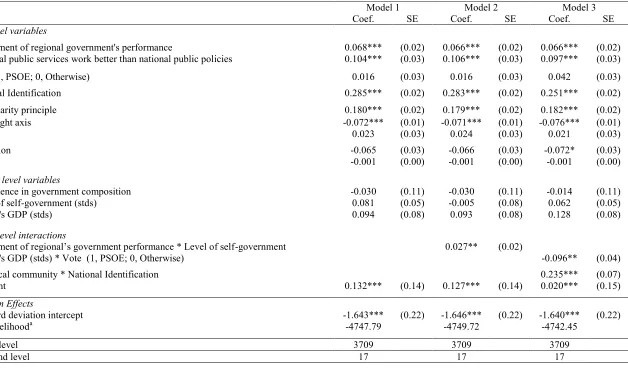
Table 3 reports the results of our random intercepts fixed slopes hierarchical model with individual characteristics and contextual factors as predictors of autonomist support. The first model includes the crucial independent variables together with all the individual-level controls. The second model adds an interaction term: the levels of self-government of each region (number of competences) and the assessment of regional
governments‘ performance. The third model includes two complementary interactions: the first assesses the relationship between voting patterns and the standardised regions‘ GDP. The second assesses the relationship between national identity and the existence of a historical region17.
As expected, and in line with the literature, the variable of national identification confirms H1. When national identification is not Spanish, the support for more extensive
decentralisation is expected to increase.
The first model also shows that the assessment of regional governments‘ performance
and regional governments‘ public services have a strong impact in explaining regionally-oriented support (confirming H2). Therefore, when citizens consider that
their regional government is doing a good job, they want them to have more power to handle other issues or public domains. According to our model, when the assessment of regional government's performance increases by one point, the support for decentralisation is expected to increase by approximately 0.07 points. Unfortunately, in the first model, none of the variables at the second-level of analysis is significant.
However, two of the control variables show results which were expected. Firstly, the subsidiary principle is positive and significant: those who think that policy making decisions should be made closer to the citizens (at the most decentralised level), want for their regional government a strong capacity to develop their own public policies.
17
18
Secondly, as the literature on the Spanish party competition has highlighted, the left-right variable indicates that decentralisation support is stronger among leftist18.
The second model adds the interaction between the assessment of regional governments‘ performance and the level of self-government in each region. The interaction is significant at the 95% level. This result is coherent with the argument that the relationship between the assessment of regional governments‘ performance and the support for decentralisation is weaker if the level of self-government drops. More specifically, the interaction between these two variables is positive and significant, showing that the association between them is stronger with positive levels of assessment and higher levels of self-government.
18
Table 3 Determinants of the autonomist support (Hierarchical model)
* p<.1, ** p<.05, *** p<.01 aLog likelihood baseline model: Model 1, 106.23; Model 2, 105.75; Model 3, 100.62; Prob > chi2:0.000
Model 1 Model 2 Model 3
Coef. SE Coef. SE Coef. SE
Fist level variables
Assessment of regional government's performance 0.068*** (0.02) 0.066*** (0.02) 0.066*** (0.02) Regional public services work better than national public policies 0.104*** (0.03) 0.106*** (0.03) 0.097*** (0.03)
Vote (1, PSOE; 0, Otherwise) 0.016 (0.03) 0.016 (0.03) 0.042 (0.03)
National Identification 0.285*** (0.02) 0.283*** (0.02) 0.251*** (0.02)
Subsidiarity principle 0.180*** (0.02) 0.179*** (0.02) 0.182*** (0.02)
Left-Right axis -0.072*** (0.01) -0.071*** (0.01) -0.076*** (0.01)
Gender 0.023 (0.03) 0.024 (0.03) 0.021 (0.03)
Education -0.065 (0.03) -0.066 (0.03) -0.072* (0.03)
Age -0.001 (0.00) -0.001 (0.00) -0.001 (0.00)
Second level variables
Congruence in government composition -0.030 (0.11) -0.030 (0.11) -0.014 (0.11)
Level of self-government (stds) 0.081 (0.05) -0.005 (0.08) 0.062 (0.05)
Region's GDP (stds) 0.094 (0.08) 0.093 (0.08) 0.128 (0.08)
Cross-level interactions
Assessment of regional‘s government performance * Level of self-government 0.027** (0.02)
Region's GDP (stds) * Vote (1, PSOE; 0, Otherwise) -0.096** (0.04)
Historical community * National Identification 0.235*** (0.07)
Constant 0.132*** (0.14) 0.127*** (0.14) 0.020*** (0.15)
Random Effects
Standard deviation intercept -1.643*** (0.22) -1.646*** (0.22) -1.640*** (0.22)
Log likelihooda -4747.79 -4749.72 -4742.45
N first level 3709 3709 3709
20
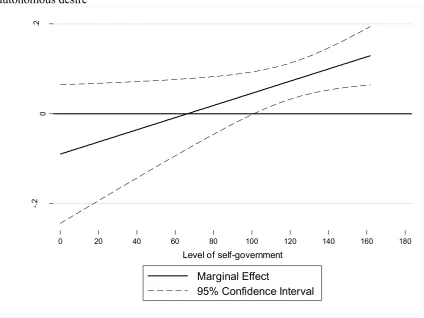
As suggested by King et al. (2000), and following Brambor (2006), we include the constitutive terms and their interaction in order to avoid the biased calculation of the intercepts in the regression lines assessing the impact of the independent variable in every conditional circumstance. We illustrate the marginal effect of X and the corresponding standard errors across the full range of the modifying variable (Z). We plot the marginal effect of the assessment of regional governments‘ performance on the support for decentralisation with the level of self-government (Figure 1). The results show that the effect of the assessment of regional governments‘ performance is significant and positive when the AC reaches a certain degree of self-government. In
other terms, the effect of the assessment of regional governments‘ performance is 0
[image:21.595.88.513.333.651.2]among low levels of government, but much stronger among higher levels of self-government.
Figure 1: Marginal effects of assessment of the government‘s performance on
autonomous desire
In the third model we add two interaction terms. The first tests the relationship between voting for another party than the Socialist Party (incumbent party in the national government in 2005) and the standardised difference of the regions‘ GDP. Surprisingly, the effect is negative. This means that the effect of voting for the party in opposition is
-.
2
0
.2
0 20 40 60 80 100 120 140 160 180
Level of self-government
Marginal Effect
21
weaker as the regions‘ GDP increases. This effect goes against the hypothesis that only in wealthier regions parties (both national and regional) try to seek support for increasing levels of decentralisation.
The interaction between the national identity and historical community variables attempts to test if national identity has a stronger impact in these regions. As previously mentioned, the question about national identity is asked in all regions, even though most citizens who do not feel first and foremost Spanish live in Catalonia and the Basque Country. Together with Galicia, they are considered the three regions with a strong national and linguistic cleavage. Other things being equal, the interaction between both variables is positive and significant. This indicates that the tendency to use national identity to frame attitudes towards decentralisation is stronger in those regions that are considered historical. Again, especially in regions where a differing identity than Spanish is important, national identity plays an important role in explaining the support for a strong regional government.
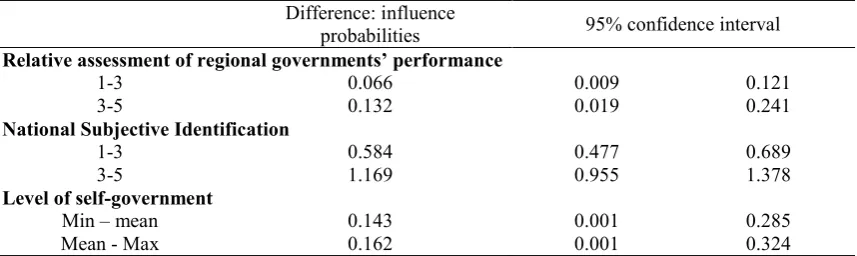
In order to estimate the strength of the effects, we estimate first differences in how support for more autonomy changes when the assessment of regional governments‘ performance is altered, holding other variables at their means. Table 4 contains the difference for several variables and the associated estimated difference in the probability to influence the autonomist support (column two), together with a 95 %
confidence interval. If the assessment of regional government‘s performance increases from 1 (regional government has performed badly) to 3 (median of the scale), the probability of increasing support for a strong regional government rises by 0.066. Likewise, an increase in the same independent variable from 3 to 5 (regional government has performed very well) leads to a rise of 0.132 in the probability of supporting a strong regional government.
22
Table 4 First Differences: effect of key independent variables on the support for a strong regional government
Difference: influence
probabilities 95% confidence interval Relative assessment of regional governments’ performance
1-3 0.066 0.009 0.121
3-5 0.132 0.019 0.241
National Subjective Identification
1-3 0.584 0.477 0.689
3-5 1.169 0.955 1.378
Level of self-government
Min – mean 0.143 0.001 0.285
Mean - Max 0.162 0.001 0.324
Only the variable in question is changed; all other variables are hold at their means.
Conclusions
This paper has analysed why some Spanish citizens support a stronger regional government. The study of decentralisation has received much scholarly interest over the last decade, as several countries have decided to transfer national powers to separate regional entities. Particularly, the question of why a state decides to decentralise lies at the heart of the most recent analysis of decentralisation policies.
So far the literature has explained the phenomenon according to two mechanisms: on the one hand, decentralisation as a product of sub-national identities. This line of reasoning asserts that the psychological attachment to the people, institutions and elites in a region that arises by the existence of a different culture, language or history (or a combination of these factors) increases the probability for demanding higher levels of self-government. On the other hand, decentralisation has been recently considered as an endogenous process: once implemented, the regional governments (that is, regional parties or regional branches of the same party) bargain over decentralisation policies in order to increase their capacity in regional affairs. As parties switch towards a pro-regional discourse, they seek the support of citizens. Parties will have more legitimacy to demand higher levels of self-government as long as their claims are aligned with
citizens‘ support for decentralisation.
23
regional identity (mainly Catalonia and the Basque Country) and ACs created artificially in the 1980s.
The empirical analysis (hierarchical model) confirmed our hypotheses derived from the theoretical model. Sub-national identity is, as expected, a good predictor of regionally-oriented support and is particularly strong in those regions considered historical. It can therefore be concluded that sub-national identity has a good chance in explaining autonomy-oriented support.
Additionally, in line with one of our main arguments, we have demonstrated that even in those regions without a different or strong sub-national identity, support for higher levels of self-government may emerge from the dynamics generated by the regional arena. That is, those who consider that the regional government is doing a good job, show a strong support to strengthen regional government capacities. The same effect is produced when citizens consider that regional public policies work better than national ones.
We also included a cross-level interaction to test at which level self-government matters. As shown in Figure 1, the marginal effect of the assessment of regional governments‘ performance on the support for a strong regional government increases when the level of self-government is higher.
This finding represents a further step in the continuing scholarly debate regarding the causes of decentralisation. As regional governments assume more capacities and begin to develop their own public policies, they increase their visibility. Citizens may thus consider that public policies should be closer to them, as a matter of principle or simply because they are perceived as more efficient.
This article consequently finds itself within the literature that considers decentralisation as an endogenous process. Scholars should continue their efforts on studying decentralisation as an outcome derived from institutional design and party competition dynamics. In this sense, our analysis considers ‗government composition‘ as a ‗rough‘ measure of party strategies. Other alternatives, such as the priority that each party gives to decentralisation in each region (using, for example, similar indicators than those used in the Comparative Manifesto Project), should be considered in the future as a more precise way to tackle cross-regional differences on supporting decentralisation.
24
the design of the final territorial model and are an important feature in understanding how parties behave and how institutions are modelled in a multilevel setting.
Acknowledgements
We are extremely grateful to the comments, suggestions and critiques received in the IX Spanish Congress of Political Science and Public Administration in Malaga (23-25 September 2009) and in the VIII Basque Congress of Sociology in Bilbao (10-12 February 2010). We also appreciate the valuable ideas of Maria José Hierro and the
‗teaching lessons‘ of Aina Gallego. Thees Spreckelsen, Sergi Prados-Pardo and Sarah Wilkins Laflamme have also been useful in several stages of this research. Any mistakes or omissions are attributable to the authors of this article. This is one of several joint papers by the authors; the ordering of names thus reflects a principle of alphabetical order. Both authors have contributed equally.
Marc Guinjoan is a Ph.D. candidate in the Department of Political and Social Sciences at Universitat Pompeu Fabra (UPF), Barcelona since 2008. His dissertation deals with party strategies and electoral systems, even though he is also interested in decentralisation policies and nationalisms.
25 References
Amat, Francesc, and Albert Falcó-Gimeno. 2010. Legislative Bargaining and Decentralization: Evidence for 15 OECD Parliamentary Democracies. Working paper/Nuffield College. University of Oxford.
Amat, Francesc, Ignacio Jurado, and Sandra León. 2009. A political theory of decentralization dynamics. Estudios/Working Papers. Centro de Estudios Avanzados en Ciencias Sociales, no. 248.
Anderson, Cameron D. 2006. Economic Voting and Multilevel Governance: A Comparative Individual-Level Analysis. American Journal of Political Science
50, no. 2: 449–463.
Beramendi, Pablo, and Christopher J. Anderson, eds. 2008. Democracy, inequality, and representation: A comparative perspective. New York: Russell Sage Foundation.
Brambor, Thomas, William Roberts Clark, and Matt Golder. 2006. Understanding Interaction Models: Improving Empirical Analyses. Political Analysis 14, no. 1: 63 -82.
Bryk, Anthony S., and Stephen W. Raudenbush. 2002. Hierarchical linear models: applications and data analysis methods. Thousand Oaks, CA: SAGE.
Coller, Xavier, and Rafael Castelló. 1999. Las bases sociales de la identidad dual: el caso valenciano. Revista Española de Investigaciones Sociológicas 88: 155–183.
Colomer, Josep M. 1998. The Spanish ‗state of autonomies‘: Non-institutional federalism. West European Politics 21, no. 4: 40-52.
De Winter, Lieven, and Huri Türsan, eds. 1998. Regionalist Parties in Western Europe. Routledge/ECPR Studies in European Political Science. London: Routledge. Díez Medrano, Juan. 2003. Framing Europe: Attitudes to European Integration in
Germany, Spain and the United Kingdom. Princeton, N.J: Princeton University Press.
Erk, Jan, and Wilfried Swenden. 2009. The new wave of federalism studies. In New Directions Federalism Studies, ed. Jan Erk and Wilfried Swenden. London: Routledge.
Giordano, Benito. 2000. Italian regionalism or 'Padanian' nationalism — the political project of the Lega Nord in Italian politics. Political Geography 19, no. 4: 445-471.
Gourevitch, Peter Alexis. 1979. The Reemergence of "Peripheral Nationalisms": Some Comparative Speculations on the Spatial Distribution of Political Leadership and Economic Growth. Comparative Studies in Society and History 21, no. 03: 303-322.
Guibernau, Montserrat. 2006. National identity, devolution and secession in Canada, Britain and Spain. Nations and Nationalism 12, no. 1: 51-76.
Hooghe, Liesbet, Gary Marks, and Arjan Schakel. 2010. The Rise of Regional Authority: A Comparative Study of 42 Democracies. London: Routledge.
Kam, Cindy D, and Robert J. Franzese Jr. 2007. Modeling and interpreting interactive hypotheses in regression analysis. Ann Arbor: University of Michigan Press. Keating, Michael. 1998. Territorial Competition and Political Restructuring in Western
26 University.
King, Gary, Michael Tomz, and Jason Wittenberg. 2000. Making the Most of Statistical Analyses: Improving Interpretation and Presentation. American Journal of Political Science 44, no. 2: 341–355.
Landman, Todd. 2008. Issues and methods in comparative politics: an introduction. London: Routledge.
Lijphart, Arendt. 1980. The structure of inference. In The Civic Culture Revisited, ed. Gabriel A. Almond and Sidney Verba. Newbury Park, CA: SAGE.
Máiz, Ramón, Pablo Beramendi, and Mireia Grau. 2002. La federalización del Estado de las Autonomías: evolución y déficit institucionales. In Veinte años de autonomía en España, ed. Joan Subirats and Raquel Gallego, 379-411. Madrid: Centro de Investigaciones Sociológicas.
Maravall, José María. 2008. La confrontación política. Madrid: Taurus.
Martínez-Herrera, Enric. 2002. From nation-building to building identification with political communities: Consequences of political decentralisation in Spain, the Basque Country, Catalonia and Galicia, 1978–2001. European Journal of Political Research 41, no. 4: 421-453.
Moreno, Luis. 2002. Decentralization in Spain. Regional Studies 36, no. 4: 399-408. Orte, Andreu, and Alex Wilson. 2009. Multi-level Coalitions and Statute Reform in
Spain. Regional & Federal Studies 19, no. 3: 415-436.
Pallarès, Francesc, and Michael Keating. 2003. Multi-Level Electoral Competition.
European Urban and Regional Studies 10, no. 3: 239-255.
Rabe-Hesketh, Sophia, and Anders Skrondal. 2008. Multilevel and longitudinal modeling using Stata. College Station, Texas: Stata Press.
Riker, William H. 1969. Six books in search of a subject or does federalism exist and does it matter? Comparative Politics 2, no. 1: 135–146.
Robinson, WS. 2009. Ecological Correlations and the Behavior of Individuals.
International Journal of Epidemiology 38, no. 2: 337 -341.
Rodden, Jonathan, and Susan Rose-Ackerman. 1997. Does federalism preserve markets? Virginia Law Review 83, no. 7: 1521–1572.
Roller, Elisa, and Pieter Van Houten. 2003. A national party in a regional party system: The PSC-PSOE in Catalonia. Regional and Federal Studies 13, no. 3: 1–22. Seligson, Mitchell A. 2002. The renaissance of political culture or the renaissance of the
ecological fallacy? Comparative Politics 34, no. 3: 273–292.
Sharma, Chanchal Kumar. 2006. Decentralization Dilemma: Measuring the Degree and Evaluating the Outcomes. Indian Journal of Political Science 67, no. 1: 49-64. Sorens, Jason. 2008. Regionalists Against Secession: The Political Economy of
Territory in Advanced Democracies. Nationalism and Ethnic Politics 14, no. 3: 325-360.
Spolaore, Enrico, and Alberto Alesina. 2003. The size of nations. Cambridge, Mass.: MIT Press.
Stimson, James A., Michael B. MacKuen, and Robert S. Erikson. 1995. Dynamic representation. American Political Science Review 89, no. 3: 543–565.
Uriarte, Edurne. 2002. Ciudadanos y partidos en el consenso y disenso sobre el Estado de las Autonomías. Revista Española de Ciencia Política, no. 100: 255-276. Van Houten, Pieter. 2000. Regional Assertiveness in Western Europe: Political
27 University of Chicago.
Wibbels, Erik. 2006. Madison in Baghdad?: Decentralization and Federalism in Comparative Politics. Annual Review of Political Science 9, no. 1: 165-188. Wibbels, Erik, and Jonathan Rodden. 2002. Beyond the fiction of federalism: