DEVELOPMENT OF INSTRUMENTS OF READING, WRITING, AND CO
ELEMENTARY SCHOOL
Associate Professor of Education Science Muhammadiyah
ARTICLE INFO ABSTRACT
The purpose of this study is to abilities of
reading, writing, and counting. Reading, writing, and counting are elementary school students
grade. In order to increase
standardized instrument to measure the ability to read write and count
300 students in grade district
Correlation
writing and counting have an index α ≥ 0.50, so that each instrument is reliable
Copyright © 2016, Nahjiah Ahmad. This is an open access article distributed under the Creative Commons Att distribution, and reproduction in any medium, provided the original work is properly cited.
INTRODUCTION
Every child born into the world brings a number of unique potentials with him/her. From this potential, as an adult need explore with a variety of meaningful experiences through environmental education in both formal and informal.
Armstrong, (2000): believes that every child born i
world with a unique potential, which, if nurtured properly, can contribute to a better world. The biggest challenge for parents and teachers is to remove a boulder blocking their way in discovering, developing, and celebrate the grace that they ha it.To develop what is described by Armstrong is by providing education as early as possible to hone a variety of intelligence that is in the child, when he was studying in kindergarten and elementary school. Elementary school age learners of one, two, and three are in the age range of six to nine years. At the age of all aspects of the development of intelligence (Multiple Intelligences) grow and develop very remarkable. Therefore, to develop aspects of children's intelligence possessed the necessary methods, models of education in line with the mental development of children as well as teachers' creativity in running the models and methods. This effort is a manifestation
*Corresponding author: Nahjiah Ahmad,
Associate Professor of Education Science Muhammadiyah University of North Maluku, Ternate; Indonesia.
ISSN: 0975-833X
Article History:
Received 23rd January, 2016
Received in revised form 15th February, 2016
Accepted 27th March, 2016
Published online 26th April,2016
Key words:
Reading, Writing, Counting,
Developing Instrument.
Citation: Nahjiah Ahmad, 2016. “Development instruments of reading, writ
International Journal of Current Research, 8, (04), 30039
RESEARCH ARTICLE
INSTRUMENTS OF READING, WRITING, AND COUNTING ABILITY, FOR
ELEMENTARY SCHOOL AT STUDENTS BEGINNING CLASSES
*Nahjiah Ahmad
Associate Professor of Education Science Muhammadiyah University of North Maluku,
ABSTRACT
he purpose of this study is to develop an instrument for measuring the reading, writing, and counting abilities of elementary school beginner students. Henceforth be used by teachers in measur reading, writing, and counting. Reading, writing, and counting are
elementary school students to be mastered to be able to commence
grade. In order to increase the interest in reading, writing and counting, standardized instrument to measure the ability to read, write and count.
write and count to 900 students tested consisted of 300 first graders, 300 second gra 300 students in grade III.This research was conducted on students at ten
district Matraman. Instruments that have been tested validated using
CorrelationAnalisys and calculation of reliability. Reliability of the measuring instrument reading, writing and counting have an index α ≥ 0.50, so that each instrument is reliable
is an open access article distributed under the Creative Commons Attribution License, which distribution, and reproduction in any medium, provided the original work is properly cited.
a number of unique is potential, as an adult need to explore with a variety of meaningful experiences through environmental education in both formal and informal. To quote : believes that every child born into this world with a unique potential, which, if nurtured properly, can biggest challenge for parents and teachers is to remove a boulder blocking their way in discovering, developing, and celebrate the grace that they have it.To develop what is described by Armstrong is by providing education as early as possible to hone a variety of intelligence that is in the child, when he was studying in kindergarten and elementary school. Elementary school age learners of one, two, nd three are in the age range of six to nine years. At the age of all aspects of the development of intelligence (Multiple Intelligences) grow and develop very remarkable. Therefore, to develop aspects of children's intelligence possessed the hods, models of education in line with the mental development of children as well as teachers' creativity in This effort is a manifestation
hammadiyah University
of the sense of responsibility of educators to improve the basic ability of children when learning in the early grades in elementary school. A basic ability is the ability to read, write and count. The ability to read, write and count each student in a different school. There are students who read a quick process, but the writing is slow, there are also students that the writing process was quick but Numeracy The slow and there are also students who read write fast and slow calculation.
background of the above problems, the formulation of the problem can be stated as follows; 1) whether the instrument's ability to read, write and count early grades of elementary school students, developed the concept of the validity of the right; 2) how empirical validation of the instrument reading, writing and math early grades of elementary school students; 3) how the reliability of the instrument's ability to read, write and count early grades of elementary school students developed. For the purpose of this research is to build and develop the instrument reading, writing and arithmetic to be validated as a standard measurement tool to assess the ability to read, write and count elementary students, grades I, II, and III
Variable Theory Study
Reading Ability
Reading is a language skill. Reading has an important role in addition to other skills. Reading is a skill receptive and is a
International Journal of Current Research
Vol. 8, Issue, 04, pp.30039-30045, April, 2016
INTERNATIONAL
OF CURRENT RESEARCH
Development instruments of reading, writing, and counting ability, for elementary school 30039-30045.
UNTING ABILITY, FOR
STUDENTS BEGINNING CLASSES
University of North Maluku, Ternate, Indonesia
measuring the reading, writing, and counting students. Henceforth be used by teachers in measuring reading, writing, and counting. Reading, writing, and counting are the basic ingredients for commence the learning process up to a higher interest in reading, writing and counting, it is required to build a and count. Ability instruments to read, to 900 students tested consisted of 300 first graders, 300 second grade students and students at ten elementary schools in the . Instruments that have been tested validated using Corrected Item Total Reliability of the measuring instrument reading, writing and counting have an index α ≥ 0.50, so that each instrument is reliable.
ribution License, which permits unrestricted use,
of the sense of responsibility of educators to improve the basic ability of children when learning in the early grades in elementary school. A basic ability is the ability to read, write . The ability to read, write and count each student in a different school. There are students who read a quick process, but the writing is slow, there are also students that the writing process was quick but Numeracy The slow and there are also o read write fast and slow calculation. Based on the background of the above problems, the formulation of the problem can be stated as follows; 1) whether the instrument's ability to read, write and count early grades of elementary ed the concept of the validity of the validation of the instrument reading, writing and math early grades of elementary school students; 3) how the reliability of the instrument's ability to read, write and count early grades of elementary school students developed. search is to build and develop the instrument reading, writing and arithmetic to be validated as a standard measurement tool to assess the ability to read, write and count elementary students, grades I, II, and III
. Reading has an important role in addition to other skills. Reading is a skill receptive and is a
INTERNATIONAL JOURNAL OF CURRENT RESEARCH
very complex and involve a variety of skills. Read by Jamaris (2009: 168) is an activity which is complex because it involves the ability to remember the graphic symbols in the form of letters, remembering the sound of these symbols and writing graphic symbols in a series of words and sentences which implies. Read by Kennedy (1981: 5) is a person's ability to recognize visual forms, connecting with the sound and meaning derived based on the experience of the past, trying to understand and interpret the meaning of it. Read besides being a physical or mental activity is also a person's ability to make sense of something that is based on past experiences. Haris and Sipay as quoted by Manzo and Manzo (1995: 10) defines, reading from the traditional side is the interpretation of the meaning of written language. Further said reading is a process-related verbal mind and all other communication is the ability to hear, speak and write in order to give meaning to written language. This suggests that in order to be able to read the necessary capacity to think and all other communication so as to give the meaning of written language.
Burns, et al (1996: 45) argues that reading ability is vital in an educated society. However, children who do not understand the importance of learning to read will not be motivated to learn. Learning to read is a constant effort, and the kids who see the high value of reading in personal activities will study harder than the children who did not find the advantage of reading activities.Santrock (2007: 422) argues that children cannot be said to read if they can only read the word, like in kindergarten. Reading requires mastery of the basic rules of phonology, morphology, syntax and semantics. Relates to the ability to read, Syafei in Farida (2008: 2) suggests three terms that are often used to provide the basic components of the process of reading, recording, decoding, and meaning. Recording refers to the words and sentences, and then associate it with the sound corresponding to the writing system used, while the process of decoding (encoding) refers to the process of translating a series of graphics into words. Recording and decoding process usually takes place in early elementary classes, namely class I, II, and III, known as the initial reading. Emphasis is read at this stage is that the process of perception, that is the introduction of a series of letters of correspondence with the sounds of language. While the process of understanding the meaning (meaning) emphasized in high-grade primary school classes.
Reading should have a purpose, because someone is reading with a purpose, tend to be more understanding than people who do not have a purpose. In the act of reading in the classroom, teachers should set goals to read by providing appropriate special purpose or by helping them set goals to read the students themselves. Interest is read by Blanton, and Irwin Burns (1996: 156) includes: (1) Pleasure, (2) improve reading aloud, (3) using a certain strategy, (4) to update their knowledge about the topic, (5) where new information to let you know that he knows, (6) to obtain information to report orally or in writing, (7) to confirm or refute the predictions, (8) featuring experiments or applying information obtained from the text in some other way and learn about the structure of the text and (9) to answer specific questions. Burns argues essentially reading consists of two parts, the process and the product, further stated, covering nine aspects of the reading process to produce a product; namely the aspect of sensory
perception, sequence, experience, experience, learn,
associations, attitudes and ideas. He also explained that the process begins with the visual sensory readings obtained through disclosure of graphic symbols through the sense of sight. Children learn to distinguish visually between graphic symbols (letters or words) that are used to present oral language.
The next activity is a perceptual action, namely the activity of knowing a word until one meaning based on past experience. Activities involving the perception of sensory impressions that enter the brain. When a person reads, the brain receives pictures and later revealed the words printed pages based on the experience of the reader before the object, idea, or emotion that is presented by the class. The reader identifies the set of written symbols, either in the form of words, phrases, or sentences. Then the reader gives meaning to interpret the text read. Readers of one another to understand the text may not be the same. Despite reading the same text, they might give a different meaning. Aspects of the sequence in the reading process are a series of events arranged linearly following article, which usually appears on one page from left to right or from top to bottom. Experience is an important aspect in the reading process. Children who have a lot of experience that will have wider opportunities in developing an understanding of the vocabulary and concepts they encounter in reading compared to children who have limited experience. Therefore, teachers or parents must provide direct or indirect experience for their children, for example, the experience of places, objects and processes described in the text so that the material will more easily absorb them. concrete experience (direct experience) and indirect experience will improve the conceptual development of children, but of direct experience is more effective than direct experience.
Teachers and parents can help children learn a language that is commonly found in books by telling and reading stories, encouraging the activity of the event and inform, encourage discussion in the classroom, using the experience of language through stories, and encourage dramatic play. Increased ability to think through reading should start early. Elementary school teachers can guide students by asking questions that allow them to increase the capacity to think. The questions asked teachers should stimulate students' thinking, such as the question of why and how. So, the questions asked in connection with reading not only questions that produce answers facts. Getting to know the relationship between symbols with the sounds of language and meaning is an aspect of the association in reading. Children learn to connect a graphic symbol with the sound of the meaning of language. Without the ability of the student association may not be able to understand text. Affective aspect is the process of reading-related activities focusing attention, tendency evokes read (according to their interests), and motivation to read while reading. Concentration, pleasure and motivation needed in reading. Elementary school children should have been trained to focus on reading material to read.
Motivation and pleasure of reading are very student aid to focus on reading. Aspects of the idea of giving begins with the use of sensory and perceptual background with experience and affective responses and construct meaning from the text he read in private. Meaning builds upon reading the text, but not all found in the text. Text amended by the reader of the information taken from the text. Readers with a background of different experiences and different affective reaction will produce different meanings of the same text. The product reads the communication of thoughts and emotions between writer and reader. Communication can also occur from reader development through the integration of knowledge that has been held readers with the information presented in the text.
Communication in reading depends on an understanding that is affected by all aspects of the reading process. Reading comprehension is very dependent on all aspects involved in the reading process. In addition to the capabilities required in carrying out the activities, the various aspects of the reading process must also be met by the reader. Aspects of the idea would be obtained if other aspects of the reading process must work in harmony. So that results can be achieved with a maximum reading, the reader should dominate activity in the reading process. Therefore, a primary school teacher plays an important role in guiding the students so that they are able to control the activities in the process of reading the fine. The ability to read is referred to in this research is a skill or power that the early grades of elementary school students to do something as a result of the learning experience that includes cognitive, affective and psychomotor. Reading is a physical or mental activity in translating signs and symbols within the meaning and scouting new meaning to the cognitive and affective systems already owned by the students so that they can understand the message contained in the text.
Writing Ability
Gie (1992: 17) argues about writing is a whole series of activities of a person in expressing ideas and convey to the reader the writing language to be understood by the reader. This opinion can be understood that writing is a series of activities such as someone in expressing the thoughts, feelings, opinions, and attitudes of the writer to the reader to understand what is written. McCrimmon (1984: 6) points out, writing is a difficult job, but in writing, the author the opportunity to say something about themselves, communicating ideas can even learn something unknown. A similar opinion was expressed Cere (1985: 144) writes that it is a form of self-expression, what is in the mindset in writing. The second argument indicates that writing is an activity in expressing ideas or ideas that emerged from the author. The complexity of writing this so that it can be said that "writing" is a difficult activity. Written language is defined as a form of communication that is based on a system of symbols, parallel to the spoken language and sign language. Santrock found written language composed of lingual units are used in the community, has rules beheadings and merge (Santrock, 2005). Learning to write for children of primary school age need to be stimulated. Stimulation in terms of stimulating children to recognize, understand and use written symbols of language to communicate in accordance with the stages of development.
Stimulation is given in various forms, ranging from exposure to production form. Stimulation of language or learning to write in writing are not taught to read and write. Stimulation in the sense decorated focus on delivering visual literacy and verbal stimuli to be optimally used by children to express ideas and feelings. The target is for children to realize the function of language in the form of the hair symbols appropriate level of mastery. Musfiroh (2009: 11) suggests that stimulation has meaning: to encourage interest in reading, providing an environmentally literate is ready to be explored by children, foster phonemic awareness, encouraging the emergence graphemic awareness, awareness grafofonemis, for the provision of reading. Further said stimulation has meaning: to encourage children to express ideas and experiences through visual symbols are gradually referring to conventional linguistic symbol, in this case is grapheme Indonesian. Thus, it can be expected that stimulates children to optimize the stimulation of written language in accordance with the child's developmental level and cannot be separated from the state of the environment in the atmosphere of this learning, encouragement from parents and teachers. Based on the above, this study is the ability to write is the ability of primary school students started classes in both writing dictated by the teacher and wrote a letter kept upright. Age students start classes ranging from 6-8 years in development, still need to be stimulated, including the development of written language, in order to improve the ideas and motivation of the child to want to learn to write.
Counting Ability
Numeracy is a branch of mathematics, and mathematics is a tool of scientific thinking (Dragon, 1980: 13). Scientific way of thinking is a tool to acquire scientific knowledge. This is because the math is the highest form of logic that results in a system that is the logical organization of the science that produces various statements in the form of mathematical models. Numeracy skills is the ability to perform arithmetic operations, the ability to solve simple problems such as addition, subtraction, multiplication and division or algebraic manipulations. Numeracy skills, including skills with numbers, involving mental aptitude in dealing with problems in accordance with the rules that have been studied, such as addition and multiplication. This ability will be useful in dealing with problem solving on the number and manipulation thereof.
Characteristics of EarlyChildhoodDevelopmentClasses On ElementarySchool
early elementary school age classes, among other things, they have been able to demonstrate the ego of gender, has started to compete with colleagues, have friends, have been able to share, and independent. Emotional development of children aged 6-8 years, among others, children have been able to express reactions to others, has been able to control the emotions, has been able to part with his parents and had started to learn about right and wrong. For the development of intelligence early grade elementary age children demonstrated by his ability to undertake serious, classifying objects, interested in figures and in writing, increasing vocabulary, love to talk, understand cause and effect and the growing understanding of space and time.
How Children Learn
Piaget (1991: 10) states that every child has its own way of interpreting and adapting to its environment (the theory of cognitive development). According to him, every child has the cognitive structure called schemata is a system concept that exists in the mind as a result of the understanding of the object in its environment. An understanding of the object takes place through the process of assimilation (object linking to an existing concept in mind) and accommodation (the process of utilizing the concepts in the mind to interpret the object). Both of these processes if it continues will make the old knowledge and new knowledge becomes balanced. In this way the child can gradually build knowledge through interaction with the environment. Based on this, the learning behavior of children is influenced by aspects of itself and its environment. Secondly, it is impossible to separate because learning occurs in the context
of the interaction of the child with the environment. Primary
school age children are at the stage of concrete operations. In the age range of children begin to show behavioral study as follows: (1) Start looking at the world objectively, shifting from one aspect of the situation to another aspect is reflective and look at the elements simultaneously, (2) Starting to think operationally, (3) using operational thinking to classify objects, (4) Creating and using connectivity rules, simple scientific principle, and using a causal relationship, and (5) Understanding the concept of substance, liquid volume, length, width, area, and weight
Teaching and Learning meaningful
Learning is essentially a process of change in personality in the form of skills, attitudes, habits, and understanding. This change is settled in behavior that occurs as a result of training or experience. Learning is essentially a process of interaction between children with children, children with learning resources and child educators. This learning activity will be meaningful to the child if done in a comfortable environment and provide safe spaces for children. The learning process is individualized and contextual, meaning that learning occurs within the individual in accordance with its development and environment. Meaningful learning is a process of tying new information on relevant concepts contained in a person's cognitive structure. The meaningfulness of learning as a result of the events of teaching is characterized by the relationship between the aspects, concepts, information or new situations
with the relevant components in the cognitive structure of students. The learning process is not just memorized concepts or mere facts, but an activity of linking concepts to produce a full understanding, so that the concepts learned will be well. Thus, meaningful learning to occur, then the teacher should always strive to know and explore the concepts that have been owned by the students and help integrate harmoniously these concepts with new knowledge that will be taught. In other words, learning will be more meaningful if the child has learned firsthand what to enable more senses than just listening to the person / teacher explained.
Constructs Measurement
The construct of reading, writing, and arithmetic are the variables which are a synthesis of the theories of reading, writing, and arithmetic is discussed and analyzed and presentation described in theoretical assessment or review of the literature. Constructs are described in the definition of the conceptual and operational definitions which also includes the dimensions and indicators of the measured variable. Variable constructs are variables in the data capture (instrument) requires theories and concepts are translated into indicators needed to make grains have a question that will be used as a measuring tool to measure reading, writing, and arithmetic elementary school students beginning classes. Definition of the instrument in general is a tool used to measure natural phenomena and social phenomena observed. There is a wide range of expert opinion regarding the instrument, the instrument as a data collection tool is a tool used to collect data on the variables for the needs of a development or research. The instrument is a key component in a research activity, it can be understood that the instrument used sufficient quality in terms of valid and reliable, so that the data obtained would correspond to the real facts on the ground.
Djaali and Pudji (2004: 81) argues that the instrument plays an important role in determining the quality of a study, because the validity of the data taken was obtained and determined by the quality instrument used, in addition to data collection procedures were taken and data collected. Conceptually figures essentially continuous measurement results that move from the pole to the other pole opposite. For example, from low to high, from negative to positive. Measurement reading, writing, and arithmetic initial graders by giving numbers (scores) to attribute the ability of learning outcomes in reading, writing and arithmetic as basic capabilities. Referring to the theoretical assessment, basic skills of reading, writing and arithmetic, then the measurement is meant here is that after they join the program in the classroom by referring to the curriculum SBC and thematic approach.
Instrument Development Theory
to interpret a score. Further stated also that there are criteria of good instruments, namely: (1) instruments or tests relevant or measure the behavior to be measured, (2) the balance between the objectives and items that represent them, (3 efficiency of the time required in the implementation of the test, scoring and administration, (4) objectivity in the scoring and interpretation of results, (5) validation, (6) reliability and (7) the speed in completing the test. From these criteria are preferred in the preparation of instruments is default validity, reliability and practicality.
Standard instrument is an instrument developed empirically through some testing. Raw instrument has some limitations, both concerning the contents, operation of measurement and the measurement results. Gronlund (1990: 3) describes the characteristics of the instrument standard, namely: (1) the grains are technically qualified, (2) the administration and assessment clear, (3) the existence of norms and interpretations are uncertain, (4) the instructions and supplies instruments more. In general, there are two things that are important in the standardization of instruments, namely the content and its administration. Aikem said, besides seeing its validity and reliability, standardization of instruments also involves in terms of administration and scoring. The standardization of the formulation in terms of content includes grains and manual process. Standardization of the administration in terms of material includes measuring tools, measuring tools, equipment,
measurement, timing, interpretation and reporting of
assessment guidelines.
Thorndike (1977: 385) suggests several steps that must be done to develop instruments so that the instrument fit for use. Such measures include: (1) a region or attributes latent to be measured should be defined, (2) must be determined who will use or respond, (3) needs to be specified contents, cover any topic, (4) specify formats grain, the kind of response expected, and the procedure of granting the score, (5) for the design of the trial, in order to obtain the data to be analyzed in order to select the items can be used, (6) specify the procedures used for the standardization of measuring instruments and (7) make design manual test execution. Gable (1986: 170-177) outlines the steps that work must be taken in developing the following instruments: (1) elicits a conceptual definition, (2) develops an operational definition, (3) selecting the technical administration of the scale, (4) do review justification items related to techniques of scale that have been established, (5) select a response or sample size, (6) the preparation of instructions for a response, (7) prepare a draft for instruments, (8) prepares the final instrument, (9) to collect data early trials, (10) the analysis of trial data by using the technique of factor analysis, item analysis and reliability, (11) the revision of the instrument, (12) to analyze the validity and reliability enhancements and (15) set up manual tests. The purpose of this instrument development is to create and develop an instrument that is valid and reliable in measuring the ability to read, write and count the early grades of elementary school students. The goal of developing the instrument's ability to read, write and count in this research is revealing indicators and the factors contained in item instrument to get the standard instrument in measuring the ability to read, write and count elementary school students of class I, II and III and valid reliable.
Methodology
This research is the development of an instrument that aims to develop and validate an instrument measuring the ability to read, write and count the early grades of elementary school students. This research was conducted on samples of the portion of the population targeted research. The number of samples or the respondent to be taken in this study refers to the opinion of Gabel (1993: 51) who argued that the development of instruments for sample is approximately six to ten times the number of grains in the instrument. In this study, the authors use Gebel opinion, which is six times the number of grains of 300 respondents, consisting of 300 class I, class II and III, the total number of 900. Steps development of instruments measuring the ability to read, write and count can be described as follows; 1) formulate concepts / constructs. 2) developing
competencies and indicators, 3) grid Instruments,
4) preparation of questions based on competencies and indicators in the instrument's ability to read, write and count the early grades of elementary school students, 5) setting the parameters, 6) test the validity of the panel, in this trial the instrument given to a group of panelists (experts) to select grains through theoretical validation, 7) the results of the assessment of experts revised by using the mean value (average value) that has been formed (first test), 8) the second test of grade elementary students proceed with the initial validation, test validity and reliability as well as the norms stipulated use of the instrument's ability to read, write and count the early grades of elementary school students. Inter-rater reliability to know that adeals expert in assessing the ninth instruments that have been prepared. To determine the inter-rater reliability Ebel used the formula as set forth in Guilford (1999: 135) that:
rkk =
b e
V V
Vb (1)
Where:
rkk = inter-rater reliability index.
Vb = variance item
Ve = residual variance
Items have been assembled into a set of instruments is calculated reliability by using Cronbach Alpha formula, as follows:
=1
k
k
2
2
1
t i
s
s (2)
Where:
α = reliability coefficient k = item number
si2 = variance score grain
st2 = total score variances
RESULTS AND DISCUSSION
validated using item analysis, calculate reliability. The second phase, the results are validated tests again to the same respondents after the respondent following the final exams, further validated. Both of these trials were analyzed using Program Statistical Social Science (SPSS V. 16.0).
Validity Concept
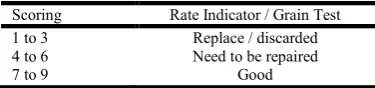
[image:6.595.311.559.227.409.2]The assessment by panelists conducted with a view to determine the validity of the concept / construct theoretically developed measurement instrument. Targets include their conformity assessment concepts / constructs used to be a grain test. There are two main points were rated by panelists, that is; compliance indicators developed the concepts / constructs used, and suitability test items were developed to be a reference indicator. To obtain an assessment of the measuring instrument is the ability to read, write and count of the panelists, the design of the development of tests that have been compiled files on 30 panelists, who will assess each indicator and test items are based on a certain scale. The scale reflects the criteria for awarding scores on the opinion of the panelists indicator test items, as listed in the following table.
Table 1. Criterion validity by experts
Scoring Rate Indicator / Grain Test
1 to 3 Replace / discarded
4 to 6 Need to be repaired
7 to 9 Good
The validity of each item and indicator test can be known based on the mean value obtained from Silverback panelists. The mean value is further based on judging criteria has been determined that, if the mean scores panelists have 1 to 3, the item / indicator needs to be replaced. And if the panelists had mean scores of 4 to 6, the item / indicator needs to be repaired. If the panelists had mean scores 7 to 9, the grain / indicators are good. Based on the evaluation of the measuring instrument reading, writing and arithmetic that were developed in this study can be stated that in general the assessors fairly unanimous in giving judgment, as reflected in the acquisition of the mean scores for each indicator grains. Corresponding calculation values obtained inter-rater correlation coefficient as shown in Table 2 as follows.
Table 2. Calculation results correlation between appraisers
No Variables The correlation coefficient (rkk) inter-rater
1. Students Reading Ability Class I
Students Writing Ability Class I Counting Ability Students of Class I
0,924 0,985 0,850
2. Students Reading Ability Class II
Students Writing Ability Class II Counting Ability Student Class II
0,813 0,859 0,583
3. Students Reading Ability Class III
Students Writing Ability Class III Counting Ability Student Class III
0,710 0,745 0,957
From the calculation indicates that the instrument has the consistency of inter-rater reliability is high, greater than 0.50.
Empirical Validity
Testing the validity of the instrument was conducted in two phases of trials using the same respondents. The test result is calculated validation grain, using the technique of Correction Item-Total Correlation is a way to correlate the scores grains with total scores (With SPSS version 16.0).
The items than have Correction value - Total Correlation smaller than r table (0,113) analyzed around several times until the value indicates the number is greater than r table. The results of calculations can be presented in the following table.
Table 3. Calculation results validity item
No Variables Trial Test 1 Trial Test 2
1. Students Reading
Ability Class I
All item valid All item valid
Students Writing Ability Class I
Item1,5 18 not valid
All item valid
Counting Ability Students Class I
Item 1 not valid Item 1 not valid
2. Students Reading
Ability Class II
All item valid All item valid
Students Writing Ability Class II
Item 1,26,28,29,30 not valid
Item, 1,26,29,30 not valid Counting Ability
Students Class II
Item 4 not valid All item valid
3. Students Reading
Ability Class III
All item valid All item valid
Students Writing Ability Class III
Item 1 not valid Item 1 not valid
Counting Ability Students Class III
Item 1 not valid Item 1 not valid
Based on the validation stages, it can be concluded that the instrument reading, writing and math grade elementary school students beginning of the development have a valid construct to measure students' basic capabilities in accordance with the degree of development.
Reliability
[image:6.595.68.256.342.386.2] [image:6.595.35.293.593.701.2]The reliability of the measuring instrument reading, writing and arithmetic have an index α ≥ 0.50, so that each instrument is a reliable factor. The coefficient of each instrument is presented in the following table.
Table 4. Calculation Results Cronbach alpha reliability coefficient
No Variables Coefficient (α)
1 2
1. Students Reading Ability Class I
Students Writing Ability Class I Counting Ability Students of Class I
0,744 0,638 0,928
0,694 0,768 0,903
2. Students Reading Ability Class II
Students Writing Ability Class II Counting Ability Student Class II
0,726 0,883 0,847
0,771 0,875 0,898
3. Students Reading Ability Class III
Students Writing Ability Class III Counting Ability Student Class III
0,903 0,906 0,869
[image:6.595.316.550.614.722.2]Implication
The implications of the results of the development of the instrument's ability to read, write and count elementary school students of class I, II, and III, among others; during this time students are taught in accordance with the achievement of the curriculum regardless of the child's development process, it is necessary to exercise about reading writing and arithmetic gradually; considering the age of the child at the beginning of class ranges between 6-8 years, it is necessary to apply the concept of learning while playing, the learning fun; therefore, a child's world is identical with the play, it is expected that the learning process should not be done during the day for children to learn in an atmosphere that is not pleasant; to the elementary school education providers should use instruments developed to measure the ability of students at each level of corresponding developments; it should be strengthened further development of this instrument by teachers or researchers, and tested with a larger sample involving several provinces to gain validity and reliability more comprehensive.
Conclusion
Based on the validation stages, it can be concluded that the instrument reading, writing and math grade elementary school students beginning of the development have a valid construct to measure students' basic capabilities in accordance with the degree of development. Results of testing by experts according to their respective fields, as well as by empirical testing and validation twice, it can be seen the number of the questions are valid. Device final instrument developed high enough to have validity. The validity of acquired and developed from the second phase by the respondent validation of each class of 300 students. Cronbach alpha reliability coefficient greater than 0.50 (α≥0, 50).
Recommendation
To the elementary school education providers should use instruments developed to measure the ability of students at each level of corresponding developments. It should be strengthened further development of this instrument by teachers or researchers, and tested with a larger sample involving several provinces to get the validity and reliability of more comprehensive.
REFERENCES
______. Children. Boston: McGraw-Hill, 2005.
______. Counting History and Development. Jakarta: Gramedia, 1980.
______. Essential of Learning of Instruction. London: Illinois The Drayden Press, 1985.
______. The Child and Reality Problems of Genetic Psychology. New York: Penguin Book, 1983.
______. The Child 'Conception of Number. New York: Humanities Press, 1987.
______. The Psychology of Intelligence. New York: Routlegde, 2001.
Anwar, Saifuddin. Reliability and Validity of Interpretation and Computing. Yogyakarta: Liberty, 1986.
Armstrong, Thomas. Multiple Intelligences in the Classroom.
Virginia: Association for Supervision Curriculum
Development, 2000.
Burns, Paul C., Betty D. Roe, and Elenor P. Ross. Today's Teaching Reading in Elementary School Boston: Houghton Mifflin Publishing Company, 1984
Cere, Anne Roggles. Writing and Learning. New York: Macmillan Publishing Company, 1985.
Cronbach, Lee J. Essential of Psychological Testing. New York: Harper's Row Publishers, 1984.
Djaali and Pudji Muljono. Measurement in Education. Jakarta: Graduate UNJ 2004.
Ebel, Roberrt E., and David A.Frisbie. Essential of Educational Measurement. New Jersey, Prentice Hall, 1999.
Gable, Robert K. Instrument Development in the Affective Domain. Boston: Kluwer-Nijhoff Publishing, 1986.
Gable, Robert K., and Mariam B. Wolf. Instrument deveploment in the Affective Domain. Boston: Kluwer Academic Publishers, 1993.
Gagne, Robert. Principle of Instructional Design. New York: Orlando's Harcour Brace Company, 1993.
Gornlund, N. E., and Robert L. Linn. Measurement and Evaluation in Teaching. New York: Macmillan Publishing company, 1990.
Gronlund, N. E. measurment and Evaluation. New York: Macmilan Publishing Company, 1990.
Jamaris, Martini. Difficulties Learning Perspective,
Assessment and Penanggulangganya. Jakarta: Yayasan Penamas Pure 2009.
Kennedy, Eddy C. Method in Teaching Development Reading. London: Precentice-Hall International (UK) Limited, 1981. The Liang Gie. Introduction to the World of Coral fabricated. Yogyakarta: Liberty, 1992.
Manzo, Antony V., and Ula C. Manzo. Teaching Children to Be Literate. London: Harcourt Brace college Publishers, 1995.
McCrimmon, Robert. Writing with a Purpose. Boston: Houghton Mifflin Company, 1984.
Mueller, Daniel. Measuring Social Attitude: A Handbook for Researchers and Practitioners, New York: Teachers College, 1986.
Musfiroh, Tadkiroatun. Cultivating Early Childhood Literacy. Jakarta: Gramedia, 2009.
Naga, Dali S. Introduction to the Theory Score. Jakarta: Gunadarma, 1992.
Piaget, Jean, and Barbel Inheler. Child Psychology, translation Miftahul Jannah. Yogyakarta: Student Library, 2011. Piaget, Jean. The Child's Conception of Number. New York:
W.W Norton and Company, 1979.
Santrock, John W. Educational Psychology, translation Tri Wibowo. Jakarta Prenada Media Group, 2007.
Tampubolon, D. P. Literacy Reading Techniques Creative and Efficient. Bandung: Angkasa, 1990.
Waston, S., and J. Waston. Educational and Psychological Assessment of Exceptional Children. Toronto: The C. V Mosby Company, 1982.