http://www.scirp.org/journal/jmp ISSN Online: 2153-120X
ISSN Print: 2153-1196
DOI: 10.4236/jmp.2016.713162 September 30, 2016
New Basic Theory of Gravity
Hubert J. Veringa
Department Mechanical Engineering, Eindhoven University of Technology, Eindhoven, Netherlands
Abstract
Although Newton’s law of gravity already exists for centuries, and its validity is be-yond any doubt, we are still lacking a basic theory to explain the specific features of this law. The general belief is that any suitable theory should include, or will be a merger of, classical quantum theory and general relativity, but until now no accept-able mathematical model taking both aspects into account has proposed. The present letter is written to present a new scheme of analysis for the mutual interaction be-tween particles that have some exchange with respect to time and space. It is found that the right form of Newton’s gravity law emerges by consequently working through the existing schemes of both quantum mechanics and the basic equations of relativity theory as expressed by the Dirac equation.
Keywords
Gravity, Quantum Physics, General Relativity
1. Introduction
Newton’s law of gravity is the cornerstone of many disciplines in space technology, as-tronomy and cosmology, but so far no acceptable theory to explain its peculiarities is existing. It is broadly accepted that any suitable theory should include, or will be a merger of, classical quantum theory and general relativity [1][2]. The main problem is, however, that the basic equations of quantum mechanics and relativity are not in cor-respondence. This fact is most easily seen that, when the common factor in the Dirac equation and the Schrödinger equation are used to combine both, a contradiction shows up. The reason for this contradiction is that relativity requires co-variance throughout where the Schrödinger equation is not co-variant. There are examples where this con-tradiction is circumvented like in the theory of the magnetic moment of particles, lead-ing to the spins. In the present paper, a new scheme of analysis is presented for the mutual interaction between particles that have some exchange with respect to time and
How to cite this paper: Veringa, H.J. (2016) New Basic Theory of Gravity. Jour-nal of Modern Physics, 7, 1818-1828.
http://dx.doi.org/10.4236/jmp.2016.713162
Received: September 5, 2016 Accepted: September 27, 2016 Published: September 30, 2016
Copyright © 2016 by author and Scientific Research Publishing Inc. This work is licensed under the Creative Commons Attribution International License (CC BY 4.0).
1819
space. The specific requirements on invariance and co-variance of operators and quan-tities will be carefully taken care of and are finally found to be of great importance for the result. This pair formation is described quantum mechanically, either starting from the classical Schrödinger equation or the relativistic Dirac equation. This latter is for-mulated in a quantum mechanical setting. Both result in the same wave function de-scribing pairs of particles. Since this wave function represents a pair potential, a relati-vistic mass can be attributed to it which is used in the Dirac equation to derive an inte-raction field between the members that form the ensemble. It is found that the right form of Newton’s gravity law emerges by consequently working through the proposed schemes of both quantum mechanics and the basic equations of relativity theory as ex-pressed by the Dirac equation1.
2. Forming of Pairs
Starting point is the assumption that there are two independent particles indicated by the masses mi and mj which are described by the normal Schrödinger equation. In the
present treatment the kinetic energy is taken into account and they experience some force reflected by the potential Vi and Vj. Spherical symmetry is next adopted and the
only boundary condition is that the wave function is zero at infinity. An observer at mi
at a distance rij from particle mj and another on mj at rji from particle mi will see that the
total wave equation is defined as follows [5]:
2 2 2
(
)
, , 2 2 , ,
1 1
2 .
ij ij t ij t ij ji ij t i j ij t ij ij j ji ji
ij ji
H i r r V V
t r r r m r r r
∂ ∂ ∂ ∂ ∂
Ψ = Ψ = − + Ψ + + Ψ
∂ ∂ ∂ ∂ ∂
(1)
where Ψij t, is the time and space dependent wave function. The time dependence can
be removed by replacing the time dependent wave function Ψij t, by e
ij
iE t ij
Ψ
. Fur-ther define Vi+Vj by Vij and we get:
(
)
2 22 2
2 2
1 1
0.
2 2
ij ij ij ij ij ji ij
i ij ij ij j ji ji ji
E V r r
m r r r m r r r
∂ ∂ ∂ ∂
− Ψ + Ψ + Ψ =
∂ ∂ ∂ ∂
ħ
(2)
To simplify the equation replace Eij−Vij by εij to propose a solution that is valid
in areas where the Vij is not of great influence anymore as follows:
eiij ijr i ji jir ,
ij ji ij
ij ji
r r
β β
α α +
Ψ = +
(3)
where αij and βij are constants independent of space coordinates and time. This
solution means that we consider the wave function outside the surroundings where the potential energy with all its peculiarities has a very minor effect on the shape of the wave function. The only interaction that can play a role will then be based solely on gravitational interaction. By substituting the solution in Equation (3) the following re-lation is found:
1The analysis is based on standard arguments of quantum theory and specific and general relativity theory.
1820
2 2
2 2
e e
2
e 0.
ij ij ji ji ij ij ji ji
ij ij ji ji
i r i r i r i r
ij ji ji ij ij ji ij ji
ij ji j i i j ij ji
i r i r ij ji
ij
ij ji i
r r m m m m r r
r r
β β β β
β β
α β α β β β α α
α α ε
+ +
+
− + − + +
+ + =
(4)
The first term at the left hand side is to be set to zero so that in a pair-wise process
0
ij ji mj ji ij mi
α β +α β = and 2 2 2 2
2 2
ij mi ji mj ij
β +β =ε .
At the moment not much is known about the α's, but one requirement to be imposed on the wave function is that it represents a pair of particles. For the time being it can be said that:
a) The α's cannot depend on the running variables in the wave equation: rij or t. It
will be a constant that can only depend on fundamental nature constants and the par-ticle masses.
b) It should make no difference for the outside world how one member sees its part-ner or whether and how we see the two members of the pair. It means that most likely we can say: α =ij f m
( )
i f m( )
j .c) There is no pair if either mi or mj equals zero so that f m
( )
i =0 for mi =0.Later it will be found that, for the sake of symmetry in the mutual gravitational inte-raction, the two α's should be equal. It also means that the β’s have opposite signs and fixed values and by taking the α's equal we make their values independent of the masses and the energies of the members of the pair. The εij could have been split into two
separate quantities as εij and εji to dedicate the
2
ij
β and 2
ji
β -values to the separate
energies of the two particles. It is also interesting to notice that the solution of the wave equation for the pair looks different from a solution for a single particle:
ei ri i
i i
i
r β α Ψ =
. (5)
For instance if we take a look at the ri dependence in the solution (3) we see that
there isan extra r2 dependent factor in the exponential term. This latter term is
insuffi-cient to make such a solution applicable for the operator working on r2. For it to be
suf-ficient we need the total pre-exponential factor as given in Equation (3).
Another approach is taking the Dirac equation as the starting point. In this way, we guarantee full co-variance throughout the entire analysis. The Dirac equation reads [6]:
2 2 2 2 4 0
E −p c =m c
or expressed alternatively:
2 2 4 2 2 2 4
0 0 1
E m c −p c m c = ,
and translated into quantum mechanical language for an ensemble of two particles:
(
)
( )
2( )
22 2 4 2 2 4 2 2 2 2
,0 ,0 ,0 ,0 0.
ij i ji j ij ij i ji j ij
E m c E m c − p m c p m c
− Ψ − Ψ = (6)
where pij is the momentum operator to be written out in spherical coordinates as in
1821
it immediately can be seen that, with the solution of the form as in Equation (3), the same interpretation as before can be given.
For the α's it means that:
d) If the energy of the ensemble should be related to the masses of each member, which definitely is the case outside the area where the potential energy is not of any importance, it follows that: 2 2 2 2
(
)
2 2
ij mi ji mj ij mi mj
β +β =ε =σ + and a similar
equation in the case that the Dirac equation is taken as starting point. It means, follow-ing the other boundary condition α βij ji mj+α βji ij mi =0, that αij =αji. This is in
accordance with the argument given in point b). For the transparency of the analysis, we will, however, not yet take into account that the α's are equal. Leaving the statement of the equality of the αij values for later has an interesting, causality related,
conse-quence on the symmetry of the gravitational interaction between particles.
It appears that with the simple assumption of having a pair of particles, and taking a wave equation with spherical symmetry, a solution is obtained that, apparently, couples the particles into pairs. It is surprising that the procedure only works well with sets of two particles.
The wave function as derived gives the presence of an entity for which it is derived. In this case it is the pair potential so that a mass can be dedicated to this potential de-fined as * 2
ijmo ij
Ψ Ψ and which becomes equal to:
2 * 2
0
ij ji ij ij
ij ji m
r r
α α
Ψ Ψ = +
. (7)
As said before, in this expression the 2 0
m which occurs in the Dirac equation can be
identified as a quantity that represents the presence of a pair of particles. It is related to the mass of the pair since the product of the complex conjugated wave function and the wave function with the appropriate operator, in this case the 2
0
m , gives the expectation
value of the operator. The α-values in this last equation accommodate the influence of this 2
0
m but, as it follows from α βij ji mj +α βji ij mi =0 with αij =αji that there is
some freedom in choosing its dependence on relativistic parameters such that the right hand side of Equation (7) becomes an invariant as it should be.
3. Relativistic Interaction
Now, as a next step, the pair is considered as essentially one entity and the problem can be analysed in the relativistic four dimensional space where the Dirac equation is the appropriate starting point [1][6]:
2 2 2 2 4 0
E −p c =m c or −p c2 2 =m c02 4−E2.
Again we will have to translate this equation into the appropriate quantum mechan-ical language for pairs as one entity and therefore make the following transformations:
(
)
2 2 2 4 2
, , 0 , ,
ij t ji t ij t ji t
p cϕ ϕ m c E ϕ ϕ
− = − ,
1822
(
)
22
2 2 2 2 2
2 2 2 2
1 1 1 1
.
ij ji
ij ji ij ji
ij ij ji ji ij ji ji ij
ij ji ij ji
p p p
r r r r
r r r r r r r r
r r r r
= +
∂ ∂ ∂ ∂ ∂ ∂ ∂ ∂
= − + + +
∂ ∂ ∂ ∂ ∂ ∂ ∂ ∂
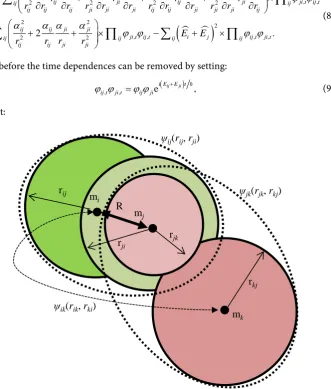
The last expression is, as different from earlier, a mixed sum of the momenta. This representation is a consequence of the fact that the particles have been treated only in pairs and that spherical symmetry remains to be adopted. Referring to Figure 1 the to-tal relativistic Dirac equation for an undefined number of pairs (ij) is set up. There are
particles which make a total of = N!/(2(N − 2)!) pairs, each of which are described by a wave function as a solution of the initial Schrödinger equation. As before the α-values accommodate all necessary multiplication constants. Adding up for all pairs and treating them as mutually independent and taking into account the basic rules of quantum mechanics, lead to:
(
)
2 2 2 2 2 2
, ,
2 2 2 2
2 2
, ,
2
, ,
2 2
1 1 1 1
2 .
ij ji ij ji ij ji t ij t ij ij ji ji ij ji ji ij
ij ji ij ji
ij ij ji ji
ji t ij t i j ij t ji t
ij ij
ij j ij
i
j i
j i
i j
j i
c r r r r
r r r r r r r r
r r r r
E E
r r
r r
ϕ ϕ
α α α α
ϕ ϕ ϕ ϕ
∂ ∂ ∂ ∂ ∂ ∂ ∂ ∂
+ + + ×
∂ ∂ ∂ ∂ ∂ ∂ ∂ ∂
= + + −
× + ×
∏
∑
∑
∏
∑
∏
(8)
As before the time dependences can be removed by setting: ( )
, , e ,
ij ji i E E t ij t ji t ij ji ϕ ϕ ϕ ϕ +
= (9)
[image:5.595.217.549.295.685.2]so that:
Figure 1. Forming and describing of =N! 2(N−2 !) pairs.
mi
mk rij
rkj
ψij(rij, rji)
ψjk(rjk,rkj)
ψik(rik,rki)
rji rjk mj
1823
(
)
,(
)
2 , 2 .i j ij t ji t ij ji ij ji ij E +E ϕ ϕ = ij E +E ϕ ϕ
∑
∑
(10)If all α's would have been equal to zero, a propagating wave ϕ ϕij t, ji t, extending in the
radial direction with the light velocity would have resulted. Non zero values of 𝛼𝛼 re-duce this speed and, as a consequence, give mass to the field ϕ ϕij t, ji t, . The proposed
solution will be:
c ij
ij ij ijr
α
ϕ =γ
, (11) which is inserted into:
(
)
2 2 2 2 2
2 2 2 2
2 2
2 2
2
2 1 1 1 1
2 .
ij ji ij ji
ij
ij ji ij ji ij ji
ij
ij ij ji ji ij ji ji ij
ij ji ij ji
ij ij ji ij ji ij ji ij ij ji ij j ij i ij c E E
r r r r
r r r r r r r r
r r r r
r r
r r
ϕ ϕ
ϕ ϕ
α α α α
ϕ ϕ ∂ ∂ ∂ ∂ ∂ ∂ ∂ ∂ + + + ∂ ∂ ∂ ∂ ∂ ∂ ∂ ∂ = + + + × + × ×
∏
∏
∑
∑
∑
∏
(12)From the boundary condition that ϕij
(
rji,αij)
=0 for rji to infinity a fifthcondi-tion on the α's can be derived:
e) αij is negative under all circumstances.
Putting all five conditions on αij together we can already conclude that the explicit
expression for it is:
f)
(
)
2nij ji m mi j
α =α = −σ′ with n equal to 1, 2 etc.
Now, some algebra needs to be done, but in order to redistribute the various contri-butions it is easiest to start from the simplified equation:
(
)
22 2
2
2
2
2 2 2
2 2
2 .
ij ij ji ji ij ji ij ji ji ij ij ji
ij ji ji ij ij ji
ij ji ij ji
ji ij ji ij
ij ji ij ji
E E E E
r r r r r r
c r r c r r
ϕ ϕ ϕ ϕ ϕ ϕ ϕ ϕ
α α α α
ϕ ϕ ϕ ϕ
∂ ∂ ∂ + + + + + ∂ ∂ ∂ ∂ + + = (13)
with the solution proposed in Equation (11) it can immediately be seen that the sixth term in the first line is equal to the right hand side.
At this point a remark has to be made: removing the term 2 2 kl rkl
α means that some basic interaction occurs between the gravitational field and the particle. Obviously, for this separate term, a Dirac equation can be formulated that shows that an entity with some relativistically derived mass operates and leaves behind a contribution to the in-teraction energy in the Equation (13). So already at this point there is direct inin-teraction between the pair and the field around. Also removing the sixth term left together with the only remaining term at the right means that there is third interaction between the fields and the pair.
1824
(
2 2)
2 2
2 2 2
0 2
.
2
ij ij ji ji ij ji ij ji ji ij
ij ji ji ij
ij ji ji ij ij ji
E E E E
r r r r
c
r r
c
ϕ ϕ ϕ ϕ ϕ ϕ
α α ϕ ϕ
∂ ∂
+ + + +
∂ ∂
+ +
=
(14)
The contributions can now be redistributed, but first multiply all terms by r rij ji and
observe that the proposed solution is the only one that gives a sharp value for the quan-tity E rij ij and E rji ji:
(
2)
2 ji 0,ij ji ij ij ji ji ij ij ji ij ij ji ij ij ji ij r
E r r E E r r c c
r ϕ ϕ α ϕ ϕ α ϕ ϕ
+ + + = (15a)
(
2)
2 ij 0.
ji ji ij ij ji ji ij ij ji ji ij ji ji ij ji ji r
E r r E E r r c c
r ϕ ϕ α ϕ ϕ α ϕ ϕ
+ + + = (15b)
Cutting the Equation (14) into two separate ones as given in Equations (15a) and (15b) looks like arbitrary, as any cut between terms can be made, but if we now come back to the original suggestion as made in f), we a see that the gravitational interaction becomes symmetric. The gravitational energy of particle i is equal to the gravitational energy of particle j. It also reflects the point that a pair has to be seen as one entity. The observer cannot distinguish between the separate members of the pair.
It is also important to notice that the operators Ek and rl commute. It means that
“Er” is the quantity that has a sharp value, meaning that E has a sharp value if r is well defined.
4. Law of Gravity
Most important for finding out how the members of a pair see each other is to look at the Equations (15a) and (15b) by an observer on mi who sees the particle mj at a
dis-tance of rij and an observer on particle mj looking at mi from a distance rji. Both see each
other from the same distance rij=rji=R and they already know that αij =αji = −α′.
There are no operators anymore in Equation (15), and they can conclude that
ij ji
E =E =E. This is an important conclusion. Obviously an electron and a proton
forming a pair will have mutual interactions which are the same although their masses differ by some factor of about 1800 [7]. The result is a simple relation:
2 2 3 2.
E R = cα′ (16)
The boundary condition is that ϕ ϕij ji goes to zero for r to infinity so that α′ >0,
and because both particles in the pair change their energy by the same amount. It fol-lows for the two members of the ensemble together that:
2ER= 6cα′, (17)
and the gravitational force is given by: 2
2E R constant R .
− ∂ ∂ =
bo-1825
dies in the real world without any interference.
Now it is important to see how pairs consisting of particles of different masses present themselves in α′. As a consequence of Einstein’s law that the rest energy of a
particle is proportional to its mass which is also a direct consequence of the fact that the pairs which gives gravitational interaction are acting as single entities, and in view of Equation (17) we can only conclude that the exponent n in condition f) is equal to one. As a consequence of the result in this equation the attractive force between two par-ticles is proportional to the product of the two interacting masses. It also follows that due to gravitational interaction which carries energy, and for which a separate Dirac equation can be set up, some mass, although not much, is attributed to the pairs.
The final result is:
(
)
6 i j
E= σ′c⋅ m m R (18)
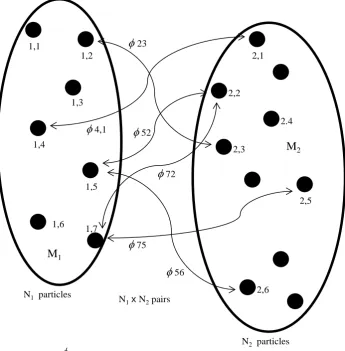
Referring to Figure 2 where two masses M1 and M2 have particles numbered as m1j
and m2k form N1 × N2 pairs described by φkl =ϕ ϕ1k 2l in which each kl-combination
[image:8.595.201.547.327.679.2]contributes separately to the interaction energy. Adding up all the interactions between
Figure 2. Interaction between masses.
M
1M
21,1
1,2
1,5
1,6 1,4
1,3
2,2
2.4
2,3
2,5
2,6 2,1
φ
4,1φ
72φ
75φ
23φ
52φ
561,7
N1 particles
N2 particles N1x N2pairs
1826
particles, which in principle see each other at different distances which is a problem that has already been solved in the formulation of the classical theory of electrostatics [8].
Finally, Newton’s gravitation law is obtained which reads: divg=4πρG in which g is defined as a gravitational field around an entity constituting a space coordinates
dependent mass density ρ. G is the well known gravitational constant equal to: 6.673 ×
10−11 m3∙kg−1∙sec−2.
In accordance with the theory of electrostatics the gravity law can also be given in vector representation for bodies M1 and M2 which have their centres of gravity at a
se-paration of R:
(
3)
12= GM M1 2 R .
F R (19)
From Equations (18) and (19), an explicit expression for the parameter σ′ can be
derived and also, with the help of Equations (11) and (12), the small mass to be attri-buted to the gravitational interaction can be found.
5. Discussion
Without claiming anything about the validity or the consequences of the model pro-posed, a simple straightforward model on the mutual interaction between two particles that influence the surrounding field leads elegantly to the right description of the gravi-tational interaction between two masses.
First, the Schrödinger equation is set up for two particles where the only assumption is that they are there and that the wave equation will have purely spherical symmetry. Surprisingly this is a solution that leads to the forming of pairs, in which only two par-ticles are participating. One particular particle can form pairs with all others present, but each pair has to consist of two individual particles. The pair density probability, given by the wave function, is then used to substitute for the relativistically invariant entity, 2
0
m , in the Dirac equation [1][6]. It has been shown that the Dirac equation can
be taken in the first calculation as well so that the whole analysis would be based on co-variant equations. This would lead to the same form of the probability density, al-though with different constants, but it creates no problems when allocating the mass dependences to the α's.
Replacing the quantities in the Dirac equation by the appropriate operators, and again taking purely spherical symmetry, it is found that a solution is only possible when the interaction energy of the pair is proportional to the inverse of the distance between them. It is important consider that the operators Ek and rl commute. It means that
“Er” is the quantity that has a sharp value, meaning that E has sharp value if r is well defined.
After adding up the effects the appropriate form of the classical Newton gravitation law is found.
The gravitational constant in Newton’s law, G, is expressed by G= 6σ′c in
which the parameter σ′, equal to 2.34 × 10⁴ m/(kg)4, can be seen as a universal
1827
The surprising, and at the same time bizarre, conclusion of the analysis given is that, apparently, each single particle has interaction with all other particles. It means that in the universe an unimaginable number of pair-wise interactions exists with greatly va-rying intensity and extensions and which depend on the masses of the members of the pair. It is difficult to comprehend, but it follows unambiguously from the equations de-scribing the behaviour of the pairs.
An important aspect to mention is the fact that the right hand side in Equation (12) should be invariant under Lorentz transformation. However, the rkl is not. Therefore
the parameters αkl should transform in the same way as rkl, but apparently it would
make left and right hand side in equation 16 transform differently, which cannot be the case. We should however notice that the Planck’s constant, h, is invariant, but
2π
h
=
is not.
Make the following “thought experiment”. Consider a pair flying away from us at a speed v such that the separation vector of the members of the pair is aligned in the di-rection of v. Due to the fact that π transforms just like 1/rkl the result is that the
interac-tion energy of the pair we measure becomes invariant. There is invariance throughout if the alignment is perpendicular to the speed. So the conclusion is that the interaction energy in the pair is invariant and independent of the alignment towards the observer, as it has to be.
Two remarks have to be made about the analysis proposed:
1) Equation (16) allows for both minus and plus signs for the E-values. It means that the force between particles can be negative and positive: repulsive and/or attractive. Apparently nature as we observe it has chosen for the low energy attractive variant. If the opposite would have been taken the universe could not exist.
2) The Equation (3) has singularities for rkl to zero. However, one might take the
0 ij r
α constant below a certain distance (r0) from the particle centre and solve the
Equation (8) for just one single particle and see that, differing from the analysis for pairs, a first order solution emerges and mass (αij r c0 ) is attributed to the particle,
which to some extent is in analogy with superconductivity to explain the Meissner ef-fect [1][9][10].
6. Conclusions
1) Using basic rules of quantum mechanics and relativity and preserving side condi-tions of invariance and co-variance where necessary, Newton’s law on gravity can be derived theoretically. It contains the main factors of mass dependence and distance between particles and bodies in the right way.
2) It has by no means relevance to dark matter or dark energy. But the result allows for both attractive and/or repulsive gravitational interaction. It can be speculated that at certain distance or strength of the interaction it may change sign.
Acknowledgements
1828
publish this study.
Auke Veringa ([email protected]) has been of great help to increase the accessibil-ity of this paper also for non specialists in this field.
References
[1] Ryder, L. (2009) Introduction to General Relativity. Cambridge University Press, Cam-bridge.http://dx.doi.org/10.1017/CBO9780511809033
[2] Heacox, W.D. (2015) The Expanding Universe. Cambridge University Press, Cambridge. [3] Heitler, W. (1945) Elementary Wave Mechanics. Oxford Clarendon Press, Oxford. [4] Ney, E.P. (1965) Electromagnetism and Relativity. Harper &Row, New York.
[5] Messiah, A. (1961) Quantum Mechanics. Vol. 1, North Holland Publishing Company, Am-sterdam.
[6] Messiah, A. (1985) Quanten-Mechanik, Band 2. Walter de Gruyter, Berlin. [7] Greulich, K.O. (2010) JournalofModernPhysics, 1, 300-302.
http://dx.doi.org/10.4236/jmp.2010.15042
[8] Panowsky, W. (1972) Melba Philips: Classical Electricity and Magnetism. Addison Wesley Publishing Company, Boston.
[9] Bardeen, J., Cooper, L.N. and Schrieffer, J.R. (1957) PhysicalReview, 108, 1175.
http://dx.doi.org/10.1103/PhysRev.108.1175
[10] Higgs, P.W. (1964) PhysicsReviewLetters, 12, 132-133.
http://dx.doi.org/10.1016/0031-9163(64)91136-9
Submit or recommend next manuscript to SCIRP and we will provide best service for you:
Accepting pre-submission inquiries through Email, Facebook, LinkedIn, Twitter, etc. A wide selection of journals (inclusive of 9 subjects, more than 200 journals)
Providing 24-hour high-quality service User-friendly online submission system Fair and swift peer-review system
Efficient typesetting and proofreading procedure
Display of the result of downloads and visits, as well as the number of cited articles Maximum dissemination of your research work
Submit your manuscript at: http://papersubmission.scirp.org/