ISSN Online: 2329-3292 ISSN Print: 2329-3284
Research on Constructing Innovation-Driven
Development Evaluation System Based on the
Essential Component of Intellectual Property
Yueping Du, Yilin Wang
School of Economics & Management, Xidian University, Xi’an, China
Abstract
The innovation-driven development strategy based on the essential component of intellectual property is an important strategy in the new period of China. Based on the understanding of generalized innovation and the model of input-output, the ar-ticle analyzes the support for innovation-driven development of intellectual property, and from three aspects of intellectual property: investment, conversion and output, starting to build a model of three first-level indicators and twenty-four secondary in-dicators to evaluate the innovation-driven economic development based on the es-sential component of intellectual property.
Keywords
Intellectual Property, Innovation-Driven, Economic Development, Evaluation System
1. Introduction
Since the reform and opening-up, economy of China developed rapidly, and the growth of GDP remained high; however, the shortage of resources and environmental pollu-tion is unavoidable. The enormous pressure of environment requires us to rethink the mode of economic development. We should change the way of promoting economic growth gradually from “factor-driven”, “investment-driven” to “innovation-driven”. The 18th National Congress of the Communist Party of China clearly indicated that we should play the important role fully of technological innovation in economic growth to change the mode of economic development, and emphasized the implementation of innovation-driven development strategy. The Third Plenary Session of the 18th CPC Central Committee clearly indicated once again that it is necessary to strengthen the application and protection of intellectual property rights in order to deepen the reform of the science and technology system. Intellectual property is the product of modern How to cite this paper: Du, Y.P. and
Wang, Y.L. (2017) Research on Construct-ing Innovation-Driven Development Eval-uation System Based on the Essential Component of Intellectual Property. Open Journal of Business and Management, 5, 149-158.
http://dx.doi.org/10.4236/ojbm.2017.51014
Received: December 10, 2016 Accepted: January 10, 2017 Published: January 13, 2017
Copyright © 2017 by authors and Scientific Research Publishing Inc. This work is licensed under the Creative Commons Attribution International License (CC BY 4.0).
commodity economy and the development of science and technology. As one of the law-protected innovations, intellectual property is playing an important role in eco-nomic growth. “The state council’s several opinions on accelerating the construction of the power of intellectual property rights under the new situation” in 2016, pointed out that to improve the development of evaluation system, intellectual property products will be gradually incorporated into the national economic accounting, and intellectual property indicators will be incorporated into the national economic and social devel-opment planning, constructing an innovation-driven develdevel-opment evaluation system based on the essential component of intellectual property. “Opinion” indicated that, intellectual property rights is playing a more and more important role in the growth of the national economy.
Therefore, it is very important to understand and evaluate the regional innovation- driven development based on the essential component of intellectual property, and to establish a comprehensive evaluation index system which emphasizes the outstanding of intellectual property rights. First of all, getting a clear understanding of the concept of innovation-driven development is very important, then we explored the supporting mechanism of intellectual property on innovation-driven development and finally built a prominent role of intellectual property in the comprehensive evaluation index system. Therefore, this article mainly researches the intellectual property evaluation indexes to construct evaluation system of innovation-driven development. This is a new explora-tion of the theory and practice of innovaexplora-tion-driven development, which also possesses practical significance to promote regional economic development.
2. Literature Review on Evaluation of Innovation-Driven
Development
In abroad, the EU Innovation Policy Research Center developed a European Innovation Scoreboard, which is currently considered as the most representative of the mature In-novation Evaluation System. The Main Index System of EIS is reflected in five aspects, the innovation-driven, knowledge creation, innovation, technology and intellectual property. Since then, the EU has launched the “Global Innovation Scoreboard” and “Innovative Union Scoreboard”, to improve Innovation evaluation system further.
per-formance, also evaluated and compared the innovation-driven capability of China’s 31 provinces by principal component analysis method [3]. Yin, M. J. (2015) based on the connotation of innovation-driven development and the ideas of input-output, built the evaluation model of provincial innovation-driven development, which used the GDP index to measure the volume and level of economic development, and used the sales revenue of new product, number of admissibility for three types of patent applications and transaction amount of technology market to measure the level of the regional technology innovation [4]. In accordance with the “Impact-Effect-output-input” idea, Hu, C. P. (2016) established the innovative evaluation system of Shaanxi Province, in-cluding 4 first-level indicators (impact indicators, effect indicators, output indicators, input indicators), 11 secondary indicators and 38 third-level indicators [5]. Li, Q. (2016) compared the status of input and output based on provincial innovation-driven development, and built an evaluation system of the innovation-driven development of the provincial area. This evaluation system comprises 6 first-level indicators (social de-velopment, R & D resources, market efficiency, economic industry, research, technical support), 17 secondary indicators and 37 third-level indicators. She made a compara-tive study of innovation-driven development in Jiangsu, Beijing, Shanghai, Zhejiang and Guangdong Provinces [6].
This shows that there isn’t a unified index system for the evaluation of innova-tion-driven development in China. Most researchers start from the macroscopic point of view and comprehensively evaluate the process of innovation-driven development. The evaluation index covers a wide range, but due to that many indicators cannot be quantified, the process is too dependent on qualitative and subjective methods.
Based on the idea of input-output, this paper builds up the evaluation index system around the process, creatively constructs innovation-driven development evaluation system based on the essential component of intellectual property in our country. In this research, we will focus on the intellectual property right, and emphasize the role of in-tellectual property right in the innovation-driven development.
3. The Support Mechanism Analysis of IP on
Innovation-Driven Development
Tian, L.P. (2013) pointed out that the implementation of innovation-driven develop-ment strategy and accelerate the economic developdevelop-ment pattern is the same strain [7]. To realize the transformation from element-driven to innovation-driven, we must promote intellectual property as the growth factor, stimulate innovation vitality and promote the application of innovation results, so as to truly promote the promotion of economic development. Based on the theory of new economic growth, which reveals that the main source of economic growth is knowledge innovation and technological progress, and the direct goal of intellectual property rights is to stimulate intellectual property innovation and technological progress.
believes that innovation is the essence of economic development and emphasizes the important role of innovation in the development process. Zhang, L.W. (2013) consi-dered that the innovation solved two basic problems of the economic development: First, the problem of diminishing returns factor of production, the second is about the bottleneck problem of scarce resources [8]. This is because that the innovation is a change which brings a new combination of production factors into the production sys-tem, it will inevitably break the original track of economic development, thereby solv-ing the above two problems. Therefore, we can clearly know that innovation is the driving force of economic development. So what is the source of innovation? Intellec-tual Property Office Shen, Y.C. (2014) said that “innovation-driven development has two important issues, first of all is the question about the source for innovation, the second is the question about the final one kilometer innovation achievements into practical productivity conversion. Both of them are closely related to intellectual prop-erty rights In a sense, intellectual propprop-erty rights is the source of innovation, the sup-port of innovation-driven development, and also the connection between the innova-tion and the market. Besides, it is a very important link to achieve the goal from strong technology to strong industry and then to the strong economy” [9]. We believe that the broad innovation contains many aspects, such as knowledge and technology innova-tion, management innovainnova-tion, system innovation and so on. The intellectual property is the most important content in knowledge and technology innovation. It refers to the exclusive right enjoyed by the right holder in the intellectual work. As a result, intellec-tual property rights owns an incentive mechanism, which protects owners’ rights and interests, stimulates the continuous innovation activities, and drives economic growth further .
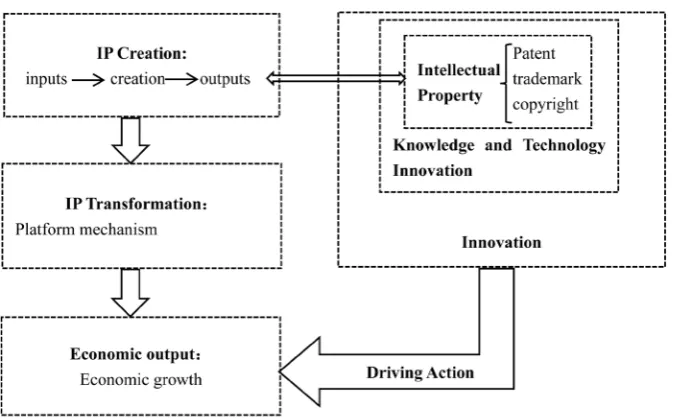
whether the intellectual property rights can become the real productive forces. In the output link, because of the wide range of factors that the economic development in-volves, not only contains changes in factors of production inputs, but also contains the power, quality, environment and other factors of development, which is not conducive to quantitative statistics, so we only focus on the direct economic output, which gives us a more intuitive observation of the change of numbers in output as a result of the increase of input.
For the support mechanism analysis of IP on innovation-driven development, we can use Figure 1 to represent. Innovation-driven development emphasizes that develop-ment depends on innovation to drive. It’s reflected in the contribution of innovation to economic development. The innovation-driven development evaluation system based on the essential component of intellectual property is mainly to measure the contribu-tion of intellectual property to economic development. Therefore, the essence of the research we are investigating is the role of intellectual property in innovation-driven economic growth.
4. The Constructing Principles of Innovation-Driven
Development Evaluation System Based on the
Essential Component of Intellectual Property
4.1. Scientific Principles [image:5.595.206.544.507.716.2]The evaluation system should be able to effectively reflect the role of intellectual prop-erty rights in the innovation-driven development. The evaluation indicators should be set according to the mechanism of intellectual property rights and economic growth, fully reflect the input, transformation and output and highlight the focus with making a comprehensive coverage. In the process of determining the comprehensive evaluation index, a high level of field experts should be involved to ensure that each indicator has its overall representativeness. Only quantitative indicators that can be measured should be selected, to eliminate the strong subjectively qualitative indicators and ensure the
establishment of evaluation indexes being scientific, authoritative. At the same time, we should also use scientific evaluation methods, standardized evaluation procedures to ensure the objectivity of the evaluation during the evaluation process.
4.2. Object-Oriented Principles
The purpose of this research is to evaluate the level of regional economic growth driven by intellectual property rights of the innovation, to raise a new perspective which is dif-ferent from the previous researches. With the advent of the knowledge economy, the work of IPR has become a necessary requirement to improve the core competitiveness of the region. The evaluation model to be constructed in this article can not only guide the government to carry out IPR evaluation, but also clarify the future development di-rection and the focus of work, the most important thing is to be able to improve the output of intellectual property rights further, and smooth the transformation of intel-lectual property operation channels, so as to promote regional economic growth and enhance the inherent driving force for regional development.
4.3. Independence Principles
In the evaluation system, the internal indicators should be distinct, and the evaluation indexes at the same level should be independent from each other, so as to avoid the overlapping of the indexes. Based on the input-output idea, according to the process of the interaction between intellectual property rights and economic growth, this research will be divided into three parts: input, transformation and output, and the three links are independent from each other. Three links within the target design, should also mi-nimize the correlation between the indicators, to avoid cross-items.
4.4. Operability Principles
The meaning of each evaluation index should be clear. The indicators data can be ob-tained through the National Statistical Yearbook or the official release of the data, no direct data indicators should be easy to calculate through the available method to en-sure the authority of the data. At the same time, each evaluation index should be able to carry out comparative analysis of horizontal and vertical, not only different indicators can be compared, but also the data of the same indicator from different time can be compared. It can not only make a comparative analysis of the contribution of intellec-tual property rights to economic growth in different regions, but also make a dynamic comparison of the evaluation results of different time in the same region. So as to com-prehensively evaluate the role of intellectual property rights in economic growth from a historical and realistic perspective. In addition, a reasonable control of the size of the index system is necessary, to avoid the formation of a too large target group or a indi-cator system involving too complex level.
5. Construction of Innovation-Driven Development
Evaluation System Based on the Essential Component
of Intellectual Property
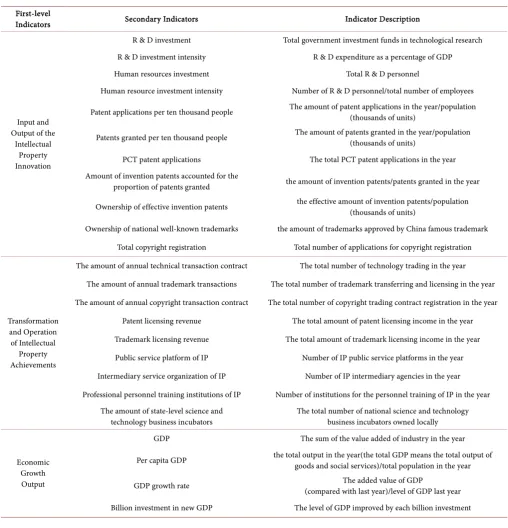
rights on innovation-driven development, we followed the principles of the index sys-tem construction and consulted a number of experts’ advice, then established the inno-vation-driven development evaluation system based on the essential component of in-tellectual property which consists of 3 first-level indicators and 24 secondary indicators. The evaluation system mainly reflects the following three aspects: Firstly, investment and output of intellectual property innovation; Secondly, the transformation and oper-ation of intellectual property rights; Thirdly, output of economic growth (Specific Index System Table 1).
Table 1. Innovation-driven development evaluation system based on the essential component of IP.
First-level
Indicators Secondary Indicators Indicator Description
Input and Output of the
Intellectual Property Innovation
R & D investment Total government investment funds in technological research R & D investment intensity R & D expenditure as a percentage of GDP Human resources investment Total R & D personnel
Human resource investment intensity Number of R & D personnel/total number of employees
Patent applications per ten thousand people The amount of patent applications in the year/population (thousands of units)
Patents granted per ten thousand people The amount of patents granted in the year/population (thousands of units)
PCT patent applications The total PCT patent applications in the year Amount of invention patents accounted for the
proportion of patents granted the amount of invention patents/patents granted in the year
Ownership of effective invention patents the effective amount of invention patents/population (thousands of units)
Ownership of national well-known trademarks the amount of trademarks approved by China famous trademark
Total copyright registration Total number of applications for copyright registration
Transformation and Operation
of Intellectual Property Achievements
The amount of annual technical transaction contract The total number of technology trading in the year
The amount of annual trademark transactions The total number of trademark transferring and licensing in the year
The amount of annual copyright transaction contract The total number of copyright trading contract registration in the year
Patent licensing revenue The total amount of patent licensing income in the year
Trademark licensing revenue The total amount of trademark licensing income in the year
Public service platform of IP Number of IP public service platforms in the year
Intermediary service organization of IP Number of IP intermediary agencies in the year
Professional personnel training institutions of IP Number of institutions for the personnel training of IP in the year The amount of state-level science and
technology business incubators The total number of national science and technology business incubators owned locally
Economic Growth Output
GDP The sum of the value added of industry in the year
Per capita GDP the total output in the year(the total GDP means the total output of goods and social services)/total population in the year
GDP growth rate The added value of GDP
5.1. Input and Output Indicators of the Intellectual Property Innovation Input and output indicators of IP innovation reflect the regional ability of IP creation, including 11 secondary indicators.
From the perspective of investment in R & D funding, we set two indicators, “R & D investment”, “R & D investment intensity” that reflect the financial resources invest-ment conditions of IP creation in the area, and use the R & D funding which accounted for the highest in the investment instead of all the funds invested. During the IP crea-tion process, not only material inputs are needed, but also the human resource input. In this research, from the perspective of personnel investment, we set the “human re-sources investment”, “human rere-sources investment intensity” two indicators to reflect the input of intellectual property investment in human resources.
For the measurement of IPR outcomes, we start from researching the three main categories of IPR: patents, trademarks and copyrights. This article sets five indicators to reflect the regional outcome level of the patent, “Patent applications per ten thousand people”, “Patents granted per ten thousand people” and “PCT patent applications” re-flect the number of regional IP output, in which “PCT patent applications” refers to the applicant for a patent in China may file an international patent application or apply for a patent to a number of countries through PCT (Patent cooperation Treaty). Speaking of patents, according to the “Patent Law” which provides that China’s patents are di-vided into three types, invention patents, utility model patents and design patents. The invention patents are generally regarded as the highest content of science and technol-ogy and the most valuable type of patent. Therefore, it is necessary to inspect the de-velopment of invention patent. Meanwhile, “patent law” states that term of the inven-tion patent is 20 years from the date of filing. But in reality, not all the patents can be protected until the expiration of the term, part of the patent will early lose the legal ef-fect because of the applicant voluntarily giving up. Thus, the number of valid invention patents is more being able to reflect the actual possession of the right of patent appli-cant than the number of invention patents. According to this, this article sets up the index of “Amount of invention patents accounted for the proportion of patents granted” and “Ownership of Effective Invention Patents” to examine the quality of in-tellectual property output.
In addition to the patents, intellectual property rights also include two main con-tents, trademarks and copyrights. We set two indicators “Ownership of National well-known trademarks” and “Total copyright registration”. As the well-known trade-mark is the most valuable tradetrade-mark and owns the highest quality, so we choose the amount of well-known trademarks to reflect the level of regional trademark develop-ment. The number of copyright registration reflects the active degree of cultural and ar-tistic creation of citizens and legal persons, as well as the protection of intellectual property rights, and intuitively reflects the development of copyright in a region.
From the aspects of intellectual property rights market trading volume, we set up three indicators, “The amount of annual technical transaction contract”, “The amount of annual trademark transactions” and “The amount of annual copyright transaction contract”, respectively reflect the transformation of intellectual property rights from the technology, trademarks and copyrights, showing the active degree of intellectual prop-erty transactions.
From the aspect of the quantity of intellectual property rights, based on the data availability, we set up two indicators, “Patent licensing revenue” and “Trademark li-censing revenue”, the patent lili-censing revenue reflects the technology transactions of the universities, research institutes and non-service inventors, while trademark licens-ing revenue reflects the development of the enterprise operatlicens-ing brand assets.
From the aspect of subject of intellectual property transformation, we set up four in-dicators, “Public Service Platform of IP”, “Intermediary Service Organization of IP”, “Professional personnel training institutions of IP” and “The amount of State-level Science and Technology Business Incubators”. The intermediary services of intellectual property rights reflect the development of intellectual property intermediary service on the one hand and the maturity of the intellectual property economy on the other hand.
5.3. Output Index of Economic Growth
Output indicators of economic growth reflect a country or a region’s ability to produce goods and services. A country or a region’s economic growth is a result of the com-bined action of multiple factors. In the study of the reasons for promoting economic growth cannot exhaust all the elements, as the focus of this study is from a focal point to dig the contribution of intellectual property to economic growth effect.
There are many indicators about economic growth, the indicator system selecting different research angles will be different. Based on data availability, from a macro point of view, we select four indicators, “GDP”, “Per Capita GDP”, “GDP growth rate” and “Billion investment in new GDP”, to fully reflect the level of regional economic growth.
6. Conclusions
Based on the implementation of intellectual property rights as an important part of in-novation-driven development strategy, according to the input-output idea, this article builds a regional evaluation system of innovation-driven development from three as-pects (intellectual property rights, transformation and economic growth), which in-clude 3 first-level indicators and 24 secondary indicators. The index is objective, con-crete and practical, which reflects and highlights the role of intellectual property rights in economic development, and consummates the research on the theory of innova-tion-driven development evaluation system.
innova-tion-driven development of the provinces or cities.
In the future, we will select the typical provinces or cities to carry out empirical anal-ysis, to reveal the important role of intellectual property rights in promoting the mode change of the economic development and advancing economic growth with scientific data. Constantly improving the model in practice, we will promote the implementation of the innovation-driven development strategy and make recommendations for the government.
References
[1] Wu, Y. and Li, W.J. (2014) Innovation-Driven Development Evaluation System. Opening
Herald, 4, 88-92.
[2] Wei, Y.P. and Jia, Z.H. (2014) Evaluation Studies of innovation-Driven Elements Of Inno-vative City. Science and Technology Management Research, 19, 1-5.
[3] Wang, W. (2015) Regional Differences in China’s Economic Growth Driven by Innovation.
Journal of Northwest University (Philosophy and Social Sciences), 45, 133-137.
[4] Yin, M.J. (2015) Research on the Evaluation of the Provincial Administrative Region Inno-vation-Driven Development. Industrial Technology & Economy, 12, 71-77.
[5] Hu, C.P., Li, W.H. and Wang, X.H. (2016) Innovative Province Evaluation-The Case of Shanxi. Science and Technology and Economy, 29, 26-30.
[6] Li, Q. and Xia, H.L. (2016) The Comparative Study of the Implementation of Innova-tion-Driven Development in Jiangsu and Beijing, Shanghai, Zhejiang, Guangdong. Suzhou
University of Science and Technology (Social Science Edition), 33, 27-32.
[7] Tian, L.P. (2016) Thoroughly Implement the Strategy of Intellectual Property, Effectively Support the Innovation Driven Development. Technology and Law, 103, 72-74.
[8] Zhang, L.W. (2013) Research on the Innovation-Driven Development. China Soft Science, 1, 1-5.
[9] Shen, C.Y. (2014) Intellectual Property Drives the INNOVATION development and Sup-ports the Development of New Economic.
http://finance.cnr.cn/zt/jjnh/ycbd/20141221/t20141221_517170332.shtml
Submit or recommend next manuscript to SCIRP and we will provide best service for you:
Accepting pre-submission inquiries through Email, Facebook, LinkedIn, Twitter, etc. A wide selection of journals (inclusive of 9 subjects, more than 200 journals)
Providing 24-hour high-quality service User-friendly online submission system Fair and swift peer-review system
Efficient typesetting and proofreading procedure
Display of the result of downloads and visits, as well as the number of cited articles Maximum dissemination of your research work