Munich Personal RePEc Archive
A note on the empirical test of herding:
a threshold regression approach
Saumitra, Bhaduri
Madras School of Economics, Chennai, India
11 April 2012
Online at
https://mpra.ub.uni-muenchen.de/38037/
A Note on the Empirical Test of Herding: A Threshold Regression
Approach
Abstract:
The paper aims at investigating herding behaviour in equity market by applying an alternative econometric methodology. The paper applies the threshold test developed by Hansen [2000] to standard herding model in order to capture a non-linear effect of extreme market movement on the trading behaviour of the participants. Using the econometric model with threshold effect, the paper finds little evidence for market-wide herding for the Indian equity market. Even in the extreme market conditions, participants appear to discriminate between different securities, as predicted by the rational asset pricing paradigm.
1. Introduction:
Over the years, it has become a major challenge to academics as well as practitioners to
understand the behavior of market participants. The Efficient Market Theory assumes
that investors form rational expectations of future prices and discount all market
information into expected prices in the same way. However, these rationality assumptions
underpinning the efficient market hypothesis are often challenged in reality as the
observed stock returns display “herd behaviour” in many markets. The herding behavior
describes a group of individuals who act to imitate the decisions of others or market
without paying any attention to their own belief or information. Consequently, prices tend
to deviate from fundamental value, thus affecting the risk and return characteristics of
stock returns.
There is a growing body of work that has examined the herding behavior across
different contexts. The theoretical models of herding behavior have been developed by
Bhikchandani and Sharma (1992), Scharfstein and Stein (1990) and Devenow and Welch
(1996). While the empirical studies have focused on testing herding in various
circumstances including cross country and cross market studies, Chan, Cheng and
Khornana (2000), analyzed the herding behaviour in the stock markets in the US, Hong
strong herding behaviour for their sample. In a more country specific studies Hwang and
Salmon (2004) and Demirer and Kutan (2006), examined the herding behaviour in the
stock markets of South Korea and China, respectively. Herding behaviour has also been
examined in other markets which include study by Gleason, Mathur and Peterson (2004)
for exchange traded funds and future markets, while Weiner and Green (2004) for
herding in heating oil and crude oil futures markets. Wermers, (1999) have tested the
existence of herding behavior among mutual fund managers.
Barring a few exception, most of the empirical models of herding are based on
Christie and Huang (1995) (hereafter referred to as CH) and Chang et al. (2000)
(hereafter referred to as CCK) model which uses the cross sectional standard deviation
(CSSD) and cross sectional absolute standard deviation (CSAD) across stock returns as a
measure of average proximity of individual returns to the realized market return1. CH and CCK focus their analysis of herding for periods of extreme market movements, as they
argue that traders are more likely to herd at times of heightened uncertainty and extreme
market turbulence.2,3
1
Hwang and Salmon (2004) have used other measure of herding such as cross‐sectional dispersion of the factor sensitivity of assets within a given market.
2
However, herd behavior may be present when markets are quiet, because during these times the role of the market portfolio may be replaced by other factors that serve as herding objectives (Hwang and Salmon, 2004).
3
The cross‐sectional standard deviation (CSSD) is expressed as:
2 , , 1 ( ) ( 1) N
i t m t i t R R CSSD N = − = −
∑
While the cross‐sectional absolute deviation is expressed as:
1 , ,
1 N t i t
i
CSAD R R
N =
=
∑
− m t
N is the no. of firms in the portfolio.Ri t, Is the observed stock return of firm i at time t. Rm t, Is the cross‐
Most of the empirical models of herding use the rational asset- pricing model
(CAPM) to arrive at a test for herding under extreme market conditions, where herding is
defined as traders ignoring their private assessment of individual assets and following the
trend of the overall market. Thus, if herding occurs, individual returns will converge to
the aggregate market return, resulting in decreased dispersion of individual returns from
the market return4.
Therefore, empirically, herding is tested during the trading intervals characterized
by large swings in average prices, in which a lower than expected level of cross sectional
variation would indicate herding. Though the theoretical model provides robust
conclusions, most of the empirical models of herding suffer from the subjectivity
involved in defining the extreme market movements. Therefore, the goal of this paper is
to address this limitation by applying a new econometric methodology. The paper applies
the recent threshold regression method developed by Hansen [2000] to standard CSAD
regressions, to capture a non-linear effect of extreme market movement on the herding
behaviour. To our knowledge, this is the first paper that intends to test herding with
Hansen’s test.
The remainder of the paper is organized as follows: Section two presents the
methodology proposed in the paper to test the herding behaviour in the stock market.
Section 3 describes the data while section 4 reports the empirical results .Section five
concludes the paper.
2. The Empirical model and testing procedure:
4
Further, the findings of Nofsinger and Sias (2002) indicate that institutions herd together and trade with the momentum of the market on days when there are large movements in the aggregate market. Goetzman (1995) expands on this result when he describes investor behavior during market fads and crashes. According to Goetzman (1995), a fad occurs when stock prices are apparently moving together to a greater extent than normal, stock returns are going up, and the whole market is going up. During a fad, the cross‐sectional variation would be expected to be low. Goetzman (1995) argues that this reduced
variation would also be expected with investor mass pessimism, for instance, during a panic or crash. In
markets not marked by either euphoria or mass pessimism the cross sectional variation would be expected to be higher.
Rational asset- pricing models and herding behavior propose distinct predictions
regarding the behavior of the cross-sectional standard deviation of returns during periods
of markets stress. Rational asset- pricing models predict that during extreme market
movements, large changes in the absolute value of the market return translate into an
increase in dispersion due to the differing sensitivities of individual securities to the
market return. The existence of market wide herding behavior, in contrast, dictates that
dispersions would be relatively low in presence of large market movements.
Conventionally, the test for herding, or alternatively for rational asset pricing, uses the
following empirical specification:
t U t U t L t L
t D D
CSSD =α +β +β +ε
where the CSSD is cross-sectional standard deviation at time t, and is defined as
∑
= − − = n i mt itt r r
n CSSD 1 2 ) ( 1 1
and DL=1 if the market return on day t lies in the extreme lower tail of the distribution and zero otherwise; DU=1 if the market return on day t lies in the extreme upper tail of the return distribution and zero otherwise. The dummy variables act to
capture differences in investor behavior during extreme up or down versus relatively
normal markets. Therefore, the significantly negative coefficients would indicate herd
behaviour. Typically extreme market movements are defined arbitrarily as consisting of
the lower and higher 1%, 2% and 5% tails of the market distribution.
However, to avoid the subjective definition of extreme behaviour and also to
account for non-normality of returns and the fat tails of return distributions that affect
standard deviation metrics more than they affect absolute deviation measures, CCK
proposes an alternate model to identify herding. The CCK model predicts that market
participants are more likely to herd during market stress, as characterized by periods of
large price movements. Thus, one would expect a less than proportional increase in
CSADt for extreme values of return (Rmt).
t mt mt
t R R
The coefficient γ2 captures the non-linear relationship that may exist between CSADt and
Rmt.
The primary objective of the paper is to apply a new econometric methodology to test
herding behaviour in the equity market in order to investigate the effects of the
non-linearity. We shall apply the recent threshold regression method developed by Hansen
[2000] to standard CSAD regressions, in order to capture a non-linear effect of extreme
market movement on the herding behaviour. The threshold model allows splitting up of
the sample into different regimes and tests the herding for each of these regimes
respectively. Further, this empirical model also helps to test the assumption that herding
may also occur during normal market movements5. Finally, the paper also tests herding in relatively extreme up-market and down-markets conditions, where the down-market
(up-market) is defined as comprising all observations for which the return is less than zero
(greater than zero). This specification allows us to capture potential asymmetries in the
herding behaviour without confining our search to the extreme tails of the distribution.
The paper applies the test advocated by Hansen [2000] to assess the null hypothesis of a
linear regression against a threshold regression (TR) analysis. The threshold models have
a wide variety of applications in economics. Direct applications include models of
separating and multiple equilibria. Other applications include empirical sample splitting
when the sample split is based on a continuously-distributed variable.
An empirical TR model to test herding behaviour is given by:
) 2 ( | | ) 1 ( | | ' 2 ' 1 γ β γ β > + = ≤ + = t t mt t t t mt t q u R CSAD q u R CSAD
Where CSADt and qt are the dependent variable and the threshold variable, while |Rmt | is
the independent variable capturing the absolute market return. The threshold variable,
5
which is |Rmt| in our model, is used to split up the sample into two groups called
"regimes". The model allows the regression parameters to differ depending on the value
of q. The random variableut is a regression error.
The model (1)-(2) can be written in a single equation form with the introduction of the
dummy variable dt=I (|Rmt|≤γ) where I (
.
) denotes the indicator function. If we set thevariable |Rmt(γ)|=|Rmt|.dt, then equations (1)-(2) are equal to
) 3 ( |
) ( | | |
'
t mt
mt
t R R u
CSAD =β +θ γ +
where β=β2 and θ =β1-β2.
Equation (3) allows all regression parameters to differ between the two regimes. Hansen
[2000] develops an algorithm based on a sequential OLS estimation which searches over
all values γ=q{t} t=1,...,T. The procedure also provides estimates of β and θ. The null
hypothesis of rational asset- pricing model is captured as β1>β2>0 against the alternative
of herding behaviour as β2 <β1. Hansen [2000] proposes a heteroskedasticity-consistent
F-test bootstrap procedure to F-test the null of linearity. Since the threshold value is not
identified under the null, the p-values are computed by a fixed bootstrap method. The
independent variables are supposed to be fixed, and the dependent variable is generated
by a bootstrap from the distribution N(0, et)) where et is the OLS residual from the
estimated threshold model. Hansen [2000] shows this procedure yields asymptotically
correct p-values. Therefore, if the hypothesis of linearity is rejected with β1=β2, one can
split the original sample according to the estimated threshold value and further test for
herding using the restriction β2 < β1 .
3. Data and Sample
Christie and Huang (1995) argued that the herding behavior is often a short-term
phenomenon and can only be captured with a high frequency data. Further, Tan et al
(2008) while analyzing herding behavior in the Chinese stock market also concluded that
data. Therefore, following the existing literature the paper uses daily stock price data to
test herding behaviour in the Indian equity market. The non availability of inert-day data
has constrained us to use the data with next highest frequency i.e. the daily data.
The daily data on stock prices, market capitalization for all firms listed on BSE-500 has
been collected over the period from January 1, 2003 to 31 March, 2008, constituting 1301
observations6.
Since, there have been new firms included in BSE-500 in the sample period for which
only partial data was available; we have considered a consistent set of firms in our
analysis leading to a balanced sample of 349 firms. The data is obtained from Capitaline
database. The stock return for all firms is calculated asRt =100*(log( ) log(Pt − Pt−1)).
Table 1 contains summary statistics for average daily return for BSE 349 companies. In
2008, the mean value of average daily return is in negative and has a higher standard
deviation which confirms the then turbulence in the Indian Market. The minimum
average daily return for the total sample (-5.101%) also occurs on 21st January 2008. The
second lowest minimum average daily return (-4.734) was on 17th May 2004 when
SENSEX slumped by 842 points due to political uncertainty in domestic market as
National Democratic Alliance government went out of power. The average daily return
for the entire sample is 0.06% with a characteristic negative skewness observed in the
return data.
4. Empirical Results:
Table 2 shows the results of global OLS regressions of standard CSAD model and test for
a threshold effect. Using 1000 bootstrap replications, the p-value for the threshold model
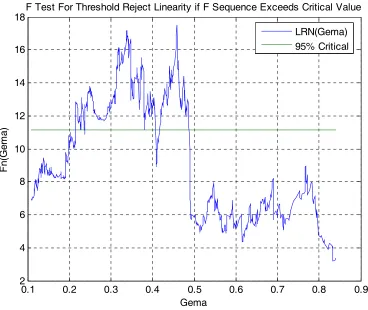
using |Rmt| is significant at 0.001 suggesting a possible sample split based on |Rmt|. Figure
1 displays a graph of the normalized likelihood ratio sequence LR*(n) as a function of the
threshold. The LS estimate of γ is the value that minimizes this graph, which occurs at
6
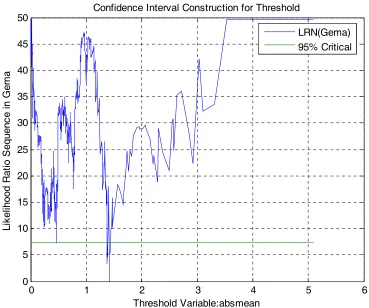
1.413%. The 95% critical value is also plotted in Figure 2 and the asymptotic 95%
confidence interval can be considered as between 0.458% and 1.433% from the graph
where LR*(n) crosses the dotted line. Therefore, the results show that there are
reasonable evidences for a two-regime and nonlinear effect in CSAD7.
Observations Mean Standard
Deviation
Minimum Maximum Skewness
2003 253 0.152 0.582 -1.626 1.822 -0.289
2004 254 0.057 0.763 -4.734 2.635 -1.662
2005 251 0.092 0.499 -2.355 1.475 -0.969
2006 250 0.050 0.709 -3.311 2.305 -1.361
2007 249 0.083 0.556 -2.207 1.591 -1.106
2008 61 -0.314 1.374 -5.101 3.036 -0.575
Total 1317 0.068 0.687 -5.101 3.036 -1.406
Table 1: Summary Statistics: Average Daily Return (BSE 349 companies)
Table 2: Global OLS Estimation, Without Threshold
Dependent Variable (CSAD) Estimate Standard Error
Constant 0.719579 0.00745
|Rmt| 0.295904 0.013674
R2 0.35
Note: The null of no threshold is rejected 1%. The heteroskedasticity correction used for SE
7
Figure 1: F-test for testing the null of linearity against a threshold specification using |Rmt| as threshold variable.
0.1 0.2 0.3 0.4 0.5 0.6 0.7 0.8 0.9
2 4 6 8 10 12 14 16 18
F
n
(G
em
a)
Gema
F Test For Threshold Reject Linearity if F Sequence Exceeds Critical Value
Figure 2: Sample split: Confidence interval construction for the threshold.
0 1 2 3 4 5 6
0 5 10 15 20 25 30 35 40 45 50
Threshold Variable:absmean
Li
k
el
ihood R
at
io S
equenc
e i
n G
em
a
Confidence Interval Construction for Threshold
LRN(Gema) 95% Critical
Fixing γ at the LS estimate of |Rmt| at 1.413% we split the sample in two regimes where
distribution of observations in normal (|Rmt| <1.413%) and extreme market movements
(|Rmt| >1.413%) is 95.93% and 4.07% respectively. It is important to note that the
extreme tail of the return distribution contains 4% data which is consistent with CH
specification of extreme events. Further, the extreme market returns are 23.5 time higher
than that of an average daily return of 0.06%.
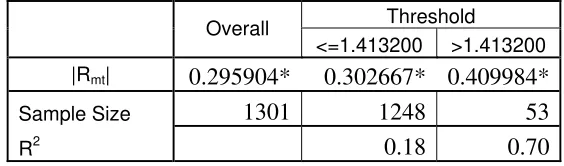
The coefficient of the absolute market return, as reported in table 3, is positive and
that the Indian traders actually trade away from the market consensus during the periods
of market stress. In other words, the null hypothesis of rational asset- pricing model, i.e.,
Table 3: Regression Estimation with the CSAD as dependent variable.
Threshold
Overall <=1.413200 >1.413200
|Rmt| 0.295904* 0.302667* 0.409984*
Sample Size 1301 1248 53
R2 0.18 0.70
* Bootstrap p values indicate significance at 1% level.
Table 4 explores the potential asymmetries in the herding behaviour without confining
our search to the extreme tails of the distribution. We test extreme up-market and
down-markets conditions, where the down-market (up-market) is defined as comprising all
observations for which the return is less than zero (greater than zero). The result reported
in table 4 shows a threshold effect in up market while we do not observe a similar effect
during the down market movements.
Regression result presented in table 4 provides strong support for the rational
asset- pricing prediction corroborating that there is a positive relationship between CSAD
and the absolute market return and specifically the level of dispersion increases at the tail
of the market return distribution.
Therefore, the result presented in the paper conforms to the predictions of the
rational asset-pricing model as against herding as the dispersions in returns in the Indian
equity market increase when the market is subject to greater levels of stress. To check the
robustness of the empirical result presented in the paper several alternative specifications
have been tested including the standard CCK model with R2mt as an additional
explanatory variable. However, most of these unreported exercises corroborate the basic
[image:13.612.164.446.118.201.2]Table 4: Regression Estimation with the CSAD as dependent variable.
Threshold Threshold
Up market
(Overall) <=0.230213 >0.230213
Down Market
(Overall) <=1.504560 >1.504560
|Rmt| 0.352536* 0.196715 0.430753* 0.269502* 0.26766 0.418527*
Bootstrap P value for
Threshold effect 0.0000* 0.821
Sample Size 744 214 530 557 527 30
* Bootstrap p values indicate significance at 1% level.
5. Conclusion:
The paper investigates herding behaviour in the India equity market by applying
threshold model developed by Hansen [2000]. The results presented in this paper show
that the threshold specification does capture the non-linear effect of extreme market
movements on the trading behaviour of the participants. However, the threshold effect
provides no evidence for market-wide herding in the Indian equity market. Even in the
extreme market conditions, participants appear to discriminate between different
References
Bikhchandani S., Sunil. S. (2000). Herd Behavior in Financial Markets . IMF Working Paper WP/00/48.
Chang, E.C., Cheng, J.W., Khorana, A., (2000), “An Examination of Herd Behavior in Equity Markets: An International Perspective”, Journal of Banking and Finance 24, 1651-1679.
Christie, W. G., and Huang, R. D., (1995), “Following the pied piper: Do individual returns herd around the market? Financial Analyst Journal, Vol. 51 (4), pp. 31-37.
Demirer, R. and Kutan, A. M., (2006), “Does herding behavior exist in Chinese stock market?” Journal of International Financial Markets, Institutions and Money, 16, 123-142.
Devenow, A., Welch, I., (1996), “Rational herding in financial economics”, European Economic Review 40, 603–615.
Gleason, K.C., Mathur, I, Peterson, M.A., 2004, Analysis of Intraday Herding Behavior among the Sector ETFs, Journal of Empirical Finance 11, 681-694.
Goetzman, W. (1995). “Discussion: On Fads, Crashes and Asymmetric Information," in Richard Sylla and Mike Bordo, Eds. Anglo-American Finance Systems: Institutions and Markets in the 20th Century, Irwin Publishers, 1995.
Hansen B. (2000) “Sample splitting and threshold estimation”, Econometrica, vol 69, No 1555-1596..
Hong, H., Kubik, J. D., Solomon, A., (2000), “Security Analysts’ Career Concerns and Herding of Earnings Forecasts”, RAND Journal of Economics 31, 121–144.
Hwang, S., and Salmon, M., (2004), “Market stress and herding,” Journal of Empirical Finance, Vol. 11, pp.585-616.
Nofsinger, J.R., and R.W. Sias (2002). “Herding and Feedback Trading by Institutional and Individual Investors”, Journal of Finance, 54, 2263-2295.
Scharfstein, D.S., Stein, J.C., (1990), Herd Behavior and Investment, American Economic Review 80, 465-479.
Wermers, R., (1999), Mutual Fund Herding and the Impact on Stock Prices, Journal of
Finance 54, 581-622.