Shadow of the contract: how contract
structure shapes inter-firm dispute
resolution
Lumineau, Fabrice and Malhotra, Deepak
2011
Online at
https://mpra.ub.uni-muenchen.de/38359/
SHADOW OF THE CONTRACT:
HOW CONTRACT STRUCTURE SHAPES INTER-FIRM DISPUTE RESOLUTION
Fabrice Lumineau
University of Technology Sydney P.O. Box 123
Broadway NSW 2007 Australia
Email: [email protected]
Deepak Malhotra
Harvard Business School Baker Library, Room 471
Boston, MA 02163 Email: [email protected]
KEYWORDS
Contractual Governance; Disputes; Framing; Interest-Based Negotiation and Rights-Based
Negotiation, Control and Coordination, Power
ABSTRACT
This paper investigates how contract structure influences inter-firm dispute resolution processes
and outcomes by examining a unique dataset consisting of over 150,000 pages of documents
relating to 102 business disputes. We find that the level of contract detail affects the type of
dispute resolution approach that is adopted when conflict arises, and that different approaches are
associated with different costs for resolving the dispute. We also find that the effect of contract
choice on dispute resolution approach is moderated by the degree of coordination required in the
relationship, and that the effect of dispute approach on costs is moderated by the degree of power
asymmetry between the parties. Thus, even after controlling for various attributes of the
exchange relationship and the dispute, the choice of contracting structure has important strategic
INTRODUCTION
Inter-firm relationships such as joint ventures, strategic alliances, and vertical integration have
become ubiquitous. Such relationships allow firms to create value and build competitive
advantage (Dyer, 1997; Anand and Khanna, 2000). In spite of their increasing importance and
use, however, inter-firm relationships entail significant risks (Park and Ungson, 2001). In
particular, parties to an inter-firm relationship face the threat of opportunism by exchange
partners (Williamson, 1985), and in cases where such opportunism goes unchecked, the
possibility of an estranged relationship or a costly dispute. As has been widely noted, ‘golden
opportunities’ for exploitation are ever-present in inter-organizational relationships (Nooteboom,
1996), and promises between partners are not always kept (Reich and Mankin, 1986).
Anticipating the potential for opportunism and conflict, firms rely on inter-firm
governance mechanisms to mitigate relationship risks and facilitate cooperation (Ring and Van
de Ven, 1992; Gundlach, Achrol, and Mentzer, 1995; Lusch and Brown, 1996). One such
mechanism involves the use of contractual governance as a means of control (Williamson, 1985).
Contracts, by carefully delineating rights and responsibilities, allow parties to constrain attempts
at exploitation (Brown, Dev, and Lee, 2000). Research in strategy has taken a broader view of
the role that contractual governance plays with regards to managing inter-firm relationships
(Reuer and Ariño, 2007; Hoetker and Mellewigt 2009; Li, Poppo, and Zhou 2010). By looking
at contracting decisions as entailing strategic choice, strategy scholars have argued that contracts
are not simply tools for the enforcement of negotiated agreements, but as elements of strategy
that can facilitate value creation and cooperation (Luo, 2002; Lui and Ngo, 2004; Argyres,
Most relevant to the current endeavor, prior research reveals that the degree of reliance on
contractual governance structures has implications for whether and when disputes will surface in
relationships (e.g., Gundlach and Achrol, 1993). Highly contractual relationships entail greater
costs associated with structuring and monitoring the relationship, but are effective in avoiding
conflict in stable environments where each party’s rights and responsibilities are clear and
consistent with what was agreed upon in writing (Williamson, 1985). In contrast, less
contractual governance structures may be more useful when uncertainty is high, prior agreements
and expectations are unlikely to provide clear guidance on appropriate behavior, and the parties
are interested in building and leveraging trust and cooperative norms (Macaulay, 1963;
Granovetter, 1985; Uzzi, 1997; Malhotra and Murnighan, 2002).
In this paper, we focus on a related, but largely ignored function of contractual
governance: the role contracts play after a dispute has actually surfaced. We start with the
observation that regardless of the extent to which contracts are used to manage inter-firm
interactions, disputes will occasionally emerge. While it is important to understand whether and
when contracts are likely to be effective in preventing conflict, it is also crucial to understand
how a reliance on contracts will impact the dispute resolution process and its outcomes. Our
paper looks at how the degree of contractual detail influences inter-firm behaviors after a conflict
has arisen, and when and how contracts will be effective in reducing the costs associated with
inter-firm conflicts.
In order to examine the means by which contracts impact the inter-firm dispute resolution
process, we draw upon extant psychological research on dispute frames (Pinkley, 1990; Pinkley
and Northcraft, 1994) and work done by Ury, Brett, and Goldberg (1988) on alternative means
resolution approach that is adopted when conflict arises, and that different approaches are
associated with different costs for resolving the dispute. Thus, even after controlling for various
attributes of the exchange relationship and of the dispute, the choice of governance mechanism
has important implications for the way in which interacting parties manage conflict.
We leverage a large, unique dataset that consists of more than 150,000 pages of details
regarding 102 disputes arising in vertical exchange relationships. We had access to all legal files
related to inter-firm contract disputes handled by one law firm in the years 1991–2005. The data
include a wide range of contractual and exchange characteristics for each relationship, along with
thousands of pages of communication between the disputants, thereby enabling us to study in
detail the process by which each dispute was resolved. Our article is organized as follows. In
the following sections, we present the theoretical background for the study and develop our
hypotheses. We then describe the data, methods, and results of our analysis. We conclude with
a discussion of the results, limitations, and opportunities for future research.
THEORETICAL DEVELOPMENT
Contractual governance as a means of coordination and control
Mutual cooperation in inter-firm relationships, although necessary for value creation, is neither
automatic nor easily fostered. A critical barrier to such cooperation is the risk of exploitation by
an opportunistic partner (Williamson, 1985). In recognition of the mixed-motive nature of most
exchange relationships (Kogut, 1988; Gulati, 1999), firms rely on governance mechanisms to
mitigate their risks and promote cooperation (Ring and Van de Ven, 1992; Gundlach et al., 1995;
Contractual governance provides one such mechanism for fostering cooperation (Dwyer,
Schurr, and Oh, 1987; Jap and Ganesan, 2000). Backed by legal authority, formal contracts
between firms detail the rights and obligations of parties within an exchange agreement (Lyons
and Mehta, 1997). Contractual arrangements also make explicit the unspoken assumptions that
underlie the transaction and ensure that the parties have a shared understanding of each side’s
role in the relationship (Smitka, 1994). By providing to firms the option of going to a third party
(e.g., the courts) to sanction an opportunistic trading partner (Dyer, 1997), contracts protect
against exploitation, albeit at potentially high cost.
Contracts are ubiquitous in inter-organizational relationships in most industries, but they
vary widely in their intent and complexity (Crocker and Reynolds, 1993). Some contracts
contain a large number of provisions; others seek to codify as little as possible. Some contracts
focus heavily on the need to mitigate the risk of opportunism and include a host of provisions
that seek to control the behavior of each party (Williamson, 1985); others focus above all else on
ensuring that the parties have a shared understanding of the relationship so that they can
coordinate their efforts optimally (Salbu, 1997; Mellewigt, Madhok, and Weibel, 2007).
Despite their prevalence, all contracts are inevitably incomplete (Grossman and Hart,
1986; Williamson, 1996). Some are incomplete out of necessity—i.e., it is impossible to
delineate all of the contingencies that may arise in a relationship (Simon, 1961; Malhotra and
Murnighan, 2002). Others may be incomplete by design: some parties will choose to limit the
extent to which they rely on contractual governance structures even when greater contractual
detail is possible. There are (at least) three reasons why parties may choose to limit their reliance
on contractual governance. First, parties may want to reduce the costs associated with contract
allow for greater strategic flexibility, recognizing that additional information regarding each
party’s needs, interests, and capacities will be uncovered over time (Bernheim and Whinston,
1998; Malhotra, 2009). Third, parties may wish to encourage the development of mutual trust
and cooperative norms, aspects of relational governance that may be ‘crowded out’ when too
much emphasis is placed on contractual governance (Sitkin and Roth, 1993; Tenbrunsel and
Messick, 1999; Malhotra and Murnighan, 2002).
Contractual and relational governance mechanisms are not mutually exclusive, and many
have argued that parties should, ideally, rely on both mechanisms for managing relationship risk
(Poppo and Zenger, 2002; Gulati and Nickerson, 2008). We do not take a stand on whether
contracts and relational norms can or cannot co-exist in harmony. Instead, we take as our point
of departure the empirical observation that, in practice, inter-firm relationships inevitably rely on
multiple mechanisms for coordination and control. In other words, what varies, in most
inter-firm relationships, is not whether contracts are employed, but rather the degree to which
contractual mechanisms are leveraged (Gundlach and Murphy, 1993; Heide, 1994).
While research on inter-firm governance has devoted considerable attention to studying
how varying degrees of contractual governance impact outcomes, this research has primarily
focused on broad measures of performance, such as profitability (Lusch and Brown, 1996) and
partnership satisfaction (Poppo and Zenger, 2002). Less well established is how contract choice
impacts actual inter-firm behaviors—i.e., how governance structures influence precisely those
behaviors they are designed to govern. Furthermore, while the link between governance
structure and performance is now well established, what has received far less attention are the
Here we seek to address both issues. We examine how contractual governance structures
influence inter-firm behaviors and outcomes when the primary objective of governance—to
promote cooperation—fails. We also shed light on the psychological and behavioral processes
that mediate between governance structure and outcomes. Finally, while previous studies have
focused on examining either the antecedents or the consequences of governance structure, we
include both in our analysis. This allows us to control for the antecedents of governance
structure when we evaluate the efficacy of contractual governance in resolving disputes.
The effect of contractual governance on dispute resolution
Contractual governance impacts behavior not only directly, through a delineation of appropriate
behaviors, but also indirectly, by shaping beliefs and expectations. Governance structures help
to create norms (Heide and Wathne, 2006), which serve ‘to guide, control, or regulate’ (Macneil,
1980: 38) the behavior of firms and actors that represent them. In the context of relationship
risk, norms specify permissible limits on (self-serving) behaviors (Ouchi, 1979; Rousseau, 1995)
and help mitigate deviant behavior (Stinchcombe, 1986). Thus, governance structures create a
‘logic of appropriateness’ which provides the lens through which firms evaluate each other’s
behavior, and, in turn, the appropriateness of their own response (March, 1994).
In order to understand the effect that governance structures have on a firm’s approach to
the dispute resolution process, we rely on the concept of psychological framing (Tversky and
Kahneman, 1981; Pinkley, 1990). Framing refers to the cognitive processes by which parties
understand and enact their organizational environment (Daft and Weick, 1984; Reger, Gustafson,
DeMarie, and Mullane, 1994; Fiss and Zajac, 2006). As such, frames consist of cognitive
the context of inter-firm negotiations, such ‘sense-making’ processes impact the behaviors that
each party considers appropriate for dealing with the dispute (Pinkley and Northcraft, 1994; Ring
and Van de Ven, 1994; Vlaar, Van Den Bosch, and Volberda, 2006).
Because the same dispute can be framed in different ways (Brewer and Kramer, 1986;
Pinkley, 1990; McCusker and Carnevale, 1995), any analysis of the likely approach a disputant
will adopt must include an assessment of which frame, if any, will dominate. As with schema
formation generally (Fiske and Taylor, 1991), dispute framing is influenced by past experiences
as well as contextual stimuli (Pinkley and Northcraft, 1994; Schweitzer and DeChurch, 2001).
In inter-firm relationships, one critical (and often salient) contextual stimulus is the governance
structure within which the firms’ experiences have been shaped. Thus, the degree of reliance on
contractual detail is likely to influence the (cognitive) dispute frame adopted by each party, and
in turn, the (behavioral) approach they will employ in resolving the dispute.
Here we focus on two common approaches for resolving inter-firm disputes: the
rights-based approach and the interest-rights-based approach (Brett, Goldberg, and Ury, 1990).1 According to
Brett et al. (1990), the rights-based approach is primarily distributive, adversarial, and
competitive. This approach relies ‘on some independent standard with perceived legitimacy or
fairness to determine who is right’ (Ury et al., 1988: 7). Parties adopting a rights-based approach
to dispute resolution are likely to focus on arguments that portray their own position as
legitimate and defensible, while portraying the other’s claims and demands as invalid and
unsupported by the standards which govern the relationship. In contrast, the interest-based
1
approach is integrative, consensual, and problem-solving (Ury et al., 1988). Parties adopting an
interest-based approach are likely to share information regarding each party’s perspective and
underlying interests, and to emphasize mutually acceptable alternatives to escalating the conflict.
Which approach, if either, is likely to dominate depends in part on the psychological
frame(s) adopted by the disputants. Pinkley (1990) argues that a critical dimension along which
conflicts (e.g., inter-firm disputes) are likely to be framed is the ‘cooperate vs. win’ dimension.
A ‘cooperate’ frame entails beliefs regarding mutual responsibility for the conflict and leads to
behaviors aimed at achieving a mutually desirable outcome. Thus, a cooperative frame will lead
to an interest-based approach for dispute resolution. In contrast, a ‘win’ frame entails a zero-sum
approach in which only one side is likely to—or even ought to—prevail (Malhotra, 2010). This
is consistent with a rights-based approach to resolving the conflict.
Importantly, it is possible that both of these psychological frames will be activated within
the same dispute (Fiske and Taylor, 1991). This is especially likely when the conflict is drawn
out or complex, when there are areas of agreement as well as disagreement, and when multiple
individuals are involved; all of these features are common in inter-firm disputes.
The rights-based approach and the interest-based approach are not mutually exclusive;
most disputes involve a reliance on both (Ury et al., 1988). As such, in our hypotheses and
analyses, we separately evaluate the degree to which each approach is used without assuming
that one will necessarily crowd out the other. For example, a disputant may leverage the strength
of her legal argument (right-based) while simultaneously discussing whether an alternative to
litigation is possible (interest-based). Adair and Brett (2005) demonstrate that while either
typically iterate between approaches. Lytle et al. (1999) suggest, however, that which approach
dominates can have important consequences for whether—and how—the dispute is resolved.
Contractual governance and adoption of a rights-based approach
We argue that increasing reliance on contractual governance, because of its explicit emphasis on
rights, prohibitions, and legal sanctions, will be more likely to result in a win-lose framing of the
conflict (Pinkley, 1990) and thus encourage a rights-based approach to dispute resolution.
Contractual governance not only allows, but can encourage the parties to consider their rights
and potential liabilities. Furthermore, because contracts typically contain explicit provisions
regarding the sanctions that can be imposed on the offending party, this creates incentives for
each side to defend its behavior and question the appropriateness of the other’s actions. Because
parties in conflict typically interpret events and motivations in a self-serving manner (Miller and
Ross, 1975; Bazerman and Moore, 2008), the ‘who is right and who is wrong’ approach can
escalate, with each side increasingly evaluating its own rights-based actions as appropriate and
the other’s rights-based actions as aggressive and deserving of retaliation (De Dreu, Nauta, and
Van de Vliert, 2006). Thus, an emphasis on the contractual side of governance can support a
coercive approach and reliance on adversarial dispute resolution. More formally:
Hypothesis 1: The more contractual the governance structure, the greater will be the
reliance on a rights-based approach for resolving subsequent inter-firm disputes.
Contractual governance and adoption of an interest-based approach
The effect of contractual governance on interest-based negotiation is less straightforward. This
(Salbu, 1997; Gulati, Lawrence, and Puranam, 2005). First, as discussed at length previously,
contracts promote cooperation by placing limits on the behavior of each party, thereby mitigating
the risk of exploitation by the other party (Williamson, 1985). Second, even if neither party
intends to behave opportunistically, contracts promote cooperation by helping the parties
coordinate their efforts (Mellewigt et al., 2007). Thus, in addition to fulfilling the traditional role
of constraining overly self-serving behavior, contracts can help exchange partners define and
align their expectations (Woolthuis, Hillebrand, and Nooteboom, 2005). Because different
relationships will differ in the degree to which the parties are concerned about coordination
issues, the relative level of control vs. coordination provisions will vary across contracts.
Thus, on the one hand, less contractual governance should be more likely to encourage
the adoption of an interest-based approach. This is because a reduced emphasis on contractual
detail, by design, forces the parties to rely upon and build mutual understanding, trust, and
reciprocity even before a dispute emerges (Macneil, 1980; Heide and John, 1992), whereas
greater contractual detail focuses on reducing risk by obviating the need for trust (Malhotra and
Murnighan, 2002). Accordingly, we hypothesize the following main effect of contractual
governance on interest-based negotiations:
Hypothesis 2a: The more contractual the governance structure, the less will be the
reliance on an interest-based approach for resolving subsequent inter-firm disputes.
On the other hand, in situations where the contracting process is heavily focused on
promoting inter-firm coordination, greater contractual detail may more effectively promote
interest-based bargaining. There are two reasons to expect this. First, when emphasis on
coordination is high, the contracting process—and the contracts themselves—will create a
emerges, coordinating provisions of the contract may lay the groundwork for more productive
communication and information sharing between the parties. Thus, we hypothesize:
Hypothesis 2b: For a given level of contractual detail, the more coordination-focused the
contract, the greater will be the reliance on an interest-based approach for resolving
subsequent inter-firm disputes.
In addition to this direct effect of coordination provisions on interest-based negotiation,
we suggest coordination efforts and contractual detail will interact, such that when
coordination-focus is high, greater contractual detail will facilitate (rather than inhibit, as in H2a)
interest-based negotiation. This is because an emphasis on coordination during the contracting phase,
when sufficiently prominent, is likely to direct attention more generally towards ‘the positive
(what we want to achieve and how) than on the negative (which legally enforceable measure we
put in place to safeguard property or knowledge)’ (Woolthuis et al., 2005: 835). This suggests
the following hypothesis regarding the prospects for interest-based dispute resolution:
Hypothesis 2c: When emphasis on coordination is high, the more contractual the
governance structure, the greater will be the reliance on an interest-based approach for
resolving subsequent inter-firm disputes.
The cost of dispute resolution
Inter-firm disputes can be tremendously costly, especially when conflict escalates to the point
where litigation is a possibility. The costs depend on various factors, such as the stakes involved
in the dispute, the likelihood of continued appeals, and the degree to which egos and emotions
are involved (Malhotra, Ku, and Murnighan, 2008). The cost of the dispute is also likely to be
argued above, both the interest-based and the rights-based approach are expected to play a role in
each dispute; what will differ across disputes is the extent to which each approach is leveraged.
A large body of research, dating back at least three decades, has lauded the interest-based
approach as the ‘low cost’ option for dispute resolution (Fisher, Ury, and Patton, 1981).
However, most arguments in favor of the interest-based approach (and against the rights-based
approach) associate ‘interest-based’ with ‘alternative dispute resolution’ (ADR; e.g., settlement
via negotiation, mediation, etc.), whereas the rights-based approach is typically associated with
settlement through litigation. Not surprisingly, ADR has been found to be considerably less
costly than litigation (Brett, Barsness, and Goldberg, 1996).
We explore a less substantiated, but perhaps more interesting possibility: that even
controlling for the type of resolution mode (i.e., through private resolution or through court
ordering), a rights-based approach will be more costly than an interest-based approach. There
are a number of reasons to expect this. First, the primary objective of the rights-based
approach—to determine which party is right and which party is wrong—is often difficult to
achieve. While some rights are formalized in law or contract, others are based on normative
standards which the parties may disagree about after conflict has erupted. Ury et al. (1988: 7)
point out that ‘there are often different—and sometimes contradictory—standards that apply.
Reaching agreement on rights, where the outcome will determine who gets what, can often be
exceedingly difficult, frequently leading the parties to turn to a third party to determine who is
right.’ Thus, the rights-based approach is likely to result in a more heavy involvement of
lawyers, thereby driving up costs. Moreover, as argued by Adair and Brett (2005), parties in a
dispute tend to reciprocate the approach used by the other. When one adopts the zero-sum logic
Meanwhile, interest-based negotiation leads to a consideration of a broader set of
potential solutions than does the rights-based approach (Fisher et al., 1981; Lax and Sebenius,
1986; Malhotra and Bazerman, 2007), making it more likely that a low-cost resolution will be
found. Furthermore, interest-based negotiation emphasizes information exchange and
cooperation, which makes it more likely that an acceptable resolution will be found quicker.
This discussion suggests the following hypotheses:
Hypothesis 3a: The greater the reliance on a rights-based approach, the higher will be
the cost of resolving the dispute, controlling for whether the dispute is resolved in court.
Hypothesis 3b: The greater the reliance on an interest-based approach, the lower will be
the cost of resolving the dispute, controlling for whether the dispute is resolved in court.
In addition to the predicted main effects of dispute resolution approach on cost (à la
Hypotheses 3a and 3b), we also consider a moderating effect of power asymmetry (White III,
Joplin, and Salama, 2007). Inter-firm relationships vary considerably in the degree to which the
parties have outside options, deep pockets, or other means by which to sustain some level of
independence from their counterpart. Emerson (1962) argues that power is a function of the
criticality and availability of resources: power increases when the resource a party controls is
more highly demanded, and less widely available. Thus, power is the inverse of dependence.
Likewise, negotiation scholars (Fisher et al., 1981; Raiffa, 1982; Thompson, 1991) argue that
power is a function of a party’s alternatives to reaching agreement, but may also be a function of
the resources a party can mobilize in the service of coercing the other side (Lax and Sebenius,
Considerable evidence suggests that the nature of the negotiation process is influenced by
the relative power of the parties involved (Fouraker and Siegel, 1963; Gaski, 1984; McAlister,
Bazerman, and Fader, 1986). The near-consensus appears to be that symmetry results in more
cooperative interactions and a lower likelihood of dispute, whereas asymmetry leads to a greater
divergence in perspectives and more self-serving cognitions and behaviors (Dwyer and Walker,
1981). Consistent with this, when there is symmetry of power, parties are likely to ‘avoid
extreme actions that could prompt retaliation by their partners’ (Dwyer and Walker, 1981: 105)
and a costly escalation of conflict. Meanwhile, Lin and Germain (1998: 182) argue that
‘unbalanced power relations provide an incentive to less integrative behavior.’ McAlister et al.
(1986) demonstrate that less value is created in negotiations when there is an asymmetry of
power because power imbalances lead negotiators to focus too much on exercising or defending
against power, and too little on information exchange and joint problem solving.
While asymmetric relationships appear more likely than symmetric relationships to result
in conflict, it is less obvious how symmetric vs. asymmetric inter-firm relationships differ with
regards to the costs of resolving conflicts after they have erupted. For example, asymmetry may
actually reduce dispute costs when the parties have adopted a ‘win-lose’ frame and are relying
on the rights-based approach. If asymmetry leads to a pronounced tendency for the dominant
party to negotiate aggressively (Lin and Germain, 1998) or impose a solution on the other (Ury
et al., 1988), this will lead to a quicker and cheaper (albeit not mutually satisfying) resolution. In
contrast, when asymmetry decreases (i.e., when the parties have close to equal power), a
rights-based conflict may continue to escalate as each party attempts to prevail over the other and
Hypothesis 4a: The detrimental effect of a rights-based approach on dispute costs will be
lessened when power asymmetry increases.
Meanwhile, the interest-based approach (which helps to reduce costs, à la Hypothesis 3b)
may be especially beneficial when power asymmetry increases. Asymmetry results in less
perspective taking among those who are in the position of power (Galinsky, Magee, Inesi, and
Gruenfeld, 2006) which disrupts information exchange and makes it unlikely that the parties will
understand each other’s interests. Power asymmetry also encourages the use of threats, thereby
making cooperative interaction less likely (De Dreu, 1995). These are precisely the barriers to
effective dispute resolution that the interest-based approach is designed to overcome. Thus,
interest-based negotiation may be most useful in mitigating the cost of conflict when power
asymmetry is high. This suggests the following hypothesis regarding interest-based negotiation:
Hypothesis 4b: The beneficial effect of an interest-based approach on dispute costs will
be enhanced when power asymmetry increases.
In our analyses of the role of power asymmetry, we control for the level of mutual
dependence that exists in the relationship. Building on Emerson’s (1962) seminal work on
power relations, Casciaro and Piskorski (2005) and others (Piskorski and Casciaro, 2006; Gulati
and Sytch, 2007) have argued that the effects of power imbalance may differ across conditions of
high vs. low mutual dependence. The level of mutual dependence may be a function of the
alternatives each party has (cf., Emerson, 1962) or, as suggested by Williamson’s (1985)
exchange, or both (Casciaro and Piskorski, 2005). Thus, our analyses include measures of
mutual dependence based on exchange alternatives as well as asset specificity.2
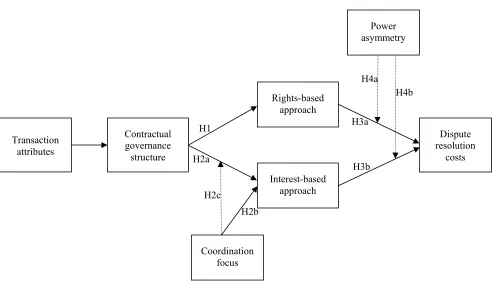
Figure 1 summarizes our general model and hypotheses:
‘Insert Figure 1 here’
DATA AND METHODS
Data collection
We were granted access to all legal files concerning contract disputes handled by one law firm in
Western Europe between 1991 and 2005. The law firm is a mid-sized company which was
founded in the late 1980s. We restricted our sample to all two-party disputes involving vertical
relationships; these represented 80 percent of the two-party disputes handled by the firm.
Of the 102 cases (i.e., disputes) in our sample, 99 involved only European firms; each of
the other three involved at least one non-European firm. Because some companies were repeat
clients of the law firm and involved in more than one dispute, the sample contained 178 different
firms.3 To check for potential selection bias, differences between included and excluded firms
and files were examined. We found no significant differences between files/firms included vs.
excluded from the sample on any dimension we examined (e.g., governance structure, size, etc.).
Because all of the inter-firm relationships we study involve legal disputes, it is important
to also consider the representativeness of our sample and whether our results would generalize to
the broader universe of inter-firm relationships. To address this issue, we conducted a series of
2
Interactions between power asymmetry and mutual dependence are beyond the scope of this paper as such predictions would involve complex three-way interactions between dispute resolution approach, power asymmetry, and mutual dependence.
3
analyses to assess the degree to which key characteristics of our sample—at the contract level,
the firm level, and the relationship level—compare with available benchmarks in datasets that do
not involve disputing firms. At the contract level, we compared the contractual complexity of
our sample with contracts described in prior research. Specifically, on Parkhe’s (1993: 829)
unweighted index of complexity, our sample’s score (4.37) is situated comfortably between the
score (3.69) for Reuer and Ariño’s (2002; 2007) sample of 88 alliances involving Spanish firms
(of various sizes from a variety of industries) and the score (5.05) of Reuer, Ariño, and
Mellewigt’s (2006) sample of 66 alliances in the German telecommunications industry. At the
firm level, we compared the revenue of firms in our sample with revenue data on 123,595
comparable firms provided in the AMADEUS database managed by the Bureau van Dijk, which
is a pan-European database of financial information on over 11 million public and private
companies. Comparing firms by industry (using the two-digit SIC code) revealed no clear
pattern of differences. Finally, at the relationship level, we compared the percentage of prior ties
between parties in our data (32.4 percent) with inter-firm relationships described in prior
research. Gulati (1995) reports that 12 percent of firms in his sample had a previous direct tie;
Reuer and Ariño (2002) report that 20 percent of firms in their sample had previously engaged
with the same partner in a different venture; Hagedoorn and Hesen (2009) report that 53 percent
of their sample includes a prior relationship between the contracting parties. The level of prior
ties in our relationship is comfortably within the range implied by prior research. Taken
together, these analyses suggest that our sample appears, a priori, to consist of contracts, firms,
and relationships, that do not differ significantly from the larger universe of (non-dispute)
datasets on dimensions that we can identify. While such analyses cannot entirely eliminate the
The law firm provided extensive and detailed information on the 102 disputes that we
analyzed. Each legal file contained between 800 and 5,000 pages and included (a) the original
contract, along with any contract revisions that had been made prior to the dispute, and (b) all
documents exchanged during the dispute-resolution process. In addition to providing us with
legal documents, the lawyers in each case obtained from the clients all potentially relevant
information related to the initial context of the relationship, the origins of the conflict, and its
evolution over time. In total, over 150,000 pages of documents were analyzed for this study.
Data collection took place over four months. This period of immersion enabled us to
speak extensively with the lawyers and administrative staff of the firm. In addition, 17
structured interviews, lasting between one and three hours each, were conducted with lawyers at
the firm and with law professors specializing in contract law. These discussions and interviews
were used, as needed, to clarify our understanding of legal procedures, validate the distinction
between contractual functions, and check our interpretation of clauses. Due to the highly
confidential character of the data, it was not possible to speak directly with the disputing firms.
A dispute prototype
Although the dataset consists of more than 100 disputes which vary on multiple dimensions (as
described further below), it may be helpful to provide an example of a dispute from our study.
Sample dispute
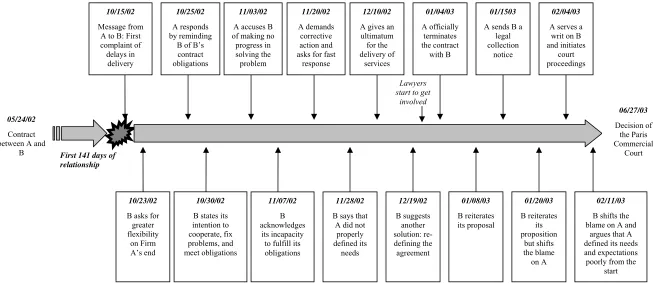
In May, 2002, a mid-sized German firm in the automotive industry (Firm A) contracted with a
large French firm in the IT industry (Firm B). The contract called for Firm B to be paid
€320,000 over the length of the relationship, during which time Firm B was to develop and
disgruntled with Firm B’s performance. 141 days after the contract was signed, Firm A accused
Firm B of having repeatedly missed delivery deadlines. After a number of emails failed to
resolve the problem, managers at Firm A decided to engage the services of a law firm. This took
place 95 days after Firm A had voiced its initial complaint. In response, Firm B hired the law
firm which eventually provided us with our data. The dispute continued for another 176 days, at
which point it was resolved in court. The legal costs added up to €14,720 (for Firm B). A total
of 16 messages were exchanged between the two firms during the course of the dispute. We had
access to all messages, even those exchanged prior to the involvement of the law firm.
Figure 2 presents a timeline of the key events associated with this sample case.
‘Insert Figure 2 here’
Variables and measurements
Cost of dispute resolution
Dispute resolution costs were estimated using legal fees; that is, the (Log) amount of money paid
by the client to the law firm (in thousands of inflation-adjusted Euros). While these figures
clearly underestimate the total costs associated with the dispute (e.g., we only measure fees paid
by one disputant and we cannot measure non-legal costs incurred by either party), our interest in
this study is to compare dispute costs across situations involving different governance structures
and/or different approaches for resolving the dispute. For this purpose, underestimation (if
unbiased) is not likely to be problematic. Because all of our data comes from the same law firm,
we have no reason to suspect any bias in the data that would interact with our hypotheses.
Governance structure
The analysis of governance structure is based on an examination of the actual formal contracts
signed by the firms. We measured the level of contractual detail governing the relationship at
the time the dispute arose. We relied upon a set of indicators developed by Parkhe (1993) which
help to evaluate various provisions in the formal contract. Parkhe (1993: 829) conducted a
computer-aided search of the relevant legal literature and arrived at the following eight
provisions that might be included in a formal contract: (1) the exchange of periodic written
reports of all relevant transactions; (2) prompt written notice of any departures from the
agreement; (3) the right to examine and audit all relevant records through a firm of CPAs; (4)
designation of certain information as proprietary and subject to confidentiality provisions of the
contract; (5) non-use of proprietary information even after termination of agreement; (6)
termination of agreement clauses; (7) arbitration clauses; and (8) lawsuit provisions.
Based on Parkhe (1993), and following the precedent of Deeds and Hill (1999) and Reuer
and Ariño (2007), our measure of the degree of contractual governance is based on the number
of Parkhe’s (1993) provisions represented in the contract (ranging from zero to eight). The
contractual detail score provides a measure of the degree of contractual governance, ranging
from zero to eight, with higher scores representing a greater reliance on contractual governance.4
Coordination focus
Reuer and Ariño (2007: 322) argue that the first three provisions of Parkhe’s eight-item index
relate to coordination between the contracting parties, and may thus be used as a proxy for the
4
degree to which the parties focus on coordinating their expectations and behaviors. In our
examination of these three types of provisions, however, we find that clause category #3 (‘the
right to examine and audit all relevant records through a firm of CPAs’) may arguably have more
to do with ‘enforcement’ (cf., Reuer and Ariño, 2007), than coordination.5 Meanwhile, clause
categories #1 and #2 appear to focus more clearly on coordination. We therefore measure
coordination focus as the ratio of coordination-related clauses included in the contract—i.e.,
clause 1 and/or 2 from Parkhe (1993)—to the total number of clauses in the contract. By
controlling for the total number of clauses, the ratio measure mitigates concerns that coordination
provisions were included incidentally—i.e., due to institutional factors that promote greater
contractual detail, rather than to deal with coordination issues. Moreover, by assessing the
percentage of the contract devoted to coordination, the measure seeks to capture the extent to
which a focus on coordination motivated the contracting process.
We also conducted two sets of robustness checks with regards to our measure of
coordination focus. In the first, we measured coordination focus using all three provisions
identified as ‘coordination provisions’ by Reuer and Ariño (2007). The findings were almost
identical to those reported below, with no change in the results of our hypothesis tests. In the
second analysis, we again started with all three types of coordination provisions. A rater then
evaluated each coordination provision in the entire dataset, along with the context in which the
clause was embedded, and eliminated all seemingly ambiguous provisions. A second rater
evaluated 10 randomly selected clauses for each type of provision, the level of agreement
between raters was 93.3 percent. This process created a more conservative measure of
coordination by eliminating 5.96 percent of provisions. Analyses based on this measure of
coordination focus again produced identical results. Below, we report on analyses that measured
coordination focus based on whether clause categories #1 and #2 were included in the contracts.
Type of resolution approach
To assess the degree to which interest-based and rights-based approaches were employed, every
document exchanged between the disputing firms during the entire resolution process was
analyzed. Each communication by one firm to the other was counted as a message. Following
the methodology used to test signaling theories (e.g., Spence, 1974; Harms, 2004), the choice not
to reply to a communication by the other party was also coded as a (‘no reply’) message. In
total, 2,293 messages were studied (of which only 132 were coded as ‘no reply’). A scheme for
categorizing interest- vs. rights-based statements was constructed to evaluate each message.
Prior studies have shown that some communications contain mixed or dual messages (e.g.,
Lewicki, McAllister, and Bies, 1998). As such, we allowed each message to be coded as
pursuing neither, one, or both of the approaches. The ratio of rights-based messages to total
messages was calculated, and served as a measure of the degree to which the rights-based
approach was pursued. Likewise, the ratio of interest-based messages to total messages served
as a measure of the degree to which the interest-based approach was pursued. Thus, consistent
with our hypotheses, we separately coded for rights-based and interest-based messages, making
it possible for a particular dispute to be coded as high (or low) in both approaches. For example,
consider a dispute which has a total of 32 messages, with 14 interest-based and 21 rights-based
messages (clearly, some messages are coded as both). The score for interest-based approach
Coding of messages was done by two researchers, following Weber’s (1990) protocol.
Drawing upon Ury et al.’s (1988) and Brett et al.’s (1990) definitions of rights-based and
interest-based approaches, the team developed a list of relevant preliminary response categories
to use for information coding. We first applied our coding scheme to four cases. Second, we
assessed the sample coding and slightly revised the coding rules as a result. (See Appendix for
the final list of response categories used to code messages.) Third, all documents exchanged by
the parties were independently read and coded by each coder. We proceeded with an item
selection and classification process (Jauch, Osborn, and Martin, 1980) with a systematic
computer-basedanalysis of the data using Concordance™ software. Fourth, we assessed the
reliability of coding: the percent of agreement between the raters (98% for rights-based and 97%
for interest-based) and the correlation between the ratings (β = 0.969, p < 0.01 for rights-based
and β = 0.928, p < 0.1). Any disagreements on ratings were solved by discussion.
Asymmetry
Power asymmetry between the partieswas measured using two different proxies for firm
strength (Emerson, 1962; Brass, 1984; Lax and Sebenius, 2006; Gulati and Sytch, 2007): firm
revenues and an estimate of the number of alternatives to dealing with the other party.
Asymmetry of revenues was measured as:
log [ABS [(Revenue of Firm A)-(Revenue of Firm B)]
Revenue was measured in thousands of inflation-adjusted Euros for the year when the
contract was signed. These data were obtained from the Bureau van Dijk’s ORBIS database,
To approximate the number of alternatives each party may have to dealing with the other,
we did a content analysis of the communications between parties to look for mentions of
alternative options and/or alternative partners (e.g., ‘You know that if you continue to deny the
facts, we will turn to [Firm X] to supply this part;’ ‘If we aren’t able to put this relationship on
the right track, we will produce the [part] ourselves.’). Because the text did not allow us to
calculate the precise number of alternatives that each party has, we estimated the strength of
one’s alternatives based on the frequency with which the party mentioned alternatives.
Asymmetry of alternatives was measured as:
[ABS [(# of references to alternatives by Firm A)-(# of references to alternatives by Firm B)]
Control variables
Type of settlement: We controlled for the type of resolution that was eventually pursued
(litigation vs. private settlement) because the anticipation of this eventuality may have influenced
the parties’ choice of interest-based vs. rights-based approach. Type of Settlement takes the
value of 0 if the dispute was eventually settled through litigation and the value of 1 if the dispute
was eventually settled via private negotiation.
Dispute resolution clause: As some contracts explicitly included a dispute resolution
provision (e.g., ‘Any dispute arising out of or in connection with this Agreement shall be settled
without recourse to the courts…’), we included a dummy variable to indicate the presence (=1)
of such a clause in the contract.
National vs. international: As less information tends to be known about foreign firms
than domestic firms, and because international disputes may vary on multiple dimensions, we
(Reuer et al., 2006: 315). We created a dummy variable with a value of 0 for relationships
between firms from the same country and 1 for international relationships.
Sum of alternatives: Building on Emerson’s (1962) seminal work, Casciaro and Piskorski
(2005), among others (e.g., Gulati and Sytch, 2007) have highlighted the need to control for the
level of ‘mutual dependence’ when assessing the effects of power asymmetry. We used a proxy
for ‘mutual dependence’ by including a measure of the sum of alternatives that each party had to
dealing with the other. A higher value on this measure, indicating that the parties have strong
alternatives to dealing with each other, would indicate a lower degree of mutual dependence.
Sum of revenues: Because larger firms (e.g., those with internal legal departments) may
be more inclined towards pursuing litigation, we controlled for firm sizes through the summation
of firm revenue (logarithmic value). This measure is necessarily calculated at the dyad level
because our dependent variable (cost of resolution) is a dyadic outcome.
Number of messages: Finally, we controlled for the number of messages sent during the
dispute. Variance in the number of messages may reflect differences in the type, complexity, or
extent of the dispute, or in the nature of the relationship, all of which may impact the approach
adopted and the costs incurred. We observed an average of 22 messages per conflict.
Instrumental variables: antecedents of governance structure
A number of our hypotheses predict differential effects (e.g., on dispute costs) resulting from the
degree of contractual detail. However, governance structures are not randomly assigned to
inter-firm relationships; they are typically chosen (or negotiated) at the outset of the relationship. This
creates a potential endogeneity problem and may result in biased coefficient estimates and/or
model (Hamilton and Nickerson, 2003; Bascle, 2008). We thus include in our model those
factors that may impact governance decisions. In so doing, we use three-stage least square
regressions generating reduced-form estimates of governance choices. We then include
predicted values from these equations as instruments in a second-stage equation estimating the
impact of governance structure. Following prior research (e.g., Casciaro, 2003; Reuer and
Ariño, 2007), governance choice was estimated as follows:
Governance Choice = a0 + a1*Prior relationship length + a2*Technical detail + a3*Time
bound + a4*Asset specificity + a5*Type of transaction + e
We included each of these variables in our model as follows:
Prior relationship length: As the history between the partners is likely to influence the
degree of contractual detail (Mayer and Argyres, 2004), we looked at the duration of prior
relationship between the partners. Based on the information provided in the case files, we
counted the number of days from the start of any previous exchange between the parties to the
date that the current transaction began.
Technical detail: The level of complexity of a transaction may affect the governance
structure that is needed or chosen. We controlled for the level of technical detail of the contract
as measured by the degree to which technical specifications of the transaction were specified in
the contract (Ryall and Sampson, 2009). This variable was calculated as the logarithm of the
number of pages of technical details included in the contract or in its appendix.
Time bound: Deadlined vs. open-ended contracts might also be expected to affect choice
of governance. For example, parties with short-term contracts may envision a small ‘shadow of
contractual provisions (Poppo, Zhou, and Ryu, 2008). We included a dummy variable to control
for whether the contract specified a predefined length of time or whether it described an
open-ended relationship (Reuer and Ariño, 2007: 323). If the contract contained a deadline, the time
bound variable took the value 1; open-ended contracts took the value 0.
Asset specificity: Asset specificity refers to the degree to which the assets used in support
of the transaction can be redeployed to ‘alternative uses and by alternative users without sacrifice
of productive value’ (Williamson, 1991: 282). An increase in asset specificity limits the ability
of firms to redeploy assets, thereby increasing dependency and contracting hazards (Williamson,
1985). We measured the level of asset specificity (Williamson, 1985; David and Han, 2004)
with a content analysis of each legal file to code for references to relationship-specific assets in
the following categories: (a) human assets (i.e., knowledge specific to a particular partner,
specialized skills and training); (b) physical assets (i.e., specialized production equipment and
inter-organizational systems such as those that link buyer and supplier production); and (c) site
specificity (i.e., idiosyncratic investments in facilities dedicated to the relationship). We created
an index of asset specificity by summing across these categories (0 = no evidence of such asset
specificity; 1 = such asset specificity is described) to get an integer variable between zero and
three.
Type of transaction: Because different types of transactions may be subject to different
normative or technical constraints when it comes to picking a governance structure (Saussier,
2000), we included a variable to control for this. The types of transactions involved in the
(29.4%), information technology contracts (26.5%), and contracts for consulting or other
services (8.8%).6
RESULTS
Inter-firm relationships in our sample varied in the degree to which they relied on contractual
governance. On our measure of governance structure (Parkhe, 1993), which ranges from a
minimum of zero (weakly contractual) to eight (extremely contractual), the mean level of
contractual detail was 4.37.
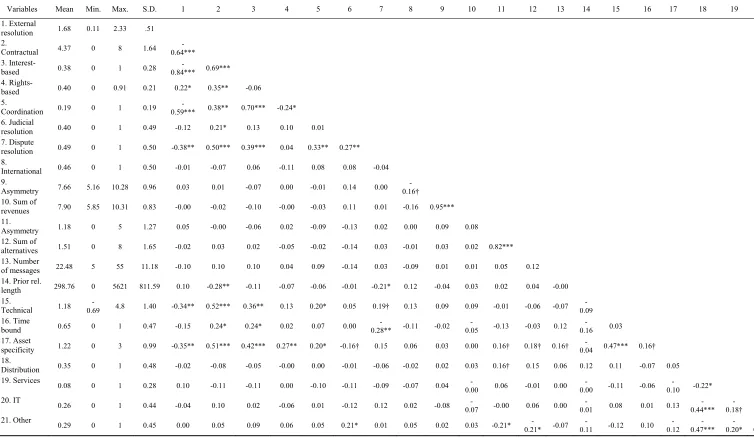
Table 1 provides summary statistics and Pearson correlations for the variables used in our
analysis. Because some variables were significantly correlated, we checked for potential
multicollinearity. The variance inflation factors (VIF) were all well below 10 (with the
maximum being 4.11), suggesting that multicollinearity was not a concern.
‘Insert Table 1 here’
As the first step in our analysis, we ran a regression to test the effects of transaction
attributes on (choice of) governance structure; this analysis would serve as the first-stage model
of our subsequent three-stage model analysis of hypotheses. The results reveal that, consistent
with prior research (e.g., Reuer and Ariño, 2007), governance was likely to be relatively more
contractual when technical detail was high (β = 0.42, p < 0.001), asset specificity was high (β =
0.53, p < 0.001), and the relationship was time-bound (β = 0.47, p < 0.10). The ‘type of
transaction’ variables were not significant predictors of governance structure.
6
Hypothesis 1 predicted that contractual governance would encourage greater reliance on
a rights-based approach than would relational governance. As predicted (See Table 2, Model 2),
controlling for attributes of the relationship, of the transaction and of the dispute, the higher the
level of contractual detail, the more likely it was that the parties would use the rights-based
approach to resolve the conflict (β = 0.05, p < 0.01).7
‘Insert Table 2 here’
Hypothesis 2a predicted that the more contractual the governance structure, the lower the
reliance on an interest-based approach. Contrary to our prediction (see Table 2, Model 4), we
see that contractual governance tends to increase the use of an interest-based approach (β = 0.13,
p < 0.001), although as the results of Hypothesis H2c demonstrate, this is especially the case
when coordination focus is high.
Hypothesis 2b, which predicted that an increasing emphasis on coordination would result
in a greater reliance on interest-based negotiation, was supported (β = 0.76, p < 0.001; Table 2,
Model 5). Hypothesis 2c, which also focused on the interest-based approach, predicted an
interaction between governance structure and coordination focus. As hypothesized (see Table 2,
Model 6), the greater the emphasis on coordination in the relationship—as measured by a higher
percentage of the contract terms focusing on coordination rather than control—the more likely it
was that greater contractual detail would lead to an increased use of the interest-based approach
(β = 0.20, p < 0.01).8 In other words, if contracts are aimed more at coordination than control,
they are more likely to foster the use of an interest-based approach if and when a dispute arises.
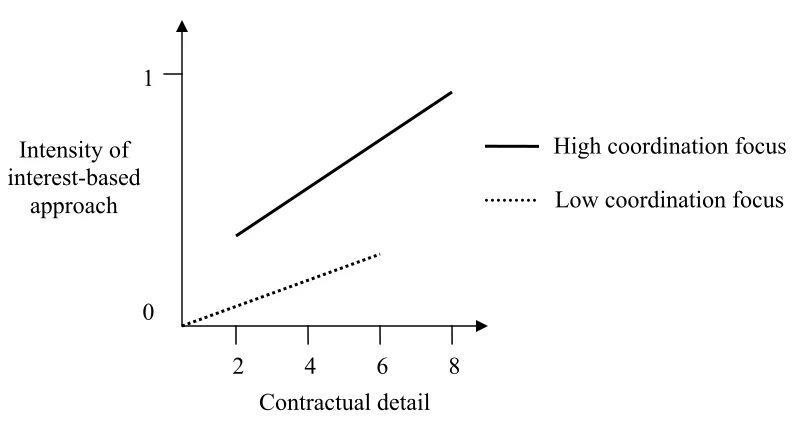
We plot the interaction result to illustrate this moderating effect of coordination focus in Figure
7
3. For purposes of illustration, we create a dummy variable to distinguish cases with high (1) vs.
low coordination focus (0). To do so, we execute a median-split of the sample so that there are
close to equal numbers of ‘high’ (N = 47) and ‘low’ (N = 55) focus-on-coordination
relationships; based on the median split, high coordination relationships are those in which
coordination provisions account for 20 percent or more of the contractual detail.
‘Insert Figure 3 here’
Hypothesis 3a predicted that relying on the rights-based approach would lead to higher
costs associated with resolving the dispute; Hypothesis 3b predicted that interest-based
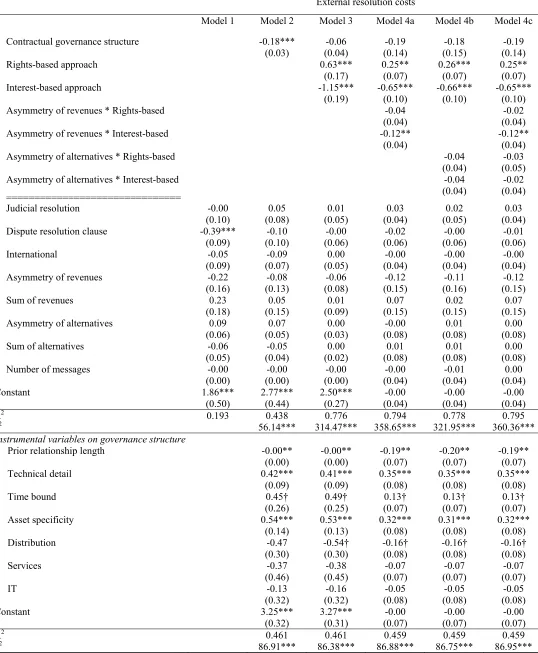
negotiation would reduce costs. Both hypotheses were supported (See Table 3, Model 3): costs
increased with a greater reliance on the rights-based approach (β = 0.63, p < 0.001), but
decreased with a greater reliance on the interest-based approach (β = -1.15, p < 0.001). It is
worth emphasizing that this analysis controls for the type of settlement reached (i.e., private vs.
court-ordered).
Hypotheses 4a and 4b predicted that the effect of rights-based and interest-based
negotiation on dispute costs would be moderated by the degree of power asymmetry between the
two firms (See Table 3, Model 4a). In testing this prediction, we controlled for the level of
mutual dependence in the relationship, as measured by the ‘sum of alternatives,’ and used two
different measures of power asymmetry: one based on firm revenue and the other based on
alternatives to dealing with the other party. We found no effects of power asymmetry using our
measure of ‘alternatives,’ so we focus here on the results of our revenue-based measure.
Hypothesis 4a, which predicted that the effect of a rights-based approach on higher costs would
be mitigated when asymmetry was high, was not supported (β = -0.04, not significant);
would be enhanced when asymmetry was high, was supported (β = -0.12, p < 0.01). In other
words, the interest-based approach may be most useful (from a cost-reduction perspective) when
the disputants are least likely, as a result of power asymmetry, to naturally engage in cooperative
interaction.9
Supplementary analysis: mediation model
As a supplementary analysis, we looked at whether the effect of governance structure on dispute
costs is mediated by the dispute resolution approach adopted by the two parties. To test this
mediation model, we followed the procedure outlined by Baron and Kenny (1986). First (see
Table 3, Model 2), we regressed our dependent variable (dispute resolution costs) on our
independent variable (governance structure) and found a significant effect of governance on
costs (β = -0.18, p < 0.001). Second (see Table 2, Models 2 and 4), we established that
governance structure was a significant predictor of our proposed mediators: rights-based (β =
0.05, p < 0.01) and interest-based (β = 0.13, p < 0.001) approach. Finally (see Table 3, Models
4), we found that when we simultaneously regress the dependent variable (costs) on the
independent (governance) and mediating variables (rights and interests), the mediating variables
are still significant predictors (β = 0.25; p < 0.01 and β = -0.65; p < 0.001, respectively), but
governance is no longer significant. This suggests that the effect of governance on costs is
mediated by the dispute resolution approach adopted by the parties.
‘Insert Table 3 here’
DISCUSSION
9
The paper leveraged a unique dataset consisting of over 150,000 pages of documents related to
102 inter-firm disputes in order to examine a heretofore unexamined consequence of managing
inter-firm relationships using contractual governance structures. When disputes arise, heavy (vs.
light) contractual structures lead to different approaches for resolving the dispute. In turn, these
approaches result in different costs associated with dispute resolution. Furthermore, the results
suggest that the effect of governance structures on interest-based negotiation is moderated by the
degree of emphasis on coordination in the relationship: contractual governance is more likely to
result in interest-based negotiation when the focus on coordination is high and the contract is
being used to coordinate the firms’ expectations and behaviors. We also find that the effect of
interest-based negotiation on costs is moderated by the degree of power asymmetry (as measured
by firm revenues) between the parties: the greater the asymmetry, the more useful is
interest-based negotiation. We also confirm previous findings regarding the antecedents of contractual
detail (Reuer and Ariño, 2007; Ryall and Sampson, 2009).
One unexpected finding—regarding the positive effect of contractual detail on
interest-based negotiation—merits further discussion. One possible explanation is that time spent
drafting the contract, even when its primary purpose is to guard against opportunism, allows the
parties to better understand each other’s interests and to establish working rules and habits for
how to amicably resolve points of contention. This suggests that the contracting process may do
more than influence the psychological frame that parties adopt; a greater emphasis on contracting
may also encourage parties to take the task of resolving conflict more seriously, regardless of the
approach they will adopt. Clearly, additional research on this is warranted.
This paper sought to bridge two streams of research from two different disciplines. On
traditions, has focused on studying the impact of governance. The effect of governance on
micro-level interactions has largely been ignored (Ness and Haugland, 2005). On the other hand,
negotiation and dispute resolution scholars, whose work is based largely in the psychological and
‘micro-OB’ research traditions, have paid relatively little attention to the macro contexts that
shape negotiation behaviors. In bridging these two streams of research, and these disciplines, we
were able to gain some unique insights into the influence of governance structures on the types
of negotiations that arise between exchange partners.
Well over a decade ago, Zaheer and Venkatraman (1995) argued that studies of inter-firm
governance must go beyond focusing on structural elements of strategic relationships and begin
to understand processes. This study represents an effort to tackle this challenge by jointly
examining inter-firm governance structures and inter-firm processes in an effort to understand
outcomes. We find that analysis of governance structure alone is insufficient to explain dispute
outcomes. The results also suggest that a firm’s preference for a particular governance structure
should not simply be based on a consideration of transactional attributes (i.e., the structure of the
relationship); it should also consider the ways in which governance structure will (a) shape the
psychological frame through which organizational actors will make judgments and (b) influence
subsequent firm and inter-firm behaviors (i.e., processes). The results appear to encourage
further explorations of how contract design decisions, as elements of strategy, can be used to
influence inter-organizational relationships and performance.
The paper also provides insights with more immediate practical relevance. Managers
seeking to establish vertical relationships need to consider not only how effectively the
governance structure helps to avoid potential conflict, but also how effective it is in the event
governance structures are most useful in promoting trust and cooperation (Gundlach et al., 1995;
Jap and Ganesan, 2000), and in avoiding conflict (Brown et al., 2000; Gulati and Nickerson,
2008), little is known regarding which structures are best suited for guiding firms through a
dispute that was not avoided. Thus, despite the empirical challenge it represents, the research
agenda of strategy scholars working on inter-organizational relationships can be interestingly
extended to further take into account actual cases of conflicts and disputes between firms. This
would represent a useful counterbalance to the overwhelming emphasis on cooperation and gains
in the study of inter-organizational relationships (e.g., Gulati, Lavie, and Singh, 2009). It is also
worth considering the intriguing possibility that the types of contracts which are best suited for
avoiding conflict may not be the best suited for resolving conflict, a possibility that we could not
evaluate, but is worthy of further study.
A number of limitations of the current study—and associated avenues for further
research—are also important to consider. First, there is a possibility of selection bias inherent in
the way our data was collected (i.e., from a law firm). We did not observe conflicts between
exchange partners unless they escalated to the point where lawyers became involved, potentially
skewing our sample towards the most serious and challenging disputes. On the other hand, if
governance structures can shape dispute frames and behaviors even after conflict has escalated to
the point where lawyers are involved (and the principles are presumably less involved), it is quite
plausible that effects of governance structure will hold when disputes are less severe. We have
also attempted to evaluate the representativeness of our dataset through a series of analyses that
compare key characteristics of our sample—at the contract level, the firm level, and the
While we did not find any significant differences on dimensions that we can identify, this does
not eliminate the possibility of selective representation.
Second, our study was conducted primarily on firms from continental European countries
that have a legal system based on civil law. While there is no obvious reason why the
hypotheses and results would differ under different legal institutions, future research in other
institutional settings and regions would be valuable to confirm or modify our findings.
Third, our measure of dispute costs captures only the observable costs incurred for firms
who were represented by the law firm supplying the data. In so doing, we were forced to ignore
internal costs related to the resources mobilized within each firm and to opportunity costs
resulting from a damaged relationship. This creates opportunities for future research that might
probe more deeply into the various types of costs that are impacted by governance structures.
Alternatively, future research may do well to focus on entirely different outcome measures, such
as disputant satisfaction.
This paper represents an initial attempt to explore some of the psychologically-based
micro-processes that determine how governance structures influence strategic inter-firm
behaviors and outcomes when contractual governance fails to achieve its primary objective of
promoting cooperation and stability. The results as well as the limitations may serve as guides to
ACKNOWLEDGEMENTS
We thank Rich Bettis and two anonymous reviewers for their comments and help in developing
this paper. We also thank James Henderson, Michael Jensen, Joanne Oxley, and Ed Zajac for
providing valuable feedback. A previous version of this paper was presented at the 2009
International Association for Conflict Management conference and the 2009 Academy of