A Bayesian Network Model of the Particle Swarm
Optimization for Software Effort Estimation
Germanjit Singh Sandhu
Student, Department of CSE Lovely Professional University Phagwara, Punjab (India) – 144411Dalwinder Singh Salaria
Assistant professor, Department of CSELovely Professional University Phagwara, Punjab (India) – 144411
ABSTRACT
Rapid growth of software industry leads to need of new technologies. Software effort estimation is one of the areas that need more attention. Exact estimation is always a challenging task. Effort Estimation techniques are broadly classified into algorithmic and non-algorithmic techniques. An algorithmic model provides a mathematical equation for estimation which is based upon the analysis of data gathered from previously developed projects and Non-algorithmic techniques are based on new approaches, such as Soft Computing Techniques. Effective handling of cost is a basic need for any Software Organization. This paper presents the new hybrid Bayesian Network model of PSO for effort estimation. we have developed a tool in MATLAB and at last proved that Bayesian Network with PSO gives more accurate results than other existing techniques. For sake of ease, we use NASA 93 datasets to verify the model and also compare the proposed model with COCOMO and Bayesian Regulation Neural Network Model and it is found that the developed model provides better estimation.
General Terms
Particle Swarm Optimization, Neural network, Bayesian Network.
Keywords
COCOMO, PSO, Bayesian Network, Effort Estimation
1.
INTRODUCTION
Software effort estimate is one of the noticeable & mind catching field. But since it was started, it is challenging factor for software industry and Academia to realize the exact estimation of software development. In today’s fast changing world, success in managing projects is a critical factor for the success of the entire organization. Estimation that either overestimated or underestimated both is very critical. In case of Overestimating time and effort (or budget), due to a presumed lack of resources or because the projected completion is too late, can convince management not to approve projects that may otherwise contribute to the organization. On the other hand, underestimation may result in approval of projects that will fail to deliver the expected product within the time and budget available. There are many factors that influence the Software estimation, some of them are: uncertainty, level of detail of preparing the project plan, managerial factors, lack of past data, pressure to lower estimation and estimator experience [11]. In spite of the critical role of accuracy, examples of incorrect estimation abound, especially in IT projects, resulting in enormous waste of time and money. Some techniques which were used in the past are not in use during present time, like SLIM [3], checkpoint [2], Seer [1]. In all the way of work time, many of new advance roads have been suggested for effort estimation
like Genetic programming [17], Fuzzy logic [12], Neural Network [8], data mining [5], etc. One cannot state that one model give better accuracy above all. Each and every give different level of accuracy in different Environment. But in recent days, soft computing techniques like PSO [7] gains main attention. The main focus of this paper is to investigate the accuracy of estimation using Bayesian network approach based on PSO and this has been done with the help of tool generated by us in MATLAB. This paper comprises as follow: section 2 describes the some former effort estimation models and review of related work to PSO, section 3 includes introduction of Bayesian Network and PSO, in section 4 problem is stated, section 5 describes methodology used, section 6 includes experimental results and comparisons. In last conclusion and future scope is given.
2.
REVIEW OF LITERATURE
high [10]. In 1990, GC Low and DR. Jeffery also concluded in their paper that Function point method is more consistent then the line of code measure [9]. But on the other side, function point method is unable to deal with Uncertain,
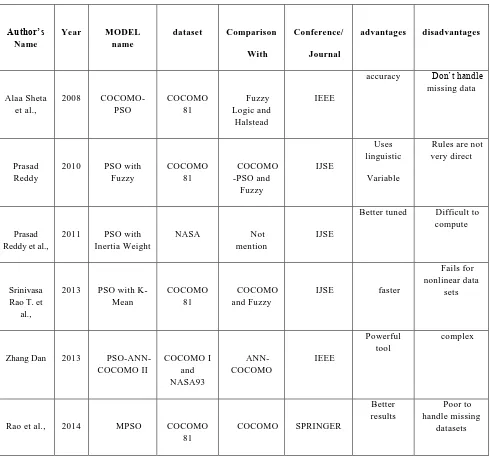
[image:2.595.51.541.142.599.2]imprecise and incomplete data. Many researcher collaborate PSO with different types of techniques for effort estimation. Some of PSO collaborate models are given below:
Table 1. Summary of PSO Effort Estimation Approaches with Their Pros and Cons
Author’s Name
Year MODEL
name
dataset Comparison
With
Conference/
Journal
advantages disadvantages
Alaa Sheta et al.,
2008
COCOMO-PSO
COCOMO 81
Fuzzy Logic and Halstead
IEEE
accuracy Don’t handle missing data
Prasad Reddy
2010 PSO with Fuzzy
COCOMO 81
COCOMO -PSO and
Fuzzy
IJSE
Uses linguistic
Variable
Rules are not very direct
Prasad Reddy et al.,
2011 PSO with Inertia Weight
NASA Not
mention
IJSE
Better tuned Difficult to compute
Srinivasa Rao T. et
al.,
2013 PSO with K-Mean
COCOMO 81
COCOMO and Fuzzy
IJSE faster
Fails for nonlinear data
sets
Zhang Dan 2013 PSO-ANN-COCOMO II
COCOMO I and NASA93
ANN-COCOMO
IEEE
Powerful tool
complex
Rao et al., 2014 MPSO COCOMO
81
COCOMO SPRINGER
Better results
Poor to handle missing
datasets
Artificial Neural Network Model Based on PSO
Sheta, Alaa proposed a collaboration of artificial neural network (ANN) and Constructive Cost Model (COCOMO)[20] [3], which expanded by Particle Swarm Optimization (PSO). PSO-ANN-COCOMO II model accurately estimate the cost of Software development. This revised model not only raised the speed of artificial neural network but also resolve the problem of dependency of initial weight in learning ability of artificial neural network. With keeping the advantages of COCOMO model, this model get better the learning capability of original model.
PSO-ANN-consequence is supported by two data set ( COCOMO I and NASA93).There are three critical factors in software development process: Time, Cost and Manpower. By appraising these parameters at early phase of project, we can get an effective development process. As original ANN-COCOMO II model provide good solution to vagueness of data and uncertainty found in software attributes, but every model have some cons also, low speed convergence and high dependency on network for initial weight are some short-coming in ANN-COCOMO II model. Particle swarm optimization algorithm solves these problems.
Efficiency is tested by using three datasets: 10 NASA software projects, 18 NASA projects and COCOMO 81 database, which was based on a range of criterions for assessment of software cost estimation. By comparison of all the models, discussed in this paper, it proved that model developed by using particle swarm optimization algorithm is better than all.
The PSO-tuned COCOMO model
Bohem developed the simple COCMO model in 1981 [1]. For the better software effort estimation Sheta et.al used the PSO model along with simple COCOMO model in 2008. Generalization of computation is achieved for all the projects by using PSO model [22].
PSO with Inertia Weight model
In 2010 PVGD et.al used PSO with initial weights in order to tune the parameters. For the continue moving of particles in the same direction a nonzero inertia weight is introduced. Decreasing the inertia over time introduces a shift from the exploratory (global search) to the exploitative (local search) mode. [14]
Multi Objective Particle Swarm Optimization for software Cost Estimation
Recently 2014 Rao ,et al. proposed a model for software cost estimation using Multi Objective (MO) Particle Swarm Optimization. By considering two objectives- Mean Absolute Relative Error and Prediction, parameters of model tuned by using MOPSO [15]. For testing COCOMO dataset is considered. From the comparison, it proved that model developed using MO gives better results than standard COCOMO. Also found that by giving more classification among training data gives efficient results. At the deficiency part of this model, it returns set of solution rather than returning a single solution.
The PSO with K-mean Model
In 2013, Rao et al. proposed Particle Swarm Optimization technique is proposed which drive on data sets which are clustered using the K-means clustering algorithm [16]. PSO has been employed to generate parameters of the COCOMO model for each cluster of data values. Back Propagation technique is used to train the Neural Network. COCOMO 81 dataset is used for testing and also the results have been compared with standard COCOMO model and as well as the neuro fuzzy model. It is concluded from the results that the neural networks with efficient tuning of parameters by PSO operating on clusters, can generate better results and hence it can function efficiently on ever larger data sets.
3.
INTRODUCTION TO BAYESIAN
NETWORK AND PSO
BN are a strong modeling technique which increases some different unique characteristics. A powerful feature of BN is the possibility, through application of probability theory, to model uncertainty or subjectivity. that allows the integration
of objective evaluations, learned from data, with subjective evaluations estimated by experts [19]. Also another feature is the possibility to carry out what-if analyses, by giving the model with variations in input values, referred to as evidences, and monitoring the effect on the output. The main advantage of BN is that it can deal well with missing data, which happens number of times in all software projects datasets. BNs are named after and founded on the Bayes theorem, which models the relationship between two variables. The Bayes theorem basically builds the relationship between the prior and posterior probabilities. The prior probability taking some specified value regardless of other variables, that is, it is the default probability. Posterior probability is variable taking some value, given some evidence, i.e. it is the updated probability after new information is input. BNs is basically the graph structure that models the causal relationships between the variables, and a quantitative part made up of node probability tables (NPT's) which contain the probability distributions. The directed acyclic graph (DAG) encrypts the dependencies between the variables. The nodes represent the relevant variables (factors) in the domain being modeled, and each directed arc depicts the dependencies between these factors [19]. The NPT's contain the prior and conditional probabilities. BNs can be modeled fully based on data, through a hybrid approach, i.e. integrating data modeling and experts knowledge or fully expert-based. Expert Knowledge can be coded by means of subjective or qualitative variables and also in the network topology by defining the relationships between the variables.
PSO is a population related search technique. In the population, there are different set of particles which signifies the solution for problem. These particles are generally initialized randomly in most evolutionary computation methods. At the time of starting process, each particle based on some evaluation, changes their personal position with positive speed [7]. The speed is calculated based on experience of the particle itself and all of the population. This changed process is repetitive for different generations. This process stops either when the task is completed or when the maximum number of generations is reached.
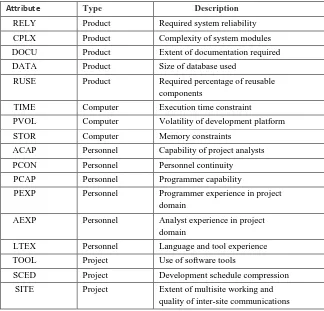
Table 2. Cost Drivers for COCOMO
Attribute Type Description
RELY Product Required system reliability
CPLX Product Complexity of system modules
DOCU Product Extent of documentation required
DATA Product Size of database used
RUSE Product Required percentage of reusable components
TIME Computer Execution time constraint
PVOL Computer Volatility of development platform
STOR Computer Memory constraints
ACAP Personnel Capability of project analysts
PCON Personnel Personnel continuity
PCAP Personnel Programmer capability
PEXP Personnel Programmer experience in project domain
AEXP Personnel Analyst experience in project domain
LTEX Personnel Language and tool experience
TOOL Project Use of software tools
SCED Project Development schedule compression
SITE Project Extent of multisite working and quality of inter-site communications
4.
PROBLEM STATEMENT
The main aim of any software development organizations is to finish the project within acceptable or customary schedule and budget. Budget is mainly driven by labor cost and time and together they form a measure called effort. From quality point of view estimating effort is one of the major important factors. Because estimation either it be over estimate or under estimate, produces worst results. In case of over estimation of time and effort project completion is too late due to lack of resources, which refuses the management to approve that favored project. On the other hand, under estimation may result in approval of projects that will fail to deliver the expected product within the time and budget available [11]. So, there is a need of accurate estimation effort technique at early Stages of software development. In this research, the main aim is to improve software effort estimation by using Bayesian network with PSO. The main reason for using such a learning system for this problem is to keep the estimation process up-to-date by incorporating up-to-date project data. At last Comparison is drawn between training algorithms used in
this research to state that Bayesian Network with PSO gives much accurate estimation. One algorithmic approach, COCOMO is also compared with Bayesian Regulation of neural network model.
5.
PROPOSED METHODOLOGY
Following are the steps used for Effort Estimation:
5.2
Division of Data
Data set is divided into two parts: Training and Testing. For our work we divide the data into 85-15% ratio i.e. 80 rows for training and 13 for testing. These 13 rows are randomly chosen by formula (ceil (1+ (93-1)*rand(13,1))), available in MATLAB. From this, for testing row number 15,40,92,74,91,94,5,80,59,64,71,63, 38 are chosen.
5.3
Cost Drivers
Cost drivers for this work choose from the cost drivers designed for COCOMO II. Table 2 represents, Cost drivers for COCOMO.
5.4
Normalization of data
The first step in training to normalize the data , because in Bayesian network the data is only pass to the network when it is in normalize .so the formula for normalization is
I1 = (I1 - min(I1))/(max(I1)-min(I1)) - 1;
Where I1 is the data which are input by radio button.
5.5
Initializing parameters to PSO
algorithm
After the normalization of data, the next step is to initializing the parameters to PSO i.e., initialize the swarm, velocity and positions of the particles
5.6
Creation of Bayesian network
5.7
Training
Once the network weights and biases are initialized, the network is ready for training.
5.8
Performance Criteria
Mean Magnitude Relative Error: MMRE is frequently used to evaluate the performance of any estimation technique. It seems obvious that the purpose of MMRE is to assist us to select the best estimation approach. It measures the percentage of the absolute values of the relative errors, averaged over the N items in the "Test" set and can be written as [4]:
MRE = {actual effort} - {estimated effort}|}\ actual effort}
MMRE = 1/N ( Σ MREi )
MMRE of COCOMO = 6.92/13
= 0.51
MMRE of BR = 6.446/13
= 0.49
MMRE of Bayesian Network with PSO = 0.85/13 = 0.065
6.
EXPERIMENTAL RESULTS AND
COMPARISION
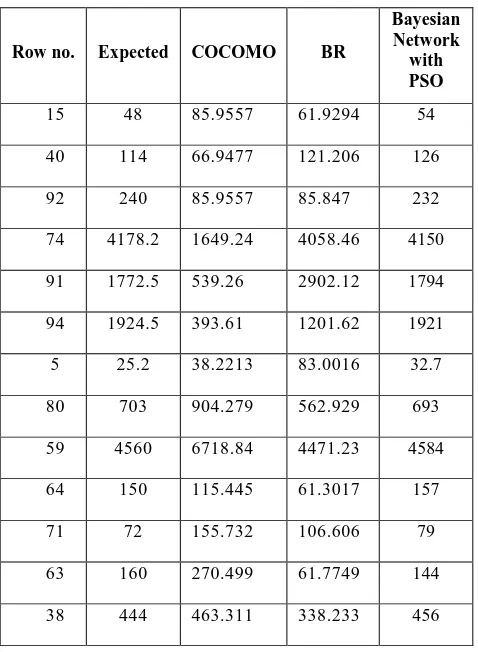
Table 4 summarizes the result obtained by COCOMO model Bayesian Regulation Neural Network Model and Bayesian Network Model of PSO. In the testing phase the calculated efforts and errors using different training algorithms and COCOMO is shown in table 3 and table 4 respectively.
Table 3. Comparison between different training algorithms
Performance
criteria COCOMO BR
Bayesian with PSO
MMRE 0.51 0.49 0.065
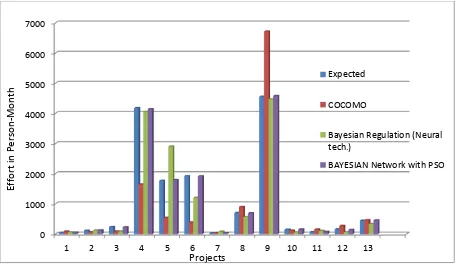
Figure 1 clearly present Bayesian Network with PSO is more accurate than others. As evident from the table 3, the predicted values of the Bayesian Network with PSO efforts is very close to the expected or actual values as compare to Bayesian Regulation Neural Network and COCOMO.
7.
CONCLUSION
[image:5.595.310.549.95.421.2]Effort Estimation is one of the crucial tasks in software project management. This simulation with NASA93 dataset has been carried out using tool created with the help of MATLAB. Bayesian Network is generated using PSO. The result from our simulation shows that Bayesian Network Model of PSO gives the best performance, among the other training algorithms. We have experimented with 15 attributes of the COCOMO and further investigation can be done with other attributes and also concentration needed for process maturity.
Table 4. Effort Estimation by using COCOMO, BR and Bayesian Network with PSO
Row no. Expected COCOMO BR
Bayesian Network
with PSO
15 48 85.9557 61.9294 54
40 114 66.9477 121.206 126
92 240 85.9557 85.847 232
74 4178.2 1649.24 4058.46 4150
91 1772.5 539.26 2902.12 1794
94 1924.5 393.61 1201.62 1921
5 25.2 38.2213 83.0016 32.7
80 703 904.279 562.929 693
59 4560 6718.84 4471.23 4584
64 150 115.445 61.3017 157
71 72 155.732 106.606 79
63 160 270.499 61.7749 144
Fig 1: Column chart for effort estimation
8.
REFERENCES
[1] Boehm, B.W. Software Engineering Economics. rentice-Hall, Englewood Cliffs, N.J. 1981.
[2] Boehm, Barry, Chris Abts, and Sunita Chulani. Software development cost estimation approaches—A survey." Annals of Software Engineering 10.1-4 (2000): 177-205.
[3] Boehm, Barry, et al. "Cost models for future software life cycle processes: COCOMO 2.0." Annals of software engineering 1.1 (1995): 57-94.
[4] de Barcelos Tronto, Iris Fabiana, Jose Demisio Simoes da Silva, and Nilson Sant'Anna. "Comparison of artificial neural network and regression models in software effort estimation." Neural Networks, 2007. IJCNN 2007. International Joint Conference on. IEEE, 2007.
[5] Dejaeger, Karel, et al. "Data mining techniques for software effort estimation: A comparative study." Software Engineering, IEEE Transactions on 38.2 (2012): 375-397.
[6] E. C. Laskari, K. E. Parsopoulos and M.N. Vrahatis, Particle Swarm Optimization for Minimax Problems , Evolutionary Computation, In: (Eds.) CEC '02 Proceedings of the 2002 Congress On, 2, 2002, pp. 1576 -158.
[7] Eberhart, Russ C., and James Kennedy. "A new optimizer using particle swarm theory." Proceedings of the sixth international symposium on micro machine and human science. Vol. 1. 1995.
[8] Haykin, Simon. Neural networks: a comprehensive foundation. Prentice Hall PTR, 1994.Kemerer, Chris F. "An empirical validation of software cost estimation models." Communications of the ACM 30.5 (1987):
416-Software Engineering, IEEE Transactions on 16.1 (1990): 64-71.
[10] Matson, Jack E., Bruce E. Barrett, and Joseph M. Mellichamp. "Software development cost estimation using function points." Software Engineering, IEEE Transactions on 20.4 (1994): 275-287.
[11] Morgenshtern, Ofer, Tzvi Raz, and Dov Dvir. "Factors affecting duration and effort estimation errors in software development projects." Information and Software Technology 49.8 (2007): 827-837.
[12] Nisar, M. Wasif, Yong-Ji Wang, and Manzoor Elahi. "Software development effort estimation using fuzzy logic-A survey." Fuzzy Systems and Knowledge Discovery, 2008. FSKD'08. Fifth International Conference on. Vol. 1. IEEE, 2008.
[13] PVGD, Prasad Reddy, and CH VMK Hari. "Software Effort Estimation Using Particle Swarm Optimization with Inertia Weight." Global Journal of Computer Science and Technology 11.18 (1969).
[14] PVGD, Prasad Reddy. "Particle swarm optimization in the fine-tuning of fuzzy software cost estimation models." International Journal of Software Engineering (IJSE) 1.2 (2010): 12-23.
[15] Rao, G. Sivanageswara, Ch V. Phani Krishna, and K. Rajasekhara Rao. "Multi Objective Particle Swarm Optimization for Software Cost Estimation." ICT and Critical Infrastructure: Proceedings of the 48th Annual Convention of Computer Society of India-Vol I. Springer International Publishing, 2014.
[16] Rao, Srinivasa, C. H. Hari, and Prasad Reddy PVGD. "Predictive and Stochastic Approach for Software Effort
0 1000 2000 3000 4000 5000 6000 7000
1 2 3 4 5 6 7 8 9 10 11 12 13
Expected
COCOMO
Bayesian Regulation (Neural tech.)
BAYESIAN Network with PSO
Projects
Effort
in
P
erson
-Mo
n
[17] Shan, Yin, et al. "Software project effort estimation using genetic programming." Communications, Circuits and Systems and West Sino Expositions, IEEE 2002 International Conference on. Vol. 2. IEEE, 2002.
[18] Suresh Chandra Satapathy, J.V.R. Murthy, P.V.G.D. Prasad Reddy, B.B. Misra, P.K. Dash and G. Panda, Particle swarm optimized multiple regression linear model for data classification Applied Soft Computing , 9, ( 2), (2009), Pages 470-476.
[19] Tierno, Ivan AP, and Daltro J. Nunes. "Assessment of Automatically Built Bayesian Networks in Software Effort Prediction." CIbSE. 2012.
[20] Zhang. "Improving the accuracy in software effort estimation: Using artificial neural network model based on particle swarm optimization." Service Operations and Logistics, and Informatics (SOLI), 2013 IEEE International Conference on. IEEE, 2013.