A Review on Rular Postman Problem for Optimizing System through
Nearest Neighbour Algorithm
Waseem Ahmad
1Zulfikar Ali Ansari
2Aliza Raza Rizvi
31,2,3
AKTU, India
Abstract— The paper is generalized new version of travelling salesman problem that is rural postman problem in this the packet delivery in road network is formulated as rural postman problem where the driver (i.e. the salesman) receives road (i.e. edge) blockage messages. The postman which are used to delivered mail to instance place. Each postman start from main location at different time every day. The postman pickup mail or application from start location to the instance place in many different routes and return back the start location in at specific time, starting from early morning until the end of official working hours, on following condition. (1). Every location will be visited once in each route. (2) The capacity of each postman is enough for all application including the each route.
Keywords: TSP, Nearest Neighbour Algorithm, Rural Postman Problem
I. INTRODUCTION
Nowadays combinatorial optimization problems arise in many circumstances, and we need to be able to solve optimal problems efficiently. Unfortunately many of these problems are proven to be NP-hard i.e. it is often impossible to solve the instances in any reasonable time. Combinatorial optimization is an emerging field at the forefront of combinatory and theoretical computer science that aims to use combinatorial techniques to solve optimization problems. A discrete optimization problem seeks to determine the best possible solution from a finite set of possibilities Combinatorial optimization is widely applied in a number of areas now a days. However, it is often unnecessary to have an exact solution. Minimum spanning tree and travelling salesman problem is the example of combinatorial optimization problem. Rural postman problem is general case of Chinese post man problem where subset of set of link of given graph is required to traversed as minimum cost. The Probabilistic Rural postman problem with time constraint is a problem in which each postman/customer requires a visit only with a given probability and independently of the others. The goal is to find an a priori tour of minimal expected length over all customers, with the strategy of visiting a random subset of customers in the same order as they appear in the a priori tour. The PRPPWC is NP-hard, and only very small instances may be solved by exact methods. There are several motivations for studying the effect of including probabilistic elements in combinatorial optimization problems. The two most important motivations are, firstly the desire to define and analyse models which are more appropriate with reality where randomness is a major source of concern. For example, for many delivery companies, only a subset of their customers requires a delivery each day. Ideally we would like to re-optimize, i .e find an optimal TSP tour for every day. However, we may not have the resources to do this, or even if we have them it may be very time consuming to do that. It is therefore necessary to adopt a model that takes into account random phenomena. Secondly the possibility to analyse the
stability of optimal solutions to deterministic problems when the instances are disturbed by the absence of certain data. In general, the problem is NP-hard, since the Traveling Salesman Problem can be easily transformed into it. The Traveling Salesman Problem consist of finding a shortest closed tour which visits all the cities in a given set.
II. LITERATURE REVIEW
Combinatorial optimization problems arise in many circumstances, and we need to be able to solve optimal problems efficiently. Unfortunately, many of these problems are proven to be NP-hard, i.e., it is often impossible to solve the instances in any reasonable time. A discrete optimization problem seeks to determine the best possible solution from a finite set of possibilities. Combinatorial optimization is widely applied in a number of areas now a days. Unfortunately, many combinatorial optimization problems are NP hard which usually means that they are unsolvable in practice. Optimization is the process of making something better. An optimization problem is a problem which boosts the solution or finds the better solution from all available solution spaces. The terminology “best” solution implies that there is more than one solution. The Travelling salesman problem also results in more than one solution, but the aim is to find the best solution in a reduced time and the performance is also increased. So the heuristic genetic algorithm is used. The Travelling Salesman Problem (TSP) [1] is an optimization problem used to find the shortest path to travel through the given number of cities. Travelling salesman problem states that given a number of cities N and the distance between the cities, the traveler has to travel through all the given cities exactly once and return to the same city from where he started and also the cost of the path is minimized. This path is called as the tour and the path length is the cost of the path
C´ordoba et al. in [3] propose an heuristic algorithm for the RPP based on Monte Carlo methods. The basis of the idea is to simulate a vehicle traveling randomly over a graph. The vehicle starts on a randomly selected node of a graph. It moves, randomly, from a node to an adjacent node. At each step, the destination is selected on the basis of certain probabilities. The vehicle returns to the initial node once all the required edges have been traversed. All the process is repeated a specified number of times and the shortest one is considered as the output of the algorithm.
Shangce Ga and Yirui Wang [4] proposed Ant colony optimization with clustering for solving the dynamic location routing problem this technique resolve dynamic optimization problem due to robustness and adaptation. The aim such algorithm in dynamic environment is no longer to find an optimal solution but it trail it over time. In this paper a clustering ant colony algorithm with three immigrant i.e. random immigrant, elitism-based immigrant and memory based immigrants aimed to resolving the vehicle routing problem in dynamic environments. To and surrounding cities in each class. Then Ant colony algorithm is utilized to handle the vrp in dynamic environment.
Keld Helsgaun [5] proposed Solving the Clustered Traveling Salesman Problem Using the Lin-Kernighan-Helsgaun Algorithm The Clustered Traveling Salesman Problem (CTSP) is an extension of the Traveling Salesman Problem (TSP) where the set of cities is partitioned into clusters, and the salesman has to visit the cities of each cluster consecutively. It is well known that any instance of CTSP can be transformed into a standard instance of the Traveling Salesman Problem (TSP), and therefore solved with a TSP solver. This paper evaluates the performance of the state-of-the art TSP solver Lin-Kernighan-Helsgaun (LKH) on transformed CTSP instances. Although LKH is used as a black box, without any modifications, the computational evaluation shows that all instances in a well-known library of benchmark instances, GTSPLIB, could be solved to optimality in a reasonable time. In addition, it was possible to solve a series of new very-large-scale instances with up to 17,180 clusters and 85,900 vertices. Optima for these instances are not known but it is conjectured that LKH has been able to find solutions of a very high quality.
Zirour et al. [6] presented a genetic algorithm to solve the VRP with Time Windows and Fuzzy Demand to minimize the aggregate distance for vehicles paths and the delay times at the customers due to any time violations. The GA is utilized to solve this problem which is formulated in two steps, in order to minimize the expenses in both steps due to initial solutions in the first step and the expenses of path failure in the second step. Their research showed that their solutions are close to best solutions.
Zhong [7] presented the VRP with time windows (VRPTW) and proposed a mathematical model for it. He presented an enhanced GA to solve the model. First the initial population was computed then a pair of individuals was selected after calculate the fitness values to make the crossover to generate two new individuals. He used a new crossover operator (NOX) which is better than other operators in generating a child that is different from its parent even if the parents are similar. For permutation, he used a modified mutation operator which includes swapping
mutation and inversion operator. In swapping, the genes were swapped on two selected positions. In inversion operator, two separation location within a chromosome were found randomly, and then overthrow the substring among them to produce a child. The research results showed that the improved genetic algorithm is effective in achieving good solutions.
Huili Zhang [8] Presented The Steiner traveling salesman problem with online edge blockages. we are given an edge-weighted graph G = (V,E) and a subset D _ V of destination vertices, with the optimization goal to find a minimum weight closed tour that traverses every destination vertex of D at least once. During the traversal, the salesman could encounter at most k non-recoverable blocked edges. The edge blockages are real-time, meaning that the salesman knows about a blocked edge whenever it occurs. We first show a lower bound on the competitive ratio and present an online optimal algorithm for the problem. While this optimal algorithm has nonpolynomial running time, we present another online polynomial time near optimal algorithm for the problem. Experimental results show that our online polynomial-time algorithm produces solutions very close to the offline optimal solution.
Huili Zhang and Weitian Tong [9] proposed The Steiner traveling salesman problem with online advanced edge blockages .The package delivery in an urban road network is formulated as an online Steiner traveling salesman problem, where the driver(i.e. the salesman) receives road(i.e. edge) blockage messages when he is it a certain distance to the respective blocked edges Such road blockages are referred to as advanced information. With these online advanced road blockages the driver wishes to deliver all the packages to their respective customers and returns back to the service depot through a shortest route. During the entire delivery process, there will be atmost k road blockages, and they are non-recoverable.
Thomas A. Roemer [10] The Traveling Salesman Problem with flexible coloring that describes This paper introduces a new generalized version of the Traveling Salesman Problem in which nodes belong to various color classes and each color class must be visited as an entity. We distinguish the cases of the problem for which the colors are either pre assigned or can be selected from a given subset of colors. We establish computational complexity and provide concise formulations for the problems that lend themselves to derive tight lower bounds. Exact solutions for special cases and a two-phase heuristic for the general case are provided. Worst case performance and asymptotic performance of the heuristic are analyzed and the effectiveness of the proposed heuristic in solving large industrial size problems is empirically demonstrated.
Zhang et al. [12] presented a new method to optimize VRP with multiple depots, multiple customers used the vehicle, and multiple products by using a new search method called the fuzzy logic-guided genetic algorithms (FLGA). The fuzzy logic is used to set the crossover and mutation average after ten successive generations. In crossover, a new crossover operator is used to solve this problem called the partial uniform and partial order (PUPO) crossover. The PUPO crossover includes two kinds of crossover: a uniform crossover, and an order crossover. In mutation, a new mutation operator is suggested to resolve this problem called the partial uniform and a partial swap (PUPS) mutation. The PUPS mutation contains two kinds of mutation: a uniform mutation and a swap mutation. The results showed that their search technique in a set of data generated randomly surpassed other searches used to solve the problem such as tabu search branch and bound, simulated annealing, and standard genetic algorithm.
Lau et al. [13] presented a hybrid genetic algorithm to solve the multi-depot and periodic VRP. They proposed many contributions in crossover operation, management of unfeasible solutions, evaluation procedure and diversity. These contributions enhance the hybrid algorithm to achieve good solutions.
Cao et al. [14] presented a developed genetic algorithm to tackle the weaknesses of early and delayed convergence of classical genetic algorithm. Their research showed that the performance of the technique used is best than the traditional genetic algorithm.
Chunhua etal. [15] presented a developed genetic algorithm to resolve the VRP with disruption events that may happen during the routes such as traffic accidents or vehicle breakdowns. The VRP pattern is depend on a set of solving traditional strategies depend on the notion of disruption management. These procedures are used to simplify the solving of complicated optimization problem and simplify the solution space. When a vehicle on a tabled task in the distribution program breaks down, the other transport vehicles or additional ones could compensate for that and complete the mission to deliver the goods of the disabled vehicle at the time, where serving the customer at the time is the most important goal for each solution. They improved the population and crossover operations in the genetic algorithm to improve the solution. They also improved the validity of procedures and methods by representing the failure times and disruption vehicles.
Patrick jailet [16] Analysis of probabilistic combinatorial optimization problem in Euclidian space deals with explicit inclusion of probabilistic element in problem definition. Based on probabilistic travelling salesman problem objective is rigorous treatment of probabilistic approach in the plane.
Bellman and al [17] proposerd Well Solved Cases of Probabilistic Traveling Salesman Problem he can be solved in an easy way. First we give the relation between the two problems deterministic and probabilistic. Second, we study the stability of the deterministic problem. We prove that in the small travelling salesman problem, several tours were optimal, but there is only one stable among them: The absence of certain cities does not disturb the tour induced by the method of modification of the optimal tour a priori.
Juraj Hromkovi [18] proposed Stability of Approximation Algorithms for Hard Optimization Problems it is to relativize this specification of tractability. The main reason for this attempt is that we consider the requirement for the tractability to be strong because of the definition of the complexity as the “worst-case” complexity. The current point of view is that optimization problems are considered to be tractable if there exist polynomial-time randomized approximation algorithms that solve them with a reasonable approximation ratio. If a optimization problem does not admit such a polynomial-time algorithm, then the problem is considered to be not tractable.
Yannis Marinakis and Magdalene Marinaki [19] proposed A Hybrid Honey Bees Mating Optimization Algorithm for the Probabilistic Traveling Salesman Problem The Probabilistic Traveling Salesman Problem is a variation of the classic Traveling Salesman Problem and one of the most significant stochastic routing problems. a new hybrid algorithmic nature inspired approach based on Honey Bees Mating Optimization (HBMO), Greedy Randomized Adaptive Search Procedure (GRASP) and Expanding Neighborhood Search Strategy (ENS) is proposed for the solution of the Probabilistic Traveling Salesman Problem. The proposed algorithm has two additional main innovative features compared to other Honey Bees Mating Optimization algorithms that concern the crossover operator and the workers.
III. PROBLEM IDENTIFICATION
problem is of considerable practical importance, apart from evident transportation and logistics areas. A classic example is in printed circuit manufacturing: scheduling of a route of the drill machine to drill holes in a PCB. In robotic machining or drilling applications, the "cities" are parts to machine or holes (of different sizes) to drill, and the "cost of travel" includes time for retooling the robot (single machine job sequencing problem).The generalized travelling salesman problem, also known as the "travelling politician problem", deals with "states" that have (one or more) "cities" and the salesman has to visit exactly one "city" from each "state". One application is encountered in ordering a solution to the cutting stock problem in order to minimize knife changes. Another is concerned with drilling in semiconductor manufacturing.
IV. RESEARCH AND OBJECTIVE
Main goal of this paper is minimize total travelling distance cost
The objective is
1) Study and analysis of Rural postman problem with different technique and method.
2) Design and development of PRPPWTC using Nearest Neighbor Algorithm to minimize distance cost.
3) Verification and Validation of PRPPWTC using Nearest Neighbor Algorithm to minimize distance cost
V. METHODOLOGY
A. Nearest Neighbour Algorithm:
Nearest Neighbour Algorithm is effective in solving highly complex problems such as VRP. These are mainly optimization problems.
It is efficient to
1) Providing a faster and more accurate solution.
2) Reducing error rate caused by accuracy in assumptions. 3) In distributing a problem on parallel computers, which is
difficult by linear programming, the distributed results can be easily compared.
4) Stop the execution at any time, because there is a solution at any time, whatever it might be, better.
NNA are non-deterministic, i.e. they are stochastic in decisions, which make them more robust. It is a key technology in random search to solve unclear and complex problems, which require large time space for optimal solution. It is an important technique in the search for the perfect choice of a solution set that is available for a particular design. NNA is an excellent technique to solve huge problems with a high computational complexity, especially in computer science, where the problems need to enhance solutions. NNA can be applied in the following applications. Tour selection, the goal of tour optimization for travelling salesman problem and vehicle routing problem to reduce the costs and visit all locations with constraints. Multi-constrained problems, such as routing of the network for the internet with different features. Many types of optimization problems such as Distributing packages, traffic optimization, puzzle optimization and others.
There are some step of NNP algorithm
1) start on an arbitrary vertex as current vertex.
2) find out the shortest edge connecting current vertex and an unvisited vertex V.
3) set current vertex to V. 4) set current vertex to V.
5) if all the vertices in domain are visited, then terminate. 6) And last go to step 2
The nearest neighbour algorithm is easy to implement and executes quickly, but it can sometimes miss shorter routes which are easily noticed with human insight, due to its "greedy" nature. As a general guide, if the last few stages of the tour are comparable in length to the first stages, then the tour is reasonable; if they are much greater, then it is likely that there are much better tours. Another check is to use an algorithm such as the lower bound algorithm to estimate if this tour is good enough.In the worst case, the algorithm results in a tour that is much longer than the optimal tour. To be precise, for every constant r there is an instance of the traveling salesman problem such that the length of the tour computed by the nearest neighbour algorithm is greater than r times the length of the optimal tour. Moreover, for each number of cities there is an assignment of distances between the cities for which the nearest neighbour heuristic produces the unique worst possible tour.
B. Solution Generation:
C. Feasibility Checking:
The VRP problem is one of the problems that have no perfect solutions yet. Many researchers over the last few decades until now have established a lot of researches, and used many methods with different techniques to handle it. But, for all researches, finding the lowest cost is very complex and needing innovative methods to find an approximate optimal solution. Routing and scheduling problem is based on specific features of the rendered services, such as routing and scheduling objectives, number of vehicles, starting and ending location, and vehicles capacities. The objective of most routing and scheduling problems is to minimize the total cost, which is a function of vehicles number, capacity, route distance and vehicles operation and maintenance. Student’s transportation is a service, provided by real study to facilitate the access of students to different locations, which represent the faculties and other departments in the main location. Therefore, the solution must schedule the problem to achieve minimum cost and on schedule.
VI. RESULTS AND DISCUSSION
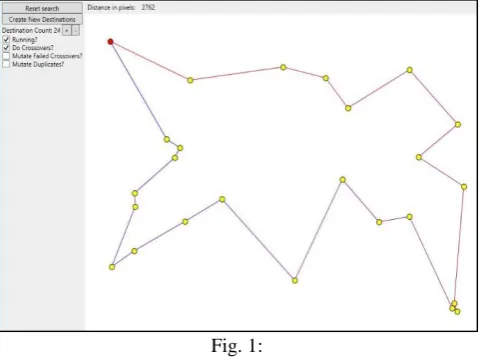
[image:5.595.311.548.65.262.2]The VRP has many applications in real life. It appears in a wide area of transportation and distribution such as transportation of people and products, delivery service and garbage collection. All these problems have economic importance, particularly in developed countries. The economic factor in savings expenditures is a big motive for companies and researchers in an attempt to find the best way to resolve and improve transport efficiency. This is the traditional and basic vehicle routing problem in which all the information on the routes (customer location and demands) is known in advance before starting and will not be changed or updated after the routes began this means, no customers (cities) or new demands need to be inserted into one of the routes. In fact, if a new request has to be inserted, it will be very complex and need more planning process.
[image:5.595.48.290.490.669.2]Fig. 1:
Fig. 2:
VII. SCOPE AND FUTURE WORK
Main scope of this project is minimize total distance and also minimize total time. The scope and work define the division of work to be performed under a contract or subcontract in the completion of a project typically broken out into specific tasks with deadlines.
A. Problem definition:
In this study the problem is follows: The postman which are used to delivered mail to instance place. Each postman start from main location at different time every day. The postman pickup mail or application from start location to the instance place in many different routes and return back the start location in at specific time, starting from early morning until the end of official working hours, on following condition. (1). Every location will be visited once in each route.(2) the capacity of each postman is enough for all application including the each route.
B. Goal and application:
The main goal is distance and time minimization. There are lot of application are use in this type of problem these are routing problem ,Minimum spanning tree, Machine scheduling problem, time allocation problem , Mail delivery, Grarbaze collection, Cutting edge application, Route inspection problem etc.
The main scope is industrial concern like cutting edge application now a days.
REFERENCES
[1] optimization problem
[2] P Fernandez C´ordoba, L.M. Garc´ıa Raffi, and J.M. Sanchis. A Heuristic Algorithm based on Monte Carlo methods for the Rural Postman Problem. Computers Ops. Res., 25(12):1097–1106, 1998.
[3] Shangce Gaoab, YiruiWanga, Jiujun Chengc,Yasuhiro Inazumib,Zheng Tang . Ant colony optimization with clustering for solving the dynamic location routing problem Applied Mathematics and Computation 20 july 2016.
[5] Zirour, M., 2008. Vehicle routing problem: models and solutions. Journal of Quality Measurement and Analysis JQMA, 4(1), pp.205-218.
[6] Zhong-yue, S., Zhong-liang, G. and Qin, W., 2010, January. An improved adaptive genetic algorithm for vehicle routing problem. In Logistics Systems and Intelligent Management, 2010 International Conference on (Vol. 1, pp. 116-120). IEEE.
[7] Huili Zhang Presented The Steiner traveling salesman problem with online edge blockages nov 2014.
[8] Huili Zhang and Weitian Tong proposed The Steiner traveling salesman problem with online advanced edge blockages 30 December 2015 pg 1-13.
[9] Thomas A. Roemer The Traveling Salesman Problem with flexible coloring 18 April 2012.
[10]Matthias Mnich proposed Improved integrality gap upper bounds for traveling salesperson problems with distances one and two 22 September 2017 pg [1-22]. [11]Zhang, Y., Liu, J., Duan, F. and Ren, J., 2007, November.
Genetic algorithm in vehicle routing problem. In Intelligent Information Hiding and Multimedia Signal Processing, 2007. IIHMSP 2007. Third International Conference on (Vol. 2, pp. 578-581). IEEE.
[12]Lau, H.C., Chan, T.M., Tsui, W.T. and Pang, W.K., 2010. Application of genetic algorithms to solve the multidepot vehicle routing problem. IEEE Transactions on Automation Science and Engineering, 7(2), pp.383-392.
[13]Cao, E. and Lai, M., 2007. An improved genetic algorithm for the Vehicle Routing Problem with Simultaneous Delivery and Pick-up Service. In Proceedings of the 6th Wuhan International Conference on E-Business (pp. 2100-2106).
[14]Chunhua etal. presented a developed genetic algorithm to resolve the VRP.
[15]Patrick jailet Analysis of probabilistic combinatorial optimization problem in Euclidian space 1993.
[16]M. Bellalouna,V.Th.Paschos and W.Khaznaji, “Well solved cases of probabilistic traveling salesman problem,” 42emes Journees deStatistique, 2010. [17]J. Hromkovic, “Stability of approximation algorithms for
hard optimization problems,” PSOFSEM’99: Theory and Practice of Informatics, vol. 1725, pp. 29–47, 1999. [18]Y. Marinakis, M. Marinaki, “A hybrid honey bees