Advances in Computing and Technology
The School of Computing, Information Technology and Engineering, 6th Annual Conference 2011 216
REFLECTIONS ON THE NEED FOR AN IMPROVED
QUANTITATIVE MODELING APPROACH
Amin Hosseinian Far, Hamid Jahankhani, Elias Pimenidis, and D.C.
Wijeyesekera
School of Computing, IT and Engineering University of East London
{Amin, Hamid.Jahankhani, E.Pimenidis, Chitral}@uel.ac.uk
Abstract. There are common elements in different sustainability models regardless of their application that can be applied to almost any system. Some of the existing models try to establish a quantitative approach to assess sustainability, some reflect the changes of the target systems through longitudinal evaluations on case studies and many of the models illustrate the concept using a descriptive breakdown. This paper tries to find the common elements used in the important existing sustainability models by comparing the models using a comparison framework. These elements will be later become the components of a system model. This system model is represented using Complex Adaptive Systems and Systems‟ theories and also quantitative modelling techniques in order to eliminate some of the dilemmas in the existing sustainability modelling.
1.
Introduction
This paper evaluates existing sustainability models in terms of their usefulness and proposes a new systems model for sustainability research. Although various models have been theorized around different case studies and applications, some offer practical benefits worth of further examination. In order to evaluate the models and to critically compare them, a comparison framework has been set. The framework regards the key common elements within the majority of the models and evaluates them using the comparison criteria. It also summarizes the key knowledge in the field. This provides a better understanding of the research context and the gaps within the existing models. For this reason, the main data collection method is narrative extraction, the methodology is deductive, and the research design base is theoretical.
1.1 The Framework
According to the Oxford Dictionary (2010), a framework is a “basic structure underlying a system, concept, or text. This research comparison framework is constructed based on different perspectives perceived from a sustainability model.
1.2 Investigating sustainability model perspectives
A sustainability model can be analyzed based on the following facets:
1. Components
2. Modelling Approach 3. Applications
4. Design Base 5. Concept Clarity
Advances in Computing and Technology
The School of Computing, Information Technology and Engineering, 6th Annual Conference 2011 217
identify the common elements and one might say why not only comparing the components. But the reason for selection of other criteria and putting them in the framework is that it will be helpful to identify the advantages and drawbacks of different approaches and their level of clarity.
2.
Existing Models
Todorov & Marinova (2009) have classified all sustainability models into five main types: Pictorial Visualizations Models, Quantitative Models, Physical Models, Conceptual Models, and Standardizing models.
Brundtland report founded the grounds for primary generic sustainable models. This United Nations report introduced the term „Sustainable Development‟ in different chapters and its elements were subsequently used in various sustainability representations. Later the Human Environment UN Conference in 1972 in Sweden elaborated on the work proposed in the Brundtland report. The latter report simply introduced Human and Environment as the only relation that need to be analyzed; although it has not introduced the detailed facts regarding the interactions (UNEP, 1972) The Brundtland report focuses on the notion of development. Furthermore, it defines the sustainability ability of the development by two major concepts; the needs and the ecological resources. The report emphasizes that the harmony between these two will assure a sustainable trend. This report also defines some other factors that affect the relation between needs and resources. In addition, political will is considered as a main factor for sustainability and development (Brundtland, 1987). Soon after, based on the intimations gotten from this report, the three dimensions of the three
pillar sustainability model were brought in. The vagueness of the Brundtland report was highlighted in the World Summit report which was held in 2002 (UN, 2002), The 2002 UN report, tires to redress the balance between the three themes of sustainability. During the last thirty three years different models were proposed from non UN independent academics, non academics, and industries.
Arbogast, Thornton, & Bradley (2010) established one of the latest Corporate Sustainability models. It describes the company sustainability using different variables and the indicators. In other words the sustainability for a company can be quantified using variable indices. The following variables are considered in the model:
1. Industry Group Percentile Energy Productivity
2. Industry Group Percentile Carbon Productivity
3. Industry Group Percentile Water Productivity
4. Industry Group Percentile Waste Productivity
5. Leadership Diversity 6. Percent Tax Paid
7. Sustainability Leadership
Advances in Computing and Technology
The School of Computing, Information Technology and Engineering, 6th Annual Conference 2011 218
on the mentioned variables. The regression equation used is as follows:
Where the „b‟s are constant. Each ‟b‟ is the estimated
coefficient of each variable. Now this is the question: How does the estimation take place? Arbogast and Bradley acknowledge that each variable is still open to research. The Model used is a cross-sectional quantitative research. The vagueness of the sustainability concept has been diminished using numerations.
One of the newest models for Urban Sustainability is „The Europe 2020 Strategy‟. Stockholm in Sweden is an application of the strategy (Europian Green Capital, 4 May 2010). The report introduces different projects, but what all projects have in common are the centers of attention:
1. Energy in the city 2. Transportation 3. Climate Adaptation 4. Eco-Cycle solutions 5. Lifestyle
This descriptive model does not consider the role of human in the above five elements (Except slightly in the lifestyle). The role of politics has been highlighted in many sections of the report. Politics and better to say policy making is important due to the need for investment. (Europian Green Capital, 4 May 2010).
An interesting simplification for sustainability has been used in a sustainability model used for rural water supply systems. This model categorizes the sustainability of water supply systems into
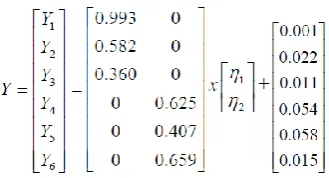
three categories of Low Sustainability, Moderate Sustainability, and High Sustainability (Masduqi, Endah, Soedjono, & Hadi, n.d.). The model uses sustainable indicators, using nine variables. The quantitative methodology has used two main equations to enumerate the measurements:
Figure 17: First equation of MASDUQI WATER supply model
Figure 18: Second EQUATION OF MASDUQI WATER SUPPLY MODEL
The nine variables that the model has employed and used in the above equations are as follows:
1. Availability of water source 2. Selection of Technology 3. Investment Cost
4. Technical Operation 5. Institutional Management
6. Existence and Ability of Operator 7. Availability of spare parts
8. Operation Costs
[image:3.595.311.515.222.339.2] [image:3.595.312.477.402.491.2]Advances in Computing and Technology
The School of Computing, Information Technology and Engineering, 6th Annual Conference 2011 219
[image:4.595.313.514.113.298.2]The second equation uses observed variables which are known as indicators where the first equation is for latent variables. Two indices known as reliability index and sustainability index are defined via summation of different variables. The following path diagram (Fig. 3) is illustrating the influences of each variable on another. The path diagram can be replaced using influence diagrams:
Figure 19: Masduqi Path DIagram
The model is a theoretical, quantitative model which uses cases studies and sustainability indicators. The variables stated, can be classified into the main popular three dimensions of sustainability: Economy, Environment, Economy.
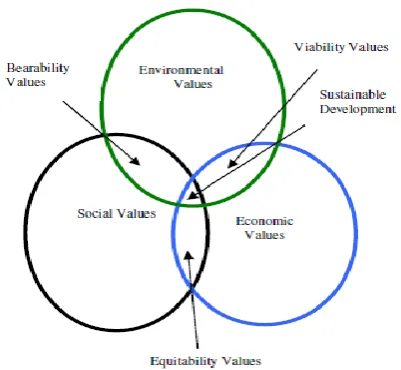
One of the latest models that tries to provide a platform for engineering applications is called Sustainable Engineering Infrastructure or for short SEI (Okon, Ekpo, & Elhag, 2010). Basically the SEI model is a mathematical model which does not specify an application. It generates variables from the main three themes and some other overlapping areas.
Figure 20: Three elements of sustainability development
The illustration and the containing concepts provide the variables for the SEI model. The variables are then substituted into a
mathematical equation. The final SEI model is represented as follows:
Where
(Okon, Ekpo, & Elhag, 2010)
[image:4.595.80.281.270.398.2]Advances in Computing and Technology
The School of Computing, Information Technology and Engineering, 6th Annual Conference 2011 220
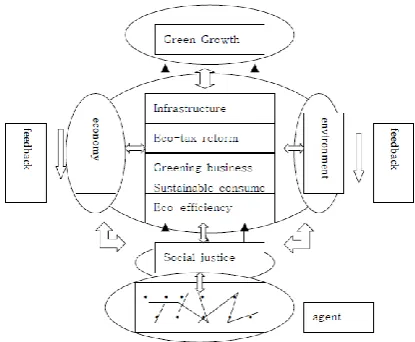
(Kwon, 2007) has used the Complex Adaptive System tools and theories to model sustainability and to achieve what it called Green Growth. The model has considered the main three themes, but the role of patents cannot be seen in this model. In addition, the Society domain is reflected as the agent of the CAS while the life styles which are still part of Society theme cannot be an agent.
Fig. 5 shows the model where the elements are in the centre:
Figure 21: CAS representation of sustainability
3.
Components
The main components in all sustainability models are Economy, Environment, and
Society. Some of the models derive more sets from each of these three themes, and some develop multidisciplinary variables from two or even all three themes. The role
Model Components Modeling
Approach
Design Base Application Concept
Clarity
Three Pillar Model Society, Environment, Economy
Theoretical Theoretical General, Can be Applied To Almost any System
Vague
Concentric Circles Society, Environment, Economy
Theoretical Theoretical General Vague
Overlapping Circles Society, Environment, Economy-trade-offs between different components
Theoretical Theoretical General Vague
Corporate Model Society, Environment, Economy
Quantitative Methodology, Theoretical
Cross-Sectional Experimental
Corporate Sustainability Less Vague, Comprehensi ble The European 2020
Strategy
Society(Life Style & Politics),
Environment, Economy
Case Study Theoretical, Experimental, Should be tested longitudinally
Sustainable Cities Vague in some aspects
Masduqi water supply system model
Nine variables derived from Environment, Economy, Society
Quantitative Theoretical, Observation of case studies for data collection and testing
Water Supply Systems Clear
SEI Economy,
Environment, Economy
Quantitative Theoretical Engineering Vague at some points
CAS Economy, Society,
Environment
[image:5.595.316.524.111.282.2]Advances in Computing and Technology
The School of Computing, Information Technology and Engineering, 6th Annual Conference 2011 221
of politics is almost forgotten in most of the models. The term governance substitute „politics‟ in order to provide a better conceptualization of the project management and the funding decision making process. One of models that has considered „governance‟ as one of the main three themes of sustainability is called „sustainable investment‟ (Urwin & Watson, 2010). The economy pillar of sustainability is dissolved into govenrnance where all the funding and descion makings are comming from. Furthermore, new concepts such as investment beliefs and asset allocations are introduced a the affective factos of sustainable developmetn. The policy making and politics are defined in the social theme of some models but, some researchers consider that as a Society theme. The role of politics becomes more important at the time of investments. Technology is a constituent which is normally described as Patents. A new technology in one system affects the interactions between the old adjusted three themes. Therefore the introduction of patents through time should be regarded as a major element of sustainability.
4.
Analysis
Table 1. summarizes the comparisons between some of the models. The models are basically compared based on the set criteria. It is clear that the qualitative approaches have given a vague final understanding of the concept, whilst the quantitative models are clearer and provide a better understanding. The quantitative models are mostly using regression modeling. The sustainability of their application system is set as the dependant variables. As the name indicates, dependant variables depend on some other independent variables. The independent variables are derived from the three themes of
sustainability introduced earlier. The observed independent variables are normally called the indicators or sustainability indicators and other independent variables are known as latent variables. Generally speaking, an indicator is a variable that provides valuable information that can be later used in decision making (Miller, 2007). Some other quantitative models have used the set theory and other mathematical equations to easily quantify the sustainability ability of systems. There are many quantitative models which have not been covered in this paper. Some use the dynamic physics concepts to elucidate the complex, dynamic, open concept of sustainability. The longitudinal research design has been used in those models. The changes in a system are monitored through time. Boulanger & Brechet (2005) categorize the quantitative models for sustainability. This classification believes that the models for sustainability can be „Macro Econometric‟, „Computable General Equilebrium‟, „Omtimization Models‟,
„Systems‟ Dynamic Models‟,
„Probalistic/Bayesian Network‟ or a „Multi-agent‟ system model (Boulanger & Brechet, 2005).
A measurable conceptualization for economy domain is the best way to get to common variables. For instance a measurable economy is where all the variables define the values in and values out of the system. That will provide the Economy of the System. The main generic themes/components of sustainability are common in almost every sustainability model are as follows:
1. Economy 2. Environment 3. Society 4. Politics
Advances in Computing and Technology
The School of Computing, Information Technology and Engineering, 6th Annual Conference 2011 222
5.
Conclusion
The main components of sustainability which are used in all sustainability models are Economy, Environment, and Society. Some models provide more components. These further components are all derived from the main three components or interactions between them. Sustainability modeling can be categorized into two main classes: Quantitative Models or Qualitative Models; although Todorov & Marinova (2009) have provided more detailed classifications. Except the pictorial and visualized models, most of the models have theoretical design bases with different methodologies. Some of the quantitative models use experimental approaches mainly in Sustainable Urban Development field. Longitudinal designs normally reside on top of these experimental design bases. Governance is a domain that is substituted by the social or economy domains of sustainability; although some theories categorize the politics as a separated theme. The technology used is an element that does not exist within the three themes of sustainability.
6. References
Arbogast, G., Thornton, B., & Bradley, J. (Sep 2010). A Global Corporate Sustainability Model. AABRI Conference.
Orlando.
Boulanger, M., & Brechet, T. (2005). Models for policy-making in sustainable development: The state of the art and
perspectives for research. Ecological Economics , 326-366.
Brundtland, H. (1987). Development and International Economic Co-operation. Oslo: United Nations.
Europian Green Capital. (4 May 2010).
Sharing best practice in sustainable urban development. Brussel: Europian Commission.
Kwon, H. (2007). A COMPLEX ADAPTIVE SYSTEMS APPROACH FOR THE GREEN Growth. ISSS .
Masduqi, A., Endah, N., Soedjono, E., & Hadi, W. (n.d.). Sustainability model of rural watersupply systems. Retrieved Sep
19, 2010, from
http://www.its.ac.id/personal/files/pub/3333-
ali-masduqi-Masduqi%20-%20Sustainability%20model%20of%20rura l%20water%20supply%20systems.pdf Miller, C. (2007, Sep). Creating Indicators of Sustainability, A Social Approach.
Retrieved Aug 17, 2010, from ASU: http://www.cspo.org/documents/article_mill er-igsd_creating_indicators.pdf
Okon, B., Ekpo, S., & Elhag, T. (2010). A Sustainable Engineering Infrastructure Model for the 21st Century. World Congress on Engineering. London.
Oxford Dictionary. (2010, April).
framework. Retrieved August 18, 2010,
from OxfordDictionaries:
Advances in Computing and Technology
The School of Computing, Information Technology and Engineering, 6th Annual Conference 2011 223
Todorov, V., & Marinova, D. (2009). Models of Sustainability. 18th World IMACS / MODSIM Congress. Cairns, Austrailia: mssanz.
UN. (2002). World Summit Report on Sustainable Development. Johannesburg : UN.
UNEP. (1972). REPORT OF THE UNITED
NATIONS CONFERENCE ON THE
HUMAN ENVIRONMENT. Stockholm: UN.
Urwin, R., & Watson, T. (2010). Sustainable Investing Practice: Simplified Complexity.