Open Access
Vol 12 No 4
Research
Tirofiban preserves platelet loss during continuous renal
replacement therapy in a randomised prospective open-blinded
pilot study
Andreas Link
1, Matthias Girndt
2, Simina Selejan
1, Ranja Rbah
1and Michael Böhm
11Klinik für Innere Medizin III, Universitätsklinikum des Saarlandes, Kirrberger Strasse, 66421 Homburg/Saar, Germany 2Klinik für Innere Medizin IV, Universitätsklinikum des Saarlandes, Kirrberger Strasse, 66421 Homburg/Saar, Germany
Corresponding author: Andreas Link, [email protected]
Received: 8 Apr 2008 Revisions requested: 16 May 2008 Revisions received: 16 Jun 2008 Accepted: 29 Aug 2008 Published: 29 Aug 2008
Critical Care 2008, 12:R111 (doi:10.1186/cc6998)
This article is online at: http://ccforum.com/content/12/4/R111 © 2008 Link et al.; licensee BioMed Central Ltd.
This is an open access article distributed under the terms of the Creative Commons Attribution License (http://creativecommons.org/licenses/by/2.0), which permits unrestricted use, distribution, and reproduction in any medium, provided the original work is properly cited.
Abstract
Introduction Approximately one third of all patients with cardiogenic shock suffer from acute kidney injury. Percutaneous coronary intervention, intra-aortic balloon pump, and continuous renal replacement therapy (CRRT) require effective antiplatelet therapy and anticoagulation, resulting in a high risk for platelet loss and bleeding events. The reversible platelet glycoprotein IIb/IIIa receptor inhibitor tirofiban was investigated to preserve platelet number and activation in a prospective open-blinded endpoint evaluation study.
Methods Forty patients with cardiogenic shock and acute kidney injury requiring CRRT were randomly assigned to two groups receiving unfractioned heparin (UFH) (n = 20) or a combined anticoagulation with UFH and tirofiban (n = 20). The primary endpoint was platelet loss during CRRT. Secondary
endpoints were urea reduction, haemofilter life span, bleeding events, and necessity for platelet transfusions.
Results In UFH-treated patients, the percentage of platelet-monocyte aggregates significantly increased (P < 0.001) and consecutively platelet cell count significantly decreased (P < 0.001). In contrast, combined treatment with UFH and tirofiban significantly decreased platelet-monocyte aggregates and platelet numbers (P < 0.001).
Conclusions This pilot study provides evidence that the use of tirofiban in addition to UFH prevents platelet loss and preserves platelet function in patients with cardiogenic shock and acute kidney injury requiring CRRT. The pathophysiological inhibition of platelet aggregation and platelet-monocyte interaction appears to be causally involved.
Introduction
Approximately one third of all patients with cardiogenic shock suffer from acute kidney injury. This increases in-hospital mor-tality from 53% to 87% [1]. Early revascularisation, intra-aortic balloon pump (IABP), and antithrombotic therapy improve out-comes in cardiogenic shock [2]. In cases of acute kidney injury with necessity for continuous renal replacement therapy (CRRT), effective anticoagulation is required. However, exces-sive anticoagulation in critically ill patients receiving CRRT may cause changes in platelet function, platelet loss, and bleeding events [3,4].
The contact of blood with surfaces of the extracorporeal mem-brane circuits and different anticoagulants leads to platelet
and leukocyte activation [5,6] and platelet-leukocyte coaggre-gation [7,8]. All of these interactions result in glycoprotein (GP) IIb/IIIa receptor activation that becomes capable of bind-ing soluble fibrinogen [9]. GP IIb/IIIa receptor antagonists pri-marily act on the platelet surface by inhibition of fibrinogen binding that is essential for platelet bridging and aggregate formation [10].
Tirofiban is a reversible short-acting inhibitor of platelet GP IIb/ IIIa receptors used in acute coronary syndromes and cardiac interventions [11]. The hypothesis that tirofiban preserves platelet number and function and shortens postoperative bleeding times was first described in baboons [12] and in patients with heparin-induced thrombocytopenia type II
Critical Care Vol 12 No 4 Link et al.
II) during cardiopulmonary bypass surgery [13,14]. The aim of this study was to prove the efficacy of tirofiban on platelet pro-tection and safety in critically ill patients with cardiogenic shock and necessity for CRRT receiving either conventional therapy with unfractionated heparin (UFH) or additional tirofiban.
Materials and methods
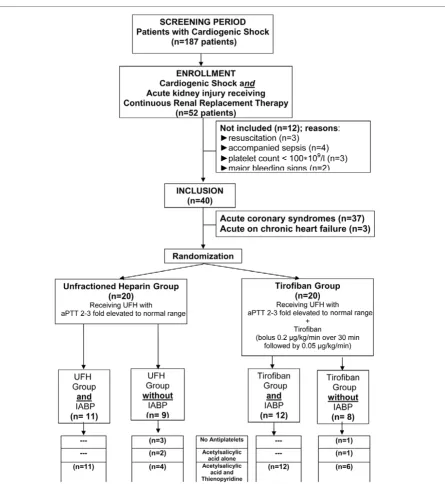
The PROBE (prospective randomised open-blinded endpoint) design study was approved by the ethics committee of the state medical board. Patients with cardiogenic shock (n = 187) and acute kidney injuries with necessity for CRRT (n = 52) were evaluated from January 2006 to December 2007. Cardiogenic shock was confirmed by both clinical and haemo-dynamic criteria. The clinical criteria were hypotension (systo-lic blood pressure of less than 90 mm Hg for at least 30 minutes or the need for supportive vasoactive medications to maintain a systolic blood pressure of greater than 90 mm Hg) and evidence of end-organ hypoperfusion (cool, diaphoretic extremities). Haemodynamic criteria were a reduced cardiac index (<2.2 L/minute per m2) and the presence of elevated pulmonary capillary occlusion pressure (>15 mm Hg) [15]. Acute kidney injury with necessity for CRRT was defined as a urine output of less than 0.5 mL/kg per hour for 6 hours and/ or an increase in serum creatinine of greater than or equal to 1.5 mg/dL within 24 hours according to the RIFLE (Risk, Injury, Failure, Loss, and End-stage kidney disease) criteria grade risk of renal dysfunction [16]. After admission to the intensive care unit (ICU) and after informed consent was given, all study par-ticipants (n = 40) were randomly assigned using a computer algorithm: UFH (n = 20) versus UFH + tirofiban (n = 20). Fig-ure 1 outlines data on patient enrolment, exclusion criteria, and follow-up. The primary endpoint was platelet loss during CRRT. Secondary outcomes were the efficacy of CRRT, measured by steady-state blood urea nitrogen (BUN) during CRRT, the need for platelet substitution (platelet count of less than 20 × 109/L) and major bleeding signs. Major bleeding included any bleeding requiring surgical intervention with a timely connection with CRRT, bleeding documented by com-puted tomography and/or ultrasound (intracerebral as well as retroperitoneal, abdominal, intestinal, or urogenital) or a decrease in haemoglobin of greater than 5 g/dL within 72 hours with a timely connection with CRRT. Minor bleeding involves a haemoglobin drop of less than or equal to 5 g/dL with or without an identified bleeding site.
CRRT was performed as continuous veno-venous haemodial-ysis, using a pump system (ADM; Fresenius, Bad Homburg, Germany) and capillary polysulfone haemofilters (Ultraflux® AV 1000S; Fresenius). Blood flow ranged from 100 to 120 mL/ hour. Dialysis flow was, on average, 2,000 mL/hour. The ultra-filtration rate was adjusted to patient hydratation and haemo-dynamic status. Haemofilters and tubing were changed routinely every 24 hours according to the manufacturer's rec-ommendations. Therefore, blood was reinfused to the patient
and the entire set of single-use tubes was changed together with the haemofilter. Blood products were administered during a CRRT pause if necessary when haemofilters were changed. The efficacy of CRRT was measured by mean treatment dose and steady-state BUN during CRRT [17]. The study drugs standard unfractioned heparin (UFH) and tirofiban were administered into the extracorporeal circuit as a prefilter infu-sion. All patients received UFH (Heparin-Natrium-ratiopharm®; ratiopharm GmbH, Ulm, Germany) by intravenous bolus appli-cation of 80 IU/kg followed by a continuous infusion with 18 IU/kg per hour. For UFH dose titration, plasma activated partial thromboplastin time (aPTT) was measured every hour until a two- to three-fold aPTT was reached. In cases of a steady state, CRRT was started and aPTT was measured twice daily. The short-acting reversible GP IIb/IIIa inhibitor tirofiban (Aggr-astat®; MSD Sharp & Dohme GmbH, Haar, Germany) has a protein binding of 65% and an elimination half-life of 1.5 to 2 hours predominantly achieved via the renal pathway. Accord-ing to the manufacturer's recommendations for severe renal insufficiency (creatinine clearance of less than 30 mL/minute), patients of the tirofiban group received, in addition to UFH, tirofiban by intravenous bolus application of 0.2 μg/kg per minute over 30 minutes followed by a continuous infusion with 0.05 μg/kg per minute. According to clinical guidelines, pro-phylactic platelet transfusions are recommended beyond a platelet count of less than 10 × 109/L [18]. Because of the off-label use of tirofiban, the threshold level for prophylactic plate-let transfusion was changed to 20 × 109/L.
Laboratory tests
phycoerythrin-cyanin [PECy5]-conjugated; Beckman Coulter, Krefeld, Ger-many). Increases in PAC-1 have been shown to be directly correlated with the activation of GP IIb/IIIa binding to fibrino-gen and/or monocytes. Measurements were performed by flow cytometer (FACSCalibur; Becton Dickinson, Heidelberg, Germany) and the Cellquest software system (Becton Dickin-son, Heidelberg, Germany). Monocytes were selectively gated for analysis by forward scatter, side scatter, and
CD14-PECy5. The percentages of PAC-1+/CD41a+/CD14+ platelet-monocyte aggregates were measured. Nonspecific immun-ofluorescence was determined using unspecific control mon-oclonal antibodies.
Statistical methods
[image:3.612.91.537.89.573.2]The sample size calculation was performed by the software of the Survey System (Creative Research Systems, Petaluma,
Figure 1
Study flowchart
Critical Care Vol 12 No 4 Link et al.
CA, USA). The sample size was calculated by the following acceptations: a platelet loss of more than 50% to baseline and a variability of platelet counts of 15%. To detect platelet loss with a power of 95%, a sample size of at least 20 patients in each study group was required. To compare the two treatment regimens, the Mann-Whitney U test and analysis of variance were used. Data were given as mean ± standard deviation. Dif-ferences were considered significant if the P value was less than 0.05. Observed-to-expected (O/E) mortality ratios were reported for each group using the observed-to-SAPS II (Sim-plified Acute Physiology Score) expected rates per group. Ninety-five percent confidence intervals were calculated.
Results
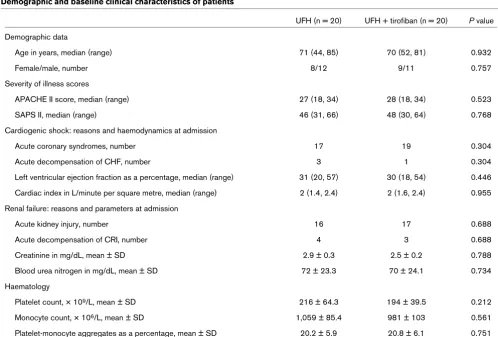
Forty patients with cardiogenic shock and acute kidney injuries receiving CRRT were studied for an alternative anticoagulation regimen with the GP IIb/IIIa receptor antagonist tirofiban. Baseline characteristics of the patients are shown in Table 1. All baseline characteristics were well balanced between the treatment groups. Thirty-six of the patients had an acute myo-cardial infarction, and only four patients had a cardiogenic shock based on acute on chronic heart failure. Clinical
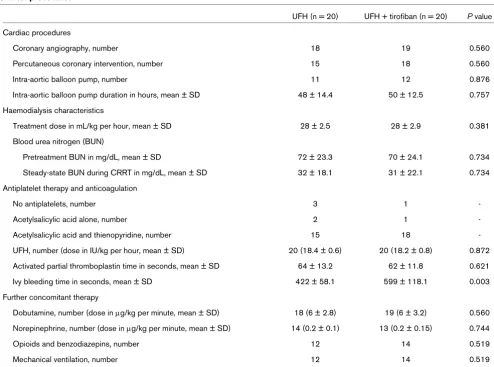
proce-dures are summarised in Table 2. All patients with acute coro-nary syndromes received a percutaneous corocoro-nary intervention, and in 23 cases an IABP was implanted. Most patients received vasoactive therapy at randomisation and during the whole study period of 4 days.
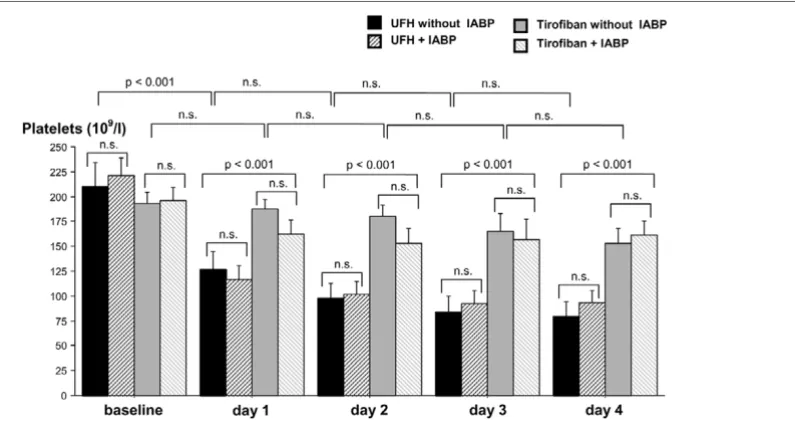
Platelet counts are shown in Figure 2. Baseline platelet counts in the two treatment groups were equivalent (194 ± 39.5 ver-sus 216 ± 64.3 × 10⁹/L, P = n.s. [not significant], n = 20). Already after 1 day, patients assigned to tirofiban + UFH had a significant higher platelet count compared with patients assigned to UFH (172 ± 52.9 versus 121 ± 49.2 × 10⁹/L, P = 0.003, n = 20). This difference between the two treatment groups continued over the study period up to 4 days (158 ± 45.3 versus 87.3 ± 41.1 × 10⁹/L, P < 0.0001, n = 20).
[image:4.612.55.553.377.713.2]The influence of IABP treatment on platelet count is shown in Figure 2. At day 2, which is the mean IABP duration, there was no significant difference in platelet count between the UFH groups with or without IABP. In the same way, no significant differences could be observed in the tirofiban groups with or
Table 1
Demographic and baseline clinical characteristics of patients
UFH (n = 20) UFH + tirofiban (n = 20) P value
Demographic data
Age in years, median (range) 71 (44, 85) 70 (52, 81) 0.932
Female/male, number 8/12 9/11 0.757
Severity of illness scores
APACHE II score, median (range) 27 (18, 34) 28 (18, 34) 0.523
SAPS II, median (range) 46 (31, 66) 48 (30, 64) 0.768
Cardiogenic shock: reasons and haemodynamics at admission
Acute coronary syndromes, number 17 19 0.304
Acute decompensation of CHF, number 3 1 0.304
Left ventricular ejection fraction as a percentage, median (range) 31 (20, 57) 30 (18, 54) 0.446
Cardiac index in L/minute per square metre, median (range) 2 (1.4, 2.4) 2 (1.6, 2.4) 0.955
Renal failure: reasons and parameters at admission
Acute kidney injury, number 16 17 0.688
Acute decompensation of CRI, number 4 3 0.688
Creatinine in mg/dL, mean ± SD 2.9 ± 0.3 2.5 ± 0.2 0.788
Blood urea nitrogen in mg/dL, mean ± SD 72 ± 23.3 70 ± 24.1 0.734
Haematology
Platelet count, × 109/L, mean ± SD 216 ± 64.3 194 ± 39.5 0.212
Monocyte count, × 106/L, mean ± SD 1,059 ± 85.4 981 ± 103 0.561
Platelet-monocyte aggregates as a percentage, mean ± SD 20.2 ± 5.9 20.8 ± 6.1 0.751
without IABP. Similarly, no differences in platelet count in patients with or without IABP were detected on days 3 and 4. After discontinuation of IABP, no significant increase in plate-let count was observed for either the UFH or the tirofiban group until the end of the study period.
Besides the different anticoagulation with UFH or UFH and tirofiban, the patients were treated with different antiplatelet regimens (no antiplatelets, acetylsalicylic acid alone, or com-bined antiplatelet therapy with acetylsalicylic acid and thienopyridine) (Table 2). Since the number of patients in the subgroups with no antiplatelet therapy or with acetylsalicylic acid alone was too low, no statistical analysis could be per-formed. But, as shown in Figure 3, the course of platelet count was comparable in the three antiplatelet subgroups during the whole study period.
The efficacy of CRRT was estimated by mean treatment dose, steady-state BUN during CRRT, and haemofilter life span. The calculated mean treatment dose was 25 to 30 mL/kg per hour in both anticoagulation regimens and confirmed by an accept-able steady-state BUN during CRRT (Taccept-able 2).
The platelet transfusion threshold was defined as a platelet count of less than 20 × 109/L. During the study period, in three patients of the UFH group, a platelet loss of less than 20 × 109/L was registered without any bleeding signs. Two patients received one platelet unit and one patient needed two units for platelet increase. The number of platelet units related to the cumulative days of CRRT was calculated as 0.05 ± 0.02. In the tirofiban group, no platelet transfusion was necessary. Thus, the difference of platelet transfusions between the two groups was significant (P = 0.016, n = 20) (Table 3).
The study was not powered for mortality. The in-hospital mor-tality rates were 35% in the UFH + tirofiban group and 40% in the UFH group. ICU mortality, hospital mortality, O/E mortality ratios, and 95% confidence intervals were calculated (Table 3).
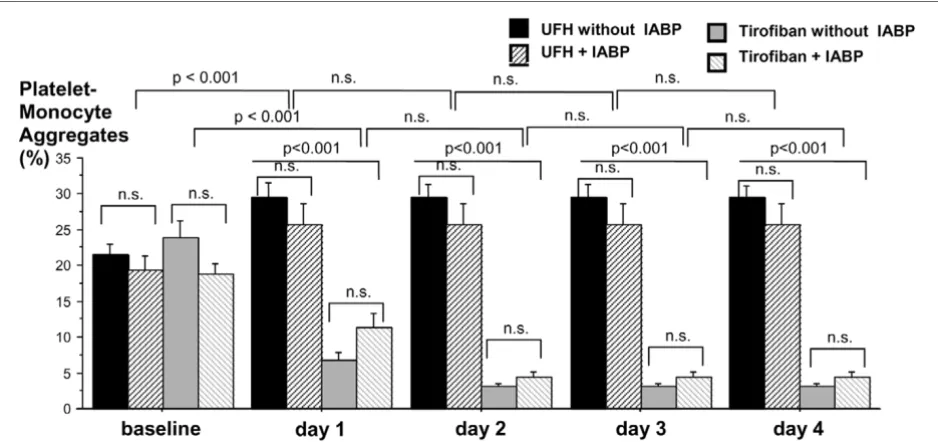
In all patients, the baseline levels of monocytes were not differ-ent between the two anticoagulation regimens (UFH + tirofiban versus UFH: 981 ± 103.6 versus 1,059 ± 85.4 × 10⁶/L, n = 20, P = n.s.). During CRRT with UFH + tirofiban, monocyte counts increased significantly (1,394 ± 151 versus 945 ± 77.3 × 10⁶/L, n = 20, P = 0.012). The percentage of PAC-1/CD41a-positive monocytes before starting CRRT was equivalent between the two anticoagulation regimens (20.8% ± 6.1% versus 20.2% ± 5.9%, n = 20, P = n.s.). Within 24 hours, the combined UFH + tirofiban anticoagulation resulted in a decrease of PAC-1/CD41a-positive platelet-monocyte coaggregates whereas with UFH alone these coaggregates increased (9.5% ± 5.8% versus 27.5% ± 9.3%, n = 20, P < 0.001). The follow-up of 4 days presented a further decrease of platelet-monocyte coaggregates in the tirofiban group; within the UFH group, the coaggregates remained stable but elevated to baseline (27.5% ± 9.3% versus 20.2% ± 5.9%, n = 20, P < 0.001). This difference between the two anticoagu-lation regimens was already present after 24 hours of treat-ment (Figure 4).
Discussion
[image:5.612.134.532.95.306.2]In a pilot study, we investigated the possible use and effective-ness of the reversible platelet GP IIb/IIIa receptor inhibitor tirofiban to preserve platelet number and function during CRRT in patients with cardiogenic shock. Tirofiban additional to UFH for anticoagulation apparently prevented platelet loss
Figure 2
Mean platelet counts during the study period in patients treated with unfractioned heparin (UFH) versus UFH + tirofiban and with or without intra-aortic balloon pump (IABP)
Critical Care Vol 12 No 4 Link et al.
over a period of 96 hours of CRRT. Furthermore, the inhibition of the activated platelet fibrinogen receptor GP IIb/IIIa (PAC-1) by tirofiban results in an inhibition of platelet-leukocyte inter-action and aggregation [7,8,21]. We examined changes in platelet loss and platelet-monocyte coaggregates by analysing the platelet-specific CD41a and PAC-1 antigen on monocytes using three-color flow cytometry as whole-blood technique. The percentage of platelet-monocyte coaggregates showed a highly significant decrease by combined anticoagulation with UFH and tirofiban. Platelet-monocyte aggregates were shown to promote monocyte adhesion to endothelium and to induce proinflammation [22-25]. Our findings suggest that the com-bined anticoagulation with UFH and tirofiban during CRRT inhibits platelet activation and platelet-monocyte interactions with consequences for platelet protection and antithrombotic and anti-inflammatory effects. In contrast, the treatment with UFH alone increased platelet-monocyte binding.
Platelet loss under CRRT in the UFH group was marked. This may be related to the critically ill patients with cardiogenic
shock combined with acute kidney injury. Our results are com-parable to other examinations of critically ill patients with mul-tiple organ dysfunction syndrome and acute kidney injuries [26]. Neither the concomitant treatment with intra-aortic coun-terpulsation nor the antiplatelet therapy with acetylsalicylic acid and thienopyridine had an effect on the platelet loss between these subgroups.
[image:6.612.57.551.110.477.2]The efficacy of CRRT assessed by mean treatment doses and steady-state BUN during CRRT was comparable in the two treatment groups. Despite the different anticoagulation regi-mens and the higher potency of anticoagulation within the tirofiban + UFH group, this therapy was not associated with an increased number of bleeding events. To minimise the risk of bleeding, tirofiban and UFH were administered into the extra-corporeal circuit as a prefilter infusion. The study was not focused on bleeding events and therefore an analysis regard-ing bleedregard-ing events would be totally underpowered. But as a result, no clinically important bleedings were detected and no transfusions of red blood cells or platelet units were necessary
Table 2
Clinical procedures
UFH (n = 20) UFH + tirofiban (n = 20) P value
Cardiac procedures
Coronary angiography, number 18 19 0.560
Percutaneous coronary intervention, number 15 18 0.560
Intra-aortic balloon pump, number 11 12 0.876
Intra-aortic balloon pump duration in hours, mean ± SD 48 ± 14.4 50 ± 12.5 0.757
Haemodialysis characteristics
Treatment dose in mL/kg per hour, mean ± SD 28 ± 2.5 28 ± 2.9 0.381
Blood urea nitrogen (BUN)
Pretreatment BUN in mg/dL, mean ± SD 72 ± 23.3 70 ± 24.1 0.734
Steady-state BUN during CRRT in mg/dL, mean ± SD 32 ± 18.1 31 ± 22.1 0.734
Antiplatelet therapy and anticoagulation
No antiplatelets, number 3 1
-Acetylsalicylic acid alone, number 2 1
-Acetylsalicylic acid and thienopyridine, number 15 18
-UFH, number (dose in IU/kg per hour, mean ± SD) 20 (18.4 ± 0.6) 20 (18.2 ± 0.8) 0.872
Activated partial thromboplastin time in seconds, mean ± SD 64 ± 13.2 62 ± 11.8 0.621
Ivy bleeding time in seconds, mean ± SD 422 ± 58.1 599 ± 118.1 0.003
Further concomitant therapy
Dobutamine, number (dose in μg/kg per minute, mean ± SD) 18 (6 ± 2.8) 19 (6 ± 3.2) 0.560
Norepinephrine, number (dose in μg/kg per minute, mean ± SD) 14 (0.2 ± 0.1) 13 (0.2 ± 0.15) 0.744
Opioids and benzodiazepins, number 12 14 0.519
Mechanical ventilation, number 12 14 0.519
in patients treated with the combined tirofiban + UFH antico-agulation. Nevertheless, further studies are warranted to ascertain the safety of an anticoagulation regimen with tirofiban + UFH during long-term CRRT.
One might argue that the study could be limited by (a) the open-label character of its design, (b) the small number of patients, (c) the lack of a specific antidote for tirofiban, and (d) missing data on long-term efficacy and bleeding events of tirofiban during CRRT. Because of the pilot-study character and the off-label use of tirofiban during CRRT, the physicians were not blinded. However, clinical evaluation and determina-tion of primary endpoints were done separately by clinical and experimental investigators, the latter of which were blinded to the clinical data of the patients. As there is no specific antidote for tirofiban in cases of bleeding events, donor platelets should be transfused and haemofiltration is suggested for extracor-poreal elimination of tirofiban [27]. A recent development of a rapid whole-blood point-of-care platelet function assay, the rapid platelet function assay, now allows for the bedside monitoring of platelet inhibition by GP IIb/IIIa receptor antago-nists [28]. Further investigations with larger numbers of patients are necessary for the determination of haemofilter run times, long-term efficacy, and bleeding events of tirofiban dur-ing CRRT.
Conclusion
The GP IIb/IIIa receptor antagonist tirofiban inhibits platelet activation and platelet-monocyte interaction. Its use in addition to UFH during CRRT prevents platelet loss and preserves platelet function.
Competing interests
The authors declare that they have no competing interests. This study, which originally included 20 patients, was initiated with financial support from MSD Sharp & Dohme GmbH. Investigations of an additional 20 patients were financed by the authors.
Authors' contributions
AL helped to initiate the study, participated in the statistical analysis of the data and in interpreting the data, and drafted the manuscript. MG led CRRT and participated in the statisti-cal analysis of the data and in interpreting the data. SS and RR participated in experimental investigations. MB helped to
initi-Figure 3
Mean platelet counts during the study period in patients treated with unfractioned heparin (UFH) versus UFH + tirofiban and with different antiplate-let therapy regimens
Mean platelet counts during the study period in patients treated with unfractioned heparin (UFH) versus UFH + tirofiban and with different antiplate-let therapy regimens. Data are shown as mean ± standard deviation.
Key messages
• The glycoprotein IIb/IIIa receptor antagonist tirofiban inhibits platelet activation and platelet-monocyte interaction.
[image:7.612.61.558.90.355.2]Critical Care Vol 12 No 4 Link et al.
[image:8.612.63.550.106.369.2]ate the study and participated in the statistical analysis of the data and in interpreting the data. All authors read and approved the final manuscript.
Table 3
Primary and secondary endpoints
UFH (n = 20) UFH + tirofiban (n = 20) P value
Platelet/Monocyte counts at the end of CRRT
Platelet count, × 109/L, mean ± SD 87 ± 41.1 158 ± 45.3 0.001
Monocyte count, × 106/L, mean ± SD 945 ± 77.3 1,394 ± 151 0.012
Platelet-monocyte aggregates as a percentage, mean ± SD 27.5 ± 9.3 3.9 ± 2.1 0.001
Bleeding events during CRRT
Minor bleeding, number 2 1 0.560
Major bleeding, number 0 0 1
Platelet transfusions during CRRT
Platelet units per patient per day, mean ± SD 0.05 ± 0.02 0 0.016
Outcome
Intensive care unit mortality rate, number (percentage) 8 (40) 7 (35) 0.752
Hospital mortality rate, number (percentage) 8 (40) 7 (35) 0.752
SAPS II predicted mortality rate as a percentage 36.9 41.4
-Observed-to-expected mortality ratio 1.08 0.85
-95% confidence interval for the observed-to-expected mortality ratio 0.46, 1.97 0.34, 1.59
-Values are presented as number of patients or mean ± standard deviation (SD). CRRT, continuous renal replacement therapy; SAPS, Simplified Acute Physiology Score; UFH, unfractioned heparin.
Figure 4
Mean platelet-monocyte aggregates during the study period in patients treated with unfractioned heparin (UFH) versus UFH + tirofiban and with or without intra-aortic balloon pump (IABP)
[image:8.612.73.542.457.678.2]Acknowledgements
We would like to thank all of the people who were involved in the study.
References
1. Koreny M, Karth GD, Geppert A, Neunteufl T, Priglinger U, Heinz G, Siostrzonek P: Prognosis of patients who develop acute renal failure during the first 24 hours of cardiogenic shock after myocardial infarction. Am J Med 2002, 112:115-119. 2. Hochmann JS, Sleeper LA, White HD, Dzavik V, Wong SC, Menon
V, Webb JG, Steingart R, Picard MH, Menegus MA, Boland J, San-born T, Buller CE, Modur S, Forman R, Desvigne-Nickens P, Jacobs AK, Slater JN, LeJemtel TH, SHOCK Investigators: Should we emergently revascularize occluded coronaries for cardio-genic shock: one-year survival following early revasculariza-tion for cardiogenic shock. JAMA 2001, 285:190-192. 3. Bold J, Menges T, Wollbrück M, Sonneborn S, Hempelmann G:
Continuous hemofiltration and platelet function in critically ill patients. Crit Care Med 1994, 22:1155-1160.
4. Mulder J, Tan HK, Bellomo R, Silvester W: Platelet loss across hemofilter during continuous hemofiltration. Int J Artif Organs 2003, 26:906-912.
5. Notohamiprodjo M, Andrassy K, Bommer J, Ritz E: Dialysis mem-branes and coagulation system. Blood 1986, 4:130-141. 6. Lins LE, Boberg U, Jacobson SH, Kjellstrand C, Ljungberg B,
Skroder R: The influence of dialyzer geometry on blood coag-ulation and biocompatibility. Clin Nephrol 1993, 40:281-285. 7. Spangenberg P, Redlich H, Bergmann I, Losche W, Gotzrath M,
Kehrel B: The platelet glycoprotein IIb-IIIa complex is involved in the adhesion of activated platelets to leukocytes. Thromb Haemost 1993, 70:514-521.
8. Gawaz MP, Mujais SK, Schmidt B, Blumenstein M, Gurland HJ: Platelet-leukocyte aggregates during hemodialysis: effect of membrane type. Artif Organs 1999, 23:29-36.
9. Kawabata K, Nakai S, Miwa M, Sugiura T, Otsuaka Y, Shinzato T, Hiki Y, Tomimatsu I, Ushida Y, Hosono F, Maeda K: Platelet GP IIb/IIIa is activated and platelet-leukocyte coaggregates formed in vivo during hemodialysis. Nephron 2002, 90:391-400.
10. Gawaz MP, Mujais SK, Schmidt B, Burland HJ: Platelet-leukocyte aggregation during hemodialysis. Kidney Int 1994, 46:489-495.
11. The PRISM-Plus Investigators: Inhibition of the platelet glyco-protein IIb/IIIa receptor with tirofiban in unstable angina and non-Q-wave myocardial infarction. N Engl J Med 1998, 338:1488-1497.
12. Hiramatsu Y, Gikakis N, Anderson HL III, Gorman JH III, Marcinkie-wicz C, Gould RJ, Niewiarowski S, Edmunds LH Jr: Tirofiban pro-vides "platelet anaesthesia" during cardiopulmonary bypass in baboons. J Thorac Cardiovasc Surg 1997, 113:182-193. 13. Koster A, Kukucka M, Bach F, Meyer O, Fischer T, Mertzlufft F,
Loebe M, Hetzer R, Kuppe H: Anticoagulation during cardiopul-monary bypass in patients with heparin-induced thrombocyto-penia type II and renal impairment using heparin and the platelet glycoprotein IIb/IIIa antagonist tirofiban. Anesthesiol-ogy 2001, 94:245-251.
14. Straub A, Azevedo R, Beierlein W, Wendel HP, Dietz K, Ziemer G: Tirofiban (Aggrastat®) protects platelets and decrease
plate-let-granulocyte binding in an extracorporeal circulation model. J Thorac Cardiovasc Surg 2006, 54:162-167.
15. Hollenberg SM, Kavinsky CJ, Parrillo JE: Cardiogenic shock. Ann Intern Med 1999, 131:47-59.
16. Venkataraman R, Kellum JA: Defining acute renal failure: the RIFLE criteria. J Intensive Care Med 2007, 22:187-193. 17. Uchino S, Bellomo R, Morimatsu H, Morgera S, Schetz M, Tan I,
Bouman C, Macedo E, Gibney N, Tolwani A, Oudemans-van Straaten H, Ronco C, Kellum JA: Continuous renal replacement therapy: a worldwide practice survey. The beginning and end-ing supportive therapy for the kidney (B.E.S.T. kidney) investigators. Intensive Care Med 2007, 33:1563-1570. 18. Greinacher A, Kiefel V, Klüter H, Kroll H, Pötzsch B, Riess H:
Rec-ommendations on platelet transfusion by the Joint Working Party of the German Society of Transfusion Medicine (DGTI), Thrombosis and Haemostasis Research (GTH), and Haemo-tology and Oncology (DGHO). Dtsch Med Wochenschr 2006, 131:2675-2679.
19. Mielke CH, Kaneshiro MM, Maher IA: The standardised normal Ivy Bleeding Time and its prolongation by aspirin. Blood 1969, 34:204-215.
20. Michelson AD: Flow cytometry: a clinical test of platelet function. Blood 1996, 87:4925-4936.
21. Shattil SJ, Hoxie JA, Cunningham M, Brass L: Changes in the platelet membrane glycoprotein IIb-IIIa complex during plate-let activation. J Biol Chem 1985, 260:11107-11114.
22. Elstad MR, La Pine TR, Cowley FS, McEver RP, McIntyre TM, Pres-cott SM, Zimmerman GA: P-selectin regulates platelet-activat-ing factor synthesis and phagocytosis by monocytes. J Immunol 1995, 155:2109-2122.
23. Weyrich AS, Elstad MR, McEver RP, McIntyre TM, Moore KL, Mor-rissey JH, Prescott SM, Zimmerman GA: Activated platelets sig-nal chemokine synthesis by human monocytes. J Clin Invest 1996, 97:1525-1534.
24. Neumann FJ, Zohlnhofer D, Fakhoury L, Ott I, Gawaz M, Schömig A: Effect of glycoprotein IIb/IIIa receptor blockade on platelet-leukocyte interaction and surface expression of the platelet-leukocyte integrin MAC-1 in acute myocardial infarction. J Am Coll Cardiol 1999, 34:1420-1426.
25. da Costa Martins P, Berk N van den, Ulfman LH, Koenderman L, Hordijk PL, Zwaginga JJ: Platelet-monocyte complexes support monocyte adhesion to endothelium by enhancing secondary tethering and cluster formation. Arterioscler Thromb Vasc Biol 2004, 24:193-199.
26. Morabito S, Guzzo I, Solazzo A, Muzi L, Luciani R, Pierucci A: Con-tinuous renal replacement therapies: anticoagulation in the critically ill at high risk of bleeding. J Nephrol 2003, 16:566-571.
27. Koster A, Chew D, Merkle F, Gruendel M, Jurmann M, Kuppe H, Oertel R: Extracorporeal elimination of large concentrations of tirofiban by zero-balanced ultrafilration during cardiopulmo-nary bypass: an in vitro investigation. Anesth Analg 2004, 99:989-992.