THE WRITING NEEDS OF OMANI EFL STUDENTS FOR TIlE DEVELOPMENT OF GRADE 11 ENGLISH PROGRAM: A NEEDS
ANALYSIS Said Al-Saadi
Ministry of Education, Sultanate of Oman, [email protected]
Moses Samuel
University of Malaya, Kuala Lumpur, Malaysia [email protected]
Abstract: This article gave a detailed description of a national large scale needs analysis in the reform of the grade 11English language curriculum in Oman. It highlighted the needs analysis practises of using triangulation of multiple sources (students, teachers, supervisors, heads of department, and textbooks) and multiple methods (questionnaires, interviews, content analysis) in the data collection stage to validate the study findings. The actual grade 11English Language textbooks (n=4) were first analyzed for writing skills content and then contrasted with the perceived needs of 982 students, 64 teachers, 4 supervisors, and 3 heads of department. The findings revealed that a gap existed between the content of the grade 11 curriculum and the perceived needs of the students. The Grade 11£L curriculum provided little space for students to develop writing competence. The findings related to language innovation/reform were then discussed and implication were made for the grade 11program aim, principles, teaching methodology, content and teacher training in Oman.
Keywords, needs analysis; writing difficulties; curriculum innovation; implementation needs
INTRODUCTION t aIld
Needs analysis (NA), by its very nature, is highly context-depend~~ atiOIl population-specific (West, 1994). Most NAs are concerned with needs spec1;eceIlt at the level of individuals or, most often, learner type (long, 2005). VI is1I researchers like Nelson (2000) and Long (2005) stress that what is needed ~o about serious effort by applied linguists to identify generalizations that can be rna ;ldiIlgs how to conduct NA for certain populations in certain sectors. However, the II){tare about language tasks, genres, and so forth encountered inthis or that conteil1lilar detailed and insightful, they are often only of u e to other context of same or Sf great students. Whereas the findings based on studies of far wider audiences ar~0 IpIlg
~~ionale for recommendation need to be explicit, empirically-supported (Waters & Ilches, 2001) and expressed in familiar terms since the primary audiences for findings from the public sector NAs include politicians, economists and other stakeholders. This study contributes to the literature of NA by conducting a large sca~eanalysis of the writing needs of Om ani EFL learners in the public schools, Whichwill provide the framework for conducting NA on a national basis, putting in ~ractice all the methodological issues and making the results of this NA available
Or public in empirically-supported recommendations. This article reports on the extent to which the current EL program at Omani grade 11 schools fulfil the writing ~eeds of Omani students. The narrative of our journey is organized as follows. We
Irst discuss some observation regarding the latest NA articles and relate them to the lleed for such study. Second, we briefly describe the setting and methods of the lleeds analysis in terms of the triangulation of source and methods. Third, we ~~arnine the findings for each of the three research questions. We conclude by ISCUssingin detail some of the pedagogical implications of the findings for the reform of the grade 11 El curriculum in Oman.
LITERATURE REVIEW
The target populations of many NA studies are in the level of undergraduates ~~dents, .for example, Patterson (2001), Al- Busaidi (2003) ~nd Shuja'a (2004)
Ii
dy ulllversity students' language needs, whereas Al-Dugaily (1999) and Al-G~s~eini (2004) investigate the linguistic needs in college level students. Thec dlUgs about the language genres, task, and so forth, are often applied to other contexts with the same or similar students. Recent researchers of NA, such as tholernan(1998), Long (2005), Brecht and Rivers (2005) and Cowling (2007), stress
ae notion of generalization of the NA findings in the societal level. Long (2005) gr&uesthat "what is needed now is a serious effort by applied linguists to identify Peneralization, that can be made about low best to conduct needs analysis for IOPUlationA or B in sector C orD,given constraints E or F. (p. 5)" At the societal
s:v
e1, the needs for language are generally defined within very general social goals r ~h as national security, social justice or the like (Brecht & Rivers, 2005). Theallon lb' h . 1 I . . I'
PI .a e ehind associating language Wit soc leta goa IS to motivate po ICY and
laannIng for language education at the national level. Inlight of this innovation in
tn
ll&uage Teaching and Needs Analysis, the present research is devoted to a ~;~hOdology for laying out -to the best extent possible-the analysis of the Omaniob students' learning needs in public schools. As to methodology, two Stservations can be made in relation to NA procedures. All studies used English ",~~entsand English teachers as the main sources of information. This complements
~ l~ CUrrent and previous studies finding, that learners and teachers have special
(~ t to, When it comes to deciding the content of the course they are to undergo ~o~~~ht& Rivers, 2005; Hutchinson & Waters 1987; Holliday 1.992, 1994; Long,
a", ' Nunan, 2001).This conclusion is logical because It raises the level of
th
areness of both parties as to why they are doing what they are doing and leadsel11t . I' J
"'h
0 reflect usefully on means and ends. ItIS a so Important to note, t iat, evenPrell learners and teachers are able to provide useful and reliable insight about eSentOr futur needs, better and more readily accessible sources may be available
including experienced language supervisors, graduates of the program concerned, employers, administrators, and so forth. This is achieved by Al-Husseini (2004~ who approached 6 groups of sources and Shuja'a (2004) who also approache employers in addition to students and teachers to make the data obtained ro~~ reliable and meaningful. Others, such as Al-Dugily (1999), Patterson (2001) and Busaidi (2003) depend on students and teachers as the main and the only source :or their data collection; the reliability of their findings is in question, since involV11l~ other relevant sources would have provided more insight into the language involv~ in functioning successfully in their target discourse.The second observation, ~n relation to the methodological aspect, is that questionnaires and interviews are t e
most dominant tools used in all studies (see Table 2.3). Al-Dugily (1999) uses thero as the only tools for data collection in his study. It is commonly noticed that roanY of NA studies in teaching English as a second language (TESL) resear~hes ~~ carried out via semi structural interviews, or more commonly questionnalIes, .0
instance, Aguilar (2005), Choo (1999), Abdul Aziz (2004), Keen (2006), DavI~~ (2006), Vadirelu, (2007), Taillefer (2007), Cowling (2007) Cid, Granena and Trag1y (2009) and Spada, Barkoui, Peters, So and Valeo (2009). Yet, they are not the o~ i resources in most of NA researches. Recently, NA studies such as Al~Hussel~i (2004), Shuja'a (2004) and Patterson (2001), focused their NA by uSIng. rouhe method approach "Triangulation" to, as Patterson (2001) puts it, "both clartfy,t a meaning and increase the validity" of the research findings. Triangulation I~ n procedure used by NA researchers to enhance the readability of their interpret~U~s of their data (Long, 2005). It involves the use of multiple-data-collection roet °nd and may also involve the incorporation of multiple data sources, investigators ~ng theoretical perspectives (Aguilar, 2005). The rationale behind the notion of applY~d triangulation techniques is to contribute to the trustworthiness of the data ent increase confidence in research findings. Based on this assumption, the ~re~ple study considers triangulation of methods and sources as a main research fflnc~ish that is going to be practically carried to gain a clearer picture of students Eng nd language learning needs. Ba ed on the understanding of the strengthS f~he weaknesses of the former studies, the pre ent study tries to take ad antage,
ff
rent development in NA theories by expanding the focus to consider di e and approache of NA and by focusing on a national level need ana,lyse~ef to implementation needs, Ital 0 triangulate the rie , meth d and ource 10Of t the ustain a m re ~eaningf:tl, valid and .reliable jnformat~on. It i hoped, t~~gJish present tudy will help 10 under tanding and de eloping the tate of 'nS inlanguage teaching in thi ' part of the world and to put in practice the inoO\'aliO the era of a' suggested by Long (2005) and 0\ ling (2007),
OBJE TIVE OF TIlE T DY
Ihe following re earch questions guide thi studv:.I Inllgtl'oalfe
J, What are the writing skills dev loped in the current English
cours 'book in grad' 11
or
mani sch )1'? deJ J3. To what extent are the students EL writing needs met by the content of English language course book in grade 11 of Om ani schools?
METHODOLOGY
Triangulation of data collection techniques and source of information are considered crucial factors in needs analysis (Brecht & Rivers, 2005; Coleman, 1998; Cowling 2007; Long 2005; Richards, 2001). Therefore, multiple sources, such as, students, teachers, supervisors, heads of departments and the grade 11 textbooks were approached for the purpose of data collection. In addition, varieties ?f data were gathered and compared using multiple methods such as questionnaires, Interviews, and content analysis.
Participants
A. stratified sampling technique was used to select 982 EFL students and 46 EL teachers teaching English in grade 11 schools. Also 4 EL supervisors and 3 heads of department (supervision and curriculum department) were purposely selected due to their limited number from the Ministry of Education in Oman. The random students' and teachers' sample was withdrawn from four out of eleven educational regions of the whole Sultanate. These four regions were Muscat, Al-Sahrqyah South, AI- Batenah South and Al- Batenah North. According to the current study, the Omani students are divided into regions, and each region is divided into schools, the schools are sub divided into male and female schools. A stratified sampling technique was used to randomly select the study samples as in Table 1, which shows that 982 students participated in this study; divided into 524 male students and 458 female students studying English in grade 11 of Omani schools, whereas teachers were divided into 34 male and 30 female teachers teaching grade 11 EL Program.
l'able 1
~ts' Profile in Terms of Gender and Regions
Region Total
Muscat L-Batyneh Al-Batyneh Al-Sharqyeh
~ North South
ender
Male 119 103 124 178 524
).
Female 43 126 121 168 458
~ 162 229 245 346 982
It, ,
OtIS IInportant to understand that all regions adopt the same language program. In ther word'. they have the arne course books, as essment style, resource , a~d. so f~rth,Ih students in all Omani regions '~lllre the same background charac~enstlc . IIey are for XL mple, Omaru, boy' and girl, aged between ,16 to 18 years,. IIIgrade
c .
I:ach of the elev n re 'Ions can represent the other' 111 terms of philo ophy,Instrument d The current study used questionnaires to collect information from students ~ teachers in the Omani public schools. The EL teachers' survey was written 10 English, while the students' survey was in Arabic for two reasons. First, it was easier for students to understand in their native language. Second, the statements included were difficult and responding to them in English might make it more complex for students to fully grasp the intent of the survey. The questionnaires were first written in English and then translated into Arabic. Two procedures were taken to ensure the accuracy of the translation. First, the source version of th~ questionnaires was translated into Arabic and then the Arabic version was translat~h back into English by the researcher and other people who were familiar Wit English and Arabic. The back translation was for two purposes, to ensure that. the original intent of the source questionnaire was perceived and to make a companso~ between the Arabic and English versions. The students' and teache~ questionnaires consisted of three sections. Section one collected the demograplu~ mformation about teachers and students. It is worth saying that the persona information like gender, school type were not considered as study variables rather they provided information about whether the questionnaires were distrib~ted t~ ~ sufficiently varied sample to represent the study population. Section two wclu ed the language writing needs. These data were based on self-reports on the type. ~ g
frequency of writing skills and sub-skills that the students practice. The WflU~s skills were chosen for their documented importance in the skill literature. T. b
mcluded 23 items (refer to the appendix) representing skills and sub-skills, W~ICe
students were asked to indicate on a scale of frequency, how often they ~e difficulty doing each one during their study. Indeveloping this test, Iconsulted
N-following studies in needs analysis, e.g. Graves, (200 I), Al-Busaidi (~003), her Husseini (2004), ASyabi (1995) and from my own experience as an EnglIsh teae and supervisor.
Piloting the questionnaire it
Before piloting the questionnaire, it had gone through a pre-piloting st~ge ~her~d wa distributed among five ELT specialists from Sultan Qaboos Ufilverslt~ 'l1g Ministry of Education. Other copies were di tributed among PhD students stu
i~be
in University of Malaya. Their contribution was to comment on the language d II students' que tionnaire and its uitability for the language competence of gra ~011 of Ornani po t-ba ic educati n tudent. They were al 0 reque ted t corn~eflo!J1ethe design and its fitness. They advi ed to implify the language and expla~n : step of the term u sed in the questionnaire. The overall utcome fthi pre-ptl~t1f1gtUdY
wa more irnplificauon of the it rns inv Ived in the que tionnaire. The pdot ~ the wa carried out 10 AI- harqyeh outh region. The pil tmg was to lind o~'hich
general legibility of the, tud . It provided information a ut th extent.to \(t hfls participant were co-op irative and ke n to help 111finis lung th que '110nna~r~.. flnd also helped in te ting the study" tru .twc rthmcs: III terms )1' the \a!ldlt~d for reliability of the, tudy instrument. lmos t 10 .tudcnts w ire randornl sclcctL;dcntS piloting the questionnaire from f ur different sch I' c n'Isting of 50 mak stllj"the
, " (1
questionnaire. The researcher himself administered the pilot run to the piloting sample to gather information regarding the time it took the students to complete the qUestions, the clarity of the instruction, the ambiguity of the questionnaire items, requirement to include new topics, and the difficulties encountered in questionnaire adaptation. The pilot questionnaires were collected back immediately. The pilot run gave the research useful hints and clues to discover loopholes and inaccuracies in the questionnaire. Only 80 copies of the questionnaires were found suitable to be a~alyzed and 20 were rejected due to incomplete answers. These 80 copies were dIvided into 30 male students and 50 female students. This step was followed by an analysis of the subjects' responses to the questionnaire to ensure more reliability and validity of the scale as explained below.
The Questionnaire Reliability
An
indicator of the trustworthiness in the quantitative research tools is the Instrument's reliability. It indicates that the developed questionnaire would give the sarne results if it measures the same thing (Neuman, 2001). The proposed qUestionnaire's reliability was estimated by the Internal Constancy Approach. This approach was based on calculation of the correlation coefficient between each item score and the score of the whole scale. Cronbach's alpha coefficient was used, and the reliability statistic was .939 which was considered as significant and indicated that the all items included were reliable. Educators like Likert and others (1934) agreed that a reliability coefficient between .62 and .93 can be trusted.The Questionnaire Validity
Before being able to conclude that this study was trustworthy and ethical, however, sOrne more detailed aspects of the issue must be considered. A qualitative study cannot accomplish its most basic functions if the researcher has not established trust and reciprocity in the field. Therefore, to examine whether the developed instrument wOuld report valid scores, the validity of the instrument was studied (Neuman,
2001). The validity of the current study was assured using content validity, which is the extent to which the questions on the instrument were representative of all the POssible questions that a researcher could ask about the study content= (Creswell,
2005). The main rationale behind using this form of validity was that the possibility Cl.f that expert would know and can comment about the investigated topic was high Since tudent' linguistic needs were familiar to the involved experts. It could have been of Ie usefulne s if the research theme related to assessing personalities or attitude c re . In rder t make use of the panel of judges' or experts' feedback regarding the extent to whi h the new scale measure the writing competences ~eed d by mani tudents, the que tionnaires were handed to 12 arbitrators from
tnan. Yemen and th UK. They were addressed formally in aletter asking them to ~~adth item and determine the suitability of eac~l item to ~easure stu?ents'
In
'ui 'tic need and pro ide their comment regarding the clarity of the Items, ~~~ughtsand pr s ntr tion and to commcnt. n the transl~tion .(ifincluded). !his. tep I 'lilted 111 'han '111 f s 111 of the terms 111 the quesnonnaire to more implifiedacademic standard, so some of the items, which were classified as irrelevant skills were deleted.
Data Analysis
As to the questionnaires, descriptive and inferential statistical were used to ans~er the research questions by implementing the SPSS software. The descriptIve statistics were used to indicate the percentage and the frequency distribution of th~ re pondents' answers. Measures of central tendencies (mean and median) an
. ns independent sample t- test were used to analyze the data for the research q~estI~f 2-3. Interviews' data were analyzed by close study of the transcripts to IdenU Y what interviewees say about their attitudes and perceptions about the curren~ English curriculum, the needed writing skills and sub-skills to improve student~ linguistic competencies in English. After conducting the interviews, the analysIs started with their transcription from the audio cassettes. Finally content analysis ash systematic and objective research method was used in collecting data for resero:ch question one. A textbook analysis was used in this section to analyze the Enghs language tasks, skills and sub-skills embedded in the grade 11 English language teaching materials.
RESULTS AND DISCUSSION
The Actual Writing Skills Included In The Current Grade 11EL Textboo~s &
The first research question analyzes the present learning situation (HutchIll~on
we
Waters, 1987) by identifying the writing skills and the sub-skills found III tEnglish Language textbook through the use of content analysis. Perhaps the rno~s important source of present situation data in designing an EL syllabus is the analY~e of authentic texts (Richards, 2004). Content analysis enhances the readers' and k researcher's understanding of what is the exact content of the grade 11 courseboo t
by making explicit the patterns of writing skills choices found in the cu~eI1d textbooks. Grade 11 EL textbooks were titled 'Engage with Engli h', which al!1l~s t teaching English a a foreign language to Omani students in the public sChOOrs' fhe coursebook and workbooks were divided into two book for two s~rnest~v~ Each book was divided into five themes and each theme wa cla sified tntod.1 g
different units. Each unit of the five focu e on particular language skills- rea ~~v~ grammar, vocabulary, listening & speaking and writing. t the end, there wer~ ed optional page on' cro s culture' and 'Reading for plea ure". They "Vere desl;~ok
<IS stand alone unit which can be used in cia or for self tudy. The work for mirrored the framew rk of the cur' b ok. Itwas al divided into tw~ bO?k~t1de two semesters. The acti ities involved In the workb k were those which JOChere
writing and further language pracuce activities. By th end of each the!11C,tJar)' were review age which provided revision a tiviti ' f r grammar and voc.a~t1
A
included in the theme as well a wordli t acti itre and per onalization acttVlt~'lsO
rrammar reference ecuon and w rdlist and a funcuon languag review wcfe ed!I provided at th back f the workbc k. In addition, the w rkb ok conWlflfldcd
. . h i I J' . •• 1exIt:
wntrnu cellon, w ere stuc cnt c imp etc ree Wnung assi nun nts nne . 'lionS
writing task' ew approache to sec nd and f r i'11 Ianzuau tea 'lung iJls~fll\ Ihe
. h d i' . (' I' '11 f' I .'I~ II
CUrrent analysis was task based analysis. Long and Norris (2000), Long (2005) and Ferch (2005) advocated that task based needs analysis allows coherence in course design. The rationale for doing task based analysis rather than linguistic analysis Was because the task analysis usually offers more insights about the students' needs compared to 'usages' modelled in grammar based language teaching materials. It revealed more than the text based analysis about the dynamic qualities of target discourse (Long, 2005). Task based NA readily lend themselves as input for the ?esign of language syllabus or course. The findings of the textbooks analysis Identified the main writing skills and sub skills included in ten themes found in grade 11 English language textbooks. The skills and sub skills are listed in appendix 1, which presents a summary of the finding of the writing skills and sub-skills included in grade 11 EL textbooks in both semesters. Unit five of each theme emphasized development of students' writing skills. Almost all included writing tasks requiring students to write for a purpose rather than writing for the sake of writing. Repeatedly, students were referred to the process involved in writing before ~tarting to accomplish any writing task. Different genres of writing were highlighted
Inevery theme, such as vocational and academic genres, which provided the space for practicing different genres that can build solid foundation of writing skills. StUdents were exposed to the stage of writing from reading a model text to free Writing. Examples of the writing purposes found in grade 11 EL textbooks were to Write an email, holiday postcard, description of a tourist resort, letter of complaint, Shortprofile or biography, film review, application letter, and a festival report.
During the analysis, it was noticed that writing tasks were separated at the baCk of the workbook and students had to refer to that section whenever they want to perform any writing tasks. This created the feeling with teachers and students that Writing was not an essential task to be mastered because what was kept at the back of the book was supplementary material or glossaries. Italso impressed upon the teachers that writing was not given sufficient attention in the new textbooks as found out during the teacher interviews. Although the analyzed material provided Chance to practi e different writing genres, they should be more creative and have stimulating activities to focus students' attention on the things to be learned. ~obelman and Wiriyachitra (1995) stressed that writing material should be Intere ting, related to tudents ' interests, practical and related to real world tasks. l'he finding of re earch que tion one can be fed back into the grade 11 EL program and can al 0 work as a foundation for material developers, for two reasons. First,
the analytical methodology applied here provided real world or real life task naly i , which offered more insights about the students' needs through comparing
hat i pre ented to them and their perceived priority as in research question two. econd, the tas k based A findings are the bases for Task Based Language eaching TBL I',which as des ribed by [ ong 2005, is radically lea~er-centered and ater for the learn rs' internal developmental syllabus. The findings of the task :SCd cornpl mentcd tho se
or
the other. in tnlment~, pro.viding ~rst l:and formatton about the writing u ses reported as III the que uonnarre and interviewsThe Perceived English Language Writing Needs of Omani Students in Grade11 h
Inwhat follows, the findings presentation is organized according to the researc participants so, the students fmdings are presented separately followed by the findings related to the teachers and finally supervisors and heads of depart1l1en~ This is helpful to show the different perceptions and priorities according to eac group. It is also helpful to achieve cross group and within group comparison, to draw on the similarity and diversity of language use in post basic education schools.
aJ Finding related to the students .
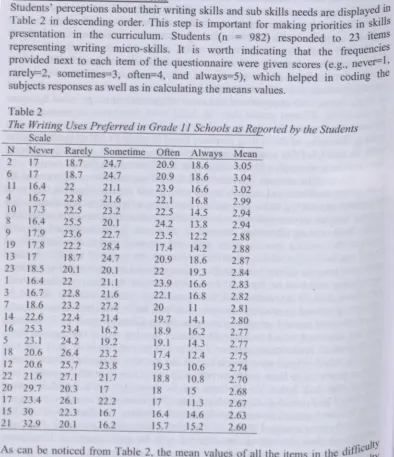
[image:9.418.7.401.157.614.2]Students' perceptions about their writing skills and sub skills needs are displayed. Is Table 2 in descending order. This step is important for making priorities in skil 5
presentation in the curriculum. Students (n = 982) responded to 23 ite~S representing writing micro-skills. It is worth indicating that the frequencl~S provided next to each item of the questionnaire were given scores (e.g., never- , rarely=2, sometimes=3, often=4, and always=5), which helped in coding the subjects responses as well as in calculating the means values.
Table 2
The Writing Uses Prel!rred in Grade 11Schools as Rel!..orted by the Students
Scale
N Never Rarel~ Sometime Often Alwa~s Mean
2 17 18.7 24.7 20.9 18.6 3.05
6 17 18.7 24.7 20.9 18.6 3.04
11 16.4 22 2l.l 23.9 16.6 3.02
4 16.7 22.8 21.6 22.1 16.8 2.99
10 17.3 22.5 23.2 22.5 14.5 2.94
8 16.4 25.5 20.1 24.2 13.8 2.94
9 17.9 23.6 22.7 23.5 12.2 2.88
19 17.8 22.2 28.4 17.4 14.2 2.88
13 17 18.7 24.7 20.9 18.6 2.87
23 18.5 20.1 20.1 22 19.3 2.84
1 16.4 22 21.1 23.9 16.6 2.83
3 16.7 22.8 21.6 22.1 16.8 2.82
7 18.6 23.2 27.2 20 11 2.81
14 22.6 22.4 21.4 19.7 14.1 2. 0
16 25.3 23.4 16.2 18.9 16.2 2.77
5 23.1 24.2 19.2 19.1 14.3 2.77
18 20.6 26.4 23.2 17.4 12.4 2.75
12 20.6 25.7 2 .8 19.3 10.6 2.74
22 216 271 21.7 18 10. 2.70
20 29.7 20.3 17 18 I 2.6<
17 2 .4 26.1 22.2 17 11. 2.67
15 0 22.3 16.7 164 14.6 2.6
21 32.9 20 I 16.2 157 152 2.60
s can be noticed from Ofable 2. the mean value. trail th it ms in th dil::!~~::~ scale arc high and ranging from .05 to 2.60. IIi rh mean' values 111the dd_'~ln\C
difficulty in achieving any skill, their ability in the same skill is low. On the other hand, where they have little difficulty in a skill, their ability in that skill is high. The above means values therefore reveal that according to the students' perception they have less ability with English writing or overall face difficulty dealing with any writing task. The shared pattern about the highest first five items is that they all have communicative and academic purpose. Item number 2, as an example, is the highest scoring item with mean value of 3.05. This indicates that students' most perceived difficult task, of the included writing tasks, was to organize their writing, so that the reader can understand their main ideas. This is also true for items 6, 11, 4, and 10, which deal with the same phenomena: making themselves clear when writing any text in English or to how best they can express themselves while writing any argument in English. On the other hand, the last items with the lowest mean values in Table 3 (i.e., items 17, 15, and 21) share a scientific purpose. This however does not mean that grade 11 students have no problem explaining in English writing the content of graphs, tables, charts and diagrams, or writing a report on scientific projects done in a laboratory. This finding is justified by the fact that the Omani grade 11 students are not learning science in school through the use of English instruction and also there is a very little or no exposure to English during their science lesson. Therefore, according to students, writing English for scientific PUrposes is not very required because they are not using it during their grade 11 study.
~illdi/Jgs Related to the Teachers
"feachers' perceptions about their students' writing skills and sub skills needs are displayed in Table 3 in descending order. This step is important for making
~riorities in skills presentation in the curriculum. Teachers (n
=
64) responded to 23 Items representing writing micro-skills."fable 3
The Language Writing Uses Preferred in Grade 11Schools as Reported by the ~hers
~Scale
LNever Rarel~ Sometime Often Alwa~s Mean
21 9.4 14.1 18.8 20.3 37.5 3.63
II 3.1 7.8 32.8 24.2 14.1 3.56
7 4.7 14.1 25 35.9 20.3 3.53
I
.1 15.6 31.3 26.6 23.4 3.52
8
0 18. 35.9 21.9 23.4 3.50
16
10.9 17.2 14.1 28.1 29.7 3.48
10
0 I . 32. 29.7 18.8 3.48
19
3.1 172 2 .1 32.8 18.8 3.47
S
3.1 156 2 .1 9.1 14.1 3.45
3
4.7 9.4 40.6 2, .1 17.2 3.44
4.7 156 281 5.9 15.6 3.42
4.7 9.4 _5 17.2 3.41
10.9 14 I 17.2 29.7 3.41
14 1.6 20.3 37.5 25 15.6 3.33
9 3.1 12.5 46.9 28.1 9.4 3.28
4 4.7 23.4 28.1 28.1 15.6 3.27
17 4.7 21.9 28.1 34.4 10.9 3.25
13 4.7 18.8 42.2 25 9.4 3.16
23 3.1 20.3 51.6 18.8 6.3 3.05
20 7.8 21.9 40.8 18.8 10.9 3.03
18 4.7 23.4 42.2 26.6 3.1 3.00
22 4.7 25 42.2 26.6 1.6 2.95
As can be noticed from Table 3, the mean values of all the items in the teachers' difficulty scale are high and ranging from 3.63 to 2.95, which is higher than for the students' self-reported difficulties. High means values in the difficulty scale means more difficulty, which is related to less ability. The above means values theref~r~ reveal that according to the teachers' perception, students have less a~i~itY WI~ English writing or overall face challenges while dealing with any wntIng tas . Another interesting point is the difference found between teachers and s~~ents ~ the priorities among writing sub-skill. Students' first five most needed wntlllg su d
kills shared communicative and academic purpose, such as items 2, 6, 11, 4, a~ 10. On the other hand, teachers' first five priorities were scientific and academIc oriented writing tasks as in item number 21 to write a report on scientific projects done in a laboratory, item number 11 to translating some concepts and ideas from Arabic to English, item 1 to write a summary of information they have read o~ listened to, and item 8 to use correct grammar, vocabulary, punctuatio~ an
sp lhng. Scientific oriented writing tasks were the least needed skills accordlllg ~o students whereas teachers perceived them as the most challenging task to e mastered. This finding can be justified by the fact that the teachers are more ~w~~ of the future coming EL related challenges that would face students while trYI~~ g ca:rr on their further study whereas students' judgment of the most .ne~ded wnt:as skills were based on their current cia sroorn needs. The needs analysis literature t documented instance of discrepancy between the perceptions of differ~~ stakeholders groups with regard to the students language needs (e.g., A~-Huss~~4: 2004; Kakai & Kikuchi, 2009; Krohn, 2008; Purpura, & Graziano-king: 2 hei; Taillefer, 2007). To learn whether the current study participants differed IIItd as perceptions of the mani EFL student EL need , a comparison was perfonne test III Fable 5 between students and teacher . Therefore, Independent SaJl1ples t ed was used to deduce the difference and to decide on the ignificance of the de..~U~jS' di fferences. difference i .tatistically significant if it i le than .05 (IvJll
2004)
Table 4
Teacher' ami students .Inli<.pendent , 'amples TC;_;St;_;1....;;·('..:..;.S.:..;_1I/;.;;t.:.;..,·
---!-test lor Equality of Means
Writinu scale -5.710 1044
.Il!(-tal~
000
Students and teachers seemed to perceive their English-language needs in grade 11 English courses in almost a different way. There were significant differences between students and teachers in the perceived EL needs in writing. The writing perceived needs difference was significant (t = -5.730, df = 1044, p < .05). This indicates that students and teachers perceived writing needs differently. This finding, similar to other studies in previous research in need analysis in some other contexts (Ferri, 1998; Robinson, 1991) which revealed that there are discrepancies among the perceptions of instructors and students. The results show that instructors may not always be the best judges of students' needs and challenges.
£}Findings Related to the Supervisors and Heads ofDepartmellts
The supervisors and heads of department were interviewed by the researcher to provide more in-depth insight into the actual needs of the grade 11 students. The interviewees were unable to recall within the time limit of the interview all the language uses that take place in grade 11 schools. This raised questions about the Suitability of the interviews to find out about detailed needs. The interviewees were asked to specify the priorities among the four language skills (listening, speaking reading and writing). Despite their post, the informants gave different kinds of responses. One head of department perceived that all the four skills carried equal irnportance because they are very essential to carry out the students' study. Two supervisors stated that 'the priority should be directed first to productive skills then to receptive skills.' They thought that during grade 11 students should be prepared to produce the language according to their demands. This claim agreed with l<.ittidhawom's (2001) finding which showed that all the four sub-skills of Language Skills were perceived to be equally important for their second-year English courses. While the needs analysis yielded a lucid picture of the needs of stUdents, supervisors' skill priorities are less clear and therefore more difficult to derme precisely. The inconsistency of priorities chosen by the supervisors and heads of department reflects the diversity of professional practices which affects not Only the extent of their attitudes but also their skill priorities of the four skills. Writing wa in the middle ranks. A head of department commented that 'our Students in grade 11 all of them without exceptions should be able to read and to Write at least should be taking about an ILTS (band 4.5 level)'. They should not be
all
of them becau e there must be strugglers, but again facilities and places for the Struggler are not available. The system also does not provide the resources either interm of material or training. because that everybody is stocked to the one book. the tud nt at grade 11 learly need a bit of advanced writing. skills ~n a variety of eXtended ontexts. They need writing because they are taught to wnte newspaper repOrt and article" formal and informal letters, essay and so forth. They also need
to be .kilful in some imp rtant sub skill of writing such as 'brainstorming, ()rganlzatl n of idea , paragraphing, using signposts, using to~ic sentences and
,ltpp rting mten es.'The student . ac~or?ing
t?
a~other supe.rvlso~, also need. to adevcI p ritical thinking and lat ral tlllnk~ng kl.ll . acco~pant.ed With st~dy kills tOd r~s <r.h skills as a pn:parator kit for their tollowll1g higher studie at thee .
Students' perceived needs vs. actual content of the grade 11EL textbooks
A shared pattern that emerged from analyzing questionnaires and interviews was that writing was placed in the third rank according to all participants. The five most difficult writing tasks according to teachers are scientific and academic oriented writing tasks such as writing a report on scientific projects done in a laboratory, translating some concepts and ideas from Arabic to English, expressing ideas and arguments effectively, writing a summary of information they read or listened to, using correct grammar, vocabulary, punctuation and spelling. With regard to g~de 11 EL textbooks, they did not shed the light on scientific oriented tasks. In addltl.on students were asked not to make use of mother tongue language during their Enghsh classes as an approach, which meant to increase students' dependency on English. It
would have resulted in better learning conditions if students' first language was strategically used to facilitate their learning. However students were repeat.e?IY referred to the process involved in writing before starting to accomplish any wnung task; the textbooks did give the students the chance to redraft their writing. As man~ EL textbook students were asked to perform the writing tasks and submit the finad draft or write it down in their workbook. Strategies should be developed and included in the course book to give the student the chance to write the first draft ~ get written feedback and based on that rewrite the second or the final draft again In their workbook, so that by the end students can have the chance to compare ~e progress in their writing competency. Writing is a very difficult skill, but it can. e maste~ed only by co.ntinuous ~riting (Al-Saadi, 20?8). Ther.e is n~ .short c~t to I:~ Thus It becomes obligatory to involve our students IIIexclusive writing seSSIOns. d
IS, in this context, recommended to have at least one full session per week dev~te to writing, so that students should have plenty of opportunities to practice a vanety
of different writing skills. t
Although the analyzed material provided the chance to practise differens writing genres, they should be more creative and have timulating activiti~s to fO~~) students' attention on the thing to be learned. Hobelman and Wiriyachltra (19 t stressed that writing material should be interesting, related to students' interes ~ practical and related to real world tasks. Insum, grade 11 EL provided little spa~d for students to develop writing competence. The new Grade 11 EL syllabus shouft
acknowledge that the kills involved in learning to write include the ability to dfad, revise, conference, edit, proofread, and publi h, and to 11rm well- tructu:ea; effective texts (Richards, 2004). A been advocated by many rc earcher suc. ed Ka rwpet (2009) and Shujaa (2004), training in .. riting kill i b ing e~lpha;IZll for l' FL student in the pre ent international community. For the Om am gra : as context, training m writing communicative event hould be further promoteo09). they have been determined to be the m t frequently needed kill (Kacwpet,2 loP
IMPLICATIONS FOR THE REFORM OF THE GRADE 11 EL PROGRAM Recent writings on the needs analysis literature; e.g. Al-Husseini (2004), Orafi and Borg (2009), Wang (2006), and Waters and Viches (2001) concluded that needs analysts have to consider from the early starts the implementation needs. This can be achieved by seriously involving the different bodies (e.g., teachers, managers, students, administrators ... ) form early stages and during the planning stage. Non _ implementation supported NA throws into question the relevance of conducting NA and the validity of its outcomes (Long, 2005). Therefore, many researches on innovation in ELT have appeared in the last two decades, such as Holiday and Cooke (1982); Holiday (1994, 2001); Graves (2001); Orafi and Borg (2009); Waters and Vilches (2001), provided language specialists, teachers and material developer with a coherent set of guiding principle for the implementation of language teaching innovation/reform. EL writing teaching and learning in the grade 11 Om ani schools should aim at raising the writing competency of all pupils while ensuring our most able achieve the best international standards. Based on that, the majority of grade 11 pupils should attain a good level of competence in English, in both writing and reading. All our pupils should be able to use English to express themselves and should attain foundational skills. They should be able to use English in everyday situations and for functional purposes, such as giving directions, information or instructions and making requests. The underlying principles of EL Writing teaching and learning should be based on the following principles, adapted from the previous Omani syllabus and other EL Syllabus, namely, the Singaporean
BL
Syllabus 2010 Primary (Foundation) & Secondary (Normal [Technical]). • Contextualization, writing tasks and activities should be designed for pupilsto learn the language in familiar, authentic and meaningful contexts of use. • Learner-Centeredness, Learners are at the centre of the teaching-learning
process. Teaching will be differentiated according to pupils' needs, abilities and interests.
• Proces rientation, the development of writing skills and knowledge involve the teaching of processes. The teacher should model and scaffold
uch processes for pupils, while guiding them to put together their final written and!or multimodal products.
the ontent and to devel p the current EL program in grade 11, it is believed Ihat the language u es identified by this empirical study shou!d be regarded as learner ' target language need on which the grade ~1 EL curnculums should be ba ed. The fulfillment of the learners' needs by Engli h for general purposes EGP teqUir n iderau 11
r
meth dology. With a major focu on developing learner ability to u languag appropriately, the ,tudent-cente:ed approach .is suggested for leaChingI· Pr
r grad' 11 mall! EFl I.earners. The flOdlll~ of thi tudy ug¥est lhal, teach r' and oth r Elr
spe ialists 111 Oman need to thl~ about the~e~chlng-learllint pr ' " 111 I rms of their students, rather than the kind of es entialist and
liltic terms that are di tatcd by theory-based met? d a,n.dapproaches. The, student-Center d appr a h IS b'11l1.!wel .omed. resu!ting ,l~lpo,ltI:e learning expenence IJ1 Ilot onte ts F r example, unan (_001) identifies ~he involvement of learner III
detennining success. For its principles and other reasons, which are given presently, the students-centred approach is recommended for the design, implementation and teaching of the grade 11 Omani EL program. It is a response to the Suggesti~ns made by the interviewees, who suggested that 'we have to look at the way EnghSh is taught how it is taught? What resources are there to support it? And to get ~e students feedback not only to the curriculum, so we need everyone to be involved ~ the process.' Region-wide, ambitious educational innovations can only succeed
11
the teachers, who can potentially act as supportive agent, operate along agree principled and have the means and the competence to intensively coach and teach. Borg (2003) described teachers as 'active, thinking decision makers w~o mak~ instructional choices by drawing on complex, practically-oriented, personahzed, an context-sensitive network of knowledge, thoughts and beliefs' (p. 81). This can be achieved according to Al-Husseini (2004) by involvement and training. To m~ke the most of the training program, the ministry should conduct a nationwide trainWg needs analysis for the Omani EL teachers in schools. The training priorities for these teachers should be based on an empirical investigation of their urgent wants, lacks and necessities. Training therefore has to keep up with the teachers as refresher courses; especially for those teachers who are resistant to change. ~he Ministry of education should also implement national or international intenSlV~ English language proficiency upgrading courses for teachers with poor or w~a English. These programs should be focused and accompanied with teac~?g methodology sessions. Ministry of Higher Education and the Omani universlt~eS should collaborate to implement an effective and up-to-date BA program . Of preparing undergraduates to teach EFL using the most appropriate te~Chlnf methodology that matches with the principles and philosophy of the Omanl E~h curriculum. Inaddition, it is essential that the Ministry of Higher Education, Whl~ certifies any English language BA program in the country, liaise closely with t e English language section.CONCLUSION . ds
This article presented a framework for analyzing students' language learmng n~es
in a nationwide context for the purpose of establishing better learning objectIves' and de igning content, material and methodology for English language cour~O) Recent needs analysts namely AI-Husseini (2004), Long (2005) and Nelson (20 the reported that until now, few -if no- studies have been conducted to analyze ted
learning needs of a whole ociety or a nation. The cietal approach of N a.dop8Y
by this study, particularly with regard to arnpling, data collection and analySIS,~l.It
be applicable to further tudie in similar context around the world, In order. totiOO
needs analy is on a the r tical and empirical ba Long (2005) call ft r "replica 'c81
WIth different p pulation in different ctors" (p.12) a w 11a n w mcthodol°f'red approach (Krohn, 200 ). The pre nt study provided an ample of new uneXP ~ to population or conte t III tv0 ways. Firstly, no attempt ha: been arned 01.1orld
systematically study the language needs of school stud nts 111 the rnb ~~eof
(Kandt!' 2009), or more sp .cifi ally in th mani c ntext to th best knt)\\ letg'lor
the research r. econdly, it inve stig:ted th k, nun ' ne d at the scho I llO\VdicS
. "ttl
investigate the learners' needs at university or college level, such as Al Busaidi (2003), Shuja'a (2004), Al-Husseini, (2004) and Keen (2006). The current study also replicated the mixed-methods methodology, where data were collected from several sources (informants and documents) and via different methods of data collections procedures and instruments (structured interviews, questionnaires and textbooks analysis). This methodology, which allowed for the collection of both qualitative and quantitative data, was found effective for obtaining a comprehensive and triangulated picture of language needs. Triangulation of data collection techniques and source of information were considered crucial factors in needs analysis (Brecht & Rivers, 2005; Coleman, 1998; Cowling, 2007; Long, 2005; Richards, 2001). Therefore, one particular innovation of this study was its utilization of two types of triangulations; methodological triangulation and data triangulation (Krohn, 2008). Multiple sources, such as, students, teachers, supervisors, and heads of the departments were approached during data collection.
In
addition, varieties of data were gathered and compared using multiple methods, such as questionnaires, interviews, and content analysis. The current study also provided a methodological empirical example of an assertion made by Waters and Vilches (2001) and Richards (2001) that involving decision makers, such as, language specialists, supervisors, heads of the departments, administrators, employers, and so forth, is very fundamental to be initially familiarized at the foundation building stage. It is also important for the success of implementation of any study, since they decide whether to accept, reject or modify the implementation of the study findings.l{EFEREN CES
AgUilar, R. (2005). Sources, Methods and triangulation in Needs Analysis: A Critical
Perspective in a Case Study ofWaikiki Hotel maids. In M. H. Long (Ed.), Second
language eeds Analysis, (pp. 127-165). Cambridge: Cambridge University Press.
AI-Busaidi, aleh (2003). Academic Needs ofEFL Learners in the Intensive English
Language Program at the ultan Q~bo?s University in the. Sultanate of Oman.
Unpublished PhD. University of Illinois, Urbana-Champaign.
Al-Dugaily, A. J. ('999). Towards Study o~the ~SP Course~ and Students.Need~ in t~e
Faculty of Engineering, Sana'a University. Unpublished Phd thesis. University of
cience and Technology, anaa,Yemen.
A.I-llusseini, uleiman. (2004). n Analysis of English Nee~s of Om ani S~dents on
Vocational and Teclmical Course with ImplementatIOn for the Design of
Foundation Y ar nglish Language Program. Unpublished PhD thesis, University
of Leeds K
1\1_aadi, aeed Harned. (200<). Effective Evaluatio~ of tudents' Writ.ing: An Applied
Perspective. Journal of the English for pecific Purposes pecial Interest Group,
n
L 1- 4. . R' fROrg, . ( 00 ). Teachers Cogniti n in l.anguage Teaching: A evtew 0 es~arch on What
1 anguag > I'ea hers Think. Know, Believe, and Do. Language Teaching, 36,
81-t. 109 . . I d I
uOshel. .1. •lk 'k K (2002). From eeds AnalYSIS to curncu urn eve opment:
. • ",11M )s I, . . for i dents i
I . '1(1 I lealth Care oml11l1l1lCatlon or Immigrant stu ents 111U A.
'slgllll1g a c)lI1S
Brecht, R., &Rivers, W. (2005). Language Needs Analysis at the societal level. In M. H.
Long (Ed.), Second language Needs Analysis (pp. 79-104). Cambridge, UK:
Cambridge University Press.
Cid, E., Granena, G., & Tragant, E. (2009). Constructing and validating the Foreign
Language Attitudes and Gal Surveys (FLAGS). System, 37, 496-513.
Coleman, H. (1998). Analysing language needs in large organizations. English for Specific
Purposes, 7, 135-169.
Cowling, J. (2007). Needs Analysis: Planning a syllabus for a serious ofIntensive
Workplace Course at a Leading Japanese Company. English for Specific purposes,
26,426--442.
Creswell, J. W. (2005). Educational research: Planning, conducting, and evaluating
quantitative and qualitative research. NJ: Pearson Education.
Davies, A. (2006). What do learners really want from their EFL course? ELT Journal, 60,
3-12.
Deutch, Y. (2003). Needs analysis for academic legal English Courses in Israel: A model of setting priorities. Journal of English for Academic Purposes, 2, 125-146.
Ferch, T (2005). Goal One, Communication Standards for Learning Spanish and Level One
Spanish Textbook Activities: A Content Analysis. Unpublished PhD, The
University of Akron, USA.
Ferris, D. (1998). Students' views ofacadernic aural/oral skills: A comparative needs
analysis. TESOL Quarterly, 32(2),289-318. . gS
Graves, K. (2001). A framework of course development processes. In D. Hall &A. HeWill
(Eds.), Innovation in English Language Teaching (pp. 178-196). London, UK:
Routledge.
Hobelman, Paul & Wiriyachitra, Arunes. (1995). A balanced approach to the teaching o~
intermediate - level writing skills to EFL students. In Thomas Kral (Ed.), Creatlve
English Teaching Forum (pp. 122-126). Washington, DC: English Language
Program Division.
Holiday, A., & Cooke, T. (1982). An Ecological Approach to ESP. In Alan Water (Ed.),
Lancaster Practical Papers in English Language Education (pp. 124-140). oxford,
UK: Pergamon Press.
Holliday, A. (1992). Tissue Rejection and Informal Order in ELT Projects: Collecting the
right Information. Applied Lingustic, 13(1),403- 424.
Holliday, A. (1994). Appropriate methodology and social context. Cambridge, UK:
Cambridge University Press.
Hutchinson, T., &Waters, A. (1987). English for specific purposes: A learning centred
approach. Cambridge, UK: Cambridge University Press. [I
Kaewpet, Ch. (2009). Communication needs of Thai civil engineering students. English of
pecific Purposes, 28, 266-278. 5t
Kandil, A. (2009). eeds analysis and the Arab learners. TE OL Arabia pecial Intere
Group 0/U- IG Archives. Retrieved from
httpv ilearn.Zflm.corrv research- needs.htrn
Keen, Jackie (2006). English for p cific Purp ses for the Law Programme at Taylor'S
College: A eeds nalysis. Unpublished M , University of Malaya. Kunia
lumpur.
d-Kitudhaworn. Panama. (2001). n sscssrneut ofth .nghsh-Language eeds ofSc~l1n
ycar 1hal ndergraduate Ln 'In ering tudcnts IIIa Thai Public 111\ersltyIII
'I hailand IIIRelation tothe econd- Year F AP Program in 1ngineering
npublished PhD thesrs. West Virginia niversuy
Krohn, N. (2008). The Hebrew language Needs of Rabbinical Students in the Conservative
movement. Unpublished PhD, Columbia University, USA.
Long, M., & Norris, J. (2000). Task Based Language Teaching and Assessment. In M.
Byran (ed.) Encyclopaedia of Language Teaching (pp. 597-603). London, UK:
Routledge.
Long, M. H. (2005a). Methodological Issues in Learner Needs Analysis. InM. H. Long
(Ed.), Second language Needs Analysis (pp. 19-76). Cambridge: Cambridge
University Press.
Muijs, D. (2004). Doing quantitative research in education with SPSS. London, UK: Sage.
Nelson, M (2000). Learning Vocabulary in another language. Cambridge, UK: Cambridge
University Press.
Neuman, W (2001). Social research methods: Qualitative and quantitative approaches.
Boston, MA: Allyn &Bacon.
Nunan, D. (2001) Action Research in language education. In D. Hall & A. Hewings (Eds.), Innovation in English Language Teaching (pp. 197-207). London, UK: Routledge.
Orafi, Senussi Mohammed & Borg, Simon (2009). Intentions and Realities in Implementing
Communicative Curriculum Reform. System, 37, 243-253
Pavelich, J. L. (1973). Teaching writing to foreign students. Journal of Technical Writing
and Communication, 3, 103 - 108.
Purpura, J. E., &Graziano-king, J. (2004). Investigating the Foreign Language Needs of
Professional School Students in International Affairs: A case Study, Teachers
College, Columbia University Working Papers in TESOL & Applied Linguistic,
4( 1). From http://www.tc.columia.edulacademic/tesol/W ebjournal/archiveslhtm
Read, J. (2008). Identifying academic language needs through Diagnostic Assessment.
Journal of English for Academic Purposes, 7,183-190.
Richards, J. C.(2001). Curriculum Development in Language Teaching. Cambridge, UK;
Cambridge University Press.
Richards, J. C. (2004). Second Language writing. Cambridge, UK; Cambridge University
Press.
R.obin on, Pauline. (1991). ESP today: A practitioner guide. New York, NY: Prentice Hall.
Shuja'a, Abdulhameed. (2004). Business English in Yemen: An empirical study of Needs
Analysis. Unpublished PhD, Deemed University, India.
Spada, N., Barkaoui, K.,Peters,
c.,
So, M., & Valeo, A. (2009). Developing a questionnaireto investigate Second Language Learners' preferences for two types
offonn-focused instructions. System, 37, 70-81.
l'aillefer, G (2007). The Professional Language Needs of Economic Graduates: Assessment
and perspectives in the French context. Englis? for Specifi~ Purposes, 26, 135-155.
Wang, Hong. (2006). An implication study of the English as a Foreign Language curriculum
polices in the Chinese Tertiary context. Unpublished PhD thesis, Queen's
University, Canada. . .
Waters, .,& ilche " (2001). Imp ELT innovation: A Needs Analysis Framework. ELT
Journal. 55(2).3 - 141. . .