International Journal of Emerging Technology and Advanced Engineering
Website: www.ijetae.com (ISSN 2250-2459, ISO 9001:2008 Certified Journal, Volume 7, Issue 10, Oct 2017)
231
Intrusion Detection using Artificial Neural Network and
Swarm Intelligence Algorithm
S. Vijaya Rani
1, Dr. G. N. K. Suresh Babu
21Assistant Professor, MCA Department, Brindavan College, Dwaraka Nagar, Bengaluru, Karnataka- 560063 2
Associate Professor, MCA Department, Acharya Institute of Technology, Bengaluru 560107
Abstract-- Intrusion detection system (IDS) is a mechanism used for the detection of malicious attack. In this paper intrusion detection with different combination of neural network are used to achieve a good accuracy. We use five different set of data sets namely DEFCON, NSL-KDD, DARPA, ISCX-UNB and KDD 1999 Cup. In existing systems there is no pre-processing and optimization. Without pre-processing the redundant data cannot be removed so we proposed a new swarm intelligence approach to pre-process the data. It converts the non-numerical value into numerical value. Also it remove the noise and irrelevant data. Pre-processed data is trained by five different types of Neural Networks they are Feed Forward Neural Network (FFNN), Deep Neural Network (DNN), and Joint Evolution Neural Network (JENN) using Genetic Algorithm, Radial Basic Function Neural Network (RBNN) and Hybrid Neural Network (HNN).After implementing these network function an Artificial Bee Colony optimized method is applied to give a better accuracy rate and efficiency to enhance the system.
Keywords: Pre-processing, Artificial Neural Network, Swarm Intelligence algorithm, Artificial Bee colony (ABC).
I. INTRODUCTION
An intrusion detection system is a system or program used to detect the malicious attack [1]. Intrusion detection systems are a basic security component which can also be used in cloud environment to improve the security level. But conventional IDS are not able to fully handle the features of the cloud, such as highly distributed or the variety of services [2]. It frequently supervise and examines network traffic for potential vulnerabilities and possible existence of active attacks [3]. Distinct IDS along with Security threats, security goals, different attacks, classification of attacks are given and comparison in WSN [4]. An intrusion detection system assembles data from a PC or a system and examinations this data to recognize conceivable security ruptures against the network or system [5].The NN ensemble is a knowledge pattern here many neural networks are combined and utilized to determine a problem [6]. The abilities of Neural Network make the Deep Neural Network (DNN) to effectively look through the network traffic with an accelerated performance [7]. An All-Spin ANN where a solitary spintronic gadget goes about as the fundamental building square of the framework [8].
Artificial Neural Networks (ANNs) have been displayed that can bring an enormous agreement of support in medical domains of oncology, critical care, cardiovascular medicine, bioinformatics including survival study [9]. Inputs of the Artificial Neural Network are spectral features dimensionally reduced by PCA. ANN using spectral features which are reduced dimensions by PCA for triple-mental state problem [10].To make an adequate ANN model for estimation of slant stability, in view of the ascertained information, a three-layer artificial neural network is selected [11]. To decrease the computing time of the NN-based ECG analysis method, they proposed a Wavelet-based Artificial NN (WANN) framework are used [12]. The prediction is achieved with the flexible methodology of ANNs utilizing back propagation approach [13]. Computer-aided Detection (CAD) with artificial neural network in radiology can provide a functional and advantageous way to physicians aiming at improving accuracy and assisting in previous discovery of cancer, saving the time of radiologists in exam evaluation of cancer [14].Pre-processing technology is utilized to decrease the redundant information and removing the noise. In pre-processing, more filtering technique is developed for probe kind of attacks.In network using Hybrid Binary Partial Swarm Optimization and RF algorithm for probe attacks classification. The impacts of pre-processing systems like high-pass, band-pass filtration, envelope determination and wavelet change of the vibration signals, prior to feature extraction [15]. The remaining part of this paper represents the following, The Section II described about related work, Section III briefly explain the proposed work. And Section IV denotes Result and Discussion. Finally section V contains conclusion.
II. RELATED WORK
International Journal of Emerging Technology and Advanced Engineering
Website: www.ijetae.com (ISSN 2250-2459, ISO 9001:2008 Certified Journal, Volume 7, Issue 10, Oct 2017)
232
The dataset was processed using WEKA tool. Here Multilayer Perceptron Neural Network was employed. Cross validation method was used to validate the data. The solution provides great accuracy. Furthermore, MAE, RMSE, RAE and RRSE were calculated for the present study. The performance of the classifier is calculated by using ROC curve.Ajay Shiv Sharma et al [17] proposed a techniques for Gene selection for tumour classification using resilient back propagation Neural Network. Classification of tumour into its subtypes is a basic problem nowadays in tumour diagnosis and treatment. The right classification of tumour into its subtypes prompts to the suitable treatment. Conventional strategies classify cancers depend on morphological appearance that prompts to misclassification on account of the comparative appearance of sub-sorts of cancer. To conquer this issue of misclassification, gene expression profiles of genes are utilized. But microarray data contains thousands of genes so the technique is need to diminish the data dimensionality. T-test scoring scheme is utilized for selecting important genes and Artificial NN is connected for the classification process. Resilient back propagation is utilized as training algorithm. The developed method classifies the information with more accuracy.
Alexandre et al [18] proposes machine learning algorithm for pattern classification refer high-dimensional vectors (perceptions) to classes in light of speculation from illustrations. Manufactured Neural Networks as of now accomplish state-of-the-art solution in this process. Although such networks are ordinarily utilized as black-boxes, they are additionally accepted to learn (high-dimensional) more elevated amount representations of the first perceptions, envisioning the connections between scholarly representations of perceptions, and imagining the connections between artificial neurons.
Dema Zaidan Andraws Swidan et al.[20] proposed the framework that examines the keystroke dynamics and utilizations it as a second authentication figure. The audit proposes a model for a reassure application made for gathering timing and non-timing data from keystroke flow. In addition to other mentioned in literature studies, they proposed complex password combination, which consists of text, numbers, and special characters. Also artificial neural networking utilized in the Strengthening access control. NN model based on multilayer perceptron classifier which uses back propagation algorithm is proposed. Several experiments have been done based on specific machine learning for data mining and classification toolkit named WEKA. The acquired solutions demonstrate that keystroke dynamics gives adequate level of execution measures as a moment confirmation figure.
The discernible part for non-timing features close to the timing features is illustrated. These features have a critical part to improve the execution measures of keystroke element behavioral authentication. The developed structure attain lower error rate of false acceptance of 2.2%, false rejection of 8.67%, and equal error rate of 5.43% which are better than most of references provided in the literature.
Vinod Kumar Giri et al. [21] proposed ANN approach and Wavelet analysis for ECG classification. ECG is essentially the graphical representation of the electrical action of cardiac muscles amid constriction and discharge stages. It helps in assurance of the cardiac arrhythmias in a well way. Because of this early recognition of arrhythmias should be possible legitimately. As it were can state that the bio-potentials produced by the cardiac muscles brings about an electrical flag called Electro-cardiogram (ECG).
LIMAM Selma et al. [22] proposed the integration and inflation of Three-Dimensional Periodic Phased Array Antenna using ANN Method. There frequent logical yields are not accessible for complex genuine frameworks, so that the computational cost of a single investigation can be restrictive. Consequently the plan technique must be extremely successful and adaptable. Optimization algorithms have given a difficult set as dependable methods for electromagnetic designs. At that point, this work concentrates on utilizing a proficient ANN scheme for the demonstrating and blending of the consistently separated linear phased array antenna. So, assuming the network’s training database includes a finite set of samples of targets at certain angles are available. Neural Networks are multi-layered perceptron (MLP) with a back-propagation training algorithm. The given synthesis approach assured considerable improvements in terms of performances, computational speed (convergence’s time) and software chosen displayed and examined by neural networks. However ANN is utilized generalization with early stopping method for produced the rapid solutions of synthesis.
International Journal of Emerging Technology and Advanced Engineering
Website: www.ijetae.com (ISSN 2250-2459, ISO 9001:2008 Certified Journal, Volume 7, Issue 10, Oct 2017)
233
0In any case, depiction of ETS in a dividing biological system utilizing high-determination imagery has to a great extent stayed slippery because of the intricacy of the species structure and their appropriation.M. Sami Solima et al. [26] proposed an imperative apparatus for avoiding the barrier of a network against attacks. It screens the exercises happening in a PC system or network and investigates them for perceiving interruptions to ensure the PC network. The vast majority of the current IDSs utilize the majority of the 41 aspects are available in the network packet to analyse and look for intrusive pattern, while some of these features are redundant and irrelevant. A very much characterized feature selection algorithm makes the classification procedure more powerful and proficient. Another hybrid algorithm NNIV-RS (Neural Network with Indicator Variable utilizing Rough Set for quality lessening) algorithm is utilized to decrease the measure of PC assets like memory and CPU time required to recognize attack. Rough Set Theory is utilized to choose out feature reducts. Pointer Variable is utilized to speak to dataset in more effective way. Neural system is utilized for system movement bundle classification. Tests and examination were done on NSL-KDD dataset which is the enhanced form of KDD99 informational index. The investigations comes about demonstrated that the proposed algorithm gives better and strong representation of information as it could choose features bringing about 80.4% data reduction, select significant attributes from the selected features and accomplish recognition precision around 96.7% with a false alert rate of 3.
L. E. A. Vieira et al. [27] proposed Examination of particle pitch angle distributions (PADs) has been utilized as a way to understand a large number of various physical systems that prompt to flux varieties in the Van Allen belts and furthermore to particle precipitation into the upper atmosphere. In this work they built up a neural network-based data clustering philosophy that consequently differentiate particular PAD sorts in an unsupervised way utilizing particle flux data. One can immediately recognize and find three surely understood PAD sorts in both time and spiral separation, in particular, 90∘ crested, butterfly, and flattop distributions. Keeping in mind the end goal to show the appropriateness of their philosophy. However it is underscored that our approach can be utilized with multi stage spacecraft data. PAD classification results are in sensibly great concurrence with those acquired by standard statistical fitting algorithms. The proposed philosophy has a potential use for Van Allen belt's checking.
III. PROPOSED WORK
In this paper ID with different combination of neural network are used to achieve a good accuracy. We use five different set of data sets namely DEFCON, NSL-KDD, DARPA, ISCX-UNB and KDD 1999 Cup. The attacks in the data set flows in four categories DOS: denial of service, R2L: Remote to User, U2R: User to Root, Probing. To reduce the false positive rate and also increase the ability of detection the paper also suggested a new Swarm Intelligence(SI) approach to pre-process the data. Figure 1 shows the proposed work Architecture. It converts the non-numerical value into numerical value. It also used to clarify a complex optimization problem. After completing the pre-processing the data is trained by using five different types of neural network such as Feed Forward Neural Network (FFNN), Deep Neural Network (DNN), and Joint Evolution Neural Network (JENN), Radial Basic Function Neural Network (RBNN), Hybrid Neural Network (HNN).optimization is a technique used to giving a resources to the perfect possible effect. After implementing these network function an artificial bee colony (ABC)optimization method is applied to give a better accuracy rate and efficiency to improve the system which is Joint Evaluation Neural Network.
3.1 Dataset Description
International Journal of Emerging Technology and Advanced Engineering
Website: www.ijetae.com (ISSN 2250-2459, ISO 9001:2008 Certified Journal, Volume 7, Issue 10, Oct 2017)
234
There are four types of attacks they are,U2R (User to Root), R2L (Remote to Local) Probe and Dos. CAIDA data set usually have anomaly traffic attacks from DDOS attack. NSL-KDD data set contains selected records of complete KDD data set. The NSL-KDD data contains 41 features, 41 attributes and 5 classes.MIT University implement DARPA project in 1998 to help IDS developers to examine their products. All the traffic was recorded in TCP dump file consists of normal traffic and four major groups of attacks. ISCX dataset (Information Security Centre of Excellence) is provided with a set of complete traffic of real-time network, carefully acquired for the applications which include web browsing, mails. The UNB ISCX IDS dataset comprises of labeled network traces, incorporating full packet payloads in pcap organize, which along with the important profiles are freely accessible for analysts. KDDCUP'99is the generally broadly utilized data set for anomaly detection. The KDD training dataset comprises of roughly 4,900,000 single association vectors, each of which contains 41 highlights and is named as either ordinary or particular attack. The test dataset contains around 300, 000 specimens with an aggregate 24 training types, with an extra 14 attack types in the test data set only.3.2 Pre-processing
Data pre-processing is a data mining technique that changing over a rough data into a justifiable arrangement. There are number of strategies and tools are utilized for pre-processing. In this paper we propose another swarm intelligence approach for pre-processing.
3.3 Swarm Intelligence Algorithm
After getting the data set the swarm intelligence approach are utilized to change over the non numerical value into numerical value. It watch referred to attacks as well as channels loud and superfluous information. For example, Probe, Dos, U2R (User to Root) and R2L (Remote to Local) and typical these attacks are proposed with numerical value from 0 to 4.
1. Normal=0,Probe=1,Dos=2.R2L=3,U2R=4 2. TCP=3, UDP=7, icmp=9.
3.4 Classification
The pre-processed data are given into the classification .In this step the artificial neural network is needed to classify the data sets into training and test data sets.
3.5 Feed Forward Neural Network
MFNN (Multi Layered Feed Forward Neural Network) trained with back propagation algorithm are the most attractive Neural Network.
The processing steps of feed forward neural networks are explained below: Training data is enforced to the input layer and its effect multiplies and passes through the network until producing an output. For each outputto calculate the error signal the actual output is compared to the expected output. Now the error signal is moved over the output node to hidden layer. This process is repeated until all node receives an error signal. Once the error signal is reached to the all nodes then the error is used to update the node values for connection weights until the state allows the training patterns to be encoded.
3.6 Back Propagation Algorithm
The Back Propagation algorithm aim is to achieve a minimal value of the error function by adjusting the weight distance using a gradient descent technique.
The error functions are calculated by using this equation.
3.7 Deep Neural Network
DNN has three layers such input layer, single or multiple hidden layer and output layer. The multiple hidden layers are utilized to clarify a classification problems. The DNN processing steps of proposed IDS is used the Input layer and Hidden layer1, Hidden layer 2, Hidden layer 3 and Output layer. We use to make a training process more effective so we choose to train one layer of the Deep Neural Network at a time. This process is achieved by using auto –encoders for each hidden layer. The DNN utilized to feature selection and IDS. For instance we use 41 features from KDD data set. The input layer fed 41 features to the DNN. The first auto-encoder is hidden layer 1 which select 20 features out of 41 features from the input layer. The quantity of features is equal to the capacity of neurons. The second autoencoder is hidden layer 2 is selects the 10 features out of 20 features from hidden layer1.then the Hidden Layer1 and Hidden Layer 2 are enters to the pre training process of deep neural network.
3.8 Pre-training
International Journal of Emerging Technology and Advanced Engineering
Website: www.ijetae.com (ISSN 2250-2459, ISO 9001:2008 Certified Journal, Volume 7, Issue 10, Oct 2017)
235
3.9 Softmax Layer
In this layer the supervised training is done using labels of the training data. After, compressed data are given to the Hidden layer 3 .This layer further decrease the features to 5.this softmax layer classifies the attack classes from the given data set. Finally use back propagation to fine tune the entire network using supervised data.
3.10 Joint Evolutionary Neural Network
JENN is compared with some other neural network such as RWNN and ENN which do not optimize all aspects of input features, network structure and connection weights. JENN is a precise model for normal behaviours also it has better detection capabilities. Modern neural network extends normally work with a couple of thousand to a couple of million neural units and a huge number of associations, which is still a few requests of size less mind boggling than the human brain and nearer to the figuring force of a worm.
3.11 Fitness evaluation
The base of the fitness of every individual is depicted as
where T is the amount of training data samples, n is the amount of output samples, Yi (t) and Zi(t) are exact and precise outputs of sample i for sample training data t. As the method suggested in this paper is used for finding the best accuracy rate detected by the neural network, therefore fit denotes the fitness value of each training samples.
3.12 Cross over operator
Cross over operator creates a new fitness function by replacing the least fitness value in the training data set. In this section taking two top most fitness value genes and apply the crossover operation on them then develops new chromosomes and now we have to calculate the fitness value of that new produced genes.
M is the set of training data set, H is the hidden data set, P is the set of output data, and CO (i) is the set of output of the fitness value.CI (i) is the set of training set of input data.
3.13 Mutation operator
Mutation adjusts at least one quality values in a chromosome from its underlying state. Mutation means changing any position value and then calculate the fitness value for it. The newly created by means of selection and crossover population can be further applied to mutation.
3.14 Radial Basis Function Neural Network
RBFNN is a type of neural network. It has three layers known as input layer, hidden layer and output layer. The hidden layer comprise of Gaussian transfer function its yield are conversely relative to the focal point of the neuron. The training sets are given to the input layer. The ranges of values are subtracted by the average and dividing by the four equal parts (inter quartile range.)The input neurons layer deliver the values to hidden neuron. In this hidden layer the neuron contain radial basis function and it is different from each dimension. Also hidden layers computes the space of the values from the focal point of neuron and compute the Kernel function to the space using the spread values. The qualities are multiplied by a weight joined with the neuron and moved to the summation layer. This layer includes the weighted value and this is considered as a yield of the network.
3.15 Hybrid Neural Network
The proposed hybrid neural network uses the two different neural networks like SOM and BPN. Initially the pre-processed data are fed to the Data Normalization.
3.16 Data Normalization
In Normalization the larger valued input variable may suppress to influence by smaller ones. The data is normalized by using this equation:
𝑥𝑚 , 𝑥𝑚𝑎𝑥 are the minimal and maximal value of the data set.
𝑥𝑛 is the normalized data.
After normalization, pre-processed and normalized data set are fed into SOM network for dimensionality reduction. The Self organization map has two forms of operation, in training process a map is built a new input vector quickly given a location on the map and it is automatically classified. The lies weight of the neurons is calculated by using the Euclidean space between input vector and weight vector.
International Journal of Emerging Technology and Advanced Engineering
Website: www.ijetae.com (ISSN 2250-2459, ISO 9001:2008 Certified Journal, Volume 7, Issue 10, Oct 2017)
236
The amount of neuron in the input layer that coincides to the input features and four neurons in the output layer. In output layer neurons corresponds our attacks (DOS, Probe, R2L, U2R).The amount of hidden units is specifically identified with the abilities of the network. The BP algorithm is utilized to train the network propagates the error from the output layer to the hidden layer to restore the weight matrix.3.17 Optimization
Optimization is a technique used to giving a resources to the perfect possible effect. The classified data are move to the optimizer to choosing a best neural network by using artificial bee colony algorithm.
3.18 Intrusion Detection Using Artificial Bee Colony
ABC is a population based heuristic search technique used for optimization problems. ABC is an extremely powerful optimization strategy for constant optimization issue. ABC is capable of handling unconstrained and as well as constrained optimization problem. The ABC algorithm comprises of three departments: scout bees, onlooker bees, and employed bees. The maximum cycle number (MCN), which is the number of development cycles, and the maximum value, which defines the prearranged amount of cycles to discard a solution 𝑧𝑖 if it cannot be developed.
The four essential steps of ABC algorithms are: Initialization phase, Employed bee phase, Onlooker bee phase and Scout bee phase
Once the classification data are fed to ABC then the following steps are processed as Algorithm (1), the algorithm loads the training dataset as food sources. It produces the underlying population arrangements from an intention less determination of the training data and registers the fitness value for every solution.
𝒙𝒎=𝒍𝒊+𝒓𝒂𝒏𝒅(𝟎,𝟏)∗(𝒖𝒊−𝒍𝒊)
, 𝑙𝑖->upper bound and lower bound of food source, rand (0, 1) is a random number with in the range of (0, 1).After aimless selection then calculate the fitness value for each solution
𝒗𝒎𝒊 = 𝒙𝒎𝒊 + 𝜱𝒎𝒊(𝒙𝒎𝒊 − 𝒙𝒌𝒊)
i → is a randomly preferred parameter index 𝑥𝑘𝑖 → is a randomly selected food source
𝛷𝑚𝑖 →is an aimless number with in the range [1,1] The population consists of two parts with the same size. The employee bee is the first and the second is onlooker bee. Each result𝑧𝑖is a one dimensional vector consisting of the preferred features. Next, an employee bee is assigned for each solution to evaluate the fitness value (quality) of that solution according to (1).
The employee bee select the result as a candidate from the neighbor food sources and then find the global, optimal solution.
is the Objective value of 𝑖𝑡ℎ solution.
According to the information passed from employee bees, an onlooker bee computes the fitness values shared and selects a food source with a probability value computed as in (3).
SN denotes the total number of food sources. An onlooker bee creates another arrangement chose among the neighbours of a past arrangement and checks its fitness value. If the value is higher than the previous one, it will replace the old one with the new position. Otherwise, it remembers the old position. Scout bees intend to find new irregular sustenance sources to supplant the arrangements that can't be enhanced in the wake of coming "as far as possible" esteem. Keeping in mind the end goal to get the best upgraded arrangement, the calculation should experience a predefined number of cycles (MCN). The important steps involved in the algorithm are described below,
For all employed bees initial food sources are produced.
Repeat
Each employed bee goes to a food source in her memory and decides a neighbour source, then assesses its nectar amount and dances in the hive.
Each onlooker watches the move of employed bees and picks one of their sources relying upon the dances, and afterward goes to that source. Subsequent to picking a neighbor around that, she assesses its nectar amount.
Abandoned food sources are resolved and are supplanted with the new food sources found by scouts. The best food source discovered so far is enlisted.
IV. RESULT AND DISCUSSION
This suggested system explained a correlation of various data set with different combination of neural network and it has been implemented in MATLAB.
4.1 Datasets and Neural Networks
International Journal of Emerging Technology and Advanced Engineering
Website: www.ijetae.com (ISSN 2250-2459, ISO 9001:2008 Certified Journal, Volume 7, Issue 10, Oct 2017)
237
The data set contains Flag, Service, Protocol and attacks such Probe, Dos, U2R (User to Root) and R2L (Remote to Local).4.2 Performance Analysis
[image:7.595.320.545.137.325.2]In this research has produced the different combination of neural network to detect a good accuracy when compared to other model. Also in existing they suggested only one data set for intrusion detection but we proposed different types of dataset to detect an exact result.The Table 1 shows about the accuracy rate of neural network. From the table the accuracy rate of joint evolutionary neural network is high than the other neural network.
Table 1.
Accuracy Rate of Different Combination of Neural Network
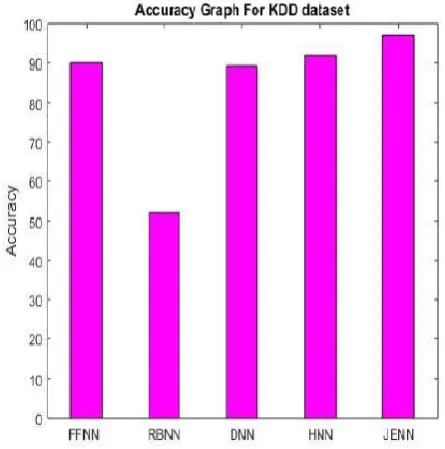
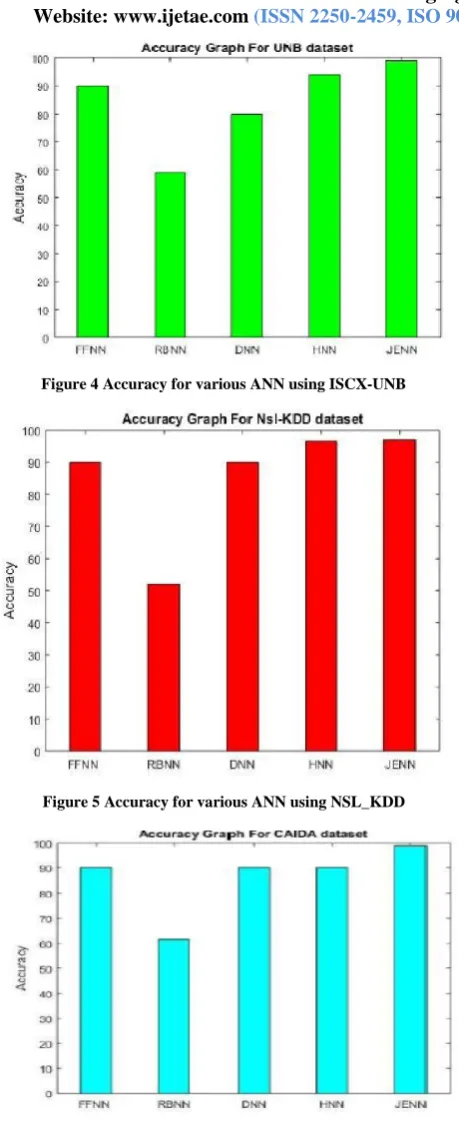
From the above figure the X axis represent the accuracy rate and Y axis represent the network classifier. A graphical representation of Figure 2 to 5 shows the accuracy rate using different kind of data set and different types of neural network. The joint evolutionary neural network using Artificial Bee Colony algorithm is more dominant than other. It give the better accuracy rate. The accuracy of JENN is 97%, 99%, 97%, 99%, 97% for DARPA, CAIDA, NSL-KDD, ISCX-UNB, KDD cup1999.
Figure 2. Accuracy for various ANN using DARPA dataset
[image:7.595.58.269.310.460.2]The RBNN has low accuracy which means 51% using DARPA dataset, 52% of KDD dataset, 59% of ISCX-UNB data set, and 52% of NSL-KDD dataset. It has a lowest accuracy rate when compared to the other neural network.
[image:7.595.328.551.416.641.2]International Journal of Emerging Technology and Advanced Engineering
Website: www.ijetae.com (ISSN 2250-2459, ISO 9001:2008 Certified Journal, Volume 7, Issue 10, Oct 2017)
[image:8.595.52.282.115.679.2]238
Figure 4 Accuracy for various ANN using ISCX-UNB [image:8.595.312.550.457.740.2]Figure 5 Accuracy for various ANN using NSL_KDD
Figure 6. Accuracy for various ANN using CAIDA
From the above figure the X axis represent the accuracy rate and Y axis represent the network classifier. A graphical representation of Figure 2-6 shows the accuracy rate using different kind of data set and different types of neural network.
The joint evolutionary neural network using genetic algorithm is more dominant than other. It give the better accuracy rate. The accuracy of JENN is 97%, 99%, 97%, 99%, 97% for DARPA, CAIDA, NSL-KDD, ISCX-UNB, KDD cup1999.The RBNN has low accuracy which means 51% using DARPA dataset, 52% of KDD dataset, 59% of ISCX-UNB data set, and 52% of NSL-KDD dataset. It has a lowest accuracy rate when compared to the other neural network.
V. CONCLUSION
A network based Intrusion detection system using different types of network classifiers was proposed in this paper. This system classifies the dataset to detect attacks. Also this research has been proved that, the Joint Evolutionary Neural Networks produce the better result when compared to Feed Forward Neural Network, Deep Neural Network, Radial Basis Neural Network and hybrid neural network. The pre-processing technique are used to make the performance more upgraded. Also the noise and irrelevant data was removed by using the prepossessing technique. We have used the optimization method for allocating a resources to the best possible effect. So the proposed method give the better accuracy rate.
REFERENCES
[1] Tammi, Matin W, Biswas NA, Nasim Z, Shorna KZ and Shah FM (2015) Artificial Neural Network based System for Intrusion Detection using Clustering on Different Feature Selection. International Journal of Computer Applications 126(12). [2] Modi, Chirag, Patel D, Borisaniya B, Patel H, Patel A, and
Rajarajan MK (2013) A survey of intrusion detection techniques in cloud. Journal of Network and Computer Applications 36(1) : 42-57.
[3] Duhan, Sonu. Intrusion Detection System in Wireless Sensor Networks: A Comprehensive Review.
[4] Duhan, Sonu. Intrusion Detection System in Wireless Sensor Networks: A Comprehensive Review.
[5] Thomas, Ciza and Balakrishnan N (2009) Improvement in intrusion detection with advances in sensor fusion. IEEE Transactions on Information Forensics and Security 4(3): 542-551.
[6] Zhou, Zhi-Hua, Wu J, and Tang W (2002) Ensembling neural networks: many could be better than all. Artificial intelligence 137(1): 239-263.
[7] Potluri, Sasanka, and Diedrich C (2016) Accelerated deep neural networks for enhanced Intrusion Detection System. In Emerging Technologies and Factory Automation (ETFA),2016 IEEE 21st International Conference on, 1-8. IEEE.
[8] Sengupta, Abhronil, Shim Y, and Roy K (2016) Proposal for an All-Spin Artificial Neural Network: Emulating neural and synaptic functionalities through domain wall motion in ferro magnets.
International Journal of Emerging Technology and Advanced Engineering
Website: www.ijetae.com (ISSN 2250-2459, ISO 9001:2008 Certified Journal, Volume 7, Issue 10, Oct 2017)
239
[10] Anh, Hoang NT, Hoang TH, Thang VT, and Quyen Bui TT (2016) An Artificial Neural Network approach for electroencephalographic signal classification towards brain computer interface implementation. In Computing & Communication Technologies, Research, Innovation, and Vision for the Future (RIVF), 2016 IEEE RIVF International Conference on, 205-210. IEEE.
[11] Kostić, Srđan, Vasović N, Todorović K, and Samčović A (2016) Application of artificial neural networks for slope stability analysis in geotechnical practice. In Neural Networks and Applications (NEUREL), 2016 13th Symposium on, 1-6. IEEE. [12] Chen, Jimmy KC, Ni YS, and Wang JY (2016) Electrocardiogram
diagnosis using wavelet-based artificial neural network. In Consumer Electronics, 2016 IEEE 5th Global Conference on, 1-2. IEEE.
[13] Gandhi, Niketa, Petkar O, and Armstrong LJ (2016) Rice crop yield prediction using artificial neural networks. In Technological Innovations in ICT for Agriculture and Rural Development (TIAR), 2016 IEEE, 105-110, IEEE.
[14] Htwe, Zin K, Yamamori K, Katayama T, and Kyi TM (2016) Automated lung nodule classification by artificial neural network and fuzzy inference system." In Consumer Electronics, 2016 IEEE 5th Global Conference on IEEE, 1-2.
[15] Samanta B and Al-Balushi KR (2003) Artificial neural network based fault diagnostics of rolling element bearings using time-domain features. Mechanical systems and signal processing 17(2): 317-328.
[16] Gandhi, Niketa, Petkar O, and Armstrong LJ (2016) Rice crop yield prediction using artificial neural networks. In Technological Innovations in ICT for Agriculture and Rural Development (TIAR), 2016 IEEE, 105-110.
[17] Kaur, Sukhdeep, Sharma AS, Kaur H, and Singh K (2016) Gene selection for tumor classification using resilient backpropagation neural network. In Advances in Computing, Communication, & Automation (ICACCA)(Fall), International Conference on, 1-5, IEEE.
[18] Rauber, Paulo E., Fadel SG, Falcao AX, and Telea AC (2017). Visualizing the Hidden Activity of Artificial Neural Networks. IEEE Transactions on Visualization and Computer Graphics 23(1): 101-110.
[19] Dileep, MR and Danti A (2016) Multiple hierarchical decision on neural network to predict human age and gender. In Emerging Trends in Engineering, Technology and Science (ICETETS), International Conference on, 1-6. IEEE.
[20] Salem, Asma, Zaidan D, Swidan A, and Saifan R (2016) Analysis of Strong Password Using Keystroke Dynamics Authentication in Touch Screen Devices. In Cyber security and Cyber forensics Conference (CCC), 15-21. IEEE.
[21] Gautam, Kumar M and Giri VK (2016) A Neural Network approach and Wavelet analysis for ECG classification." In Engineering and Technology (ICETECH), 2016 IEEE International Conference on, 1136-1141. IEEE .
[22] Bilel, Hamdi, Selma L, and Taoufik A (2016) Artificial neural network (ANN) approach for synthesis and optimization of (3D) three-dimensional periodic phased array antenna." In Antenna Technology and Applied Electromagnetics (ANTEM), 2016 17th International Symposium on IEEE, 1-6.
[23] Makandar, Aziz, and Patrot A (2015) Malware analysis and classification using Artificial Neural Network." In Trends in Automation, Communications and Computing Technology (I-TACT-15), 2015 International Conference on IEEE, 1: 1-6. [24] Bhadran, Bindhya, and Nair JJ (2015) Classification of patterns on
high resolution SAR images. In 2015 International Conference on Computing and Network Communications (CoCoNet), 784-792. IEEE.
[25] Omer, Galal, Mutanga O, Abdel-Rahman EM, and Adam E (2015) Performance of support vector machines and artificial neural network for mapping endangered tree species using WorldView-2 data in Dukuduku forest, South Africa. IEEE Journal of Selected Topics in Applied Earth Observations and Remote Sensing 8(10): 4825-4840.
[26] Sadek, Rowayda A, Soliman MS, and Elsayed HS (2013)
Effective anomaly intrusion detection system based on neural network with indicator variable and rough set reduction.
International Journal of Computer Science Issues (IJCSI) 10(6): 227-233.
[27] Souza, VM , Vieira LEA, Medeiros C, Da Silva LA, Alves LR, Koga D, Sibeck DG et al. (2016) A neural network approach for identifying particle pitch angle distributions in Van Allen Probes data. Space Weather 14(6).
[28] Zhu, Qiancheng, Li J, Yuan P, Z Shi, Lin M, Chen D, and Wang T
(2016) Accuracy compensation of a spraying robot based on RBF neural network. In Advanced Robotics and Mechatronics (ICARM), International Conference on, 414-419. IEEE, 2016. [29] Chae, Hee-su, Jo B, Choi SH, and Park T (2013) Feature selection