C a r g o vi b e s : h u m a n r e s p o n s e t o
vi b r a ti o n d u e t o fr ei g h t r a il
t r affic
Wa d di n g t o n , DC, Woo d c o c k, JS, S m i t h , MG, Ja n s s e n , S a n d Way e ,
KP
h t t p :// dx. d oi.o r g / 1 0 . 1 0 8 0 / 2 3 2 4 8 3 7 8 . 2 0 1 5 . 1 0 7 6 6 2 3
T i t l e
C a r g o vi b e s : h u m a n r e s p o n s e t o vi b r a ti o n d u e t o fr ei g h t
r a il t r affic
A u t h o r s
Wa d di n g t o n , DC, Woo d c o c k, JS, S m i t h , MG, Ja n s s e n , S a n d
Way e, KP
Typ e
Ar ticl e
U RL
T hi s v e r si o n is a v ail a bl e a t :
h t t p :// u sir. s alfo r d . a c . u k /i d/ e p ri n t/ 3 6 1 2 5 /
P u b l i s h e d D a t e
2 0 1 5
U S IR is a d i gi t al c oll e c ti o n of t h e r e s e a r c h o u t p u t of t h e U n iv e r si ty of S alfo r d .
W h e r e c o p y ri g h t p e r m i t s , f ull t e x t m a t e r i al h el d i n t h e r e p o si t o r y is m a d e
f r e ely a v ail a bl e o nli n e a n d c a n b e r e a d , d o w nl o a d e d a n d c o pi e d fo r n o
n-c o m m e r n-ci al p r iv a t e s t u d y o r r e s e a r n-c h p u r p o s e s . Pl e a s e n-c h e n-c k t h e m a n u s n-c ri p t
fo r a n y f u r t h e r c o p y ri g h t r e s t r i c ti o n s .
Full Terms & Conditions of access and use can be found at
http://www.tandfonline.com/action/journalInformation?journalCode=tjrt20
Download by: [University of Salford] Date: 22 March 2016, At: 03:06
International Journal of Rail Transportation
ISSN: 2324-8378 (Print) 2324-8386 (Online) Journal homepage: http://www.tandfonline.com/loi/tjrt20
CargoVibes: human response to vibration due to
freight rail traffic
David Waddington, James Woodcock, Michael G Smith, Sabine Janssen &
Kerstin Persson Waye
To cite this article: David Waddington, James Woodcock, Michael G Smith, Sabine Janssen & Kerstin Persson Waye (2015) CargoVibes: human response to vibration due to freight rail traffic, International Journal of Rail Transportation, 3:4, 233-248, DOI: 10.1080/23248378.2015.1076623
To link to this article: http://dx.doi.org/10.1080/23248378.2015.1076623
© 2015 The Author(s). Published by Taylor & Francis.
Published online: 01 Sep 2015.
Submit your article to this journal
Article views: 360
View related articles
View Crossmark data
CargoVibes: human response to vibration due to freight rail traffic
David Waddingtona*, James Woodcocka, Michael G Smithb, Sabine Janssenc and Kerstin Persson Wayeb
a
Acoustics Research Centre, University of Salford, Salford, UK;bDepartment of Occupational and Environmental Medicine, University of Gothenburg, Gothenburg, Sweden;cTNO, Delft, The
Netherlands
(Received 22 April 2015; accepted 20 July 2015)
The aim of this paper is to present an overview of the research concerning human response to vibration conducted in the EU FP7 CargoVibes project. The European Union-funded project CargoVibes involved 10 partners from 8 nations and ran from April 2011 to April 2014. The project was concerned with railway-induced ground-borne vibration affecting residents close to freight lines, with one work package that investigated human response to vibration, including sleep disturbance, community annoyance and the production of a best practice guide for evaluating response. Laboratory trials at the University of Gothenburg were used to measure the effects of vibration on sleep. Physiological and psychological impacts of vibration exposure were found. TNO led a meta-analysis (N = 4129) to determine exposure–response relationships for railway vibration, with existing data for community response supplemented with field studies in the Netherlands and Poland. The University of Salford led production of a guidance document that presents the state of the art regarding vibration measurement and assessment. Specific topics in the guide include human perception, evaluation methods, annoyance, sleep impacts and non-exposure factors. The outcomes presented in this paper represent a significant advance in the understanding of the human response to railway vibration and a step towards much needed harmonization of assessment methods.
Keywords:railway vibration; sleep disturbance; vibration survey; vibration annoyance; community response; exposure–response relationships
1. Introduction
Noise and vibration from railways can be potential showstoppers for the development of new lines or the intensification of traffic on those existing. Compared to noise, vibration is often overlooked. However, due to an increase in public sensitivity and the success of noise mitigation measures, vibration is becoming an increasingly important issue.
To reduce these nuisances to acceptable levels, innovative engineering solutions are needed to address the mechanisms causing them, most commonly generated by vehicle– track interaction. To achieve the ultimate aim of reducing or limiting their impact on the lives of people living close to tracks, an understanding of the human responses involved is vital. Freight trains are particularly problematic with regard to generation of low-frequency vibra-tion and noise which has the potential to propagate to nearby homes and influence residents.
*Corresponding author. Email:[email protected]
Vol. 3, No. 4, 233–248, http://dx.doi.org/10.1080/23248378.2015.1076623
© 2015 The Author(s). Published by Taylor & Francis.
This is an Open Access article distributed under the terms of the Creative Commons Attribution-NonCommercial-NoDerivatives License (http://creativecommons.org/licenses/by-nc-nd/4.0/), which permits non-commercial re-use, distribution, and reproduc-tion in any medium, provided the original work is properly cited, and is not altered, transformed, or built upon in any way.
One purpose for this research is to determine mechanisms that explain the differences in people’s responses to vibrations from freight trains, meaning that mitigation measures can be better targeted and implemented in the most effective manner.
This paper summarizes the findings of the European Union (EU) project CargoVibes, the objective of which was to develop and validate measures to ensure acceptable levels of vibration for residents living in the vicinity of freight railway lines, and so facilitate the expansion of freight traffic on rail. The paper starts with a brief overview of the CargoVibes project, challenges and work programme. Next the investigation of human response with CargoVibes is described, together with a summary of the main results. Finally, this work is discussed in relation to ongoing work, concluding with recommenda-tions for further work.
2. EU FP7 CargoVibes project
2.1. Overview
As pointed out in a 2001 White paper for European transport [1], EU rail operators are keen to increase the market share of goods traffic from 8% in 2001 to 15% by 2020. Night-time slots will play an important role in reaching this goal. Yet to do so, public concerns about annoyance and sleep disturbance caused by railway vibration in residential areas will need to be addressed. Current evaluation criteria are generally deemed too strict and, further-more, not based on relevant surveys. In addition, there are no uniform assessment methods available, and knowledge amongst railway engineers and infrastructure managers of mitigation measures is uncommon and incomplete. In response, CargoVibes was working to establish appropriate criteria, given the particular characteristics of freight traffic. Existing mitigation measures for conventional railway are not directly applicable to freight trains, which generate a different soil vibration pattern than conventional railways in terms of vibration amplitude and frequency content. Within the project, viable and efficient new measures for rail goods traffic were designed and validated.
2.2. Consortium members
Ten partners participated in the CargoVibes [2] project, funded under the European Union’s 7th Framework Programme. Consortium members are listed by country in
Table 1.
2.3. Key challenges
The key research challenges for the CargoVibes team were as follows:
● Establishing acceptable vibration levels for residents living near to freight lines.
● Designing methods to assess the effectiveness of mitigation measures.
● Designing new mitigation measures effective specifically for freight trains and vehicles.
2.4. CargoVibes work programme structure
The programme was divided into seven work packages (WP) as summarized inTable 2. WP 2 studied real-life cases of disturbance caused by low-frequency vibrations
(below 20 Hz). The latter problem cannot be solved by conventional vibration-control measures such as under-sleeper pads, or ballast mats; nor is constant tamping of the track a feasible response. WP 3 focused on the development of three innovative mitigation measures for vibrations generated by freight rail traffic at three different levels: the wheel– rail contact point, the track infrastructure and the transmission path. Methods for assessing the effectiveness of these measures were developed by WP 4. WP 5 involved the end user board which consisted of industry and stakeholder representatives, WP 6 focused on aggregating and disseminating the information gathered while WP 7 covered management of the overall project. This paper concentrates on the work of WP 1 which investigated human response to vibration, including sleep disturbance, community annoyance and the production of a best practice guide for evaluating response.
3. Investigation of human response to vibration
3.1. Aims and objectives
The aim for the work package concerning human response to vibration was to determine acceptable levels of vibration from railway transportation. The following objectives were established:
[image:5.493.106.388.76.227.2](1) To describe and assess reported health impacts of vibration among residents living near railway lines.
Table 2. CargoVibes work packages.
Work package Title of work package
WP 1 Evaluation of whole-body vibration
WP 2 Evaluation procedures for mitigation measures
WP 3 Development of cost-effective, viable mitigation measures WP 4 Validation of measures and procedures
WP 5 End user board
WP 6 Dissemination and exploitation
[image:5.493.104.395.264.361.2]WP 7 Management
Table 1. Consortium members listed by country.
Organization Country
Alfa Products & Technologies (APT) Belgium
Composite Damping Materials (CDM) Infrabel (INFRABEL)
Beijing Jiaotong University (BJTU) China
Nederlandse Organisatie voor Toegepast Natuurwetenschappelijk Onderzoek (TNO)
Netherlands
Instytut Kolejnictwa (IK) Poland
Empresa de Manutençao de Equipamento Ferroviario (EMEF)
Instituto de Soledura e Qualidade (ISQ)
Portugal
Göteborgs Universitet (UGOT) Sweden
University of Salford (USAL) UK
(2) Experimentally evaluate sleep disturbance due to whole-body vibration from railway transportation.
(3) Provide a guidance document on how to apply the results in practice.
The main responsibility for objective 1 was with TNO, objective 2 with the University of Gothenburg (UGOT) and objective 3 with the University of Salford (USAL). Shared initial work involved the development of a questionnaire for the field study and for the laboratory study, and later to provide the necessary input to the guidance document.
3.2. Objective 1: exposure–response relationships and factors influencing these relationships
A state-of-the-art overview was given of the results from various field studies done so far on the evaluation of vibration from several railway sources. On the basis of experience gained from these studies and from many previous studies on effects of noise on humans, a questionnaire was developed to measure self-reported response to vibration and noise, such as perception, annoyance and sleep disturbance.
The process was carried out by a series of meetings, selecting questions used previously in noise research, while also addressing specific issues related to vibration, for example, the exact formulation of the vibration disturbance question and of attitudinal questions related to vibration. Furthermore, a set of questions on sleep quality was included to obtain comparable data for some parameters in the field as in the laboratory (see objective 2). This questionnaire was translated from English into Dutch and Polish and checked by several native speakers. It was used in field surveys in the vicinity of a railway line with freight traffic in the Netherlands (N= 156) and in Poland (N= 104) to assess the response to (measured) vibration in combination with other individual and situational factors. Vibration exposure in these surveys was assessed through continuous monitoring during a week in 2–4 reference houses, while short measurement were done in another 10–16 reference houses. Vibration levels for the other houses were obtained by using observed distance relations to estimate the vibration at the foundation, and then applying the amplification factor between foundation and middle of the room of the reference houses to other, similar houses.
Next, these survey data were combined with the original data from available earlier railway vibration field studies, providing complementary data for exposure–response analysis. To enable the comparison of the various metrics used in the separate studies, a conversion matrix was developed that allows the conversion of one metric into another. Subsequently, in a comparative meta-analysis, the expected degree of annoyance due to railway vibrations at a given vibration level was quantified in exposure–response relationships.
3.3. Objective 2: results of the sleep disturbance study
Sleep is considered by the World Health Organization as an important biological function, the disturbance of which can deeply impair health. There is clear evidence that exposure to environmental noise can result in sleep disturbance, but as there are comparatively fewer studies, the evidence is less clear for sleep disturbance caused by vibration. To investigate sleep disturbance, experimental studies were designed using vibration signals representative of the spectral content and amplitude of freight trains from field measure-ments provided by TNO, UGOT and USAL. Based on the field measuremeasure-ments and the
technical range of the laboratory system, a 10 Hz signal was used at three amplitudes ranging from a maximal weighted (Wd) amplitude of 0.0058 to 0.0204 m/s2. Horizontal
vibration was rated as subjectively more annoying in a pilot study and so was used in the main trials. Different numbers of passages and interactions between noise and vibration exposure were examined. Across three studies, a total of 59 young healthy volunteers participated. Gender and sensitivity to noise was balanced within the design. Physiological changes in cardiac activity and sleep macro- and micro- structure were recorded polysomnographically, and subjective ratings were collected in the morning and evening using questionnaires [3].
3.4. Objective 3: guidance document for the evaluation of railway vibration
Guidance on how to apply the results of this work package in practice was developed in the form of a best practice guidance document. The guide aims to promote a harmonized approach to the assessment of vibration with regard to human response, whilst recogniz-ing that in current practice a range of standards are in existence in different countries. The deliverable outlines the currently available methods for the evaluation of disturbance from railway-induced vibration in residential environments. In addition, the deliverable presents the current state of the art in the human response to whole-body vibration in the ranges of frequency and amplitude relevant to railway-induced vibration.
On 14 May 2013, a workshop was held at USAL that gathered international experts in the field of railway vibration from industry, consultancy and academia. The aim of this workshop was to discuss key aspects and challenges of the evaluation of vibration in residential environments with respect to human response. The outcomes of this workshop were used to shape and inform the contents of the guide. Additionally, a draft of the document was presented at the 11th International Workshop on Railway Noise in Uddevalla, Sweden [4], and made available online for comment prior to it being finalized. These activities were undertaken to ensure the guidance document is relevant to the needs of operators, infrastructure managers, planners, consultants, scientists and policymakers. Objective 3 is fully reported in deliverable D1.5: Guidance document for the evaluation of railway vibration [5].
4. Results
4.1. Objective 1: exposure–response relationships and factors influencing these relationships
The surveys in the Netherlands and in Poland revealed influences of vibration exposure and several individual and situational factors on annoyance and sleep disturbance. At the site in the Netherlands, vibration levels as well as self-reported annoyance and sleep disturbance were rather high, especially with regard to freight train vibration, and a clear relationship between exposure and response was found. At the site in Poland, with mostly freight trains, exposure levels were even higher, but annoyance was relatively low and there was no clear relationship with vibration exposure [6].
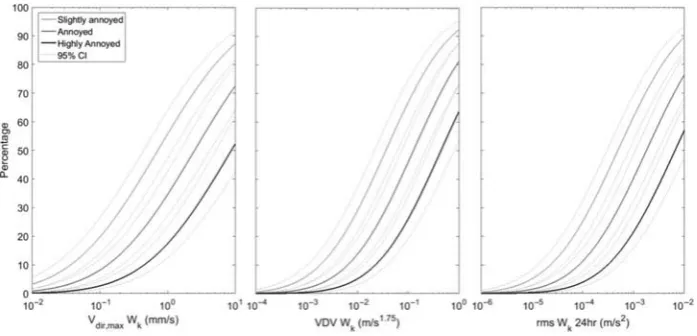
The new survey data were combined with the original data from almost all surveys reported in peer-reviewed literature or made public in a research project report in which both vibration exposure and vibration annoyance were assessed. In a comparative meta-analysis, the expected degree of annoyance due to railway vibrations was quantified for three different metrics in exposure–response relationships. The maximum vibration level
Vdir,max(fast-exponentially filtered maximum over a week, velocity based, mostly
accord-ing to DIN 4150 [7] and SBR-B [8], with ‘dir’ standing for the directional frequency weighting according to ISO 2631-1 [9]) was chosen as the primary metric for the meta-analysis. However, to explore the role of the intensity of the railway lines (i.e. the number of passages), the explanatory value of the equivalent energy metricrmsand the vibration dose value (VDV) was compared to that ofVdir,max.
A statistical model developed for analysing the association between noise exposure and effects reported with a rating scale was applied here to study the association between vibration exposure and self-reported annoyance in the pooled data from the available studies (see [10] and [11] for more details). Using this regression method, the annoyance score on a virtual 100-point scale for each respondent is modelled as a function of the exposure level, with a random effect for study to take into account differences between studies. Also, the probability to exceed a certain annoyance score (e.g. being highly annoyed) at a given vibration level, which may be more important for policy than the average expected annoyance score, can be estimated for any value of the exposure variable, yielding the expected percentage at least slightly annoyed (%LA), the percentage at least annoyed (%A) and the percentage highly annoyed (%HA), as well as their 95% confidence intervals.
Before studying the overall association between exposure and response in the pooled dataset, differences between studies in annoyance response were explored. Although there was differentiation between all studies, exceptionally the high-speed train in Japan (Shinkansen) was associated with a very high annoyance response at relatively low vibration levels. Because no evidence was found for major differences in annoyance response between mixed freight and passenger rail, underground and light rail sources, it was decided to pool these data in one model. Subsequently, based on all available data sets except for the Japanese (Shinkansen) study (N= 4129), exposure–response relation-ships were derived showing the expected percentage of residents annoyed or highly annoyed by vibration level.
[image:8.493.73.422.452.620.2]The resulting exposure–response curves and their confidence intervals are shown in
Figure 1. The predictive values of the three metrics are all in the same range and do not
Figure 1. Meta-analytic exposure-response curves (total 4129 exposure and response data) quan-tified for three common metrics:Vdir,max,VDVandrms.
allow conclusions to be drawn on the preferred metric. Despite differentiation in the annoyance response between studies, there is a clear relationship between vibration exposure and the annoyance response of residents, which can be used as a basis of criteria for the evaluation of railway vibration [12].
4.2. Objective 2: results of the sleep disturbance studies
From the experimental studies, it was determined that nocturnal vibration has a negative impact on sleep, and that the effect increases with greater vibration levels. An initial pilot study was performed to investigate the influence of vibration excitation direction on human response [3]. It was concluded that in the frequency range of interest for railway freight, approximately between 5 and 10 Hz, vibration applied lengthwise along the bed was the most suitable exposure.
In an ecologically valid laboratory setting, a first sleep study examined 12 young, healthy individuals [13]. Both noise only and noise accompanied by very low amplitude vibration (0.4 mm/s, comfort weighted [14]) had little effect. Self-reports of vibration causing sleep disturbance, poor sleep, awakenings, difficulty falling asleep and resulting in tiredness in the morning, all increased with increasing vibration amplitude from 0 to 0.4 to 0.7 to 1.4 mm/s. Additionally, subjective sleep quality decreased with increasing vibration amplitude. Heart rate in the 60 s window following the start of each train, as measured using electrocardiogram, also increased with increasing vibration levels.
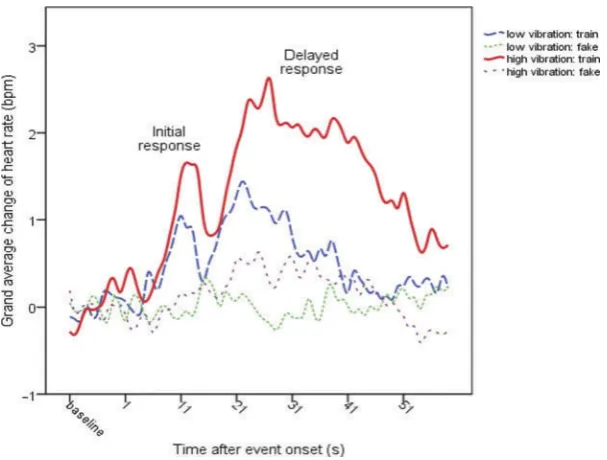
A second study on 24 individuals was conducted, where self-reported sleep outcomes were measured via questionnaires and objective sleep was measured using polysomno-graphy, a technique involving the recording of electrical brain activity (EEG), eye move-ments and tonic muscle activity. In nights with high vibration and 36 trains, a deleterious impact on sleep was observed, with increased wakefulness, earlier awakenings, reduced rapid eye movement (REM) sleep and reduced deep sleep stability. Higher amplitude vibrations were also more likely to contribute towards sleep fragmentation, rather than just shortening of sleep [15]. Stronger cardiac activations were observed following trains with high vibration compared to low vibration (seeFigure 2) [16].
A third study indicated that at the levels used in the experimental paradigm the effects of noise alone and vibration alone appeared directly additive towards physiological response. Across all three studies, both noise only and noise accompanied by very low level vibration had little effect on human sleep, while noise and high vibration level was found to significantly influence both subjective evaluated sleep and physiological measures of sleep. Subjective sleep disturbance increased with increasing vibration levels, whereas disturbance due to noise was unaffected. There were additionally indications that the impact of higher vibration levels was greater amongst persons rating themselves as being sensitive to noise [17].
In summary, higher vibration levels had a greater impact on sleep, both in terms of self-reported outcomes and physiological response measures. The effect of number of trains was less conclusive and requires additional research.
4.3. Objective 3: guidance document for the evaluation of railway vibration
The guidance document [5] describes how to apply the results from WP 1 in practice. The document reports the state of the art including
(1) Meta-analytic exposure–response curves for assessment of annoyance due to vibration
(2) Effects of vibration on sleep (3) Influence of non-exposure factors
The document is intended to provide an extension to the current body of guidance, allowing assessments of vibration to be conducted based on the most up-to-date scientific information. It provides a set of practical tools to assess railway-induced environmental vibration including a summary of current national standards, polynomial fits to the exposure–response curves, proportions of people annoyed at current guideline levels as predicted by the meta-analytic curves, information on the significant effects of vibration on sleep and the influence of non-exposure factors. Whilst the primary aim of the CargoVibes project relates to freight operations, the good practice guide is applicable more generally to railways.
Three broad areas related to the human response to railway-induced vibration were addressed in the guidance document: annoyance, sleep disturbance and non-vibrational factors.
4.3.1. Annoyance
[image:10.493.96.400.62.292.2]Annoyance is one of the most widely used measures of the impact an environmental stressor has on the population and is often the measure on which policy development is based. Although there are a number of field studies that have related vibration exposure to annoyance, comparison of the results of these studies is problematic due to differences in
Figure 2. Averaged change in heart rate during sleep following freight train pass-bys of different vibration amplitudes. A greater change in heart rate is evident for high (1.4 mm/s) vibration than low (0.7 mm/s) vibration. Reproduced from [16].
the metric used to express vibration exposure. The guidance document provides a review of these studies and presents the harmonized socio-vibrational field data discussed in
Section 4.1.Practical issues relating to the measurement of vibration and current vibration limits are also discussed. Polynomial approximations to the meta-analytic curves shown in
Figure 1for the proportion of respondents being slightly annoyed (SA), annoyed (A) and highly annoyed (HA) are provided in the guidance document, and are presented here in Equations (1)–(12) for three different metrics.
Equations (1)–(4) present vibration as directionally weighted maximum velocity
Vdir,max, as used in DIN/SBR but directional. These equations must not be used outside
the range 0.01 to 10 mm/s Vdir,max.
%SAVdir;max¼ 0:559X
4
1 2:594X13þ4:681X12þ31:802X1þ36:118 (1)
%AVdir;max ¼ 0:863X1
40811X
13þ8:602X12þ23:181X1þ18:527 (2)
%HAVdir;max ¼ 0:460X1
4þ0:850X
13þ7:620X12þ12:720X1þ7:522 (3)
where
X1¼
log10ðVdir;maxÞ þ0:5
0:86733 (4)
Equations (5)–(8) present vibration as weighted root mean square acceleration rms, as used in ISO. These equations must not be used outside the range 0.001 × 10⁻³to 10 × 10–3 m/s2rms.
%SArms¼ 1:806X243:198X23þ11:812X22þ35:059X2þ25:390 (5)
%Arms¼ 1:648X240:0:13X23þ13:826X22þ22:510X2þ11:380 (6)
%HArms¼ 0:527X24þ2:089X23þ9:850X22þ10:785X2þ3:910 (7)
where
X2 ¼
log10ðrmsÞ þ4
1:1564 (8)
Equations (9)–(12) present vibration as weighted vibration dose value VDV, as used in BS [18]). These equations must not be used outside the range 0.1 × 10⁻³to 1000 × 10–3 m/s1.75VDV.
%SAVDV ¼ 1:751X344:019X33þ10:845X32þ38:038X3þ29:118 (9)
%AVDV ¼ 1:952X340:768X33þ14:679X32þ26:054X3þ13:832 (10)
%HAVDV ¼ 0:885X34þ1:834X33þ11:605X32þ13:529X3þ5:086 (11)
where
X3¼
log10ðVDVÞ þ2
1:1564 (12)
These equations must not be used outside of the indicated ranges. Use of these equations outside of the indicated ranges will result in highly inaccurate estimations of the annoyance response.
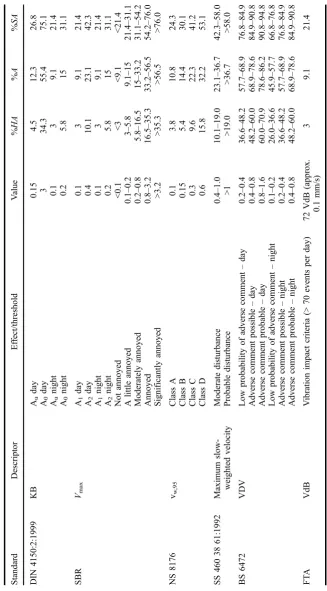
Table 3 shows the per cent highly annoyed, annoyed and slightly annoyed at current guideline limits as predicted by the meta-analytic curves shown inFigure 1. It should be noted that the meta-analytic exposure–response curves predict annoyance using vibration exposure evaluated over a 24-hour period, whereas a number of limits in Table 3 are specifically for the day or night period [19]. Adjustment factors derived in the meta-analysis have been applied to transform the guideline values into the descriptors used in the meta-curves. Namely, a factor of 1.15 to take into account the differences between the Wk and Wm frequency weightings and a factor of 1.25 to take into account the differences between fast and slow time weightings.
4.3.2. Sleep disturbance
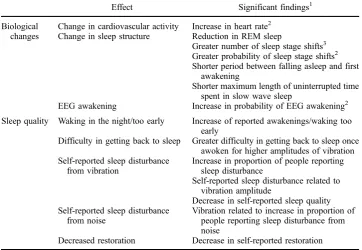
The good practice guide reviews available evidence relating vibration exposure to sleep disturbance and outlines the main results of the laboratory-based sleep study. There is currently insufficient data to derive generalized exposure–response relationships or thresh-olds for the effects of vibration on sleep. Exposure to vibration has been found in laboratory andfield studies to be significantly related to a number of adverse effects on sleep. The guidance document presents this evidence as a summary of the effects of vibration on sleep for which a statistically significant finding has been reported in the literature. The table is reproduced here inTable 4.
4.3.3. Non-vibrational factors
It is well established that the human response to environmental noise is strongly influ-enced by non-acoustical factors and there is good evidence to show that this is the case for the human response to environmental vibration. Situational and attitudinal factors that have been found to influence response to vibration in research by the USAL and by TNO are reported and discussed in the guidance document. A summary of the non-exposure factors that have been identified so far as having a significant effect on the annoyance response to vibration from railways is given in Table 5. However, there is currently insufficient evidence to derive generalized magnitudes for the influence of these factors on annoyance as these findings are based on only two studies [20].
5. Discussion
As part of this study, questionnaire and vibration exposure data were collected in field studies at two railway sites in the Netherlands and one in Poland. At one of the sites in the Netherlands (Barendrecht), the vibration exposure was so low that hardly any annoyance was reported. This is thought to be due to successful (noise) mitigation measures consisting of the covering of the railway tracks. At the other site in the Netherlands (Den Bosch), higher vibration levels were found with a rather high annoyance response,
T able 3. Per cent highly annoyed, annoyed and slightly annoyed at current guideline limits predicted by the meta-analytic exposure – response relationships. Standard Descriptor Ef fect/threshold V alue % HA % A % SA DIN 4150:2:1999 KB Au day 0.15 4.5 12.3 26.8 A0 day 3 34.3 55.4 75.1 Au night 0.1 3 9.1 21.4 A0 night 0.2 5.8 15 31.1 SBR Vmax A1 day 0.1 3 9.1 21.4 A2 day 0.4 10.1 23.1 42.3 A1 night 0.1 3 9.1 21.4 A2 night 0.2 5.8 15 31.1 Not annoyed <0.1 <3 <9.1 <21.4 A little annoyed 0.1 – 0.2 3 – 5.8 9.1 – 15 21.4 – 31.1 Moderately annoyed 0.2 – 0.8 5.8 – 16.5 15 – 33.2 31.1 – 54.2 Annoyed 0.8 – 3.2 16.5 – 35.3 33.2 – 56.5 54.2 – 76.0 Significantly annoyed >3.2 >35.3 >56.5 >76.0 NS 8176 vw ,95 Class A 0.1 3.8 10.8 24.3 Class B 0.15 5.4 14.4 30.1 Class C 0.3 9.6 22.3 41.2 Class D 0.6 15.8 32.2 53.1 SS 460 38 61:1992 Maximum slow-weighted velocity Moderate disturbance 0.4 – 1.0 10.1 – 19.0 23.1 – 36.7 42.3 – 58.0 Probable disturbance >1 >19.0 >36.7 >58.0 BS 6472 VDV Low probability of adverse comment – day 0.2 – 0.4 36.6 – 48.2 57.7 – 68.9 76.8 – 84.9 Adverse comment possible – day 0.4 – 0.8 48.2 – 60.0 68.9 – 78.6 84.9 – 90.8 Adverse comment probable – day 0.8 – 1.6 60.0 – 70.9 78.6 – 86.2 90.8 – 94.8 Low probability of adverse comment – night 0.1 – 0.2 26.0 – 36.6 45.9 – 57.7 66.8 – 76.8 Adverse comment possible – night 0.2 – 0.4 36.6 – 48.2 57.7 – 68.9 76.8 – 84.9 Adverse comment probable – night 0.4 – 0.8 48.2 – 60.0 68.9 – 78.6 84.9 – 90.8 FT A VdB V ibration impact criteria (> 70 events per day) 72 VdB (approx. 0.1 mm/s) 3 9.1 21.4
[image:13.493.87.415.60.652.2]showing a clear relationship between exposure and response. At the site in Poland (Radzionków), the exposure levels were even higher, but annoyance was relatively low and no clear relationship with vibration exposure was found. It is suggested that this was due to differences in attitudinal factors, such as the higher perceived necessity of freight trains in the industrial town of Radzionków, which was shown to reduce annoyance, or the higher concern for damage in Den Bosch, which was shown to increase the annoyance response to vibration. Furthermore, noise sensitivity (perhaps serving as a proxy for sensitivity to vibration), self-reported hearing of railway noise and noise from rattling objects were all found to influence the response to vibration. These results indicate that while vibration due to freight trains causes annoyance the degree of annoyance also depends on other factors [21].
[image:14.493.66.429.80.330.2]Since the completion of this project, other works by the authors have made significant advances in the understanding of the human response to railway vibration. Recommendations for best practice have been presented for the development of social surveys [22], for the measurement of vibration exposure for the study of vibration annoyance [23] and for the combination of exposure and response measurements in field studies of human response to vibration in residential environments [20]. One result of this further research shows the difference in people’s responses to vibration from passenger and freight trains, meaning that mitigation measures can be better targeted and implemented in the most effective manner [24]. Other work has focused on describing
Table 4. Effects of vibration on sleep.
Effect Significant findings1
Biological changes
Change in cardiovascular activity Increase in heart rate2 Change in sleep structure Reduction in REM sleep
Greater number of sleep stage shifts3 Greater probability of sleep stage shifts2 Shorter period between falling asleep and first
awakening
Shorter maximum length of uninterrupted time spent in slow wave sleep
EEG awakening Increase in probability of EEG awakening2
Sleep quality Waking in the night/too early Increase of reported awakenings/waking too early
Difficulty in getting back to sleep Greater difficulty in getting back to sleep once awoken for higher amplitudes of vibration Self-reported sleep disturbance
from vibration
Increase in proportion of people reporting sleep disturbance
Self-reported sleep disturbance related to vibration amplitude
Decrease in self-reported sleep quality Self-reported sleep disturbance
from noise
Vibration related to increase in proportion of people reporting sleep disturbance from noise
Decreased restoration Decrease in self-reported restoration
Notes: 1The effects presented in this column are those for which a statistically significant result has been observed relating the effect to vibration exposure. However, it should be noted that these effects do not occur irrespective of vibration level.
2
This response relates to individual vibration events. 3This response relates to the sleep macrostructure.
how non-exposure factors can be used alongside vibration mitigation measures to make rail more acceptable to trackside inhabitants [25]. These research techniques also are being extended to the investigation of the human response to construction induced vibration in residential environments.
Since the conclusion of the CargoVibes project, the UGOT team has continued research in this field and has made early efforts to investigate where a reaction threshold during sleep for vibration might exist and also examined at what noise and vibration levels a similar subjective and physiological response may occur [26]. They are currently working to determine physiological response thresholds to railway freight vibration during sleep. In the laboratory, USAL have shown that the perception of railway-induced ground-borne vibration is multidimensional in nature, resulting in a statistical model capable of predicting annoyance due to single train passages with a high degree of accuracy [27]. These perceptual testing techniques are currently being extended to the influence of source type and audible rattle from railway induced vibration on human response [28]. This means that design solutions initially aimed at boosting engineering performance can also be used to also increase the acceptability of rail.
6. Conclusions
[image:15.493.67.426.77.331.2]The EU FP7 CargoVibes project delivers guidance on the evaluation of human response to vibration from railways in residential environments. This is achieved by outlining the currently available methods of evaluation in light of the current state of the art and
Table 5. Summary of the effects of non-exposure factors on annoyance.
Factor Significant findings
Time of day Evening Annoyance greater during the evening than
during the day at the same level of vibration exposure
Night Annoyance greater during the night than during the evening at the same level of vibration exposure
Situational Visibility of source Annoyance greater if the source is visible Time spent at home Annoyance greater for people who spend fewer
than 10 hours per day at home
Type of area Annoyance greater for people living in rural areas
Attitudinal Concern of damage Annoyance greater for those concerned that vibration is damaging their property or belongings
Expectation regarding future vibration
Annoyance greater for those expecting vibration to get worse in the future
Necessity of source Annoyance greater for those considering the source unnecessary1
Noise sensitivity Annoyance from vibration greater for those considering themselves as noise sensitive
Socio-demographic Age Annoyance greater for those in the middle age group
Note:1This result was observed for freight trains and may not be generalizable to mixed railway.
therefore may be considered best practice at the time of writing. A review of current standards summarizes the documents available on a national and international level offering guidance on the evaluation of perceptible vibration in buildings. These docu-ments differ in terms of the single-figure vibration exposure descriptors advocated, frequency weightings, measurement methods and guideline values for the prevention of adverse effects. The evaluation method that takes precedence depends upon the country in which the evaluation is being conducted.
There are three types of descriptors that are advocated in current standards: maximum runningrmsvelocity or acceleration, energy equivalentrmsvelocity or acceleration over a given evaluation period and the cumulative vibration dose value. The weight of evidence to favour one of these descriptors over another is at present insufficient to advocate a change in current evaluation methods. Therefore, guidance has been provided where possible in terms of three common vibration exposure descriptors. It is suggested that future vibration surveys be reported in terms of these three descriptors and that raw time histories are retained for future analysis.
To assess annoyance due to railway-induced vibration, meta-analytic exposure– response curves have been derived. These may be used to estimate the per cent highly annoyed (%HA), per cent annoyed (%A) and the per cent slightly annoyed (%SA) at different levels of vibration exposure. The curves are suitable for the prediction of community annoyance due to steady-state railway-induced vibration. The results of the CargoVibes project did not allow a conclusion regarding the question whether at a given exposure level the response to freight trains is different from the response to passenger trains. Also, the CargoVibes project did not allow the investigation of the combined influence of vibration and noise on railway-induced annoyance. Field and laboratory data are needed to understand the interaction between noise and vibration exposure. In particular, data are needed to derive relationships for human response to ground-borne noise and vibration-induced rattle.
A number of situational, attitudinal and socio-demographic factors that influence these relationships are identified and reported. Future socio-vibration surveys should further explore the effects of non-exposure factors as this evidence suggests that these factors have at least as large an influence on the annoyance response as vibration exposure expressed in current descriptors.
To assess the effects of vibration on sleep, a laboratory assessment has been conducted. These experiments, along with a review of published literature, have identified a number of adverse effects that vibration exposure has on sleep. At present, there are insufficient data to derive exposure–response relationships or to determine thresholds for these sleep effects. Future studies should therefore focus on quantifying the levels of vibration at which these sleep effects begin. Epidemiological studies are needed if the effects of vibration on health are to be explored.
Acknowledgements
This paper contains material previously presented at ICSV22, Florence, Italy. The authors wish to thank Calum Sharp, Gennaro Sica and Andy Moorhouse of the University of Salford, Ilona Croy, Oscar Hammar and Mikael Ögren of the University of Gothenburg, Arnold Koopman and Henk Vos of TNO, and Witold Groll and Karolina Wiśniewska of the Polish Railway Institute for their contributions to this work as part of Work Package 1 of the CargoVibes project. Background information and raw data, not openly publicized before, has been made available by T. Yano of Kumamoto University (Japan), S. Fidell (USA), R. Klaeboe (Norway), A. Gidlöf-Gunnarsson (Sweden) and D. Waddington (UK).
Disclosure statement
No potential conflict of interest was reported by the authors.
Funding
This research was co-funded by the 7th Framework Program of the EC [grant agreement number FP7-SME-2010-1-262293].
References
[1] European transport policy for 2010; 2001. http://ec.europa.eu/transport/themes/strategies/ 2011_white_paper_en.htm.
[2] http://www.cargovibes.eu/Home[cited 2015 Jan 30].
[3] Smith MG, Ögren M, Persson Waye K Vibration and noise induced sleep disturbance from freight trains−The importance of vibration direction. Proceedings of Meetings on Acoustics; Vol. 15, 2013; DOI:10.1121/1.4773190.
[4] Woodcock JS, Peris E, Waddington DC, et al. Developing a good practice guide on the evaluation of human response to vibration from railways in residential environments. In: Nielsen JCO, Anderson D, Gautier P-E, et al., editors. Noise and vibration mitigation for rail transportation systems SE–36. Heidelberg: Springer Berlin; 2015. p. 305–312. [5] Woodcock J, Peris E, Moorhouse A, et al. Attenuation of ground-borne vibration affecting
residents near freight railway lines. Cargovibes (ACPO–GA-2011-266248): Deliverable D1.5, 2013 Sept; 65 p.
[6] Janssen SA, Vos H, Koopman A. Attenuation of ground-borne vibration affecting residents near railway. Maastricht, Netherlands: Euronoise; 2015.
[7] DIN 4150 - 2:1999 Structural vibration - Part 2: Human exposure to vibration in buildings (English version). Deutsches Institut Fur Normung E.V.; 1999.
[8] Stichting Bouwresearch. Deel B: Hinder voor personen in gebouwen. Delft: TNO Built Environment; 2006. ISBN 978-90-5367-429-1
[9] ISO 2631-1:1997. Mechanical vibration and shock - Evaluation of human exposure to whole-body vibration - Part 1: General requirements. 1997.
[10] Miedema HME, Oudshoorn CGM. Annoyance from transportation noise: relationships with exposure metrics DNL and DENL and their confidence intervals. Environ Health Perspect. 2001;109(4):409–416. DOI:10.1289/ehp.01109409.
[11] Groothuis-Oudshoorn CGM, Miedema HME. Multilevel grouped regression for analyzing self-reported health in relation to environmental factors: the model and its application. Biom J. 2006;48(1):67–82. DOI:10.1002/(ISSN)1521-4036.
[12] Woodcock J, Sica G, Peris E, et al. Quantification of the effects of audible rattle and source type on the human response to environmental vibration. J Acoust Soc Am. Forthcoming 2015. [13] Smith MG, Croy I, Ögren M, et al. On the influence of freight trains on humans: a laboratory investigation of the impact of nocturnal low frequency vibration and noise on sleep and heart rate. PLoS One. 2013;8(2):e55829.
[14] SIS. SS 460 48 61 Vibration and shock - Measurement and guidelines for the assessment of comfort in buildings (in Swedish). Stockholm: SIS (Standardiseringskommissionen i Sverige); 1992. [15] Persson Waye K, Smith M, Ögren M, et al. The impact of railway freight with regard to
vibration level, noise and number of trains on sleep. Nara, Japan: ICBEN; 2014.
[16] Croy I, Smith MG, Persson Waye K. Effects of train noise and vibration on human heart rate during sleep: an experimental study. BMJ Open. 2013;3(5):e002655–e002655. DOI:10.1136/ bmjopen-2013-002655.
[17] Smith MG, Croy I, Hammar O, et al. Nocturnal vibration and noise from freight trains impacts sleep. International Congress on Acoustics 2013. In: Proceedings of Meetings on Acoustics; Montreal, Canada: p. 040114. 2013. DOI:10.1121/1.4800407.
[18] BS 6472-1:2008. Guide to evaluation of human exposure to vibration in buildings. Vibration sources other than blasting. 2008.
[19] Woodcock J, Moorhouse AT, Waddington DC. A multidimensional evaluation of the percep-tion and annoyance caused by railway induced groundborne vibrapercep-tion. Acta Acust United Acust. 2014;100(4):614–627. DOI:10.3813/AAA.918741.
[20] Waddington DC, Woodcock J, Peris E, et al. Human response to vibration in residential environments. J Acoust Soc America. 2014;1351: 182–193. DOI:10.1121/1.4836496. [21] Janssen S, Coelho BZ, Koopman A, et al. Annoyance due to vibration from freight railway
lines in the Netherlands and Poland. In: Proceedings 10th European Congress and Exposition on Noise Control Engineering, EuroNoise 2015; May 31-June 3; Maastricht, The Netherlands; 2015. p. 595–598.
[22] Whittle N, Peris E, Condie J, et al. Development of a social survey for the study of vibration annoyance in residential environments: good practice guidance. Appl Acoust. 2015;87:83–93. DOI:10.1016/j.apacoust.2014.06.015.
[23] Sica G, Peris E, Woodcock JS, et al. Design of measurement methodology for the evaluation of human exposure to vibration in residential environments. Sci Total Environ. 2014;482:461–471. DOI:10.1016/j.scitotenv.2013.07.006.
[24] Sharp C, Woodcock J, Sica G, et al. Exposure-response relationships for annoyance due to freight and passenger railway vibration exposure in residential environments. J Acoust Soc America. 2014;135(1):205–212. DOI:10.1121/1.4836115.
[25] Peris E, Woodcock J, Sica G, et al. Effect of situational, attitudinal and demographic factors on railway vibration annoyance in residential areas. J Acoust Soc America. 2014;135(1):194–204. DOI:10.1121/1.4836495.
[26] Ögren M, Smith MG, Persson Waye K. Comparison of annoyance from railway noise and railway vibration. Maastricht, Netherlands: Euronoise; 2015.
[27] Woodcock J, Moorhouse AT, Waddington DC. A multidimensional evaluation of the percep-tion and annoyance caused by railway induced groundborne vibrapercep-tion. Acta Acust United Acust. 2014;1004: 614–627. DOI:10.3813/AAA.918741.
[28] Janssen SA, Vos H, Koopman A. A meta-analysis of surveys into vibration annoyance from railway. Paper presented at: Internoise 2013; Innsbruck, Austria; 2013.