International Journal of Emerging Technology and Advanced Engineering
Website: www.ijetae.com (ISSN 2250-2459,ISO 9001:2008 Certified Journal, Volume 4, Issue 8, August 2014)
352
An Extensive Review on STBC for MIMO OFDM System
Gaurav Maurya1, Prof. Pramod Patel 2
1
Master of Engg. Research Scholar, 2Research Guide, TIT College Bhopal
Abstract-- Space-Time Block Coding (STBC) with Multiple-Input Multiple-Output (MIMO) set-up proves to be an efficient method for better BER performance and efficient PAPR. In this review paper we have study the different Methodology for achieving the better BER performance. Finally compare the performance of the STBC-OFDM systems for various systems. The system of using multiple antennas at both transmitter (TX) and one receiver (RX) is, referred to as multiple antennas is called Multiple-Input Multiple-Output (MIMO) system. One of the major advantages of these systems is the substantial increase in the channel capacity, which immediately translates to higher data throughput. Another advantage of MIMO systems is the significant improvement in data transmission reliability, i.e., very low bit error rate (BER). These compensation are achievable without any expansion in the required bandwidth or increase in the transmit power.
Index Term- STBC, OFDM, MIMO, 64-QAM, SLM
I. INTRODUCTION
Orthogonal Frequency Division Multiplexing (OFDM) has become the popular modulation technique in high speed wireless communications. It is more advantageous comparatively to the other technologies. In spite of its advantages it has some obstacles also. The high peak-to- average ratio (PAPR) is the main obstacle which causes non-linearity at the receiving end. The PAPR in the OFDM system, its effect and name some techniques which can be used to reduce the PAPR according to the requirement. New techniques for digital transmission have developed to meet the increasing demand for higher data rates in communications which can be used in both wired and wireless environments. To meet out the high spectral efficiency and high data rate, an efficient modulation scheme is to be employed. A promising modulation technique that is increasingly being adopted in the telecommunication field is Orthogonal Frequency Division Multiplexing (OFDM). Orthogonal Frequency Division Multiplexing (OFDM) is a Multi-Carrier Modulation technique in which a single high rate data-stream is divided into multiple low rate data-streams and is modulated using sub- carriers which are orthogonal each other. OFDM is a ―Multi-Carrier Transmission Scheme‖ ODFM is a good solution for high speed digital communications.
In this the data to be transmitted is separated over a large number of orthogonal carriers, each being modulated at a low rate. The carriers can be made orthogonal by appropriately choosing the frequency spacing among them. But with these benefits there are some issues in using OFDM:
(i) OFDM signal has very high Peak to Average Power Ratio (PAPR)
(ii) Inter carrier Interference between the subcarriers can cause a big problem in the system.
The problem of high PAPR associated in OFDM. We will discuss what is PAPR, how it causes problem in existing OFDM & its effect and give a review of several techniques for sorting out this problem.
II. MIMO-OFDMTECHNIQUE OVER FREQUENCY -SELECTIVE CHANNELS
A schematic of a MIMO-OFDM system utilizing STBC with two transmit and two receive antennas is shown in Figure 1. The transmitter of the system is identical to the MISO-OFDM employing STBC. Assuming that the channel characteristics remain constant over the period of two transmission bursts, the received signals are given by in (1), (2), (3) and (4).
{ ( ) ( ) ( ) ( ) ( )} (1)
{ ( ) ( ) ( ) ( ) ( )} (2)
{ ( ) ( ) ( ) ( ) ( )} (3)
{ ( ) ( ) ( ) ( ) ( )} (4)
Where ( ) are the discrete-time filter representations of the channel from the j-th transmit antenna to the i-th the receive antenna. The STBC decoder at the receiver antenna will estimate the transmitted symbols at the k-th subcarrier frequency using the decoding equations given by [5, 6]
̃ ( ) ( ) ̂( ) ( ) ̂ ( ) ( ) ̂( )
( ) ̂ ( ) (5)
International Journal of Emerging Technology and Advanced Engineering
Website: www.ijetae.com (ISSN 2250-2459,ISO 9001:2008 Certified Journal, Volume 4, Issue 8, August 2014)
353
Where ( ) are the frequency response values of the channel from the j-th transmit antenna to the i-th the receive antenna for the k-thsubcarrier, and ̂( ) are the output of FFT blocks at the k-th subcarrier.
Figure1. Schematic of a 2×2MIMO-OFDM System Utilizing STBC
( ) [ , ,
,
-] ( ) ( ) [ ,
,
,
-]
( ) [
, ,
,
-] ( ) ( ) [
, ,
,
-]
̃( ) [ ̃, ̃,
̃,
-] ̃( ) [ ̃, ̃,
̃, -]
PAPR
The PAPR is the relation between the maximum power of a sample in a given OFDM transmit symbol divided by the average power of that OFDM symbol. PAPR occurs when in a multi- carrier system the different sub-carriers are out of phase with each other. This ratio of the peak to average power value is termed as Peak-to- Average Power Ratio.
OFDM System- Fig. show a block diagram of basic OFDM system model. The input data symbol are first passed through serial to parallel convertor forming a complex vector size N. we call the vector as
, - .After IFFT transform the signal ( ) can be written as
( ) ∑N- K X K
X
x
I/P
O/P
Figure. 2.1 Block diagram of OFDM System
=1/NT, is the OFDM symbol duration and t is the discrete time. The PAPR of the transmit signal can be expressed mathematically. The root mean square (RMS) magnitude of the OFDM signal is defined as the root of the time average of the power P, where P is defined by.
∫ | ( )| (1)
∑ | ( )|
(2)
The value p in this case corresponds to a single OFDM symbol and depends on the sequence of information carrying coefficients X(k). the average power of OFDM symbols can be written as * +.where E[.] denotes the expected value. Thus, the PAPR of an OFDM signal can be defined as
| ( )|
( )
STBC Encoder
( ) ( )
IFFT Cyclic Prefix
Addition
( ) ( )
IFFT Cyclic Prefix
Addition
FFT Cyclic Prefix
Removal
FFT Cyclic Prefix
Removal
STBC Decoder
Channel Estimation Information 1
2
1
2
( ) ( )
( ) ( )
( )
( )
̂( )
̂( ) ̂
̂
̃ ( ) ̃ ( )
International Journal of Emerging Technology and Advanced Engineering
Website: www.ijetae.com (ISSN 2250-2459,ISO 9001:2008 Certified Journal, Volume 4, Issue 8, August 2014)
354
| ( )|
| ( )| ( )
If the input data is normalized, then [| ( )| ]
and we get
| ( )| ( )
It is clearly show that maximum PAPR is equal to the number of subscriber.
Orthogonal frequency division multiplexing (OFDM) is a multi carrier modulation technique where the revolution of 4G wireless communication is focused towards OFDM systems. The main drawback of OFDM system is high Peak to average power ratio.
Selective Mapping Technique (Slm)
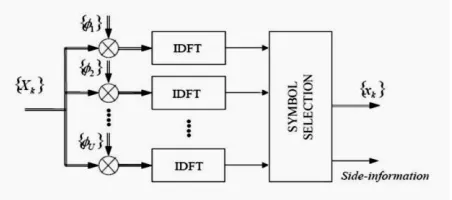
[image:3.612.57.283.461.561.2]Many methods are there to reduce the PAPR, but both complexity and redundancy are high and only small gains in PAPR are achieved. When the phases of different sub-carriers add up in phase the possibility of PAPR being high is for sure. Therefore one method to reduce the in-phase addition is to change the phase before converting the frequency domain signal into time domain. Hence before taking the N point IDFT each block of input is multiplied by an φ vector of length N. Now there is a possibility that the PAPR may turn low.
Fig 2.2 : Scheme of a Modulator with Selective Mapping
The figure 1 shows the scheme of a modulator with selective mapping technique. The algorithm for selective mapping technique is as follows:
Step 1: Got input vector X of length D and let N=integer
Step2: for i=1: N
Step 2. : Generate φ i of length D
Step 2.2: Multiply φ i with the input vector and get Z (Freq domain)
Step 2.3: Compute IDFT and get z (Time domain)
Step 2.4: Determine PAPR using the formula
| ( )|
| ( )|
Step 2.5: Increment the value of i
Step 3: Go-to Step 2
Step 4: PAPR of length N is obtained.
Step 5: Select a threshold Y. One with minimum PAPR is used for transmission
Step 6: If minimum of PAPR>Y then increment a
Counting
Step 7: Perform Steps 1-6 M times Step 8: Obtain final counting
Step 9: Increase the value of N and repeat previous
Steps1-8
Step 10: Plot the Graph for different N values where X axis Line: Threshold values
Y axis Line: [PAPR low>Y]
II. LITERATURE REVIEW
Feng Hu, Libiao Jin, Jianzeng Li, and Jingwen Ji investigated to introduce a novel receive diversity scheme in high-rate, non-orthogonal space-time block coded (STBC) large multiple-input multiple-output (MIMO) systems that achieve high spectral efficiencies and coding gains. While extremely simple scheme (such as those presented in [1] [2]) capable of attaining a significant fraction of the open-loop Shannon capacity of the (4, 1) channel, no such schemes are known for the case of no less than two receive antennas. Following the (4, 1) approach, a new approach in this letter involving linear
receiver processing is designed to receive diversity-multiplexing. The given design procedure can be easily extended to the multi-output system and a code, which outperforms the MISO (4, 1) code. Results show the proficiency of the design procedure, representing that significant improvements in both capacity and BER.
International Journal of Emerging Technology and Advanced Engineering
Website: www.ijetae.com (ISSN 2250-2459,ISO 9001:2008 Certified Journal, Volume 4, Issue 8, August 2014)
355
Authors Parismita Gogoi and Kandarpa Kumar Sarma demonstrated in their research paper the Diversity methods provide the receiver with independently faded copies of the transmitted signal with the expectation that at least one of these replicas will be received correctly. This work gives a method based on Space-Time Block Coding (STBC) with Multiple-Input Single-Output (MISO) and Multiple-Input Multiple-Output (MIMO) set-up for use in wireless channels. A special type of STBC called Alamouti code is used for exploiting the performance of MISO and MIMO in frequency selective fading environment. Performance differences are analyzed with and without STBC in frequency selective faded channels. Results demonstrate that spatial diversity along with the power of STBC drastically improves the error performance.Parismita Gogoi and Kandarpa Kumar Sarma analyzed and estimated in this research work that the combination of coding with spatial diversity opens up new dimensions in wireless communications, and could offer efficient solutions to the challenges faced in realizing reliable high-speed links. Use of Space-Time Block Coding (STBC) with Multiple-Input Multiple-Output (MIMO) set-up proves to be an efficient method for this. This work given an estimation technique based on block type pilot symbols having an orthogonal nature for use in Space-Time Block Coding (STBC) with Multiple Antennas setup. BER performance curves from the estimation technique show a result proving its effectiveness.
Year Author Title Approach Result
2013 K.Sundaravadivu and S.Bharathi.,M.E
STBC Codes for Generalized Spatial
Modulation in MIMO Systems
STBC is used instead of spatial modulator.
BPSK modulation is better for good BER Vs SNR and
FER Vs SNR
2012 Parismita Gogoi & Kandarpa Kumar Sarma
Pilot Assisted Channel Estimation Technique for
Alamouti STBC- MISO System and MIMO Set-up
with
BPSK and QPSK modulation
Use of Space-Time Block Coding
(STBC) with Multiple-Input Multiple-Output
(MIMO)
Highly effective and reliable for high-speed links.
2012
Feng Hu, Libiao Jin, Jianzeng Li, and
Jingwen Ji
Novel Constructions of MIMO STBC Designs Employing Four Transmit
Antennas
MIMO STBC Designs Employing Four Transmit
Antennas
Achieves high spectral efficiencies and coding gains
2012 Minggang Luo, Liping Li
A Rotating Blind Separation Algorithm Suitable for MIMO-STBC Systems
without Precoder
Proposed a rotation transform to maximize the independence between the real and imaginary parts without precoder (rotation)
at the transmitter side.
Separate complex PSK-modulated signals blindly with high Symbol
Error Rate (SER) performance
2012
Parismita Gogoi and Kandarpa Kumar
Sarma
STBC coded MISO and MIMO set-up in frequency selective for wireless fading
channels with BPSK and QPSK modulation schemes
Alamouti (STBC) with Multiple-Input
Single-Output (MISO) and Multiple-Input Multiple-Output (MIMO)
Improves the error performance in frequency
selective wireless fading channels.
K.Sundaravadivu and S.Bharathi., M.E, proposed and analyze a generalized spatial modulation scheme for GSM multiple antenna will be active during the transmission. A spatial modulation (SM) scheme with multiple active transmit antennas, which are called as multiple active spatial modulation (MA-SM) with Compare to SM in STBC the bit error probability is good and signals to noise ratio will be increased.
International Journal of Emerging Technology and Advanced Engineering
Website: www.ijetae.com (ISSN 2250-2459,ISO 9001:2008 Certified Journal, Volume 4, Issue 8, August 2014)
356
III. PROPOSED METHODOLOGYIn our proposed methodology the STBC OFDM system is proposed to reduce PAPR which will enhances the performance with multiple inputs & multiple output (MIMO).Using Efficient 64 QAM modulation technique.
At receiver side filters can be used with PTS or SLM algorithm & these are median/moving average filter is adopted to achieve the higher performance of Bit error rate v/s signal to noise ratio etc. In Figure 4.1 shows the block diagram of proposed methodology.
Fig.4.1 Shows the Block diagram STBC
IV. CONCLUSION
The goal of this review paper is to analyze and study the performance of MIMO systems to the conventional SISO systems. This goal was accomplished by investigating the STBC technique and the corresponding decoding algorithms. The investigated space time coding techniques were combined with OFDM to develop the MIMO-OFDM systems and the BER performance of these systems comprehensive studied. A comprehensive background of the MIMO systems was presented, including the input-output relations, space-coding techniques over flat and frequency selective channels and the decoding algorithms. The different schemes were investigated for MIMO OFDM modulation cases. The various MIMO systems have been studied in this work.
REFERENCES
[1] S. M. Alamouti, ―A simple transmit diversity technique for wireless communications,‖ IEEE J. Sel. Areas Commun., vol. 16, pp. 1451– 1458, Oct. 1988.
[2] P. Wolniansky, G. Foschini, G. Golden, and R. Valenzuela, ―V-blast: an architecture for realizing Very high data rates over the rich- scattering wireless channel,‖ in Proc. 1998 International Symp. Signals, Syst.,Electron., pp. 295–300.
[3] Jintao Wang, Shuyun Jia, and Jian Song, ―Generalised Spatial Modulation System with Multiple Active Transmit Antennas and Low Complexity Detection Scheme‖ IEEE Transactions On Wireless Communications, Vol. 11, No. 4, April 2012.
[4] H. Jafarkhani, Space-Time Coding, Theory & Practive. CambridgeUniversity Press, 2005.
[5] V. Tarokh, H. Jafarkhani, & A. R.Calderbank, ―Spacetime block codes from orthogonal designs,‖ IEEE Trans. Inf. Theory, vol. 45, no. 5,pp. 1456–1467, July 1999.
[6] E.Biglieri,Y. Hong, and E. Viterbo,―On fast-decodable space-time block codes,‖ IEEE Trans. Inf. Theory, vol. 55, no. 2, pp. 524– 530,Feb. 2009.
[7] E. Ba¸sar and Ümit Aygölü, ―High-rate full - Diversity space-time block codes for three and four transmit antennas,‖ IET Commun., vol. 3, no. 8,pp. 1371–1378, Aug. 2009.
[8] ―Full-rate full-diversity STBCS for three and four transmit antenns,‖Electron. Lett., vol. 44, no. 18, pp.1076–1077, Aug. 2008. [9] D. Tse and P. Viswanath, Fundamentals of Wireless
Communication. Cambridge University Press, 2005.
[10] J. Jeganathan , A. Ghrayeb, L. Szczecinski, and A.Ceron, ―Space shift keying modulation for MIMO channels,‖ IEEE Trans. WirelessCommun., vol. 12, pp.3692–3703, July 2009.
[11] R. Mesleh, H. Haas, S. Sinaovic, C. W. Ahn , and S. Yun, ―Spatial modulation,‖ IEEE Trans. Veh. Technol., vol. 57, no. 4, pp. 2228– 2241, July 2008.
[12] R. Mesleh, H. Haas, C. W. Ahn, and S. Yun, ―Spatial modulation— anew low complexity spectral efficiency enhancing technique,‖ in 2006Commun. Netw. China, pp. 1–5.
[13] A. Younis, N. Serafimovski, R. Mesleh, and H. Haas, ―Generalized spatial modulation,‖ in Proc. 2010 Signals, Syst. Comput., pp. 1498– 1502.
[14] J. Fu, C. Hou, W. Xiang, L. Yan, and Y. Hou, ―Generalized spatial modulation with multiple active transmit antennas,‖ in Proc. 2010 IEEE Globecom Workshops, pp. 839–844.
[15] E. Ba¸sar, Ümit Aygölü, E. Panayici, and H. V. Poor, ―Space-time blockcoded spatial modulation,‖ IEEE Trans. Commun., vol. 59, pp. 823–832,Mar. 2010.
[16] W. Rudin, Functional Analysis, 2nd edition. McGraw Hill Educ ation, 2003.
Input Data Modulation STBC OFDM Modulation
IFFT
Cyclic Prefix
Channel Noise
Remove cyclic prefix OFDM
demodulation FFT
Removing coding & Demodulation
International Journal of Emerging Technology and Advanced Engineering
Website: www.ijetae.com (ISSN 2250-2459,ISO 9001:2008 Certified Journal, Volume 4, Issue 8, August 2014)
357
[17] R.W. Farebrother, Linear Least Squares Computations. MarcelDekker, 1988.
[18] G. Strang, Introduction to Linear Algebra. Wellesley- Cambridge Press, 2003.
[19] J. Jeganathan, A. Ghrayeb, and L. Szczecinski, ―Spatial modulation: optimal detection and performance analysis,‖ IEEE Trans. Commun .Lett., vol. 12, pp. 545–547, Aug. 2008.
[20] A. Paulraj, R. Nabar, and D. Gore, Introduction to Space-Time Wireless Communications. Cambridge University Press, 2003.
Author’s Profile