International Journal of Emerging Technology and Advanced Engineering
Website: www.ijetae.com (ISSN 2250-2459, ISO 9001:2008 Certified Journal, Volume 3, Issue 10, October 2013)
180
Survey of Various Trust Models and Their Behavior in Wireless
Sensor Networks
V. Umarani
1, K. Soma Sundaram
2 1,2Jaya Engineering College, Tamilnadu, India
Abstract— The major challenge faced by wireless sensor networks is security. Because of dynamic and collaborative nature of sensor networks the connected sensor devices makes the network unusable. To solve this issue, a trust model is required to identify malicious, selfish and compromised nodes. It supports the decision making processes in wireless sensor networks such as pre key-distribution, data aggregation, sink node selection and self reconfiguration of sensor nodes. This paper discussed the general structure, design issues, trust metrics and the corresponding attacks and defense mechanisms of trust model. It also discusses various trust models used in decision making process of Wireless Sensor Networks.
Keywords — Attacks, Security, Trust metrics, Trust model, Wireless sensor network
I. INTRODUCTION
Wireless sensor network (WSN) contains thousands of sensor nodes with less memory and low power devices. It is vulnerable to insider and outsider attacks because of collaborative and dynamic nature. Several cryptographic algorithms were available for generic enhanced securities, but most of them are not suitable for wireless sensor networks. Cryptography mechanism does not enough to prevent any insider attacks, because those algorithms could not identify malicious node or selfish behavior of nodes. But it does not provide additional security or no explicit rules to protect each node and also no enhancement of distributed data gathering and collaborative data processing in networks. The main purpose of the trust model is to enhance the overall performance by monitoring network activities, minimizing the risk and ensuring the network activities of entity such as data gathering and data processing.
The term trust management was introduced by Blaze et.al [4] to define a coherent framework for the study of security policies, credentials and trust relationships. The term trust has been defined by several ways, as The Merriam-Webster’s Dictionary [2] defines trust as ―assured reliance on the character, ability, strength, truth of someone or something‖. Dictionary.com [2] describes trust as the ―firm reliance on the integrity, ability or character of a person or thing‖.
In brief, trust is the reputation of entity where reputation is opinion about others. Trust is a belief that ensures entity as secure and reliable. Thus trust model is used to differentiate trust worthy and untrustworthy nodes in a network. It encourages trustworthy nodes to communicate and discourages untrustworthy nodes to participate in the network. Also, it increases the network lifetime, throughput and resilience of the wireless sensor network.
In this paper the sections are organized as follows: section 2 deals with classification of trust, some of the most widely used trust metrics and attacks identified, section 3 discusses the structure of trust model, section 4 describes the major issues in constructing trust model and section 5 reviews various trust models discussed in the literatures.
II. TRUST CLASSIFICATION,METRICS AND ATTACK
IDENTIFICATION
In wireless sensor network, trust specifies the reliability or trust worthiness of sensor node. Trust may be classified in different ways based on how they are used. Trust may be subjective or objective based on task. Depending on property, trust may be social trust or QOS trust. Social trust considers intimacy, honesty, privacy, centrality, connectivity and QOS trust considers energy, unselfishness, competence, cooperativeness, reliability, task completion capability, etc.
In general, trust may be classified as behavioral or computational trust based on where it is used. Behavioral trust defines trust relations among people and organizations. Computational trust defines trust relation among devices, computers, and networks.
International Journal of Emerging Technology and Advanced Engineering
Website: www.ijetae.com (ISSN 2250-2459, ISO 9001:2008 Certified Journal, Volume 3, Issue 10, October 2013)
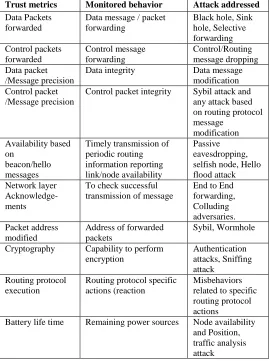
[image:2.612.306.579.134.285.2]181 There are several trust metrics taken by trust model to calculate the trust value. TABLE I discusses [2]` some of the trust metric monitored by trust model and the attack addressed by corresponding trust metric.
[image:2.612.34.304.355.716.2]Figure I General Classification Of Trust
Table I
Trust Metrics, Monitored Behavior And Attack Addressed
Trust metrics Monitored behavior Attack addressed Data Packets
forwarded
Data message / packet forwarding
Black hole, Sink hole, Selective forwarding Control packets
forwarded
Control message forwarding
Control/Routing message dropping Data packet
/Message precision
Data integrity Data message modification Control packet
/Message precision
Control packet integrity Sybil attack and any attack based on routing protocol message
modification Availability based
on
beacon/hello messages
Timely transmission of periodic routing information reporting link/node availability
Passive eavesdropping, selfish node, Hello flood attack Network layer
Acknowledge-ments
To check successful transmission of message
End to End forwarding, Colluding adversaries. Packet address
modified
Address of forwarded packets
Sybil, Wormhole
Cryptography Capability to perform encryption
Authentication attacks, Sniffing attack
Routing protocol execution
Routing protocol specific actions (reaction
Misbehaviors related to specific routing protocol actions
Battery life time Remaining power sources Node availability and Position, traffic analysis attack
Consistency of reported values /data
Consistency of sensing results, reported values
Compromised nodes, No response attack Sensing
communication
Reporting of events Selfish node behavior at application level Reputation
validation
Trust value obtained from third parties
Bad mouthing attack, Fake Warning-report attack Hop Count scheme Number of nodes forward
request
Lying about hop count, Sybil attack Reputation
Response
Check the execution of reputation mechanism
Selfish node attack
III. STRUCTURE OF TRUST MODEL
In wireless sensor networks, trust model plays an important role in identifying misbehavior nodes and providing collaboration among trustworthy nodes. It improves the lifetime of networks that inspire expectations among future interactions. The model is capable of capturing and distributing feedbacks about current interactions among nodes and stores the trust information for future. It also uses feedback to guide trust decisions. Depending on trust information stored, it may be classified as centralized, distributed and hybrid model [1] and given in Figure II.
Centralized trust model consists of a single globally trusted server that determines the trust values of every node in the network. In distributed trust model, every node locally calculates the trust values of all other nodes in the network that increases the computational cost. Also each node needs to maintain an up-to-date record about the trust values of the entire networking in the form of a table.
Hybrid trust model contains the properties of both centralized as well as distributed trust management approaches. The main objective of this approach is to reduce the cost associated with trust evaluation as compared to distributed approaches. This scheme is used with clustering schemes in which cluster head acts as a central server for that cluster.
In the certificate-based trust model, trust is mainly based on the provision of a valid certificate assigned to a target node by a centralized certification authority or by other trusted issuer. In the behavior-based trust model, an entity calculates the trust values by continuous direct or indirect monitoring of other nodes
International Journal of Emerging Technology and Advanced Engineering
Website: www.ijetae.com (ISSN 2250-2459, ISO 9001:2008 Certified Journal, Volume 3, Issue 10, October 2013)
[image:3.612.54.289.142.272.2]182
Figure II Structure of trust model
[image:3.612.42.296.329.495.2]The main advantages and disadvantages of trust model are listed in Table II.
Table II
Pros And Cons Of Structure Of Trust Model
Structure Pros Cons
Centralized Least computational overhead and least memory usage
Most Communication overhead, least reliable, lack of scalability Distributed Most reliable and
scalable
Most computational overhead
Hybrid Less communication overhead than centralized and less memory
Large computational overhead than centralized, large memory requirement than centralized , less reliable and scalable compared to distributed
IV. DESIGN ISSUES IN TRUST MODEL
Trust model can be designed by considering the three major components such as information gathering, information modeling and decision making. Each stage has several issues that can be considered carefully in design of trust model in wireless sensor networks [2].Some of them are listed below
,
A. Information Gathering
Information gathering is a process in which, a node collects information about other nodes that is interested. The main task is to determine type of information should be collected about other neighboring nodes, reputation metrics used to find the behavior of node and how are they distributed. Information may be gathered as direct observation (first hand information) or indirect observation that is second hand information (called reputation).
Second hand information can be collected by propagating information through nodes which are vulnerable to bad mouthing attack and ballot attack. In bad mouthing attack, attackers give negative feedback about well behaved nodes to decrease the trustworthiness. In ballot attack, malicious node gives positive feedback to other malicious nodes to increase their trustworthiness
B. Information modelling
[image:3.612.308.588.358.694.2]It specifies how node calculates reputation value of other nodes which are participating in the networks. Trust system may be a centralized, distributed or Hybrid. In centralized approach is not carefully designed, because single point of failure and is not scale well. In distributed approach, each node calculates reputation values itself and scale well. Hybrid approach is combination of centralized and distributed approach.
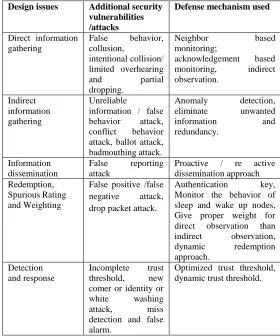
Table III
Design issues attacks and their defense mechanism
Design issues Additional security vulnerabilities /attacks
Defense mechanism used
Direct information gathering
False behavior, collusion,
intentional collision/ limited overhearing and partial dropping.
Neighbor based monitoring;
acknowledgement based monitoring, indirect observation.
Indirect information gathering
Unreliable
information / false behavior attack, conflict behavior attack, ballot attack, badmouthing attack.
Anomaly detection, eliminate unwanted information and redundancy.
Information dissemination
False reporting attack
Proactive / re active dissemination approach Redemption,
Spurious Rating and Weighting
False positive /false negative attack, drop packet attack.
Authentication key, Monitor the behavior of sleep and wake up nodes, Give proper weight for direct observation than indirect observation, dynamic redemption approach.
Detection and response
Incomplete trust threshold, new comer or identity or white washing attack, miss detection and false alarm.
Optimized trust threshold, dynamic trust threshold.
International Journal of Emerging Technology and Advanced Engineering
Website: www.ijetae.com (ISSN 2250-2459, ISO 9001:2008 Certified Journal, Volume 3, Issue 10, October 2013)
183
C. Information dissemination
Information sharing involves three important issues: (i) dissemination frequency, (ii) dissemination locality, and (iii) dissemination content. Dissemination frequency may be proactive (share information at each interval specified) or reactive (share information when any accepted changes). Dissemination locality may be local (information published within a neighborhood node) or global (the information is propagated to nodes outside the radio range of the node publishing the reputation information). The content is raw information or processed information that shares false reporting attack
D. Redemption, spurious rating and weighting of time
An important issue in maintaining and updating reputation is how past and current information are weighted. Generally first hand observation has more weight than second hand information. If second-hand information is used to influence reputation, some nodes may lie and give spurious rating about others.
E. Detection and Response
It specifies how to detect misbehaviors and specify the response of system. Here, uses several trust metrics to calculate trust value that can be used to find misbehaviors. Response may give punishment or reward that also one of the issues in trust management system.
Each and every stages of designing trust model provide additional security vulnerabilities and has several solutions [20] for careful design of trust model as in TABLE III.
V. VARIOUS TRUST MODELS IN WIRELESS SENSOR
NETWORKS
Trust plays an important role in human life environments and virtual organizations. Trust is an important issue in distributed system. In e-services, trust estimate the risk of transaction involved between buyers and sellers. For example policy maker and key note as first trust management used in web services. Amazon, eBay, and NetFlix [5], have deployed reputation-based trust in ranking their products and suppliers. In the context of a network, trust may help its elements to decide whether another member of the same network is being uncooperative or malicious. In Ad-hoc network, trust plays an important role in finding misbehaviors, routing, cooperation and resource sharing. Trusted AODV[23], Trusted GPSR[24], Trust Aware DSR[25] and CONFIDENT [21] are responsible for routing. CORE[22], OCEAN[40] are responsible for cooperation among nodes in Ad-hoc Network.
In WSN, trust plays a major role in detecting a node which is not behaving as expected (either faulty or maliciously). Trust judges the quality of node and their services. Also it assists on decision making process such as data aggregation, routing and reconfiguring sensor nodes. This paper focuses mainly on various trust models used in wireless sensor network. Some of them are as follows.
The reputation-based framework for high integrity sensor network (RFSN) [6] is a first trust based model designed and developed for sensor networks. It makes use of watchdog mechanism to collect data and monitor different events in the node to build reputation of the node and then get the trust rating of the node. Some of the proposed improved models of beta based reputation in sensor networks are MA&TP-BRSN [7], RFM-WSN [8]. The RASN [39] is reputation agent based framework for WSN to incorporate on/off attack resisting model which is improved model of RFSN.
The watchdog is responsible for detecting non forwarding behavior of node in a network. Extended watchdog [11] mechanism is used to monitor all its neighbors’ behavior based on information collected from MAC layer. It uses new direct last-hop neighbor behavior evaluation mechanism (LHDA) which collects information from MAC layer when RTS/CTS/DATA/ACK control packets are enabled. It is mainly based on direct observations and it has low computation overhead and resilience to attacks.
The Retrust [34] is an attack-resistant and lightweight trust management scheme to detect faulty or malicious behaviors and improve the performance of medical sensor network. The Bayesian fuse algorithm [33] used to combine more than one trust component to evaluate trust worthiness of all nodes in a network. It uses communication trust (beta distribution) and data trust for trust calculation. It reduces the false reporting attack.
International Journal of Emerging Technology and Advanced Engineering
Website: www.ijetae.com (ISSN 2250-2459, ISO 9001:2008 Certified Journal, Volume 3, Issue 10, October 2013)
184 The bio-inspired trust and reputation model, called BTRM-WSN [12] is a distributed based ant colony approach which is used to improve the collaboration among nodes by selecting most trustworthy nodes along the path from sensor node to sink node. The quality based distance vector QDV [13] is an ant colony based reputation model used to provide reliable communication and to provide QOS based security in WSN. It protects the network from packet injection attack.
The agent-based trust model for Wireless Sensor Networks (ATSN) and Agent based Trust management (ATRM) [9] are agent based reputation approaches. In ATRM, distributed certificate based trust model monitor the behavior of network with the help of agent module. Agent module performs the reputation calculation by issuing t-certificate. Sensor node decides the transaction of node or not from mobile agent by issuing r-certificate. It addresses the uncertainty issue, but still cooperates with the malicious nodes and has one value of trust rating for different events.
The TMA [31] is dynamic certification based trust management architecture for hierarchical WSN that reduces the computation and communication overhead by considering both behavioral and direct trust. The reliable data aggregation and transmission protocol, called RDAT [14] is a distributed functional based beta reputation model. It improves the reliability of data aggregation and transmission by evaluating each type of sensor node action using a respective functional reputation. It prevents false injection attack /compromised attack.
The Ambient Trust Sensor Routing (ATSR) [18] is a trust-aware, location-based routing protocol which protects the WSN against routing attacks, and also supports large-scale WSNs deployments. It is used to evaluate the reliability of the nodes by weighted reputation mechanism
The trust-based secure data aggregation protocol (TBS)[27] used to select the aggregator which has highest combined trust value to avoid aggregation attacks. The robust adaptive approach based on hierarchical monitoring (RAHIM)[28] is a centralized reputation scheme which provides secure data aggregation and less communication overhead in cluster based wireless sensor networks. The reputation-based secure data aggregation (RSDA) [32] is used to improve the accuracy of aggregated data and enhance the network lifetime.
The trust management model for internet of things called TRM-IoT [15] is a fuzzy based reputation model which is used to establish collaboration among nodes and to monitor malicious misbehavior. The trust model use fuzzy logic in WSN [30] which is used to provide efficient and safe communication from source to destination.
The Sensor Trust [17] is a resilient model for improving data integrity. It evaluates the trust worthiness of node in hierarchical WSN using Gaussian distribution-based fine-grained method.
The addition encouragement and multiplication punishment (AEMP) [19] is a new routing trust based protocol to enhance WSN ability against attacks from inside network. It needs more computation and communication resources to decide best route.
The direct trust dependent link state routing protocol (DTLSRP)[26] is a trust based routing protocol to protect network from routing attacks.
The role based trust management language (RT) [16] is used for representing security policies and credentials in decentralized, distributed access control systems. For example Policy maker, Keynote, SPKI/SDSI, Role Based Access control (RBAC) are based on RT language and RTD specify policies over wireless sensor node which delegates their roles to other node when location changes. It specifies delegation based on attributes not their identities. The RRAS [46] is the reputation based role assignment method for assigning roles or levels of node to improve throughput of wireless sensor networks
The distributed reputation based beacon trust system (DRBTS)[37] is a reputation based distributed structure for monitoring misbehaviors of WSN. It is a first reputation model for secure localization using voting majority scheme. The resilient geographic routing protocol (RGR)[29] is used to provide secure, validated localization and trust based routing using probabilistic multi path routing protocol. It prevents broadcast manipulation attack such as mobility attack, multiple unicast packet attack and byzantine attacks.
The TMF [38] is a dynamic trust management framework which reduces communication overhead, computation overhead and memory requirements by combining both behavior and certificate based scheme.
International Journal of Emerging Technology and Advanced Engineering
Website: www.ijetae.com (ISSN 2250-2459, ISO 9001:2008 Certified Journal, Volume 3, Issue 10, October 2013)
185 But [14] focused on trust to improve data integrity which is important for data aggregation in network.
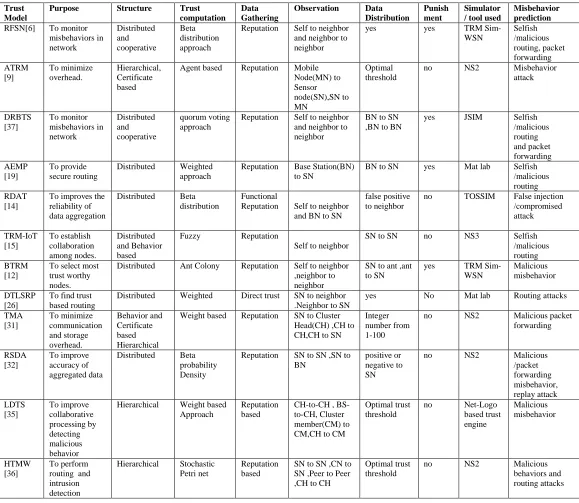
[image:6.612.17.596.209.712.2]Some research works [11] are mainly based on direct observations or subjective observation which does not enhance the functionality and not observed all kinds of attacks in wireless sensor network.
Table IV
Design Of Various Trust Model In Wireless Sensor Networks
Trust Model
Purpose Structure Trust computation
Data Gathering
Observation Data Distribution
Punish ment
Simulator / tool used
Misbehavior prediction
RFSN[6] To monitor misbehaviors in network Distributed and cooperative Beta distribution approach
Reputation Self to neighbor and neighbor to neighbor
yes yes TRM
Sim-WSN Selfish /malicious routing, packet forwarding ATRM [9] To minimize overhead. Hierarchical, Certificate based
Agent based Reputation Mobile Node(MN) to Sensor node(SN),SN to MN Optimal threshold
no NS2 Misbehavior attack DRBTS [37] To monitor misbehaviors in network Distributed and cooperative quorum voting approach
Reputation Self to neighbor and neighbor to neighbor
BN to SN ,BN to BN
yes JSIM Selfish /malicious routing and packet forwarding AEMP [19] To provide secure routing
Distributed Weighted approach
Reputation Base Station(BN) to SN
BN to SN yes Mat lab Selfish /malicious routing RDAT
[14]
To improves the reliability of data aggregation
Distributed Beta distribution
Functional
Reputation Self to neighbor and BN to SN
false positive to neighbor
no TOSSIM False injection /compromised attack TRM-IoT [15] To establish collaboration among nodes. Distributed and Behavior based
Fuzzy Reputation
Self to neighbor
SN to SN no NS3 Selfish /malicious routing BTRM
[12]
To select most trust worthy nodes.
Distributed Ant Colony Reputation Self to neighbor ,neighbor to neighbor
SN to ant ,ant to SN
yes TRM Sim-WSN
Malicious misbehavior DTLSRP
[26]
To find trust based routing
Distributed Weighted Direct trust SN to neighbor .Neighbor to SN
yes No Mat lab Routing attacks TMA [31] To minimize communication and storage overhead. Behavior and Certificate based Hierarchical
Weight based Reputation SN to Cluster Head(CH) ,CH to CH,CH to SN
Integer number from 1-100
no NS2 Malicious packet forwarding RSDA [32] To improve accuracy of aggregated data
Distributed Beta probability Density
Reputation SN to SN ,SN to BN
positive or negative to SN
no NS2 Malicious /packet forwarding misbehavior, replay attack LDTS [35] To improve collaborative processing by detecting malicious behavior
Hierarchical Weight based Approach
Reputation based
CH-to-CH , BS-to-CH, Cluster member(CM) to CM,CH to CM
Optimal trust threshold
no Net-Logo based trust engine Malicious misbehavior HTMW [36] To perform routing and intrusion detection
Hierarchical Stochastic Petri net
Reputation based
SN to SN ,CN to SN ,Peer to Peer ,CH to CH
Optimal trust threshold
International Journal of Emerging Technology and Advanced Engineering
Website: www.ijetae.com (ISSN 2250-2459, ISO 9001:2008 Certified Journal, Volume 3, Issue 10, October 2013)
186 In each research work, authors use different mechanism for reputation calculation such as beta distribution [6,7,8] and 14,32,46], weighted approach [17,26,27,31,35,38,42], Bayesian approach[21,22,33], ant colony approach[12,13], fuzzy[15,30] ,agent based[9,39] and so on.
Work [6,7,8,14,32,46] are mainly based on beta based reputation model which is effective approach to monitor network behavior, give reward and punishment based on their behavior of forwarding packets, but not focused on functional based or event based sensor nodes. It does not differentiate positive or negative events in sensor network. In weight based approach [17,26,27,31,35,38,42], trust worthy node is selected based on how they are weighted and trust node is capable to compare received data with sensed data duration and is mainly based on synchronization.
In agent based approach [9, 39], agent node is responsible for trust calculation. So, Agent node has long radio range, more power and large storage base. Beacon trust model which uses reputation values that is vulnerable to attacks.
There is no general trust model suitable for all kinds of application in wireless sensor network and previous research work focused on derivation of new trust relations from old ones; e.g., trusted third-party services, transitive trust relations, delegation. Now, researchers are focusing on how to create new trust relations that are not derived from old ones, and create new opportunities for cooperation among users and among services.
VI. CONCLUSION
The need of trust model in wireless sensor network is extensively discussed in this paper. Trust metrics, issues in building a wireless sensor networks and some of the research work done on trust management are also discussed. There is no standard adversarial model where current trust systems compete to provide a higher level of security or resilience to attacks. The designers of each system solved the trustworthiness problem in WSNs from different angles and some designers solved the problem by considering only routing misbehaviors or only depend on task and so on.
It is believed that each activity, such as routing or data aggregation has its own challenges and need to be considered carefully. Trust model in wireless sensor network cause new attacks such as ballot attack, bad mouthing attack, selective behavior attack, on-off attack, new comer attack and so on. So the researchers developed a trust model carefully to handle wireless sensor network attack as well as trust attacks.
Future research work in trust management focuses on generalized, scalable and reconfigurable trust model suitable for distributed computing system. It handles malicious and non malicious misbehavior in networking, sensing and data processing. This can improve the security issues to meet specific application demands.
REFERENCES
[1] Huaizhi Li and Mukesh Singhal, 2007 Trust Management in distributed Systems, IEEE Computer Society, pp: 45-53.
[2] Vishal Rathod, Mrudang Mehta, 2011 Security in Wireless Sensor Network‖, A survey in Journal of Engineering & Technology, Vol.-1, Issue-Vol.-1, pp.35-45.
[3] Theodore Zahariadis, Helen C. Leligou, Panagiotis Trakadas and Stamatis Voliotis, 2010 Mobile Networks- Trust management in wireless sensor networks in European Transactions on Telecommunications, pp. 386–395.
[4] M.Blaze, J.Feigenbaum, and J.Lacy, 1996 Decentralized Trust Management in IEEE Symposium on Security and Privacy, pp.150-168.
[5] Ling Liu, Weisong Shi, 2010 Trust and Reputation management in IEEE Internet Computing, pp.1089-7801.
[6] S. Ganeriwal, L. K. Balzano, M. B. Srivastava, 2008 Reputation-based framework for high integrity sensor networks in ACM Transactions on Sensor Networks pp.1-37
[7] Yang Guang, Yin Gui-sheng, Yang Wu et al,2009 Reputation Model based on behavior of sensor nodes in WSN in Journal on Communication, pp. 18-26.
[8] Xiao De-qin, Feng Jian-zhao, Yang Bo et al,2007 Reputation formal model for wireless sensor network‖ in Computer Science, pp.84-87.
[9] Boukerch , L. Xu , K. EL-Khatib,2007 Trust-based security for wireless ad hoc and sensor networks in Computer Communications, pp. 2413–2427,2007.
[10] Li Lin and Jinpeng Huai,2007 QGrid: An Adaptive Trust Aware Resource Management Framework in IEEE Systems Journal, Vol. 3, No. 1, pp. 78-90.
[11] Lei Huang , Lixiang Liu,2008 Extended Watchdog Mechanism for Wireless Sensor Networks in Journal of Information and Computing Science Vol.3, No. 1, pp. 39-48.
[12] Félix Gómez Mármol, Gregorio Martínez Pérez, 2008 Providing trust in wireless sensor networks using a bio-inspired technique in Journal on communication, pp.86-94.
[13] S.K. Dhurandher, S. Misra, M.S. Obaidat, N. Gupta,2009 An ant colony optimization approach for reputation and quality-of-service-based security in wireless sensor networks in Security and Communication Networks, pp. 215–224.
[14] Suat Ozdemir, 2008 Functional reputation based reliable data aggregation and transmission for wireless sensor networks in Computer Communications, pp 3941–3953.
[15] Dong Chen, Guiran Chang, Dawei Sun, Jiajia Li, Jie Jia, and Xingwei Wang, 2011TRM-IoT: A Trust Management Model Based on Fuzzy Reputation for Internet of Things in ComSIS Vol. 8, No. 4, Special Issue, pp. 1208-1228.
International Journal of Emerging Technology and Advanced Engineering
Website: www.ijetae.com (ISSN 2250-2459, ISO 9001:2008 Certified Journal, Volume 3, Issue 10, October 2013)
187
[17] Guoxing Zhana, Weisong Shi, Julia Deng, 2011 SensorTrust: A resilient trust model for wireless sensing systems in Pervasive and Mobile Computing, pp.509–522
[18] Theodore Zahariadis , Helen Leligou, Panagiotis Karkazis, Panagiotis Trakadas, Ioannis Papaefstathiou, Charalambos Vangelatos, Lionel Besson, 2010 Design and Implementation Of A Trust-Aware Routing Protocol For Large WSN in International Journal Of Network Security & Its Applications (IJNSA), Vol.2, No.3,pp.123-143.
[19] Gu Xiang, Qiu Jianlina, Wang Jina, 2012 Research on Trust Model of Sensor Nodes in WSNs in International Workshop on Information and Electronics Engineering (IWIEE), pp.45-57.
[20] Youngho Cho and Gang Qu, Yuanming Wu, 2012 Insider Threats against Trust Mechanism with Watchdog and Defending Approaches in Wireless Sensor Networks in IEEE Symposium on Security and Privacy Workshops, pp. 134-141.
[21] S. Buchegger and J. Y. L. Boudec, 2002 Performance analysis of the CONFIDANT protocol (Cooperation Of Nodes - Fairness In Dynamic Ad-hoc NeTworks) in The 3rd ACM International symposium Mobile Ad-hoc Networking & Computing (MobiHoc '02).
[22] P. Michiardi and R. Molva, 2002 CORE: A Collaborative Reputation Mechanism to Enforce Node Cooperation in Mobile Ad-hoc Networks in The IFIP TC6/TC11 Sixth Joint Working Conference on Communications and Multimedia Security: Advanced Communications and Multimedia Security Portoroz, Slovenia. [23] X. Q. Li, M. R. Lyu and J. C. Liu, 2004 A Trust Model Based
Routing Protocol for Secure Ad-Hoc Networks in Proceedings of the IEEE Conference on Aerospace, Big Sky,Montana, Vol. 2, 6-13. [24] A. A. Pirzada and C. McDonald, 2007 Trusted Greedy Perimeter
Stateless Routing in Proceedings of the 15th IEEE International Conference on Networks, Adelaide, November, pp. 19-21.
[25] S. Marti, T. Giuli, K. Lai and M. Baker, 2000 Mitigating Routing Misbehavior in Mobile Ad-Hoc Networks in Proceedings of the 6th Annual International Conference on Mobile Computing and Networking, ACM Press, Boston,( 6-11), pp. 255-265.
[26] Shaik Sahil Babu, Arnab Raha, Mrinal Kanti Naskar ,2010 A Direct Trust Dependent Link State Routing Protocol Using Route Trusts for WSNs (DTLSRP) in Journal of Scientific Research Wireless Sensor Network, 3,pp 125-134.
[27] Bhavna Arora Makin and Dev Anand Padha, 2010 A Trust-Based Secure Data Aggregation Protocol for Wireless Sensor Networks in IUP Journal of Information Technology, Vol. VI, No. 3,pp 7 – 22. [28] Nabila Labraoui,Mourad Gueroui,Makhlouf Aliouat,Jonathan Petit,
2011 RAHIM: Robust Adaptive Approach Based on Hierarchical Monitoring Providing Trust Aggregation for Wireless Sensor Networks in Journal of Universal Computer Science, vol. 17, no. 11 , 1550-1571.
[29] Ke Liu, Nael Abu-Ghazaleh , Kyoung-Don Kang, 2007 Location verification and trust management for resilient geographic routing in Journal of Parallel and Distributed Computing, 67,215 – 228. [30] Tae Kyung Kim, and Hee Suk Seo ,2008 A Trust Model using
Fuzzy Logic in Wireless Sensor Network in World Academy of Science, Engineering and Technology, 18, pp 61-66.
[31] Junqi Zhang, Rajan Shankaran, Mehmet A. Orgun Vijay Varadharajan and Abdul Sattar , 2010 A Trust Management Architecture for Hierarchical Wireless Sensor Networks , 35th annual
IEEE conference on local computer networks.LCN ,pp. 268-273
[32] Alzaid, Hani and Foo, Ernest and Gonzalez Nieto, 2008 RSDA: Reputation-based Secure Data Aggregation in Wireless Sensor Networks in Proceedings 1st International Workshop on Sensor Networks and Ambient Intelligence (SeNAmI), Dunedin, New Zealand.
[33] Mohammad Momani, 2010 Bayesian Fusion Algorithm for Inferring Trust in Wireless Sensor Networks in Journal of networks,vol.5,no.7,pp.815-824.
[34] Daojing He, Chun Chen, Sammy Chan, Jiajun Bu, and Athanasios V. Vasilakos, 2012 ReTrust: Attack-Resistant and Lightweight Trust Management for Medical Sensor Networks in IEEE transactions on information technology in biomedicine, vol. 16, no. 4, pp.623-632. [35] Xiaoyong Li, Feng Zhou and Junping Du, 2013 LDTS: A
Lightweight and Dependable Trust System for Clustered Wireless Sensor Networks in IEEE transactions on information forensics and security, pp 451-551.
[36] Fenye Bao, Ing-Ray Chen, MoonJeong Chang, and Jin-Hee Cho, 2012 Hierarchical Trust Management for Wireless Sensor Networks and its Applications to Trust-Based Routing and Intrusion Detection in IEEE Transactions on network and service management, vol. 9, no. 2, pp.169-183.
[37] A. Srinivasan, J. Teitelbaum and J. Wu, 2006 DRBTS: Distributed Reputation-based Beacon Trust System in the 2nd IEEE International Symposium on Dependable, Autonomic and Secure Computing (DASC’06), Indianapolis, USA.
[38] Junqi Zhang, Rajan Shankaran, Mehmet A. Orgun, Vijay Varadharajan and Abdul Sattar, 2010 A Dynamic Trust Establishment and Management Framework for Wireless Sensor Networks‖ in IEEE/IFIP International Conference on Embedded and Ubiquitous Computing, pp. 484 -492.
[39] Pengzhi Shi, Haiguang Chen,2012 RASN: Resist on-off Attack for Wireless Sensor Networks in The 2nd International Conference on Computer Application and System Modeling published by Atlantis Press, Paris, France, pp. 0690 to 0693.
[40] Sorav Bansal, Mary Baker, 2003 Observation-based Cooperation Enforcement in ad-hoc networks, pp702-708.
[41] Guoxing Zhan, Weisong Shi, and Julia Deng, 2012 Design and Implementation of TARF:A Trust-Aware Routing Framework for WSNs in IEEE Transactions on Dependable and secure computing vol.9, pp.184-196.
[42] Younghun chae, 2012 Redeemable reputation based secure routing protocol for wireless sensor networks, a thesis in university of rhode island, pp.1-55.
[43] Félix Gómez Mármol , Gregorio Martínez Pérez, 2010,Towards pre-standardization of trust and reputation models for distributed and heterogeneous systems‖ in Computer Standards & Interfaces vol .no 32 ,pp.185–196.
[44] A. Boukerch, L. Xu , K. EL-Khatib,2010 Trust-based security for wireless ad hoc and sensor network in Computer Communications Vol no 30 , pp. 2413–2427.
[45] Javier Lopez, Rodrigo Roman, Isaac Agudo, Carmen Fernandez-Gago, 2010 Trust management systems for wireless sensor networks in Best practices in Computer Communications Vol.no 33, pp. 1086– 1093.
International Journal of Emerging Technology and Advanced Engineering
Website: www.ijetae.com (ISSN 2250-2459, ISO 9001:2008 Certified Journal, Volume 3, Issue 10, October 2013)
188
[47] G.Edwin Prem Kumar, Titus. I, Sony. I,Thekkekara 2012 A Comprehensive overview on Application of Trust and Reputation in wireless Sensor network in International conference on modeling optimization and Computing in Procedia Engineering Vol no.38,pp.2903-2912.