A comparative analysis of procurement
methods used on competitively tendered
office projects in the UK
Muriro, A and Wood, GD
Title
A comparative analysis of procurement methods used on competitively
tendered office projects in the UK
Authors
Muriro, A and Wood, GD
Type
Conference or Workshop Item
URL
This version is available at: http://usir.salford.ac.uk/23055/
Published Date
2010
USIR is a digital collection of the research output of the University of Salford. Where copyright
permits, full text material held in the repository is made freely available online and can be read,
downloaded and copied for noncommercial private study or research purposes. Please check the
manuscript for any further copyright restrictions.
The Construction, Building and Real Estate Research Conference of
the Royal Institution of Chartered Surveyors
Held at Dauphine Université, Paris, 2-3 September 2010
ISBN 978-1-84219-619-9
© RICS
12 Great George Street London SW1P 3AD
United Kingdom
www.rics.org/cobra
September 2010
The RICS COBRA Conference is held annually. The aim of COBRA is to provide a platform for the dissemination of original research and new developments within the specific
disciplines, sub-disciplines or field of study of:
Management of the construction process
• Cost and value management
• Building technology
• Legal aspects of construction and procurement
• Public private partnerships
• Health and safety
• Procurement
• Risk management
• Project management
The built asset
• Property investment theory and practice
• Indirect property investment
• Property market forecasting
• Property pricing and appraisal
• Law of property, housing and land use planning
• Urban development
• Planning and property markets
• Financial analysis of the property market and property assets
• The dynamics of residential property markets
• Global comparative analysis of property markets
• Building occupation
• Sustainability and real estate
• Sustainability and environmental law
The property industry
• Information technology
• Innovation in education and training
• Human and organisational aspects of the industry
• Alternative dispute resolution and conflict management
• Professional education and training
Peer review process
All papers submitted to COBRA were subjected to a double-blind (peer review) refereeing process. Referees were drawn from an expert panel, representing respected academics from the construction and building research community. The conference organisers wish to extend their appreciation to the following members of the panel for their work, which is invaluable to the success of COBRA.
Rifat Akbiyikli Sakarya University, Turkey
Rafid Al Khaddar Liverpool John Moores University, UK Ahmed Al Shamma’a Liverpool John Moores University, UK Tony Auchterlounie University of Bolton, UK
Kwasi Gyau Baffour Awuah University of Wolverhampton, UK
Kabir Bala Ahmadu Bello University, Nigeria Juerg Bernet Danube University Krems, Austria
John Boon UNITEC, New Zealand
Douw Boshoff University of Pretoria, South Africa Richard Burt Auburn University, USA
Judith Callanan RMIT University, Australia Kate Carter Heriot-Watt University, UK
Keith Cattell University of Cape Town, South Africa Antoinette Charles Glasgow Caledonian University, UK
Fiona Cheung Queensland University of Technology, Australia Sai On Cheung City University of Hong Kong
Samuel Chikafalimani University of Pretoria, South Africa Ifte Choudhury Texas A and M University, USA Chris Cloete University of Pretoria, South Africa Alan Coday Anglia Ruskin University, UK Michael Coffey Anglia Ruskin University, UK
Nigel Craig Glasgow Caledonian University, UK
Ayirebi Dansoh KNUST, Ghana
Peter Davis Curtin University, Australia
Peter Defoe Calford Seaden, UK
Grace Ding University of Technology Sydney, Australia Hemanta Doloi University of Melbourne, Australia
John Dye TPS Consult, UK
Peter Edwards RMIT, Australia
Charles Egbu University of Salford, UK
Ola Fagbenle Covenant University, Nigeria
Ben Farrow Auburn University, USA
Peter Fenn University of Manchester, UK
Peter Fisher University of Northumbria, UK Chris Fortune University of Salford, UK
Valerie Francis University of Melbourne, Australia
Rod Gameson University of Wolverhampton, UK Abdulkadir Ganah University of Central Lancashire, UK
Seung Hon Han Yonsei University, South Korea Anthony Hatfield University of Wolverhampton, UK
Theo Haupt Cape Peninsula University of Technology, South Africa Dries Hauptfleisch University of the Free State, South Africa
Paul Holley Auburn University, USA
Danie Hoffman University of Pretoria, South Africa Keith Hogg University of Northumbria, UK Alan Hore Construction IT Alliance, Ireland Bon-Gang Hwang National University of Singapore
Joseph Igwe University of Lagos, Nigeria
Adi Irfan Universiti Kebangsaan Malaysia, Malaysia Javier Irizarry Georgia Institute of Technology, USA Usman Isah University of Manchester, UK
David Jenkins University of Glamorgan, UK
Godfaurd John University of Central Lancashire, UK Keith Jones University of Greenwich, UK
Dean Kashiwagi Arizona State University, USA
Nthatisi Khatleli University of Cape Town, South Africa Mohammed Kishk Robert Gordon’s University, UK Andrew Knight Nottingham Trent University, UK Scott Kramer Auburn University, USA
Esra Kurul Oxford Brookes University, UK
Richard Laing Robert Gordon’s University, UK Terence Lam Anglia Ruskin University, UK Veerasak Likhitruangsilp Chulalongkorn University, Thailand John Littlewood University of Wales Institute, Cardiff, UK Junshan Liu Auburn University, USA
Champika Liyanage University of Central Lancashire, UK Greg Lloyd University of Ulster, UK
S M Lo City University of Hong Kong
Mok Ken Loong Yonsei University, South Korea
Martin Loosemore University of New South Wales, Australia
David Manase Glasgow Caledonian University, UK Donny Mangitung Universitas Tadulako, Malaysia Patrick Manu University of Wolverhampton, UK Tinus Maritz University of Pretoria, South Africa Hendrik Marx University of the Free State. South Africa
Ludwig Martin Cape Peninsula University of Technology, South Africa Wilfred Matipa Liverpool John Moores University, UK
Steven McCabe Birmingham City University, UK Annie McCartney University of Glamorgan, UK Andrew McCoy Virginia Tech, USA
Enda McKenna Queen’s University Belfast, UK
Michael Murray University of Strathclyde, UK
Saka Najimu Glasgow Caledonian University, UK Stanley Njuangang University of Central Lancashire, UK
Henry Odeyinka University of Ulster, UK
Ayodejo Ojo Ministry of National Development, Seychelles Michael Oladokun University of Uyo, Nigeria
Alfred Olatunji Newcastle University, Australia Austin Otegbulu
Beliz Ozorhon Bogazici University, Turkey
Obinna Ozumba University of the Witwatersrand, South Africa
Robert Pearl University of KwaZulu, Natal, South Africa Srinath Perera Northumbria University, UK
Joanna Poon Nottingham Trent University, UK Keith Potts University of Wolverhampton, UK
Elena de la Poza Plaza Universidad Politécnica de Valencia, Spain Matthijs Prins Delft University of Technology, The Netherlands Hendrik Prinsloo University of Pretoria, South Africa
Richard Reed Deakin University, Australia Zhaomin Ren University of Glamorgan, UK Herbert Robinson London South Bank University, UK Kathryn Robson RMIT, Australia
Simon Robson University of Northumbria, UK
David Root University of Cape Town, South Africa Kathy Roper Georgia Institute of Technology, USA Steve Rowlinson University of Hong Kong, Hong Kong Paul Royston Nottingham Trent University, UK Paul Ryall University of Glamorgan, UK
Amrit Sagoo Coventry University, UK
Alfredo Serpell Pontificia Universidad Católica de Chile, Chile
Winston Shakantu Nelson Mandela Metropolitan University, South Africa Yvonne Simpson University of Greenwich, UK
John Smallwood Nelson Mandela Metropolitan University, South Africa Heather Smeaton-Webb MUJV Ltd. UK
Bruce Smith Auburn University, USA
Melanie Smith Leeds Metropolitan University, UK Hedley Smyth University College London, UK John Spillane Queen’s University Belfast, UK Suresh Subashini University of Wolverhampton, UK Kenneth Sullivan Arizona State University, USA
Joe Tah Oxford Brookes University, UK
Derek Thomson Heriot-Watt University, UK
Matthew Tucker Liverpool John Moores University, UK
Chika Udeaja Northumbria University, UK
Basie Verster University of the Free State, South Africa Francois Viruly University of the Witwatersrand, South Africa
John Wall Waterford Institute of Technology, Ireland Sara Wilkinson Deakin University, Australia
Bimbo Windapo University of Cape Town, South Africa Francis Wong Hong Kong Polytechnic University Ing Liang Wong Glasgow Caledonian University, UK Andrew Wright De Montfort University, UK
Peter Wyatt University of Reading, UK
Junli Yang University of Westminster, UK
Wan Zahari Wan Yusoff Universiti Tun Hussein Onn Malaysia, Malaysia
George Zillante University of South Australia
Benita Zulch University of the Free State, South Africa Sam Zulu Leeds Metropolitan University, UK
In addition to this, the following specialist panel of peer-review experts assessed papers for the COBRA session arranged by CIB W113
John Adriaanse London South Bank University, UK Julie Adshead University of Salford, UK
Alison Ahearn Imperial College London, UK Rachelle Alterman Technion, Israel
Deniz Artan Ilter Istanbul Technical University, Turkey
Jane Ball University of Sheffield, UK Luke Bennett Sheffield Hallam University, UK
Michael Brand University of New South Wales, Australia Penny Brooker University of Wolverhampton, UK
Alice Christudason National University of Singapore Paul Chynoweth University of Salford, UK
Sai On Cheung City University of Hong Kong Julie Cross University of Salford, UK
Melissa Daigneault Texas A&M University, USA Steve Donohoe University of Plymouth, UK
Ari Ekroos University of Helsinki, Finland
Tilak Ginige Bournemouth University, UK Martin Green Leeds Metropolitan University, UK David Greenwood Northumbria University, UK Asanga Gunawansa National University of Singapore
Jan-Bertram Hillig University of Reading, UK Rob Home Anglia Ruskin University, UK
Peter Kennedy Glasgow Caledonian University, UK
Anthony Lavers Keating Chambers, UK Wayne Lord Loughborough University, UK Sarah Lupton Cardiff University
Tim McLernon University of Ulster, UK Frits Meijer TU Delft, The Netherlands
Jim Mason University of the West of England, UK Brodie McAdam University of Salford, UK
Francis Moor University of Salford, UK
Issaka Ndekugri University of Wolverhampton, UK
John Pointing Kingston University, UK
Razani Abdul Rahim Universiti Technologi, Malaysia
Linda Thomas-Mobley Georgia Tech, USA Paul Tracey University of Salford, UK
Yvonne Scannell Trinity College Dublin, Ireland
Cathy Sherry University of New South Wales, Australia Julian Sidoli del Ceno Birmingham City University, UK
Keren Tweeddale London South Bank University, UK
Henk Visscher TU Delft, The Netherlands
1
A comparative analysis of procurement methods used on
competitively tendered office projects in the UK
Anywhere Muriro
School of the Built Environment, The University of Salford Maxwell Building
Salford, Greater Manchester M5 4WT
Gerard Wood
School of the Built Environment, The University of Salford Maxwell Building
Salford, Greater Manchester M5 4WT
Abstract
The proliferation of procurement methods used for construction projects has inevitably resulted in comparisons being made between the performances associated with each of them. The challenge for researchers in this field has been largely to do with how to compare procurement systems on a like-for-like basis.
In addition the focus of previous studies has tended to be mainly on the critical success factors as assessed at the post-contract stage with less consideration of the effective benchmarking or measurement of success used in assessing the differences between systems and projects. Because of the limitations in previous studies it is perhaps not surprising that, to-date, there seems to be no general consensus on the optimum procurement method to be adopted for similar construction projects.
With this in mind this paper compares empirical information related to the successful tender for procurement methods used in competitive tendering of office projects in the United Kingdom (UK). It uses numeric/quantitative indicators such as construction costs, construction speed, construction time and intensity of construction. Several research techniques were used to achieve this goal. The research data was obtained from the BCIS database. The tender analysis data gathered was grouped in frequency
2
of construction costs, unit costs, construction speed and intensity of construction. This is despite the fact that projects tendered under D&B method were more complex, of greater value and larger than those tendered using traditional methods.
Keywords:
Procurement methods, success factors, benchmarking, numeric/quantitative indicators.1. Introduction
The selection of the most appropriate procurement method is critical for both the client and other project participants as it is an important factor that contributes to the overall client’s satisfaction and project success. This selection will be dependent upon a number of factors such as cost, time and quality which are widely considered as being the most fundamental criteria for clients seeking to achieve their end product ‘at the highest quality, at the lowest cost and in the shortest time’ (Hackett et al. 2007). The existence of a wide variety of procurement methods available to project developers on the market today has led to several comparisons being made on how the different procurement methods have performed at the end of the construction phase.
However, there is little evidence from literature reviewed of such comparisons being undertaken at tender stage. In addition previous comparisons tended to focus at comparing procurement methods at a single point in time and no regard was made to analyse differences and similarities over a period of time in order to get a greater understanding of trends in the observed data. Since many variables affect project performance during the execution phase the objective of this paper is to critically analyse construction time, construction speed, unit cost of construction and intensity of construction for new build office projects tendered using different procurement methods in the UK based on secondary quantitative data gathered by the Building Cost Information Service (BCIS).
3
2.
Research methodology and process
The main goal of the research is to quantitatively analyse and compare the performance of procurement methods used in the tendering of office projects in the UK over the last six years. Several research techniques were followed to achieve this goal. The review of related literature helped to define and differentiate between the most commonly employed procurement methods adopted in the UK over the last decade.
Research data was obtained from the BCIS tender analyses data base. The data gathered was then grouped in frequency distribution tables to facilitate rigorous and effective interpretation, analysis, checking and statistical significance testing. As part of the analysis, univariate comparisons of procurement methods used were also undertaken.
2.1 Literature Review
Review of the literature indicates a plethora of research endeavours undertaken over the years aimed at trying to understand the benefits of project delivery systems/procurement methods that have been used in the last few decades. Both qualitative and quantitative research have been undertaken; Oberlender and Zeitoun (1993) quantitatively studied early warning signs of project cost and schedule growth, Pocock (1996) developed a method for measuring the impact of project integration on the performance of public sector projects, Bennett et al (1996) compared the cost, schedule and quality performance of design and build projects and design/bid/build projects recently built in the UK and Walker (1997) analysed construction time performance by looking at traditional versus non-traditional procurement methods.
4
What is common to previous research reviewed in this study is the importance given to time– cost relationships in the delivery of construction projects. There is a general recognition that construction time is a corner stone measure of project success. Recent literature reviewed also reflects a wide variety of approaches in dealing with the factors affecting construction
durations for different types of projects.
There seems to be a general acceptance of the theory that due to the integration of design and construction time and cost savings are more likely to be achieved in design and build than in traditional procurement method. These theories have been used to develop hypotheses of this study.
Obvious gaps in previous research are the fact that pre-contract time – cost relationships utilising tender data seems to have been largely overlooked. While post contract studies undertaken at the end of construction projects are important in undertaking post mortem studies, pre-contract studies are key to an in-depth understanding of project performance attributes associated with procurement methods before the production process. In addition the focus of previous studies has tended to be mainly on critical project success factors post-contract with less consideration of the effective benchmarking or comparative analysis at tender stage in assessing the differences between systems and projects.
Because of the limitations in previous studies it is perhaps not surprising that to date there seems to be no general consensus on the optimum procurement methods to be adopted for similar construction projects.
5
3.0
Data collection, main findings and interpretation
Tender data on new build office projects was obtained from the BCIS website. Since project costs would naturally vary from place to place and the effects of inflation would mean that projects tendered some time ago would have different cost profiles to those that have been tendered more recently the researcher rebased the tenders to a tender price index of 212 (2nd Quarter 2010) and further adjusted the tenders to a common location index of 122
representing the Greater London geographical area.
Out of 82 projects office projects downloaded from the BCIS website 33 were discounted from the analysis as they were either refurbishment/fit out/conversion/refurbishment type projects or lacked sufficient quantitative data that was required for the research. From the remaining 49 projects 35 were tendered using the D&B procurement method and 14 were tendered using the traditional method.
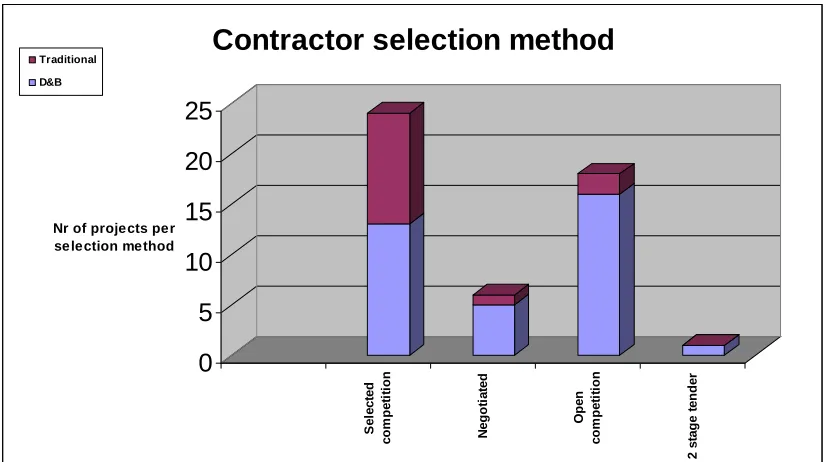
[image:13.595.91.504.512.743.2]Contractor selection methods used was varied across the projects reviewed but selected competition was the most common method used (49% of the projects analysed) followed by open competition (37%), Negotiation (12%) and Two stage tender (2%) as represented in Figure 1 below.
Figure 1:Contractor Selection methods
0
5
10
15
20
25
Nr of projects per se lection method
S e le ct ed co m p e ti ti o n N e got ia te d Op en co m p e ti ti o n 2 s tag e t e n d e r
Contractor selection method
Traditional6
The specification for most of the projects reviewed is an average of three storey, reinforced concrete strip and pad foundation, steel frame, face brick/block walls and aluminium cladding.
The high percentage in competitive selection methods used in appointing contractors is in line with perceptions noted in the review of related literature in which clients are viewed as seeking to have their end products at the lowest price. Competition, whether selected or open, is perceived to generate this aspiration.
What is surprising from the research findings is that a larger proportion of D&B contractors were selected using open competition while a larger proportion of traditional contractors were selected using selected competition. It would appear from the literature reviewed that one of the reasons why the D&B delivery method has evolved over the years is an aspiration by clients to tap into the contractor’s expertise in not only interpreting the employer’s
requirements but producing a design fit for that purpose. This being the case one would have expected clients to be selective on which contractor to choose for this key task.
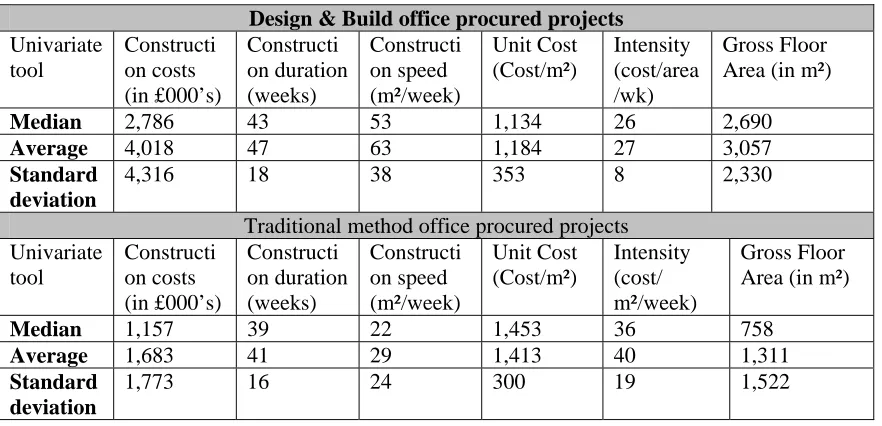
[image:14.595.85.526.539.752.2]Central tendency and variability characteristics of the research data was computed using univariate analysis. Univariate analysis was undertaken for construction costs, construction durations, construction speeds, unit costs, intensity of construction and gross floor areas of all projects under review and the results, classified by procurement method, is shown in Table 1 below.
Table 1: Summary of research results classified by procurement methods
Design & Build office procured projects
Univariate tool Constructi on costs (in £000’s) Constructi on duration (weeks) Constructi on speed (m²/week) Unit Cost (Cost/m²) Intensity (cost/area /wk) Gross Floor Area (in m²)
Median 2,786 43 53 1,134 26 2,690
Average 4,018 47 63 1,184 27 3,057
Standard deviation
4,316 18 38 353 8 2,330
Traditional method office procured projects Univariate tool Constructi on costs (in £000’s) Constructi on duration (weeks) Constructi on speed (m²/week) Unit Cost (Cost/m²) Intensity (cost/ m²/week) Gross Floor Area (in m²)
Median 1,157 39 22 1,453 36 758
Average 1,683 41 29 1,413 40 1,311
Standard deviation
7
Construction cost in this research is defined as the tender cost of the office project represented by the winning tender sum. Unit cost and intensity are the two cost measures used to further analyse construction costs. Unit cost is defined as tender cost/gross floor area. Construction intensity is the unit cost of construction per unit time. Construction speed is the gross floor area/construction duration.
The null hypotheses postulated in the paper are that there are no differences in unit costs, construction speeds and intensity of construction for the 2 procurement methods while the alternative hypotheses postulated stated that there are differences in the performance metrics measured. Each sample mean for the 2 procurement methods was tested for comparison at a 95% confidence level (p=0.05). Therefore no significance is reported unless test values achieve this level of significance. Since one of the 2 samples used in this research is small (less than 30) and since the researcher wanted to test whether one mean of each of the procurement methods performance metrics is significantly higher or significantly lower than the other a one-tailed t test was deemed appropriate.
The null hypotheses were rejected in favour of the alternative hypotheses as the observed differences of the sample means of the 2 procurement methods were all found to fall outside the acceptance region of the critical t value. It can therefore be inferred from the research results that D&B tendered office projects achieved significantly lower unit costs than similar projects tendered through the traditional method. D&B tendered projects significantly outperformed tendered office projects procured using the traditional method with 63% of the D&B projects achieving scores over 60 m²/week compared to only 14% of the traditional projects. Significant differences in intensity of construction were also observed between the 2 procurement methods with over half of the office of the traditional projects scoring almost twice as much as their D&B counterparts.
3.1 Unit costs of construction (Total tender cost/m²)
8
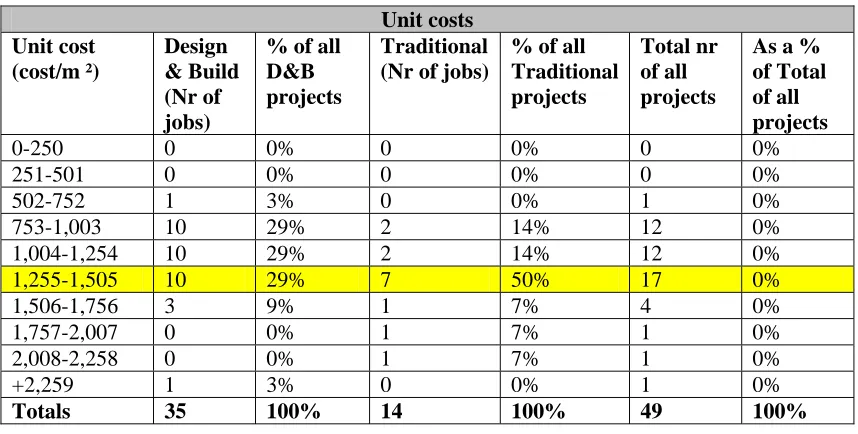
Table 2: Unit cost of construction per procurement method
Unit costs Unit cost
(cost/m²)
Design & Build (Nr of jobs)
% of all D&B projects
Traditional (Nr of jobs)
% of all Traditional projects
Total nr of all projects
As a % of Total of all projects
0-250 0 0% 0 0% 0 0%
251-501 0 0% 0 0% 0 0%
502-752 1 3% 0 0% 1 0%
753-1,003 10 29% 2 14% 12 0%
1,004-1,254 10 29% 2 14% 12 0%
1,255-1,505 10 29% 7 50% 17 0%
1,506-1,756 3 9% 1 7% 4 0%
1,757-2,007 0 0% 1 7% 1 0%
2,008-2,258 0 0% 1 7% 1 0%
+2,259 1 3% 0 0% 1 0%
Totals 35 100% 14 100% 49 100%
A summary of the unit cost classifications by procurement method is further tabulated below in Table 3 below.
Table 3: Unit costs by procurement method
Classification % D&B projects % of Traditional projects
Relatively low 60% 29%
Average costs 29% 50%
Relatively high 11% 21%
Similar observations were done for construction speed and intensity of construction. Similarly projects were classified as average, below and above average depending on the classification range. The findings for these performance metrics are presented in Tables 4 and 5 below.
3.2 Construction speed
[image:16.595.86.515.418.473.2]9
Table 4: Construction speed by procurement method
Classification % D&B projects % of Traditional projects
Relatively slow 9% 50%
Average 29% 36%
Relatively fast 62% 14%
3.3 Construction intensity
Similarly average construction intensity range was observed to be £24-£29/ m²/week. Observed construction intensities lower than the averages were classified as relatively low and construction intensities higher than the average were classified as high. Table 5 below presents a summary of the results.
Table 5: Construction intensity by procurement method
Classification % D&B projects % of Traditional projects
Relatively low 29% 7%
Average 40% 29%
Relatively high 31% 64%
4.0
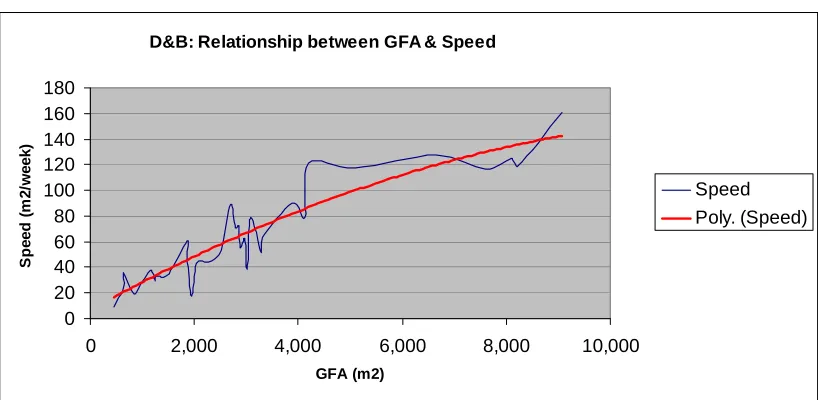
Interrelationships between observed attributes
[image:17.595.84.517.355.411.2]10
Figure 2:D&B -Relationship between project size & construction speed
D&B: Relationship between GFA & Speed
0 20 40 60 80 100 120 140 160 180
0 2,000 4,000 6,000 8,000 10,000
GFA (m2) S p ee d (m 2/ w e e k ) Speed Poly. (Speed)
Figure 3: Traditional: Relationship between project size & construction speed
Traditional method: Relationship between GFA & Speed
0 10 20 30 40 50 60 70 80 90 100
0 1,000 2,000 3,000 4,000 5,000 6,000 7,000
GFA (m2) S p ee d ( m 2/ w eek) Speed Poly. (Speed)
[image:18.595.90.502.341.539.2]11
Figure 4:Traditional method: Relationship between project size and unit costs
Traditional method: Relationship between Unit costs & size
0 500 1000 1500 2000 2500
0 1000 2000 3000 4000 5000 6000 7000
Area (in m2)
U
n
it
co
s
ts (£
/m
2)
Unit cost Poly. (Unit cost)
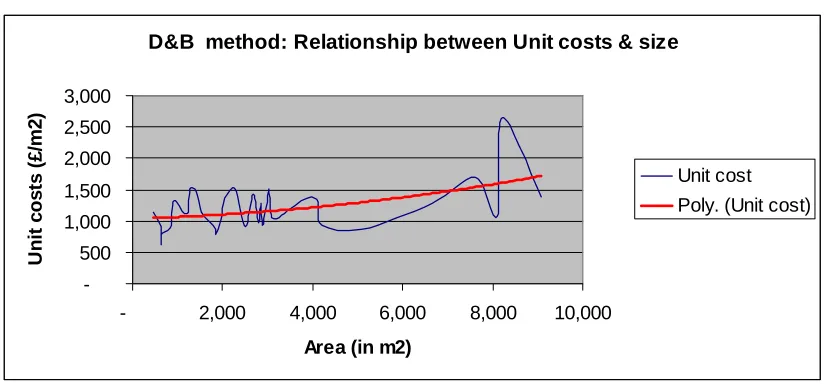
Figure 5:D&B method: Relationship between project size and unit costs
D&B method: Relationship between Unit costs & size
-500 1,000 1,500 2,000 2,500 3,000
- 2,000 4,000 6,000 8,000 10,000
Area (in m2)
U
n
it
co
st
s
(£
/m
2)
Unit cost
Poly. (Unit cost)
[image:19.595.91.503.340.533.2]12
Figure 6:Traditional method: Relationship between year of tender and construction speed
Traditional method: Relationship between year of tender & construction speed
0 20 40 60 80 100
2003 200420052006 20062006 20062006 20062007 2007 20072008 2009 Year of Tender
C ons tr uc ti on s p e e d Speed Poly. (Speed)
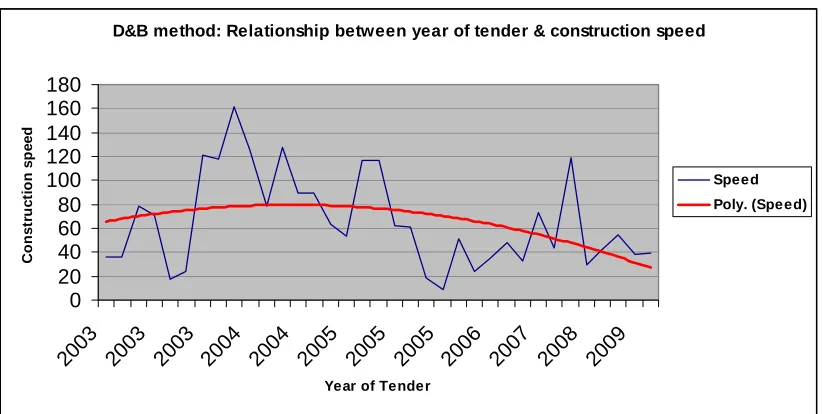
Figure 7:D&B method: Relationship between year of tender and construction speed
D&B method: Relationship between year of tender & construction speed
0 20 40 60 80 100 120 140 160 180 200 3 200 3 200 3
2004 200 4
200 5
2005 200 5
200 6
200 7
2008 200 9
Year of Tender
C ons tr uc ti on s p e e d Speed Poly. (Speed)
It can be observed from the above Figures 6 and 7 that while D&B tendered projects
[image:20.595.93.504.387.594.2]13
Figure 8:D&B method: Relationship between year of tender and unit costs
D&B method: Relationship between year of tender & unit costs
-500 1,000 1,500 2,000 2,500 3,000
2003 2003 2003 200 4
2004 2005 2005 2005 200
6
2007 2008 2009 Year of Tender
[image:21.595.91.503.368.587.2]U n it c o st s Series1 Poly. (Series1)
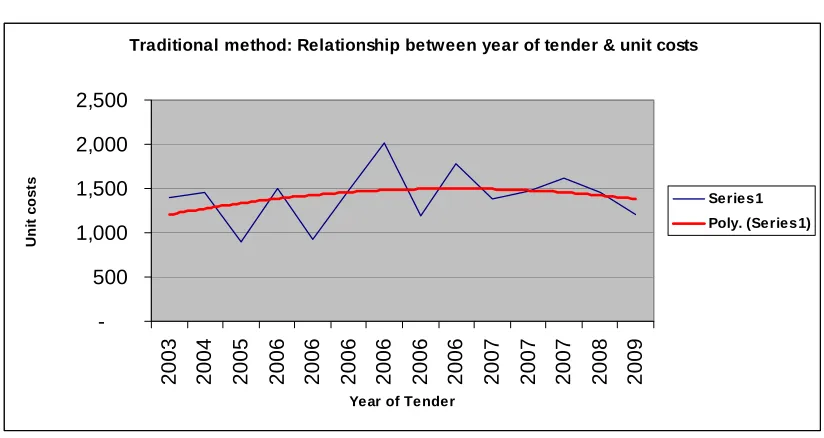
Figure 9:Traditional method: Relationship between year of tender and unit costs
Traditional method: Relationship between year of tender & unit costs
-500 1,000 1,500 2,000 2,500 20 03 20 04 20 05 20 06 20 06 20 06 20 06 20 06 20 06 20 07 20 07 20 07 20 08 20 09
Year of Tender
U n it co st s Series1 Poly. (Series1)
14
5. Research limitations/implications
Data in this research was based on tender base information in terms of project construction costs and durations. The research therefore did not track changes post contract. Such changes play a key role in performance measurement of procurement systems in terms of cost growth and programme growth. Future research should therefore encompass not only the pre-contract project performance data but also post contract project performance data such as client satisfaction, cost predictability and time predictability associated with different procurement methods. In addition quality performance metric measurements were not taken into account which does have impacts on construction speed, intensity of construction and unit costs. Design phase durations were also not taken into account in the measurement of durations used in the research.
6. Practical implications
The selection of an appropriate procurement method is crucial to the successful performance of a construction project with regards to not only cost and time (as analysed in this research) but quality achieved as well. It also ensures a smooth project delivery process and eliminates problems duringconstruction. The research provides comparative quantitativedata that should assist project developers to make decisions on procurement strategy and methods. The fact that the research has used a longitudinal section of the sampled data (samples covering 6 years) means that the research results will help foster a better understanding of the role played by procurement method on cost and time attributes.
7. Conclusions
The research presented in this paper is part of an ongoing professional doctorate research to comparatively analyse performance of different procurement methods used to deliver office projects in central London in the last 5 years. Primary data based on a combination of mailed questionnaires and semi-structured interviews are currently being collected in order to address the overall aims and objectives of the main research.
15
16
References
Bennett, J., Pothecary, E., Robinson, G. (1996). “Designing and building a world-class
industry.” Rep. No. ISBN 07049 1170 1, University of Reading, Reading, U.K.
Building Cost Information Service (2010). Retrieved 19 April 2010, from
http://service.bcis.co.uk/v2000/bcis/docs/frames.html?login=indirect
Elhag, T.M., Boussabaine, A.H. (1998). Statistical analysis and cost models development.
EPSRC Research Grant Report, University of Liverpool.
Hackett, M. Robinson, I., & Statham, G. (2007). The Aqua Group Guide to Procurement,
Tendering & Contract Administration. Revised and updated (3rd ed.). Oxford: Blackwell
Publishing.
Ireland, V. (1983). The role of managerial actions in the cost, time and quality performance
of high risk commercial projects, Unpublished PhD, University of Sydney, New South Wales,
Australia.
Oberlender, G.D., & Zeitoun, A.A. (1993). “Early warning signs of project changes”. Rep. to the Constr. Industry Inst., Source Document 91, April, Austin, Tex.
Pocock, J.B. (1996). “The relationship between alternative project approaches, integration,
and performance,” Unpublished PhD, University of Illinois at Urbana-Champaign,III.
Sidwell, A. C. (1982). A critical study of project team organisational forms within the
building process. Unpublished PhD, Department of construction and environmental health.
University of Aston, Birmingham.
Walker, D. H. T. (1997). Construction time performance and traditional versus