• No results found

Diffusion-reaction Problem and its Solution through Method of Weighted Residual Hiral Desai 1, H. D. Doctor2

N/A
N/A
Protected

Academic year: 2020

Share "Diffusion-reaction Problem and its Solution through Method of Weighted Residual Hiral Desai 1, H. D. Doctor2"

Copied!
5
0
0

Loading.... (view fulltext now)

Full text

(1)

International Journal of Emerging Technology and Advanced Engineering

Website: www.ijetae.com (ISSN 2250-2459, ISO 9001:2008 Certified Journal, Volume 8, Issue 12, December 2018)

1

Diffusion-reaction Problem and its Solution through Method of

Weighted Residual

Hiral Desai

1

, H. D. Doctor

2

1,2

Department of Mathematics, V.N.S.G.U., Surat, India

Abstract—In this paper, the method of weighted residuals is used to solve a problem involving boundary condition. The collocation method for solving ordinary differential equations is examined. The results are encouraging and fairly match with those obtain from other well-known methods. The method is tested on a Diffusion-reaction problem. The solution is estimated for different reaction rate ( ).The collocation method for solving diffusion–reaction problem is applied and a tabular and graphical comparison of error obtains from solution is discussed in detail.

KeywordsResiduals, Weight function, Trial function

I. INTRODUCTION

Differential equations are used for mathematical modeling in science and engineering. However, it is apparent that there may be no known analytic solution to such differential equations and even when it does exist it might be very difficult to obtain. In such cases, the numerical techniques that reduce excessive demand for computational time and at the same time giving a close approximation to the exact solution. Method of weighted Residuals have been developed in the mathematical literature on numerical solutions to partial differential equations but appear to be generally applicable to economic problems. For many continuous-time economic problems, partial differential equations formulations of equilibria are immediate and natural, and we would directly use these techniques. Owing to the fact that this method has many advantages such has unified theory, versatility in application, less amount of computer work, simplicity in programming, independence of variational principles, convenience and accuracy, and know ability of residual errors, has inspired many researchers of the numerical method to develop it for use in the field of solid mechanics. In this paper, collocation method is used on a diffusion-reaction problem. The estimation is done for different reaction rate and its result are compared with other method of weighted residuals [1,2].

II. METHOD OF WEIGHTED RESIDUALS

The method of weighted residuals was used to find approximate solutions to differential equations before the finite element method came into existence. The method was introduced by Crandall in 1956 [3]. Other scientists like Finlayson and Scriven [4], Vichnevetsky [5] and Finlayson [6] have also used this method. The method is used to solve boundary value problems arising from fluid flow, structural mechanics and heat transfer. It is well known because of the interactive nature of the first step. The user provides an initial guess for the solution which is then forced to satisfy the governing differential equations and its boundary conditions. The guessed solution is chosen to satisfy the boundary conditions, however it does not necessarily satisfy the differential equations.

The method of weighted residuals requires two types of functions namely the trial functions and weight functions. The former is used to construct the trial solution.

A trial function of the form

 X y  X c  X

y i

N

i i

a

  

1 (1)

We apply the method of weighted residuals in five steps [7,8]:

1. Expand the unknown solution in a set of basis functions, with unknown coefficients or parameters; this is called the trial solution.

2. Make the trial solution satisfy the boundary conditions (usually).

3. Define the residual.

4. Set the weighted residual to zero and solve the equations.

5. Examine the error by constructing successive approximations, and show convergence as the number of basis functions increases.

(2)

International Journal of Emerging Technology and Advanced Engineering

Website: www.ijetae.com (ISSN 2250-2459, ISO 9001:2008 Certified Journal, Volume 8, Issue 12, December 2018)

2

1.The collocation method, 2.The sub-domain method, 3.The least squares method, 4.The moment method, 5.The Galerkin method.

2.1. Collocation Method

The collocation method was first used by Frazer et al [ 9]. There after Bickley [ 10] used it in 1941 along with the least squares method and the Galerkin method to solve unsteady heat condition problems.The collocation method has been used over a wide range of problems in recent times [ 11].

In this method, the weight functions are taken from the

family of the Dirac delta ( ) functions in the domain , that is Wi X XXi.. The Dirac delta function is defined by         otherwise X X X

X i i

0 1

(2)

and has the property that

  

i

 

i

X f X XX dxf X

(3)

Hence the integration of the weighted residual

K N i dX X W X R

X i   

( ) ( ) 0, 1,2,,

(4)

results in forcing the residual to zero at specific points in the domain. That is, with this choice of the weighted function, equation (4 ) reduces to

  

X X X

dx R

 

X 0 ,i 1,2, ,N K. R

Xii   

 

(5)

As the number of collocation points Xi increases, we satisfy the differential equation at more points and hence force the approximate solution to approach the exact solution. The ease of performing integrals with the Dirac delta function is an added advantage of the collocation method[7,8].

III. NUMERICAL EXAMPLE

Consider the differential equation defined on [0.1] with its boundary conditions which represents a diffusion-reaction equation in chemistry given by[12,13],

 

 

1 1

0 0 , 0 ' 2 2 2      y y y dX dy dX y d (6)

Where α is a constant parameter that denotes the reaction rate which is termed slow for small values of α and fast for larger

α’ s

. The solution y(X) describes the concentration of a chemical substance at distance X

The exact solution to this equation is given by,

 

 

 

 

 

 sinh cosh 2 sin cosh 2 2 2 1     x x e x y x (7)

Where, 2 1 4 2

 

3.1. Two terms trial solution for a slow Reaction Rate Pick the Trial Solution from a subspace of dimension two of C [0,1] as

 

2

2

1 c 1 X

c X

y

a   

(8)

Trial solution obtain by the collocation method is,

 

1 4

1 2

/5

X X

[image:2.612.318.567.189.661.2]

yc    (9)

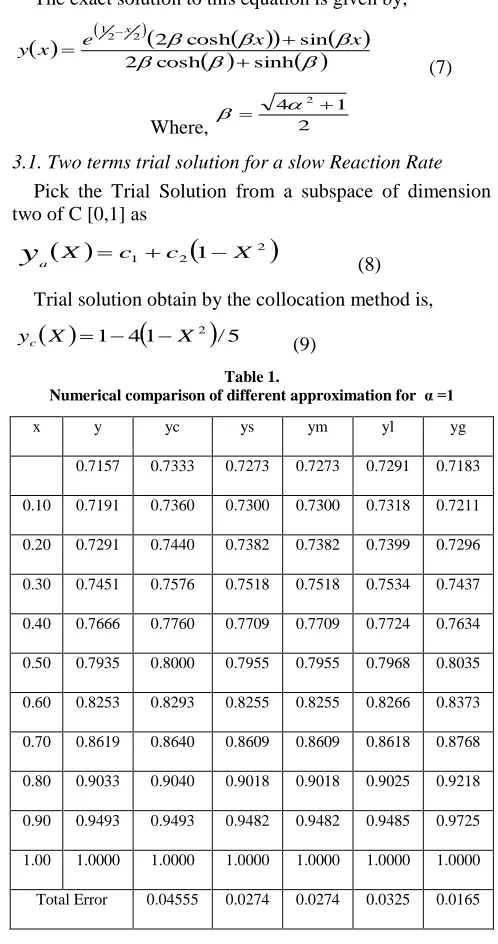
Table 1.

Numerical comparison of different approximation for α =1

x y yc ys ym yl yg

0.7157 0.7333 0.7273 0.7273 0.7291 0.7183

0.10 0.7191 0.7360 0.7300 0.7300 0.7318 0.7211

0.20 0.7291 0.7440 0.7382 0.7382 0.7399 0.7296

0.30 0.7451 0.7576 0.7518 0.7518 0.7534 0.7437

0.40 0.7666 0.7760 0.7709 0.7709 0.7724 0.7634

0.50 0.7935 0.8000 0.7955 0.7955 0.7968 0.8035

0.60 0.8253 0.8293 0.8255 0.8255 0.8266 0.8373

0.70 0.8619 0.8640 0.8609 0.8609 0.8618 0.8768

0.80 0.9033 0.9040 0.9018 0.9018 0.9025 0.9218

0.90 0.9493 0.9493 0.9482 0.9482 0.9485 0.9725

1.00 1.0000 1.0000 1.0000 1.0000 1.0000 1.0000

(3)

International Journal of Emerging Technology and Advanced Engineering

Website: www.ijetae.com (ISSN 2250-2459, ISO 9001:2008 Certified Journal, Volume 8, Issue 12, December 2018)

3

Figure1. (a)Diffusion rate by MWR and (b)Error by MWR

Figure 1. and Table 1. Show that approximate solution match closely with exact solution. Hence the error is small for slow reaction rate α=1

.

3.2. Two Terms Trial solution for a Fast Reaction Rate:

 

2

2

1 c 1 X

c X

y

a   

(10)

Trial solution obtain by the collocation method is,

 

2

1

2821

.

1

1

X

X

[image:3.612.59.454.91.600.2]

Y

c

(11)

Table 2.

Numerical comparison of different approximation for

x y yc ys ym yl yg

0.00 0.0001 -0.2821 -0.4354 -0.4354 -0.2202 -0.2085

0.10 0.0002 -0.2693 -0.4210 -0.4210 -0.2080 -0.1964

0.20 0.0005 -0.2308 -0.3780 -0.3780 -0.1714 -0.1602

0.30 0.0013 -0.1667 -0.3062 -0.3062 -0.1104 -0.0997

0.40 0.0033 -0.0770 -0.2057 -0.2057 -0.0250 -0.0151

0.50 0.0086 0.0384 -0.0786 -0.0786 0.0849 0.0936

0.60 0.0223 0.1795 0.0813 0.0813 0.2191 0.2266

0.70 0.0576 0.3461 0.2679 0.2679 0.3777 0.3837

0.80 0.1492 0.5384 0.4833 0.4833 0.5607 0.5649

0.90 0.3863 0.7564 0.7273 0.7273 0.7682 0.7704

1.00 1.0000 1.0000 1.0000 1.0000 1.0000 1.0000

[image:3.612.53.274.134.575.2]
(4)

International Journal of Emerging Technology and Advanced Engineering

Website: www.ijetae.com (ISSN 2250-2459, ISO 9001:2008 Certified Journal, Volume 8, Issue 12, December 2018)

4

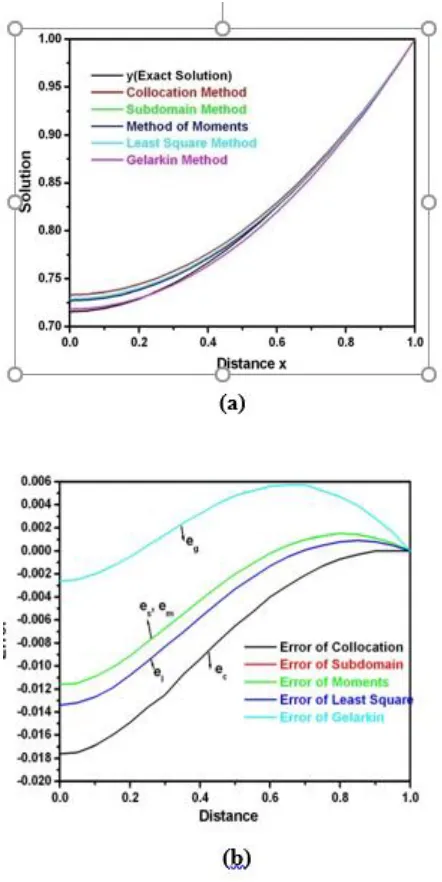
Figure 2. (a)Diffusion rate by MWR and (b) Error by MWR

Figure 2. and table 2. Show that approximate solution deviate sharply from the exact solution. Hence the error is large for fast reaction rate α=10.

3.3. Three Terms Trial Solution for a Fast Reaction Rate:

In order to improve the accuracy of the solution for a fast reaction rate , retain three terms in the trial

solution. Hence the new trial solution is,

2

2

3 2 2

1 c 1 X c X 1 X

c

y

a     (12)

the trial solution obtain by the collocation method is,

 

2

2

2

1 6010 . 1 1

9403 . 0

1 X X X

X

Yc     

[image:4.612.58.270.144.337.2]

(13)

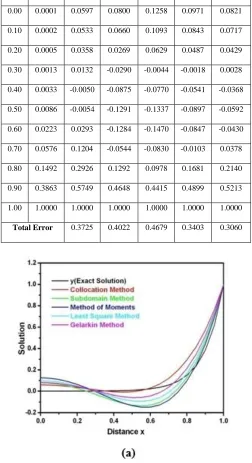
Table 3.

Numerical comparison of different approximation for

x y yc ys ym yl yg

0.00 0.0001 0.0597 0.0800 0.1258 0.0971 0.0821

0.10 0.0002 0.0533 0.0660 0.1093 0.0843 0.0717

0.20 0.0005 0.0358 0.0269 0.0629 0.0487 0.0429

0.30 0.0013 0.0132 -0.0290 -0.0044 -0.0018 0.0028

0.40 0.0033 -0.0050 -0.0875 -0.0770 -0.0541 -0.0368

0.50 0.0086 -0.0054 -0.1291 -0.1337 -0.0897 -0.0592

0.60 0.0223 0.0293 -0.1284 -0.1470 -0.0847 -0.0430

0.70 0.0576 0.1204 -0.0544 -0.0830 -0.0103 0.0378

0.80 0.1492 0.2926 0.1292 0.0978 0.1681 0.2140

0.90 0.3863 0.5749 0.4648 0.4415 0.4899 0.5213

1.00 1.0000 1.0000 1.0000 1.0000 1.0000 1.0000

[image:4.612.318.570.186.649.2]
(5)

International Journal of Emerging Technology and Advanced Engineering

Website: www.ijetae.com (ISSN 2250-2459, ISO 9001:2008 Certified Journal, Volume 8, Issue 12, December 2018)

5

Figure3. (a)Diffusion rate by MWR and (b) Error by MWR

Figure3. and table 3. Shows that error reduce when reaction rate increase for fast reaction rate.

IV. CONCLUSION

In the present work, the solutions obtain by collocation method gives better approximation because of the property of the Dirac delta function, which makes estimation easier. It is conclude from the graphs and tables that for slow reaction rate, all the five methods show small error and the approximate solution match closely with the exact solution. Hence, the concentration profile of the chemical substance is shallow and can easily be described by only two terms.

For higher reaction rate, the concentration profile becomes steep and the trial solution with two terms is unable to track the solution. The sub-domain and least square methods are tedious to use. Although Galerkin method gives good accuracy to most problem but the collocation method is preferred for most practical problem due to easy calculation.

REFERENCES

[1] Y. Aregbesola, S. Odejide, Mathematical Sciences Research Journal 9(9) (2005) 236–243.

[2] W. Ames, Nonlinear Partial Differential Equation in Engineering, Academic Press New York (1965).

[3] S.H. Crandall, Engineering Analysis, McGraw-Hill New York (1956).

[4] B.A. Finlayson and Scriven L.E., App. Mech. Rev. 19 (1966) 735 − 748.

[5] R. Vichnevetsky, IEEE Trans. Comp. C − 18 (1969) 499 − 512. [6] B.A. Finlayson, The Method of Weighted Residuals and Variational

Principles, Academic Press New York(1972).

[7] H.D. Doctor -Spline Collocation Approach to Flow Problems.Ph.D.Thesis,(1985).

[8] H.D.Doctor, A.B.Bulsari and N.L.Kalthia. Spline Collocation Approach To Boundary Value Problems.International Journal For Numerical Methods in Fluids,vol.4, 511-517 (1984).

[9] B.A. Finlayson, Nonlinear Analysis in Chemical Engineering,McGraw-Hill Inc. United States of America Chemical Engineering (1980).

[10] W.G. Bickley, Phil. Mag. 32(7) (1941) 50 – 66.

[11] J. Villadsen and W.E. Stewart, Solution of Boundary Value Problems by Orthogonal Collocation, Science Direct Chem. Eng. Sci. 22 (1967) 1483 −1501.

[12] G. Richard and D. Duong, Applied Mathematics and Modeling for Chemical Engineers, John Wiley and sons Inc. Canada (1995). [13] P. Sridhar, Implementation of the One Point Collocation Method to

Figure

Table 1. Numerical comparison of different approximation for  α =1
Table 2. Numerical comparison of different approximation for
Figure 2. (a)Diffusion rate by MWR and (b) Error by MWR

References

Related documents

Al respecto, sostiene: “Esta [el alma bella] es, en efecto, su saber de sí misma en su unidad translúcida y pura, - la autoconciencia que sabe este puro saber del puro ser dentro

However, where the main purpose of the case studies is to inform long- term strategy through a richer analysis of the range of impacts that arise - and how they manifest in

Digital competence involves articulated cognitive resources (knowledge, skills, attitudes and values) to perform tasks related to the use of available technological

Diet rich in polyunsaturated fatty acids, such as virgin coconut oil (VCO), has been associated with a reduced risk of CVD to some degree, coconut oil has become a

These were backed up by substantial budgetary allocations, but agricultural output is still very low (Ojo, 2011). Therefore, the general objective of this study is to establish

This scientometric analysis focused on four main non-communicable diseases; cardiovascular dis- eases, cancers, diabetes, and chronic respiratory diseases researches in

The results of flexural strength test are tabulated in Table From the result it was observed that the flexural strength of the concrete increases with increase in the

The text is able to educate the young reader on various levels; one, how history is told in a different perspective through the lens of people who have the lived experience; second,