P e r s o n al i d e n tific a ti o n b a s e d o n
m o bil e-b a s e d k e y s t r o k e d y n a m i c s
T h a r w a t , A, I b r a h i m , A, G a b er, T a n d H a s s a n i e n , AE
h t t p :// dx. d oi.o r g / 1 0 . 1 0 0 7 / 9 7 8-3-3 1 9-9 9 0 1 0-1_ 4 2
T i t l e
P e r s o n al id e n tific a ti o n b a s e d o n m o b il e-b a s e d k e y s t r o k e
d y n a m i c s
A u t h o r s
T h a r w a t , A, I b r a h i m , A, G a b er, T a n d H a s s a n i e n , AE
Typ e
C o nf e r e n c e o r Wo r k s h o p I t e m
U RL
T hi s v e r si o n is a v ail a bl e a t :
h t t p :// u sir. s alfo r d . a c . u k /i d/ e p ri n t/ 5 2 0 6 5 /
P u b l i s h e d D a t e
2 0 1 8
U S IR is a d i gi t al c oll e c ti o n of t h e r e s e a r c h o u t p u t of t h e U n iv e r si ty of S alfo r d .
W h e r e c o p y ri g h t p e r m i t s , f ull t e x t m a t e r i al h el d i n t h e r e p o si t o r y is m a d e
f r e ely a v ail a bl e o nli n e a n d c a n b e r e a d , d o w nl o a d e d a n d c o pi e d fo r n o
n-c o m m e r n-ci al p r iv a t e s t u d y o r r e s e a r n-c h p u r p o s e s . Pl e a s e n-c h e n-c k t h e m a n u s n-c ri p t
fo r a n y f u r t h e r c o p y ri g h t r e s t r i c ti o n s .
Personal Identification Based on Mobile-based
Keystroke Dynamics
Alaa Tharwat1,2,6, Abdelhameed Ibrahim3,6, Tarek Gaber4,6, Aboul Ella Hassanien 5,6
1
Faculty of Engineering, Suez Canal University, Egypt
2 Faculty of Computer Science and Engineering, Frankfurt University of Applied
Sciences, 60318 Frankfurt am Main, Germany 3 Faculty of Engineering, Mansoura University, Egypt
4 Faculty of Computers and Informatics, Suez Canal University, Egypt 5 Faculty of Computers and Information, Cairo University, Egypt 6
Scientific Research Group in Egypt (SRGE) http://www.egyptscience.net
Abstract. This paper is addressing the personal identification problem by using mobile-based keystroke dynamics of touch mobile phone. The proposed approach consists of two main phases, namely feature selec-tion and classificaselec-tion. The most important features are selected using Genetic Algorithm (GA). Moreover, Bagging classifier used the selected features to identify persons by matching the features of the unknown person with the labeled features. The outputs of all Bagging classifiers are fused to determine the final decision. In this experiment, a keystroke dynamics database for touch mobile phones is used. The database, which consists of four sets of features, is collected from 51 individuals and con-sists of 985 samples collected from males and females with different ages. The results of the proposed model conclude that the third subset of fea-tures achieved the best accuracy while the second subset achieved the worst accuracy. Moreover, the fusion of all classifiers of all ensembles will improve the accuracy and achieved results better than the individ-ual classifiers and individindivid-ual ensembles.
Keywords: Keystroke dynamics, RHU keystroke, Genetic algorithm, Bagging classifier, Personal identification
1
Introduction
Passwords, personal identification number (PIN), and pattern lock are con-sidered the most common methods to protect the identity of smartphone’s own-ers from illegal accesses. However, the PIN method is subject to the dictionary attack as well as shoulder surfing attack. Also, Pattern locks are subject to side channel attack. The most importantly, such commonly used methods for identifying a legitimate owner of a smartphone fail to recognize and detect an adversary when she/he has broken the PIN/Password [3] making these methods ineffective for continuous authentication.
Continuous authentication is a process in which user’s behavioral biometrics are used for authenticating a smartphone user [4]. Mobile authentication based on behavioral biometrics depends on learning from user behaviors which do not change over a period. This includes gait patterns [5], signature [6], voice [7], and touchscreen interactions [8, 9]. Such characteristics are then implicitly used to identify a given smartphone user thus preventing an illegitimate user from accessing the device. The authentication decision in this context is taken based on distinctive features collected from the user’s behaviors.
This paper describes an approach addressing the personal identification prob-lem by using mobile-based keystroke dynamics. In the proposed approach, a keystroke dynamics dataset is used [10]. The most important features are se-lected using GA. Moreover, Bagging classifier used the sese-lected features to iden-tify persons by matching the features of the unknown person with the labeled features.
The rest of the paper is organized as follows; Section (2) presents the feature selection technique using a genetic algorithm and the Bagging classifier ensemble. Our proposed approach are presented in Section (3) while, the experimental results are given in Section (4). The discussion of the obtained results and the conclusion of the paper are presented in Section (5) and (6), respectively.
2
Preliminaries
2.1 Genetic Algorithm (GA)
Genetic Algorithm (GA) is one of the well-known optimization algorithms. The main idea of GA depends on evaluating and modifying the current population, i.e., a set of solutions, which are represented in binary numbers and selects the best solutions to generate new solutions from it. Hence, GA searches mainly in binary spaces to find the optimal solutions [11].
Mathematically, given the initial population setP ={p1, p2, . . . , pn}, where
pi is one candidate, agent or chromosome. Each chromosome consists of many
Lecture Notes in Computer Science: Authors’ Instructions 3
and (3) uniform. For example, in the single point crossover method, the infor-mation of two chromosomes 00100101 and 10111010 are exchanged and this can be achieved by selecting one cutting point and exchange one part from each par-ent to generate new chromosomes, 00101010 and 10110101. The cutting point is chosen randomly in many algorithms. In the mutation process, the original chromosome, i.e., parent, mutate randomly by changing the value of one or more bits to generate a new chromosome, i.e., child. Moreover, GA allows the chro-mosomes to mutate and generate a near identical chromosome from the original one. The current chromosomes and the new generated ones are evaluated using the fitness function and the best chromosomes are selected (survived) to the next generation, this is called selection step [12].
The performance of GA is controlled by many parameters such as the pop-ulation size (N), crossover rate (Pc), mutation rate (Pm), and the number of
iterations (T). The population size represents the total number of chromosomes while the crossover rate represents the probability of accepting an eligible pair of chromosomes for crossover. The mutation rate is the probability of switching bits in the chromosomes [13]. The steps of GA are summarized in Algorithm 1.
Algorithm 1 Genetic Algorithm
1: Initialize populationP={p1, p2, . . . , pn}, wherenrepresents the number of
chro-mosomes in the populations, and the total number of generations isT. 2: for all (Generationst < T)do
3: for all(i= 1 to n/2)do
4: Select two parentspi andpn/2+ifromP.
5: OffspringOi=CrossOver(pi, pn/2+i)
6: OffspringOi=Mutation (OffspringOi)
7: end for
8: Combine the original populationP and the new offspringsOiinto newPN ew=
P+Oi
9: Evaluate all chromosomes in the new populationPN ew
10: Select the best chromosomes to survive for the next generation 11: end for
2.2 Bagging Classifiers
Bagging is an acronym fromBootstrap AGGregatING and it is one of the well-known ensemble methods that creates its ensemble by training different classifiers on a random distribution of the training set. Many samples from the original training set (X) are drawn randomly with replacement to form a new training set XN ew, which is then used for training one individual classifier Ci in the
chosen multiple times, while the other samples are left out [15, 16]. The details of Bagging classifier are in Algorithm [2].
Algorithm 2 Bagging Algorithm
Input: Required ensemble sizeT, Training setS={(x1, y1),(x2, y2), . . . ,(xN, yN)}
while(t < T)do
Build a dataset St, by randomly sampling N times from S (with replacement)
Train a modelhtusingSt and add it to the ensemble
end while
for all(new test pattern (´x,y´))do for all(modelsht)do
Classify the unknown or test pattern using the model ht, the output of the
classification isCt
end for
Combine the outputs of the modelCi, i= 1,2, . . . , T
end for
3
Proposed Model
The proposed approach in this research consists of two main phases, namely feature selection and classification. As shown in Fig. (1), our dataset that is used in this research has four different sets (f1, f2, f3,andf4) of features. In the
first phase, GA is applied for each feature subset separately to select the best features in each subset (fnew1, fnew2, fnew3,andfnew4). In the second phase, the
data were partitioned into training set which is used to train the Bagging model and testing set which is used to evaluate the proposed model. More details about each phase in the next two sections.
3.1 Feature Selection Phase
In this phase, the GA was employed for selecting a small subsetdfrom a large set of features D to remove independent and redundant features. The large set of features is denoted by, X ={f1, f2, . . . , fD}. While the small subset of
features denoted by, Y ={f1, . . . , fd}, where d ≤D. GA first initializes a set
of chromosomes coded in binary code randomly. Each chromosome represents a subset of features, and each bit of the chromosome denoting the presence, i.e., 1, or absence, i.e., 0, of that feature in this subset. Thus, the dimension of search spaceRdfor the features is determined by the total number of featuresd[17].
Lecture Notes in Computer Science: Authors’ Instructions 5
3.2 Classification Phase
In this phase, the new subset of features (fnewi, i= 1,2,3,4) that were selected
in the first phase are used. This phase consists of two main steps; training and testing. Each new subset of features is divided into training and testing sets. In the training step as shown in Fig. (1), each training set from the new subsets of features is used to train one Bagging model. Thus, four different models are built using the new four feature subsets that were selected. In the testing phase, each testing subset is matched or classified with their corresponding training model that is built using the corresponding feature subset. The outputs of the four classification processes are combined using majority voting to get the final decision. Dataset GA GA GA GA Firstlfeaturelset
vf1E
Secondlfeaturelset vf2E
Thirdlfeaturelset vf3E
Fourthlfeaturelset vf4E
Fnew1
Fnew2
Fnew3
Fnew4
S1 S2 S3
Cm C3 C2 C1 RandomlSampling Sm CombinelClasifiersMlOutput Prediction BagginglClassifier Training Testing Training Testing Training Testing Training Testing Mutation Crossover Generation Evaluation FitneslValue Population GeneticlAlgorithmlvGAE Feature lSelection lPhase Feature lSelection
lPhase f1 f2 f3
f2 f1
f2=1,lmeanslf2lislselected f1=0,lmeanslf1lislnotlselected
[image:6.595.137.566.281.619.2]fN
4
Experimental Results
4.1 Dataset
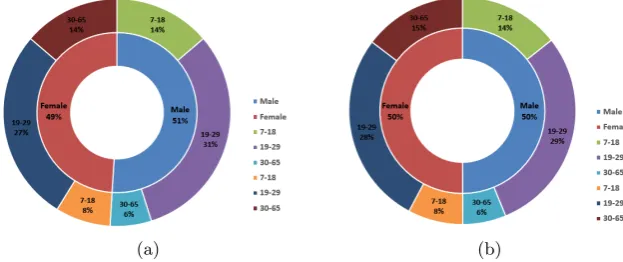
[image:7.595.148.460.445.576.2]In this experiment, a keystroke dynamics database for touch mobile phones was used. The database is collected from 51 individuals. Each individual is requested to type a password ”rhu.university” 15 times during three different sessions [10]. The data in each session are collected separately and the average time between each session was five days. The database consists of 985 samples collected from males and females with different ages as shown in Fig. (2). The distribution of the database is shown in Table (1) and Fig. (2).
Table 1: Distribution of the keystroke dynamics database.
Gender
Age Group
Total 7-18 19-29 30-65
Users Samples Users Samples Users Samples Users Samples Male 7 137 16 281 3 59 26 477
Female 4 75 14 263 7 140 25 478
Total 11 212 30 544 10 199 51 955
In the database there are four information were extracted from each user includes the timing between a key pressure and a key release, timing between a key release and a key pressure, the timing between two key pressures, and timing between two key releases [10].
(a) (b)
Fig. 2: A distribution of samples and users of dynamic keystrokes database, (a) distribution of the users over gender and age groups, (b) distribution of the samples over gender and age group.
Lecture Notes in Computer Science: Authors’ Instructions 7
features using GA. While in the second experiment, the Bagging classifier was used to match the testing and training patterns.
4.2 Feature Selection Experiment
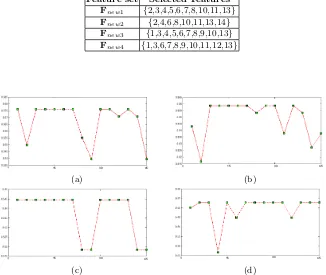
[image:8.595.144.470.332.607.2]This experiment is conducted to select the most powerful features. As mentioned above, the dataset that was used in this research is consists of four subsets of features. In this experiment, GA is used to select the best subset of features from each subset. Each subset from the original features was used as an input to the GA algorithm, and the GA selects the best subset of features. The GA has many parameters that affect the performance of GA. In this experiment, the population size of GA is 50, crossover rate=0.6, mutation rate=0.01, and the number of iterations=45. The results of this scenario are summarized in Table (2) and Fig. (3).
Table 2: The selected features (Fnewi) using GA algorithm
Feature set Selected Features Fnew1 {2,3,4,5,6,7,8,10,11,13}
Fnew2 {2,4,6,8,10,11,13,14}
Fnew3 {1,3,4,5,6,7,8,9,10,13}
Fnew4 {1,3,6,7,8,9,10,11,12,13}
45 30
15 (a)
45 30
15 (b)
45 30
15 (c)
45 30
15 (d)
4.3 Classification Experiment
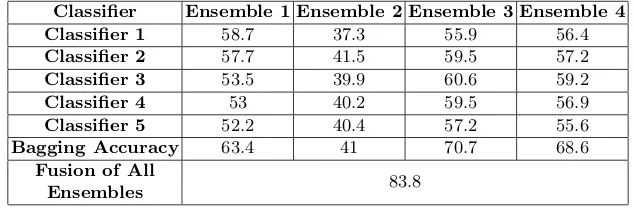
In this experiment, the second phase of the proposed model shown in Fig. (1) is investigated. This experiment is consists of two steps. In the first step, four different Bagging classifiers are trained. Each Bagging classifier has five weak or individual decision tree classifiers. Each new features subset was divided into training and testing subsets as follows, (fnewi=T Rnewi+T Snewi). Each subset
of the training features (T Rnewi, i= 1,2,3,4) represents the input to one
[image:9.595.143.464.365.471.2]Bag-ging classifier. Each BagBag-ging classifier generates a model, which will be used in the testing step to classify the unknown or test samples. The results of the train-ing step are summarized in Table (3). In the second step, the testtrain-ing samples were classified using the Bagging models that were calculated in the training step. Each testing subset was matched separately and the outputs of all Bag-ging classifiers were fused into one decision. The results of the testing step are summarized in Fig. (4).
Table 3: Accuracy (in %) of the individual classifiers of the Bagging ensemble, the accuracy of the ensemble, and the fusion of the four ensembles in the training step.
Classifier Ensemble 1 Ensemble 2 Ensemble 3 Ensemble 4 Classifier 1 97.3 78.3 92.9 91.5
Classifier 2 92.4 76.3 92.1 90.8
Classifier 3 90.7 77 92.8 91.4
Classifier 4 92.1 78.4 91.4 94.7
Classifier 5 92.6 74.9 92.9 93.1
Bagging Accuracy 100 99.2 100 100
Fusion of All
Ensembles 100
Table 4: Accuracy (in %) of the individual classifiers of the Bagging ensemble, the accuracy of the ensemble, and the fusion of the four ensembles in the testing step.
Classifier Ensemble 1 Ensemble 2 Ensemble 3 Ensemble 4 Classifier 1 58.7 37.3 55.9 56.4
Classifier 2 57.7 41.5 59.5 57.2
Classifier 3 53.5 39.9 60.6 59.2
Classifier 4 53 40.2 59.5 56.9
Classifier 5 52.2 40.4 57.2 55.6
Bagging Accuracy 63.4 41 70.7 68.6
Fusion of All
[image:9.595.147.464.561.666.2]Lecture Notes in Computer Science: Authors’ Instructions 9
5
Discussions
From Table (2) many remarks can be seen. The number of selected features in all subsets was ten, except the second feature subset consists of eight features, which reflects that the second feature subset has redundant features more than the other feature subsets. From Fig. (3) we note that the fitness function fluctuated up and down and in the first and third subsets of features the fitness function value reached its minimum. In our experiment, in all runs (i.e. all feature subsets) the best solution is used to select the new subset of features.
Table (3) shows the experimental results of the training step in the classifica-tion phase and it has many findings. Firstly, the accuracy results of the individual classifiers in all subset of features are more than 90%, except in the second subset achieved accuracy ranged from 74.9% to 78.4%, which reflects that the second subset of features is not robust enough again identifying persons. Secondly, the first subset of features achieved the best accuracies. Thirdly, the accuracy of each Bagging, which represents the fusion of all individual classifiers in the Bagging classifier achieved an excellent accuracy ranged from 99.2% to 100%, which re-flects that the individual classifiers are independent; and hence, the fusion rule (majority voting) achieved good results. The fifth remark is that the fusion of all Bagging achieved accuracy equal to 100%.
Table (4) presents the results of the testing step in the classification phase. As shown in the table, the third subset of the selected features achieved the best results while the second subset achieved the minimum accuracy. The accuracy of the Bagging classifier achieved accuracy better than all its individual classifiers, and it was ranged from 41% to 70.7%, while the fusion of all Bagging classifiers was 83.8%.
6
Conclusions and Future Work
selection methods and also investigate other ensemble classifiers to increase the performance of the approach.
References
1. www.statista.com: Smartphone users worldwide 2014-2020 ((accessed October 11, 2017))
2. Baljit Singh Saini, N.K., Bhatia, K.S.: Keystroke dynamics for mobile phones: A survey. Indian Journal of Science and Technology9(6) (2016) 1–8
3. Md Liakat Ali, John V. Monaco, C.C.T., Qiu, M.: Keystroke biometric systems for user authentication. Journal of Signal Processing Systems86(2–3) (2017) 175–190 4. Alzubaidi, A., Kalita, J.: Authentication of smartphone users using behavioral biometrics. IEEE Communications Surveys & Tutorials18(3) (2016) 1998–2026 5. Gafurov, D.: A survey of biometric gait recognition: Approaches, security and
challenges. In: Annual Norwegian computer science conference. (2007) 19–21 6. Blanco-Gonzalo, R., Miguel-Hurtado, O., Mendaza-Ormaza, A., Sanchez-Reillo,
R.: Handwritten signature recognition in mobile scenarios: Performance evaluation. In: Security Technology (ICCST), 2012 IEEE International Carnahan Conference on, IEEE (2012) 174–179
7. Lu, H., Bernheim Brush, A., Priyantha, B., Karlson, A., Liu, J.: Speakersense: Energy efficient unobtrusive speaker identification on mobile phones. Pervasive Computing (2011) 188–205
8. Zheng, N., Bai, K., Huang, H., Wang, H.: You are how you touch: User verification on smartphones via tapping behaviors. In: Network Protocols (ICNP), 2014 IEEE 22nd International Conference on, IEEE (2014) 221–232
9. Buza, K.: Person identification based on keystroke dynamics: Demo and open chal-lenge. In: CAiSE Forum, 28th International Conference on Advanced Information Systems Engineering. (2016)
10. El-Abed, M., Dafer, M., Khayat, R.E.: Rhu keystroke: A mobile-based benchmark for keystroke dynamics systems. In: International Carnahan Conference on Security Technology (ICCST), 2014, IEEE (2014) 1–4
11. Diaz, J.M., Pinon, R.C., Solano, G.: Lung cancer classification using genetic al-gorithm to optimize prediction models. In: The 5th International Conference on Information, Intelligence, Systems and Applications (IISA,2014), IEEE (2014) 1–6 12. Li, S., Wu, H., Wan, D., Zhu, J.: An effective feature selection method for hy-perspectral image classification based on genetic algorithm and support vector machine. Knowledge-Based Systems24(1) (2011) 40–48
13. Grefenstette, J.J.: Genetic Algorithms and Their Applications: Proceedings of the Second International Conference on Genetic Algorithms. Psychology Press (2013) 14. Gaber, T., Tharwat, A., Hassanien, A.E., Snasel, V.: Biometric cattle identification approach based on webers local descriptor and adaboost classifier. Computers and Electronics in Agriculture122(2016) 55–66
15. Breiman, L.: Bagging predictors. Journal of Machine learning24(2) (1996) 123– 140
16. Tharwat, A., Gaber, T., Awad, Y.M., Dey, N., Hassanien, A.E.: Plants identifica-tion using feature fusion technique and bagging classifier. In: The 1st Internaidentifica-tional Conference on Advanced Intelligent System and Informatics (AISI2015), November 28-30, 2015, Beni Suef, Egypt, Springer (2016) 461–471