Clean Audio for TV broadcast: an object
based approach for hearing impaired
viewers
Shirley, BG and Oldfield, RG
10.17743/jaes.2015.0017
Title
Clean Audio for TV broadcast: an objectbased approach for hearing
impaired viewers
Authors
Shirley, BG and Oldfield, RG
Type
Article
URL
This version is available at: http://usir.salford.ac.uk/id/eprint/33236/
Published Date
2015
USIR is a digital collection of the research output of the University of Salford. Where copyright
permits, full text material held in the repository is made freely available online and can be read,
downloaded and copied for noncommercial private study or research purposes. Please check the
manuscript for any further copyright restrictions.
PAPERS
Vol. 63, No. 4, April 2015 (C 2015)
DOI: http://dx.doi.org/10.17743/jaes.2015.0017
Clean Audio for TV broadcast: An Object-Based
Approach for Hearing-Impaired Viewers
BEN SHIRLEY,AES Member
,AND ROB OLDFIELD,AES Member
University of Salford, Salford, UK
A significant proportion of any population suffer from some form of hearing loss, and age demographics mean that this proportion is increasing. A prominent effect of hearing loss is an increased difficulty to pick out speech signals in the presence of background noise or music, which can be particularly problematic for broadcast audio content. Consequently a common subject of complaints to broadcasters is that the dialogue is masked by background noise/music or that speech intelligibility is poor. This paper presents these issues, reviews previously proposed solutions, and presents an object-based approach that can be implemented within MPEG-H that can give users control of their audio mix and hence facilitate enhancements to be made for hearing impaired viewers.
0 INTRODUCTION
There are estimated to be around 10 million people who are deaf or hard of hearing in the UK including around 8.3 million who suffer from mild to moderate deafness [1] and would gain some benefit from a clean audio provision in television audio. The term clean audio is used here to mean an audio mix with reduced background noise and/or enhanced dialogue. Support groups for people with hearing impairments—such as Hearing Link (previously known as Hearing Concern and Link) and national broadcast watch-dog organizations such as the Independent Television Com-mission (ITC) and then Ofcom in the UK—receive many complaints from hard of hearing people that the dialogue on TV is unclear and hard to understand owing to the level of background “noise.” This noise consists of background music, sound effects, and speech that can mask the dialogue thus reducing comprehension. This level of complaints to user groups and broadcast regulators has been mirrored in complaints to broadcasters. A survey carried out by the BBC in 2010 indicates that 60% of viewers had difficulty in understanding speech on TV [2]. Digital TV, and espe-cially the increasing availability of surround sound content, has the potential for much improved TV sound quality and could therefore be of great benefit to hearing impaired view-ers. However the wish to take advantage of the increased dynamic range available in digital TV broadcast may in-stead lead to increased problems for hearing impaired peo-ple. More recently there has been significant interest in a so-called object-based approach to audio with standardiza-tion activity taking place in the form of MPEG-H [3–5]. Object-based audio moves broadcasts away from the
tradi-tional channel-based paradigm where the requisite number of audio channels are broadcast to match the reproduction system at the user end and, instead, broadcasts the neces-sary audio components needed in order to reconstruct the audio scene at the user end. Applying such an object-based approach affords much greater control over the reproduced sound scene and the balance between the various compo-nents such as speech, background noise, music, etc., and therefore shows much promise as a means of improving the audio for the hearing impaired population. This paper begins with an overview of the scale and nature of common hearing losses and then proceeds to discuss these effects in terms of broadcast audio content and how this is affected by digital broadcasts. Subsequent to this, an object-based approach to the problem is proposed as exemplified by the FascinatE Project and the standardization activity of MPEG-H. Finally a case study is given as to how such an approach could be practically realized for a real broadcast.
1 PREVALENCE OF HEARING LOSS
the number of people suffering from hearing loss in the UK to be around 10 million [1]. Davis [6] carried out a survey across several cities in the UK and concluded that 16% of UK adults have a bilateral hearing impairment and 25% have a bilateral or unilateral impairment. Of these only 10% self-reported that they had bilateral hearing difficulty in a quiet environment indicating the difficulties of reliance on self-reported statistics. The Medical Research Council’s statistics show clearly the correlation between hearing loss and age.
Even allowing for inaccuracies from self-reporting, the use of different classification systems across different coun-tries has increased the complexities involved in understand-ing the prevalence of hearunderstand-ing loss. Nevertheless, the data available makes clear that hearing loss as a result of the ag-ing process is widespread. In addition to age-related hearag-ing loss (ARHL), the national burden of hearing difficulties at-tributable to noise at work is considered to be substantial [8]. Several sources provide indications as to the prevalence of noise induced hearing loss (NIHL) in the UK, a Health and Safety Executive (HSE) sponsored report [9] collates data from a number of sources as follows. In 1995 14,200 people were in receipt of benefit for industrial deafness [10], how-ever a Medical Research Council survey quoted by HSE [11] estimates the true number to be closer to 509,000; the discrepancy being mainly because the conditions needed in order to claim benefit include a high degree of hearing loss (>50 dB in both ears). Among young people the im-pact and cause of hearing loss, in particular NIHL, may be different, one substantial component being entertainment. Studies into hearing impairments from recreational activi-ties [12, 13] have found noise levels substantial enough to cause some permanent hearing damage with repeated ex-posure across a wide range of activities. Detailed studies into musicians [14, 15], employees in the entertainment in-dustries [16], and young people listening to music on head-phones [17] largely indicate substantial impact of enter-tainment sound exposure on the hearing of younger people. The variety of hearing impairments present in the popula-tion as a whole therefore varies considerably according to the cause of impairments. Even within the population that suffers from ARHL each person’s hearing loss is unique in terms of its frequency characteristics. Furthermore issues such as loudness recruitment (an increased perception of loudness) and frequency selectivity or frequency resolution (leading to spectral blurring and masking effects) mean that the problem of improving TV sound for the hearing impaired group is therefore not as straightforward as might be supposed.
2 HEARING LOSS AND TV BROADCAST
A limited amount of research has been carried out specif-ically focused on TV audio for people with hearing impair-ments, principally by the broadcast industry. This section documents and comments upon that research. The method-ology and detailed results of the BBC’s own large scale sur-vey into hearing impairments and TV audibility are unpub-lished, however some key outputs have appeared in news
success. Research on audio processing to improve intelli-gibility for TV sound can be found in Armstrong’s useful literature review [26] that points out the considerable diffi-culties inherent in separating speech from competing noise. He concludes that, “audio processing cannot be used to cre-ate a viable ‘clean audio’ version for a television audience.” Indeed the problems of blind source separation for audio are well documented for natural acoustic environments and are of limited effectiveness except in anechoic conditions [27]. However it seems likely that produced media such as a surround sound, or even stereo mix, where mixing param-eters are not simply the result of source and microphone placement but are produced subject to known guidelines and conventions, may present a special case. Examples of this are documented later in this paper. Some research has been carried out aimed specifically at improving the in-telligibility of speech on TV audio for hearing impaired people. Early work by Carmichael [28] on the DICTION project indicated that, at the time of the research, although signal processing could make speech sound clearer, it could not improve measures of objective intelligibility in terms of word recognition. M¨usch [29] has argued that processing can still reduce the cognitive effort required for compre-hension and has discussed algorithms aimed at decreasing listener effort and, as a consequence, improving intelligi-bility. M¨usch explains that older listeners tend to prefer higher listening levels to younger listeners because of ele-vated hearing thresholds but also that the effect of loudness recruitment reduces the level at which listening becomes uncomfortable or painful. Consequently there is evidence of what Rumsey refers to as a reduced “window of comfort-able dynamic range” [30] for older listeners. M¨usch argues that the cognitive load caused by the mental processing used to filter out background sound and “clean up” the speech means that there is reduced attention for the higher level cognitive processing used to contextualize sentences and therefore fill any “gaps” caused by words not heard. He suggests that the problem for older people in understanding speech on TV is not usually cognitive impairment but is pri-marily of a sensory nature. Reduced frequency resolution affecting the recognition of speech formants is cited as one reason, another being the reduced ability of hair cells in the inner ear to detect phase effectively. The arguments here are that audibility is key and that signal processing may not be able to improve individual word recognition but may be able to reduce listening effort and therefore the cognitive load that may play a part in preventing comprehension for hearing impaired people. Others, cited by Carmichael [28], have argued that there are more factors at work than simply the sensory impairments themselves. Cervellera [31] points to age related degradation of nerve pathways as adding sig-nificant “noise” to perceived sounds; Stine et al. [32] and Rabbit [33] point to evidence that slower and less efficient cognitive systems resulting from the aging process also add to the problem. Certainly the combination of high dy-namic range audio, competing background noise, reduced comfortable dynamic range, lack of frequency resolution, and other effects brought on by physiological change such as degraded nerve pathways and reduced/slowed cognitive
Table 1. Age distribution of self-assessed hearing loss as published inInternational Journal of Audiology[7].
With mild, moderate, severe, Adults Aged or profound hearing loss
16–60 6%
61–80 47%
81 and over 93%
performance, explain why older viewers may find it difficult to understand speech on TV and the subsequent number of complaints received by Ofcom and television broadcasters.
2.1 The Impact of Multichannel Audio Broadcast
As discussed already, instances of produced media clearly provide a different set of issues compared to the usual challenges of blind source separation of audio. Indeed multichannel surround sound formats may in themselves bring intelligibility advantages for hearing impaired (and other) television viewers. One solution, adopted into some broadcast standards [34, 35] identifies a simple approach that takes advantage of the fact that most 5.1 program con-tent uses the center channel primarily for speech (where speech is present). The Clean Audio Project [36] demon-strated significant improvements in speech clarity for peo-ple with hearing impairments by a simpeo-ple re-balancing of channels in a 5.1 mix where dialogue was in center channel only; this principle is detailed in Fig. 1. The re-balancing was to be controlled by broadcast metadata indi-cating whether the material was appropriate for this “clean audio mix.”
Fig. 1. Example of a clean audio system reference model reproduced from UK Clean Audio Forum liaison statement to ITU Focus Group on IPTV [37]
and has therefore been the subject of considerable research. Commenting on frequency response problems caused by signal path delays David Clark [42] states that “clearly the ‘phantom’ center is an entirely different listening experi-ence than pure left or pure right. One might ask if stereo is deeply flawed as [a] sound reproduction technique or if interference notches should simply be ignored.” Impacts for listeners beyond intelligibility mean that considerable efforts have gone into attempts to remove, or reduce the effects of crosstalk, some of which could also have po-tential benefit for hearing impaired people in reducing the impact of crosstalk on intelligibility of speech noted in [41]. Methods have been proposed to reduce crosstalk im-pact by Cooper and Bauck [43] and [44] but these may be impractical in the context of broadcast television viewing as they utilize crosstalk cancellation techniques that rely heavily on the listener being in the ideal listening position. Clearly in a home environment this is very rarely the case. Vickers [45] recognizes this and points out that “when the listener is not equidistant from the speakers, the comb fil-ter peaks and nulls will be in different frequency locations at the two ears.” The resultant comb filtered perception in any given location in the room then becomes very un-predictable and impossible to compensate with additional comb filters. There is some debate as to the specific cause of intelligibility problems resulting from crosstalk. Bucklein [46] suggests that intelligibility difficulties may actually be made worse by peaks resulting from the crosstalk effect, rather than the troughs, as might be assumed; however the underlying problem remains, regardless of which effect of crosstalk is most detrimental. Other approaches to reduce crosstalk impact such as decorrelation methods [47, 48] have been suggested with the aim of randomizing the ef-fects and to hence make the impact less prominent. These approaches can be seen as a signal processing equivalent of relying on room reflections to even a room response by creating a diffuse field, but some have cited artifacts and distortions from these methods that, with musical content, can manifest as unacceptable change in timbre [49].
Vick-ers suggests a further possibility for improving the timbral quality of the center image (and therefore improving the intelligibility of centrally positioned speech); by deriving a center channel from two-channel stereo content, which would then be presented as a real, rather than a phantom, source. He suggests a method for accomplishing this us-ing frequency domain upmixus-ing [50] and provides a useful review of upmixing methods to this end [33]. Clearly this would be a useful direction for improved TV audio repro-duction for hearing impaired listeners if it could be shown to be effective. Derived side channels (L and R) that did not contain speech could be reduced in level with refer-ence to the new derived center channel content in order to improve speech intelligibility. However his research sug-gested that existing upmixing algorithms either provided inadequate center channel separation or produced “watery sound” or “musical noise” artifacts although formal subjec-tive testing was not applied to assess this thoroughly [51]. In other related work Goodwin and Jot [52] make reference to primary-ambient decomposition in extracting ambient information from stereo signals using principal component analysis (PCA). Other research by Zielinski et al. [53] doc-uments principal component analysis (PCA) processing to separate sources for produced media under certain specific conditions. The research utilized PCA using parallel signal paths as shown in Fig. 2.
Fig. 2. System diagram showing a “speech filtered” covariance matrix determining attenuation or deletion of components in unfiltered path [54]
The method was shown to work well for situations where speech was in one channel only but had the disadvantage of requiring some considerable human interaction to take place before the process could be effectively carried out; the choice of section used to generate the unmixing ma-trix was key to the success of the method. Additionally the method assumes that the unmixing matrix generated by PCA of this section is applied to full duration of the 5.1 material, the assumption being that this will be appropriate for the entirety of the remaining media. The work presented in this review of prior research suggests that Armstrong’s unequivocal conclusion that, “whilst audio processing can be used to create cosmetic improvements in a speech signal it cannot be used to improve the ability of an audience to follow the words” [26] may be valid for the general case, however actual intelligibility improvements have been re-liably demonstrated under experimental conditions from produced multichannel media.
3 OBJECT-BASED AUDIO SOLUTIONS TO HI TV AUDIO
Broadcast and audio industry developments from Dolby and DTS [55, 56] have been at the forefront of recent com-mercial interest in object-based audio systems. Although initially aimed at redefining spatial audio production and reproduction, object-based broadcast has the potential to enable individually customizable audio experiences for viewers including for viewers with hearing impairments. In channel-based systems, such as those currently broad-cast, audio event positions are defined in terms of the level and time relationships between the signals fed to the loud-speakers and are mixed into one “package” of channels for a specific target loudspeaker layout. Sound sources are mixed such that unmixing individual elements becomes a complex and often insoluble problem. Conversely, in an object-based system, audio events can remain separate and are tagged with coordinate (and other) information as metadata. While potentially making the produced audio mix less predictable on a “standard” reproduction system at the home, and hence less controllable by the mixing engineer, it does allow for a greater degree of flexibility in rendering at the set top box.
For program audio derived from multiple microphones and other produced media this has a number of benefits, one of which is that it can facilitate a format agnostic system [57] that is defined without reference to any specific loudspeaker configuration. As long as the decoder at the user’s TV or set top box (STB) has an appropriate decoder, an object-based audio scene may be decoded to any loudspeaker layout without need for downmixing or upmixing. Recent devel-opments by Fraunhofer have utilized object-based methods in order to create a “dialogue enhancement” algorithm that pre-prepares material for broadcast in such a way that it can be unmixed to two individual components at the set top box. In this implementation dialogue enhancement parameters are generated as part of the mixing process and these con-tain sufficient information to derive original speech sources from the mixed AV media at the STB. Instead of transmit-ting separate speech and background, an AAC or HE-AAC bitstream is transmitted that contains mono, stereo or 5.1 mixed content. Metadata containing the unmixing param-eters required to separate out sources required to create a clean audio output are transmitted as part of this transmis-sion. The advantage to this solution is that it could be made backwards compatible with existing equipment; where no decoder was present in the STB, the default stereo or 5.1 mix would be heard. This solution was demonstrated for two-channel stereo material as part of BBC Wimbledon coverage [58] where viewers were able to use a PC-based software application to adjust levels of commentary com-pared to court-side ambience. Although the process brought some additional complexity to the production process au-dience response was favorable. The technology is further described in [59] as an implementation of MPEG SAOC (Spatial Audio Object Coding) where the dialogue or com-mentary is considered as an audio object that can be ex-tracted from the pre-mixed audio based on the parameters transmitted with the broadcast audio mix.
3.1 Object-Based Clean Audio in the FascinatE Project
interactive [57]. The system was based around user navi-gation of an ultra-high definition panorama with accompa-nying adaptive 3D audio. The FascinatE project outcomes give an interesting view of how clean audio could be im-plemented in a future object-based audio system alongside other interactive elements. The premise of the clean au-dio work in FascinatE was that by retaining separation of speech, and other audio content important to the narrative meaning of the program material throughout the broadcast chain, it would be possible to implement a clean audio mix as suggested by the UK Clean Audio Forum [37] and imple-mented in EBU [34] and ETSI [50] recommendations. The standards suggest attenuation of “non-speech channels” by 6 dB (where speech is present and in center channel only); however by using an object based audio system it would be possible to set a personalized level of attenuation of speech and various non-speech objects depending on the require-ments of the viewer. This section describes the project’s implementation of clean audio and describes the techniques developed that would need to be adopted by the broadcast industry in order for these methods to become a reality. Here object-based audio was utilized as a means to pro-vide dynamically matched audio for interactive navigation through an audio-visual scene. The project captured a very high-resolution panorama [61] (approx 7K ×2K pixels) and allowed pan, tilt, and zoom navigation of the panorama by the user. In order to provide matching audio for the user-defined scene it was necessary to move away from a conventional channel-based audio paradigm. Instead an au-dio capture system based on an object-based paradigm was used to capture the audio scene as part of a live broadcast; audio events were captured complete with 3D coordinate information specifying where in the audio scene the sound event had taken place. This is analogous to a gaming audio scenario and, in the same way as a first person game allows navigation around and between audio objects, the object-based audio capture enabled users to pan around and zoom into the AV scene with audio events remaining in their cor-rect locations in the reproduced sound field. It was possible in the FascinatE system to zoom across a scene and past audio objects, which would then move behind the user’s viewpoint thus realizing a realistic audio scene to match the chosen visual viewpoint. By utilizing the production and acquisition techniques developed in the FascinatE project a system was developed that could provide a clean audio output without any need to address the issue of separating speech components from the background “noise” that has been the subject of much of this paper. By maintaining a separation of all audio components and objects that make up a program throughout the broadcast chain it was possible to enable mixing of every aspect of broadcast audio at the user-end based on user preferences including a requirement for clean audio for hard of hearing people. For a produced program, such as that described in Forrester and Churn-side’s work on perceptive radio [62], it is relatively trivial to enable a hearing impaired mix to be made via simple user command; sound effects and music could be lowered relative to dialogue for example, and an implementation of 6 dB or any other attenuation of non-speech content
(even one customized based on user requirements) would be straightforward and could be readily adapted for acces-sibility purposes. The FascinatE project, however, focused on broadcast of live events and this created considerable challenges for the provision of object-based clean audio. The project covered a range of event genres as part of the test shoots and the example given here—that of live sports broadcast (see Sec. 3.3), is of most relevance to the concept of clean, or accessible, audio.
3.2 MPEG-H for Object-Based Clean Audio
The forthcoming MPEG-H standard [5] offers a prac-tical implementation of an object-based audio system. In this standard audio elements can be defined and broad-cast as separate components and the relative levels of each of these elements can be altered or panned within the re-produced sound scene at the user-end. MPEG-H supports channel-based systems as well, and audio elements can be either audio objects, ambisonic sound fields or loudspeaker channels. Using the MPEG-H format users can have con-trols over the individual elements of the broadcast sound scene including the selective muting or altering of individ-ual channels. Due to advertising revenue streams in many countries it may not be possible to allow the reduction in level or muting of commentary channels but the MPEG-H standard also allows content creators to place restric-tions on the interactivity/adjustment of the audio elements within a scene so this could be accounted for at the pro-duction end. In the context of this paper one could imag-ine the restriction being that the level of the commentary with respect to the background could only be raised rather than muted or lowered. Using MPEG-H there is also the possibility to include in the broadcast, commentary/audio from different languages making the broadcast more accessible.
3.3 Clean Audio for Live Sports Coverage
sounds introduced to live sport by Sky have been adopted in computer gaming and have become synonymous with live sports coverage. There is a parallel here with diegetic and non-diegetic sounds in film. Diegetic sounds are usually defined as “sounds whose source is visible on the screen or whose source is implied to be present by the action of the film” [63]. In improving the TV experience for hard of hear-ing people it may be that diegetic sounds that are critical to the narrative of the program should be treated differently to the background “noise” whose reduction has been the focus of much research cited here, thus it is important in an object-based system to capture and broadcast these sounds as separate elements to allow the users to customize their output to suit their individual needs. To this end three cat-egories of sounds were considered: speech content whose comprehension is critical, background noise that has been shown to be detrimental to both clarity and to perceived overall sound quality, and other non-speech sounds that are considered important to comprehension and/or enjoy-ment of the material. In approaching an object-based audio broadcast these should each be capable of being processed or mixed independently either directly by the user, or based on predetermined user preferences at the set top box. In the example of a live football broadcast these categories consisted of speech in the form of live commentary, crowd noise that could be considered as detrimental to compre-hension, and on-pitch sounds such as ball-kicks and the sound of the referee’s whistle that may be important for comprehension and also for perceived overall sound qual-ity. In current TV broadcasts these discrete audio object categories are not available at any point in the broadcast production chain and therefore the end user has no control over the relative levels of these sounds. In order to provide these three sound sources as independent and controllable entities some considerable development had to take place in the acquisition and production techniques used to capture a complex sound scene such as that found at a live sports event [64]. Currently the key objectives for audio in foot-ball coverage are twofold; picking up sounds on the pitch as clearly as possible during the game and utilizing the 5.1 surround sound capability to give the viewer a sense of im-mersion and of “being there.” These objectives are achieved by use of two separate microphone setups common to UK Premier League coverage and also to coverage of World Cup and other international football. For on-pitch sounds the ball-kicks and whistle-blows are happening some dis-tance from any possible microphone position so shotgun microphones are used to pick them up. Twelve shotgun mi-crophones are positioned around the football pitch facing towards the action. If all of the microphones are live in the mix at any given time the background noise from the crowd swamps the sounds from the pitch making them inaudible. In order to prevent this from happening, microphones are mixed live so that only the microphone, or microphones, closest to the ball location is in the mix at any given time1.
1Although this setup is common for football, capture techniques
vary between live events.
This requires a skilled sound engineer to follow the action on the pitch on the mixing console in the outside broadcast truck and ensure that only the appropriate microphones are active in the mix. As the broadcast is live the engineer must predict where the ball is going to be next but also has to be aware of what likely camera angles will be chosen by the producer. At any given moment during the event between one and three microphones will be active in the mix. All of these microphones are panned centrally, either to a central loudspeaker, or more often to a phantom center between left and right in order to avoid any potential issues from the downmixing process. The crowd sound for live football coverage is considered key to building the atmosphere for the television viewer and is usually picked up by a single SoundField microphone suspended from the gantry above the crowd. For television broadcast the Z (height) compo-nent of the B-format mic encoder output is ignored and the B-format signals are decoded into a 5.1 feed at the OB truck. This 5.1 crowd noise channel is mixed into surround and left and right channels of the 5.1 program audio both to give a more immersive experience for viewers and also to cover up any audible artifacts from mixing between the pitch-side microphones. Although the pitch-side shotgun microphones pick up many of the sounds on the pitch that are of interest the audio feeds from these also contain large amounts of crowd noise. Trying to separate these on-pitch sounds by reducing the mix of the SoundField microphone dedicated for crowd noise leads to unpleasant and disori-entating effects as microphones in different areas of the stadium are faded in and out. Therefore in order to pro-vide an object-based solution accessible to hard of hearing viewers such as that described there was a need to develop a method of separating out on-pitch sounds effectively from crowd noise.
3.3.1 Method: New Production Techniques for Audio Acquisition
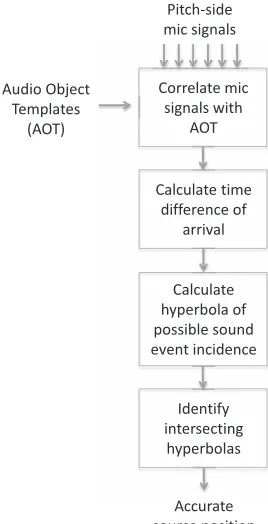
for each class of sound that was required to be captured as a discrete object; in this case templates for ball-kicks and whistle-blows based on envelope and spectral content were created. Software was developed that monitored every pitch-side microphone, comparing it to the stored audio ob-ject template. When a matching sound event was detected in a microphone feed all other microphone feeds were scanned for matching characteristics to identify all microphones that had some element of the event present in its feed. For ev-ery pair of microphone feeds that picked up the event a hyperbola, along which the event must have occurred, was calculated based on the difference in time of arrival of the sound at the two microphones. Where more than two micro-phone pairs had captured the sound event the intersections of the calculated hyperbolas gave an accurate coordinate lo-cation for the sound event. In the FascinatE project, which utilized object-based audio for spatial positioning of audio objects in surround and 3D reproduction systems, these co-ordinate locations were used to automatically position the sound dependent on a user-defined viewpoint, by a virtual director system [66] or on a viewpoint defined by the pro-duction team. In the case of audio objects for clean audio the critical factor is different; the audio objects are panned centrally, as in current broadcast, and the key outcome is to identify the audio event and extract it from the acous-tic scene in isolation from crowd noise and other sounds that may be detrimental to clarity, thus enabling freedom to mix the relative levels of the individual components at the user-end. In order to accomplish this, the microphone feed containing the loudest example of the sound event was iden-tified based on the derived location of the sound event. Once this microphone was identified an envelope was applied to the microphone feed based on the temporal characteristics of the detected sound event. In this way relevant pitch-side microphones were only ever active in the produced mix for the duration of the sound event. The short section of crowd noise picked up by that microphone was then effectively masked by the sound event itself. A flow diagram for the object extraction process can be seen in Fig. 3. The resultant audio object, together with its paired coordinate metadata was coded into the broadcast audio stream for decoding at the rendering device.
The user of the system was presented with an interface enabling selection of pre-determined reproduction mixes the input of which was three discrete streams of audio:
1) Clean BBC commentary feed with no background noise taken directly from the commentary micro-phone;
2) Crowd noise from an Eigenmike located on the gantry at the camera position;
3) On-pitch sounds extracted using the audio object extraction techniques described here.
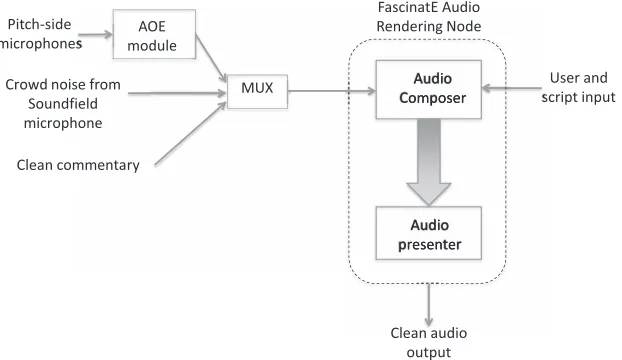
[image:9.581.342.476.42.304.2]The three streams were combined and transmitted over IP to the audio part of the FascinatE Render Node (FRN). The FRN consisted of the Audio Composer (developed by University of Salford) and the Audio Presenter (developed by Technicolor). The Audio Composer was responsible for
Fig. 3. Flow diagram illustrating audio object extraction devel-oped in the FascinatE project
decoding the various audio streams and metadata received, arranging them spatially and mixing them based on user input and on scripts generated as part of the production. User input included the chosen user-defined scene incor-porating the pan, tilt, and zoom information necessary to spatially position the on-pitch audio appropriately for the chosen camera view. Additionally user-choices of the rel-ative levels of foreground (commentary and on-pitch) and background (crowd) sound could also be selected. Script information was generated in two ways, at both production and user end.
Fig. 4. Clean Audio in FascinatE: Extracted audio objects, crowd noise, and clean commentary multiplexed for transmission, decoded, and reproduced by the FascinatE audio render node
4 CONCLUSIONS
An object-based approach to clean audio, combined with methods to isolate sounds that are important to the narrative and meaning of a broadcast, has the potential to enable users to have complete control of the relative levels of all aspects of audio from TV broadcast. Any of the solutions previ-ously discussed, such as non-speech channel attenuation, dynamic range control, and other processing could then be carried out on only the speech, or other important content of the program, in isolation depending on user preferences and on the nature and genre of the program material. Al-though the FascinatE implementation described here was for live event broadcast, object-based methods could be ap-plied to any genre—live sports probably being one of the most challenging because of the difficulties in extracting the audio objects. The main limitation of the system de-scribed was that of latency. In the FascinatE project there was sufficient video latency that all processing could take place and the resultant stream of audio objects, together with positional metadata, could be streamed alongside the panoramic video stream to the end user. There are sub-stantial challenges associated with adapting the technique for real-time implementation in today’s broadcast systems, namely a much reduced video processing latency of around 20 ms. This technique for provision of clean audio was demonstrated using recorded microphone feeds at the Fas-cinatE project’s final demonstration at the University of Salford’s campus at MediaCityUK on 30 May 2013. Dur-ing the demonstration visitors were able to alter the balance between foreground and background audio where the fore-ground audio consisted of commentary and on-pitch sounds and the background consisted of crowd noise.
5 ACKNOWLEDGMENT
The research leading to these results has received fund-ing from the European Union’s Seventh Framework Pro-gramme ([FP7/2007-2013]) under grant agreement no.
[248138]. The authors would also like to thank SISLive and BBC for their cooperation during data acquisition and also for the invaluable assistance of Hearing Concern, LINK, and Action on Hearing Loss during this work.
6 REFERENCES
[1] Action on Hearing Loss, “Hearing Loss Statistics” (2014). URL http://www.actiononhearingloss.org.uk/your-hearing/about-deafness-and-hearing-loss/statistics.aspx, accessed 5 December 2014.
[2] Voice of the Listener & Viewer, “VLV’s Audibility of Speech on Television Project Will Make a Real Dif-ference,” VLV News Release, March 2011. Available at http://www.vlv.org.uk/documents/06.11Pressreleasefrom VLV-AudibilityProject-0800hrs1532011 002.pdf, ac-cessed 5 December 2014.
[3] J. Herre, J. Hilpert, A. Kuntz, and J. Plogsties, “MPEG-H Audio—The New Standard for Universal Spa-tial/3D Audio Coding,” presented at the137th Convention of the Audio Engineering Society(2014 Oct.), convention paper 9095.
[4] S. Meltzer, M. Neuendorf, D. Sen, and P. Jax, MPEG-H 3D Audio—The Next Generation Audio System (Insti-tution of Engineering and Technology, 2014).
[5] MPEG, “ISO/IEC 23008, High Efficiency Cod-ing and Media Delivery in Heterogeneous Environments (open)” (2013).
[6] A. C. Davis, "The Prevalence of Hearing Impairment and Reported Hearing Disability among Adults in Great Britain,"Int’l J. Epidemiology, vol. 18, no. 4, pp. 911–917 (1989).
[7] W. Noble, G. Naylor, N. Bhullar, and M. A. Akeroyd, "Self-Assessed Hearing Abilities in Middle- and Older-Age Adults: A Stratified Sampling Approach,"Int’l J. Audiol-ogy, vol. 51, no. 3, pp. 174–180 (2012).
Britain,"Occup. Environ. Med., vol. 59, no. 9, pp. 634–639 (2002).
[9] K. T. Palmer, D. Coggon, H. E. Sydall, B. Pannett, and M. J. Griffin, “CRR 361/2001 Occupational Exposure to Noise and Hearing Difficulties in Great Britain,” Tech-nical Report, University of Southampton (2001).
[10] Health and Security Executive (HSE), “Health and Safety Statistics 1996/7,” Technical Report, Health and Safety Commission (1997).
[11] Health and Security Executive (HSE), “Statistics: Noise Induced Deafness Summary,” available at http:// www.hse.gov.uk/noise/statistics.htm, accessed: 5 Decem-ber 2014.
[12] W. W. Clark, “Noise Exposure from Leisure Activ-ities: A Review,”J. Acous. Soc. Amer., vol. 90, no. 1, pp. 175–181 (1991).
[13] M. Maassen, W. Babisch, K. D. Bachmann, H. Ising, G. Lehnert, P. Plath, P. Plinkert, E. Rebentisch, G. Schuschke, M. Spreng, G. Stange, V. Struwe, and H. P. Zenner, “Ear Damage Caused by Leisure Noise,”Noise & Health, vol. 4, no. 13, pp. 1–16 (2001).
[14] A. Axelsson, A. Eliasson, and B. Israelsson, “Hear-ing in Pop/Rock Musicians: A Follow-Up Study,”Ear and Hearing, vol. 16, no. 3, pp. 245–253 (1995).
[15] A. Axelsson and F. Lindgren, “Hearing in Pop Mu-sicians,”Acta Oto-laryngologica, vol. 85, nos. 1-6, pp. 225– 231 (1978).
[16] S. Sadhra, C. A. Jackson, T. Ryder, and M. J. Brown, “Noise Exposure and Hearing Loss among Student Em-ployees Working in University Entertainment Venues,” An-nals of Occupational Hygiene, vol. 46, no. 5, pp. 455–463 (2002).
[17] J.-H. Peng, Z.-Z. Tao, and Z.-W. Huang, “Risk of Damage to Hearing from Personal Listening Devices in Young Adults,”J. Otolaryngology, vol. 36, no. 3, pp. 179– 183 (2007).
[18] BBC, “Clear Sound: Best Practice Tips" (2011), [cited 14 August 2013]; BBC Academy training guide. Available from: http://www.bbc.co.uk/academy/ production/article/art20130702112135255, accessed 5 De-cember 2014.
[19] Royal National Institute for Deaf People (RNID), Annual Survey Report 2008 (2008).
[20] Royal National Institute for Deaf People (RNID), Annual Survey Report 2005 (2005).
[21] ITU-R 54/6, Sound Systems for the Hearing Im-paired (1994).
[22] C. D. Mathers, “A Study of Sound Balances for the Hard of Hearing,” Technical Report, BBC (1991).
[23] D. J. Meares, “R&D Report 1991–14: HDTV Sound: Programme Production Developments,” Technical Report, BBC (1991).
[24] W. Hoeg and T. Lauterbach,Digital Audio Broad-casting: Principles and Applications of DAB, DAB+ and DMB(Wiley, 2009).
[25] C. Uhle, O. Hellmuth, and J. Weigel, “Speech En-hancement of Movie Sound,” presented at the125th Con-vention of the Audio Engineering Society(2008 Oct.), con-vention paper 7628.
[26] M. Armstrong, “Audio Processing and Speech In-telligibility: A Literature Review,” Technical Report, BBC (2011).
[27] P. Kendrick and B. Shirley, “Performance of In-dependent Component Analysis When Used to Separate Competing Acoustic Sources in Anechoic and Reverber-ant Conditions,” presented at the124th Convention of the Audio Engineering Society(2008 May), convention paper 7413.
[28] A. R. Carmichael. “Evaluating Digital ’On-Line’ Background Noise Suppression: Clarifying Television Dia-logue for Older, Hard-of-Hearing Viewers,”Neurophysical Rehabilitation, vol. 14, nos. 1-2, pp. 241–249 (2004).
[29] H. M¨usch, “Aging and Sound Perception: Desirable Characteristics of Entertainment Audio for the Elderly,” presented at the125th Convention of the Audio Engineering Society(2008 Oct.), convention paper 7627.
[30] F. Rumsey, “Hearing Enhancement,”J. Audio Eng. Soc., vol. 57, pp. 353–359 (2009 May).
[31] G. Cervellera and A. Quaranta, “Audiologic Find-ings in Presbycusis,”J. Auditory Res., vol. 22, no. 3, pp. 161–171 (1982 Jul.).
[32] E. L. Stine, A. Wingfield, and L. W. Poon, “How Much and How Fast: Rapid Processing of Spoken Language in Later Adulthood,”Psychology and Aging, vol. 1, no. 4, p. 303 (1986).
[33] P. Rabbitt, “Mild Hearing Loss Can Cause Apparent Memory Failures which Increase with Age and Reduce with IQ,"Acta Oto-laryngologica, vol. 111, no. S476, pp. 167– 176 (1991).
[34] EBU, “EBU – TECH 3333: EBU HDTV Receiver Requirements,” Geneva, Switzerland (2009 Mar.).
[35] Open IPTV Forum, “OIPF Release 2 Specification Volume 2 – Media Formats” (2011 Jun.).
[36] B. G Shirley and P. Kendrick, "The Clean Audio Project: Digital TV as Assistive Technology,” J.Tech. & Disability, vol. 18, no. 1, pp. 31–41 (2006).
[37] UK Clean Audio Forum, “Liaison Statement from UK Clean Audio Forum to ITU FG IPTV,” Liaison Statement, International Telcommunications Union Focus Group on IPTV (2007 Jan.).
[38] R. Dressler, "A Step Toward Improved Surround Sound Making the 5.1-Channel Format a Reality,” pre-sented at the 100th Convention of the Audio Engineering Society(1996 May), convention paper 4287.
[39] T. Holman, “The Number of Loudspeaker Chan-nels,” Proc. 19th International Conference of the Audio Engineering Society: Surround Sound-Techniques, Tech-nology, and Perception (2001 Jun.), conference paper 1906.
[40] T. Holman, "The Number of Audio Channels,” pre-sented at the 100th Convention of the Audio Engineering Society(1996 May), convention paper 4292.
[41] B. Shirley, P. Kendrick, and C. Churchill, “The Ef-fect of Stereo Crosstalk on Intelligibility: Comparison of a Phantom Stereo Image and a Central Loudspeaker Source,” J. Audio Eng. Soc., vol. 55, pp. 852–863 (2007 Oct.).
of the Audio Engineering Society(1983 Oct.), convention paper 2012.
[43] D. H. Cooper and J. L. Bauck," "Prospects for Transaural Recording,” J. Audio Eng. Soc., vol. 37, pp. 3–19 (1989 Jan./Feb.).
[44] J. L. Bauck and D. H. Cooper, “Generalized Transaural Stereo,” presented at the93rd Convention of the Audio Engineering Society(1992 Oct.), convention paper 3401.
[45] E. Vickers, “Fixing the Phantom Center: Diffusing Acoustical Crosstalk,” presented at the127th Convention of the Audio Engineering Society(2009 Oct.), convention paper 7916.
[46] R. B¨ucklein, “The Audibility of Frequency Re-sponse Irregularities,”J. Audio Eng. Soc., vol. 29, pp. 126– 131 (1981 Mar.).
[47] G. S. Kendall, “The Decorrelation of Audio Signals and its Impact on Spatial Imagery,” Computer Music J., vol. 19, no. 4, pp. 71–87 (1995).
[48] M. Boueri and C. Kyriakakis, “Audio Signal Decor-relation Based on a Critical Band Approach,” presented at the 117th Convention of the Audio Engineering Society (2004 Oct.), convention paper 6291.
[49] G. Augspurger, S. Bech, R. Brook, E. Cohen, J. Eargle, and T. A. Schindler, “Use of Stereo Synthesis to Reduce Subjective/Objective Interference Effects: The Per-ception of Comb Filtering, Part II,” presented at the87th Convention of the Audio Engineering Society(1989 Oct.), convention paper 2862.
[50] ETSI, “ETSI TS101154 v1.9.1 Digital Video Broadcasting (DVB); Specification for the Use of Video and Audio Coding in Broadcasting Applications Based on the MPEG-2 Transport Stream (2009).
[51] A. Carmichael, H. Petrie, F. Hamilton, and J. Free-man, “The Vista Project: Broadening Access to Digital TV Electronic Programme Guides."Psych. J., vol. 1, no. 3, pp. 229–241 (2003).
[52] M. M. Goodwin and J.-M. Jot, “Primary-Ambient Signal Decomposition and Vector-Based Localization for Spatial Audio Coding and Enhancement,”Proc. Acoustics, Speech and Signal Processing, 2007. ICASSP 2007. IEEE International Conference on, vol. 1, pages 1–9 (2007).
[53] S. Zielinski, J. Mayne, and F. Rumsey, “Improv-ing Intelligibility of Surround Sound Us“Improv-ing Principal Com-ponent Decomposition,”Proc. Institute of Acoustics, 21st Reproduced Sound Conference, vol. 27, pt. 5 (2005).
[54] B. Shirley, “Improving Television Sound for People with Hearing Impairments,” Ph.D. Thesis (2013).
[55] C. Q. Robinson, S. Mehta, and N. Tsingos, “Scal-able Format and Tools to Extend the Possibilities of Cinema Audio,”SMPTE Motion Imaging J., vol. 121, no. 8, pp. 63– 69 (2012).
[56] A. D. Kraemer, J. Tracey, and T. Katsianos, US patent application 13/791,488: Object-oriented audio streaming system (2013).
[57] O. Schreer, J.-F. Macq, O. A. Niamut, J. Ruiz-Hidalgo, B. Shirley, G. Thallinger, and G. ThomasMedia Production, Delivery and Interaction for Platform Indepen-dent Systems: Format-Agnostic Media(John Wiley & Sons, 2013).
[58] H. Fuchs, S. Tuff, and C. Bustad, “Dialogue Enhancement—Technology and Experiments,” Technical Report, EBU (2012).
[59] H. Fuchs and D. Oetting, “Advanced Clean Audio Solution: Dialogue Enhancement,”SMPTE Motion Imag-ing J., vol. 123, no. 5, pp. 23–27 (2014).
[60] Joanneum Research, Technicolor, TNO, University of Salford, BBC, TNO, Softeco Sismat, Interactive Insti-tute, Fraunhofer HHI, ARRI, and Universitat de Catalunya. Fascinate project [FP7/2007-2013] under grant agreement no. [248138] (2010).
[61] P. Kauff, P. Eisert, J. Schuessler, C. Weissig, and A. Finn, US patent application 14/049,057: Capturing panoramic or semi-panoramic 3D scenes (2014).
[62] I. Forrester and A. Churnside, “The Creation of a Perceptive Audio Drama,” Proc. NEM Summit (2012).
[63] S. E. Carlsson “Diegetic and Non-Diegetic Sounds,” [cited 2013 September]; available from: http://filmsound.org/terminology/diegetic.htm, accessed 5 December 2014.
[64] R. G. Oldfield, B. Shirley, and J. Spille, “Object Based Audio for Interactive Football Broadcast,” Multime-dia Tools & Applications, DOI:10.1007/s11042-013-1472-2 (DOI:10.1007/s11042-013-1472-201DOI:10.1007/s11042-013-1472-2).
[65] C. Barnhill, J. West, and I. Busch-Vishniac, “Im-pulse Response of a Spherical Microphone Array (Eigen-mike),” J. Acous. Soc. Amer., vol. 119, no. 5, pp. 3378 (2006).
THE AUTHORS
Ben Shirley Rob Oldfield
Dr. Ben Shirley is a Senior Lecturer in audio technology at the Acoustics Research Centre, University of Salford, UK. He received his M.Sc. from Keele University in 2000 and his Ph.D. from the University of Salford in 2013. His doctoral thesis investigated methods for improving TV sound for people with hearing impairments. His research interests include audio broadcast, spatial audio, and also audio related accessibility solutions for people with sen-sory impairments. Dr. Shirley was principal investigator on the ITC and Ofcom funded Clean Audio project that investigated methods to improve TV sound for people with hearing impairments and was a member of the UK Clean Audio Forum that contributed to ETSI and EBU digital video broadcast standards. He led the VoIPText project developing text interfaces for people with hearing impair-ments. He has been a consultant on a wide range of audio related commercial projects. More recently he was Princi-pal Investigator for University of Salford’s work in the EU FP7 FascinatE project that developed an end-to-end inter-active future broadcast system. He is currently working on the EPSRC funded S3A project investigating future object-based spatial audio systems. Although primarily working in science and technology he also enjoys the challenge of cross-disciplinary projects and has worked with com-posers, musicians, film makers, choreographers, and artists in projects spanning areas where technology and creativity
overlap. Dr. Shirley’s teaching includes audio, broadcast, and music technology and audio production/post produc-tion at the University of Salford’s MediaCityUK campus and he has been a visiting guest lecturer delivering master-classes on sound design and 3D audio at Carnegie Mellon’s Entertainment Technology Center.
•
![Table 1. Age distribution of self-assessed hearing loss aspublished in International Journal of Audiology [7].](https://thumb-us.123doks.com/thumbv2/123dok_us/8707375.881035/4.581.310.534.66.135/table-distribution-assessed-hearing-aspublished-international-journal-audiology.webp)
![Fig. 1. Example of a clean audio system reference model reproduced from UK Clean Audio Forum liaison statement to ITU FocusGroup on IPTV [37]](https://thumb-us.123doks.com/thumbv2/123dok_us/8707375.881035/5.581.48.524.44.225/example-reference-reproduced-clean-audio-liaison-statement-focusgroup.webp)
![Fig. 2. System diagram showing a “speech filtered” covariance matrix determining attenuation or deletion of components in unfilteredpath [54]](https://thumb-us.123doks.com/thumbv2/123dok_us/8707375.881035/6.581.152.442.41.192/diagram-filtered-covariance-determining-attenuation-deletion-components-unfilteredpath.webp)