• No results found

Development and Application of a Novel Peptide Nucleic Acid Probe for the Specific Detection of Helicobacter pylori in Gastric Biopsy Specimens

N/A
N/A
Protected

Academic year: 2020

Share "Development and Application of a Novel Peptide Nucleic Acid Probe for the Specific Detection of Helicobacter pylori in Gastric Biopsy Specimens"

Copied!
6
0
0

Loading.... (view fulltext now)

Full text

(1)

0095-1137/07/$08.00⫹0 doi:10.1128/JCM.00858-07

Copyright © 2007, American Society for Microbiology. All Rights Reserved.

Development and Application of a Novel Peptide Nucleic Acid Probe

for the Specific Detection of

Helicobacter pylori

in

Gastric Biopsy Specimens

N. Guimara

˜es,

1,2

N. F. Azevedo,

1,3

C. Figueiredo,

2,4

C. W. Keevil,

3

and M. J. Vieira

1

*

IBB (Institute for Biotechnology and Bioengineering), Centre for Biological Engineering, Universidade do Minho, Campus de

Gualtar 4710-057, Braga,1and IPATIMUP (Institute of Molecular Pathology and Immunology of the University of Porto)2and

Medical Faculty of Porto,4Porto, Portugal, and School of Biological Sciences, University of

Southampton, Southampton, United Kingdom3

Received 24 April 2007/Accepted 31 May 2007

In this work, a fluorescence in situ hybridization (FISH) method for the rapid detection ofHelicobacter pylori

using a novel peptide nucleic acid (PNA) probe is reported. Laboratory testing with several different bacterial

species, including otherHelicobacterspp., has shown that this probe is highly specific forH. pyloristrains. In

addition, the PNA FISH method has been successfully adapted for detection of the pathogen in paraffin-embedded gastric biopsy specimens.

Helicobacter pylori is an important human pathogen that

causes chronic gastritis and is associated with the development of peptic ulcer disease, atrophic gastritis, and gastric cancer (27). Infection withH. pylorican be diagnosed either by non-invasive testing or by non-invasive techniques that require an upper endoscopy with collection of gastric biopsy specimens (11). Noninvasive tests are the most usual methods for routineH.

pyloridetection, but they fail to provide complementary

infor-mation on the location ofH. pyloriin the stomach and on the histopathological lesions underlying the presence of the bac-teria. Therefore, there are situations where invasive tests should be performed to provide a more complete diagnosis. Gastric biopsy specimens obtained by upper endoscopy can be analyzed for the presence of the bacterium by culture or by other molecular methods. In recent years, molecular methods for the identification of several bacteria, including random amplified polymorphic DNA, PCR, and fluorescence in situ hybridization (FISH), have been preferred over the more time-consuming culture methods (8, 21, 28).

FISH is arguably the most common method used for the detection and localization of a microorganism or particular groups of microorganisms within a sample (28). It detects nucleic acid sequences by means of a fluorescently labeled probe that hybridizes specifically to its complementary target sequence within the intact cell (15). So far, FISH methods have been based on the use of conventional DNA oligonucleotide probes containing around 20 bases. More recently, peptide nucleic acid (PNA) probes have been developed and optimized for bacterial detection. PNA molecules are DNA mimics in which the negatively charged sugar-phosphate backbone is re-placed by an achiral, neutral polyamide backbone formed by repetitive units ofN-(2-aminoethyl)glycine (17, 18). PNA can

hybridize with complementary nucleic acid targets according to the Watson-Crick base-pairing rules (7). Compared with tra-ditional DNA probes and due to the uncharged backbone, PNA probes have superior hybridization characteristics, exhib-iting rapid and stronger binding to complementary targets and an absence of electrostatic repulsion (20, 25). The optimum length for a PNA probe is 15 bp.

Several PNA probes have been designed and optimized for different organisms includingCampylobacterspp.,Candida

al-bicans,Mycobacterium avium, andLegionella pneumophila(12,

13, 30). We have previously developed a PNA probe targeting the 16S rRNA ofH. pylori(sequence, 5⬘-TAATCAGCACTC TAGCAA-3⬘) that was shown to be very specific (5). However, due to the extensive genetic diversity observed withinH. pylori, the high specificity of the probe was counterbalanced by a lack of sensitivity.

Design of the PNA oligonucleotide probe.To identify

poten-tially useful oligonucleotides, the freely available Primrose program was used (http://www.cf.ac.uk/biosi/research/biosoft /Primrose/index.html) together with the 16S rRNA databases of Ribosomal Database Project II (RDP-II), version 8.1 (http: //rdp8.cme.msu.edu/html/) (3, 6). In accordance with the Prim-rose program instructions, the selection of oligonucleotides was based on the 16S rRNA comparison of six randomly

cho-senH. pylori strains. To avoid missing possible sequences of

interest, several sets of six randomH. pyloristrains were tested. Based on the large number of 15-bp sequences obtained that could match all targets, additional criteria for the selection of the PNA FISH probe were used. These included no self-com-plementary structures within the probe and high specificity and sensitivity forH. pylori. Once the probe sequence was selected, a search was made at the National Center for Biotechnology Information (http://www.ncbi.nlm.nih.gov/BLAST/) to further confirm the specificity of the probe (14). Afterwards, the de-sired sequence was synthesized (ATDBio, Southampton, United Kingdom), and the N terminus of the oligomer was connected to Alexa Fluor 546 via a double AEEA linker.

According to the criteria mentioned above, we have chosen

* Corresponding author. Mailing address: Centro de Engenharia Biolo´gica, Universidade do Minho, 4710-057 Braga, Portugal. Phone: 351 253 604411. Fax: 351 253 678986. E-mail: [email protected].

† Supplemental material for this article may be found at http://jcm .asm.org/.

Published ahead of print on 3 July 2007.

3089

on May 16, 2020 by guest

http://jcm.asm.org/

(2)

the following PNA oligomer sequence: 5⬘-GAGACTAAGCC CTCC-3⬘. The probe was designated Hpy769 due to the start-ing position of the target sequence in the 16S rRNA of H.

pyloristrain NCTC 11637. Searches showed that the Hpy769

probe differed by at least 1 bp from the 16S rRNA sequences of bacteria other thanH. pylori, except for a few uncultured

Helicobacterspecies and one strain ofHelicobacter acinonychis.

More importantly, evaluation with the NCBI BLAST program showed that this probe is identical to 89% of all H. pylori

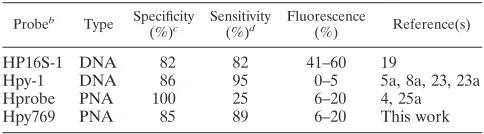
sequences, which is a significant improvement over the 25% identity obtained for the PNA probe that has already been published (4) and represents a value comparable to those of other DNA probes used forH. pyloridetection (19, 23) (Table 1). For the estimation of specificity and sensitivity, only se-quences considered to have high quality and more than 1,200 bp by the RDP-II program were selected. The H. pylori se-quences were further assessed for the existence of chimeras by using Mallard software, version 1.02 (2). At the end, 57 se-quences were selected as being trustworthy. This is still a rel-atively low number for assessing sensitivity and specificity, es-pecially if we bear in mind that many strains also have the bias of being from similar locations and consequently possess sim-ilar 16S rRNA sequences. As such, it is likely that these values will change as more sequences are deposited.

Another advantage of the probe is that, as shown in Fig. SA1 (provided as supplemental material), the target sequence is located in a higher-affinity binding area than that for Hpy-1 according to the study of Fuchs et al. (10). Even if both probes were DNA based, this should result in a brighter signal and easier visualization under the microscope for Hpy769. Because the latter is PNA based and hybridizations can therefore be performed under low-salt conditions that promote the desta-bilization of the secondary structure of the 16S rRNA (25), enhanced signal intensity is expected.

Optimization of the hybridization conditions of the probe.

The hybridization method was based on the procedure re-ported in Azevedo et al. (4) with some modifications. We started by testing different hybridization temperatures, be-tween 50°C and 68°C, and the best hybridization results were obtained at 59°C (data not shown); however, in certain random samples, it was noticed that hybridization was not as bright as expected, which made detection difficult. This problem was

solved by altering the fixation procedure to include a step of paraformaldehyde immersion followed by ethanol. The reason why this problem has not appeared for the Hprobe has not been investigated, but it might be related to altered probe characteristics due to the binding of the different type of flu-orochrome (Alexa Fluor 546) used in this work.

For the final procedure, smears of H. pylori NCTC 11637 prepared by standard methods were immersed in 4% (wt/vol) paraformaldehyde followed by 50% (vol/vol) ethanol for 10 min each and allowed to air dry. The smears were then covered with 30␮l of hybridization solution (24) and a coverslip, placed in moist chambers, and incubated for 90 min at 59°C. Follow-ing hybridization, coverslips were removed and slides were submerged in a prewarmed (59°C) washing solution containing 5 mM Tris base (Sigma), 15 mM NaCl (Sigma), and 1% (vol/ vol) Triton X (pH 10; Sigma). Washing was performed at 59°C for 30 min, and the slides were allowed to air dry.

The smears were mounted with 1 drop of nonfluorescent immersion oil (Merck) and covered with coverslips. Slides were stored in the dark for a maximum of 48 h before micros-copy. Microscopy was conducted using a Zeiss Axioplan (Oberkochen, Germany) and an Olympus BX51 (Perafita, Por-tugal) epifluorescence microscope equipped with one filter sensitive to the signaling molecule of the PNA probe. Filters that were not able to detect the probe were used as negative controls. For each experiment, a negative control was per-formed where all the steps described here were carried out but no probe was added to the hybridization solution.

Specificity and sensitivity of the probe.To test the specificity

and sensitivity of the probe, severalH. pylori strains,

Helico-bacterspp., and other bacteria were tested (Table 2). AllH.

pyloristrains were maintained on Columbia agar (Oxoid,

Bas-ingstoke, United Kingdom) supplemented with 5% (vol/vol) defibrinated horse blood (Biome´rieux, Marcy l’Etoile, France). Plates were incubated at 37°C in a CO2incubator (HERAcell

150; Thermo Electron Corporation, Waltham, MA) set to 10% CO2and 5% O2, and single colonies were streaked onto fresh

plates every 2 or 3 days. All otherHelicobacter and

Campy-lobacter species were grown on Campylobacterselective agar

(Sigma) supplemented with 5% (vol/vol) defibrinated sheep blood (Probiolo´gica, Sintra, Portugal) and were maintained under conditions similar to those for H. pylori, except for

Campylobacterspp., which were incubated at 42°C; other

bac-teria used in this study were grown on R2A agar at room temperature (20 to 25°C) for 3 days.

As shown in Table 2, Hpy769 hybridizes with all H. pylori

strains, whereas no hybridization was observed for the other bacterial species used. It is interesting that, despite the pre-dicted 89% sensitivity, the probe was able to detect all theH.

pyloristrains used in this study. Positive detection of culture

[image:2.585.42.284.89.156.2]

collections was already expected, since the 16S rRNA se-quences deposited in the RDP-II data bank were known to be complementary to our probe. It could be expected that some clinical isolates would not be detected by our probe. This was not the case, but it is worth mentioning that all clinical isolates were obtained from the same institution (the strain collection of the National Institute of Health in Lisbon, Portugal) and from individuals within the same geographical region, which might imply that 16S rRNA sequences that are conserved between strains are more likely to occur.

TABLE 1. Predicted specificities and sensitivities of the probes for

H. pyloridetectiona

Probeb Type Specificity

(%)c

Sensitivity (%)d

Fluorescence

(%) Reference(s)

HP16S-1 DNA 82 82 41–60 19

Hpy-1 DNA 86 95 0–5 5a, 8a, 23, 23a

Hprobe PNA 100 25 6–20 4, 25a

Hpy769 PNA 85 89 6–20 This work

a

Estimation of binding affinity through fluorescence intensity was based on the work of Fuchs et al. (10).

b

Sequences are as follows: HP16S-1, 5⬘-GGA GTA TCT GGT ATT AAT CAT CG-3⬘; Hpy-1, 5⬘-CAC ACC TGA CTG ACT ATC CCG-3⬘; Hprobe, 5⬘-TAATCAGCACTCTAGCAA-3⬘. The sequence of Hpy769 is given in the text.

c

Calculated as (number ofH. pylori strains detected by the probe)/(total number of bacterial strains detected by the probe)⫻100.

d

Calculated as (number of H. pyloristrains detected by the probe)/(total number ofH. pyloristrains in the databases)⫻100.

on May 16, 2020 by guest

http://jcm.asm.org/

(3)

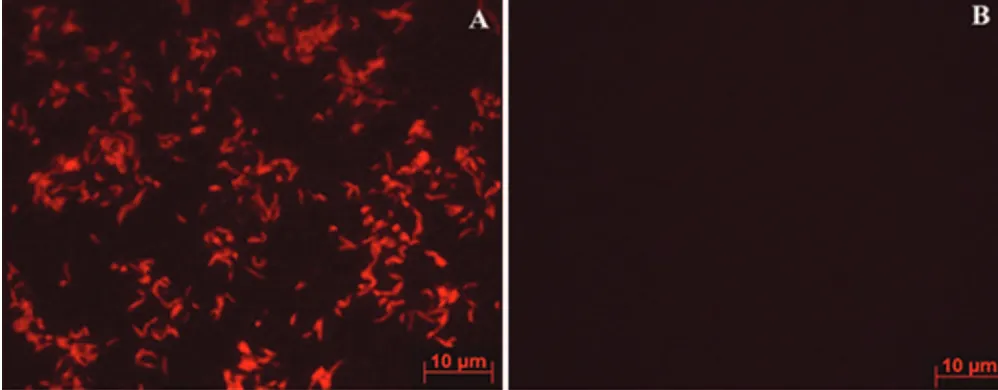
All hybridizedH. pylori strains emitted bright red fluores-cence, and the three different morphological types of the bac-terium (spiral, U-shape, and coccoid) (1) could be clearly ob-served (Fig. 1). There was no cross-hybridization to the rRNAs of other bacteria used in this study, and thus Hpy769-labeled

H. pyloricells could easily be distinguished from non-H. pylori

strains. This was the first FISH probe targetingH. pylorithat was tested against such a large number of closely related spe-cies. This is particularly important because it has been reported that existing DNA probes are at times unable to discriminate between sequences with only one base pair mismatch (30).

The identification of coccoid forms by this method assumes particular importance because it has recently been shown that the stringent response inH. pyloriinduces, besides the mor-phological conversion into a coccoid shape, a decrease in total RNA production (16, 29). Nevertheless, this method appears to be sensitive enough to detect these lower numbers of rRNA copies per cell.

Hybridization in gastric biopsy specimens.After designing

the probe and optimizing the FISH procedure, we applied the method to 15 histological slides of formalin-fixed, paraffin-embedded gastric biopsy specimens from five patients, four infected withH. pyloriand one uninfected. Three-micrometer-thick histological slides were deparaffinized and rehydrated in xylol and ethanol. Slides were immersed twice in xylol for 15 min each time and once in decreasing concentrations of etha-nol (100%, 95%, 80%, 70%, and 50%) for 5 min in each concentration and were finally washed with distilled water for 10 min. Histological slides were then allowed to air dry.

[image:3.585.42.285.82.431.2]

As shown in Fig. 2, the presence ofH. pyloricould easily be detected using the new PNA probe, though some experience at microcopy is required. After applying the PNA FISH method, we counterstained the sample with the Giemsa staining method to confirm our results (Fig. 3). Briefly, histological slides of gastric biopsy specimens were stained with 2% (vol/ vol) Giemsa solution for 30 min and washed in distilled water.

TABLE 2. Results of theH. pyloriprobe specificity test

Organism FISH outcome

H. pylori

NCTC 11367T...

ATCC 700392T...

ATCC 700824T...

1342a...

1198a...

1320a...

957a...

968a...

1330a...

ATCC 49503T... H. cinaedi

33221-1.2b...

33052-1.3b...

H. mustelae

2G1b...

2H1b...

H. felis2I4b...

H. muridarum2A5b...

H. mustelaeCIP 103769Tc...

H. canadensisCCUG 47163Tc...

H. pametensisCIP 104249c...

H. pullorumCCUG 33837Tc...

H. salomonisCIP 105607c...

H. hepaticusCIP 104100c...

H. cinaediCIP 105369c...

H. canisCIP 104753c...

Sphingomonas capsulata...

Staphylococcussp. ...⫺

Acinetobacter calcoaceticus...

Campylobactersp. strain 1 ...⫺

Campylobactersp. strain 2 ...

Campylobactersp. strain 3 ...⫺

aClinical isolate kindly provided by Maria Lurdes Monteiro. bIsolate kindly provided by Jay Solnick.

cIsolate kindly provided by Francis Mg´raud.

FIG. 1. (A) Detection ofH. pyloriusing the red fluorescent probe Hpy769 in a smear of pure culture ofH. pyloriNCTC 11637. Notice the presence of all three morphological types. (B) Lack of signal with Hpy769 in a smear of pure culture ofHelicobacter muridarum2A5. The experiments were performed in parallel, and images were obtained with equal exposure times.

on May 16, 2020 by guest

http://jcm.asm.org/

[image:3.585.42.541.499.694.2]
(4)

Slides were then immersed in 95% (vol/vol) alcohol followed by absolute alcohol.

Additional experiments have proven that PNA FISH is also able to be easily adapted to membrane filters and solid surfaces of different metallic and polymeric materials (data not shown).

Conclusions.As has been shown, the Hpy769 probe presented

an improvement over the previous PNA probe (4) in the detec-tion of the bacteria and is at least as specific as DNA probes reported in the literature forH. pyloridetection. Even though its sensitivity is slightly lower than that of probe Hpy-1 based on current data, only when more strains from a range of patients

from diverse geographical locations are sequenced will it be pos-sible to have a more correct idea of the exact values. Nevertheless, the higher suitability of PNA probes for adaptation to multiplex experiments (i.e., hybridization of several probes at the same time) implies that future improvements of the method can be more easily undertaken. In fact, Hpy769 was one of the first probes with PNA chemistry coupled with a fluorophore from the Alexa Fluor family. One of the advantages of these dyes over other fluorochromes that are used routinely is that they have a very narrow emission band, allowing better discrimination of dif-ferent dyes under the microscope in multiplex experiments.

FIG. 2. (A) Detection ofH. pylori(arrows) using the red fluorescent probe Hpy769 on a histological slide of a gastric biopsy specimen from an infected patient. (B) Results for Hpy769 with a gastric biopsy specimen from a noninfected patient. The experiments were performed in parallel, and images were obtained with equal exposure times.

on May 16, 2020 by guest

http://jcm.asm.org/

[image:4.585.133.450.66.545.2]
(5)

The PNA FISH procedure using the Hpy769 probe has been shown to be a very sensitive and specific method for the de-tection ofH. pyloriin a variety of samples, such as smears and gastric biopsy specimens. In addition, the method is easy to implement without the requirement for special equipment or facilities, apart from an epifluorescence microscope.

The detection of the bacteria in biopsy specimens is very useful because by this technique we are able not only to detect all bacteria but also to pinpoint their exact locations in the gastric tissue and even to identify their morphology, which is not possible by standard techniques such as culture methods or even PCR. In the future, the PNA FISH procedure can be adapted to identifyH.pylori in locations other than the stom-ach, detect antibiotic-resistant strains (22), and study possible interactions between differentH. pyloristrains colonizing the same individual or between H. pylori and other Helicobacter

spp. that are known to inhabit the human gastrointestinal tract (9, 26).

We thank Maria Lurdes Monteiro, Francis Me´graud, and Jay Solnick for providing the clinical isolates andHelicobacterspp. used in this study. We also thank Fa´tima Carneiro for providing the histolog-ical slides of the gastric biopsy specimens and Markku Lehtola, Sandra Wilks, and Talis Junha for helpful discussions.

This work was supported by the Portuguese Institute Fundac¸a˜o para a Cieˆncia e Tecnologia (Ph.D. grants SFRH/BD/4705/2001 and SFRH/ BD/24579/2005) and by the European Commission Research Project SAFER (contract EVK1-CT-2002-00108).

The authors are solely responsible for this work. The work presented does not represent the opinion of the European Community, and the Community is not responsible for the use that might be made of the data appearing therein.

REFERENCES

1.Andersen, L. P., and T. Wadstrom.2001. Basic bacteriology and culture, p. 27–38.InH. L. T. Mobley, G. L. Mendz, and S. L. Hazell (ed.),Helicobacter pylori: physiology and genetics. ASM Press, Washington, DC.

2.Ashelford, K. E., N. A. Chuzhanova, J. C. Fry, A. J. Jones, and A. J. Weightman.2006. New screening software shows that most recent large 16S rRNA gene clone libraries contain chimeras. Appl. Environ. Microbiol.

72:5734–5741.

3.Ashelford, K. E., A. J. Weightman, and J. C. Fry.2002. PRIMROSE: a computer program for generating and estimating the phylogenetic range of 16S rRNA oligonucleotide probes and primers in conjunction with the RDP-II database. Nucleic Acids Res.30:3481–3489.

4.Azevedo, N. F., M. J. Vieira, and C. W. Keevil.2003. Development of peptide nucleic acid probes to detectHelicobacter pyloriin diverse species potable water biofilms, p. 105–112.InA. McBain, D. Allison, M. Brading, A. Rickard, J. Verran, and J. Walker (ed.), Biofilm communities: order from chaos? BioLine, Cardiff, United Kingdom.

5.Azevedo, N. F., M. J. Vieira, and C. W. Keevil.2003. Establishment of a continuous model system to studyHelicobacter pylorisurvival in potable water biofilms. Water Sci. Technol.47:155–160.

[image:5.585.135.450.68.428.2]

5a.Can, F., Z. Yilmaz, M. Demirbilek, B. Bilezikci, G. Kunefeci, F. B. Atac, H. FIG. 3. Detection ofH. pylori(arrows) on a histological slide of a gastric biopsy specimen by using the red fluorescent probe Hpy769 (A) and counterstaining with Giemsa stain (B).

on May 16, 2020 by guest

http://jcm.asm.org/

(6)

Selcuk, H. Arslan, S. Boyacioglu, and F. I. Sahin.2005. Diagnosis of Heli-cobacter pyloriinfection and determination of clarithromycin resistance by fluorescence in situ hybridization from formalin-fixed, paraffin-embedded gastric biopsy specimens. Can. J. Microbiol.51:569–573.

6.Cole, J. R., B. Chai, R. J. Farris, Q. Wang, S. A. Kulam, D. M. McGarrell, G. M. Garrity, and J. M. Tiedje.2005. The Ribosomal Database Project (RDP-II): sequences and tools for high-throughput rRNA analysis. Nucleic Acids Res.33:D294–D296.

7.Egholm, M., O. Buchardt, L. Christensen, C. Behrens, S. M. Freier, D. A. Driver, R. H. Berg, S. K. Kim, B. Norden, and P. E. Nielsen.1993. PNA hybridizes to complementary oligonucleotides obeying the Watson-Crick hydrogen-bonding rules. Nature365:566–568.

8.Fenollar, F., and D. Raoult.2004. Molecular genetic methods for the diag-nosis of fastidious microorganisms. APMIS112:785–807.

8a.Feydt-Schmidt, A., H. Ru¨ssmann, N. Lehn, A. Fischer, I. Antoni, D. Sto¨rk, and S. Koletzko.2002. Fluorescence in situ hybridization vs. epsilometer test for detection of clarithromycin-susceptible and clarithromycin-resistant Heli-cobacter pyloristrains in gastric biopsies from children. Aliment. Pharmacol. Ther.16:2073–2079.

9.Fritz, E. L., T. Slavik, W. Delport, B. Olivier, and S. W. van der Merwe.2006. Incidence ofHelicobacter felisand the effect of coinfection withHelicobacter pylorion the gastric mucosa in the African population. J. Clin. Microbiol.

44:1692–1696.

10.Fuchs, B. M., G. Wallner, W. Beisker, I. Schwippl, W. Ludwig, and R. Amann.1998. Flow cytometric analysis of the in situ accessibility of Esche-richia coli16S rRNA for fluorescently labeled oligonucleotide probes. Appl. Environ. Microbiol.64:4973–4982.

11.Krogfelt, K. A., P. Lehours, and F. Megraud.2005. Diagnosis ofHelicobacter pyloriinfection. Helicobacter10:5–13.

12.Lehtola, M. J., C. J. Loades, and C. W. Keevil.2005. Advantages of peptide nucleic acid oligonucleotides for sensitive site directed 16S rRNA fluores-cence in situ hybridization (FISH) detection ofCampylobacter jejuni, Campy-lobacter coliandCampylobacter lari. J. Microbiol. Methods62:211–219. 13.Lehtola, M. J., E. Torvinen, I. T. Miettinen, and C. W. Keevil.2006.

Fluo-rescence in situ hybridization using peptide nucleic acid probes for rapid detection ofMycobacterium aviumsubsp.aviumandMycobacterium avium subsp.paratuberculosisin potable-water biofilms. Appl. Environ. Microbiol.

72:848–853.

14.McGinnis, S., and T. L. Madden.2004. BLAST: at the core of a powerful and diverse set of sequence analysis tools. Nucleic Acids Res.32:W20–W25. 15.Moter, A., and U. B. Gobel.2000. Fluorescence in situ hybridization (FISH)

for direct visualization of microorganisms. J. Microbiol. Methods41:85–112. 16.Mouery, K., B. A. Rader, E. C. Gaynor, and K. Guillemin.2006. The strin-gent response is required forHelicobacter pylorisurvival of stationary phase, exposure to acid, and aerobic shock. J. Bacteriol.188:5494–5500. 17.Nielsen, P. E., M. Egholm, R. H. Berg, and O. Buchardt.1991.

Sequence-selective recognition of DNA by strand displacement with a thymine-substi-tuted polyamide. Science254:1497–1500.

18.Nielsen, P. E.2001. Peptide nucleic acid: a versatile tool in genetic diagnos-tics and molecular biology. Curr. Opin. Biotechnol.12:16–20.

19.Park, C. S., and J. Kim.1999. Rapid and easy detection ofHelicobacter pylori by in situ hybridization. J. Korean Med. Sci.14:15–20.

20.Perry-O’Keefe, H., S. Rigby, K. Oliveira, D. Sorensen, H. Stender, J. Coull, and J. J. Hyldig-Nielsen.2001. Identification of indicator microorganisms using a standardized PNA FISH method. J. Microbiol. Methods47:281–292. 21.Roma-Giannikou, E., A. Karameris, B. Balatsos, J. Panayiotou, Z. Manika, C. Van-Vliet, T. Rokkas, N. Skandalis, and C. Kattamis.2003. Intrafamilial spread ofHelicobacter pylori: a genetic analysis. Helicobacter8:15–20. 22.Ru¨ssmann, H., A. Feydt-Schmidt, K. Adler, D. Aust, A. Fischer, and S.

Koletzko.2003. Detection ofHelicobacter pyloriin paraffin-embedded and in shock-frozen gastric biopsy samples by fluorescent in situ hybridization. J. Clin. Microbiol.41:813–815.

23.Ru¨ssmann, H., V. A. J. Kempf, S. Koletzko, J. Heesemann, and I. B. Autenrieth.2001. Comparison of fluorescent in situ hybridization and con-ventional culturing for detection ofHelicobacter pyloriin gastric biopsy spec-imens. J. Clin. Microbiol.39:304–308.

23a.Samarbaf-Zadeh, A. R., S. Tajbakhsh, S. M. Moosavian, M. Sadeghi-Zadeh, M. Azmi, J. Hashemi, and A. Masjedi-Zadeh.2006. Application of fluores-cent in situ hybridization (FISH) for the detection ofHelicobacter pylori. Med. Sci. Monit.12:CR426–CR430.

24.Stender, H., K. Lund, K. H. Petersen, O. F. Rasmussen, P. Hongmanee, H. Miorner, and S. E. Godtfredsen.1999. Fluorescence in situ hybridization assay using peptide nucleic acid probes for differentiation between tubercu-lous and nontubercutubercu-lous mycobacterium species in smears of mycobacterium cultures. J. Clin. Microbiol.37:2760–2765.

25.Stender, H., M. Fiandaca, J. J. Hyldig-Nielsen, and J. Coull.2002. PNA for rapid microbiology. J. Microbiol. Methods48:1–17.

25a.Thoreson, A. C. E., M. B. Borre, L. P. Andersen, L. Elsborg, S. Holck, P. Conway, J. Henrichsen, J. Vuust, and K. A. Krogfelt.1995. Development of a PCR-based technique for detection ofHelicobacter pylori. FEMS Immunol. Med. Microbiol.10:325–333.

26.Van den Bulck, K., A. Decostere, M. Baele, A. Driesseu, J. C. Debongnie, A. Burette, M. Stolte, R. Ducatelle, and F. Haesebrouck.2005. Identification of non-Helicobacter pylorispiral organisms in gastric samples from humans, dogs, and cats. J. Clin. Microbiol.43:2256–2260.

27.van Doorn, L. J., C. Figueiredo, R. Rossau, G. Jannes, M. van Asbroek, J. C. Sousa, F. Carneiro, and W. G. Quint.1998. Typing ofHelicobacter pylori vacAgene and detection ofcagAgene by PCR and reverse hybridization. J. Clin. Microbiol.36:1271–1276.

28.Wagner, M., M. Horn, and H. Daims.2003. Fluorescence in situ hybridisa-tion for the identificahybridisa-tion and characterisahybridisa-tion of prokaryotes. Curr. Opin. Microbiol.6:302–309.

29.Wells, D. H., and E. C. Gaynor.2006.Helicobacter pyloriinitiates the strin-gent response upon nutrient and pH downshift. J. Bacteriol.188:3726–3729. 30.Wilks, S. A., and C. W. Keevil.2006. Targeting species-specific low-affinity 16S rRNA binding sites by using peptide nucleic acids for detection of legionellae in biofilms. Appl. Environ. Microbiol.72:5453–5462.

on May 16, 2020 by guest

http://jcm.asm.org/

Figure

TABLE 1. Predicted specificities and sensitivities of the probes forH. pylori detectiona
TABLE 2. Results of the H. pylori probe specificity test
FIG. 2. (A) Detection of H. pylorian infected patient. (B) Results for Hpy769 with a gastric biopsy specimen from a noninfected patient
FIG. 3. Detection of H. pylori (arrows) on a histological slide of a gastric biopsy specimen by using the red fluorescent probe Hpy769 (A) andcounterstaining with Giemsa stain (B).

References

Related documents

The addition of continuous pulse oximetry surveillance to intermittent or continuous respiratory rate monitoring can be very helpful when detecting Type II RECC events unless

Conclusions: A realistic high protein weight-reducing diet was associated with greater fat loss and lower blood pressure when compared with a high carbohydrate, high fiber diet in

diagnostic testing, vector-borne and zoonotic infectious agents were frequently identi fi ed, representing 17% (23 out of 133) of identi fi ed causes of encephalitis in our

or more abnormal diagnostic test results, including autonomic function testing, sensory nerve biopsy, or IENFD in skin biopsy, were required to establish the

Bayesian Cross-Sectional Analysis of the Conditional Distribution of Earnings of Men in the United States, 1967-1996: Appendices.. Geweke, John and

Medicinal plants extract of Cocculus pendulus , Malva neglecta , Rhazya stricta , Jaubertia aucheri, Corchorus depressus , Salvia bucharica, Microcephala

In this study, based on the Rep protein sequence, some gemycircularviruses from giant panda samples showed high sequence identity to the viruses detected in insects or feces from

On the other hand, there are many parameters which we have to decide.Those are the coefficients of the spline functions and the total number of knots, and positions of the