N A N O E X P R E S S
Open Access
Electric field control of magnetization
reorientation in Co/Pb (Mg
1/3
Nb
2/3
)-PbTiO
3
heterostructure
Fenglong Wang , Cai Zhou, Dunzhu Gesang and Changjun Jiang
*Abstract
Herein, we demonstrated an apparent electric field control of magnetization reorientation at room temperature, through a strain-mediated magnetoelectric coupling in ferromagnetic/ferroelectric (FM/FE) multiferroic heterostructure. As the applied electric field increased, the magnetization tended to deviate from the original direction, which was induced by nonlinear strainvselectric-field behavior from the ferroelectric substrates. Ferromagnetic resonance showed that the in-plane magnetic easy axis of the Co film was shifted sharply with electric fieldE= 10 kV/cm, which indicates that the in-plane uniaxial magnetic anisotropy of the Co film can be inverted via the application of an electric field. These results demonstrated that converse magnetoelectric effect in the FM/FE heterostructure was indeed a feasible method to control magnetization orientation in technologically relevant ferromagnetic thin films at room temperature.
Keywords:Multiferroic heterostructure, Magnetization reorientation, Strain-mediated magnetoelectric coupling
Background
Controlling of the magnetic anisotropy or magnetization directly by using electric field [1–3] is of great importance not only in fundamental research, but also in techno-logical applications, including high density information storage, ultra-low power-consuming magnetoelectric devices and sensors [4–6]. Recently, room-temperature electric field manipulate magnetism has been achieved by converse magnetoelectric effect (CME) [7, 8] in mul-tiferroic composites such as a heterostructure of ferro-electric (FE) and ferromagnetic (FM) [9, 10]. There have been a number of studies on artificial multiferroic composite heterostructure with different ferroelectric substrates such as [Pb(Mg1/3Nb2/3)O3]1-x-[PbTiO3]x
(PMN-PT) [11, 12], BaTiO3 (BTO) [13], PbZr1-xTixO3
(PZT) [14], BiFeO3 (BFO) [15], and with magnetic
materials such as CoFe2O4, Co, FeGaB, Co0.9Fe0.1. In
such multiferroic composites, several mechanisms have been proposed to control magnetization in multiferroic heterostructure, including exchange couplling [16], exchange bias from ferroelectric-antiferromagnetic
substrates, charge accumulation/dissipation at a multi-ferroic interface [17], and strain transferred from the ferroelectric layer to the ferromagnetic layer [18]. Considering the requirements of applications, large magnetic response to electric stimuli should be per-formed at room temperature and therefore the strain-mediated magnetoelectric (ME) effect is one of the most promising candidates since strong coupling be-tween ferroelectric and ferromagnetic phases at room temperature can be achieved across their interfaces, leading to a large magnetic response to electric stimuli in such heterostructure. In the present work, we employed single crystal Pb (Mg1/3Nb2/3) -PbTiO3
(PMN-PT) as a substrate and fabricated Co film by sputtering onto PMN-PT substrate with oblique sputtering, which induced in-plane uniaxial anisot-ropy. We investigated static and dynamic magnetic properties of Co films with applying electric field and demonstrated an obviously electric-field control of magnetization reorientation in Co/PMN–PT hetero-structure at room temperature via strain-mediated CME coupling.
* Correspondence:[email protected]
Key Laboratory for Magnetism and Magnetic Materials of MOE, Lanzhou University, Lanzhou 730000, People’s Republic of China
Methods
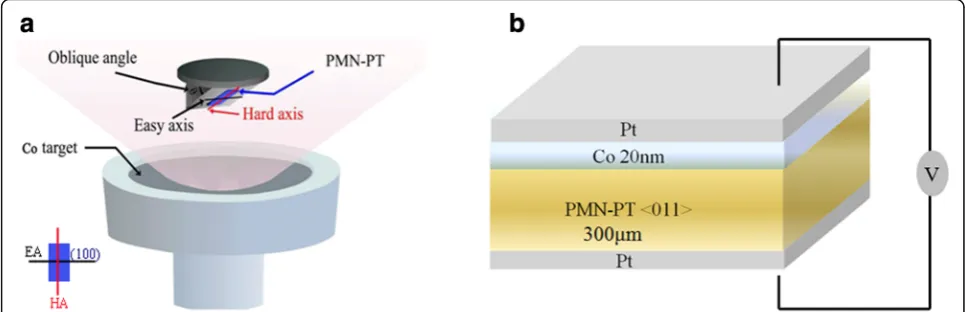
Co thin films was deposited on a PMN-PT (011) (thick-ness is 300μm) substrate by radio frequency magnetron sputtering, as shown in Fig. 1a. The background pres-sure was lower than 5 × 10⁻⁵ Pa. For the deposition of Co layers, a Co target, 75 mm in diameter and 3 mm in thickness was used as the sputtering target, and the argon gas was used as the ambient gas. The sputtering chamber was evacuated to a base pressure 0.2 Pa. The RF power was 50w. The thickness of Co layer was 20 nm. While sputtering, an Ar flow rate of 10 SCCM (SCCM denotes cubic centimeter per minute at STP). Sputtering angle of the film was 20° without applied field. Figure 1b shows the schematic drawing of the sputtering arrangement. The film thickness was mea-sured by the setback instrument (Vecco Dektak 8). The static magnetic properties were measured by vibrating sample magnetometer (VSM) and the dynamic magnetic properties were measured by in-plane ferromagnetic res-onance (FMR) measurements were performed in a JEOL, JES-FA 300 (X-band at 8.969 GHz) spectrometer. The microwave permeability measurements of the films were performed by a vector network analyzer (PNA E8363B) with micro-strip method.
Results and discussion
One 20-nm-thick Co layer with oblique sputtering angle 20°was deposited on the face of 300-um-thick PMN-PT substrate. Figure 2a shows the magnetic hysteresis loops of the Co thin film measured at room temperature, where the magnetic field was applied in the film plane, and the DC bias electric field was applied upon the FE substrate layers along their thickness direction. From Fig. 2a, before the polarization of PMN-PT, the Co film shows an evident in-plane uniaxial magnetic anisotropy. Hysteresis loop of the easy magnetization direction was substantially a rectangle, while remanence ratio (Mr/Ms)
was close to 1. Such an obvious in-plane uniaxial mag-netic anisotropy is mainly resulted by the geometry of the deposition system, such as oblique incidence [19]. To study the correlation between the change of magnetization and electric field directly, the in-plane remanence alone easy axis (EA) and hard axis (HA) of the Co layer were measured by VSM without magnetic field under different electric field as shown in Fig. 2b, c. Figure 2b, c shows that with the increase of the electric field, the remanence along EA is reduced, while in-creased the remanence in the hard axis, which indicated that a rotation of magnetic EA would be obtained. The magnetization response to electric field exhibits a symmetrical butterfly-like behavior, similar to previous reports [20] in other FM/FE heterostructure, which at-tributed to piezostrain effect from FE substrate.
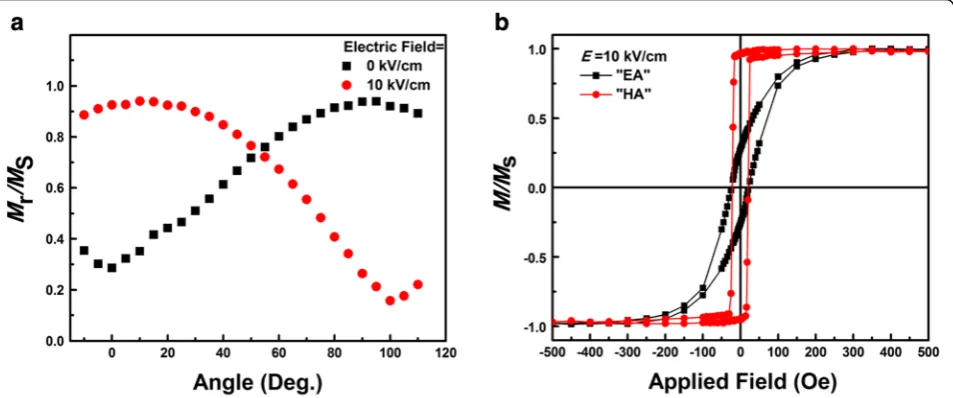
In order to demonstrate magnetic easy-axis reorienta-tion, the rotational magnetization curve (RMC) was measured, as shown in Fig. 3a. Here, before measuring an H-field with 500 Oe (higher than the saturation field) was applied along each measuring direction. From Fig. 3a, maximum position of the remanence ratio was obtained at 90° (E= 0 kV/cm) and 10° (E= 10 kV/cm), respectively, which suggested that the magnetic EA ro-tated obviously. In addition, Fig. 3b showed the magnetic hysteresis loops with E= 10 kV/cm in the original EA and HA direction. Obviously, the remanence ratio of ori-ginal HA was close to 1, which was another evidence of the occurrence of magnetic moment rotation. This giant electrical modulation of magnetization originated from the combination of the ultra-high value of anisotropic in-plane piezoelectric coefficients of (011)-cut PMN-PT and the perfect soft ferromagnetism with in-plane uniaxial anisotropy of Co film. The stress from PMN-PT, which was induced by the electric field, can be transferred to the deposited magnetic Co layer, and formed stress anisotropy. The change of the magnetization resulted
[image:2.595.56.539.557.713.2]from the competition between stress anisotropy and uni-axial anisotropy, which driven the magnetization to devi-ate from the original position.
Generally, magnetic thin film application is based on analysis of the dynamic magnetic or magnetization process, which are subjected to an effective magnetic an-isotropy field Heff as given by the
Landau-Lifshitz-Gilbert (LLG) equation [21]
dM
dt ¼−γðMHeffÞ þ
α
MSM
dM
dt ; ð1Þ
where MS is representing saturation magnetization, Heff
is effective magnetic anisotropy field, γ is the gyromag-netic factor, α is damping constant. Equation (1) illus-trated that the dynamic magnetic properties of the magnetic film be able to be regulated through control the size and/or direction of the Heff. Based on above
VSM results, an E-field controlled easy-axis reorienta-tion was obtained, which the direcreorienta-tion of the in-plane anisotropy field was adjusted. The dynamic magneto-electric response of the films was investigated using the more direct and sensitive FMR spectroscopy at room temperatures under different electric field. The external magnetic field was along in-plane direction of the thin film and the electric field were applied upon the FE sub-strate layers along [011] direction (as shown in Fig. 1b). The relation of resonance fieldvs angles between exter-nal magnetic field and the EA direction were obtained, as shown in the Fig. 4. Co/PMN-PT heterostructure thin film showed obviously in-plane uniaxial anisotropy atE= 0 kV/cm, which was consistent with the results of VSM in the Fig. 2a. However, the easy axis is rotated obviously as the electric field increased from 0 to 10 kV/cm. Moreover, effective magnetic anisotropy field was also changed from 26 Oe atE= 0 kV/cm to 1361 Oe atE= 10 kV/cm. Similar
Fig. 3aThe rotational magnetization curves under different electric field.bThe in-plane hysteresis loops of Co/PMN-PT thin films
withE= 10 kV/cm
Fig. 2aThe in-plane hysteresis loops of Co/PMN-PT thin films withE= 0 kV/cm. The easy and hard axis remanence of Co/PMN-PT thin films with
[image:3.595.60.538.88.229.2] [image:3.595.61.538.505.704.2]to the previous discussion, upon the application of an electric field the PMN-PT substrate would produce in-plane anisotropic stress on the Co film which assisted the inducement of the in-plane magnetic anisotropy. Although there existed a competition between stress-induced magnetic anisotropy and the established mag-netic anisotropy induced from oblique deposition, the former was much larger than the latter, so that the total effective magnetic anisotropy was enhanced. Therefore, The FMR results distinctly demonstrated electric field tuning the in-plane magnetic anisotropy in Co/PMN-PT heterostructure.
Usually, the influences of magnetic interactions could be much more salient in the high-frequency magnetization dynamics and the magnetization rotation can also be well
understood by means of vector network analyzer meas-urement. Figure 4 shows the dependence of complex permeability μ=μ' – j μ" on frequency for the films with different electric field measured by microstrip method using vector network analyzer (PNA E8363B). Theμ' andμ"represent the real and imaginary part of complex permeability, respectively. Figure 5 showed that the resonance frequency was 2.4 GHz with zero electric field. However, the resonance absorption peak was not observed under E= 10 kV/cm. This result can be explained by following reason: withE= 0 kV/cm, the orientation of the magnetization was perpendicular to the direction of microwave magnetic field, resulted to the magnetization precession, which was detected a resonance peak. While for E= 10 kV/cm, according to
Fig. 4the FMR resonance field (Hr)obtained for a constant actuator electric field:a0 kV/cm andb10 kV/cm
[image:4.595.58.540.88.276.2] [image:4.595.58.545.506.715.2]the results of VSM and FMR, the magnetization devi-ated from the original position due to applying an elec-tric and was along microwave magnetic field, which resulted to magnetization precession disappear. This finding has a promising potential for the electric con-trolling of microwave devices, especially phase shift de-vice, anti-electromagnetic interference etc.
Conclusions
The static and dynamic magnetic properties of Co/PMN-PT films with applying electric field have been investigated. Butterfly-shaped remanence versus electric field loops were obtained for the Co/PMN–PT thin films, which essentially tracks the strain loop in the single PMN–PT film. Ferromagnetic resonance shows that the magnetic easy axis in the Co film plane is rotated dramatically with applying an electric field, which indicated that the in-plane uniaxial magnetic anisotropy of the Co film can be inverted via the application of an electric field. The competition between the as-deposited magnetic anisot-ropy and stress anisotanisot-ropy from FE substrate resulted to reorientation of magnetization. In particularly, elec-tric field tuning the disappearance of resonance peak has crucial application in microwave devices, such as microwave absorption, etc.
Abbreviations
BFO:BiFeO3; BTO: BaTiO3; CME: Converse magnetoelectric effect; EA: Easy axis; FM/FE: Ferromagnetic/ferroelectric; HA: Hard axis; ME: Magnetoelectric; PMN-PT: [Pb(Mg1/3Nb2/3)O3]1-x-[PbTiO3]x; PZT: PbZr1-xTixO3; RMC: Rotational magnetization curve
Acknowledgements
This work is supported by National Basic Research Program of China (Grant No. 2012CB933101), the National Natural Science Foundation of China (Grant No. 11374131, 51671099).
Authors’contributions
FW performed all experiments and wrote the manuscript. All authors discussed the data. All authors read and approved the final manuscript.
Competing interests
The authors declare that they have no competing interests.
Received: 17 September 2016 Accepted: 25 January 2017
References
1. Heron JT et al (2011) Electric-field-induced magnetization reversal in a ferromagnet-multiferroic heterostructure. Phys Rev Lett 107:217202 2. Heron JT, Schlom DG, Ramesh R (2014) Electric field control of magnetism
using BiFeO3-based heterostructures. Appl Phys Rev 1:021303
3. Preziosi D, Alexe M, Hesse D, Salluzzo M (2015) Electric-field control of the orbital occupancy and magnetic moment of a transition-metal oxide. Phys Rev Lett 115:157401
4. Vaz CA (2012) Electric field control of magnetism in multiferroic heterostructures. J Phys Condens Matter 24:333201
5. Scott JF (2007) Data storage. Multiferroic memories. Nat Mater 6:256–7 6. Srinivasan G (2010) Magnetoelectric composites. Annu Rev Mater Res
40:153–178
7. Shvartsman VV, Alawneh F, Borisov P, Kozodaev D, Lupascu DC (2011) Converse magnetoelectric effect in CoFe2O4–BaTiO3composites with a core–shell structure. Smart Mater Struct 20:075006
8. Xue F, Hu J, Wang SX, He J (2015) In-plane longitudinal converse magnetoelectric effect in laminated composites: aiming at sensing wide range electric field. Appl Phys Lett 106:082901
9. Liu M et al (2009) Strong magnetoelectric coupling in ferrite/ferroelectric multiferroic heterostructures derived by low temperature spin-spray deposition. J Phys D: Appl Phys 42:045007
10. Shu L et al (2012) Thickness-dependent voltage-modulated magnetism in multiferroic heterostructures. Appl Phys Lett 100:022405
11. Dong C et al (2014) Piezoelectric control of magnetic anisotropy in the Ni0.46Zn0.54Fe2O4/Pb(Mg1/3Nb2/3)O3-PbTiO3 composite. Appl Phys Lett 104:062403
12. Wang Z et al (2014) Electrical and thermal control of magnetic coercive field in ferromagnetic/ferroelectric heterostructures. Phys Rev B 89:035118 13. Jedrecy N et al (2013) Strong magnetoelectric coupling in multiferroic
Co/BaTiO3thin films. Phys Rev B 88:3169
14. Lou J, Liu M, Reed D, Ren Y, Sun NX (2009) Giant electric field tuning of magnetism in novel multiferroic FeGaB/lead zinc niobate-lead titanate (PZN-PT) heterostructures. Adv Mater 21:4711–4715
15. Chu YH et al (2008) Electric-field control of local ferromagnetism using a magnetoelectric multiferroic. Nat Mater 7:478–82
16. Lau YC, Betto D, Rode K, Coey JM, Stamenov P (2016) Spin-orbit torque switching without an external field using interlayer exchange coupling. Nat Nanotechnol 11:758
17. Sundararaj A, Chandrasekaran G, Therese HA, Annamalai K (2015) Charge mediated room temperature magnetoelectric coupling in Zn1-xSmxO/ BaTiO3 bilayer thin film. Nanotechnology 26:315704
18. Jia C, Sukhov A, Horley PP, Berakdar J (2012) Piezoelectric control of the magnetic anisotropy via interface strain coupling in a composite multiferroic structure. EPL (Europhysics Letters) 99:17004
19. Wang G et al (2012) Observation of rotatable stripe domain in permalloy films with oblique sputtering. J Appl Phys 112:093907
20. Zhang S et al (2014) Giant electrical modulation of magnetization in Co40Fe40B20/Pb(Mg1/3Nb2/3)0.7Ti0.3O3(011) heterostructure. Sci Rep 4:3727 21. Gilbert TL (2004) A phenomenological theory of damping in ferromagnetic
materials. IEEE T Magn 40:3443–3449
Submit your manuscript to a
journal and benefi t from:
7 Convenient online submission
7 Rigorous peer review
7 Immediate publication on acceptance
7 Open access: articles freely available online
7 High visibility within the fi eld
7 Retaining the copyright to your article