Comparative Study of Different Cloud
Computing Techniques
Palvi Gupta1, Anamika Mitra2, Nishu Singh3
Department of Computer Science & Engineering, Sharda University
Abstract: The significant advances in Information and Communications Technology over the last half century led to an increasingly perceived vision that computing will one day be the 5th utility (after water, electricity, gas, and telephony). This computing utility, like all other four existing utilities, will provide the basic level of computing service which essential to meet the day-to-day needs of the general community. With the increasing prevalence and demand of large scale cloud computing environment, a researcher has to draw more attention towards the services provided by the CLOUD. As the access to the server.is increasing, centralized and distributed computing architecture will produce bottlenecks data which affect the quality of cloud computing services and bring the huge support to users. In this paper we are going to propose certain vital aspects such as memory utilization, storage capacity to check the efficiency and performance of various clouds in cloud computing environment. This is based upon the static data. The proposed mechanism enables users to access memories in various systems depending on the predefined criteria. Selection method for accessing the memory of a resource is properly introduced in this paper. Our evaluation results show that the aggregation of various clouds is effective in indicating the better efficiency and also to reduce network traffic sent over cloud networks.
Keywords: Cloud computing, Platform as a service, Performance, Software as a service, Distributed computing.
I. INTRODUCTION
Cloud computing refers to the on-demand provision of computational resources via a computer network rather than from a local computer. Users or clients can submit a task, such as word processing, to the service provider without actually possessing the software or hardware. The client’s computer may contain very little software or data perhaps a minimal operating system and web browser only, serving as a basic display terminal connected to the Internet. Since the cloud is the underlying delivery mechanism, cloud-based applications and services may support any type of software application or service in use today. In the past, both data and software used to be stored and processed on or near the computer. The development of Local Area Networks paved a path to organize multiple CPU’s and storage devices of a system which increases the performance of the entire system. In an extension to this, cloud computing fundamentally allows a functional separation between the resources used and the user's computer, usually residing outside the local network.
Cloud computing is a. promising next-generation computing epitome which primarily relies on technologies such as concurrency, consistency, stability, scalability, validity, transparency and so forth. Cloud services, which are deployed as self-contained components, are normally partial solutions that must be composed to provide a single virtualized service to Cloud [1]. Those famous companies including Amazon, IBM, HP, Google and Microsoft are creating and deploying Clouds in various locations around the world [2].
Figure.1
With this platform, companies will have the prospect to dynamically scale their hardware and software prerequisites in a more efficient way.
To further idealize the concept, firstly discuss the various Clouds providing platforms along with their specifications, usability and analyze their impact on itself and on other Clouds or vice-versa.
Various Cloud Providers
In the past years, cloud computing gained rapid development on a worldwide scale. First, it had been widely accepted by the IT industry, and frequently completed the changes from the technical concept to business model. For example Microsoft has launched the "Windows Azure" program, IBM launched "Blue Cloud" program, and Amazon has launched Amazon Elastic Compute Cloud (EC2) is a web service that provides resizable compute capacity in the cloud. It is designed to make web-scale computing easier for developers [4]. Google App Engine opens the cloud computing platform to the users who can trusteeship application on Cloud platform and enjoy certain applications for free.
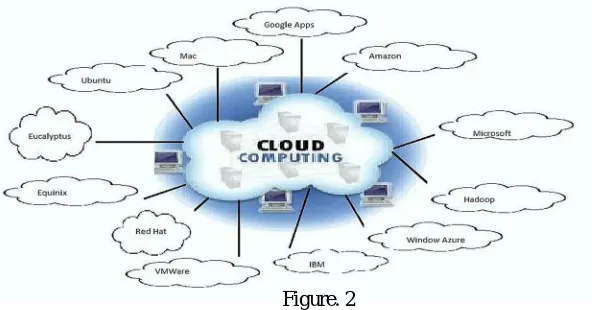
There are number of (approximate 90 in the world) Cloud Companies such as Amazon, Google Apps, Equinix, Eucalyptus, Savvis, Caspio, Bluewolf, LayeredTech, Voxeo, CloudSwitch, Nubifer, Cordys, Tropo, Cloudera, Clustercorpetc, that are works on cloud platform to make business innovations. They seem to be look like this:
Choose Cloud Provider:
Figure. 2 But here we discuss few of them.
A. Google Cloud
Google has been pushing the technological bounds of cloud computing for more than ten years [5]. Apart from the highly popular Google Search, Gmail, Chrome browser and Android OS there are various Cloud services from Google. Most of these services can be categorized under SaaS (Software as a Service) and are free. It referred to as "on-demand software. A few, like Google Maps, are free only for non-commercial use [6].
Google Cloud provides lots of services such as Google Public DNS, Google Profile, Google +1, Google Docs, Google Cloud Print, iGoogle, Blogger, Google App Engine (GAE) and many more.GAE used more in these days. It is explain as below:
[image:3.612.147.443.418.573.2]With App Engine, there are no servers to maintain: You just upload your application, and it's ready to serve your users [7]. GAE provides a powerful distributed data storage service that features a query engine and transactions. The datastore stores objects or entities instead of rows or records. It is strongly consistent and uses optimistic concurrency control. Now these days Google Docs is more preferable. User use Google docs to work on files anywhere and anytime. This is SaaS based. SaaS applications are often updated more frequently than traditional software. It helps in providing faster, and real-time, collaboration as it can be accessed from any connected device. Along with this it quickly analyzes and organizes data.
GAE related with certain implicit requirements for describing and identifying the app completely.
1) C.P.U. Capacity: 1GHz-16GHz
2) Memory Utilization: 1GB-10 GB
3) Instance Space: 128 MB- 1GB
4) Language Support: Java, Python
It provides 1GB of free storage space for data and information storage.
B. Windows Azure Cloud(WAC)
Windows Azure Cloud is launched by Microsoft Corporations. Today Cloud Computing is a really overloaded term then SOA [8]. SOA is Service Oriented Architecture. A service-oriented architecture is essentially a collection of services. These services communicate with each other. The communication can involve either simple data transmission or it could involve two or more services coordinating some action.
[image:4.612.177.402.341.449.2]The following figure illustrates it:
Figure.3
It is a basic service-oriented architecture. It shows a service consumer at the right side sending a service request message to a service provider at the left side. The service provider returns a response message to the service consumer. The request and subsequent response connections are defined in such a manner that it is understandable to both the service consumer and service provider.
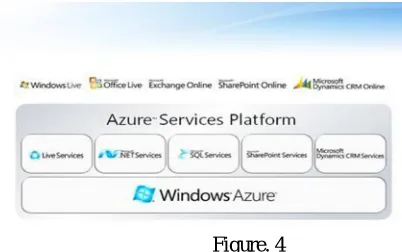
Microsoft’s cloud includes SaaS (Software-as-a-Service) offerings as shown in the top row of the below diagram, such as Windows Live and the Business Productivity Online Suite and the PaaS (Platform-as-a-Service) offering currently branded as the Azure Services Platform [8].
Figure. 4
[image:4.612.182.383.551.677.2]complexities of the systems automation and management operations on a network of globally distributed data sources. It deals with GC (Gladinet Cloud) which is further subdivided into two parts.
1) GCD ( Gladinet Cloud Desktop) access cloud storage like a local drive and backup of files, folders and email to any cloud storage service. It sync data across multiple computers using any cloud storage and secure your cloud storage with military grade encryption [9] .
2) GCS ( Gladinet Cloud Server) attach Cloud storage to your file server and protect your file, database and mail server with cloud backup It access cloud storage using CIFS/NFS with AD integration and securely access your file server anywhere with GC [9].
WAC relates with certain aspects of implicit requirements and specifications which are refer as below:
a) C.P.U. Capacity: 1GHz-8*1.6 GHz
b) Memory Utilization: 768MB-14GB
c) Instance Space: 20GB-2040 GB
d) Language Support: VB.NET, C#, PHP
C. Amazon Cloud(AC)
Amazon Cloud is describe by using certain set of instances may be little, small or large. The amount of CPU that is allocated to a particular instance is expressed in terms of these S3 and EC2 Compute Units. Amazon S3 is storage for the Internet. Data stored in Amazon S3 is secure by default. Amazon Elastic Compute Cloud (Amazon EC2) is a web service that provides resizable compute capacity in the cloud. It deals with certain set of services such as elasticity, flexibility, reliability, auto scaling etc. EC2 and S3 are designed to make web-scale computing easier for developers [10].
Amazon Cloud is refers to ACD (Amazon Cloud Drive). ACD defines as your personal hard drive in the cloud and stores music, videos, photos, and other documents on Amazon's secure servers. The files stored in ACD are secure even the computer crashes, or is lost or stolen.
Amazon Cloud based upon straining in a cloud. For better performance path-finder window option is generated for faster pulling of songs and albums for uploading and naming the files.
This AC depends upon explicit set of specifications:
1) C.P.U. Capacity: 1GHz-20*3.2GHz
2) Memory Utilization: 1.7 GB-7GB
3) Instance Space: 160GB-1690GB
a) Language Support: Any
Fig.6 It provides 5GB of free storage space.
D. Ubuntu Enterprise Cloud
foundation on which we will offer an integration of best of breed Open Source tools [11]. Eucalyptus works on IaaS (Infrastructure as a Service) style private and hybrid clouds. Designing for EC2 assures on-demand deployment and scalability, two key benefits of cloud computing. BUT requires new appliance architecture.UEC is perfect match for EC2.EC2 is public cloud and UEC is private cloud.
Ubuntu will help you to construct your own cloud for internal usage or like a cloud support for other users. Products and solutions, such as Ubuntu Server, are completely optimized to operate on both private and public cloud infrastructures. Ubuntu Cloud offers immediacy and elasticity in your IT infrastructure.
The various aspects of UEC refers as :
1) C.P.U. Capacity: 1GHz-2*2GHz
2) Memory Utilization: 512 MB-2GB
3) Instance Space: 40GB-200GB
4) Language Support: Linux
II. COMPARISON BETWEEN VARIOUS CLOUDS
Cloud computing is a new and rapidly growing technology, allowing user to use applications or store files through the internet without having to store them on the physical computer. On the basis of above mention data and information the comparison of various Clouds are to be considered.
This is to be shown by taking their Input/output performance which is shown below graphically: Input/Output Performance
Fig.7
This graph indicates that the performance of GAE is start from low level and moves towards high level on the basis of their specifications. The Amazon cloud indicates the flow from moderate level to first high level than to moderate level and again final level. This shows the variation of functionality perform by it.WAC relies the path start from lower level to moderate and finally shows its performance to peak level. Last but not the least the Ubuntu Cloud describes the flow in the positive sense means moderate to high level.
III.CONCLUSION
REFERENCES
[1] "J. Octavio Gutierrez-Garcia, Kwang-MongSim”, “Self-Organizing Agents for Service Composition in Cloud Computing" 2nd IEEE International Conference on Cloud Computing Technology and Science
[2] R. Buyya, “Market-Oriented Cloud Computing: Vision, Hype, and Reality of Delivering Computing as the 5th Utility”, Proc. of 9th IEEE/ACM International Symposium on Cluster Computing and theGrid (CCGRID’09), Shanghai, China, May, 2009, pp. 1, doi:10.1109/CCGRID.2009.97.
[3] "M. SuhailRehman, Majd F. Sakr",Initial Findings for Provisioning Variation in Cloud Computing, 2nd IEEE International Conference on Cloud Computing Technology and Science.
[4] “Amazon Elastic Compute Cloud (Amazon EC2) “http://aws.amazon.com/ec2/
[5] “Advantages of Google's cloud – Google Apps”www.google.com/apps/intl/en/business/ cloud.html
[6] “30 + Google Cloud Computing Services for You |Cloud Computing” www.techno-pulse.com/2011/.../google-cloud-computing-services.html [7] “What Is Google App Engine? - Google Code”code.google.com/appengine/docs/whatisgoogleappengine.html
[8] “Cloud Computing and the Microsoft Platform-Architecture + Strategy –Site Home-MSDN Blogs” [9] “GLADINET - Cloud Storage Access Platform & Solutions.html.
[10] “Amazon Web Services (Amazon S3, Amazon EC2).htm”