© 2015, IRJET ISO 9001:2008 Certified Journal
Page 2467
Study the Effects of Rice Bran Oil Methyl Ester on Performance and
Emission Characteristics of Agriculture Diesel Engine
Pinkesh R. Shah
Lecturer, Mechanical Department, Government Polytechnic, Ahmedabad, Gujarat, India
---***---Abstract -
Rapid escalation of fuel prices, shortage ofconventional petroleum fuel and depleting
hydrocarbon fuel reserves of the world have forced us to look for alternative fuels which can meet the ever
increasing demands of energy and also
environmentally accepted. Among the various alternative fuels, vegetable oil is a better option for diesel engine due to several advantages as renewable, environ- friendly and produced easily in rural areas. However, direct use of vegetable oil creates some durability problems so it is better to use it after converting into biodiesel as biodiesel (B.D.) is receiving increased attention as an alternative, non-toxic, biodegradable and renewable diesel fuel. Among various vegetable oils, rice bran oil is an underutilized non-edible vegetable oil which is available in large quantities in rice cultivating countries like India and a very little research has been done to utilize this oil as a replacement for mineral diesel. This introductory paper highlights the effects of rice bran oil methyl ester (RBOME) on performance and emission characteristics of agricultural diesel engine. The test was carried out on single cylinder water cooled DI diesel engine at constant speed by varying brake power with different blends of RBOME-diesel in proportions of 10%, 20%, 50% and 100% by volume of RBOME into diesel and the results were compared with diesel fuel. The transesterification process was adopted to yield RBOME and physical properties were measured to correlates the test results. The test results showed that 20% (by volume) blend of RBOME-diesel shows lower smoke, CO, HC and NOx emissions in addition to higher thermal
efficiency as compared to diesel fuel. Finally, it is concluded that while operating the engine on rice bran oil methyl ester, performance and emission parameters were found to be very close to mineral diesel for lower blend concentrations. However, for higher blend concentrations, performance and emissions were observed to be marginally inferior.
Key Words:
Rice bran oil, transesterification, diesel
engine,
performance
characteristics,
emission
characteristics
1. INTRODUCTION
Garg H. P. [1] has reported that India faces two major challenges namely energy crisis and environmental degradation. In order to meet more stringent emission norms, there is a significant pressure on automotive industries, parts manufacturers and researchers to update the current engine to meet the emission standards. Different strategies like lean burn engine, MPFI system, EGR, secondary air, LHC (Lower heat combustion), wire mesh filter, catalytic coating of piston and combustion chamber, three way catalytic converter, duel fuel mode, split injection and alternative fuels are available up to a certain extent but each technology has certain limitations of modifications in existing engine or use of advanced technology. India imports about 2/3rd of its petroleum
requirements every year, which involved a cost of approximately Rs. 80,000 crores in foreign exchange. Even 5% replacement of petroleum fuel by bio-fuel can help India to save Rs.4000 crores per year in foreign exchange [2]. Thus, among these techniques, vegetable oil is receiving more interest of researchers as it does not require engine modifications.
© 2015, IRJET ISO 9001:2008 Certified Journal
Page 2468
is receiving increased attention in India as it can be usedas an alternative, non-toxic, biodegradable and renewable diesel fuel.
1.1 Why Rice-bran Oil?
Among these vegetable oils, rice bran oil can be used as CI engine fuel because rice is one of the major crops cultivated in India. Subramani et al. [5] reported that crude rice bran oil (CRBO) with higher (more than 3%) free fatty acid (FFA) content is not suitable for eating purposes. As the second largest producer of rice in the world, India has a great potential to produce rice bran oil and it does not require any special cultivation since it is a bi-product of the rice milling process. It is obtained through the polishing of the rice grain contains 15-23% lipids and thus, if the by-products are derived from the crude rice bran oil and the resultant oils used as a feedstock for producing biodiesel, the resulting biodiesel could be quite economical and affordable. Also, the methyl esters of rice bran oils do not require any modification of existing engine hardware.
Singh et al. [6] has reported that in spite of an annual production of 91 MMT rice grain with a theoretical potential of 1.2 MMT rice bran oil, the estimated production was only 0.7 MMT in 2004-05 as per Solvent Extractors Association of India. If 80 percent rice bran oil is utilized as oil extraction, extra 0.5 MMT rice bran oil may be available for 10 percent replacement of diesel in agriculture sector of India. Rice bran oil, a renewable vegetable oil, is produced during the rice milling process, has the ability to replace diesel as a diesel engine fuel in its pure and blended forms [7]. The problems of high viscosity, low volatility and polyunsaturated character of rice bran oil can be overcome by converting the rice bran oil into methyl esters by transesterification process which
eliminate operational and durability problems
economically.
1.2 Need for Transesterification
Crude rice bran oil when used for long hours may choke the fuel filter and problem of cold starting because of high viscosity. Injector coking, sticking piston rings, heavy deposits in the engine and polymerization of the lubricating oil are other problems when rice bran oil used directly in the diesel engine in addition to problems of higher fuel consumption, lower thermal efficiency,
blow-by-losses and higher exhaust emissions [8].
Sundarapandian et al. [9] reported that after esterification of the vegetable oil its density, viscosity, cetane number, calorific value, atomization and vaporization rate, molecular weight, and fuel spray penetration distance are improved. Several processes for biodiesel fuel production have been developed, among which transesterification using alkali-catalysis gives high levels of conversion of
triglycerides to their corresponding methyl esters in short reaction times. This process has therefore been widely utilized for biodiesel fuel production in a number of countries [10].
Sinha S. et al. [11] investigated transesterification process with the objective of producing high quality biodiesel from rice bran oil by optimizing various process variables like temperature, catalyst concentration, amount of methanol and reaction time. The optimum conditions were found to be 55 °C reaction temperature, 1 h reaction time, 9:1 molar ratio and 0.75% catalyst (w/w) to yield maximum biodiesel. Similar kind of results were obtained by Lin L. et al. [12] in which optimum conditions were found to be 60 °C reaction temperature, 60 min. reaction time, 6:1 molar ratio and 0.9% KOH (w/w) to yield maximum biodiesel. The consequent engine test showed a similar power output compared with regular diesel at the cost of higher consumption rate but remarkably decrease in CO, HC and PM whereas increase in NOx emissions. A study
was undertaken by Siti Z. et al. [13] to examine the effect of temperature, moisture and storage time on the accumulation of free fatty acid in the rice bran oil and showed that more than 98% FAME in the product can be obtained in less than 8 hrs by two-step methanolysis reaction.
1.3 Literature Review on Bio-diesel in Engine
Experimental investigations were carried out with various blends of biodiesel (rice bran methyl ester) and diesel ranging from 5% to 50% ester by Agarwal A. et al. [14] on a four cylinders, transportation diesel engine to study the performance and emission and it was found that biodiesel significantly lower the emissions of harmful species from diesel engines without jeopardizing the engine performance. Agarwal D. et al. [15] concluded that process of transesterification is found to be an effective method of reducing vegetable oil viscosity and eliminating operational and durability problems after evaluating performance and emission characteristics of linseed oil, mahua oil, rice bran oil and linseed oil methyl ester (LOME) in a diesel engine. Syed S. et al. [16] reviewed the biodiesel production, combustion, emissions and performance of various types of vegetable oils.
Saravanan S. et al. [17] attempt was made to test the feasibility of producing biodiesel (CRBME) from high free fatty acid (FFA) crude rice bran oil (CRBO) by a two-step transesterification process and experimental results showed that CRBME blend has significantly reduced CO, UBHC and particulate emission than diesel with a marginal increase in NOx emissions. The blending of rice bran oil
© 2015, IRJET ISO 9001:2008 Certified Journal
Page 2469
emissions of the diesel engine. Agarwal D. et al. [19]showed that application of EGR with biodiesel blends resulted in reductions in NOx emissions without any
significant penalty in PM emissions or BSEC. Use of advanced “Fuel-cat” technology with rice bran oil was investigated in our earlier work to improve the performance and emission characteristics of diesel engine [20].
The objective of current research work is to investigate the effects of rice bran oil methyl ester (RBOME) on performance and emission characteristics of agricultural single cylinder diesel engine and compare the results with diesel as base fuel. It is my extended work of biodiesel production from rice bran oil by optimizing various process variables to produce high quality biodiesel with maximum yield [21].
2. EXPERIMENTAL SET-UP AND PROCEDURE
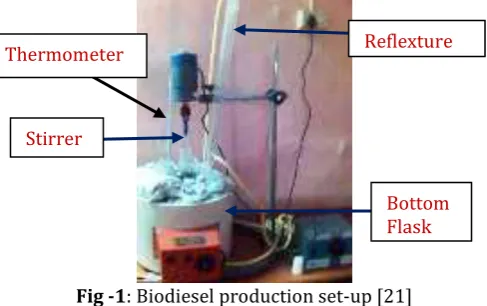
The transesterification process for production of rice bran oil methyl ester (RBOME) has been investigated earlier [21] using methanol in the presence of sodium hydroxide (NaOH) catalyst as shown in Figure 1. The various process variables like temperature, catalyst concentration, amount of methanol and reaction time were optimized with the objective of producing high quality rice bran oil biodiesel with maximum yield. The optimum conditions for transesterification of rice bran oil with methanol and NaOH as catalyst were found to be 55 °C reaction temperature, 90min. reaction time, 9:1 molar ratio of rice bran oil to methanol and 0.65% catalyst (w/woil). Rice
bran oil methyl ester thus produced was characterized to find its suitability to be used as a fuel in engines as shown in Table 1.
Fig -1: Biodiesel production set-up [21]
Considering the specific features of diesel engine, a typical diesel engine that is widely used in agricultural sector was selected for present investigation. The trials were conducted on single cylinder, 4-stroke, water cooled diesel engine having rated speed of 850 rpm and rated power of 8.0 H.P. with rope brake dynamometer located at L. D.
College of Engineering Ahmedabad as shown in the Figure 2.
[image:3.595.308.561.133.320.2]
Fig -2: Experimental set-up
[image:3.595.301.568.390.559.2]2.1 Test Fuel Characterization
Table -1: Physical properties measured of test fuels
Properties Unit Diesel
Rice Bran Methyl Ester
Standard Value Biodiesel BIS:15607
Density(27ºC) g/cm3 820 865 860-900
Flash point ºC 78 95 120
Kinematic Viscosity (40
ºC) cst 3.18 5.32 2.5-6.0
Cetane No. --- 48 50 45MIN
Net calorific
Value (MJ/Kg) 42.5 39.5 40
2.2 Instrumentations and Test Procedure
The rice bran oil methyl ester and diesel were blended by volume in different proportions as 10:90 (10-B), 20:80 (20-B), 50:50 (50-B) and 100:0 (100-B) where B denotes for biodiesel. The diesel and rice bran oil methyl ester (RBOME) were abbreviated as ‘D’ and ‘B’ respectively in this study. The fuel consumption was measure by burette and stopwatch volumetric flow rate method. The speed was measured by tachometer. The temperature was measured by digital thermometer. Density was determined by Density-meter/Hydrometer. The viscosity was measured by viscosity meter. The flash point was measured by cone type test cup and calorific value was determined by bomb calorimeter. The cetane number was Reflexture
Stirrer
Bottom Flask
flask
[image:3.595.39.283.514.667.2]© 2015, IRJET ISO 9001:2008 Certified Journal
Page 2470
measured by aniline point and diesel index method asexplained in detail in thesis [22].
The engine was operated on diesel first and then followed by rice bran oil methyl ester-diesel blends in chronological order as 10-B, 20-B, 50-B and 100-B (v/v) from no load to overload in the step of 20 % and the results were compared with diesel for performance and emissions parameters such as thermal efficiency, CO, HC, Smoke Opacity and NOx emissions. The parameters to be recorded
for all the fuels tested were fuel flow rate, engine speed, brake load, temperature and the performance parameters were calculated from their fundamental relations.
3. RESULTS AND DISCUSSION
The experimental investigation was carried out to study the performance and exhaust emissions of various blends of rice bran oil methyl ester (RBOME) at different loads on the diesel engine and the results were compared and discussed as follows:
3.1 Emission Characteristics
Smoke opacity
Chart -1: Comparison between diesel and different blends of RBOME for smoke density
Chart 1 illustrates the comparison between diesel and different blends of RBOME for smoke density and it can be seen that smoke opacity increases with increase in brake power for all the fuels tested. It is observed that 10-B and 20-B shows lower smoke density whereas 50-B and 100-B shows higher smoke than diesel. The higher smoke may be due to poor atomization because of its heavier molecular structure and higher viscosity. 20-B gives smoke opacity 25 % less as compared to that of neat diesel fuel at higher load conditions among all tested fuels due to presence of oxygen in structure of rice bran oil supports the combustion in addition to lower viscosity because of lower concentrations of rice brain oil methyl ester into diesel. Also, the higher cetane number of RBOME shorten the
ignition delay and increases the diffusion burning phase so more time is available for carbon particles to react with oxygen resulting in lower smoke density.
Carbon Monoxide (CO)
Chart -2: Comparison between diesel and different blends of RBOME for CO emission
Chart 2 illustrates the comparison between diesel and different blends of RBOME for CO emission and it can be seen that CO emissions decrease initially with increase in load and then increases sharply at higher load for all tested fuels. It is observed that CO emission is reduced by 30% for 100-B (RBOME) and 20-B shows highest reduction in the range of 30% - 50% throughout the load as compared to diesel among all tested fuels due to presence of fuel bound oxygen supports the combustion process. Also, the higher cetane number of RBOME shorten the ignition delay and increases the diffusion burning phase so more time is available for carbon particles to react with oxygen resulting in complete combustion and thus lower CO.
Hydrocarbons (HC)
© 2015, IRJET ISO 9001:2008 Certified Journal
Page 2471
Chart 3 illustrates the comparison between diesel anddifferent blends of RBOME for HC emission and it can be seen that the unburned hydrocarbons (HC) emissions displaying no definite trend. The concentration of HC is decreased by about 15 % to 20 % for 100-B up to 80 % load when compared to neat diesel fuel. The drastic increase of HC emissions at higher load is due to higher viscosity and poor volatility which may lead to poor mixing of the fuel with air and caused more hydrocarbon emission at room temperature. HC emission for 20-B is significantly lower by about 25 % to 30 % in general than that of neat diesel fuel at all loads due to complete combustion because of lower viscosity in addition to oxygen presence supports the combustion.
Oxides of Nitrogen (NOx)
Chart -4: Comparison between diesel and different blends of RBOME for NOx emissions
Chart 4 illustrates the comparison between diesel and different blends of RBOME for NOx emissions and it can be
seen that oxides of nitrogen (NOx) emissions increases
with increase in brake power for all tested fuels. It is observed that 50-B and 100-B shows 10% to 30% higher NOx emissions in general as compared to diesel due to
fuel-borne oxygen in its structure together with higher combustion temperatures favour production of more NOX
than diesel fuel. On the other hand, 10-B and 20-B emits lower NOx emissions than diesel at part load due to lower
viscosity and volatility because of higher flash point leading to poor spray characteristics and thus lower heat release rate and lower combustion temperature. The 10-B and 20-B shows higher NOx emissions at higher load
conditions than diesel. Rice bran oil methyl ester is an oxygenated fuel and it undergoes improved combustion in the engine due to the presence of molecular oxygen which also leads to higher NOx emissions.
3.2 Performance Characteristics
Brake Thermal Efficiency (BTE)
Chart -5: Comparison between diesel and different blends of RBOME for brake thermal efficiency
Chart 5 illustrates the comparison between diesel and different blends of RBOME for thermal efficiency and it can be seen that brake thermal efficiency increases with increase in brake power and become maximum at full load and then start to decrease at over load. It is observed that 100-B (RBOME) shows 6% lower brake thermal efficiency than diesel fuel at full load due to the combined effect of lower calorific value and higher density because more fuel is consumed to get the same power. However, the BTE for 10-B and 20-B are more or less nearer to diesel fuel at full load condition but the BTE for B20 is found about 5% higher than that of neat diesel at part load conditions due to the additional lubricity provided by RBOME.
4. CONCLUSIONS
From the experimental results, it can be concluded that the rice bran oil methyl ester i.e. 100-B produces higher smoke, HC and NOx emissions in addition to lower thermal
efficiency as compared to diesel fuel but 20% (by volume) blend of RBOME-diesel shows lower smoke, CO, HC and NOx emissions in addition to higher thermal efficiency
than diesel fuel. On the whole it may be concluded that 20% RBOME-diesel blends can be used in existing diesel engine without any engine modifications besides giving good performance characteristics and even better results in emission level remarkably.
ACKNOWLEDGEMENT
© 2015, IRJET ISO 9001:2008 Certified Journal
Page 2472
of Khushbu Petro-chem R & D Centre, Ahmedabad forproviding testing facility.
REFERENCES
[1] G. H.P., “Case for ethanol fuel economy in India,”
http://www.techno-preneur.net/timeis/technology/STMarchApril02/Et hanol.html, 2002. .
[2] Dr. B. Sengupta, “Central Pollution Control Board,” Delhi – 32, 2005.
[3] Agarwal A. K., “Vegetable oils versus Diesel fuel: Development and use of biodiesel in a compression ignition engine,” TERI Inf. Dig. Energy, vol. 8, pp. 191–204, 1998.
[4] Mustafa Balat and Havva Balat, “A critical review of bio-diesel as a vehicular fuel,” Energy Convers. Manag., vol. 49, no. 10, pp. 2727–2741, 2005. [5] G. L. N. Subramani Saravanan, G. Nagarajan, “Effect
of FFA of Crude Rice Bran Oil on the properties of Diesel Blends,” J. Am Oil Chem. Soc, vol. 85, no. 663– 666, 2008.
[6] T. K. B. and M. P. S. Singh Jayant, T.N. Mishra, “Emission Characteristics of Methyl Ester of Rice bran oil as fuel in compression ignition engine,” Int. J. Chem. Bimolecular Eng., vol. 1, no. 2, pp. 36–67, 2008.
[7] R. K. Rao GLN, Saravanan S, Sampath S,
“Combustion characteristics of a direct injection diesel engine fuelled with rice bran oil and its blends,” in Proceedings of the nineteenth national conference on I.C. engines and combustion, 2005, pp. 415–418.
[8] Goel Mukul, “study of the performance and emission characteristic of a diesel engine with diesel and transestrified jatropha biodiesel blends,” IIT Delhi, 2005.
[9] Sundarapandian S. and G. Devaradjane,
“Performance and Emission Analysis of Bio Diesel Operated CI Engine,” J. Eng. Comput. Archit., vol. 1, no. 2, 2007.
[10] H. N. Hideki Fukuda, a, Akihiko Kondob, “Biodiesel fuel production by transesterification of oils,” J. Biosci. Bioeng., vol. 92, no. 5, pp. 405–416, 2001. [11] S. G. Shailendra Sinhaa, Avinash Kumar Agarwala,
“Biodiesel development from rice bran oil: Transesterification process optimization and fuel characterization,” Energy Convers. Manag., vol. 49, no. 5, pp. 1248–1257, 2008.
[12] S. V. Lin Lina, Dong Yinga, Sumpun Chaitepb, “Biodiesel production from crude rice bran oil and properties as fuel,” Appl. Energy, vol. 86, no. 5, pp. 681–688, 2009.
[13] Y.-H. J. Siti Zullaikah, Chao-Chin Lai, Shaik Ramjan Vali, “A two-step acid-catalyzed process for the production of biodiesel from rice bran oil,”
Bioresour. Technol., vol. 96, no. 17, pp. 1989–1996, 2005.
[14] A. Sinha, S. and Agarwal, “Performance Evaluation of a Biodiesel (Rice Bran Oil Methyl Ester) Fuelled Transport Diesel Engine,” SAE Int. J., vol. 2005–01– 17, pp. 1–9, 2005.
[15] A. K. A. Deepak Agarwala, Lokesh Kumarb, “Performance evaluation of a vegetable oil fuelled compression ignition engine,” Renew. Energy, vol. 33, no. 6, pp. 1147–1156, 2008.
[16] S. J. Syed Ameer Basha, , K. Raja Gopal, “A review on biodiesel production, combustion, emissions and performance,” Renew. Sustain. Energy Rev., vol. 13, no. 6–7, pp. 1628–1634, 2009.
[17] S. S. S. Saravanana, G. Nagarajanb, G. Lakshmi Narayana Raoc, “Feasibility analysis of crude rice bran oil methyl ester blend as a stationary and automotive diesel engine fuel,” Energy Sustain. Dev., vol. 13, no. 1, pp. 52–55, 2009.
[18] G. V. S. and K. R. Gopalb, “An Experimental Investigation on the Performance and Emission Characteristics of a Diesel Engine Fuelled with Rice Bran Biodiesel and Ethanol Blends,” Int. J. Green Energy, vol. 8, no. 2, pp. 197–208, 2011.
[19] A. K. A. Deepak Agarwala, Shailendra Sinhab, “Experimental investigation of control of NOx emissions in biodiesel-fueled compression ignition engine,” Renew. Energy, vol. 31, no. 14, pp. 2356– 2369, 2006.
[20] P. Shah, D. Gor, D. Shah, “Experimental Investigations to Improve the Performance and Emission Characteristics of Diesel Engine Operatin on Rice Bran Oil Using Advanced ‘Fuel-Cat’ Technology,” in Internationa Conference on Advances in Energy Research (ICAER) 2009, IIT Bombay, 2009, pp. 1–9.
[21] P. Shah, S. Bhatt, D. Shah “Recent Advancement in Use of Bio-diesel (Methyl Ester) from Rice Bran Oil as Fuel for Diesel Engine,” in Proceedings of Renewable Energy Sources In India challenges & strategies, Jodhpur, 2009.