© 2016, IRJET | Impact Factor value: 4.45 | ISO 9001:2008 Certified Journal | Page 1047
HARMONY SEARCH ALGORITHM BASED OPTIMAL PLACEMENT OF
STATIC CAPACITORS FOR LOSS REDUCTION IN RADIAL DISTRIBUTION
NETWORK
NEHA GOYAL1, PUSHPENDRA SINGH2
[1] Student, [2] Assistant Professor in Department of Electrical and Electronics Engineering
Government Women Engineering College, Ajmer-305002, Rajasthan, India
Abstract - This paper presents a metaheuristic Harmony Search Algorithm for optimal location of capacitor in radial distribution system, for improving the voltage profile and to trim down of power losses. HS algorithm is a music based optimization algorithm inspired by music extemporisation process. The present work is followed by to determine the best locations and proper sizes of capacitors with different load levels using a Harmony Search algorithm. Execution of the HS Algorithm for its multifunction potentiality is one of the dignified characteristics for optimal capacitor placement in distribution system. To assert the effectiveness of the proposed algorithm, it is tested on IEEE 69-bus radial distribution networks.
Key-Words: Harmony Search Algorithm, bus voltage control, Power System, Capacitor Placement, optimization techniques, load levels.
1. INTRODUCTION
Distribution system sustained from two starring problems, poor voltage regulation and high power losses. Losses are defined as the difference between energy input in the system and the energy utilized by the end users. Its fact that electrical energy generated is not equal to the energy used by the consumers. Due to distribution network some percentage of energy is lost.
The major amount of losses is in primary and secondary distribution network, therefore the distribution system must be planned properly to ensure within limits.
To reduce the power losses and to increase the voltage profile shunt static capacitors over a great extent are used in distribution system to increase the system capacity [1]. Thus [2], the placement of capacitor at appropriate location and of proper size is becoming important to
increases saving form the loss reduction trough proper instalment. Optimally placement of capacitors in power system is determined by
many techniques such as: numerical
programming, analytical method, artificial intelligence, heuristic techniques, etc.
Meta heuristic optimization algorithm eliminates some previously mentioned difficulties, it means to find out improved solution by “trial and error” to lesser extent computational time and quickly replace the classical method in solving practical optimization problem.
Several Meta heuristic algorithms have been proposed during last few decades, these algos are Particle Swarm Optimization, Genetic Algorithm, Tabu Search, Ant colony, Bee colony, Harmony Search Algorithm. The HS algorithm is the recently developed optimization algorithm in 2001 by Geem et al. [3]. HS algorithm is music based optimization technique inspired by music improvisation process. Among these methods in solving the optimal placement of capacitor are solved by heuristic based techniques. Grainger and Lee [4] were expressed the place and capacity of capacitor as continues variable based on non linear programming. Duran et al. [5] consider the size of capacitor as a discrete variable and employed dynamic programming, whereas, Maxwell [6] suggests several benefits
of capacitor placement include: (1.) Reduced I2X
losses and energy losses. (2.) Reduced regulation cost. (3.) Reduced kVA input to feeder. (4.) Reduced I2R losses.
© 2016, IRJET | Impact Factor value: 4.45 | ISO 9001:2008 Certified Journal | Page 1048 categorised as nonlinear integer optimization
with both potential capacitor size and location discrete. [8] GA are used to minimize simplifying assumptions for optimal location of capacitor in unbalanced multi-convertor distribution system. This paper pressie Harmony Search Algorithm for optimal size and place for capacitor in radial distribution system. HS algorithm has several advantages in which it can handle both continues and discrete variables and it does not require initial value setting for decision variable. R. Sirjani [9] uses Harmony Search Algorithm successfully to arranged capacitor optimally in radial distribution systems.
In this paper HS algorithm [10] has been proposed to solve the network reconfiguration problem in the presence of capacitor. This HS algorithm is well tried on 69-bus radial distribution system.
2. PROBLEM FORMULATION
In power system Electrical power loss is an important issue. Assorted ideas have been proposed for reduction of losses. By using Newton Raphson load flow analysis the location and size of capacitor in distribution system is to be determined to compute the power losses. To identifying the size and location of capacitor meta-heuristic algorithm i.e. HS Algorithm is used.
Power flow equations of distributed
system are computed as [11]. Objective function
»Minimization =
= Real power flowing out of bus r. = Reactive power flowing out of bus r.
= Real power flowing out of bus r after reconfiguration.
= Reactive power flowing out of bus k after reconfiguration.
= Real power flowing out of bus r+1. = Reactive power flowing out of bus r+1.
Total power loss of the feeder = Voltage at bus r.
(1) =
(2) =
=
(3)
The power loss in the line connecting k and k+1 may be computed as
(4)
Power loss equation:
(5)
3. HARMONY SEARCH ALGORITHM
The Harmony Search algorithm is simple in concept, easy in execution, and few in parameters. It has been very successful for a panoramic variety of optimisation job, exhibit various advantages with respect to traditional optimisation techniques. HS algorithm was lately developed in an analogy with harmony improvisation process in which music players improves the pitch to get the better harmony. The steps for HS algorithm are:
Step i. Initialize the problem and
parameters.
Step ii. Initialize the harmony memory.
Step iii. Improvise the new harmony.
Step iv. Update harmony memory.
© 2016, IRJET | Impact Factor value: 4.45 | ISO 9001:2008 Certified Journal | Page 1049 These steps are described in next five sub
sections:
a. Initialize the problem and parameters: Optimization problem are specified as follows:
Minimize F(x); subject to ;
i = 1,2,3,4,...,N (6)
Whereas, F(x) is an objective function, and x is the set of each design variable (xi), and Xi is the set of the possible scope of values for each and every design variable {Lxi <Xi <Uxi} and N is the number of design variables. Here, the HSA parameters are also specified are: the number of solution vectors in the harmony memory or harmony memory size (HMS); (HMCR) harmony memory considering rate; pitch adjusting rate (PAR); (N) number of decision variables; number of improvisations (NI) and the termination criterion.
b. Initialize the harmony memory:
The HM Matrix filled with randomly generated solution vector. Solution vectors are sorted by values of a objective function.
H.M.s =
. . . . .
(7)
c. Improvise the new harmony:
New Harmony vector, x′, is generated based on a
three rules, namely: random selection, harmony memory consideration rate (HMCR) and pitch adjustment rate (PAR). These rules are delineated as follows:
Stochastic selection: When Harmony Search determines the value, xi′ for the
new harmony, x′ = ( ); it
arbitrarily picks some value from the total
value range with a probability of
(1-HMCR). Random selection is used for just
preceding memory initialization.
Memory consideration: It is used to choose the value for a identified element of the new vector from the nominative HM range.
with
probability HMCR (8) with probability (1-HMCR) (9)
Pitch adjustment: It is used to adjust the values of the New Harmony vector
obtained (between PARmin and
PARmax). (bw:- band width alter between a higher value and a lower value from first iteration to the last and ultimate iteration)
(10)
Find the fitness values related to the New Harmony generated and pitch adjusted
d. Update harmony memory:
Newly generated harmony vector (x') is estimated in terms of the target function value. If
the targeted functionvalue for the new harmony
vector is better than the targeted function value for the inferior harmony in the harmony
memory, then the bran-newharmony is inclosed
in the HM, and the existing inferior harmony is excluded from the HM.
e. Check the termination standards:
If the termination standards are satisfied, computation is terminated. Otherwise, Steps iii and iv are repeated.
4. RESULTS
© 2016, IRJET | Impact Factor value: 4.45 | ISO 9001:2008 Certified Journal | Page 1050 system. The HSA is then compared with Genetic
[image:4.595.319.550.160.335.2]Algorithm. In the network sectionalize switches are numbered from 1 to 68 and tie-switches are 69 to 73. Line and load data are taken from [12]. The HSA parameters are HM size = 50, PAR = 0.7, HMCR = 0.95, Max. Iter = 800, used in simulation of network. As a result reactive power is compensated by optimal capacitor placement, power factor of the system meliorate. Therefore, both the energy losses & power losses get trims. Following data is incur from load flow programme on MATLAB are carried on a computer with Intel core i-3, 2.50 GHz, and 2.0 GB RAM.
Table-1: Simulation Result of 69-Bus
Method Without
Capacitor
HSA
Switch
opened 69, 70, 71, 72, 73 11, 13, 20, 58, 61 Power losses
(MW) 0.3539 0.2425
Loss reduction
--- 0.1114
% loss
reduction --- 31.57%
Location of capacitor
(bus number)
--- 11,
61, 65
Size of capacitor
(MVAr)
--- 0.3606,
0.8801, 0.3200 % voltage
profile improvement
[image:4.595.319.539.500.669.2]--- 2.32%
Table 1: shows the losses and % voltage profile improvement after and before optimal placement of capacitor using Harmony Search Algorithm. When the optimal capacitor is not placed in radial distribution system the losses are 0.3539MW. Here, the result is obtained after 10 runs and each run completed in 288.61 seconds, get the capacitor location at bus number 11, 61, 65 of value 0.3606, 0.8801,
0.3200 MVAr, therefore minimum power loss is 0.2425 MW; hence, power loss reduction is about 31.57% after placing the capacitor of proper size and at optimal location.
0 10 20 30 40 50 60 70
0.93 0.94 0.95 0.96 0.97 0.98 0.99 1
Bus Number
v
o
lt
a
g
e
(
p
u
)
Voltage profile improvement
without capacitor with capacitor (HSA)
Chart - 1: Voltage Profile Improvement.
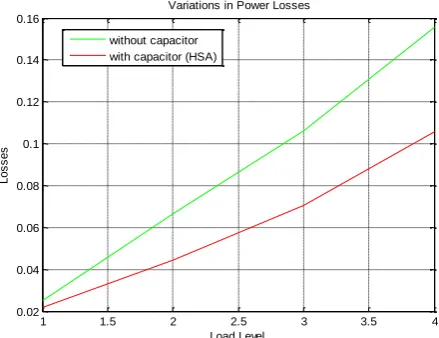
The voltage profile curves of four load conditions are shown, respectively. The configuration of voltage profiles at all load levels are nearly the same except insignificant change in voltage magnitude. Voltage uprises by the help of optimal capacitor placement. Results are obtained for 69 bus radial distribution system, are better after placing capacitors.
1 1.5 2 2.5 3 3.5 4
0.02 0.04 0.06 0.08 0.1 0.12 0.14 0.16
Load Level
L
o
s
s
e
s
Variations in Power Losses
without capacitor with capacitor (HSA)
Chart - 1: Variations in Power Losses
© 2016, IRJET | Impact Factor value: 4.45 | ISO 9001:2008 Certified Journal | Page 1051 emplacement and size of capacitor is an
significant aspect to trim down the power losses of the system.
5. CONCLUSION
An approach integrate the practise of HSA has been shown in this paper to ascertain the optimal emplacement and size of capacitors to place in a distribution system at impulsive load level. To trim down the power losses results has been obtained in IEEE 69 bus distribution system by using HS Algorithm which brings down the power losses approximately 31.57% at variant load levels. The need of the study is to reduce the power losses and heighten the efficiency of the radial distribution system.
REFERENCES
[1]R.A. Gallego, A.J. Monticelli, R. Romero,
“Optimal capacitor placement in radial
distribution networks”, IEEE Transaction on
Power Systems, Vol. 101, pp. 284-288, 1982. [2]H.M. Khodr, F.G. Olsina, P.M. De Oliveira-De
Jesus, J.M. yusta, “Maximum saving approach for location and sizing of capacitors in distribution systems”, Electric power System Research, Vol. 78, pp. 1192-1203, 2008. [3]Z.W. Geem, J.H. Kim, G.V. Longanathan, “A
new heuristic optimization algorithm: Harmony Search”, Simulation 76, pp. 60-68, 2001.
[4]J. J. Grainger and S. H. Lee, “Optimum Size and Location of Shunt Capacitors for Reduction of
Losses on Distribution Feeders”, IEEE Trans.
on Power Apparatus and Systems, Vol. 100, No. 3, pp. 1105-1118, March 1981.
[5]H. Duran et al “Optimum Number Size of
Shunt Capacitors in Radial Distribution
Feeders: A Dynamic Programming
Approach”, IEEE Trans. Power Apparatus and
Systems, Vol. 87, pp. 17643-1774, Sep 1968.
[6]M. Maxwell, “The Economic Application of
Capacitors to Distribution Feeders”, AIEE
Trans, vol.79, no. 2, pp.353-359, 1960.
[7]K. Prakash and M. Sydulu, “Particle swarm optimization based capacitor placement on
radial distribution systems”, IEEE Power
Engineering Society General Meeting, pp. 1-5, 2007.
[8]G. Carpinelli, D. Proto, C. Noce, A. Russo, P. Varilone, “Optimal allocation of capacitor in unbalanced multi-convertor distribution systems: A comparison of some fast techniques based on genetic algorithm”,
Electric Power Systems Research, Vol. 80, No.6, pp. 642-650, December 2009.
[9]R. Sirjani, A. Mohamed, H. Shareef, “Optimal capacitor placement in a radial distribution system using Harmony Search Algorithm”,
Journal of Applied Sciences, Vol.10, No.23, pp. 2996-3006, September 2010.
[10] Z. W. Geem, “Novel derivative of harmony
search algorithm for discrete design variables,” Appl. Math. Computat., vol. 199, no. 1, pp. 223–230, 2008.
[11] R. Srinivasa Rao, K. Ravindra, K. Satish, and S. V. L. Narasimham, “Power Loss Minimization in Distribution System Using Network Reconfiguration in the Presence of
Distributed Generation,” IEEE Trans. Power
Syst., vol. 28, no. 1, pp. 317-325, February 2013.
[12] R. Srinivasa Rao, S. V. L. Narasimham, M. R. Raju, and A. Srinivasa Rao, “Optimal network reconfiguration of large-scale distribution system using harmony search algorithm,” IEEE Trans. Power Syst., vol. 26, no. 3, pp. 1080–1088, Aug. 2011.
[13] Neha Goyal, Pushpendra Singh, “Optimal
Placement of Capacitors in Radial
Distribution System to Minimizes the Losses
at Variable Load Levels”, International
Journal on Recent and Innovation Trends in
Computing and Communication, Vol.2, Issue 8,
pp. 2246-2249, August 2014.
[14] Lee SH, Grainger JJ, “Optimum size and
location of shunt capacitors for reduction of losses on distribution feeders,” IEEE Trans.
On Power Apparatus and System, PAS-100(3),
© 2016, IRJET | Impact Factor value: 4.45 | ISO 9001:2008 Certified Journal | Page 1052 Neha Goyal, has
obtain degree in
Bachelor of
Technology. In
Electrical and
Electronics
Engineering from
Rajasthan Technical University, Kota in 2011. She pursuing her M.Tech In power system From Govt. Women Engg. College, Ajmer. Her area of research is Distribution system and Power Loss Minimization.
Pushpendra Singh, has obtain degree
in Bachelor of
Engg. In
Electrical from
Rajasthan University, Jaipur
in 2005.He
completed his