Optimization of Stirling Heat Pump by using Genetic Algorithm
Bhagwan Singh Dangi
1Santosh Kansal
21
ME Scholar
1,2
Department of Mechanical Engineering
1,2IET-DAVV, Indore, India
Abstract— In this research, invariable performance analysis of irreversible Stirling heat pump cycle that includes internal as well as external irreversibility. The reservoirs are considered to be of finite heat capacities. These two irreversibilities are considered simultaneously in which external irreversibility is due to the finite temperature difference between external fluid and working fluids through the heat sink and heat source and internal irreversibility is due to entropy generation and regenerative heat loss. In the present study, the input power, heating load and coefficient of performance have been evaluated using finite time thermodynamics and the above three objective functions are simultaneously optimised using multi-objective genetic algorithm (MATLAB 2015a), considering the effect of various design variables. The design variables includes for optimisation are effectiveness of heat exchanger at cold side (εC), effectiveness of heat exchanger at hot side (εH), rate of heat capacitance in heat source/sink (C) , the temperature ratio (x) and cold side temperature (TC).
Key words: Internal and External Irreversibilities; Stirling Heat Pump; Genetic Algorithm; Coefficient of Performance; Heating Load; Power Input
I. INTRODUCTION
Stirling and Ericsson cycles are one of the important cycles used for engine, refrigerator, air conditioning and heat pump systems. Stirling cycle has been utilised by various engineering applications in the construction of practical systems, like Stirling engine is used in some submarines because this engine produces very less noise thus serving its purpose for submarine which is used for secret purposes. It is also used as solar Stirling engine in some countries like New Zealand to generate electricity, it is more efficient than non-concentrated photovoltaic cells (solar panels). It works on temperature difference, so reversely it can be used for the production of desirable temperature by providing mechanical energy. In this way it can be used both as heat pump and coolers. In the recent years, remarkable attention is drawn towards Stirling engine due to noticeable advantages, for instance a lot of resources such as biomass, fossil fuels and solar energy can be applied as heat source hence various studies are presented on Stirling engine and Stirling heat pump. From the concept of finite time thermodynamics introduced by F.L. Curzon and B. Ahlborn [1] with a work on Carnot heat engine by which they show that the efficiency of an engine operating at maximum power is given by the formula [ηm = 1−√TL/TH], which is always smaller than the well known Carnot formula [ηC = 1 − TL/TH].Now a days in most of the finite time thermodynamics research work internal irreversibility did not take into account in real cycles , because of that any optimization based on it would not get results closed to the reality of Stirling engine and heat pumps. In order to get more accurate results internal irreversibility should be introduced along with external irreversibility. The
concept of internal irreversibility was first introduced by Ibrahim OM and Klein SA. The optimal performance of Stirling heat pump by means of finite time thermodynamics was implemented by Wu considering endoreversible cycle. Genetic algorithm is based on a biological evolution theory of natural selection given by Charles Darwin by which “survival of the fittest” and this concept can be applied for optimisation of mechanical systems. The non-dominated sorting genetic algorithm concept for the optimisation of Stirling engines and heat pumps was introduced by Mohammad H. Ahmadi[3].
In this paper, a detailed analysis of performance of Stirling heat pump considering both internal irreversibility as well as external irreversibility arising due to finite heat capacity of source/sink reservoirs and regenerative losses and the entropy generation within the cycles, respectively. The Stirling heat pump optimisation have been conducted using multi-objective optimisation method of Genetic Algorithm, non-dominated sorting genetic algorithm(NSGA-II).The MATLAB 2015a software is used in this research for optimisation purpose. For the optimisation of three performance objective function i.e, input power, heating load and coefficient of performance, following parameters are included as decision parameters – the effectiveness of the hot-side heat exchanger, the effectiveness of the cold-hot-side heat exchanger, the rate of heat capacitance through the heat sink and heat source, temperature ratio Th/Tc, and temperature of cold side.
II. SYSTEM DESCRIPTION
regenerator through a constant volume process. Then the process from state 3 to 4 represents isothermal compression at Th, which causes the heat sink with a finite heat capacity to gain heat and rise the temperature from TH1 to TH2. At the last from state 4 to 1working fluid rejects its heat by means of the regenerator in a volumetric process. The reservoirs (source\sink) having finite heat capacities so during isothermal processes 1-2 and 3-4 finite temperature difference and irreversibility should be considered.
Fig. 1: Stirling Heat Pump cycle Thermodynamic Analysis
During the isothermal processes, let the amount of heat added from the source at Tc is Qc, temperature of source falls from TL1 to TL2 and the amount of heat deliver to the sink at Th is Qh, temperature of the sink changes from TH1 to TH2.
𝑄ℎ = 𝑇ℎ(𝑆3- 𝑆4) =𝐶𝐻(𝑇𝐻2- 𝑇𝐻1)𝑡𝐻 (1) 𝑄𝑐 = 𝑇𝑐(𝑆2- 𝑆1) =𝐶𝐿(𝑇𝐿1- 𝑇𝐿2)𝑡𝐿 (2) Where, Entropy changes is given by
(𝑆3- 𝑆4) = nRln 𝜆1 and (𝑆2- 𝑆1) = nRln 𝜆2
Where, λ1 & λ2 are the volume ratios for the sink and source side, n is the number of mole for the working fluid and R is the universal gas constant. CH, CL are the heat capacitance rates of source/sink reservoirs and and tH, tL are the heat addition/rejection times, respectively. Also from the heat transfer theory the heat Qh and Qc will be proportional to the Log Mean Temperature Difference (LMTD), i.e.,
𝑄ℎ = 𝑈𝐻𝐴𝐻(𝐿𝑀𝑇𝐷)𝐻𝑡𝐻 (3)
𝑄𝑐 = 𝑈𝐿𝐴𝐿(𝐿𝑀𝑇𝐷)𝐿𝑡𝐿 (4)
𝑈𝐻𝐴𝐻 & 𝑈𝐿𝐴𝐿are overall heat transfer coefficient-area products and (𝐿𝑀𝑇𝐷)𝐻& (𝐿𝑀𝑇𝐷)𝐿are Log Mean Temperature difference on sink & source side, respectively, and defined as:
(𝐿𝑀𝑇𝐷)𝐻 = 𝑈𝐻𝐴𝐻[𝜃1−𝜃2 ln𝜃1
𝜃2
⁄ ] (5)
where, 𝜃1= 𝑇ℎ− 𝑇𝐻1 and 𝜃2= 𝑇ℎ− 𝑇𝐻2 (𝐿𝑀𝑇𝐷)𝐿 = 𝑈𝐿𝐴𝐿[𝜃3−𝜃4
ln𝜃3 𝜃4
⁄ ] (6)
where, 𝜃3= 𝑇𝐿1− 𝑇𝑐 and 𝜃4= 𝑇𝐿2− 𝑇𝑐
When the irreversibilities, are taken into account, the net amount of heat released to the sink and absorbed from the source are given by:
𝑄𝐻= 𝑄ℎ - ∆𝑄𝑅 (7)
𝑄𝐿= 𝑄𝑐 - ∆𝑄𝑅 (8)
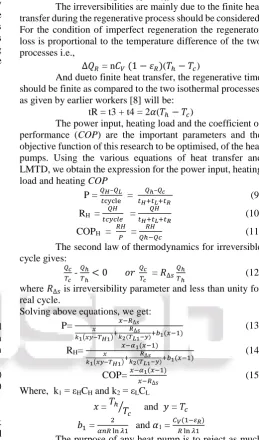
The irreversibilities are mainly due to the finite heat transfer during the regenerative process should be considered. For the condition of imperfect regeneration the regenerator loss is proportional to the temperature difference of the two processes i.e.,
∆𝑄𝑅 = n𝐶𝑉 (1 − 𝜀𝑅)(𝑇ℎ− 𝑇𝑐)
And dueto finite heat transfer, the regenerative time should be finite as compared to the two isothermal processes, as given by earlier workers [8] will be:
tR = t3 + t4 = 2𝛼(𝑇ℎ− 𝑇𝑐)
The power input, heating load and the coefficient of performance (COP) are the important parameters and the objective function of this research to be optimised, of the heat pumps. Using the various equations of heat transfer and LMTD, we obtain the expression for the power input, heating load and heating COP
P = 𝑄𝐻–𝑄𝐿 𝑡cycle =
𝑄ℎ–𝑄𝑐
𝑡𝐻+𝑡𝐿+𝑡𝑅 (9)
RH = 𝑄𝐻 𝑡𝑐𝑦𝑐𝑙𝑒 =
𝑄𝐻
𝑡𝐻+𝑡𝐿+𝑡𝑅 (10)
COPH = 𝑅𝐻
𝑃 = 𝑅𝐻
𝑄ℎ−𝑄𝑐 (11) The second law of thermodynamics for irreversible cycle gives:
𝑄𝑐 𝑇𝑐 -
𝑄ℎ
𝑇ℎ< 0 𝑜𝑟 𝑄𝑐 𝑇𝑐 = 𝑅∆𝑠
𝑄ℎ
𝑇ℎ (12)
where𝑅∆𝑠 is irreversibility parameter and less than unity for real cycle.
Solving above equations, we get:
P= 𝑥 𝑥−𝑅∆𝑠
𝑘1(𝑥𝑦−𝑇𝐻1)+𝑘2(𝑇𝐿1−𝑦)𝑅∆𝑠 +𝑏1(𝑥−1)
(13)
RH=
𝑥−𝛼1(𝑥−1) 𝑥
𝑘1(𝑥𝑦−𝑇𝐻1)+ 𝑅∆𝑠
𝑘2(𝑇𝐿1−𝑦)+𝑏1(𝑥−1)
(14)
COP= 𝑥−𝛼1(𝑥−1)
𝑥−𝑅∆𝑠 (15) Where, k1 = εHCH and k2 = εLCL
𝑥 = 𝑇ℎ 𝑇 𝑐
⁄ and 𝑦 = 𝑇𝑐
𝑏1 = 2
𝛼𝑛𝑅 ln 𝜆1 and 𝛼1 = 𝐶𝑉(1−𝜀𝑅)
𝑅 ln 𝜆1
The purpose of any heat pump is to reject as much heat as possible to the sink (space to be heated) with the expenditure of as little work as possible. This implies that we should do our best to minimize the power input for a given heating load or maximize the heating load for a given power input.
From Eqs. (13),(14) and (15) we find the optimal values of the power input, heating load and heating coefficient of performance of these heat pumps.
Multi-objective Optimisation
Fig. 2: Genetic Algorithm concept
The three objective functions considered for this study to optimise are input power (P), heating load (RH) and the coefficient of performance (COP), signified by Eqs. (13), (14) and (15), respectively. Throughout this research following parameters have been presumed as decision parameters:
TC: Cold side Temperature’s. x: Temperature ratio Th/Tc
C: Rate of heat capacitance in the heat source and heat sink.
εL: The heat exchanger effectiveness at the cold-side. εH: The heat exchanger effectiveness at the hot-side.
It is worth bearing in mind that, to reach better solution in optimization process while the decision variables may be changed, the addressed variables are normally required to fall in a reasonable interval. Throughout this research work, following limits have been considered to solve objective functions:
0.4 ≤ εH ≤ 0.9 0.4 ≤ εL ≤ 0.9 600 ≤ C ≤ 1000 K 1.3 ≤ x ≤ 1.4 250 ≤ TC ≤ 270 K
III. DISCUSSION OF RESULTS
By solving the equations of objective functions in MATLAB (R2015a) using multi-objective optimization approach that proceeds according to the Genetic Algorithm, NSGA-II procedure, minimizing input power and maximizing the heating load and coefficient of performance simultaneously.
Here, optimization has been conducted with objective functions which are presented by Eqs. (13), (14) and
(15). Design parameters through optimization process are the temperature ratio Th/Tc, the temperature of cold side, the rate of heat capacitance through the heat source, the rate of heat capacitance through the heat sink, heat exchanger effectiveness at the cold side, heat exchanger effectiveness at the hot-side.
From the previous researches, following Stirling heat pump specifications have been involved [9].
𝑻𝑯𝟏 = 320 K, 𝑻𝑳𝟏= 280 K, λ = 2.5
And some other values for air are, R = 0.287 kJ/kg.K CV = 0.718 kJ/kg.K
Numb er of Genera
tions
Decision Variables Objectives
ε H εL
C x TC
(K) P(k W)
RH( kW)
C OP
100 0.
5 0.5
28 619.
454 1.
4 269.
953 1.3 54
2.78 25
2.1 36 Table 1: represents the optimum values of the objective
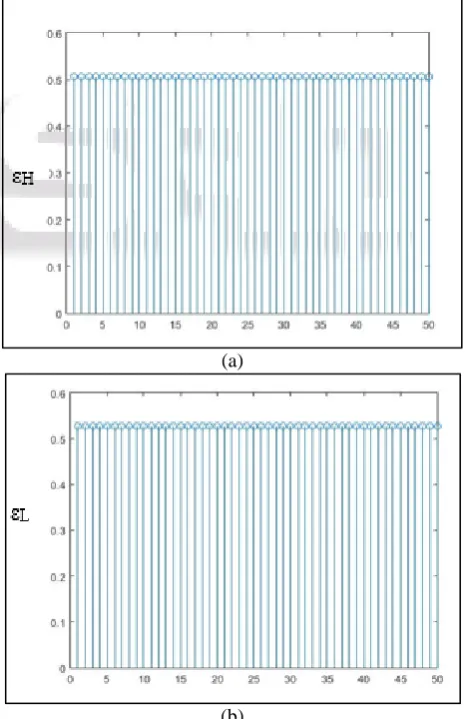
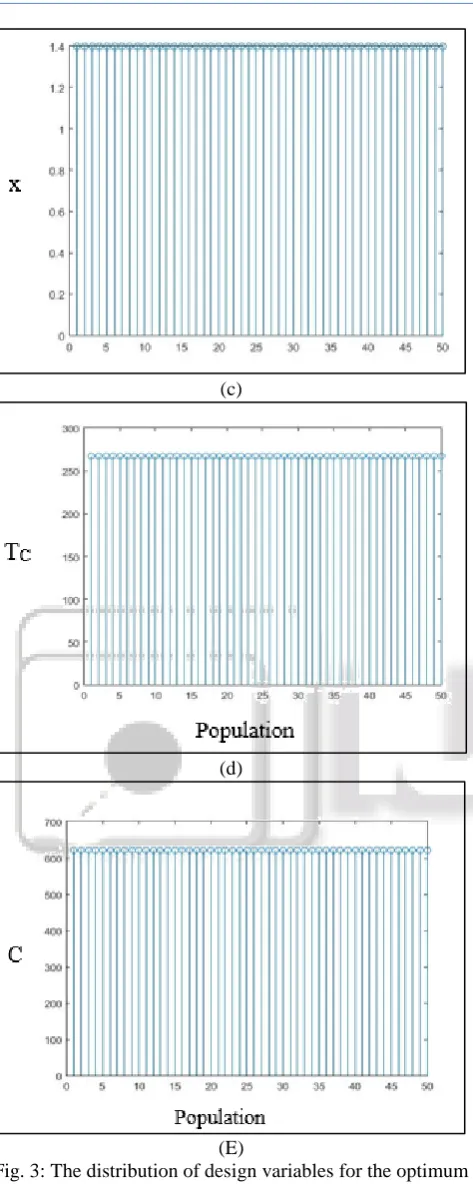
functions for multi-objective optimal solutions. The fig. 3(a)-(e) represents the distribution of design variables for the optimum points on Pareto front for the optimum (adaptive feasible solution) values of the objective functions of the Stirling heat pump.
(a)
[image:3.595.312.545.336.696.2](c)
(d)
[image:4.595.51.288.54.648.2](E)
Fig. 3: The distribution of design variables for the optimum points on Pareto front
The Fig. 4 (a) represents the optimal Pareto front relation between input power (objective 1) and heating load (objective 2) whereas Fig. 4(b) represents the score histogram for the objective functions (fun1,fun2 and fun3 shows input power, heating load and coefficient of performance respt.) of the Stirling heat pump.
(a)
[image:4.595.106.541.67.590.2](b)
Fig. 4: Pareto optimal front for objectives of Stirling heat pump
IV. CONCLUSIONS
In this research, Genetic Algorithm optimisation approach is carried out to indicate input power (P), the heating load (RH) and the coefficient of performance (COP) of the Stirling heat pump. The coefficient of performance (COP), the performance parameter that includes input power and heating load of Stirling heat pump simultaneously been satisfied for multi-objective optimisation. The design variables that includes for optimisation are effectiveness of heat exchanger at cold side (εC), effectiveness of heat exchanger at hot side (εH), rate of heat capacitance in heat source/sink (C), the temperature ratio (x) and cold side temperature (TC). Multi-objective evolutionary approach that develop from Genetic Algorithm, NSGA-II (non-dominated sorting genetic algorithm) method has been carried out in MATLAB (R2015a) and accordingly the objectives were determined.
REFERENCES
[1] F.L. Curzon, B. Ahlborn, Efficiency of a Carnot engine at maximum power output, American Journal of Physics (1975) .
[2] Ahmadi MH, Hosseinzade H, Sayyaadi H, Mohammadi AH, Kimiaghalam F.Application of the multi-objective optimization method for designing a powered Stirling heat engine: design with maximized power, thermal efficiency and minimized pressure loss. Renewable Energy 2013.
[4] Ahmadi MH, Sayyaadi H, Dehghani S, Hosseinzade H. Designing a solar powered Stirling heat engine based on multiple criteria: maximized thermal efficiency and power. Energy Conversion Management 2013.
[5] Ahmadi MH, Dehghani S, Mohammadi AH, Feidt M, Barranco-Jimene Marco A.Optimal design of a solar driven heat engine based on thermal and thermoeconomic criteria. Energy Conversion Management 2013.
[6] Ahmadi MH, Ahmadi MA, Mehrpooya M, Pourkiaei SM, Khalili M. Thermodynamic analysis and evolutionary algorithm based on multiobjective optimisation of the Rankine cycle heat engine. International Journal of Ambient Energy 2014
[7] Ahmadi MH, Mohammadi AH, Dehghani S. Evaluation of the maximized power of a regenerative endoreversible Stirling cycle using the thermodynamic analysis. Energy Conversion Management 2013.
[8] Chen L, Wu C, Sun F. Optimization of steady flow heat pumps. Energy Conversion Management 1998.
[9] A. Konak, D.W. Coit, A.E. Smith. Multi-objective optimization using genetic algorithms: A tutorial. Reliability Engineering & System Safety, 2006.