© 2015, IRJET ISO 9001:2008 Certified Journal Page
508
A Noval Approach Key Aggregate Cryptosystem for Resizable Data
Sharing in Cloud Storage
Shivadatt D Chame1, Anil Kumar2
1Mtech Student, Computer science and Engineering, Arkay college of Engineering and Technology, T.S, India
2 Assistant Professor, Computer science and Engineering, Arkay college of Engineering and Technology, T.S, India
---Abstract—gigantic research has been done on Cloud
computing security and a large number of papers have been published on this topic during the last few decades. Very few worked on Secured data sharing in cloud storage using Key Aggregate Approach. In the new technology of cloud computing platform introduces the distributed cloud resources. This Paper explains how to securely, distribute the data with others in cloud in [1]. This Paper gives a public key cryptosystem, which produces constant size Cipher texts [1]. In this paper implemented the new methods how efficiently shares the data with others in Cloud storage [2][6]. The proposed Approach gives the new techniques for Aggregate Key Cryptosystem for Resizable data on cloud storage [1].
Keywords— Public Key Encryption, Proposed Key Aggregate System.
Introduction
Cloud computing (CC) has grew a lot of attention in current years as cloud computing is characterized as a style of computing abilities delivered and utilizing the internet technology [1]. Cloud computing basically stores all cloud computing app and databases which are put at Remote areas. Because of this development of software, data and services are not trustworthy. Hence, this leads to challenges like virtualization vulnerabilities, availability vulnerabilities.
Cloud computing is Internet positioned cultivation and use of computer technology. It is an approach of computing in which dynamically [1] scalable and often resources are provided as a service over the Internet. The actual term
"cloud" borrows from telephony in that
telecommunications companies, Cloud service provider offering “(VPN)” services at a lower cost. Cloud computing is a better way to run your business. They run on a shared data center instead of running your apps yourself. Any user are able to access information from anywhere [3][6] and at any time instead of having to use dedicated machine [3] [4].
METHODS
Cryptanalysis Key for Hierarchical Approach
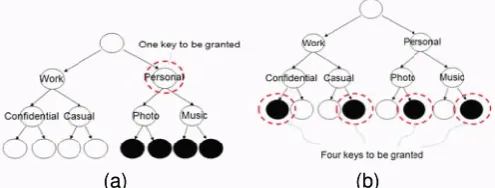
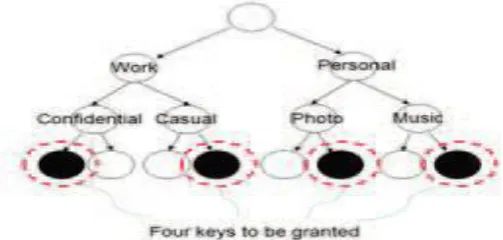
[image:1.595.315.563.342.436.2]We take the tree structure Alice can first classify the cipher text classes like Figure 3. Each node in the tree represents a secret key [1], while the leaf nodes represents the keys for individual cipher[1] text classes [1][2]. Black circles represent the keys for the classes to be delegated [2] and circles circumvented by dotted lines [1] represent the keys to be granted.
Fig 2.1 Cryptographic Keys for Predefined Hierarchy
In Figure 3(a), if Alice wants to share files in the “personal” category [1][2], she needs to grant the key for the node personal category [2], which automatically grants the delegate [4] the keys of all the descendant nodes(photo and music)[1]. This is the ideal case, where most classes to be shared [6] belong to the parent key of them is sufficient.
However, As shown in Figure 3(b), if Alice shares her demo
music at work (work→casual→demo and
work→confidential→demo) in [1] [3] who also has the rights to see some of her personal data, which leads to an increase in the total key size [3]. This approach is not flexible when the classifications [5] are more complex and she share different sets of files to different people [6]. On average, the number of keys increases with the number of branches.
Symmetric Key Cryptography
© 2015, IRJET ISO 9001:2008 Certified Journal Page
509
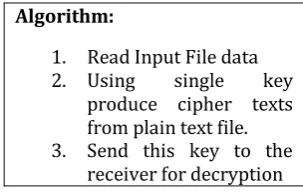
numbers will be allied with the class. The outcome of this is a constant size key. So here the sender should encrypt files with secret keys [2] which will not be feasible.
Algorithm:
1. Read Input File data
2. Using single key
produce cipher texts from plain text file.
3. Send this key to the
[image:2.595.93.245.168.265.2]receiver for decryption
Fig 1: ALGORITHM TO PROPORTIONATE KEY ENCRYPION
Numerous Private Key Encipher Algorithms Available as AES and DES etc [6]. Symmetric-key structure is simplest and faster, but the main disadvantage is that both share the same key for encryption and decryption. Asymmetric encryption averts this problem because the public key send on a network and the private key is never transmitted. Symmetric-key cryptography [8] also
called secret-key cryptography. The most popular
symmetric-key system is the Data Encryption Standard
(DES).
Finally, we note that there are schemes which try to reduce the key size. However, sharing of decryption power is not a concern in these schemes. The disadvantage of this Symmetric Key Algorithms it shares the same key for sender and receiver. Due to this reason the security will be break sometimes.
Identity Based Encryption (IBE)
It is a type of Asymmetric encryption in which the public key of a user is information about the identity of the user (e.g. a user's email address)[8]. IBE is a type of a public-key encryption [4]. It is set for encryption which is nothing but user’s public key. In IBE, secret keys are generated by using third party private key generator(PKG) and here the secret key is provided based on identity. Sender wants to share files using identity key. So sender will encrypt the files by making use of user identity and Receiver will decrypt these files by making use of his secret key. But out of key-Accumulated and IBE, only one divine casual oracles. Key aggregation is restrain as keys will be come from various identity.
There is a third party called private key generator (PKG) in IBE holds a master-secret key in [8][10] and issues a secret key to each user with respect to his identity. The encryptor user can take the public criterion and user integrity to
encrypt a message. The recipient can decrypt this cipher text by his secret key. Integrity-based encryption (IBE) is a type of asymmetric encryption the key of a user can be determined as an selfhood-string of the user e.g., an email address in [1]. In this Approach one single compact secret key can decrypt Encoded texts encrypted under many identities.
Fig 3: Identity Based Encryption
HP Identity-Based Encryption dramatically simplifies the process of sensitive communications. For example, how Alice send a secure Email to Bob using HP IBE.
Another Way IBE:
Alice’s e-mail id [email protected] is Asymmetric
key.
Alice validates myself to an “authority” and
generates the private key for this id.
Bob adopt [email protected] and few civic
parameters of the expert to encode a message to Alice.
Alice decrypts message using own private key.
Advantages:
Encryption type is public-key encryption.
This scheme has a secure key approach.
Based on the identity, secret key will be provided.
Disadvantages:
Cipher text size is non-constant.
Cost of storing cipher text and transmitting it
expensive.
[image:2.595.305.561.219.390.2]© 2015, IRJET ISO 9001:2008 Certified Journal Page
510
Our contribution: Cryptography is an amazing technique
with which veils the veracity of the message from superfluous users. The Key-Aggregate Cryptosystem (KAC) [1] affords an outstanding performance reducing
The estimation intricacy of the overall algorithm. The KAC assemblages diversified cipher texts into encode text classes and every class keeps a secret key from which the aggregate key will be generated.
Fig 1.3 Multiple secret keys to single powerful Aggregate Key
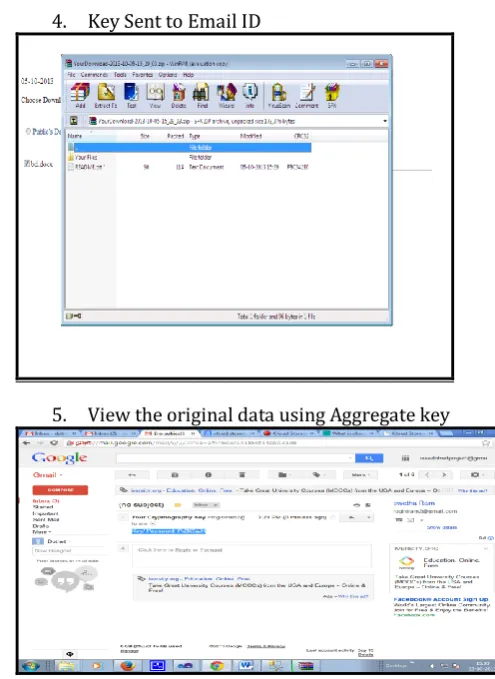
Alice can send to bob the aggregate key as an email so that
Bob can decrypt the set of data which is being encrypted using The aggregate key and the set outside this encryption remain Hidden to bob. Another advantage of this scheme is that the Size of cipher text, aggregate key and the master secret key Remains constant. KAC is a flexible work that the cipher text Classes need not establish a relationship between each other[1].
Proposed Approach – Key Aggregate Cryptosystem
The key-aggregate encryption process comprises of five polynomial-time algorithms as follows.[1]
1. Setup: This is a randomized algorithm that takes no input other than the implicit security parameter.
2. KeyGen: alternately create a public/master secret key pair (pk, msk).
3. Encrypt (pk,i,m): performed by anyone who is the owner of the data. Encrypts the data m using the public key and the index i of the cipher text class file and outputs C.
4. Extract (msk,S): A process result generates set of secrete keys forms an Aggregate Key when we input the set of indices of the cipher class with secret key in [1].
[image:3.595.315.559.111.242.2]5. Decryption : decryption is the procedure who receives the aggregate key obtaining the message m iff i ε S.
Fig 2.1 Data sharing in clouds
The above figure shows data is being shared in the cloud. Suppose a user A wants to share the data 1, 3, 5 to
Another user B, then the user A generates an aggregate key using the attributes of 1, 3, 5 and sends it to the user B. The user B thus decrypts the required data by performing the setup to generate the param, and then the keys are generated followed by the encryption process. The extract process generates the aggregate key with which the user B decrypts the data. In the traditional methods the key assignment will be providing separate keys for every data to be decrypted. Process improves key generation process as well as consumes space.
Fig 2.2 Key assignment for traditional cryptographic scheme
[image:3.595.38.287.238.351.2] [image:3.595.307.559.416.536.2]© 2015, IRJET ISO 9001:2008 Certified Journal Page
511
Fig 2.3 Key assignment in KAC
Only two different keys has to be provided for the access of
five data. Hence hierarchical level of classification of data
has a more advantageous level than the data arrangement in
class level.
The Key Aggregate Cryptosystem allows the users to upload files, share their files and to download and access the files. Uploading files into cloud requires all the files need to be encrypted and then stored. The Fig 2 shows the uploading of files into cloud. Sharing files among cloud users is done by using the aggregate key. The files are downloaded from cloud and then decrypted for accessing the files. Fig describes the sharing of data to other cloud users.
1. First Encrypt the Data file using Public Key
Encryption and Upload on Cloud Server
2. Login the User Account and Share this data with
other users using Key
3. Download File:
4. Key Sent to Email ID
5. View the original data using Aggregate key
Conclusion
User’s information privacy is a pivotal question of cloud storage. With extra numerical tools, cryptographic schemes we consider how to develop an efficient and flexible encryption scheme which decrypts any number of subset of cipher text by a single secret key. Here a delegate will always get a constant size aggregate key. So decryption of any number of cipher texts is possible by an aggregate key. This approach is more flexible than hierarchical key assignment which simply saves spaces if owner distribute a similar set of privileges.
References
[1] “Key-Aggregate Cryptosystem for Resizable Data
Sharing in Cloud Storage” Cheng-Kang chu, Sherman S. M chow, Wen-Guey T, Senior Member IEEE, Vol.25,No.2, FEB 2014.
[2] Archana Sharma C.N, Dr. K Thipswamy “Literature
Survey on Key Aggregate Cryptosystem for Multi File Data Sharing in Cloud International”, Journal of Advanced Research in CS and Software Engineering Volume 5, Issue 4,2015.
[3] Goldie Lee Joe and Dr. N. K. Sakthi “Development of
© 2015, IRJET ISO 9001:2008 Certified Journal Page
512
International Journal of Engineering Research &
Technology (IJERT)ISSN: 2278-0181.
[4] G. Suganyadevi, S. PunithaDevi “Effective Data Sharing
in Cloud Using Aggregate Key” Journal of Engineering
and Technology, Vol. 4, Special Issue 6, May 2015.
[5] C. Wang, K. Ren, W. Lou, and J. Li, “Towards Publicly
Auditable Cloud Data Storage Services,” vol. 24, no. 4, pp. 19-24, July/Aug. 2010.
[6] Xiao Zhifeng and Xiao Yang, “Security and privacy in
cloud computing Approach.” IEEE Communications Surveys & Tutorials 15, 2 (2013), 843–859.
[7] G. Ateniese, B. Masucci, “Provably-Secure Time-Bound
Hierarchical Schemes,” J. Cryptology, vol. 25, no. 2, pp. 243–270, 2012.
[8] D. Boneh, R. Canetti, S. Halevi,“Chosen-Ciphertext
Security from IBE,” SIAMCOMP, vol. 36, no. 5, pp. 1301–1328, 2007.
[9] D. Boneh, C. Gentry, “Collusion Resistant Encryption
with Ciphertexts and Private Keys,” in Proceedings of CRYPTO ’05, ser. LNCS, vol. 3621. Springer, 2005, pp. 258–275.
[10] F. Guo, Y. Mu, “IBE: How to Decrypt Ciphertexts Using a
Single Decryption Key.
[11] Identity Based Encryption :IBE - Wikipedia, the free