NEW TIME GAP ANALYTICAL MODEL FOR REAR END COLLISION
AVOIDANCE IN WIRELESS VEHICULAR NETWORKS
Suzi Iryanti Fadilah and Azizul Rahman
School of Computer Science, Universiti Sains Malaysia , Georgetown, Penang, Malaysia E-Mail: [email protected]
ABSTRACT
Wireless Vehicular Network is a system to realize information interoperability between vehicles and human, vehicles and roads, vehicles and vehicles, and transport facilities, through the network information exchange, in order to achieve the effective monitoring of the vehicle and traffic flow. While the essence of wireless vehicular network is actually to improve traffic efficiency and avoid accidents. Thus this paper aims to propose a new safety indicator called time gap interval for safe following distance (TGFD). TGFD incorporates vehicle dynamics and driver behavior factors that include the time component to broadcast and propagate suitable safety messages in vehicular ad hoc network (VANET) environment. Results from this simulation study indicate that the TGFD is comprehensive safety indicator for safety analysis.
Keywords: time gap, collision avoidance, VANET.
INTRODUCTION
Vehicular Ad-Hoc Networking (VANET) is an important component of Intelligent Transportation System (ITS), which provides an infrastructure based framework for most vehicle-to-vehicle communication applications. The development of VANETs for ITS can most significantly enhance driving safety and support the traditional traffic management functions. Vehicles act as communication nodes and relays, forming dynamic vehicular networks together with other near-by vehicles on the road and highways. Over the years, vehicular networking has become one of the famous research areas among the industry and academic community and it seem to be the most valuable concept for improving efficiency and safety in transportation for future. VANET has reached beyond the need to support the growing of wireless products in transportation industry especially for the safety. Past few years, there are many researcher had play their role to investigate various issues on the ITS. In fact, various VANET projects especially on enhancement of VANET have been executed by various governments, industries, and academic institutions around the world in the last decade. The main goals of implementing technology in the ITS domain is to minimize the road accident and the risk as much as possible by improving the safety. The short term goal of this endeavor is to detect high risk situations and alert the operator of the vehicle in an appropriate manner.
It has been established that supporting vehicle-to-vehicle and vehicle-to-vehicle-to-infrastructure communications with a Vehicular Ad-Hoc Network (VANET) can improve road safety and increase transportation efficiency. Among the candidate applications of VANETs, cooperative collision avoidance (CCA) is important safety applications of vehicular ad-hoc networks (VANETs). This system has attracted considerable interest as it can significantly improve road safety. Despite the best efforts of research and development carried out in the automotive industry, vehicle collisions are a worsening global disaster
destroying lives and livelihoods, and the good solution of road injury prevention is a must. Rear-end collision is one of the main types of vehicle collision. It is particularly important to prevent rear-end collisions and determine time gap interval of safety distance to the following vehicle. Safety distance is determined by many factors, such as dynamic vehicle state, location context, environmental context and human context.
On the other hand, high traffic growth and level of motorization are issuesto be expected in a developing country like Malaysia. Traffic congestion, road accidents and environmental degradation are the challenges that come with this phenomenon. Probably one of the most issues to be addressed currently is traffic accidents and fatalities and Malaysia is known to have a significantly high accident fatality rate in comparison to the developed countries. TGFD is an active safety system that is designed to provide a driver with warnings of an impending collision or potential hazards to prevent the collision or mitigate the consequences. Thus in this paper we focus on active safety applications. There are many different safety models but in this paper, we applied the Mercedes Benz safety model [10] as shown in Figure-1 below.
During the warning phase, block F1, sensors detect a safety deficit or a running state which deviates from the desired state and therefore the driver or the passenger are informed by warning alerts. During Assistance phase if sensors detect a critical operating condition the driver is assisted by automatic safety system. If sensors detect a high probability of an accident, pre-collision phase is activated and along with further action designed to avoid accident, in this phase protective measures can be activated. Since deploying and testing VANETs involves high cost and intensive labor, simulation is a useful alternative prior to actual implementation.
As the core technology of wireless vehicular network, VANET provides an efficient platform for information sharing and technical support and guarantees for the intelligent transportation systems and the large-scale implementation of vehicle networking. With the development of communication technology in recent years, the research about VANET has also been deepening. But few quantitative studies have been done regarding the impact of wireless vehicular network on safe distance. Moreover, the applications of wireless vehicular network will significantly change the traffic situation and result in the inapplicability of the traditional car-following model. In this paper, recent developments of network communication and control technology in the wireless vehicular network field are summarized, the new safety following distance model is established.
RELATED WORK
Figure-2. The concept of VANET technology.
The existing solution studies about safety distance always attracting VANET researchers. They [7] discussed the safe distance in avoiding collisions but the different movement status and traffic efficiency is not considered. The safety modeling was introduced by author [1] and only considering for single-lane movement and not included the safety distance. Classical time-headway
model were introduced by authors [9] and [10] and unfortunately the model only calculated safety distance where it is not enough in safety guarantee. Author [4] studied the efficiency of an assistance system in order to measure safe speed limit and distance but they did not provided the statistical analysis for safety distance and still we need a powerful evidence to introduce safety distance. The traditional braking model was introduced by author [8] but, the author does not include the scenario to the following vehicle when the leading vehicle suddenly stops. Author [8] just make an assumption the speed of the following vehicle is constant. Author [6] has proposed a new support system to the driver which driver could maintain the safe speed limit and inter vehicle distances but it does not take into consideration between front and
the back vehicles’ relative movement status. Then, author
[5] has come out the embedded adaptive cruise control system which can alerts driver to reduce speed and maintain safe distance between vehicles and passengers. However this system is not giving the general statistical expressions of safety distance. The existing solution shows that collision is close related by human, vehicular and environmental anytime anywhere. Still the main parameter of stopping time which have highest impact on braking performance and avoiding collision in ensuring safety have not been considered. Therefore, this paper attempts to propose a new safety indicator, named time gap interval for safe following distance (TGFD) which incorporates the vehicle dynamics and driver behavior factors.
RESEARCH PROBLEM
Lead vehicle’s deceleration and a following vehicle’s lacking maneuvering time is a pool result of
common incident caused a rear-end collision on a highway. Talking about insufficient maneuvering time, there are two common causes normally occurred for a following vehicle. First, drivers tend to keep shorter
time-gap than what is recommended in driver’s manuals.
Second, drivers often have a limited line-of-sight, which make it difficult to anticipate hazardous conditions beyond the vehicle immediately in front. Therefore, when Needed Reaction Time (NRT) (driver reaction time plus the
vehicle’s response time) for drivers is greater than the
Available Reaction Time (ART), a rear end collision is expected.
TGFD MODEL
Figure-3. The difference between time gap and time headway.
longitudinal space, two microscopic measures are used- distance headway and distance gap. Distance headway is defined as the distance from a selected point (usually front bumper) on the lead vehicle to the corresponding point on the following vehicles. Hence, it includes the length of the lead vehicle and the gap length between the lead and the following vehicles. To examine car-following safety in this research, we analyzed the time gap instead of the time headway, because the time gap represents the actual time available for the following vehicle to avoid a rear-end collision. Keeping a safe following distance from the leading vehicle is critical for mitigating rear-end collisions in vehicle following situation since it allows the following vehicle sufficient time to stop, and to stop gradually. Thus, in this paper the concept of TGFD is introduced. TGFD defined as the minimum time required by the following vehicle to decelerate and safely stop without hitting the leading vehicle when both leading and following vehicles apply the emergency brakes due to unforeseen circumstances. Time-gap is defined as
an adjustment of vehicle’s speed and keeps a pre-selected time-gap (gap divided by speed) between the lead vehicle
and the driver’s vehicle. To the best of our knowledge from extensive literature review done, no work ever existed using time-gap as the key parameter to our analytical model in TGFD. This is because of the earlier research had discovered that time-gap is indicated as the key factor for safety, and proper time-gap settings can lead to better performance and can compensate for in-vehicle distraction [12].
Transportation/Civil Time gap definition [13]:
RT
BT
BT
MSTG
FL
LV
(1)where MSTG (minimum time gap), RT is driver reaction time, BTFL braking time of following and BTLV
leading vehicle, respectively. Based on the analysis to the vehicular moving procedure for car following model, one of the fundamental time factors is the reaction time, which was found to be complementary to the time-gap. This means proper time-gap settings allows for good reaction time resulting in better safety. According to equation.2 by Leutzbach [11], the reaction time, RT is the sum of several times: perception time Tp, (the time needed for a driver to
recognize a coming event); decision time Td, (during
which the driver decides what action to take in response); and application time Tap, (the time needed for the driver to
take action). Consequently, we proposed (equation. 3) an extended reaction time model for VANET that includes the time component to broadcast and time component to propagate safety messages in VANET environment and time gap, TG.
ap d
p
T
T
T
RT
(2)Where MSTG = BTFL– BTLV+ γ RT
= BTFL– BTLV + γ ( Tp + Td + Tap)
Figure-4. The relationship between time and space [17].
To introduce our TGFD model, the movement features of vehicles especially during braking is first to explore. Based on the vehicular moving procedure analysis for car following model, a safe following distance can be divided into 5 components as shown in Figure-4 above. Tp indicates the perception of time and its average
value is 0.9 s [11] in general. Td indicates the decision time
where in this period, the driver trigger an emergency situation has happened ahead and ready to take immediate actions. Here, we also assume that it includes a little mechanical coordination time for braking preparation, application time Tap. Tb is a broadcast time to periodic
deliver status of vehicle from time to time to the other nodes. Tprdenotes the message propagation delay, which
indicates the average time needed for warning messages to transmit to the destination. Lastly the time gap value itself is TG. Supposedly the back vehicle will not brake until receiving the warning messages from the leading vehicle. The extended reaction time-gap in VANET given by
}
{
T
bT
pT
dT
apT
prTGFD
+TG (3)Where, TGFD is proportional to Speed of vehicle Vij:
TGFD α Vij
Where, i = α, β . . . N } is type of vehicles
Time Gap, TG:
TG= (R/V)
Where � means the relative distance between two vehicles and � means the velocity of the vehicle behind.
Broadcast time delay, Tb:
Tb = TbESM– Tb *ESM= (Tb+Tpr) - *(Tb+Tpr)
where Tb ESM is broadcast Emergency warning
message (ESM) delay of following vehicle and Tb *ESM is
from vehicle I to i+1. A beacon is handed over to the MAC layer after the generation. The 802.11p MAC performs back off and, once it has acquired access to the channel to transmit the message. This measures the freshness of the beacon upon reception and accounts queuing-, back off- and propagation delay. This is only calculated for received messages
Propagation time delay, Tpr:
Two main parameters of the 10 MHz control channel, mainly the safety message access delay and packet reception rate should be consider in order to assess the performance of safety applications over the existing 802.11p protocol. Our work on this paper focused on the message access delay. Safety message delay can be considered as the sum of the average queuing delay in the higher MAC layer, the average contention delay due to vehicle contention with other vehicle for channel access, the average transmission delay, and the average propagation delay. It can be safely assumed that the average propagation delay is negligible while the average transmission delay is fixed.
Time application, Tap (application brake time) [13]:
Tap = 0.02321v – 0.08785
Where, Tap is a braking time for passenger vehicle in
second and v is a vehicles’ speed.
While,
Tap = BT
Tap vi– Tapvi+1 = BTFL– BTLV ;
considering the braking time (time application, Tap) of the
following vehicle (vi) and the leading vehicle (vi+1)
Time perception, Tp and Time decision, Td:
[image:4.595.313.524.116.181.2]McGee et. al. [14] reported that time perception and time decision is the sum of eye movement time, fixation on the hazard time delay, recognition time delay and muscle response delay time. They found that for the 85% of drivers, eye movement delay was 0.09 seconds, fixation delay time was 0.20 seconds, recognition delay time was 0.50 seconds, decision time 0.85 seconds, muscle response delay was 0.31 seconds. But systems such as cooperative collision avoidance (CCA) and cooperative collision warning (CCW) in VANET could improves road safety by allowing hazardous conditions to be detected sooner than using human perception.
Figure-5. The concept of TGFD.
The value of proposed TGFD model (Equation 4) as illustrated in Figure 5 above is obtained from Equation (1) (2) (3) and being extended by considering the braking time (time application, Tap) of the following vehicle (vi)
and the leading vehicle (vi-1) as well as the time factors of time perception, time decision, time broadcast, time propagation and time gap in VANET environment. Different size of vehicle of leader-follower pairs such the truck following-vehicle, it will affect the TGFD value since the braking performance and capability of each vehicle is totally different. In addition, the following
vehicle driver’s physical and mental condition also will
contribute to the action and decision time of driver. Besides time broadcast delay and time propagation delay also being influence by density of network and mobility of vehicles, hence affecting the TGFD (Equation 4).
pr ap
ap d p
b
T
T
T
T
T
T
TGFD
vi
vi
(
)
1 +TG (4)
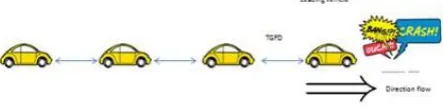
[image:4.595.315.537.602.656.2]Numerous factors influence this time factors analytical model. It can be influenced directly by factors related to vehicle, road and delay because of error during time broadcast and time propagation in VANET environment. Some of these factors are; vehicle type, speed, whether and road condition. A wise TGFD definition could consider the successful collision avoidance the relationship collision probability and time gap below (Equation 5). For example scenario: Following vehicle (fl) is driving behind leading vehicle. Leading vehicle (lv) suddenly breaks and broadcasts a warning message to other vehicle especially the nearest vehicle. Thus to avoid a collision we must have:
Figure-6. Platoon rear end collision.
factors, and therefore difficult to change. To prevent a rear-end collision; a vehicle must receive the ESM
sufficiently prior to the lead vehicle’s initiation of
deceleration to provide more ART. The rear-end collision free condition is expressed as:
TGFD Vi < *TGFD Vi-1 + TG (5)
Where Tb ESM denotes the moment that the ith-vehicle
receives the ESM, TNRT and TG are the ith-vehicle’s
needed reaction time and time gap. ∗ represents the lead
vehicle ((i−1) th). Assuming identical NRT, the ESM propagation delay from the (i−1)th to the ith vehicle must
satisfies:
Tb delay = TbESM– Tb *ESM (6)
Where Tb delay < TG
The above components were used because; more delay is required to save a careless driver who keeps a small inter-vehicle spacing. The second worst case normally occurs
when the driver relies on the lead vehicle’s brake light.
Pr (collision) = x x
e
e
126 . 4 745 . 5
126 . 4 755 . 5
1
, where x= TGFD (7) Numerous factors influence this time factors analytical model. It can be influenced directly by factors related to vehicle, road and delay because of error during time broadcast and time propagation in VANET environment. Some of these factors are; vehicle type, speed, whether and road condition. If the approaching rate is negative (i.e., leading vehicle is travelling faster than its follower), then the vehicles are automatically increasing their gap, so the TGFD remains disabled If instead the approaching rate is positive, the TGFD must compute the safety gap to determine if a vehicle is too close to its leader. A wise TGFD definition could consider the successful collision avoidance the relationship collision probability and time gap from Equation 7.TRAFFIC BEHAVIOR AND MODELING
Traffic scenario
Our traffic scenario is a non-uniform congested traffic stream that covers a three kilometer unidirectional, one-lane highway network. We assume a critical density ρ
c = 0.2 ρj and a jam density of 150 veh/km. Further, we assume that every vehicle is DSRC-enabled (100% market penetration rate). Initially, the vehicles are randomly distributed within the three kilometer road segment with a condition that the distance between any two OBU-enabled communications device is based on vehicle density value. Due to the non-uniform distribution of vehicles, there are instances of the road segment where the spacing between the forward and rear vehicle can be greater than the average vehicle spacing of the entire traffic stream for a given traffic density.
Car following model
In traffic flow theory, various microscopic traffic models have been proposed such as Gibbs, General Motors, Pipes or the K-S car following models. In our traffic network, vehicles movement is based on Newell’s car-following model for its simplicity. Furthermore, the
accuracy of Newell’s car-following model [10] has been compared with other microscopic car-following models [11], and has subsequently been verified with real highway results [12], [13]. The following formulation (1) describes
Newell’s car following model in a congested road:
SIMULATION
Algorithm in NS2
We are integrating our TGFD model in C++ and running the codes in NS2. The basic forwarding algorithm is shown in Figure 8. Upon receptions of each packet, TGFD is randomly set. TGFD determines the priority of the node for that specific packet forwarding. By adjusting TGFD, we can manipulate the priory of the node. A node that has a smaller timer will access channel before other candidate forwarders do it, so it will have priority and others.
Multihop broadcast
ESMs are sent as broadcasts. Upon receiving an ESM, a vehicle accepts this warning message only if it comes from vehicles in front with the same lane ID, the event ID is new, and the message has not exceeded its lifetime. The vehicle immediately informs its driver and broadcasts a new ESM. A sender should periodically broadcast until an implicit ACK is received. The implicit ACK is defined as an ESM with the same event ID from a subsequent vehicle in the same lane. This mechanism greatly reduces the redundancy. The EWM propagation stops when this message expires
Scenario
The scenario of 100 vehicles in each single lane and a 3-lane is evaluated for the performance. We assume low visibility on the roadway (i.e. rain, fog) such that each vehicle can only see one vehicle ahead. ESM message broadcast will be trigger when the first vehicle is forced to execute an emergency brake. Figure 8 shows the basic forwarding algorithm. Each vehicle on the highway is assumed to be equipped with a positioning device (e.g. Global Positioning System) and an IEEE 802.11p. The
warning message contains the sender’s position, lane ID,
ANALYSIS AND RESULT
We evaluate the performance of our proposed TGFD protocol using NS2.35. Specifically, we consider a highway scenario with a road length of 2 km and assume there are 3 lanes in each opposite direction. At medium vehicle density (120vehicles/km) we assume an exponentially-distributed inter vehicle spacing, whereas at high vehicle densities (180 and 240vehicles/km). We assume that every vehicle generates periodic safety messages with a transmission range of 300m and at10-Hz rate.
Figure-7. Number of collision for different vehicle density.
From Figure-7, it shows that by using TGFD model, the number of collision could be reduce for every different vehicle density of 1 until 100 nodes.
Figure-8. Based on equation 7, probability of collision versus time gap setting (TGFD). As time gap increase the
probability of collision decrease.
From figure above, it shows that the bigger the time gap value the lower the collision probability.
Figure-9. Percentage of vehicles receiving warning message versus TGFD (in seconds).
From Figure-9, result shows that the prevent vehicles receive warning message for different number of vehicles. It is clear that the possibility of a collision between the vehicles is decreased as the inter distance between them is increased. The problem of collision can be addressed separately from the problem of stability by adding a new term for the safety, but we have proved in this article that the platoon is string stable and safe in normal working conditions with small inter-vehicle distance In the differences between a highway using TGFD) and a traditional braking (without TGFD) can be appreciated. It can also be observed how the collision is drastically reduced in all vehicles when using TGFD.
CONCLUSIONS
A new safety indicator, time gap for following distance (TGFD ) is proposed for use in safety analysis in VANET environment. The TGFD is an analytical equation that describes the average naturalistic time gap that drivers tend to leave apart to avoid collision. The concept of TGFD is determined by considering the vehicle braking time (for both leading and following vehicle in a vehicle-following situation), time factors in VANET environment and driver reaction behavior. The simulation data show that this safety indicator would provide a more realistic depiction of the real traffic situation for safety analysis in platoon. Thus in future, this model could be enhanced to enforce driver to follow safe distance to prevent collision.
ACKNOWLEDGEMENTS
The authors would like to acknowledge Universiti Sains Malaysia (USM) for supporting this work under USM Short term Grant Scheme No. 304/PKOMP/6313023.
REFERENCES
[1] M. Brackstone and M. McDonald. 1999. “Car
-following: a historical review,” Transportation
[2] P. G. Gipps. 1981. “A behavioural car-following
model for computer simulation,” Transportation
Research Part B,Vol.15, No.2, pp.105–111.
[3] M. Werling, N. Kaempchen, D. Wollherr and M. Buss. 2012. “Lanebased safety assessment of road
scenes using Inevitable Collision States,” in
Proceedings of the IEEE Intelligent Vehicles
Symposium (IV ’12), pp. 31–36, Alcala de Henares, Spain.
[4] E. Adell, A.V´ arhelyi and M. D. Fontana. 2011. “The effects of adriver assistance system for safe speed and safe distance—a real-life field study,” Transportation Research Part C, Vol. 19, No. 1, pp. 145–155.
[5] S. Kannan, A. Thangavelu and R. B. Kalivaradhan. 2010. “An intelligent Driver Assistance System (I -DAS) for vehicle safety modelling using ontology
approach,” International Journal of UbiComp, Vol. 1, No. 3, pp. 15–29.
[6] F. Biral, M. da Lio, A. Saroldi, F. Tango and E. Bertolazzi. 2010. “Supporting drivers in keeping safe speed and safe distance: the SASPENCE subproject within the European framework programme 6
integrating project PReVENT,”IEEE Transactions on Intelligent Transportation Systems, Vol.11, No.3, pp. 525–538.
[7] Y. Wu, J. Xie, L. Du and Z. Hou. 2009. “Analysis on traffic safety distance of considering the deceleration
of the current vehicle,” in Proceedings of the 2nd International Conference on Intelligent Computing
Technology and Automation (ICICTA ’09), pp. 491– 494, Changsha, China.
[8] Q. Luo, L. Xun, Z. Cao and Y. Huang. 2011.
“Simulation analysis and study on car-following safety distance model based on braking process of
leading vehicle,” in Proceedings of the of 9th World Congress on Intelligent Control and Automation
(WCICA’11), pp. 740–743, Taipei, China.
[9] T. J. Ayres, L. Li, D. Schleuning and D. Young. 2001.
“Preferred time-headway of highway drivers,” in Proceedings of the IEEE Intelligent Transportation Systems Proceedings, pp. 826–829, Oakland, Calif, USA.
[10] A. Touran, M. A. Brackstone and M. McDonald. 1999. “A collision model for safety evaluation of
autonomous intelligent cruise control,” Accident Analysis and Prevention, Vol. 31, No. 5, pp. 567–578.
[11] A. Tordeux, S. Lassarre and M. Roussignol. 2010.
“An adaptive time-gap car-following model,” Transportation Research Part B: Methodological, vol. 44, no. 8-9, pp. 1115–1131.
[12] T. Lin, S. Hwang and P. Green. 2009. “Effects of time-gap settings of adaptive cruise control (acc) on driving performance and subjective acceptance in a
bus driving simulator,” Safety Science, Vol. 47, No. 5, pp. 620–625.
[13] Karim, Mohamed Rehan et al. 2013. "Minimum Safe Time Gap (MSTG) as a new Safety Indicator incorporating Vehicle and Driver Factors." Proceedings of the Eastern Asia Society for Transportation Studies. Vol. 9.
[14] McGee et al. 1983. Highway Design and Operation Standards Affected by Driver Characteristics, Volume II: Final Technical Report, Bellomo-McGee, Inc. Vienna, Virginia, Report No. FHWA-RD-83-015.