Speech segmentation with a neural encoder model of working memory
Micha Elsner and Cory Shain
[email protected] and [email protected] Department of Linguistics
The Ohio State University, Columbus, OH 43210
Abstract
We present the first unsupervised LSTM speech segmenter as a cognitive model of the acquisition of words from unseg-mented input. Cognitive biases toward phonological and syntactic predictability in speech are rooted in the limitations of human memory (Baddeley et al., 1998); compressed representations are easier to acquire and retain in memory. To model the biases introduced by these memory limitations, our system uses an LSTM-based encoder-decoder with a small num-ber of hidden units, then searches for a segmentation that minimizes autoencod-ing loss. Lautoencod-inguistically meanautoencod-ingful seg-ments (e.g. words) should share regu-lar patterns of features that facilitate de-coder performance in comparison to ran-dom segmentations, and we show that our learner discovers these patterns when trained on either phoneme sequences or raw acoustics. To our knowledge, ours is the first fully unsupervised system to be able to segment both symbolic and acous-tic representations of speech.
1 Introduction
This paper describes a new cognitive model of the acquisition of word-like units from unsegmented input. The model is intended to describe the pro-cess by which pre-linguistic infants learn their ear-liest words, a stage they pass through during the first year of life (Jusczyk and Aslin,1995; Bergel-son and Swingley, 2012). Our model is based on the standard memory model of Baddeley and Hitch(1974) in which the listener encodes lexical items into phonological working memory, but rep-resents the entire sentence as a higher-level
syn-tactic structure without phonological detail. Our model implements this architecture using encoder-decoder LSTMs with limited memory capacity, then searches for word segmentations which make it easy to remember the sentence.1
Word learning has been extensively studied in previous research, both with transcribed symbolic input and acoustics. Why attempt yet another ap-proach? Our model has three main advantages. First, as a cognitive model, it relates the kinds of learning biases used in previous work to the wider literature on working memory. Second, its sequence-to-sequence neural architecture allows it to handle either one-hot symbolic input or dense vectors of acoustic features. In contrast, existing models are typically designed for “clean” sym-bolic input, then retrofitted with additional mech-anisms to cope with acoustics. Finally, neural net-works have been impressively successful in super-vised language processing domains, yet are still underused in unsupervised learning. Even sys-tems which do use neural nets to model lexical ac-quisition generally require an auxiliary model for clustering the embeddings, which can make their learning objectives difficult to understand. Our system uses the well-understood autoencoder ob-jective to perform the segmentation task without requiring auxiliary clustering, and thus suggests a new direction for neural unsupervised learning.
In an experiment conducted on the widely used Brent corpus (Brent, 1999), our system achieves performance close to that of Fleck (2008), al-though subsequent systems outperform ours by a wider margin. We show that memory limitations do indeed drive the performance of the system, with smaller LSTM hidden states outperforming larger ones in the development set.
In a follow-up experiment designed to
ex-1The system is available from https://github.
com/melsner/neural-segmentation.
plore the flexibility of our model, we deploy the segmenter on acoustic input: the English por-tion of the Zerospeech 2015 challenge (Versteegh et al., 2015). Our model outperforms the win-ning model from that challenge (R¨as¨anen et al., 2015), although we underperform more recent un-supervised acoustic segmentation systems ( Kam-per et al.,2016;R¨as¨anen et al.,under review).
To our knowledge, our system is the first un-supervised LSTM speech segmenter, as well as the first unsupervised speech segmenter to succeed on both symbolic and acoustic representations of speech. Our results are of note for several reasons. First, they provide modeling support for the claim that memory limitations encourage lexical acquisi-tion. Second, they show that a general strategy of searching for maximally compressible represen-tations can realistically guide lexical acquisition without explicit reference to perceptual biases (c.f. e.g.R¨as¨anen et al.,2015), regardless of input rep-resentation. And third, they demonstrate the bene-fits of our adaptation of neural sequence modeling to unsupervised learning.
2 Motivations
We begin with a short overview of previous ap-proaches to the word learning problem, then ex-plain each of our main contributions in detail. Many cognitive models of the word learning prob-lem draw on Brent (1999), which used a sim-ple unigram model of the lexicon to discover re-peated patterns in phonemically transcribed input. Brent’s model laid the groundwork for later gen-erative models with more sophisticated prior dis-tributions over word frequencies, co-occurrence statistics and phonological shapes (Johnson and Goldwater, 2009, among others). Other model-ing architectures for segmentation have focused on detecting phonological boundaries between words using transitional probabilities (Christiansen et al., 1998, among others) or inducing words procedu-rally by “subtracting” known word forms from ut-terances (Lignos,2011).
All these modeling architectures are designed to work with phonemically transcribed input, and require some degree of retrofitting to work with more realistic inputs. In the Bayesian framework, this typically takes the form of a transducer which probabilistically transforms “underlying” lexical items to “surface” acoustics (Lee et al., 2015) or discrete symbols (Elsner et al., 2013); the same
framework is used for morphological segmenta-tion in Cotterell et al. (2015). For transition-based models, the input must be transformed into discrete symbols from which segment-to-segment probabilities can be extracted; this transforma-tion requires an externally trained preprocessor (a phone recognizer). Transition-based models are fairly robust to variation in the symbols (Rytting, 2007;Rytting et al.,2010;Daland and Pierrehum-bert,2011;Fleck,2008) and can be relatively suc-cessful in this framework. Extensions using neural nets (Christiansen et al.,1998;Rytting et al.,2010) are discussed in more detail below (subsec. 2.3). Lignos(2011) requires the most complex prepro-cessing of the input (segmentation into syllables, with marked lexical stresses); adapting it to noisy input is an open problem.
2.1 Working memory and learning biases Cognitive models of word segmentation rely on two kinds of learning biases to structure their in-ferred lexicons: predictability within words (of-ten expressed as a prior over phonological forms), and Zipfian unigram and bigram frequencies of words (a prior over word distributions). These biases control the entropy of utterances, making it easy for adult listeners to remember what they hear and reconstruct any missing parts from con-text (Piantadosi et al., 2012). The biases corre-spond to different components in a standard model of working memory (Baddeley, 2007; Baddeley and Hitch, 1974). In this model, listeners can store the last few items they heard in a phonolog-ical loop, from which words are transferred into
episodic memorywhich represents them at a syn-tactic/semantic level.
mem-ory as a datapoint for lexical learning. This ac-count of word learning is one of a growing number which attempt to unify acquisition and speech pro-cessing in terms of the same real-time, resource-constrained mechanisms (Apfelbaum and McMur-ray,2016).
In our model, memorization itself can be viewed as the objective for early word learning. The model attempts to reconstruct its input from mem-ory; chunks that are easy to reconstruct (and that make the context reconstructible) are good can-didate words. The working memory model ac-counts for the two types of bias normally found in Bayesian segmenters. Phonological predictabil-ity due to consistent word shapes (B¨orschinger and Johnson,2014;Johnson and Goldwater,2009) re-duces the load on the phonological loop. Pre-dictability between words reduces the load on syn-tactic memory. The two memory systems draw on different cognitive resources, which correspond to different parameters of the model.
2.2 Input representations
As stated above, traditional segmentation models operate on phonemic transcriptions and must be adapted to cope with phonetic or acoustic input. For models which infer an explicit lexicon (i.e., those which do not simply count segment transi-tions), this takes the form of a mapping between the data and the space of “underlying” latent word forms.
Learning such a mapping can be problematic. Traditional generative learning models use para-metric distributions over the data— for acoustics, Gaussians (Vallabha et al., 2007;Feldman et al., 2009) or Gaussian-HMMs (Lee and Glass,2012; Lee et al.,2015). But these are a notoriously poor fit to real speech sounds (Glass,2003).
An example of an alternative approach to rep-resentation learning from acoustics is R¨as¨anen et al. (2015). They exploit known acoustic indi-cators of syllable boundaries to infer syllable seg-ments, cluster those segments using expectation-maximization (EM), and then identify multisyl-labic words by searching for recurring cluster n -grams. As a result, their system is constrained to propose word boundaries only at proposed syl-lable boundaries regardless of the representations acquired downstream. Furthermore, EM is known to find non-optimal solutions for many problems in natural language (Johnson, 2007). To the
tent that this inhibits their system’s ability to ex-ploit information in the acoustic feature space, it might lead to misidentification of recurrent sylla-blen-grams and consequently to segmentation er-ror.
Latent underlying representations can also cause search problems, since the model must ex-plore all the possible underlying forms which might map to some utterance on the surface. In a probabilistic system capable of mapping every word to every possible realization, this quickly be-comes intractable. Many systems use dynamic programming (Mochihashi et al., 2009; Neubig et al.,2010), sometimes with pruning (Van Gael et al.,2008). But these algorithms require Markov models with small context windows, and in any case can still be slow and prone to search errors.
Neural nets, on the other hand, learn a non-linear mapping between input and output. This allows them to model speech more flexibly, out-competing Gaussian/HMMs for supervised speech recognition (Graves et al., 2013; Hinton et al., 2012). Recurrent neural nets also produce hidden representations differently than HMMs. Rather than use dynamic programming to search a latent space, they produce a single vector deterministi-cally at each timestep. Models such as LSTMs (Hochreiter and Schmidhuber, 1997) can learn long-distance sequential dependencies in their in-put without making inference more expensive.
2.3 Neural unsupervised learning
A few previous papers have used neural networks for word segmentation.Christiansen et al.(1998), drawing on older work with Simple Recurrent Networks (Elman, 1990), trains a recurrent net-work as a language model. Word boundaries are extracted at points where the network predicts an upcoming utterance boundary; that is, utterance boundaries are used as distant supervision for the locations of word boundaries. While effective, this system uses symbolic rather than acoustic input. Moreover, it may have trouble with word endings which do not end utterances, such as the endings of function words; experiments show that infants learn detailed representations of function words by 13 months (Shi et al.,2006) and use known words as “anchors” for segmentation within utterances (Bortfeld et al.,2005).
probabil-ity distribution from a phone recognizer as its fea-ture representation. This system was run on natu-ral data; results for word boundary detection were significantly above chance, though still much less accurate than results for symbolic input. The use of utterance boundaries as distant supervision may create problems for this system similar to those pointed out for Christiansen above. Moreover, the use of an SRN rather than an LSTM means that the system is essentially phonotatic; it makes its deci-sions based on the previous one or two phones, without the capacity to remember whole lexical items.
Recent work (Kamper et al., 2016) has at-tempted to harness the flexibility of neural fea-ture extractors within the generative model frame-work. This model has a hybrid architecture con-sisting of a neural feature extractor, the Correspon-dence Autoencoder, pretrained using distant su-pervision (Kamper et al., 2015), and a Bayesian clustering/segmentation model. The system repre-sents each word by neurally encoding its frames, then downsampling to obtain a fixed-dimensional word vector; the clustering model assumes that these vectors can be modeled with Gaussian clus-ters. The advantage of this approach is its ability to exploit the known strengths of both Bayesian and neural learning systems. The disadvantage is its indirectness: there is no end-to-end objective to be optimized, and the system’s lexical learning does not inform its phonetic representations.
Even outside the domain of segmentation, neu-ral networks have been most successful for super-vised problems, and are not widely used for un-supervised learning of discrete structures (trees, clusters, segment boundaries). While some re-searchers have proposed information-theoretic ob-jectives for learning clusters (Klapper-Rybicka et al., 2001), the most widely used unsupervised objective is the one used here: autoencoding. Yet autoencoders are rarely used to learn discrete hidden structures. One exception, Socher et al. (2011), uses autencoders to find a latent tree struc-ture for sentiment analysis by greedily merging adjacent nodes so as to minimize the reconstruc-tion error.
Chung et al. (2017) describe a model similar to our own which performs a segmentation task using autoencoders. Both models use multiscale autoencoding to learn a sequence model with un-known segment boundaries. The main difference
is the different technique used to deal with the discontinuities caused by switching discrete seg-ment boundary variables. However, they evaluate their model on downstream tasks (notably, char-acter language modeling) without evaluating the segmentations directly.
3 The Model
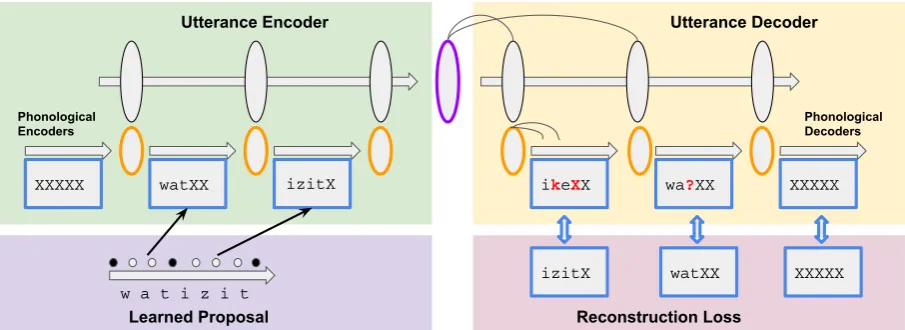
The model uses a basic encoder-decoder archi-tecture now typical in machine translation (Cho et al.,2014) and image captioning (Vinyals et al., 2015). In a typical encoder-decoder, the input is fed into an LSTM sequence model (Hochreiter and Schmidhuber, 1997) which represents it as a la-tent numeric embedding. This embedding is then fed into another sequence model, which uses it to generate an output sequence. Our two-level model performs this process in stages, first encoding ev-ery word, character-by-character, and then encod-ing the word sequence, vector-by-vector. In an au-toencoder, the objective is to make input and out-put match; thus, the decoder performs the encod-ing stages in reverse. We provide the final encoder hidden state as input to each decoder unit. To force the system’s learned embeddings to be robust to noise caused by mishearing or misremembering, we use dropout (Srivastava et al.,2014) at the in-put (deleting individual timesteps) and at the word encoding layer (deleting entire words). This archi-tecture is illustrated in Figure1.
The encoder-decoder does not predict segment boundaries directly, but gives an objective func-tion (reconstrucfunc-tion loss) which can be used to guide segmentation. Because the segment bound-ary decisions are hard (there are no “partial” boundaries), the loss function is not differentiable as a function of the boundary indicators. We use sampling to estimate the gradient, as in previous work (Mnih et al., 2014; Xu et al., 2015). Our sampling system works as follows: we begin with a proposal distributionPsegover sequences of
seg-ment boundaries for the current utterancex. We sample m sequences of boundaries, B1:m from
Pseg. Each boundary sequence splits the utterance
into words. We use the autoencoder network to encode and decode the words, and obtain the loss (the cross-entropy of the reconstructed input) for each sequence,L1:m.
Figure 1: Architecture of the model: top two panels show the encoder/decoder, bottom panels show computation of breakpoints and resulting loss. Horizontal arrows represent LSTMs.
break positions. We then treat each breakpointtin the utterance independently: for each one, we use the losses and the proposal probabilities to com-pute an importance weightwt
ifor sampleiand
po-sitiont(Eq. 2), then compute the expected prob-ability of a boundary at that position by summing over the weighted samples (Eq. 3). Essentially, a breakpoint will be more likely if it appeared in samples with low reconstruction loss, especially if it is not encouraged by the current proposal.
P(x|Bi) = P(BiP|x()xP)(Bi) ≈ Pexp(Li) jexp(Lj) (1)
wit= PPt(x|Bi)
seg(Bit) (2)
E[B(t)]≈ P1
iwti
X
i
wt
iBit (3)
We initialize by making random breakpoint pro-posals (with probability.1at each position). The random proposal does not search the space of seg-mentation boundaries particularly efficiently, so we train a better proposal using another LSTM. This LSTM simply reads the input from left to right and predicts a binary output (segment or not) at each timestep. We update the proposal LSTM by using the sampling-derived Pseg as a training
target after each batch. Thus, the proposal learns to predict segment boundaries that are likely to re-sult in low reconstruction loss for the main net-work. To force the system to explore the space, we smooth the learned proposal by interpolating it with a uniform distribution:Pseg =.9×PLST M+
.1× 1 2.
We control the memory capacity of the system using four tunable parameters: the number of hid-den states at the phonological level (Hp) and at
the utterance level (Hu) and the dropout
probabil-ity of mishearing a phonological segment (Dp) or
a word (Du). We discuss parameter tuning results
below.
The system also has several other parameters which were not tuned against the evaluation met-ric. For convenience in GPU training, we treat all sequences as fixed length, either clipping them or padding with a dummy symbol. This requires us to set a maximum length for each word (in charac-ters), and each utterance (in words and characters); we set these parameters to ensure 99% coverage of the input (for the Brent corpus, 7, 10, and 30 respectively).
Clipping creates the possibility of pathological outcomes where the system deliberately creates extremely long words, exploiting the fact that the excess characters will be discarded and will not have to be predicted in the output. We penalize this by subtracting 50 for each deleted character. Fi-nally, we find that, despite pre-training, the system may settle into an initial state where the phono-logical network simply embeds the characters and the utterance network learns a character LM. To avoid this, we subtract 10 from the objective for each one-symbol word. These parameters were tuned only lightly; we increased the values until the problematic behavior (segmentation of the en-tire utterance as one word, or each character as a word) ceased.
default settings for optimization. We use mini-batches of 128 and take 100 samples of potential segment boundaries per sequence. We perform 10 iterations of pretraining with random boundaries, 10 iterations of boundary induction with random proposals, and 70 iterations of full training with the learned LSTM proposal.
4 Results
4.1 Brent Corpus
The Brent corpus (Brent, 1999) is a standard benchmark dataset for segmentation, consisting of 9790 utterances fromBernstein-Ratner(1987), translated into phonemic transcription using the CMU dictionary. The standard metrics for seg-mentation are F-score for word boundary detec-tion (treating each boundary in isoladetec-tion) and F-score for word token segmentation (a word is cor-rect only if both its boundaries are corcor-rect and no spurious boundaries intervene). Although early work on Brent used all 9790 utterances for both development and test, we use the first 8000 utter-ances for parameter tuning. Thus, we present re-sults for the whole corpus (for comparison with previous work) and clean test results for the last 1790.
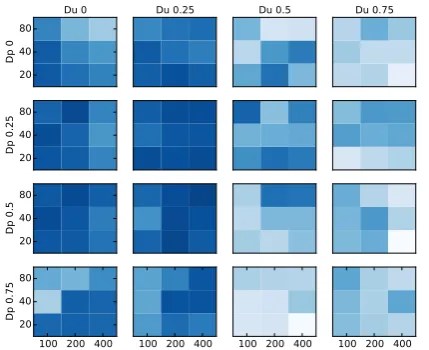
We tune the four parameters of our system,
Hp, Hu, DpandDu, using a grid search (see
Fig-ure 2). Each subplot shows a particular dropout setting, Dp/Du; the cells within represent
set-tings of Hp (rows) and Hu (columns), where
darker cells have higher boundary F-score. Exces-sive noise decreases scores, especially high word dropout (right side of the plot). For low levels of dropout, the best systems tend to have small numbers of hidden units (dark regions in the lower left); for larger dropout, more hidden units can be useful. For instance, compare the top left subplot, with 0 dropout and good performance withHp =
20, Hu = 100, to subplot 3,3, with optimal
per-formance atHp = 80, Hu = 200. In other words,
limiting the system’s memory resources is indeed the key to its performance. The best score occurs at Hp = 80, Hu = 400, Dp = 0.5, Du = 0.25
with a dev boundary F-score of 83%. We used these parameters for our final evaluation, along with 100 hidden units in the proposal network.
To further demonstrate that limited memory can bias the network to learn a low-entropy lexi-con, we perform a separate experiment using the phonological encoder/decoder alone. We create
Du 0
20 40 80
Dp 0
Du 0.25 Du 0.5 Du 0.75
20 40 80
Dp 0.25
20 40 80
Dp 0.5
100 200 400 20
40 80
Dp 0.75
[image:6.595.307.522.64.239.2]100 200 400 100 200 400 100 200 400
Figure 2: Tuning results on Brent development. Cell axes representHu andHp, darker cells have
higher scores (best 83%, worst 60%).
0.80 0.85 0.90 0.95 1.00
10 20 40 80 160
10 20 40 80 160
10 20 40 80 160
10 20 40 80 160
Hp
v
alue
Acc
[image:6.595.310.524.307.441.2]Real Pseud
Figure 3: Reconstruction accuracy of the phono-logical encoder/decoder on real words vs. length-matched pseudowords from Brent.
networks with varying Hp (setting Dp to 0); for
each network size, we train one net on real words from the gold segmentation of Brent, and another on length-matched pseudowords sampled by ran-domly segmenting the Brent corpus. Figure 3 shows the reconstruction error rates as a function of Hp. The gap between the green and orange
lines shows the difference in reconstruction error obtained by using real words rather than pseu-dowords. For the smallest Hp, neither network
does a good job; for the largest, both networks learn the sequences perfectly. For values in be-tween, however, the lines are relatively far apart, showing that the real words are easier for the net-work to remember.
System Bd P Bd R Bd F Wd F Goldwater 09 90 74 87 74
Johnson 09 - - - 88
Berg-Kirkpatrick 10
- - - 88
Fleck 08 95 74 83 71
[image:7.595.73.284.62.185.2]Ours (all) 81 85 83 72 Ours (test) 81 86 83 72 Table 1: Selected segmentation results on Brent.
forms at the lower end of the reported range for Brent segmenters, scoring 83% for boundary de-tection and 72% for word dede-tection (comparable to (Fleck,2008)). (Lignos(2011) scores 93% bound-ary F on a different corpus with marked syllable boundaries.) From a cognitive modeling point of view, it is not clear what performance we should expect on Brent to model the performance of a young human infant. Models of early word seg-mentation are motivated by studies showing that, by their first birthday, infants can distinguish many common words from nonwords (Vihman et al., 2004; Swingley, 2005). But this does not im-ply that they learn every word they hear, or that they can use their word knowledge to segment ev-ery utterance correctly. Thus, while our result is not state-of-the-art, it is good enough to conform with the reported infant results and suggest that our neural architecture is a promising direction.
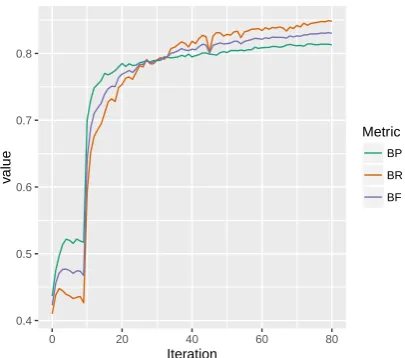
Learning curves for segmentation on the Brent corpus are shown in Figure 4. The first 10 it-erations show a gradual increase in segmentation performance using the random proposal. Perfor-mance increases sharply with the activation of the learned proposal, then climbs slowly over time. Precision initially exceeds recall (that is, the sys-tem proposes too few boundaries) but recall climbs over time as the system exploits known words as “anchors” to discover new ones, a pattern consis-tent with the infant data (Bortfeld et al.,2005). 4.2 Zerospeech 2015 acoustic segmentation We began by claiming that an advantage of our model was its flexible architecture that permits dense acoustic features as input (rather than sym-bolic phone labels) with little modification. In this section, we present preliminary results from
respective publications, except forGoldwater et al.(2009), which are corrected numbers published with their software release. Not all systems report all metrics.
0.4 0.5 0.6 0.7 0.8
0 20 40 60 80
Iteration
v
alue
Metric
BP BR BF
Figure 4: Boundary precision, recall, and F1 score by iteration on the entire Brent dataset.
a follow-up experiment in which we tested this claim by deploying our system as an acoustic seg-menter on the English portion of the Zerospeech 2015 challenge dataset (Versteegh et al., 2015). We preprocess the raw acoustic data by extract-ing 25ms 13-dimensional mel frequency cepstral coefficients with first and second order deltas at a step size of 10ms. We then train the network on the resulting sequences of 39-dimensional frames. Given that the goal of the experiment was to test the existing architecture on a novel task, we intentionally conducted this experiment with min-imal parameter tuning or architectural modifica-tion. However, we made several key changes in response to the unique challenges presented by acoustic input.
First, since we are now reconstructing dense vectors of acoustic features, we use mean squared error (MSE) instead of categorical cross-entropy as the autoencoder loss function. We consequently rescale our clipping penalty from 50 to 1, a coeffi-cient which seemed more in balance with the vari-ation in decoder loss produced by MSE. We also increase our one-letter penalty from 10 to 50, mod-eling our strong prior assumption that a 1-frame segment will never correspond to a word.
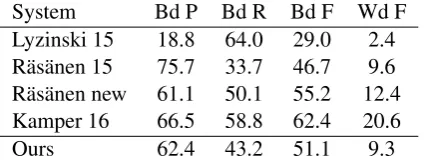
[image:7.595.312.515.63.242.2]maxi-System Bd P Bd R Bd F Wd F Lyzinski 15 18.8 64.0 29.0 2.4 R¨as¨anen 15 75.7 33.7 46.7 9.6 R¨as¨anen new 61.1 50.1 55.2 12.4 Kamper 16 66.5 58.8 62.4 20.6 Ours 62.4 43.2 51.1 9.3 Table 2: Selected word segmentation results on the the Zerospeech 2015 English corpus.
mum utterance length (in frames). The aforemen-tioned clipping penalties punish the system for ut-terances that contain too many words, preventing it from optimizing its autoencoder loss by seg-menting everywhere.
Third, for our initial proposal distribution we use the speech region segmentation provided by the Zerospeech challenge, consisting of speech in-tervals identified through automatic voice activ-ity detection (VAD), rather than using the uniform initialization described above for symbolic mode. We interpolate the initial distribution with a uni-form prior as described above.
Fourth, we discovered in practice that the as-sumption of independence between samples made by the importance scoring scheme as implemented for symbolic mode was distortionary in acoustic mode, such that the “best” segmentation discov-ered through sampling often contained many times more segments than any of its component sam-ples.3 To prevent this from happening, we simply
used 1-best rather than importance sampling for acoustic segmentation.
We trained the system for 80 iterations using pa-rameters Hp = 20, Hu = 400, Dp = 0, Du =
0.25and 1500 hidden units in the proposal LSTM. In the auto-encoder network, we limited frames per utterance, words per utterance, and frames per word to 400, 16, and 100, respectively. Results are presented in Table 2, along with a compari-son to results from other systems. Lyzinski et al. (2015) andR¨as¨anen et al.(2015) were entrants in the Zerospeech 2015 challenge, in whichR¨as¨anen et al. (2015) performed best in the word
bound-3We believe this is driven by training batches in which multiple samples receive similar scores but have fairly non-overlapping segmentations. In this case, the output segmen-tation can contain something close to the union of the best samples’ segmentation points, leading to oversegmentation. This effect is likely exaggerated in acoustic mode as com-pared to symbolic mode because acoustic word segments are generally much longer (in frames) than their corresponding symbolic word segments (in characters).
ary detection measure. As shown in the table, our system beats both of these competitors’ boundary detection scores, with a word detection score com-parable to that of R¨as¨anen et al. (2015). How-ever, since the challenge concluded,R¨as¨anen et al. (under review) have modified their system and improved their segmentation score,4 andKamper
et al. (2016) have established a new state of the art for this task. While our system currently re-mains far from these newer benchmarks, we ex-pect that with systematic parameter tuning and in-vestigation into appropriate sampling procedures for acoustic input, we might be able to improve substantially on the results presented here. We be-lieve that the results of this preliminary investiga-tion into the acoustic domain are promising, and that they bear out our claims about the flexibility of our general architecture.
5 Conclusions and future directions
This work presented a new unsupervised LSTM architecture for discovering meaningful segments in representations of continuous speech. Mem-ory limitations in the autoencoder part of the net-work apply pressure to discover compressed rep-resentations much as human memory limitations have been argued to guide lexical acquisition. By varying the size of the LSTM’s hidden state, we showed that word segmentation performance on the Brent corpus is driven by memory limitations, with performance improving (up to a point) as we constrain the system’s memory capacity. And by successfully deploying our system on both sym-bolic (character) and acoustic representations of speech, we demonstrated that our approach is flex-ible enough to adapt to either representation of the speech stimulus.
In the future we hope to pursue a number of lines of inquiry. We plan to conduct more de-tailed parameter tuning in the acoustic domain and to segment the Xitsonga dataset supplied with the Zerospeech 2015 challenge. We also intend to introduce additional layers into the autoencoder network so as to allow for joint acquisition of phone-like, morph-like, and/or word-like units in the acoustic signal; this may benefit from the al-ternate model structure of Chung et al. (2017). And we plan to explore clustering techniques that
4The new results are not yet published. Those reported above are copied from the results summary inKamper et al.
would allow our system to discover categories in addition to probable segmentation points.
Acknowledgments
We thank members of the Clippers discussion group (especially Joo-Kyung Kim, Eric Fosler-Lussier and Wei Xu) and three anonymous review-ers. Computations for this project were run on a Titan-X GPU donated by the NVIDIA Hardware Grant program and on the Ohio Supercomputer (1987). Funding was provided by NSF #1422987.
References
Keith S Apfelbaum and Bob McMurray. 2016. Learn-ing durLearn-ing processLearn-ing: Word learnLearn-ing doesn’t wait for word recognition to finish.Cognitive Science. Alan Baddeley. 2007. Working memory, thought and
action. Oxford University Press, Oxford, UK. Alan Baddeley, Susan Gathercole, and Costanza
Pa-pagno. 1998. The phonological loop as a language learning device. Psychological review105(1):158. Alan Baddeley and Graham Hitch. 1974. Working
memory. Psychology of learning and motivation
8:47–89.
Elika Bergelson and Daniel Swingley. 2012. At 6– 9 months, human infants know the meanings of many common nouns. Proceedings of the National Academy of Sciences109(9):3253–3258.
Nan Bernstein-Ratner. 1987. The phonology of parent-child speech. In K. Nelson and A. van Kleeck, ed-itors,Children’s Language, Erlbaum, Hillsdale, NJ, volume 6.
Benjamin B¨orschinger and Mark Johnson. 2014. Ex-ploring the role of stress in Bayesian word seg-mentation using adaptor grammars. Transactions of the Association for Computational Linguistics2:93– 104.
Heather Bortfeld, James L. Morgan, Roberta Mich-nick Golinkoff, and Karen Rathbun. 2005. Mommy and me. Psychological Science 16(4):298–304.
https://doi.org/10.1111/j.0956-7976.2005.01531.x. Michael R. Brent. 1999. An efficient, probabilistically
sound algorithm for segmentation and word discov-ery. Machine Learning34:71–105.
Ohio Supercomputer Center. 1987. Ohio su-percomputer center. http://osc.edu/ark:
/19495/f5s1ph73.
Kyunghyun Cho, Bart van Merrienboer, Caglar Gul-cehre, Dzmitry Bahdanau, Fethi Bougares, Holger Schwenk, and Yoshua Bengio. 2014. Learning phrase representations using RNN encoder–decoder
for statistical machine translation. InProceedings of the 2014 Conference on Empirical Methods in Nat-ural Language Processing (EMNLP). Association for Computational Linguistics, Doha, Qatar, pages 1724–1734. http://www.aclweb.org/anthology/D14-1179.
Franc¸ois Chollet. 2015. Keras. https://github.
com/fchollet/keras.
Morten H. Christiansen, Joseph Allen, and Mark S. Seidenberg. 1998. Learning to segment speech us-ing multiple cues: A connectionist model. Lan-guage and Cognitive Processes13(2/3):221–269. Junyoung Chung, Sungjin Ahn, and Yoshua Bengio.
2017. Hierarchical multiscale recurrent neural net-works. InProceedings of ICLR.
Ryan Cotterell, Nanyun Peng, and Jason Eisner. 2015. Modeling word forms using latent underlying morphs and phonology. Transactions of the Associ-ation for ComputAssoci-ational Linguistics3:433–447. Robert Daland and Janet B. Pierrehumbert.
2011. Learning diphone-based segmen-tation. Cognitive Science 35(1):119–155.
https://doi.org/10.1111/j.1551-6709.2010.01160.x. Jeffrey L Elman. 1990. Finding structure in time.
Cog-nitive science14(2):179–211.
Micha Elsner, Sharon Goldwater, Naomi Feldman, and Frank Wood. 2013. A joint learning model of word segmentation, lexical acquisition, and pho-netic variability. InProceedings of the 2013 Con-ference on Empirical Methods in Natural Lan-guage Processing. Association for Computational Linguistics, Seattle, Washington, USA, pages 42– 54.http://www.aclweb.org/anthology/D13-1005. Naomi Feldman, Thomas Griffiths, and James Morgan.
2009. Learning phonetic categories by learning a lexicon. InProceedings of the 31st Annual Confer-ence of the Cognitive SciConfer-ence Society.
Margaret M. Fleck. 2008. Lexicalized phono-tactic word segmentation. In Proceedings of ACL-08: HLT. Association for Computational Linguistics, Columbus, Ohio, pages 130–138.
http://www.aclweb.org/anthology/P/P08/P08-1016. James Glass. 2003. A probabilistic framework
for segment-based speech recognition. Computer Speech and Language17:137–152.
Sharon Goldwater, Thomas L. Griffiths, and Mark Johnson. 2009. A Bayesian framework for word segmentation: Exploring the effects of context.
Cognition112(1):21–54.
Geoffrey Hinton, Li Deng, Dong Yu, George Dahl, Abdel rahman Mohamed, Navdeep Jaitly, Andrew Senior, Vincent Vanhoucke, Patrick Nguyen, Tara Sainath, and Brian Kingsbury. 2012. Deep neural networks for acoustic modeling in speech recogni-tion. IEEE Signal Processing Magazine28(6):82– 97.
Sepp Hochreiter and J¨urgen Schmidhuber. 1997. Long short-term memory. Neural computation
9(8):1735–1780.
Mark Johnson. 2007. Why doesn’t EM find good HMM POS-taggers? InEMNLP.
Mark Johnson and Sharon Goldwater. 2009. Improving nonparametric Bayesian inference: Experiments on unsupervised word segmentation with adaptor gram-mars. In Proceedings of Human Language Tech-nologies: The 2009 Annual Conference of the North American Chapter of the Association for Computa-tional Linguistics. Boulder, Colorado.
Peter W Jusczyk and Richard N Aslin. 1995. Infants’ detection of the sound patterns of words in fluent speech. Cognitive psychology29(1):1–23.
Herman Kamper, Micha Elsner, Aren Jansen, and Sharon Goldwater. 2015. Unsupervised neural net-work based feature extraction using weak top-down constraints. In Acoustics, Speech and Signal Pro-cessing (ICASSP), 2015 IEEE International Confer-ence on. IEEE, pages 5818–5822.
Herman Kamper, Aren Jansen, and Sharon Gold-water. 2016. A segmental framework for fully-unsupervised large-vocabulary speech recognition.
arXiv preprint arXiv:1606.06950.
Diederik P. Kingma and Jimmy Ba. 2014. Adam: A method for stochastic optimization. CoRR
abs/1412.6980. http://arxiv.org/abs/1412.6980. Magdalena Klapper-Rybicka, Nicol N Schraudolph,
and J¨urgen Schmidhuber. 2001. Unsupervised learning in LSTM recurrent neural networks. In
International Conference on Artificial Neural Net-works. Springer, pages 684–691.
Chia-ying Lee and James Glass. 2012. A nonpara-metric Bayesian approach to acoustic model discov-ery. InProceedings of the 50th Annual Meeting of the Association for Computational Linguistics (Vol-ume 1: Long Papers). Association for Computa-tional Linguistics, Jeju Island, Korea, pages 40–49.
http://www.aclweb.org/anthology/P12-1005. Chia-ying Lee, Timothy J O’Donnell, and James Glass.
2015. Unsupervised lexicon discovery from acous-tic input. Transactions of the Association for Com-putational Linguistics3:389–403.
Constantine Lignos. 2011. Modeling infant word seg-mentation. In Proceedings of the fifteenth confer-ence on computational natural language learning. Association for Computational Linguistics, pages 29–38.
Vince Lyzinski, Gregory Sell, and Aren Jansen. 2015. An evaluation of graph clustering methods for un-supervised term discovery. InProceedings of Inter-speech 2015.
Volodymyr Mnih, Nicolas Heess, Alex Graves, and Ko-ray Kavukcuoglu. 2014. Recurrent models of visual attention. InAdvances in Neural Information Pro-cessing Systems. pages 2204–2212.
Daichi Mochihashi, Takeshi Yamada, and Naonori Ueda. 2009. Bayesian unsupervised word segmen-tation with nested Pitman-Yor language modeling. In Proceedings of the Joint Conference of the 47th Annual Meeting of the ACL and the 4th Interna-tional Joint Conference on Natural Language Pro-cessing of the AFNLP. Association for Computa-tional Linguistics, Suntec, Singapore, pages 100– 108. http://www.aclweb.org/anthology/P/P09/P09-1012.
Graham Neubig, Masato Mimura, Shinsuke Mori, and Tatsuya Kawahara. 2010. Learning a language model from continuous speech. In 11th Annual Conference of the International Speech Communi-cation Association (InterSpeech 2010). Makuhari, Japan, pages 1053–1056.
Steven T Piantadosi, Harry Tily, and Edward Gibson. 2012. The communicative function of ambiguity in language.Cognition122(3):280–291.
Okko R¨as¨anen, Gabriel Doyle, and Michael C. Frank. 2015. Unsupervised word discovery from speech using automatic segmentation into syllable-like units. In Proceedings of Interspeech 2015. pages 3204–3208.
Okko R¨as¨anen, Gabriel Doyle, and Michael C. Frank. under review. Pre-linguistic rhythmic segmentation of speech into syllabic units.
Anton Rytting. 2007. Preserving Subsegmental Varia-tion in Modeling Word SegmentaVaria-tion (Or, the Rais-ing of Baby Mondegreen). Ph.D. thesis, The Ohio State University.
Anton Rytting, Chris Brew, and Eric Fosler-Lussier. 2010. Segmenting words from natural speech: sub-segmental variation in sub-segmental cues. Journal of Child Language37(3):513–543.
Rushen Shi, Janet F Werker, and Anne Cutler. 2006. Recognition and representation of function words in english-learning infants. Infancy10(2):187–198.
Nitish Srivastava, Geoffrey E Hinton, Alex Krizhevsky, Ilya Sutskever, and Ruslan Salakhutdinov. 2014. Dropout: a simple way to prevent neural networks from overfitting. Journal of Machine Learning Re-search15(1):1929–1958.
Daniel Swingley. 2005. Statistical clustering and the contents of the infant vocabulary. Cognitive Psy-chology50:86–132.
Gautam K. Vallabha, James L. McClelland, Ferran Pons, Janet F. Werker, and Shigeaki Amano. 2007. Unsupervised learning of vowel categories from infant-directed speech. Proceedings of the National Academy of Sciences104(33):13273–13278. Jurgen Van Gael, Yunus Saatci, Yee Whye Teh,
and Zoubin Ghahramani. 2008. Beam sam-pling for the infinite Hidden Markov model. In Proceedings of the 25th International Con-ference on Machine learning. ACM, New York, NY, USA, ICML ’08, pages 1088–1095.
https://doi.org/10.1145/1390156.1390293.
Maarten Versteegh, Roland Thiolli`ere, Thomas Schatz, Xuan Nga Cao, Xavier Anguerra, Aren Jansen, and Emmanuel Dupoux. 2015. The zero resource speech challenge 2015. In Proceedings of Interspeech 2015.
Marilyn M Vihman, Satsuki Nakai, Rory A DePaolis, and Pierre Hall´e. 2004. The role of accentual pattern in early lexical representation. Journal of Memory and Language50(3):336–353.
Oriol Vinyals, Alexander Toshev, Samy Bengio, and Dumitru Erhan. 2015. Show and tell: A neural im-age caption generator. In Proceedings of the IEEE Conference on Computer Vision and Pattern Recog-nition. pages 3156–3164.