ScholarWorks @ Georgia State University
ScholarWorks @ Georgia State University
Art and Design Theses Ernest G. Welch School of Art and Design
Summer 8-1-2010
The Scuola Dei Mercanti: Social Networking and Marital Mobility
The Scuola Dei Mercanti: Social Networking and Marital Mobility
in Sixteenth-Century Venice
in Sixteenth-Century Venice
Rachel D. Erwin Georgia State University
Follow this and additional works at: https://scholarworks.gsu.edu/art_design_theses Part of the Art and Design Commons
Recommended Citation Recommended Citation
Erwin, Rachel D., "The Scuola Dei Mercanti: Social Networking and Marital Mobility in Sixteenth-Century Venice." Thesis, Georgia State University, 2010.
https://scholarworks.gsu.edu/art_design_theses/65
This Thesis is brought to you for free and open access by the Ernest G. Welch School of Art and Design at ScholarWorks @ Georgia State University. It has been accepted for inclusion in Art and Design Theses by an authorized administrator of ScholarWorks @ Georgia State University. For more information, please contact
SOCIAL NETWORKING AND MARITAL MOBILITY IN SIXTEENTH
-CENTURY VENICE
by
RACHEL D. ERWIN
Under the Direction of John Decker
ABSTRACT
Renaissance marriage is a much-studied subject, yet little attention has been given to the
influence of marital practice on the civic affairs of confraternities. By considering the decisions
of the Venetian Scuola dei Mercanti confraternity through the lens of Venetian marriage practice,
I demonstrate how the Mercanti employed a multi-alignment advancement strategy in a manner
similar to that employed by marriage partners seeking upward social mobility. Specifically, I
argue that the Mercanti‘s maneuvers were carried out for the purpose of transforming itself from
a
scuola piccolo
to a
scuola grande
. Viewed from this perspective, the Mercanti‘s artistic and
architectural commissions appear as carefully executed maneuvers designed to elevate its social
status. To demonstrate this thesis, I outline the Mercanti‘s strategy of aligning with the
neighboring Madonna dell‘Orto church, the prominent architect Palladio and, especially, the
older, established Scuola Grande della Misericordia.
INDEX WORDS: Scuola dei Mercanti, Scuola Grande della Misericordia, Venice, Marriage,
SOCIAL NETWORKING AND MARITAL MOBILITY IN SIXTEENTH
-CENTURY VENICE
by
RACHEL D. ERWIN
A Thesis Submitted in Partial Fulfillment of the Requirements for the Degree of
Master of Arts
in the College of Arts and Sciences
Georgia State University
Copyright by
Rachel D. Erwin
SOCIAL NETWORKING AND MARITAL MOBILITY IN SIXTEENTH
-CENTURY VENICE
by
RACHEL D. ERWIN
Committee Chair:
John Decker
Committee:
Akela Reason
Maria Gindhart
Electronic Version Approved:
Office of Graduate Studies
College of Arts and Sciences
Georgia State University
TABLE OF CONTENTS
LIST OF FIGURES
v
1
INTRODUCTION
1
2
UPWARD AMBITIONS
3
2.1
Connection to a Church
4
2.2
Distinctions among
scuole
9
2.3
Palladio and Paintings
11
2.3
Palladio and a Procession
20
3
APPLYING THE MARRIAGE METAPHOR
21
3.1
A Processional Announcement
22
3.2
Physical Identity and Proximity
23
3.3
Noble Status
26
3.4
An Attractive Dowry
29
3.5
Religion, Paternal Roles and Male Identity
31
4
CONCLUSION
34
ENDNOTES
35
LIST OF FIGURES
Figure 1 Scuola dei Mercanti and Church of the Madonna dell‘Orto, Venice, Italy.
5
Figure 2 Bartolomeo Bon, Exterior Portal, Madonna dell‘Orto.
5
Figure 3 New Misericordia Building, unfinished (L) and New Mercanti building, 1570 (R) 8
Figure 4 Plans of the Mercanti Scuola and Madonna dell‘Orto church.
8
Figure 5 Jacopo Barbaro,
View of Venice
(detail), engraving, 1500.
13
Figure 6 Paolo Veronese,
Annunciation,
Accademia Gallery, Venice.
15
Figure 7 Domenico Tintoretto,
Brothers of the Mercanti Scuola
, 1591.
15
Figure 8 Andrea Palladio, San Giorgio Maggiore monastery interior.
17
Figure 9 Mercanti exterior windows.
17
Figure 10 Andrea Palladio, drawing of Sansovino‘s new Scuola Della Misericordia façade. 19
Figure 11 Front and Reverse of Foscari/Mocenigo arch, Calle del Paradiso, Venice.
25
Figure 12
Madonna della Misericordia with Donors and Saints
, Relief above portal,
1 INTRODUCTION
uring the Carnevale festival of 1572, an elaborate commemorative procession was held in Venice in
honor of the Holy League‘s decisive victory over the Turks in the Battle of Lepanto in October, 1571.
This procession was a significant opportunity for Scuola dei Mercanti confraternity to declare its new
social identity. The procession of the festival began at the Madonna dell‘Orto church, also home to the
Mercanti‘s newly renovated building. Iain Fenlon writes that the procession seems to have certainly been
organized by the Mercanti Scuola as a means to display its newly-acquired status. Descriptions record the
procession as even more elaborate than the previous year‘s celebrations of the event.1
Among the more
than three hundred participants were a hundred citizens dressed as captive Turks, one hundred eighty
musicians arranged into seven particular groups, and allegorical political and religious personifications.
This particular victory at Lepanto was a source of exceptional pride for the citizens, who would certainly
be in attendance in addition to foreigners who traveled to the city for the Carnevale festivities. The
Mercanti used the occasion of honoring the city, and celebrating a victory over the Turks, to assert its
perceptions of its importance within the city. Simultaneously, the Mercanti was able to appropriately
proclaim its connections to prominent artists Tintoretto and Palladio, as well as to the church of the
Madonna dell‘ Orto, which was locally famous thanks to its association with a miracle-working image of
the Virgin.
The Mercanti also was especially proud of its recent merger with the prestigious Scuola Grande
della Misericordia. The merger was between two unequal scuole and meant that the Mercanti, having the
‗lower‘ status (a distinction which I will explore more thoroughly later in the paper), took advantage of
such a momentous public occasion to assert its merit within the merger and to proclaim its desire to
become a scuola grande. In order to do this, the Mercanti used several tropes from marriage practices
prevalent in Venice as metaphors for its union with the Misericordia. Further, it activated these metaphors
to ease its transition from a lower state to a more elevated position in Venetian society. Venetians would
have understood the allusion to marriage in a civic context thanks to traditions like Venice‘s annual
elements in their own wedding festivities. The Mercanti‘s efforts during the 1572 procession traded on
similar structures of civic marriage processions a means of celebrating its pride in its new union with the
Misericordia, including candle-bearers, musicians, and specially clad participants. In this instance, we can
see the Mercanti brothers as the proud ‗bridal family‘ inviting the citizens‘ participation and observance
and proudly displaying the confraternity and ‗her‘ prestigious union.
Though its strategies for grande status were valid, and its expectations high, the Mercanti was not
ultimately successful in achieving the higher title. One possible reason for this ‗failure‘ could be that this
union was, ultimately, more competitive than cooperative. The Mercanti desired to increase its status by
overshadowing the Misericordia with its wealth. The Misericordia, at the same time, worked to keep its
status and frustrate the Mercanti‘s ambition – while making use of its junior partner‘s financial resources.
A clear example of these dueling agendas is the Misericordia‘s invitation to the Doge to attend a special
mass at its new building in 1582. Though there was only a makeshift ladder to the second floor, and a
temporary canvas ceiling, the brothers worked to convince the Doge to assist in funding the remainder of
the project.2 In other words, the Mercanti was not the only scuola making a case for itself as a grande in
this ‗union.‘ In addition, the unequal nature of the merger may have actually limited, rather than enabled,
the Mercanti‘s ability to advance its status. While the Mercanti imitated the qualities and approaches of
the previous two scuole piccole raised to scuole grandi status, San Rocco and San Teodoro, it also
deviated from them by facilitating a merger with a grande that effectively placed it in an ‗inferior‘
feminine role, the significance of which I discuss in Section 3.4. While we can never be sure of the reason
for the Mercanti‘s failure, we can glean something about civic mobility in Early Modern Venice by
examining its approach to advancement. To better understand the Mercanti‘s strategy, I will examine its
history, the role of marriage in forming public identity, and the visual strategies it employed in order to
2 UPWARD AMBITIONS
The Mercanti‘s desire to elevate its status is most clear in the building the confraternity selected for itself.
Not only did it carefully choose the location for its hall, but it also hired the city‘s most celebrated
architect, Andrea Palladio, to renovate the existing structure.In 1570, the Scuola dei Mercanti hired the
renowned architect for the renovation of its new building. In May of 1572, Palladio filed litigation for
non-payment against the Scuola brothers. Palladio‘s claim clearly had merit, as he won the suit in which
he asserted that he was not only responsible for the designs, but also supervised the work for eleven
months.3 However, despite this period documentation, many historians overlook this commission because
the appearance of the Mercanti building offers seemingly little evidence of Palladio‘s involvement
compared to his better-known church façades and villas. I offer an explanation for this ‗inconsistency‘ by
considering the social and historical factors surrounding the Mercanti‘s choice of architect and building
type. Specifically, I argue that the building‘s appearance stems partly from the Mercanti‘s desire to align
itself visually, thematically, and socially to its adjacent church, the Madonna dell‘Orto, which is similarly
simple in design.
Another factor influencing the Mercanti‘s design was its commitment to maintaining a positive
corporate image while seeking out and exploiting advantageous social and political alliances in the city. A
prime example of the Mercanti‘s social maneuvering was its merger with the Scuola Grande della
Misericordia.4 This union, I argue, was the reason the Mercanti decided to rebuild its meeting hall and
decided to choose Palladio as its architect. Though the Misericordia was prestigious, critics had chastised
it for excessive spending on its new building designed by Sansovino. In facilitating its connection to the
Orto, the Mercanti Scuola intentionally chose a more conservative architectural scheme than the
Misericordia. This choice allowed it to display its wealth and status in socially appropriate ways—
through art and processions that cultivated greater piety and boosted the Venetians‘ civic and religious
devotion. In this manner, the Scuola not only distanced itself from the criticisms leveled at the scuole
grandi, but also successfully improved its meetinghouse in a manner that raised its status without
2.1 Connection to a Church
The church of the Madonna dell‘Orto is situated in the Venetian sestiere of Canareggio on the northeast
side of the city. Built in 1350, the church had originally been dedicated to San Cristoforo, patron saint of
travelers (and gondoliers), and was overseen by the monastic order of the Umiliati, a humble, penitent
order residing in Venice since the 10th century. In 1377, a ‗glowing‘ Virgin and Child sculpture in the
orchard nearby the church gained popularity as having miracle-working powers. The Bishop of Venice
decreed that the statue be brought into the church—since known as the Madonna dell‘Orto (Madonna of
the Orchard). 5 That same year, 1377, the Scuola dei Mercanti was originally formed under the title of
Scuola San Cristoforo dei Mercanti, a devotional trade guild or scuola.6 It constructed a building in the
1450‘s attached to the left nave aisle side of the Madonna dell‘Orto, and took the name of Scuola dei
Santa Maria e San Cristoforo dei Mercanti (Fig. 1). Interestingly, its name now represented both patron
saints of the Madonna dell‘Orto: Mary and Christopher. The desire to align with the church is further
confirmed in a commission for the Orto‘s main exterior portal by famous sculptor Bartolomeo Bon
(Fig. 2). Bon‘s 1460 design was submitted not to the church, but to the primary patrons, the Scuola dei
Mercanti. The two signatures on the contract were that of Bon himself and the current governor of the
Mercanti.7 The portal, completed in 1483, was topped with a statue of Saint Christopher, patron saint of
both Church and Scuola. The Mercanti‘s decision to use its funds to pay for a project to ornament the
Orto is significant. Not only did it show the members‘ spiritual dedication to the church and the patron
saints, but it also visually reinforced the connections between the Scuola and the church.
The Mercanti‘s choice of artistic commissions was also a conscious effort to align itself with the
Orto, since many of the artists it chose had very close ties with the Orto. The Madonna dell‘Orto was the
parish church of Jacopo Tintoretto and his family, as they lived and worked on a nearby street. Jacopo‘s
known works for the Orto‘s interior total eleven canvases,including two organ doors and two enormous,
forty-eight-foot-high canvases flanking the chancel altar. Though now destroyed, the Valier Chapel also
contained frescos by Tintoretto.8 Other prominent commissions to embellish the church were Giovanni
Figure 1- Scuola dei Mercanti and Church of the Madonna dell‘Orto, Venice, Italy. © Rachel Erwin, 2010.
Rosa brothers, described by Vasari as ―astounding all who see it.‖ 9
Thus, the prominence and success of
the Orto‘s interior artistic program were widely known throughout the city and region. The Scuola took a
similar approach with its new building, hiring artists associated with the Orto to link its space visually
with that of its more prestigious neighbor. In addition to numerous works by Tintoretto and his workshop,
the Mercanti also owned an altarpiece commissioned from Cima, a large polyptych of St. Christopher
surrounded by six saints.10 We know that as early as the 1460‘s when the Scuola commissioned Bon‘s
exterior portal, it also commissioned an altarpiece within the church itself, which reinforced the
corporation‘s values, lauded its reputation, and demonstrated its connection to the Orto.11
The Mercanti‘s 1570 plan for renovation shows a similar concern for aligning publicly with the
Orto. Not only did the Mercanti adopt the church‘s name, location, and artistic program, but it also, I
argue, sought to imitate the Orto‘s modest exterior and interior building program. Since scuola
architecture in Venice is independent from strict civic or religious influence, scuola buildings varied in
appearance. They could resemble churches by adopting various elements like relief portals, façade décor,
or window arrangement, as in the Scuola Grande della Carità and the old Scuola Grande della
Misericordia. Others could take on a secular appearance, or a blending of the two. Because of such
ambiguity, the exterior votive figures, in addition to the banner stands or wellhead signs placed in the
campi, helped to distinguish the scuole assembly halls from other types of buildings.12 In the case of
Spirito Santo and numerous others, the scuola façade could be strongly akin to the appearance of its
neighboring church. When the Scuola San Marco rebuilt its scuola building in the late fifteenth century,
for example, it used various architectural devices to connect it visually with Zanipolo church.13 I assert
that the Mercanti sought to foster this same type of resemblance to its adjacent church. For the Mercanti,
it was critical to its newfound prestige to draw a close association with the older and better-established
Madonna dell‘Orto.
The Madonna dell‘Orto‘s late fourteenth-century rebuilding program favored a modest,
transept-less basilica plan. The church‘s wooden truss roof, lightweight and ideal for the Venetian topography, was
further representative of the ―deliberate sobriety‖ associated with the monks at the Orto.14
scuole, and citizens in general, were criticized for displays of wealth, it was certainly beneficial for the
Mercanti to be associated with humble, penitent values, whether or not it always adhered to those values.
Increasing moral reform and sumptuary laws aimed to prevent outward displays of wealth and indulgence
that many in Venetian society felt degraded civic unity. Though not identical in style to the Orto, the
Scuola used the same simplicity and restraint in order to keep from over-adorning in a more ―profane‖
fashion that was likely to draw criticism from the populace, the clergy, or authors such as Caravia.15
Comparing the new Mercanti building to the proposed new Scuola Grande della Misericordia
building will illustrate the deliberate choices the Mercanti madeto distance itself from criticisms and
retain its connections to the humble Orto. The intended Misericordia design and the actual Mercanti
design both have rounded windows and visible string courses that make a clear visual division of the two
distinct floors common to scuola grande building design in Venice. They also share the top triangular
pediment with oculus, linking them to typical Venetian church architecture (Fig. 3). The Mercanti
exterior, however, evidences a much more conservative exterior than the proposed Misericordia program.
The row of columns lining the interior lower hall (androne) of the Mercanti Scuola was quite standard in
scuole buildings.The Mercanti columns, however, are simpler and have more ample spacing than
Sansovino‘s more complex design in the Misericordia. I argue that the spacing of the Mercanti‘s androne
columns has a similar rhythm to the spacing of the Orto columns (Fig. 4). Thus, both the interior and
exterior structures reflect the brothers‘ hopes of thematically and visually joining with the Orto.
The Mercanti not only commissioned artwork to establish its presence visually at the Orto, but it
also pursued deeper religious ties with the priests serving at the Orto.Upon renovation, the Mercanti
further cemented its spiritual involvement with the Orto by increasing clerical involvement. The Scuola
desired to enhance its devotion and praise to the Virgin through the presence and assistance of the canons
of the Orto. Contractually, groups of clerics were required to perform masses and hymns at major feast
days, every third Sunday, and for formal Banca meetings.16 Because this request for clerical aid occurred
Figure 3- New Misericordia Building, unfinished (L) and New Mercanti building, 1570 (R). © Rachel Erwin, 2010.
2.2 Distinctions among scuole
The function and social activities of scuole in Venice help explain the importance of this union for the
Mercanti Scuola‘s ambitions. Scuole were Venice‘s version of lay confraternities and usually were
dedicated to a Saint. Unlike confraternal organizations in other Italian cities, Venetian scuole had greater
control over, and participation in, civic matters. Scuole were the entry point for most citizens‘
participation in their community. There were over two hundred scuole in Venice at this time, divided into
scuole grandi, scuole delle arti, and scuole piccole: the scuolegrandi were larger in membership numbers
and wealthier, whereas the scuolepiccole were mostly artisan guilds.17 Most of the scuole were piccole;
there were only six scuole grandi at this time.
The Mercanti Scuola was a scuola piccolo, but this new merger included a scuola grande—the
Scuola della Misericordia. The Mercanti Scuola wanted to merge with the Misericordia from as early as
1556. In 1570, the Scuola della Misericordia was in such trouble economically that it decided to accept
the Mercanti‘s longstanding merger offer.18
Therefore, a new Mercanti Scuola was formed from the
existing Mercanti Scuola (Santa Maria e San Cristoforo dei Mercanti) and the Misericordia Scuola
(Scuola Santa Maria della Misericordia e San Francesco dei Mercanti e Naviganti).19 While it was
common for scuole piccole to join with other piccole, it was rare that scuole grandi merged with scuole
piccole. Due to the popularity of scuole grandi, they did not require mergers. Rather, they often petitioned
the Council for permission to accept more members due to the financial benefits they hoped to attain by
membership fees. Special circumstances surrounding the Misericordia‘s poor finances, however, even
after it had added many more members, at last provided the Mercanti the chance to become associated
with a scuola grande.
But being associated with a scuola grande was not the ultimate goal for the Mercanti. I argue that
the Mercanti not only wanted to merge with a scuole grande, but also wanted to become a scuola grande.
Precedent suggests that it was entirely plausible for the Mercanti to actually achieve grande status. Three
scuole grandi, the Carità, San Marco, and San Giovanni Evangelista, were formed around 1260, followed
fifth, the Scuola Grande San Rocco, was added in the late fifteenth century in response to plagues.
Despite its later establishment date, San Rocco grew quickly in wealth and prestige during the next
century. Its wealth and power, in fact, led it to become one of the primary scuole to ‗top‘ in the building
competitions, which I discuss later in greater depth. The Mercanti witnessed the overwhelming success
that San Rocco had managed to acquire in less than a century. In 1552, yet another scuola grande was
added—San Teodoro.21 Thus, at the time of the Mercanti‘s merger with the Misericordia in 1570, the
formation of a new scuola grande was not unprecedented. There was every reason for the Mercanti to
believe that another scuola grande could be added to the existing roster in the city. In fact, two more
scuole grandi were added after the Mercanti‘s attempts: the Carmini in 1767 and Santa Maria del Rosario
in 1765.
It is important here to clarify the categories of scuole. While it is easier to discuss the distinctions
among scuole as grande and piccolo, these categories, as Richard MacKenney notes, evidence a great
deal of complexity and fluidity.22 The original scuole labeled as grande were formed as part of the battuti
(flagellant) movement.23 Though their institutions date from the mid-thirteenth century in Venice, the
label of ‗scuola grande‘ was not applied until as late as 1467.24 As the flagellant movement in Venice
shifted to a more symbolic rather than physical set of practices during the sixteenth century, the particular
distinctness that set apart the battuti was diminished. Religious piety was available and practiced by all
scuole, therefore presenting the possibility for all pious scuole to be considered for elevation to grande
status.Evidence of this shift can be seen in the case of the Scuola San Rocco, whose founding
motivations were fundamentally different than the previous four grandi. Though formed only in 1478, by
1489 it already had submitted a petition for elevation to grande status and a grande membership
allowance of five hundred brothers.25 What began as a confraternity devoted to a plague saint ended as a
scuola grande in a matter of only eleven years due to its pious fervor. The Mercanti took note of the
factors involved in the Council‘s permission for promotion: assisting the citizens in devotion and
which were elevated to grande status in the eighteenth century due to pious works and sufficient financial
funds.26
The Rosario provides an excellent example for understanding the path the Mercanti wished to
follow. Like the Mercanti, it too was also comprised mostly of mercers and had connections to a scuola
grande, in this case the Scuola Grande San Teodoro.27 Its founding stemmed from a public holiday
mandated by Pope Pious V in 1571 in honor of the Virgin‘s role in the victory at Lepanto. In response to
Venetian growth of the Virgin‘s cult, the Council of Ten formed the confraternity in 1575 in devotion to
the Virgin of the Rosary. Since the Rosario Scuola was formed after the Mercanti-Misericordia merger, it
is possible that it followed the example of the Mercanti and attached itself to an established scuola grande
in hopes of later advancement from piccolo to grande. The Rosario likewise commissioned art in its
meeting place of its prestigious church—San Giovanni e Paolo (Zanipolo). In 1582, it dedicated the
Chapel of the Rosary in Zanipolo filled with works by Jacopo and Domenico Tintoretto, Palma il
Giovane, and other renowned artists.28 The Rosario‘s ultimate success in elevation to grande status in
1765 confirms that the Mercanti‘s strategy was, indeed, legitimate despite its ultimate failure.
2.3 Palladio and Paintings
Besides reflecting the Mercanti‘s desire to foster an alliance with the Orto, the simplicity of the
architecture of its meeting house served another purpose—to manage carefully public perception.The
Misericordia had hired Jacopo Sansovino in 1531 for its new building, but in 1570 at the time of the
merger, it remained incomplete due to lack of funds.29 To commemorate the newly formed Scuola, and to
improve its standing, the new Mercanti Scuola immediately hired Palladio to act as on-site overseer of its
building and renovations. This is no surprise, as Sansovino died earlier that same year, making Palladio
the area‘s most sought-after architect. However, compared to Palladio‘s better-known Venetian façades
like San Giorgio Maggiore, the Mercanti Scuola building is of a different character. The exterior view of
the Mercanti building is simple and unassuming. To explore fully this seeming discrepancy, we must first
Scuole Piccole and Scuole Grandi held different statuses, played slightly different social roles,
and therefore required different types of buildings. Scuole grandi buildings had two floors, featuring one
large hall on the bottom floor for everyday use, such as dispersing charity, and one large hall (sala del
capitolo) directly above it on the second floor for meetings. The sala del capitolo was also equipped with
an altar for religious gatherings. Scuole grandiadded to the upper meeting hall an albergo, a small room
where the Banca, a sixteen-member governing committee, managed daily duties.30Scuole piccole, as the
Mercanti were classified, often consisted of only one floor with one large main room.31 The Mercanti‘s
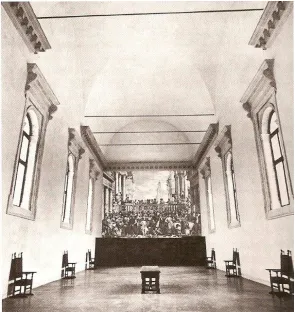
existing building at the time it consulted Palladio was consistent with those of the other scuole piccole
(Fig. 5).The Mercanti‘s merger with the more prestigious Misericordia helped to raise the Mercanti‘s
status and reputation. 32 In its plans for expansion, the Mercanti offered these telling instructions—that its
building be ―Immitando le Vistigie della scole grande.‖ 33 Even though it remained classified as a scuola
piccolo after the merger, the decision was made not only to expand the existing building, but also to add
the albergo normally reserved for scuole grandi.That the Mercanti wanted to associate itself with grander
things is no surprise, as competition between scuole was common during the sixteenth century. A scandal
associated with the Misericordia‘s earlier, pre-merger building efforts was even the subject of one of
Caravia‘s satirical poems. Published in 1541, Caravia‘s poem mocked the building competitions and other
ostentatious misdeeds of the scuole grandi that resulted in neglect of their primary beneficent purposes. 34
The Misericordia, like other scuole, had used designated charity funds for building projects and, as a
result, earned the satirist‘s disdain.
The Mercanti‘s goal of establishing its own prominence can further be seen in the decorations
carried out for the interior of the edifice. Soon after renovations commenced, the Mercanti council
commissioned numerous works from prominent Venetian artists. The current governor of the Mercanti
announced his desire to fill the finished Scuola ―con qualche bella pittura,‖ setting the pattern of future
artistic patronage by the Scuola.35 Not surprisingly, the scuola grande-type albergo was chosen as the
first room to be decorated after the completed renovation. The program kicked off with a 1575
officers. The narrative portrait hung above the bench where the Banca sat in the albergo.36 Soon after, the
brothers added a grand soffit, new walnut benches, and a Nativity of the Virgin altarpiece by Paolo
Veronese‘s brother. 37
Veronese himself was commissioned for an Annunciation to hang over the main
door (Fig. 6). In the work, the coat of arms of the Mercanti and two of the painting‘s commissioners can
be seen on the loggia and the top of the arch. The painting‘s Palladian architecture of the temple façade
and surrounding features is also significant. In 1664, Boschini wrote of the painting‘s ―most majestic
architecture‖ and divine, heavenly quality.38
Later writers described the painting‘s Renaissance loggia
with the ―most stately and Palladian architecture‖ to enclose the Virgin‘s symbolic garden. 39
It is likely
that the reference to Palladian architecture was not lost on period viewers. The Marian cycle culminated
in the ceiling‘s centerpiece, a Coronation of the Virgin by Domenico Tintoretto surrounded by four
Evangelists and Doctors of the Church by Aliense.40
Pictorial cycles in the Mercanti building continued to be commissioned, even to the point that the
current governor‘s inscription plaque became hidden and had to be relocated due to the abundance of
extant paintings in 1581. Thus, in a mere six years, the Mercanti had furbished its meeting hall with
works that approached the quantity and quality of those owned by scuole grandi. The Mercanti were the
only scuola piccolo at this time that commissioned narrative painting cycles, and it certainly had the most
extensive prestigious interior decor of any other scuola piccolo. 41 Such precious decoration prompted
Boschini and other writers of the time to recommend the Mercanti Scuola for visit in their guidebooks
thanks to these and further decorations carried out in the 1590‘s.Among the more than ninety significant
works inside werethree major works made for the next room chosen to be adorned—the upstairs sala
superiore dedicated to the Madonna della Misericordia.42 In 1591, the Mercanti commissioned Jacopo
Tintoretto‘s son Domenico to paint two group portraits of members of the Mercanti Scuola to flank the
altarpiece of the Nativity of the Virgin painted by both father and son (Fig. 7).
These two flanking group portraits deviate from previous scuole portraits in both quality and
content in that the pose, clothing, and compositional formality of the Mercanti leaders are akin to portraits
Figure 6- Paolo Veronese, Annunciation, Accademia Gallery, Venice. © Rachel Erwin, 2010.
departure in that the symbolic vestments of some members are those normally awarded to the scuole
grandi, deep red ―ducal vestments with long fur-trimmed sleeves,‖ two of which have the stola indicating
titles of governor and vice-governor of the Banca.44 The Mercanti took its aspirations even further by
directing that the ceiling of the Mercanti sala superiore imitate the sala superiore ceiling in the Scuola
Grande San Rocco, including a central image of the Brazen Serpent commissioned from Tintoretto. The
similarities between the two ceilings were no coincidence, demonstrating the Mercanti‘s strategy of
‗deliberate‘ imitation.45
After all, Tintoretto‘s San Rocco cycles were said to have ‗won‘ that Scuola the
competition among the scuole grandi.46 The Mercanti continued its deliberate use of Tintoretto and son in
the ground floor androne by commissioning from them narrative wall scenes of St. Christopher and a
ceiling of the Passion of Christ and Evangelists by Domenico, complemented by a Virgin and Child with
St. Christopher altarpiece by Jacopo.47 Therefore, the Mercanti constructed two associations with the
scuole grandi through explicit visual terms—a physical, architectural space as well as illustrious portraits
and painted cycles.
These parallels, however, often go unnoticed in the scholarly literature. It is primarily because of
the simplicity of the Mercanti‘s structural design that several scholars dismiss the importance of
Palladio‘s connection to the commission. In answer to these objections, I offer a parallel visual
connection by turning to another of Palladio‘s works for a group desiring a simpler plan. In 1560, Palladio
began work for the refectory of San Giorgio Maggiore. Construction had begun on the walls when
Palladio was brought in, and he completed the project through supervision and construction as he had
done for the Mercanti. In the refectory, Palladio topped the round-headed refectory windows with straight
cornices combined with large bracketed moldings (Fig. 8).48 On the Mercanti exterior, we see the same
window proportions and fenestrations, topped with the straight cornices (Fig. 9). Palladio repeated this
feature consistently on both primary façades of the Mercanti for a quite similar effect. Because the
building program at San Giorgio predates the renovations to the Mercanti‘s meeting house, this particular
detail shows that Palladio could, and did, use simple design solutions even though they do not seem
Figure 8- Palladio, San Giorgio Maggiore monastery interior. Photo source unknown.
Given the documentation, the issue is not whether or not Palladio was involved but, rather, to
what extent Palladio was allowed to be involved. Due to Venice‘s somewhat conservative tradition and
adherence to its Gothic precedents, architects in Venice often encountered difficulties in completing
projects. This was especially true for non-native Venetians like Sansovino and Palladio who were aware
of neither the local preferences nor the site conditions. Venetian patrons frequently rejected Sansovino‘s
plans, for example, because he proposed vaulting, an element that was not always practical in the
Venetian lagoon.49 In scuole buildings, the faithfulness to tradition sometimes reigned supreme as well.
Sansovino planned for freestanding columns to be incorporated along the canal-facing side of the new
Misericordia Scuola, but the element was immediately dismissed due to the brothers‘ distaste for the
style.50 Sansovino endured years of revisions to his plans for the new Misericordia Scuola. As Manfredo
Tafuri has noted, the role of architects working in Venice was reduced to that of a proto, more akin to a
construction overseer.51 In Sansovino‘s commission for the Misericordia‘s new building, in fact, his role
was referred to as that of proto in 1532.52 Since the nature of the Venetian architect is inherently different
than that of an architect working in Florence or Rome, for example, we must not assume that Palladio
exercised full artistic freedom in any Venetian commission he received. The Mercanti, not being able to
construct an entirely new building, hired Palladio to design and carry out the full extent of its renovations.
Given the restraints of the typical scuole buildings and the role of architects in those building processes,
Palladio‘s input and room for ‗innovation‘ was necessarily limited. These restraints raise an important
question—why use Palladio at all? Not only did the Mercanti gain a building that it could afford, and had
the specifications it desired, but it also bought access to a famous architect‘s reputation. Palladio‘s
standing as preferred architect of church and state enhanced the Mercanti‘s reputation by association,
especially since the Mercanti were the only scuola with a connection to Palladio.
The Mercanti were certainly aware of grander designs but deliberately chose a visually simple
approach. A surviving sketch by Palladio (Fig. 10), for example, is a copy of Sansovino‘s drawing of the
new Misericordia Scuola façade. After rejecting Sansovino‘s designs for vaulting and freestanding
as it was in the building competitions with other scuole, however, it ran out of money before the front was
completed. It remains incomplete today, though at the time of Sansovino‘s death in 1570, when the
Misericordia joined with the Mercanti, it had intentions of finishing the building. Palladio presumably
copied Sansovino‘s original drawing, though the purpose is debatable. It appears that Palladio intended to
publish the drawing in a future book on ‗public architecture‘ and various other ancient and modern
buildings not included in the first printing of the Four Books, showing that he clearly knew and admired
his predecessor‘s design for a more lavish scuola façade.53 Cooper suggests that the drawing could have
even been used to encourage the Mercanti towards a similar type of scuola grande design.54
2.4 Palladio and a Procession
Palladio‘s sketch not only proves his knowledge of grander designs but also serves as an additional visual
image evidencing Palladio‘s tie to the Mercanti. The Mercanti made sure to publicize its affiliation with
the architect in the most public manner possible. Howard theorizes that the Mercanti had the drawing
made into a banner and used it as an ―ephemeral façade‖ for use in a festive procession.55
I find Howard‘s
theory compelling due to the Mercanti‘s connections to the Lepanto celebration and the opportunities that
it presented. As mentioned, the 1572 celebration of the victory at Lepanto held tremendous meaning for
the Mercanti and for the city. In addition to temporary displays and memorials, permanent projects were
erected throughout Venice and its surrounding areas. Venice‘s Arsenale erected various temporary visual
memorials, statuary, and friezes, as did Vicenza to Palladio‘s newly built Loggia del Capitaniato.56 This
connection is interesting because Venice commissioned Palladio to design and construct an elaborate
temporary triumphal arch for the visit of King Henry III of France in 1574.57 Therefore, I find it
reasonable to conceive of Palladio‘s drawing being commissioned or used as a visual architectural image
for this political celebration. The Mercanti‘s use of such a banner, and even its existence, must remain
conjectural, unfortunately. The ephemeral nature of such banners, as well as the loss of archival records,
makes it impossible to say with complete certainty that my reading of this object is accurate. Given the
well-known image of a procession in St. Mark‘s square), however, it is well within the realms of possibility
that a socially self-conscious organization like the Mercanti would have desired, commissioned, and used
such a banner to promote itself during a major public festival.
Such visual objects were frequently used in civic processions, yet the Mercanti were sure to
employ only certain artists to produce images that especially announced its prominent connections. In the
case of Palladio‘s ephemeral banner, the image represented the Mercanti‘s connection to the Misericordia
Scuola and to the architect himself. Tintoretto, as a member of the Scuola and Church, probably provided
visual images for the celebration, as well.58 Tintoretto‘s contributions not only suggested his membership
in the Scuola, but also showed that the Mercanti could attract someone who had membership in, and
performed work for, scuole grandi, the State, and the Orto church.
The Mercanti‘s social aspirations, therefore, were achieved through a variety of visual elements.
The result of the Mercanti renovation is one that is in keeping with both its original building and the
church façade next to it. Though the exterior and general plan of the Mercanti Scuola remained faithful to
the decorum of scuole piccole, the addition of elements like an albergo and painted portraits with nobler
references pointed towards the Mercanti‘s perception of its status as more akin to a scuola grande. At the
same time, it removed itself from the criticisms against the scuole grandi by not asserting its wealth
through sumptuous architecture. The visual architectural conventionality also served to reinforce its social
and spiritual tie to the church of the Orto. Finally, a quite timely procession allowed for an opportune
display of its wealth, piety, and new facilities. As a result, its vision of an improved facility therefore
successfully included exterior and interior adornments that resulted in suitably raising its status in the
competitive world of Venetian citizenry.
3 APPLYING THE MARRIAGE METAPHOR
The union of scuole was common, but the unequal status of these two particular scuole is particularly
intriguing. We are left with the task of trying to understand how such seemingly mismatched partners
contemporary marriage practice. I assert that sixteenth-century Venetian marriage practice provides a
good model for understanding events such as the Mercanti merger. With an understanding of the
Mercanti‘s goals and motivations as explained in the previous sections, I will examine the union in terms
of typical aspects of Venetian marriages.
3.1 A Processional Announcement
Looking again at the 1572 Lepanto festivities, I argue that the Mercanti not only used the procession as an
opportunity to glorify itself and prove its worth, but also used ephemeral objects in a manner similar to
marital processions. The festivities surrounding a proper marriage glorified the bride and put her on
display. One of the most important parts of the extended nuptial rite was the parentado display in which
the finely dressed bride, accompanied by a dance master and instruments, was ceremonially presented to
the entire extended family over several days. Francesco Sansovino wrote of the subsequent gondola visit
to present the bride to relatives in monasteries, a public spectacle witnessed by many in the city.59 Prints
from the period record such gondola processions. A 1565 ―Marriage to the Sea,‖ for example, clearly
shows a bridal gondola as part of the event.60 An impressive procession followed the parentado,
consisting of torch-carrying servants, musicians, and the bridal party processing to the church for the
ceremony and subsequent feast at the groom‘s house.61
Artists were commissioned to produce original
poetry verses (epithalamia), songs, and theatrical displays for the new couple‘s banquet party celebration.
Sources note the superior quality of the epithalamia booklets that were printed and handed out to the
guests, often with an original print for the frontispiece that rivaled any master work of the day.62 Such
pamphlets were abundant throughout Italy and were just as important as any food or spectacle arranged
for wedding guests.63 Marriage was a series of public and semi-public events accompanied by tangible
items that represented the pride and satisfaction of the union.64
In the same manner, the 1572 procession organized by the Mercanti was a celebration of the pride
in its new union, complete with visual accompaniments similar to those used in civic marriage
opened for all to observe and would have put the reconstructed interior, furnishings, and art from
prominent artists on display as a sign of the Mercanti‘s worthiness as a partner for the Misericordia.65
Further, I argue that the Palladian-drawn banner used by the Mercanti in this procession also
functioned like the commissioned epithalamia frontispiece for wedding guests. Triumphal banners were
important objects in the Venetian world, so the use of a banner carried with it various implications. Since
Doge Orseolo introduced banners to Venice in 1000 A.D. when he concurrently instituted the beginnings
of the Marriage to the Sea festivities, banners had long been associated with marital themes.66 Sources
record that banners constituted part of the doge‘s trionfe and were also frequently carried by scuole in
processions.67 Some banners announced the scuole by an emblem (stemma), but exceptional versions with
religious images were commissioned from celebrated painters. Titian painted a processional canvas
banner of Christ Carrying the Cross for the Scuola Grande S. Rocco in 1510. Only ten years later, Marin
Sanudo recorded that the banner, also used as an altarpiece, brought about many miracles. Many people
flocked to see it and gave alms to the Scuola for its plague protection. The Scuola Grande della Carita
commissioned a painted banner in 1506 using the following justification: ―Because it is necessary first to
honour God and then to be equal to the other confraternities.‖68
The Mercanti were aware of the potential
prestige that banners provided a scuola, and by modeling the practice of banners commissioned by scuole
grandi, it likewise announced prominent connections. Since banners could be associated with victorious
political, religious, and marital themes, the Mercanti‘s use of the Palladian banner in the Lepanto
procession was consistent with each of the three themes. Its use was wholly appropriate for the occasion
and gave the Mercanti the opportunity to project its desired image publicly in the same way that couples
used printed epithalamia.
3.2 Physical Identity and Proximity
In addition to choosing the Misericordia due to its vulnerable financial condition and scuola grande
status, the Mercanti selected the Misericordia because of the benefit of physical proximity. The Mercanti
proximity, the Mercanti had the chance to observe the habits and activities of the Misericordia, acquiring
deep knowledge of the requisites of a scuola grande.
The use of coats of arms throughout the city, as well as the division of Venice into districts,
demonstrates the importance of physical location in the creation and maintenance of identity.Venice was
proud of its nobility, especially those with a long lineage in the city. A coat of arms (stemma) signified
the family‘s status and ancestry, but it was common practice for non-nobility to invent and display a crest,
as well.69Stemme projected the identity of the family or scuola, and were placed on furnishings, books,
shields, and in commissioned paintings such as the previously discussed Annunication by Veronese.
Stemme were also placed on the exterior of buildings to indicate the owner. In many cases, stemme
appeared on multiple sides of a building and adjoining properties in order to delineate the extent of each
family‘s land holdings. A particularly illustrative example of this principle is a sculpted arch with stemme
of the Foscari and Mocenigo families (Fig. 11). Placed at the base of a small bridge near the Rialto, the
Gothic arch announces the owners of the street. The two rows of property (twenty-six houses) that
constituted the calle were part of Pellegrina Foscari‘s dowry for her 1491 marriage to Alvise Mocenigo.
Both sides of the arch feature the Madonna della Misercordia type sheltering a donor. On one side is
visible a single kneeling donor and two coats of arms of the Foscari family. The reverse shows both the
Foscari and the Mocenigo coats of arms, plus a pair of donors thought to be the new couple themselves.70
Since everyone walking the streets of Venice encountered daily these public appearances of stemme, a
family came to be associated with the physical place and area in which they resided.Therefore, the
family‘s physical identity was often expressed by area, by palace location, and by proximity.
The primacy of physicality and locationality sheds light on some of the choices made by the
Misericordia and the Mercanti when creating identities. When the Misericordia brothers planned to build
a new building, they opted for the location right across the canal from the old one, on the site of the
hospital they owned.71 It also helps explain why the Mercanti set its sights on merging particularly with
the Misericordia Scuola, as opposed to another scuola grande, since the Misericordia and the Mercanti
Figure 11- Front and Reverse of Foscari/Mocenigo arch, Calle del Paradiso, Venice. Photo courtesy of Daniel Priore.
Figure 12- Madonna della Misericordia with Donors and Saints, Relief above portal, Scuola dei Mercanti, 15-16th C.
[image:32.612.74.374.429.655.2]examined in terms of this notion of physical identity. For Venetians, location was laden with meaning.
This may have largely driven the Mercanti‘s decision to have its building attached to the Orto, which was
a ‗miraculous‘ site and, therefore, an important part of the city‘s fabric. Likewise, when the Mercanti later
decided to enlarge and renovate that initial building, it did so on-site. Just as families transformed their
private palaces into expressions of their identity, the Mercanti renovated its scuola building as a statement
of its newly reconfigured identity. In the same manner that important families employed stemme, scuole
applied their coats of arms to the exterior of edifices they owned and managed. The Misericordia Scuola
was meeting at the Frari while its new building was under construction, but when it joined with the
Mercanti, it brought its fifteenth-century sculpted Madonna della Misericordia plaque (Fig. 12). The
plaque, functioning like a stemma, was transferred to a place of importance above the new Palladian
portal on the building‘s campo-facing side, just above another plaque with an inscription documenting the
new Scuola‘s first governor in 1571.73
This further suggests that the Mercanti considered the renovation
of the building not only as a means of renovating its image but also as a way to mark its new merger and
the creation of a new corporate ‗lineage.‘
3.3 Noble status
The Mercanti‘s merger with the prominent Misericordia parallels other issues of nobility in Venetian
marriage practice. One of the more fraught was that of ―noble‖ status. Noble status was of paramount
importance when pairing couples for marriage, as marriage was a primary factor that determined nobility.
The government repeatedly enacted restrictions to protect or define noble status. Late-thirteenth and
early-fourteenth-century laws, the so-called ‗closing‘ of the Serrata, limited the patriciate to preexisting
governmental families. Patrician qualification had been based on the lineage of the male, but more laws
designed to ascertain lineage more precisely were implemented in 1414 and 1430, and a law of 1422
stated that the mother‘s status must be considered as well as that of the father.74
Similar laws continued
1526 and 1535 follow-up laws which ultimately shifted control of birth and marriage to the state, making
marriage a civil (and therefore public) act.75
Hence, in the fifteenth and sixteenth centuries, the social scene began to change in Venice as
more and more marriageable females were forced into convents due to, among other things, dowry
regulation issues. Since a large majority of these girls were from the upper classes, the pool of ‗available‘
patrician women declined greatly. Certainly patricians were encouraged and expected to marry from
within their own class, but the shortage of bridal candidates resulted in what Hunecke calls a ―rapid
decline in officially registered patrician marriages.‖76 While patrician women were expected to marry
within their class, patrician men were allowed to take ‗commoner‘ (popolani) brides who had ample
funds. Stanley Chojnacki points out that popolani girls were ―explicitly invited‖ by the Venetian
government to choose such elite husbands, even allowing them to pay ¼ larger dowry than patrician
brides.77
In actuality, the incidence of ‗outsider brides‘ marrying patricians had been happening since the
beginning of the fifteenth century, if not earlier.78 The practice of taking non-patrician brides was
prevalent enough to prompt legislation in 1589 that disqualified status to non-patrician wives and their
mothers who had been slaves or engaged in immoral sexual behavior. For heirs to be eligible to sit on the
Great Council, the women must have lived ―modestly and honourably.‖79
Intended, as it were, to secure
the high caliber of the council by restricting certain women, the law in essence substantiated the already
recognized notion that both the marriage and heirs of non-patricians could be legitimate.80 These were the
issues of concern at the time of the Mercanti-Misericordia merger in 1570, less than two decades before
the enforcement of the 1589 laws. No longer was a stigma attached to marrying a bride of lower class, so
long as she demonstrated social values and sufficient material goods. Though some of the patrician class
fought for exclusivity, the reality was that it was common practice for non-nobles to be granted status due
to special financial, military, or monetary situations, especially as the sixteenth and seventeenth centuries
Yet, at the same time, just as classifications of scuole were sometimes fluid, several authors have
recently argued against a strict tripartite division of social classes, instead favoring a view that allows for
a blurring of the lines in regard to patricians, cittadini (citizens), and popolani.81 Alexander Cowan, in
Marriage, Manners and Mobility, describes the huomini civili as a larger, elite social group with a range
of social and financial similarities. Though they were not cittadini by name, most considered these
qualifying factors sufficient to consider such people equivalent to cittadini, if not more. Many were
wealthier merchants, invested in land or owned housing in Venice which, as Cowan points out, many
patricians could not afford.82 Due to the trade-oriented society of Venice, merchants and traders were not
looked upon as having lowly professions, as may have been the case in other Italian regions. Rather,
people spoke proudly of their mercantile dealings by virtue of the fact that they were the foundation of the
elite. Since patricians likewise engaged in merchant activity, the activities of merchants were sometimes
linked to those of patricians, exemplified by Vidal Vidal‘s 1591 petition regarding his daughter in which
he asserted that his father-in-law had undertaken ―large-scale trading in wool in the same way as many
Venetian nobles.‖83
Cowan cites several examples of close, friendly relations between patricians, cittadini, and
huomini civili, including patricians attending weddings and stepping up as godparents for their cittadini
friends. Moreover, they ―proudly recorded their links as fellow members of the scuole grandi,‖84 attesting
to the commonality and goodwill that they shared for each other. In fact, Doge Cristoforo Moro in his
time was a member of the Mercanti Scuola.85 Like most scuole, the Mercanti contained brothers from all
classes, but instead of mere ―craftsmen,‖ the Mercanti were known for being primarily
―merchant-entrepreneur type(s).‖86
Given this broad membership (from merchant to Doge), the Mercanti had no
reason to believe that there would be any real impediment to becoming a scuola grande.It even had
recent precedent in its favor, since the most recent scuola raised to grande status, San Teodoro, was
3.4 An Attractive Dowry
Amicable as the relations between classes might have been, it is hard to deny that cash from a large dowry
was the principal cause for men with superior status to wed women from ‗lower‘ social strata. As Cowan
aptly writes: ―It was one way in which wealthy families outside an elite could gain access to it in
exchange for an infusion of cash or real estate.‖88 Marrying a wealthy merchant‘s daughter could reverse
a patrician family‘s financial misfortunes, as was the case of Francesco Grimani who rose in rank to a
Consigliere because of marital benefits he gained from his union.89 Cowan also notes the letters of
Englishman Sir Henry Wotton which describe the rise in success of Doge Giovanni Bembo from a
poverty-stricken patrician family to supreme ruler, owing to his union with a rich cittadini daughter.90 For
a patrician groom whose family had fallen on hard times, marriage with a wealthy merchant‘s daughter
provided more financial benefits and a higher standard of living for the couple than would marrying
another struggling, financially-strapped patrician bride.
The Mercanti-Misericordia merger, like some patrician marriages, may not have been ideal for
the ‗nobler‘ Misericordia, but was mutually beneficial for all parties involved. The Mercanti gained the
status and prominence it desired while the Misericordia was able to stave off some of its financial woes.
Though direct records of the Misericordia using the Mercanti‘s vast funds may not exist, the Misericordia
would not have agreed to the merger unless it had something significant to gain. Records do indicate that
work continued on the new Misericordia building due in part to finances from a preexisting trust fund, but
the Misericordia may have also been given funds from the Mercanti to aid in the progress of the
building.91 The Mercanti also probably assisted the Misericordia in fulfillment of dues, fees related to the
Turkish war, and expenses necessary for upkeep and daily functions of the Misericordia brothers. Given
the predominate social pattern of noble marriage, it is likely that the Mercanti aided the Misericordia
monetarily in some manner—otherwise the scuola grande would have had little use for merging.
The exchange of benefits and use of money is strikingly similar to the function of a dowry in
marriages. The bride‘s dowry was used, among other things, to acquire real estate or prepare the house for
painted soffitto with nuptial themes.92 Both the Misericordia and the Mercanti continued to decorate the
interiors of their ‗houses‘ with distinguished art and architectural designs. I have suggested that the
Misericordia likely used funds from the Mercanti for its building during this time, and I further assert that
the Mercanti‘s extensive painted cycles carried out in the two decades after the merger represented the
celebration of its ‗marriage‘ and assertion of its status by lavishly furnishing its space. Kent Lydecker and
others regard Renaissance marriage as ―the most important social occasion for the purchase of art and
furnishings.‖93
In addition to soffitto, painted portraits or allegories of marriage were popular items
commissioned by couples to decorate the interior of their homes.94 By the end of the 1590‘s, the
Mercanti‘s painted cycles rivaled those of scuole grandi, an indication that the Mercanti not only saw and
imitated ‗noble‘ taste, but used the same method of soffitto, furnishings and commissioned paintings for
its marriage-like social maneuver.
In addition to a dowry, the value of the bride‘s corredo (part of the trousseau) influenced early
Renaissance marriages in Venice. According to Chojnacki, in the fourteenth century the corredo shifted
from bridal accoutrements to a monetary amount given to the groom, thus becoming another manner in
which to add value to a bride and obtain a more desirable patrician groom.95 Precedent for using marital
unions to attain ―distinction, influence, or patronage‖ was both extensive and longstanding in Venice, as
Chojnacki has shown.96 In the fifteenth century, the motivation for ‗marrying up‘ was related to
governmental benefits; families of brides accordingly pursued grooms from a higher patrician tier.97 One
example is the 1410 union of Luca Falier to Moretto Bragadin‘s illegitimate daughter, Isabetta. Falier‘s
family was of the ‗casa vecchia‘ patriciate of Venice but was enticed into a very handsome deal due to
Isabetta‘s 1,000 ducat corredo along with the 1,500 ducat dowry.98 Isabetta‘s brothers and heirs would
have also reaped socio-civic opportunities from the connections formed through the marriage.
Besides having the status of scuola grande, theMisericordia was also one of the older scuole
grandi, comparable to a ‗casa vecchia‘—old nobility with a long lineage in the city. The Mercanti
recognized that certain level of prestige and aimed to become a scuola grande just as brides like Isabetta
connections gained by the bride‘s family parallels the same increases that the Mercanti desired and hoped
to attain through its union with a more prominent ‗groom.‘ The Mercanti did achieve benefits resulting
from its merger, yet it inaccurately judged that it could officially attain equal status by stepping into the
lesser, ‗feminine partner‘ role. In Isabetta‘s case, her male brothers and heirs were the ones who stood to
inherit significant advanced social position, not the ‗bride‘ herself.
3.5 Religion, Paternal Roles and Male Identity
Coinciding with the move to safeguard the status of the patriciate in the fourteenth and fifteenth centuries,
governments of Italian city-states began redefining and implementing increased measures of criminal
justice.99 Venice was no exception, and sexual morality was especially enforced. Whether this was in
response to troubles in the socioeconomic sphere, as some scholars suggest, or in response to issues of
ecclesiastical reform, officials probably did not expect the backlash that resulted in a ―culture of illicit
sexuality.‖100
The key to the moral and social reform was proper male identity, focusing on paternal
authority to provide a disciplined household.101 In light of this, it makes sense that the Mercanti would
stress propriety in its actions. Using caution in how it would be perceived regarding its building
renovation, the Mercanti ensured that the structure did not become subject to scrutiny and criticism. At
the same time, aligning with the well-respected Orto church encouraged an association with its piety and
religious devotion. Merging with the Misericordia provided elevated status for the Mercanti, but its goals
of advancing fully to scuola grande status would result in greater responsibility in the Republic since
scuole grandi were in close relationship with the Council of Ten and participated in more civic affairs.
The Mercanti might have perceived a promotion to grande status as inheriting a position even closer to
the mythical ideal of ‗Venice‘ herself. Though the Doge took on the male role of ‗marrying‘ Venice and
her sea, the whole governmental structure was enveloped in the identity of the female figure of ‗Venetia,‘
a female personification who appeared in many allegorical paintings. Thus, a view of the Mercanti as a
Even the structure of the Venetian government demonstrates how invested it was in encouraging
moral and stable marriage alliances. Life-long bachelors, for example, tended to hold lower posts while
married men achieved the higher offices of Senator and member of the Council of Ten.During the years
of 1438-1455, for example, only one of seventy-four men who filled these high positions was
unmarried.102 Those in positions to enact reformative laws in Venice were charged with rehabilitating
social order in their own homes. Indeed, it was difficult to conceive of lifelong bachelors possessing
paternal authority. Therefore, suitable male identity equaled paternal male identity.
Male identity was not new in Venice, as the office of doge was associated with supreme male
power. Venice and her government were further associated with paternal roles in their displays of
‗marriage.‘ La Sensa, Venice‘s marriage to the sea, was an annual celebration on Ascension Day that,
more than any other ritual, suggested what Chojnacki calls the ―symbolic grandeur of patrician
husbandhood.‖103
The origins of the feast date back to approximately 1000 A.D. at the church of San
Nicolò al Lido when Doge Orseolo blessed the Adriatic Sea upon returning from a foreign expedition.
When the rite of blessing later evolved into the lavish feast of La Sensa, the association with San Nicolò
remained.104 Edward Muir points out that the importance of the cult of Saint Nicholas in Venice was
related to fertility, making the marriage to the sea festival even further connected with marital and sexual
themes.105 The actual marriage moment took place at the mouth of the lagoon near the Lido when the
doge threw his golden ring into the sea with a vow of both betrothal and domination.106 The groom and
his retinue then disembarked at the church of S. Nicolò for prayer and an extended feast. This practice has
striking similarity to patrician unions in which the couple processed in extravagance on gondolas and held
a large banquet after their ceremony. It is easy to understand why noble citizens would want to imitate
this time-honored celebration of the Sensa due to its prestige and implications of divine right to rule.
Couples even desired to wed during the Ascension feast season due to its nuptial association.107
In the thirteenth century, another nuptial-themed event was founded when Doge Ziani, upon the
behest of Bishop Ugolino, built a church (and later added a convent) in honor of a demolished one in