Hydrol. Earth Syst. Sci., 22, 4183–4200, 2018 https://doi.org/10.5194/hess-22-4183-2018 © Author(s) 2018. This work is distributed under the Creative Commons Attribution 4.0 License.
A classification algorithm for selective dynamical
downscaling of precipitation extremes
Edmund P. Meredith, Henning W. Rust, and Uwe Ulbrich
Institut für Meteorologie, Freie Universität Berlin, Carl-Heinrich-Becker-Weg 6–10, 12165 Berlin, Germany Correspondence:Edmund P. Meredith ([email protected])
Received: 7 November 2017 – Discussion started: 7 December 2017 Revised: 3 May 2018 – Accepted: 12 July 2018 – Published: 7 August 2018
Abstract.High-resolution climate dataO(1 km) at the catch-ment scale can be of great value to both hydrological modellers and end users, in particular for the study of extreme precipitation. While dynamical downscaling with convection-permitting models is a valuable approach for pro-ducing quality high-resolutionO(1 km) data, its added value can often not be realized due to the prohibitive computational expense. Here we present a novel and flexible classification algorithm for discriminating between days with an elevated potential for extreme precipitation over a catchment and days without, so that dynamical downscaling to convection-permitting resolution can be selectively performed on high-risk days only, drastically reducing total computational ex-pense compared to continuous simulations; the classifica-tion method can be applied to climate model data or re-analyses. Using observed precipitation and the correspond-ing synoptic-scale circulation patterns from reanalysis, char-acteristic extremal circulation patterns are identified for the catchment via a clustering algorithm. These extremal pat-terns serve as references against which days can be classified as potentially extreme, subject to additional tests of relevant meteorological predictors in the vicinity of the catchment. Applying the classification algorithm to reanalysis, the set of potential extreme days (PEDs) contains well below 10 % of all days, though it includes essentially all extreme days; applying the algorithm to reanalysis-driven regional climate simulations over Europe (12 km resolution) shows similar performance, and the subsequently dynamically downscaled simulations (2 km resolution) well reproduce the observed precipitation statistics of the PEDs from the training pe-riod. Additional tests on continuous 12 km resolution histor-ical and future (RCP8.5) climate simulations, downscaled in 2 km resolution time slices, show the algorithm again
reduc-ing the number of days to simulate by over 90 % and per-forming consistently across climate regimes. The downscal-ing framework we propose represents a computationally in-expensive means of producing high-resolution climate data, focused on extreme precipitation, at the catchment scale, while still retaining the advantages of convection-permitting dynamical downscaling.
1 Introduction
Hydrological modellers and regional decision-makers bene-fit greatly from high spatialO(1 km) and temporal resolution climate data to both drive their catchment-scale hydrological models and design regional planning strategies. These high-resolution data are necessary as standard-high-resolution model data O(10–100 km) suffer from many deficiencies, most noticeably both “averaging” and “scale-interaction” effects whereby (i) area averaging over large grid cell areas smooths out fine-scale detail and (ii) feedbacks from small to large scales are not represented (Volosciuk et al., 2015); these dele-terious effects are amplified towards the tails of the distribu-tion (Volosciuk et al., 2015). Despite their desirability, suit-ably high-resolution datasets are rarely available, either due to the computational expenses associated with running cli-mate models at such high spatial resolutions or, in the case of observations, due to insufficiently dense observational net-works. To bridge this gap, both statistical and dynamical downscaling techniques have been developed for precipita-tion (Maraun et al., 2010) and other variables.
(i.e. observations) are developed, allows large ensembles of high-resolution climate data to be produced from coarse-resolution models at minimal computational expense and tai-lored to specific end-user needs. Such relationships can, how-ever, only be developed in the presence of both appropriate local weather data (typically observations) and correspond-ing large-scale data (reanalysis or observational data), which are often unavailable at sub-daily and sub-hourly temporal resolutions and/or are spatially too sparse. Dynamical down-scaling with regional climate models (RCMs), O(10 km), provides an alternative to the statistical approach, which is, however, computationally far more expensive. Issues of computational expense aside, both methods have their own strengths and (sometimes common) weaknesses. The rep-resentation of large scales in the parent general circulation model (GCM) can be a limiting factor, the so-called “garbage in, garbage out” problem (Rummukainen, 2010). If the large scales are not skilfully represented, then downscaling tech-niques cannot add value (Benestad et al., 2008) as errors in the large scales will not be corrected; isolated examples of value being added via RCMs correcting large-scale errors have, however, been reported (e.g. Veljovic et al., 2010). The assumption of stationarity – that predictor–predictand rela-tionships will remain unchanged in a future climate – in RCM parametrizations and statistical downscaling methods may also not be valid (Takayabu et al., 2016), lowering con-fidence in projections. Statistical and dynamical downscal-ing both produce climate change signals that are, to varydownscal-ing degrees, influenced by the climate change signal of the par-ent GCM. If the GCM has an incorrect climate-change sig-nal this may be inherited without meaningful modification. Takayabu et al. (2016) further discuss different facets of the statistical and dynamical downscaling approaches, addition-ally explaining that the approaches are complementary and can be combined, rather than being treated as mutually ex-clusive alternatives.
In general, high-resolution RCMs (∼10 km) add value to coarser GCMs for multiple variables (Feser et al., 2011). This added value (AV) is primarily achieved through better representation of surface forcings and mesoscale processes and is thus most evident in the presence of complex topog-raphy (Heikkilä et al., 2011; Torma et al., 2015) or strong land–sea contrasts (Feser et al., 2011). For example, recent studies have shown cases in which high-resolution RCMs can not only modify but even reverse the mean-precipitation climate-change signal in their parent GCM (Torma et al., 2015), which is attributable to their representation of com-plex topography and ability to hence simulate increased con-vective activity at higher elevations in a warmer climate. Pre-cipitation, due to its high spatial and temporal variability, is perhaps the variable for which high-resolution RCMs exhibit the most AV. The strongest manifestations of AV for pre-cipitation are found at short temporal scales, in the warm season, and in regions of complex topography regardless of temporal scale and season (Di Luca et al., 2012); AV is
most evident for the extremes (Heikkilä et al., 2011). Impor-tantly, this AV should not simply be understood as represent-ing increased small-scale detail, but rather AV at the spatial scale of the driving GCM due to more processes being repre-sented (Torma et al., 2015). As input for impact and hydro-logical models, dynamical downscaling can provide a large set of physically consistent variables (Rummukainen, 2010), meaning that, for example, changes in cloud cover will be reflected in appropriate knock-on effects on other input vari-ables such as radiation, temperature, humidity, surface pres-sure, etc.
Despite their relatively high resolution, typical RCMs O(10 km) still cannot resolve many precipitation-causing processes such as convection, which must instead be parametrized. As a result, models with parametrized convec-tion tend to misrepresent heavy precipitaconvec-tion events, causing them to be too temporally persistent, too spatially widespread and not intense enough locally (Kendon et al., 2012); fur-ther issues are too much drizzle (Boberg et al., 2009) and a temporally displaced diurnal convective cycle (Hoheneg-ger et al., 2008). Increasing horizontal resolution below about 4 km, convection-permitting models (CPMs) can ex-plicitly simulate deep-convective processes and improve on many of these shortcomings (Prein et al., 2015). The ex-plicit representation of convective dynamics in CPMs pro-duces more realistic convective features (Weisman et al., 2008), more accurate local precipitation intensities (Lean et al., 2008), and an improved representation of the diur-nal convective cycle (Prein et al., 2013). With respect to the accuracy of precipitation totals, the main AV of CPMs can be expected to be found in area averages over, for exam-ple, a river catchment (Roberts, 2008). Importantly, the AV of CPMs is not restricted to improved present-climate pre-cipitation statistics (e.g. Ban et al., 2014), but may also ex-tend to the climate change signal. Recent studies show that sub-daily convective extremes in CPMs exhibit an amplified response to enhanced boundary forcings compared to that found in their coarser parametrized-convection parent mod-els (Kendon et al., 2014), which can be highly non-linear (Meredith et al., 2015). The explicit simulation of physical process chains in CPMs, which can be highly localized, gives more confidence in their projections than those derived from models using convective parametrizations.
E. P. Meredith et al.: Selective dynamical downscaling 4185
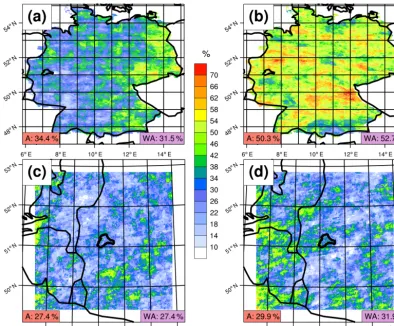
Figure 1.Coarse-resolution model extreme precipitation is a poor predictor of extreme precipitation in both observations and high-resolution simulations. Plots show the rate at which extreme precipitation events in a coarse model are temporally and spatially coincident with extreme precipitation events in(a, b)observations and(c, d)further downscaled high-resolution simulations.(a)For summer extreme precipita-tion (1979–2015), the percentage of 99th percentile days in ERA-Interim (Dee et al., 2011) for which the corresponding day in observaprecipita-tions (REGNIE; Rauthe et al., 2013) exceeds the observed99th percentile; percentiles are over all days. A value of 100 % would mean that, for a given grid cell, all “extreme” dates in ERA-Interim were also “extreme” dates in REGNIE.(b)As in(a), except for winter (1980– 2015).(c, d)As in(a), except between the 0.11 and 0.02◦CLM simulations discussed in Sect. 2 for the(c)historical (1970–1999) and
(d)RCP8.5 (2070–2099) periods. Values in the bottom-left of each panel show the area average over all data points, while values in the bottom right show area averages over the Wupper catchment in western Germany (marked; see also Sect. 2).
be viewed as wasted computational time. In an ideal proce-dure, dynamically downscaling to convection-permitting res-olution might be skipped on these redundant days and only be carried out when there is a significant chance of the catch-ment experiencing heavy precipitation. Similarly, some users are more interested in assessing the catchment-scale impacts of a selection of physically plausible extremes from a present or future climate, without being focused on precise probabil-ities derived from continuous CPM simulations (Hazeleger et al., 2015); examples of this include design situations for hydraulic infrastructure, process-oriented case studies, and stress testing. The identification of which days to downscale, however, is a non-trivial task. Coarse model precipitation on its own is a poor predictor of extreme precipitation events in both observations and CPMs, especially in the summer, when
precipitation extremes tend to be of short duration and of a convective nature (Fig. 1).
With the aim of slashing computational time and expense, we develop a transferable methodology to discriminate be-tween days with an increased likelihood of extreme precipita-tion – potential extreme days (PEDs) – and redundant days so that dynamical downscaling to convection-permitting resolu-tion can be performed over a catchment only when a day has been identified as a PED. In Sect. 2 we set out in detail our methodology and validation approach, with the subsequent sections containing results, discussion and conclusions.
2 Methodology and data
ex-treme days” (PEDs) – over the region of interest, we develop a two-step classification method based on (1) the synoptic-scale circulation pattern and (2) local-synoptic-scale (modelled) mete-orological predictors in the coarser-resolution parent model. This requires the identification of synoptic-scale circula-tion patterns that typically accompany extreme precipitacircula-tion events in our catchment and the careful selection of meteoro-logical predictors that, when a defined threshold is exceeded in the vicinity of the catchment, are conducive to the devel-opment of intense precipitation.
Our study catchment is that of the River Wupper in west-ern Germany (Fig. 2). The Wupper catchment, home to some 950 000 inhabitants, has an area of 813 km2, contains about
2300 km of streams and rivers, and drains into the River Rhine. The Wupper basin is vulnerable to winter flooding and summertime flash-flooding from mesoscale convective events; we thus focus on these two seasons.
2.1 Identification of synoptic-scale extremal circulation patterns
The REGNIE gridded daily precipitation dataset (Rauthe et al., 2013), developed by the German weather service specifically for hydrological applications and with a grid spacing of roughly 1 km, is used to compute separate time series of observed daily precipitation area-averaged over the Wupper catchment (Fig. 2) for each full winter and summer in the period 1979–2015. From these time series the 99th pre-cipitation percentiles of all days are computed separately for each season, and all days above theirseasonal99th percentile are defined as “extreme”. The areal extent of the Wupper catchment contains 753 REGNIE grid cells; precipitation-recording stations of the German weather service are marked in Fig. 2. An advantage of the REGNIE dataset is that mea-sured totals are conserved, so that observed events (dry or wet) can be found preserved in the gridded field, which is in contrast to other methods on coarser grids, which use smoothing (Rauthe et al., 2013). Despite this, the usual warn-ings about using gridded observations to study heavy precipi-tation events must be recalled. In the absence of a sufficiently dense rain-gauge network in and around the catchment, the spatial variability and local intensity maxima of heavy pre-cipitation events will not be captured in the gridded prod-uct, leading to precipitation extremes that are both underesti-mated and too spatially homogeneous, in particular in areas of complex topography and for convective events (e.g. Hofs-tra et al., 2010; Ly et al., 2011). The rain-gauge network un-derlying the gridded dataset must thus be sufficiently dense so that catchment-relevant extremes are acceptably captured. Alternatively, individual station(s) known to be broadly rep-resentative could be used for small- to medium-sized catch-ments.
[image:4.612.309.544.68.230.2]To identify the large-scale circulation patterns associated with the heavy rainfall days, the corresponding 500 hPa geopotential height (Z500) anomalies are extracted from the
Figure 2. The Wupper catchment (black outline) with main tributaries and lakes, and the River Rhine running north-northwestwards. Shading represents the regional orography as represented in the 0.02◦ CCLM model used in the simulations
(see Sect. 2.3). Note that this is not the full 0.02◦ simulation
domain, but rather a close-up of the Wupper catchment; the full spatial extent of the CPM domain and the exact region covered by this map are marked in the inner box of the top-left panels in Figs. 3 and 4. Magenta-coloured circles mark the precipitation-recording stations of the German weather service, as listed here https://www.dwd.de/DE/leistungen/klimadatendeutschland/ statliste/statlex_html.html?view=nasPublication&nn=16102.html (last access: 25 July 2018). Note that some stations do not cover the entire 1979–2015 period.
ERA-Interim reanalysis (Dee et al., 2011). REGNIE precip-itation has a measurement period of 07:30–07:30 LT (local time), equating to 05:30–05:30 UTC in summer and 06:30– 06:30 UTC in winter. Z500 anomalies are thus averaged over the timesteps 12:00, 18:00 and 00:00 UTC, i.e. the middle of the accumulation period, and are relative to their 1979– 2015 seasonal means.
precip-E. P. Meredith et al.: Selective dynamical downscaling 4187
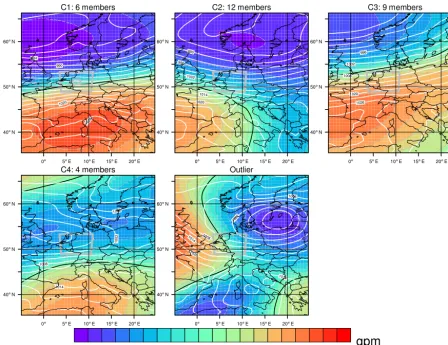
Figure 3.500 hPa geopotential height anomalies (shading) of extremal circulation patterns identified for the Wupper catchment in winter, via the clustering algorithm, and one outlier; the zero line is marked in black. White contours represent the accompanying sea level pressure patterns. The grey box centred over western Germany is the 0.02◦simulation domain (Sect. 2.3).
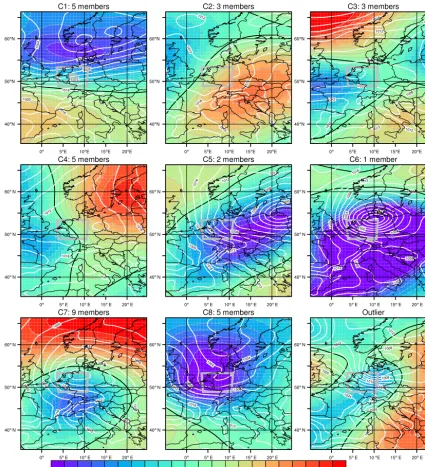
itation in the Wupper catchment can be captured within the domain when present (Figs. 3 and 4), which is easily identi-fiable from historical extremes. Prior to the cluster analyses, outliers that would have little chance of being assigned to an appropriate cluster are removed from the datasets. Out-liers are identified by computing, for each day, the Pearson pattern correlation of each Z500 anomaly pattern with that on all other extreme days; any day whose maximum pattern correlation (i.e. across all days) is more than 2 standard devi-ations below the sample mean of the same is excluded from the cluster analysis. In our case, this results in just 1 day being removed from each of the winter and summer input data, leaving 31 and 33 days respectively. As a stability crite-rion, the number of clustersKis increased until the minimum intra-cluster pattern correlation – that is, the Z500-anomaly pattern correlation between each cluster member and its own cluster mean – is not less than 0.5. This way all days are as-signed to a cluster with which they have genuine similarities, rather than simply the error-minimized “least bad” cluster, as
is typically the case in clustering large datasets of meteoro-logical variables.
The resulting Z500 anomaly clusters and any outliers are considered as “reference” extremal circulation patterns against which candidate days from a given dataset can be classified as PEDs, based on their similarity to these refer-ences. To this end, the area-weighted Pearson pattern cor-relationρi,j (uncentred) between the Z500 anomaly fields of the candidate day i and the cluster centroid j is used; for our clustering domain (Figs. 3 and 4) this encompasses 1935 data points (i.e. grid cells). A perfectρi,j would have a value of 1. With the guiding aim of correctly classifying as many extreme days (i.e.P ≥P99D) and rejecting as many non-extreme days as possible, a ρ threshold (ρjt) is
Figure 4.As in Fig. 3, except for summer.
2.2 Assessment of local-scale meteorological predictors
All remaining days not rejected based on theirρi,j are next assessed in terms of relevant meteorological predictors at the local-scale, i.e. in the vicinity of the catchment. The choice of meteorological predictor and the area around the catch-ment in which it is assessed are flexible. In general, they may depend on the catchment, season and variables avail-able from the coarser parent model. Chan et al. (2018) advise choosing predictors that are easy to diagnose from coarse-resolution models and consistent with meteorological
knowl-edge of precipitation extremes, e.g. circulation and stability metrics. Guidance may also be sought from statistical down-scaling techniques that have been successfully applied in the region.
at-E. P. Meredith et al.: Selective dynamical downscaling 4189
Table 1.Predictor variables, thresholds and region. Note that these thresholds are relative to the model’s and reanalysis’ own climatology, so that the absolute values of the anomalies and percentiles will vary depending on the model and reanalysis on which the classification algorithm is being applied. On the Gaussian N128 grid, one cell has a width of roughly 75 km. These predictors and thresholds could be used as a starting point if applying the method to other catchments, though they should not be directly transferred without first considering meteorological characteristics specific to heavy rainfall events in the new catchment.
Variable Threshold DJF Threshold JJA Time method Cells Horizontal divergence (500 hPa) 90th percentile 90th percentile Daily maximum 7×7 Relative humidity 97.5 % (300 hPa) 86 % (700 hPa) Daily maximum 7×7
CAPE n/a 90th percentile Daily maximum 7×7
Model precipitation 95th percentile (all days) 95th percentile (all days) Daily sum 3×3
n/a=not applicable.
mospheric instability, and daily accumulated coarse-model precipitation (JJA, DJF). As with the Z500 data, variables are extracted from ERA-Interim on a Gaussian N128 grid (∼0.7◦). To account for the transient nature of many ex-treme weather systems and the often low temporal resolu-tion of reanalysis or model data (e.g. 6-hourly in the case of ERA-Interim), it is not only the nearest ERA-Interim grid cell to the catchment centre that is considered, but an en-tire area of 7×7 grid cells around it (3×3 in the case of coarse-model precipitation). With the guiding aim of “catch-ing” the highest number of observed precipitation extremes (i.e.P ≥P99D) while excluding as many other days as
possi-ble, exceedance thresholds for each variable areempirically
chosen, either as exceedances of a given percentile (diver-gence, CAPE, coarse-model precipitation) or as absolute val-ues (relative humidity). The thresholds used for the Wupper catchment are summarized in Table 1. To account for dif-ferent model climatologies and thus facilitate transferabil-ity to other models, the (absolute) relative humidtransferabil-ity thresh-old (RHthresh) determined from the training data can be
rede-fined as a function of the model’s climatological mean (RH), i.e. RHthresh=A·RH, withAa constant; this function can be applied to another model’s RH to get RHthreshfor that model.
In order to be classified as a PED, each threshold must be exceeded at any one of the grid cells (not necessarily the same cell) around the catchment. A schematic summarizes the full two-step selection algorithm (Algorithm 1). Extremal patterns identified for the Wupper catchment are presented in Sect. 3.1.
2.3 Validation and simulation
The combination of variables, thresholds and clusters for de-tecting observed precipitation extremes and excluding non-extreme days is, as discussed above, empirically determined on the basis of the ERA-Interim and REGNIE datasets. Once this has been achieved, the method is applied identi-cally to 0.11◦ (∼12.2 km) evaluation simulations over the
pan-European EURO-CORDEX domain (Jacob et al., 2014), roughly 25–72◦N, 20◦W–50◦E, covering the period 1979–
2015. Simulations were performed with the regional
cli-mate model COSMO-CLM (CCLM; Rockel et al., 2008) ver-sion 4.8, with ERA-Interim reanalysis (Dee et al., 2011) as lateral boundary forcing. CCLM is the community model of the German regional climate research community jointly fur-ther developed by the CLM-Community. The years 1989– 2008 were simulated by the CLM-Community as part of the EURO-CORDEX experiment (Kotlarski et al., 2014). The years 1979–1988 and 2009–2015 (up to 31 July 2015) were simulated by the present authors using identical model ver-sion and settings.
Z500 CCLM data are interpolated to the clustering domain and the selected meteorological variables are conservatively regridded to a grid of similar spatial resolution to that used in the training stage, i.e. 0.7◦, and centred on the Wupper
catch-ment. All winter and summer days are then either classified as PEDs for further dynamical downscaling with CCLM to a convection-permitting resolution of 0.02◦(∼2.2 km) or
re-jected; the nesting ratio of 5.5:1 is in line with that recom-mended in the literature (Denis et al., 2003). The enhanced performance of CCLM at convection-permitting resolution (relative to coarser resolutions) in reproducing precipitation statistics, particularly extreme statistics, over central Europe has been extensively documented (Ban et al., 2014; Fosser et al., 2015; Brisson et al., 2016b).
ex-tremes highly sensitive to localized soil-moisture anomalies may be inadequately represented under such a procedure.
Lateral boundary conditions are updated every 3 h and 50 unevenly spaced terrain-following vertical levels are used. For each identified PED, the 0.02◦ simulation is initialized
at 12:00 UTC the preceding day to allow abundant precip-itation spin-up time; as little as 3–6 h are typically suffi-cient in CPMs though (Sun et al., 2012). PEDs on consec-utive days are downscaled continuously to save resources. For validation, the precipitation statistics of the dynamically downscaled PEDs from the CCLM evaluation runs are com-pared with those of the observed PEDs identified from ERA-Interim. Area averages of daily precipitation over the Wupper catchment are considered, using REGNIE and 0.02◦ model
output. The REGNIE and CCLM grids are of similar spa-tial resolution (1 and 2.2 km, respectively). Users should nonetheless be cognizant that datasets of different resolu-tion may exhibit differing statistical characteristics simply because of their different resolutions, e.g. for the area mean. The evaluation and validation of the identified PEDs is pre-sented in Sect. 3.2.
2.4 Verification via seasonal time-slice simulations
To provide a sterner test of the method, we additionally per-form two sets of 30-season convection-permitting time-slice simulations over the Wupper catchment so that the method can also be assessed in reverse – of the actually simulated 0.02◦extreme days (P ≥P
99D), how many would have been
identified as PEDs from the 0.11◦coarse model?
A different GCM – the Max Planck Institute’s Earth Sys-tem Model (MPI-ESM-LR) – at the start of the modelling chain provides a new challenge for the method from the pre-vious ERA-Interim-driven simulations. The MPI-ESM-LR runs are continuous transient simulations performed as part of the CMIP5 project (Taylor et al., 2012), using observed greenhouse gas concentrations from 1949–2005 (historical) and Representative Concentration Pathway 8.5 (RCP8.5; Van Vuuren et al., 2011) from 2006 to 2100. One MPI-ESM-LR member (1949–2100) has been continuously downscaled with CCLM over the EURO-CORDEX domain to 0.11◦
res-olution by the CLM-Community (Keuler et al., 2016); model settings are as in the previously discussed ERA-Interim-driven evaluation runs, greenhouse gas concentrations ex-cepted.
For the present study, we have dynamically downscaled the aforementioned 0.11◦ CCLM transient simulations to
0.02◦over 30 summers from the historical and RCP8.5
pe-riods, 1970–1999 and 2070–2099 respectively. The 0.02◦
model domain and set-up are the same as in Sect. 2.3 (green-house gas concentrations aside); simulations are initialized in April and runcontinuouslyuntil the end of August each year, with analysis restricted to JJA. Summertime extreme precip-itation in the Wupper basin tends to be of a convective and more catchment-scale nature than its wintertime counterpart,
with small-scale variability and chaotic processes playing an enhanced role in event intensity. In addition to this, poten-tial differences in large-scale circulation found in a future climate pose an additional challenge for the classification al-gorithm. The choice of 30 summers, historical and future, is thus intended to ensure a robust testing of our method. The performance testing via seasonal time-slice simulations is presented in Sect. 3.3.
3 Results and discussion
3.1 Extremal circulation patterns for the Wupper catchment
convec-E. P. Meredith et al.: Selective dynamical downscaling 4191 coarser parent model. Chan et al. (2018) advise choosing predictors that are easy to diagnose from coarse-resolution models and consistent with meteorological knowledge of precipitation extremes, e.g. circulation and stability metrics. Guidance may also be sought from statistical downscaling techniques which have been successfully applied in the region. For the Wupper catchment in summer (JJA) and winter (DJF) we select daily maxima (0600-0559 UTC) of relative humidity (700 hPa JJA, 300 hPa DJF) as an indicator of (near-)saturated air masses in the troposphere, 500 hPa horizontal divergence (JJA, DJF) as
5
an indicator of tropospheric vertical ascent (of a frontal or convective nature), convective available potential energy (CAPE; JJA) as an indicator of atmospheric instability, and daily accumulated coarse-model precipitation (JJA, DJF). As with the Z500 data, variables are extracted from ERA-Interim on a Gaussian N128 grid (∼0.7◦). To account for the transient nature of many extreme weather systems and the often low temporal resolution of reanalysis/model data (e.g. 6-hourly in the case of ERA-Interim), it is not only the nearest ERA-Interim grid cell to the catchment centre which is considered, but an entire
10
7x7 cells around it (3x3 in the case of coarse-model precipitation). With the guiding aim of ‘catching’ the highest number of observed precipitation extremes (i.e. P≥P99D) while excluding as many other days as possible, exceedance thresholds for each variable areempiricallychosen, either as exceedances of a given percentile (divergence, CAPE, coarse-model precipitation) or as absolute values (relative humidity). The thresholds used for the Wupper catchment are summarized in Table 1. To account for different model climatologies and thus facilitate transferability to other models, the (absolute) relative humidity threshold
15
(RHthresh) determined from the training data can be redefined as a function of the model’s climatological mean (RH), i.e. RHthresh=A·RH, withAa constant; this function can be applied to another model’sRHto getRHthreshfor that model.
In order to be classified as a PED, each threshold must be exceeded at any one of the grid cells (not necessarily the same cell) around the catchment. A schematic summarizes the full two-step selection algorithm (Algorithm 1). Extremal patterns identified for the Wupper catchment are presented in Sect. 3.1.
20
Algorithm 1Schematic of theclassification algorithmfor identifying PEDs in summer. Example for a single dayi.
ρi,j is the Pearson pattern correlation between day i and extremal pattern j, RH700 is relative humidity at 700 hPa,
DIV500is horizontal divergence at 500 hPa,CAPEis convective available potential energy,Pis accumulated daily precip-itation.ρjt (i.e. ρthresholds) are determined as described in Sect. 2.1. if tests of local-scale meteorological variables are performed using the thresholds and grids described in Table 1. Ifanyof the cells in the grid pass the test, then the next test is applied. For winter the algorithm is the same, except that CAPE is excluded and relative humidity is at 300 hPa.
forjin(1, . . ., K)do // Extremal patterns 1 to K
if(ρi,j≥ρjt)then // Synoptic-scale tests
if(RH700i≥RH700thresh)then // Local-scale tests
if(DIV500i≥DIV500thresh.OR.CAP Ei≥CAP Ethresh)then
if(Pi≥P95D)then
DAYiclassified as PED end if
end if end if
end if
end for
6
Algorithm 1.
tive cells can develop, across the catchment. A not dissimilar pattern was also identified by Brigode et al. (2013) in their study of extreme precipitation in Austria.
3.2 Evaluation and validation of identified PEDs
While still capturing more or less all observed extreme days, the constraints derived from ERA-Interim variables enable the classification algorithm to reduce the number of PEDs to well below 10 % of all days (Table 2). In the process, the number of “redundant days” (i.e.P < P90D) falls from about 3000 to 48 in winter and 126 in summer. The “redundant days” thus occupy a much smaller fraction in the PEDs than in the set of all days. Such a good performance in the training dataset is, however, no surprise.
Applying the same methodology to the 0.11◦CCLM
eval-uation runs (ERA-Interim driven) over the same period, a similar number of PEDs are identified for dynamical down-scaling to 0.02◦ (Table 2). The PEDs again represent well
below 10 % of all days, slashing the computational expense against a continuous simulation of the whole period by an or-der of magnitude. Of note is that although the 0.11◦CCLM
simulations are forced at the lateral boundaries by ERA-Interim, only 123 of the 320 dates identified as PEDs in CCLM in summer are also found amongst the ERA-Interim PEDs. This is attributable to the fact that RCMs without in-terior constraints (i.e. some form of internal nudging) can-not synchronously reproduce the local-scale day-to-day vari-ability of their parent model (Maraun and Widmann, 2015). RCMs of sufficiently large domain size thus often generate large internal variability (e.g. Lucas-Picher et al., 2008), of-ten comparable to that found in GCMs (Chrisof-tensen et al.,
2001), which can cause the local RCM solution to signif-icantly deviate from that of its parent model. In the pres-ence of a strong zonal throughflow, e.g. in winter, the growth of differing internal solutions is limited due to small-scale perturbations being more rapidly swept out of the domain (Giorgi and Bi, 2000). This explains the higher fraction of common days that we find in winter (150/220).
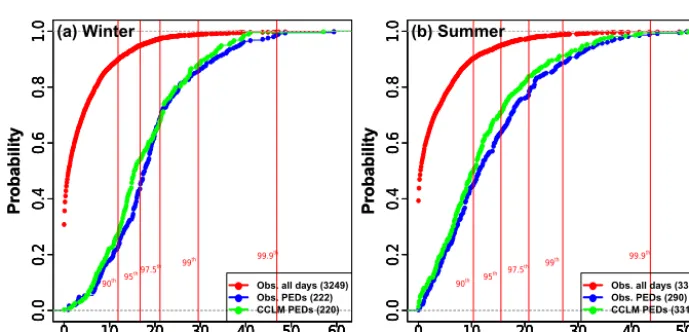
Comparing the empirical cumulative distribution func-tions (ECDFs) for catchment-averaged precipitation (ob-served) of all days and PEDs from the training dataset (ERA-Interim), the greatly increased probability of heavy precipi-tation on a randomly selected PED becomes apparent (Fig. 5, blue curve): in the set of PEDs, the probability of exceeding the climatological winter (a) 99th (90th) percentile is about 20 % (80 %), whereas in the set of all days it is only 1 % (10 %). For summer (b), the situation is less pronounced but the climatological (JJA) 99th (90th) percentile is exceeded on about 15 % (60 %) of the days in the PED set. Taking all days, the ECDF can be well described by a typical gamma distribution; the gamma distribution is known to represent the bulk of the daily precipitation distribution well, though it performs less well for the tails (Rust et al., 2013). The form of the ECDF of the observed PEDs (blue curve), however, is far removed from that of the set of all days (red curve), as the probability is shifted towards more intense precipitation. The change in form of the ECDF – from one dominated by dry to light-rain days, to one dominated by heavy- to extreme-rain days – results from the classification algorithm’s removal of days with a low potential for intense precipitation.
Dynamically downscaling all CCLM 0.11◦PEDs to 0.02◦
Table 2.Summary table of the performance of the classification algorithm for training period (ERA-Interim) and CCLM evaluation runs. “Redundant days” are defined as days with precipitation below the 90th percentile (all days). The third column shows the percentage of total days identified as PEDs, with the fourth column showing the percentage of actual extreme days contained within these PEDs. The rightmost column compares the fraction of redundant days (P < P90D) contained in the PEDs and amongst the set containing all days (“All days”).
Data/experiment Time period PEDs P99Dcaptured Redundant days
(No. of days) (No. of days) (days/total days) (days/total days)
PEDs All days
ERA-Interim DJF 1980–2015 6.8 % 100 % 22.5 % 90.0 %
(3249) (222) (32/32) (50/222) (2924/3249)
ERA-Interim JJA 1979–2015 8.6 % 97 % 44.1 % 90.0 %
(3373)∗ (290) (33/34) (128/290) (3036/3373)
CCLM-0.11◦CORDEX-EU DJF 1980–2015 6.8 % n/a n/a
(ERA-Interim driven) (3249) (220)
CCLM-0.11◦CORDEX-EU JJA 1979–2015 9.8 % n/a n/a
(ERA-Interim driven) (3373)∗ (331)
∗Ends on 31 July 2015; n/a=not applicable.
Figure 5.Empirical cumulative distribution functions of daily precipitation for all days (red, observed), PEDs (blue, observed), and CCLM PEDs (green, downscaled to 0.02◦) in(a)winter 1980–2015 and(b)summer 1979–2015 (up to 31 July 2015). Differences between the blue
and red curves (REGNIE) highlight the increased likelihood of heavy rainfall events amongst the PEDs. All values are area averages over the Wupper catchment. Vertical red lines mark important percentiles of the all-day distribution. The area of the Wupper catchment encompasses 753 and 161 grid cells of REGNIE and CCLM data, respectively. Stations in and around the Wupper catchment are marked in Fig. 2. The similarity of the blue (REGNIE) and green (CCLM) PED curves shows that, with skilful identification of PEDs, convection-permitting downscaling can reproduce the observed PED statistics well.
curve); both ECDFs are again dominated by heavy to ex-treme precipitation events, with dry days (PD<0.1 mm) al-most completely eliminated. Indeed, many of the seemingly dry to light-rain days counted over the Wupper catchment in the convection-permitting simulations do still feature heavy precipitation, though displaced to neighbouring regions of the 0.02◦ simulation domain (Fig. 6); this occurs most
of-ten in summer, owing to the more small-scale and chaotic nature of convective precipitation. The good match between the ECDFs of observed and downscaled PEDs shows that, with skilful classification of the PEDs, selective
[image:10.612.127.472.306.472.2]E. P. Meredith et al.: Selective dynamical downscaling 4193
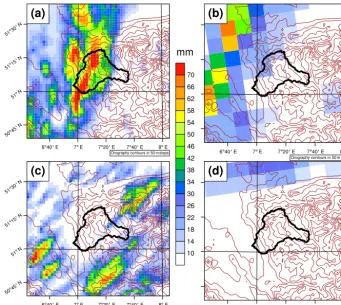
Figure 6.Illustrative modelled PEDs.(a)Example summer PED downscaled to 0.02◦and(b)the same day in the 0.11◦parent model. In
this example, the strongest precipitation directly strikes the catchment in the 0.02◦CCLM despite missing the catchment in the parent 0.11◦
CCLM.(c)Example summer PED with highly localized intense precipitation that falls outside the catchment in the 0.02◦CCLM.(d)The
corresponding day in the 0.11◦CCLM.
of the different sample sizes, i.e. the number of grid cells contained within the averaging area, in particular for small catchments and large differences in the grid-box area.
3.3 Performance testing on seasonal time-slice simulations
The dynamical-downscaling of two sets of 30-summer time slices – historical (1970–1999) and RCP8.5 (2070–2099) – from 0.11 to 0.02◦provides an additional set of tests for the
classification algorithm, namely: what fraction of the actu-ally simulated extreme days in the 0.02◦ model would the
method have identified as PEDs from the 0.11◦ model? In
addition, is classification performance degraded in a future climate? The summer season is chosen to ask these ques-tions due to the greater challenges in predicting summertime intense precipitation (see Sects. 2.4 and 3.1).
Applying the classification algorithm, identically to in Sect. 3.2, to the 0.11◦ historical and RCP8.5 simulations
again yields selections of PEDs representing less than 10 % of the total days (Table 3). Amongst these PEDs, at least 75 % of 0.02◦-simulation extreme days are captured in both
simula-Table 3.Summary table of performance of classification algorithm for 0.11◦CCLM historical and RCP8.5 simulations, continuously
down-scaled to 0.02◦over 30 summers. “Redundant days” are defined as days with precipitation below the 90th percentile (all days). The third
column shows the percentage of total days identified as PEDs, with the fourth column showing the percentage of actual extreme days con-tained within these PEDs. The rightmost column compares the fraction of redundant days (P < P90D) contained in the PEDs and amongst
the set containing all days (“All days”).
Data/experiment Time period PEDs P99Dcaptured Redundant days
(No. of days) (No. of days) (days/total days) (days/total days)
PEDs All days MPI-ESM-LR/CCLM-0.11◦ JJA 1970–1999 9.8 % 75 % 49.8 % 90.0 %
CORDEX-EU/Historical (2760) (271) (21/28) (135/271) (2484/2760)
MPI-ESM-LR/CCLM-0.11◦ JJA 2070–2099 9.5 % 82 % 42.9 % 90.0 %
CORDEX-EU/RCP8.5 (2760) (261) (23/28) (112/261) (2484/2760)
tions, the fact that the performance is the same across both climates indicates the added value of employing our down-scaling methodology, allowing more robust conclusions to be drawn from the output. Of the extreme days that are not cap-tured, 6 out of 7 (historical) and 4 out of 5 (RCP8.5) are lost due to their circulation patterns not matching any of the pre-defined extremal clusters well. This could indicate that the training period for identifying the extremal patterns is too short to encompass sufficient diversity or, more likely, that the GCM in question (MPI-ESM-LR) does not adequately represent the frequency and/or persistence of the large-scale circulation patterns that lead to observed extremes in our catchment. For example, CMIP5 GCMs are known to under-estimate the frequency of Eurasian blocking (Masato et al., 2013) and GCMs in general often underestimate the persis-tence of blocking systems (e.g. Matsueda, 2011); the pole-ward flank of such blocking anticyclones often transports warm moist air into central Europe, enabling intense convec-tive precipitation (see Sect. 3.1). In the case of MPI-ESM-LR during summer, a southward bias in the storm-track axis and over-active North Atlantic blocking are also evident in the CMIP5 historical simulations (Masato et al., 2013).
The similar performance of the classification algorithm across climates, as well as the evaluation period, is confirmed by looking at the historical and RCP8.5 ECDFs (Fig. 7). As in the training dataset, the ECDFs of the PEDs are shifted to-wards more intense precipitation compared to the ECDFs for the sets of all days. For the PEDs, the probability of exceed-ing the respective climatological (JJA) 99th (90th) percentile in the historical and RCP8.5 simulations is similar to that found in the training dataset and the dynamically downscaled PEDs of the evaluation period, roughly 10 % (55 %) (com-pared to 1 % (10 %) for all days), and the ECDFs are dom-inated by heavy to extreme events with dry days almost ab-sent. To quantify differences in the distributions of precipita-tion events amongst all days and the PEDs for discrete inten-sity ranges, we compute the relative likelihoods (R) of find-ing a precipitation event within a given intensity range for the historical and RCP8.5 simulations (Fig. 8); this is simply the
ratio of the respective probabilities, e.g.P (E|PED):P (E), with the smaller of the two probabilities used as the denomi-nator for plotting purposes.
The greatest difference between all days and the PEDs is found in the relative likelihoods of a randomly sampled day being dry, which is an order of magnitude lower in the PEDs. Indeed, considering the set of non-PEDs, the proba-bility density function exhibits an even higher density of dry days than that found for all days (not shown). Focusing on just wet-day percentiles, a regime shift from a higherR for all days to a higherR for PEDs occurs above the median wet-day event. The higherR for the PEDs grows further as event intensity nears the most extreme precipitation events, consistent across historical and RCP8.5 experiments and ap-proaching a factor of 10 in places (Fig. 8). For the most ex-treme events (PD≥PW99.9), more variability between his-torical and RCP8.5Rvalues emerges as the number of days involved limits towards zero. Future changes in the fraction of wet days, and the sensitivity of wet-day percentiles to such changes (Schär et al., 2016), likely contribute to some of the small differences in relative likelihood between the historical and RCP8.5 experiments.
3.4 Applications and outlook
[image:12.612.85.513.130.231.2]accompany-E. P. Meredith et al.: Selective dynamical downscaling 4195
Figure 7.Empirical cumulative distribution functions of daily precipitation for all days (red) and PEDs (blue) downscaled to 0.02◦.(a)
His-torical (JJA, 1970–1999),(b)RCP8.5 (JJA, 2070–2099). All values are area averages over the Wupper catchment. Vertical red lines mark important percentiles of the all-day distribution.
d d
Figure 8.Relative likelihoods of precipitation on a randomly sampled day from the set of all days and the PEDs being within a given intensity range for the(a)historical and(b)RCP8.5 0.02◦simulations. Note that precipitation intensities are based on the percentiles of wet
days (PD≥0.1 mm).
ing precipitation exceeds some catchment-relevant threshold be higher or lower in the future? This approach is in a way analogous to the framework used in conditional event attri-bution (e.g. Trenberth et al., 2015; Pall et al., 2017), where the question is posed: for some observed circulation pat-tern, how is the event’s intensity affected by known ther-modynamic changes in the Earth’s climate system? A ma-jor advantage of such an approach is the relative robustness of projected thermodynamic changes in the climate system compared to projected dynamical changes (Shepherd, 2016). From a catchment-hydrology perspective, one could imag-ine this being particularly useful for catchments vulnerable
[image:13.612.157.439.291.515.2]Figure 9. Percentage change in daily precipitation intensity be-tween the historical and RCP8.5 periods (JJA), conditional on ex-tremal circulation pattern, from the 0.02◦simulations. The numbers
indicate the total number of PEDs for each pattern (i.e. cluster) in the historical (left) and RCP8.5 (right) periods, while vertical bars represent 90 % confidence intervals. Clusters with less than 10 days in either period are excluded from the calculations. On the right hand side, the corresponding climate change signal for the 95th and 99th percentile of all days is provided for reference.
4 Further discussion
The consistent performance of the classification scheme across historical and future climates further demonstrates its utility for studying changes in defined classes of precipita-tion extreme, for example those precondiprecipita-tioned on an iden-tified extremal synoptic pattern that is known to severely af-fect a given catchment. In this regard, our method is com-plementary to current trends in how the projected impacts of climate change are communicated and adapted to end-user needs. Recent literature advocates the use of high-resolution weather models to create bespoke storylines of high-impact weather events for a given catchment in a future climate (Hazeleger et al., 2015). In the so-called “Tales” approach of Hazeleger et al. (2015), the broad statistical terms in which climate change projections are typically communicated are replaced by high-resolution simulations of carefully selected past and future weather events over a given catchment in order to study the catchment-specific impacts of individual hydrometeorological events from past and future climates. This approach is designed to form part of a collaborative process in which end users play a key role in selecting the type of events to be studied, providing vivid case-studies on which adaptation strategies can be decided (Hazeleger et al., 2015). Our methodology could be integrated seamlessly into this workflow. An additional advantage of this type of mod-elling framework is that anthropogenic factors extraneous to global climate change can easily be implemented into the modelling chain (Shepherd, 2016), for example adding po-tential changes in land-use to a high-resolution hydrological model, or changes in hydraulic infrastructure to a hydraulic model for assessing impacts on reservoirs, water-treatment plants, drainage systems, etc.
An important element in the transferability of the method to other catchments is its inherent flexibility, allowing in
par-ticular for the active involvement of end users. End users can contribute and integrate their empirical knowledge towards the identification of the local-scale meteorological predic-tors most suitable for their own catchment, perhaps taking the ones we use or those suggested in Chan et al. (2018) as a starting point. Data availability in the models to be down-scaled may, however, require choosing parameters that are only approximate indicators of the most suitable ones. For the Wupper catchment studied here, for example, we found daily maximum 700 hPa vertical velocity to perform better than daily maximum 500 hPa horizontal divergence as an in-dicator of extreme precipitation in the training dataset. The regional model that we wished to downscale, however, had saved vertical velocity at too low a temporal resolution to meaningfully calculate daily maxima. The adoption of hori-zontal divergence was thus necessitated, allowing the PEDs to still be appropriately classified while avoiding an unac-ceptable increase in computational expense. The method is additionally adaptable to the computing capacity of the user. With the caveat that excessively high thresholds will result in more undesirably rejected days, thresholds for the iden-tification of PEDs can be either raised or lowered based on available computational resources.
Data produced via a method like ours are indeed useful for many applications, though not universally so, and do also come with their own limitations. Care must therefore be taken when applying such data and interpreting subse-quent results. The issue of stationarity should be acknowl-edged: one can never be certain that a future climate will not include heavy precipitation events caused by previously unimportant circulation patterns. Non-stationarity may also, positively or negatively, impact the effectiveness of local-scale predictors. Non-stationarity is indeed a common issue also affecting model parametrization schemes and statistical downscaling – a motivating factor for anchoring our method with a convection-permitting model. Additionally, the cata-logue of downscaled PEDs is no random sample of high-resolution climate data and thus cannot be treated as tradi-tional projections. Traditradi-tional projections can only be made with continuous, multi-decadal downscaling, and not with the discontinuous time series that we produce.
E. P. Meredith et al.: Selective dynamical downscaling 4197
Coarser model data present problems too, in that they also tend not to realistically capture the peak intensities and spa-tial variability of such intense events (see Sect. 1). For such studies, hydrological models would need to be calibrated with either observations or lower-resolution RCM data. Real-istic initial conditions, e.g. for design situations, can also be obtained from such sources or, as is often the case, prescribed and varied in order to test the sensitivity to initial conditions of the catchment’s response to a given extreme. For example, the reservoir level prior to a rain-on-snow event – such events can quickly mobilize large volumes of water into runoff, po-tentially overwhelming hydraulic infrastructure.
A further means through which our methodology can be used to limit computational expense is in the selection of in-dividual models from multi-model ensembles (e.g. CMIP) to downscale over a given region, avoiding the computational expense of dynamically downscaling an entire multi-model ensemble. GCMs whose historical runs fail to satisfactorily reproduce the observed PED climatology, i.e. the seasonal frequency of PEDs, could be considered to poorly represent the regional extremal circulation patterns and thus be rejected in favour of the top N best-performing models, with N a function of both available computing resources and the re-duction in intra-ensemble spread that can be tolerated. Such a region-targeted selection of GCMs (Maraun et al., 2017) could even be combined with the aforementioned “Tales” ap-proach, making a potent tool.
5 Conclusions
Hydrological modellers, amongst others, benefit greatly from high-resolution climate data at the catchment scale – par-ticularly for studying the impacts of extreme precipitation. In achieving these high resolutions O(1 km) while main-taining data quality, dynamical downscaling to convection-permitting resolution presents numerous advantages, though it comes at an often prohibitive computational expense. To reduce the overall computational burden and instead dynam-ically downscale only those days for which there is an ele-vated likelihood of extreme precipitation in a catchment, we have developed a flexible and transferable classification algo-rithm for identifying potential extreme days (PEDs) and re-jecting days unlikely to produce intense precipitation. While reducing computational expense by over 90 %, the precipi-tation distribution of the training dataset’s PEDs – in which more or less all extreme days were captured – was well re-produced via convection-permitting dynamical downscaling, showing an ECDF dominated by heavy precipitation events. Testing the classification algorithm on continuous datasets driven by a different global model, at least three-quarters of the convection-permitting model’s summertime extremes – which are intrinsically more challenging to identify than their wintertime counterparts – were caught and computational ex-penses were again slashed by over 90 %.
Our method represents a computationally inexpensive pro-cedure to produce high-resolution climate data, focused on extreme rainfall events, for hydrological modellers and decision-makers, while retaining the advantages of the convection-permitting modelling framework (see Sect. 1). The explicit simulation of fine-scale processes along the modelling chain gives additional confidence in the end prod-uct, as fine-scale processes can substantially modulate the regional climate change signal (Diffenbaugh et al., 2005). Irrespective of increases in processor power, regional mod-els will always be able to be run at higher spatial resolutions than their global counterparts. Should global models some day run at convection-permitting resolution as standard, clas-sification algorithms can still be utilized for downscaling to ever-higher resolutions at which even more processes can be explicitly simulated, e.g. turbulence. Classification algo-rithms, such as the one presented here, for selective dynam-ical downscaling preconditioned on known extremal circula-tion patterns can thus play an important and enduring role in climate modelling.
Code and data availability. ERA-Interim reanalyses (Dee et al., 2011) are available from the ECMWF (ECMWF: http://apps.ecmwf.int/datasets/data/interim-full-daily/, last ac-cess: 25 July 2018). REGNIE precipitation data (Rauthe et al., 2013) are available from the German weather service (DWD: https://www.dwd.de/DE/leistungen/regnie/regnie.html, last access: 25 July 2018). The 0.11◦ CORDEX data used
within this study are distributed within the CORDEX framework by the Earth System Grid Federation (ESGF: e.g. https://esgfdata.dkrz.de/projects/esgf-dkrz/, last access: 25 July 2018). All remaining simulation data and scripts are available from the corresponding author on request.
Author contributions. EM developed the method, performed the analysis and wrote the paper. HR and UU contributed ideas and comments on the method, analysis and paper.
Competing interests. The authors declare that they have no conflict of interest.
cluster-ing software (http://cost733.geo.uni-augsburg.de, last access: 25 July 2018). Analyses and plotting were performed with NCL (Version 6.4.0, https://doi.org/10.5065/D6WD3XH5) and R. We thank Tim aus der Beek, Martin Göber, Komlan A. Kpogo-Nuwoklo, Tobias Pardowitz, Marc Scheibel, Christos Vagenas and Claudia Volosciuk for helpful discussions.
Edited by: Andràs Bàrdossy
Reviewed by: Patrick Laux and Rasmus Benestad
References
Ban, N., Schmidli, J., and Schär, C.: Evaluation of the convection-resolving regional climate modeling approach in decade-long simulations, J. Geophys. Res.-Atmos., 119, 7889–7907, 2014. Bárdossy, A.: Atmospheric circulation pattern classification for
South-West Germany using hydrological variables, Phys. Chem. Earth A/B/C, 35, 498–506, 2010.
Barnes, E. A. and Polvani, L.: Response of the midlatitude jets, and of their variability, to increased greenhouse gases in the CMIP5 models, J. Climate, 26, 7117–7135, 2013.
Benestad, R. E., Hanssen-Bauer, I., and Chen, D.: Empirical-statistical downscaling, World Scientific Publishing Company, Singapore, https://doi.org/10.1142/6908, 2008.
Bevacqua, E., Maraun, D., Hobæk Haff, I., Widmann, M., and Vrac, M.: Multivariate statistical modelling of compound events via pair-copula constructions: analysis of floods in Ravenna (Italy), Hydrol. Earth Syst. Sci., 21, 2701–2723, https://doi.org/10.5194/hess-21-2701-2017, 2017.
Boberg, F., Berg, P., Thejll, P., Gutowski, W. J., and Christensen, J. H.: Improved confidence in climate change projections of pre-cipitation evaluated using daily statistics from the PRUDENCE ensemble, Clim. Dynam., 32, 1097–1106, 2009.
Brigode, P., Bernardara, P., Gailhard, J., Garavaglia, F., Ribstein, P., and Merz, R.: Optimization of the geopotential heights informa-tion used in a rainfall-based weather patterns classificainforma-tion over Austria, Int. J. Climatol., 33, 1563–1573, 2013.
Brisson, E., Demuzere, M., and van Lipzig, N. P.: Modelling strate-gies for performing convection-permitting climate simulations, Meteorol. Z., 25, 149–163, 2016a.
Brisson, E., Van Weverberg, K., Demuzere, M., Devis, A., Saeed, S., Stengel, M., and van Lipzig, N. P.: How well can a convection-permitting climate model reproduce decadal statistics of precipi-tation, temperature and cloud characteristics?, Clim. Dynam., 47, 3043–3061, 2016b.
Chan, S. C., Kendon, E. J., Roberts, N., Blenkinsop, S., and Fowler, H. J.: Large-Scale Predictors for Extreme Hourly Pre-cipitation Events in Convection-Permitting Climate Simulations, J. Climate, 31, 2115–2131, https://doi.org/10.1175/JCLI-D-17-0404.1, 2018.
Christensen, O., Gaertner, M., Prego, J., and Polcher, J.: Internal variability of regional climate models, Clim. Dynam., 17, 875– 887, 2001.
Dee, D. P., Uppala, S. M., Simmons, A. J., Berrisford, P., Poli, P., Kobayashi, S., Andrae, U., Balmaseda, M. A., Balsamo, G., Bauer, P., Bechtold, P., Beljaars, A. C. M., van de Berg, L., Bid-lot, J., Bormann, N., Delsol, C., Dragani, R., Fuentes, M., Geer, A. J., Haimberger, L., Healy, S. B., Hersbach, H., Hólm, E. V.,
Isaksen, L., Kållberg, P., Köhler, M., Matricardi, M., McNally, A. P., Monge-Sanz, B. M., Morcrette, J.-J., Park, B.-K., Peubey, C., de Rosnay, P., Tavolato, C., Thépaut, J.-N., and Vitart, F.: The ERA-Interim reanalysis: configuration and performance of the data assimilation system, Q. J. Roy. Meteorol. Soc., 137, 553– 597, https://doi.org/10.1002/qj.828, 2011.
Denis, B., Laprise, R., and Caya, D.: Sensitivity of a regional cli-mate model to the resolution of the lateral boundary conditions, Clim. Dynam., 20, 107–126, 2003.
Diffenbaugh, N. S., Pal, J. S., Trapp, R. J., and Giorgi, F.: Fine-scale processes regulate the response of extreme events to global cli-mate change, P. Natl. Acad. Sci. USA, 102, 15774–15778, 2005. Di Luca, A., de Elía, R., and Laprise, R.: Potential for added value in precipitation simulated by high-resolution nested regional cli-mate models and observations, Clim. Dynam., 38, 1229–1247, 2012.
Feser, F., Rockel, B., von Storch, H., Winterfeldt, J., and Zahn, M.: Regional climate models add value to global model data: a review and selected examples, B. Am. Meteorol. Soc., 92, 1181–1192, 2011.
Fosser, G., Khodayar, S., and Berg, P.: Benefit of convection per-mitting climate model simulations in the representation of con-vective precipitation, Clim. Dynam., 44, 45–60, 2015.
Giannakaki, P. and Martius, O.: Synoptic-scale flow structures asso-ciated with extreme precipitation events in northern Switzerland, Int. J. Climatol., 36, 2497–2515, 2016.
Giorgi, F. and Bi, X.: A study of internal variability of a regional cli-mate model, J. Geophys. Res.-Atmos., 105, 29503–29521, 2000. Hazeleger, W., Van den Hurk, B., Min, E., Van Oldenborgh, G., Petersen, A., Stainforth, D., Vasileiadou, E., and Smith, L.: Tales of future weather, Nat. Clim. Change, 5, 107–113, 2015. Heikkilä, U., Sandvik, A., and Sorteberg, A.: Dynamical
downscal-ing of ERA-40 in complex terrain usdownscal-ing the WRF regional cli-mate model, Clim. Dynam., 37, 1551–1564, 2011.
Hidalgo-Muñoz, J., Argüeso, D., Gámiz-Fortis, S., Esteban-Parra, M., and Castro-Díez, Y.: Trends of extreme precipitation and as-sociated synoptic patterns over the southern Iberian Peninsula, J. Hydrol., 409, 497–511, 2011.
Hofstra, N., New, M., and McSweeney, C.: The influence of in-terpolation and station network density on the distributions and trends of climate variables in gridded daily data, Clim. Dynam., 35, 841–858, 2010.
Hohenegger, C., Brockhaus, P., and Schaer, C.: Towards climate simulations at cloud-resolving scales, Meteorol. Z., 17, 383–394, 2008.
Hurrell, J. W.: Decadal trends in the North Atlantic Oscillation: re-gional temperatures and precipitation, Science, 269, 676–678, 1995.
E. P. Meredith et al.: Selective dynamical downscaling 4199
European impact research, Reg. Environ. Change, 14, 563–578, https://doi.org/10.1007/s10113-013-0499-2, 2014.
Kendon, E. J., Roberts, N. M., Senior, C. A., and Roberts, M. J.: Re-alism of rainfall in a very high-resolution regional climate model, J. Climate, 25, 5791–5806, 2012.
Kendon, E. J., Roberts, N. M., Fowler, H. J., Roberts, M. J., Chan, S. C., and Senior, C. A.: Heavier summer downpours with climate change revealed by weather forecast resolution model, Nat. Clim. Change, 4, 570–576, 2014.
Kendon, E. J., Ban, N., Roberts, N. M., Fowler, H. J., Roberts, M. J., Chan, S. C., Evans, J. P., Fosser, G., and Wilkinson, J. M.: Do convection-permitting regional climate models improve projec-tions of future precipitation change?, B. Am. Meteorol. Soc., 98, 79–93, 2017.
Keuler, K., Radtke, K., Kotlarski, S., and Lüthi, D.: Regional cli-mate change over Europe in COSMO-CLM: Influence of emis-sion scenario and driving global model, Meteorol. Z., 25, 121– 136, 2016.
Kotlarski, S., Keuler, K., Christensen, O. B., Colette, A., Déqué, M., Gobiet, A., Goergen, K., Jacob, D., Lüthi, D., van Meij-gaard, E., Nikulin, G., Schär, C., Teichmann, C., Vautard, R., Warrach-Sagi, K., and Wulfmeyer, V.: Regional climate model-ing on European scales: a joint standard evaluation of the EURO-CORDEX RCM ensemble, Geosci. Model Dev., 7, 1297–1333, https://doi.org/10.5194/gmd-7-1297-2014, 2014.
Lean, H. W., Clark, P. A., Dixon, M., Roberts, N. M., Fitch, A., Forbes, R., and Halliwell, C.: Characteristics of high-resolution versions of the Met Office Unified Model for forecasting convec-tion over the United Kingdom, Mon. Weather Rev., 136, 3408– 3424, 2008.
Lucas-Picher, P., Caya, D., de Elía, R., and Laprise, R.: Investiga-tion of regional climate models’ internal variability with a ten-member ensemble of 10-year simulations over a large domain, Clim. Dynam., 31, 927–940, 2008.
Ly, S., Charles, C., and Degré, A.: Geostatistical interpola-tion of daily rainfall at catchment scale: the use of sev-eral variogram models in the Ourthe and Ambleve catch-ments, Belgium, Hydrol. Earth Syst. Sci., 15, 2259–2274, https://doi.org/10.5194/hess-15-2259-2011, 2011.
Maraun, D. and Widmann, M.: The representation of location by a regional climate model in complex terrain, Hydrol. Earth Syst. Sci., 19, 3449–3456, https://doi.org/10.5194/hess-19-3449-2015, 2015.
Maraun, D., Wetterhall, F., Ireson, A. M., Chandler, R. E., Kendon, E. J., Widmann, M., Brienen, S., Rust, H. W., Sauter, T., The-meßl, M., Venema, V. K. C., Chun, K. P., Goodess, C. M., Jones, R. G., Onof, C., Vrac, M., and Thiele-Eich, I.: Precipita-tion downscaling under climate change: Recent developments to bridge the gap between dynamical models and the end user, Rev. Geophys., 48, RG3003, https://doi.org/10.1029/2009RG000314, 2010.
Maraun, D., Shepherd, T. G., Widmann, M., Zappa, G., Walton, D., Gutierrez, J. M., Hagemann, S., Richter, I., Soares, P. M. M., Hall, A., and Mearns, L. O.: Towards process-informed bias correction of climate change simulations, Nat. Clim. Change, 7, 764–773, https://doi.org/10.1038/nclimate3418, 2017.
Masato, G., Hoskins, B. J., and Woollings, T.: Winter and summer Northern Hemisphere blocking in CMIP5 models, J. Climate, 26, 7044–7059, 2013.
Matsueda, M.: Predictability of Euro-Russian blocking in summer of 2010, Geophys. Res. Lett., 38, L06801, https://doi.org/10.1029/2010GL046557, 2011.
Meredith, E. P., Maraun, D., Semenov, V. A., and Park, W.: Ev-idence for added value of convection-permitting models for studying changes in extreme precipitation, J. Geophys. Res.-Atmos., 120, 12500–12513, 2015.
Merino, A., Vaquero, M., López, L., Fernández-González, S., Hermida, L., Sánchez, J. L., García-Ortega, E., and Gascón, E.: Large-scale patterns of daily precipitation extremes on the Iberian Peninsula, Int. J. Climatol., 36, 3873–3891, 2016. Pall, P., Patricola, C. M., Wehner, M. F., Stone, D. A., Paciorek, C. J., and Collins, W. D.: Diagnosing conditional anthropogenic contributions to heavy Colorado rainfall in September 2013, Weather Clim. Extrem., 17, 1–6, 2017.
Pan, Z., Takle, E., Gutowski, W., and Turner, R.: Long Simula-tion of Regional Climate as a Sequence of Short Segments, Mon. Weather Rev., 127, 308–321, https://doi.org/10.1175/1520-0493(1999)127<0308:LSORCA>2.0.CO;2, 1999.
Philipp, A., Della-Marta, P.-M., Jacobeit, J., Fereday, D. R., Jones, P. D., Moberg, A., and Wanner, H.: Long-term variability of daily North Atlantic–European pressure patterns since 1850 classified by simulated annealing clustering, J. Climate, 20, 4065–4095, 2007.
Philipp, A., Beck, C., Huth, R., and Jacobeit, J.: Development and comparison of circulation type classifications using the COST 733 dataset and software, Int. J. Climatol., 36, 2673–2691, 2016.
Prein, A. F., Gobiet, A., Suklitsch, M., Truhetz, H., Awan, N., Keuler, K., and Georgievski, G.: Added value of convection permitting seasonal simulations, Clim. Dynam., 41, 2655–2677, 2013.
Prein, A. F., Langhans, W., Fosser, G., Ferrone, A., Ban, N., Goer-gen, K., Keller, M., Tölle, M., Gutjahr, O., Feser, F., Brisson, E., Kollet, S., Schmidli, J., van Lipzig, N. P., and Leung, R.: A review on regional convection-permitting climate modeling: Demonstrations, prospects, and challenges, Rev. Geophys., 53, 323–361, 2015.
Rauthe, M., Steiner, H., Riediger, U., Mazurkiewicz, A., and Gratzki, A.: A Central European precipitation climatology – Part I: Generation and validation of a high-resolution grid-ded daily data set (HYRAS), Meteorol. Z., 22, 235–256, https://doi.org/10.1127/0941-2948/2013/0436, 2013.
Roberts, N.: Assessing the spatial and temporal variation in the skill of precipitation forecasts from an NWP model, Meteorol. Appl., 15, 163–169, 2008.
Rockel, B., Will, A., and Hense, A.: The regional climate model COSMO-CLM (CCLM), Meteorol. Z., 17, 347–348, 2008. Romero, R., Sumner, G., Ramis, C., and Genovés, A.: A
classifica-tion of the atmospheric circulaclassifica-tion patterns producing significant daily rainfall in the Spanish Mediterranean area, Int. J. Climatol., 19, 765–785, 1999.
Rummukainen, M.: State-of-the-art with Regional Climate Models, Wiley Interdisciplin. Rev.: Clim. Change, 1, 82–96, 2010. Rust, H. W., Vrac, M., Lengaigne, M., and Sultan, B.: Quantifying
Rust, H. W., Vrac, M., Sultan, B., and Lengaigne, M.: Map-ping weather-type influence on senegal precipitation based on a spatial-temporal statistical model, J. Climate, 26, 8189–8209, 2013.
Schär, C., Ban, N., Fischer, E. M., Rajczak, J., Schmidli, J., Frei, C., Giorgi, F., Karl, T. R., Kendon, E. J., Tank, A. M. K., O’Gorman, P. A., Sillmann, J., Zhang, X., and Zwiers, F. W.: Percentile in-dices for assessing changes in heavy precipitation events, Cli-matic Change, 137, 201–216, 2016.
Shepherd, T. G.: Atmospheric circulation as a source of uncertainty in climate change projections, Nat. Geosci., 7, 703–708, 2014. Shepherd, T. G.: A common framework for approaches to extreme
event attribution, Curr. Clim. Change Rep., 2, 28–38, 2016. Sun, J., Trier, S. B., Xiao, Q., Weisman, M. L., Wang, H., Ying,
Z., Xu, M., and Zhang, Y.: Sensitivity of 0–12-h warm-season precipitation forecasts over the central United States to model initialization, Weather Forecast., 27, 832–855, 2012.
Takayabu, I., Kanamaru, H., Dairaku, K., Benestad, R., von Storch, H., and Christensen, J. H.: Reconsidering the quality and utility of downscaling, J. Meteorol. Soc. Jpn. Ser. II, 94, 31–45, 2016. Taylor, K. E., Stouffer, R. J., and Meehl, G. A.: An overview of
CMIP5 and the experiment design, B. Am. Meteorol. Soc., 93, 485, 2012.
Torma, C., Giorgi, F., and Coppola, E.: Added value of regional climate modeling over areas characterized by complex terrain – Precipitation over the Alps, J. Geophys. Res.-Atmos., 120, 3957– 3972, 2015.
Trenberth, K. E., Fasullo, J. T., and Shepherd, T. G.: Attribution of climate extreme events, Nat. Clim. Change, 5, 725–730, 2015. Van Vuuren, D. P., Edmonds, J., Kainuma, M., Riahi, K., Thomson,
A., Hibbard, K., Hurtt, G. C., Kram, T., Krey, V., Lamarque, J.-F., Masui, T., Meinshausen, M., Nakicenovic, N., Smith, S. J., and Rose, S. K.: The representative concentration pathways: an overview, Climatic Change, 109, 5–31, 2011.
Veljovic, K., Rajkovic, B., Fennessy, M. J., Altshuler, E. L., and Mesinger, F.: Regional climate modeling: Should one at-tempt improving on the large scales? Lateral boundary con-dition scheme: Any impact?, Meteorol. Z., 19, 237–246, https://doi.org/10.1127/0941-2948/2010/0460, 2010.
Volosciuk, C., Maraun, D., Semenov, V. A., and Park, W.: Extreme precipitation in an atmosphere general circulation model: im-pact of horizontal and vertical model resolutions, J. Climate, 28, 1184–1205, 2015.
Weisman, M. L., Davis, C., Wang, W., Manning, K. W., and Klemp, J. B.: Experiences with 0–36-h explicit convective forecasts with the WRF-ARW model, Weather Forecast., 23, 407–437, 2008. Wilby, R. L. and Wigley, T.: Downscaling general circulation model
output: a review of methods and limitations, Prog. Phys. Geogr., 21, 530–548, 1997.