Journal of Chemical and Pharmaceutical Research, 2013, 5(12):353-357
Research Article
CODEN(USA) : JCPRC5
ISSN : 0975-7384
A method for multi-cellular synchronous tracking based on kalman filter
Fei Wang* and Benlian Xu
College of Automation Engineering, Changshu Institute of Technology, Suzhou, China
_____________________________________________________________________________________________
ABSTRACT
In the field of cell analysis, segmentation of cells and synchronous tracking is an important question for biological research. For this problem, a method for cell synchronous tracking based on Kalman filter is proposed. At first, an improved algorithm based on the combination of watershed algorithm and feature extraction is applied to achieve cell segmentation, then, a motion model is established for predicting and tracking. In the end, experiment results show that the method proposed in this paper is able to effectively fulfill cell segmentation and cell tracking.
Key words: Cell segmentation; cell tracking; Kalman filter; watershed; feature extract
_____________________________________________________________________________________________
INTRODUCTION
Many scientific biological applications as well as experiments for drug development require the observation of cell responses to a variety of stimuli. Some of the responses that need to be quantified are cell migration, cell proliferation, and cell differentiation. The corresponding conclusions require the observation of cells over extended periods of time. An effective way to achieve this is with microscopy images. However, the resulting data sets of images are large and their manual analysis is tedious, subjective, and restrictive. Thus, an automated analysis technology is needed urgently, which is able to achieve cell segmentation and subsequent tracking task[1].
Some of target tracking methods have been applied to the research of cell tracking, such as meanshift algorithm [2,3], level set [4] algorithm, extended Kalman filter[5],particle filter [6] and so on. Yan Cui [7] utilized meanshift to cell tracking,Ying Chen[3] proposed a new algorithm of non-rigid cell tracking based on balancing feature matching. Their methods are both used to track a single cell, and the tracking cell has more obvious characteristics that facilitate detection and tracking. Chunming Tang[5] applied extend Kalman particle filter to solve the problem of cell tracking, their work implemented the tracking of multi-cell, but only focused on active cells and did not achieve synchronous tracking for all cells. Moreover, the active cells have relative obvious features compare with cells surrounding them. Mingli Lu[6] used watershed algorithm to segment cells and tracking them with particle filter. In their method, the drawback is that the segmentation is affected by noise, which limited the tracking effect. Aiming at the problem of synchronization tracking of multi-cell, a method for multi-cellular synchronous tracking based on Kalman filter is proposed. At first, an improved algorithm based on combination of watershed algorithm and feature extraction is applied to achieve cell segmentation , then, a motion model is establish for predicting and tracking.
2.FRAMEWORK OF CELL TRACKING
In cell tracking process, there are two problems to be solved: segmentation and tracking.
2.1 segmentation
noise is also recognized as cells, which greatly affect the subsequent tracking process. In this paper, a method that combines the watershed algorithm and feature matching is proposed.
Algorithm:
1. Read the i-th frame and transforms it into grayscale image;
2. Computes the extended-minima transform, from which the rough binary image segmentation obtained; 3. Inverts the binary image and execute distance transform with the formula below:
(
i j)
arg min
i j,
i,
jdist x
−
x
=
x
−
x
x
∈
foreground x
∈
background
4. Apply watershed algorithm;
5. Filter noises with cell features matching; 6. Read the next frame.
In this algorithm, step 5 is a filter step, which is used to filter noise spots. As we can see, after pre-segmentation, tracking candidates were obtained, but the candidates are the mixture of cells and noise spots. So we must filter noise.
In order to filter noise spots, anomaly detection method is used to finding noise. First, cell features are extracted, then, find noise spots by feature matching. Cells have relatively stable features compare with noise spots, which facilitate removing mismatch objects and reduce or eliminate noise spots.
Cell features are described as follows: Area, expressed as:
1
0
x x
x
cell
S
s
s
x
cell
∈
=
=
∉
∑
x
s
is unit pixel and subjects to constraints:min( )
S
< <
S
max( )
S
,max( )
S
andmin( )
S
are areas before and after cell division.In this paper, tracking objects are leucocytes whose geometrical features approximate circle or ellipse. For this reason, eccentricity is chosen as a feature and given as follows
2 2 2
e
=
a
+
b
a
a and b are major axis and minor axis respectively.
Static cells appear to be circles, while dynamic cells showing a stretched condition for its moving. We use rectangle degree to illustrate its tension, which is defined as:
/ (
)
R
=
S
H W
×
For further express percentage of stretch, we define stretch degree is
E
=
W H
W is width, H is height.
By then, we get the features of cell: area, eccentricity, rectangle degree and stretch degree, with which we remove the noise spots.
2.2 cell tracking
the x-axis and y-axis. State and observation equations are as follows:
( )
(
1)
(
1)
x k
=
Ax k
− +
w k
−
(1)( )
( )
( )
z k
=
Hx k
+
v k
(2)observation vector
z k
( )
=
[
x k y k
o( ),
o( )]
T,( )
o
x k
andy k
o( )
are the observation values of frame k. State transition matrix and observation matrix are as follows:1 0 0
0 1 0
0 0 1 0 0 0 0 1
T T A = ,
1 0 0 0
0 1 0 0
H =
w(k) is the process noise which is assumed to be drawn from a zero mean distribution with covariance Qk ,v(k) is
the observation noise which is assumed to be zero mean Gaussian white noise with covariance R(k) .
2 1 0 0 0
0 1 0 0 0 0 1 0
0 0 0 1
k k w Q
σ
= , 2 1 00 1 k
k v
R =
σ
The observations in Kalman filter are determined by matching step, which is the target in previous frame is predicted in corresponding field in next frame, then, by matching process, the right cell will be found.
The predict and update steps are described below:
1. Initialize the i-th frame image, identify the cells by the proposed algorithm 2. The predicted location and velocity are obtained by equation (1)
3. Calculate the similarity between target in frame k and every candidate in frame k+1 with equation (3) , the candidates are the cells within the area less than three times of the diameter range.
4. The most similar cell is considered as the tracking target and apply it to finish update step by equation (2). 5. i++ untill end
Similarity function is defined as:
( , j) arg min j 1, 2,....,
j
Cost x y = x−y j= M (3)
x denote the tracking target in frame i,yj denote the candidates in frame i+1 ,
⋅
is Euclidean distanceRESULTS AND DISCUSSION
In order to test the proposed method, we present an objective study using several performance measures on 15 frames of the sequence images.
3.1 segmentation based on the combination of watershed and feature extraction
The method proposed in this paper fulfilled pre-segmentation, distance transform, obtained basic regional connectivity and filtering noise spots. The segmentation processes are shown as follows:
fig5 watershed fig6 Binary image fig7 last image
Figure 3 is pre-segmentation image, we can see that some of cells are still in adhesion state, which will lead to tracking mistake. Figure 4 is the segmentation before distance transform (D-T), in this image, we can tell that some cells are not separate well, the effectiveness of segmentation is not good. After distance transform, watershed is applied to image segmentation, the result is figure 5. In this image, cells are segmented more accurate, compare with figure 4, more cell objects are identified in figure 5, which will lead more accurate tracking result. After this step, binary image is obtained, in figure 6 noise spots are included, so we must find and filter it. The combination method is applied to remove the noise spots, the effectiveness is shown in figure 7.
In these 15 frames, we got average detection rate 94.4%, the main error consist in cell cluster parts, the performance is insufficient segmentation, which lead to bad tracking results.
Compare with our proposed method, level set get relative low performance in multi-cellular segmentation, especially in cell cluster parts. Level set take this parts as a cluster rather than several cells, moreover, some of cells were miss detected. The segmentation performance is as follows:
fig8 level set segmentation
3.2 multi-cellular tracking
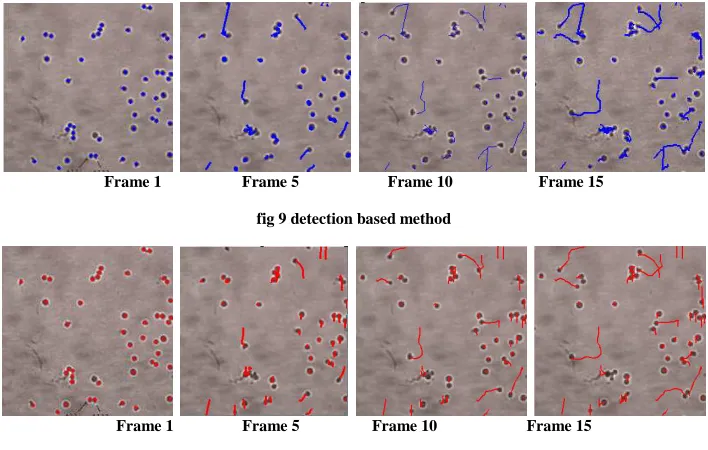
In this part, we present out method, detection based method and particle filter based method, the results are shown as follows:
[image:4.595.154.455.63.169.2]Frame 1 Frame 5 Frame 10 Frame 15
fig 9 detection based method
Frame 1 Frame 5 Frame 10 Frame 15
[image:4.595.129.483.508.733.2]Frame 1 Frame 5 Frame 10 Frame 15
fig 11 particle filter based method
Detection based method, on condition that cells scattered well, the tracking results is good, however, in cluster parts, cell matching performances are bad, which occurred in out proposed method too. Besides, detection based method, because of cells move in or out the monitoring area, mistake of matching might occur due to its low dissimilarity. In figure 9, from the 5th frame and 10th frame ,we can see that the cell moves in the frame at the top is mismatched to the nearest cell. In frame 5, the cell under the image moves out of the area, it matches to the most similarity cell. Kalman filtering prediction of direction and speed is exploited to fix the mistake of detection based method, and will lead to better tracking results, shown in figure 10. Figure 11 shows the effect of the particle filter tracking, it shows same failure in cell cluster parts, moreover, the problem of more tracking trajectory occurred because of biodiversity, for example, the bottom of the fifth frame start bifurcation and the upper right frame 10 there appears bifurcation, any possible noise is mapping to some particles that will lead to trajectories, additional a large number of particle sample are required by PF, which increase the amount of computation and reduce the tracking of real-time.
CONCLUSION
In this paper, we proposed a Kalman based Multi-cellular tracking method. At first, an improved algorithm based on combination of watershed algorithm and feature extraction is applied to achieve cell segmentation , then, a motion model is establish for predicting and tracking. In the end, experiment result shows that the proposed method is able to fulfill cell segmentation and cell tracking.
Acknowledgments
This work is supported by Natural Science Foundation of Jiangsu Province (No.BK2010261),and National Natural Science Foundation of china (No.61104186).
REFERENCES
[1] Yang L, Qiu Z, Greenaway A H, et al. Biomedical Engineering, IEEE Transactions on, 2012, 59(7): 2040-2050. [2] Yang X, Li H, Zhou X. IEEE Transactions on, 2006, 53(11): 2405-2414.
[3] YUAN Xiao Hu, CUI Yan. Chinese Journal of Biomedical Engineering, 2008, 27(3): 393-399. [4] Dzyubachyk O, van Cappellen W A, Essers J, et al. IEEE Transactions on, 2010, 29(3): 852-867. [5] Chunming Tang, Ying Liu. Journal of Biomdical Engineering , 2013, 30(001): 6-11.
[6] Lu M, Xu B, Sheng A. Cell automatic tracking technique with particle filter[M]. Advances in Swarm Intelligence. Springer Berlin Heidelberg, 2012: 589-595.