LEABHARLANN CHOLAISTE NA TRIONOIDE, BAILE ATHA CLIATH TRINITY COLLEGE LIBRARY DUBLIN OUscoil Atha Cliath The University of Dublin
Terms and Conditions of Use of Digitised Theses from Trinity College Library Dublin Copyright statement
All material supplied by Trinity College Library is protected by copyright (under the Copyright and Related Rights Act, 2000 as amended) and other relevant Intellectual Property Rights. By accessing and using a Digitised Thesis from Trinity College Library you acknowledge that all Intellectual Property Rights in any Works supplied are the sole and exclusive property of the copyright and/or other I PR holder. Specific copyright holders may not be explicitly identified. Use of materials from other sources within a thesis should not be construed as a claim over them.
A non-exclusive, non-transferable licence is hereby granted to those using or reproducing, in whole or in part, the material for valid purposes, providing the copyright owners are acknowledged using the normal conventions. Where specific permission to use material is required, this is identified and such permission must be sought from the copyright holder or agency cited.
Liability statement
By using a Digitised Thesis, I accept that Trinity College Dublin bears no legal responsibility for the accuracy, legality or comprehensiveness of materials contained within the thesis, and that Trinity College Dublin accepts no liability for indirect, consequential, or incidental, damages or losses arising from use of the thesis for whatever reason. Information located in a thesis may be subject to specific use constraints, details of which may not be explicitly described. It is the responsibility of potential and actual users to be aware of such constraints and to abide by them. By making use of material from a digitised thesis, you accept these copyright and disclaimer provisions. Where it is brought to the attention of Trinity College Library that there may be a breach of copyright or other restraint, it is the policy to withdraw or take down access to a thesis while the issue is being resolved.
Access Agreement
By using a Digitised Thesis from Trinity College Library you are bound by the following Terms & Conditions. Please read them carefully.
Studies of Gain and Lasing in Thulium
Doped Fibres
by
Severino Tessarin
A thesis submitted for the degree of Doctor of Philosophy
at the University of Dublin
School of Physics
Trinity College Dublin
This thesis has not submitted as an exercise for a degree in this or any other university. The work described is entirely my own, with exception of assistance and collaborative work mentioned in the acknowledgements. I agree that Trinity College Library may lend or copy this thesis upon request.
Abstract
Rare earth ions have absorption and emission lines in almost the entire transparent region of silica optical fibres, and they can be used as dopants inside the fibre core of single mode optical fibres employed for telecommunication. Erbium amplifiers has been far more successful than any other rare-earth doped amplifiers due to their unique properties such as high gain, low noise, polarization insensitivity and broad spectral bandwidth and they operate at 1550 nm- the wavelength where standard silica fibres have minimum losses.
In recent years, new types of glass host have been produced; they are mainly based on a mixture of heavy metal fluorides. The best known is named ZBLAN after the acronym o f the fluoride salts component (Zr, Ba, La, N) with different stoichiometric weights. Normally the phonon energy is half o f the silica fibre and the edge of the transparency region is thus shifted to longer wavelengths in the infrared region. Rare earth ion’s metastable states also have longer lifetimes in fluoride hosts and, in addition, infrared fluorescence, which is normally quenched by phonon-assisted relaxation in silica, and which shows high quantum efficiency.
Recently, in new fibres produced by Lucent, the hydroxyl ions absorption at 1400 nm has almost vanished and the losses are closed to the limit values set by the Rayleigh scattering. At the same time, the zero chromatic dispersion has been shifted at 1470 nm, therefore this window is a subject of intense research in order to create an amplifier with the same performance as its erbium counterpart. The major part of this thesis is dedicated to the design and the construction of a thulium fluoride fibre amplifier able to work efficiently around 1470 nm. The natural low efficiency of the 1470 nm-thulium amplifying transition is due to the lifetime of the terminating metastable state, which is longer than the lifetime of the upper metastable state of the transition. Therefore, the problem of improving the achievable gain is related to the possibility of forcing a reduction of the ions population in the terminating level under a 790 nm optical pumping. The design of the amplifier, with its necessity of a cavity at 1.88 ^im, was the subject of several investigations in order to fulfil all of the constraints existing. The creation of coated mirrors has been a successful approach in the past, but simulation shows the difficulty of coupling three different wavelengths efficiently inside a fibre. An alternative and cheaper approach with a straight industrial implementation is the creation of a ring cavity with two custom designed fibre chromatic couplers. The creation of this cavity will allow an amplifier and a laser to work simultaneously at different wavelengths, this effect is termed “co-operative lasing”, and has an advantage over the existing technology in that it only needs pump lasers at a single wavelength in order to operate. A model has been created to describe the amplifier and make a simulation to the maximum cavity length compatible with our pumping power; moreover several details of the cavity design and construction are also reported.
Acknowledgements
I had the immense fortune, over the last four years, to work with Prof. John Donegan and his group. I owe to Prof. Donegan, as my supervisor, a personal debt in
contributing to my formation from a human and scientific point of view. The many valuable hints and the constant encouragement that I have received have been eminently valuable. I would next like to thank Dr. Vincent Weldon for his support with the solid- state lasers. M ost of all I wish to thank Mick Lynch who worked with me for the last four years, helping me in my first trials/errors phase in the lab and for being a constant source of inspiration. The help that I have received from Mick and his wife Tina when I really needed is unforgettable.
I would like to thank also all the senior staff members: Dr. Bradley, Dr. Rakovic and Prof. McCabe and the PhD students of the Semiconductor Photonics Groups: David, Matthias, Aaron, John, Torsten and Severine. They all gave and give an important contribution in creating an excellent working environment. A special thanks deserves Richard Phelan (now Dr. Phelan) who spread a contagious hurling passion, now I am a supporter of the Kilkenny hurling team.
I would also like to thank Mr. Gwenael Maze for the preform and the doped fluoride fibres needed for this research.
A special thanks to: John Kelly, M aria Kinsella, Nigel Carroll, Ken Concannon, Dave Grouse, M ick O ’Reilly and Pat Flanagan for the collaboration that I have received during the last four years.
The following have also all helped me out when it really counted: Fiacra Harte, Angus Harte, Sonia Haccius, Patrick Leonard and Cristiana Turchetti. I would like also to thank all the people in the Dublin lodge of the Theosophical Society for the spirit of universal brotherhood that they embrace.
List of Publications.
1) Optimisation of a two colour pumped Tm^'^-doped ZBLAN flbre amplifler at
1.49 [im.
Tessarin, S.; Lynch, M.; Donegan, J.F.; Maze, G.;
Submitted to Optoelectronics, E E Proceedings, June 2005.
2) Tm^'^-doped ZBLAN amplifler at 1.49 jxm with co-operative lasing at 1.88 ^m
Tessarin, S.; Lynch, M.; Donegan, J.F.; Maze, G.;Electronics Letters,
Volume 41, Issue 16, 4 August 2005, Page(s):899 - 900
3) Thulium doped ZBLAN fibre ring-cavity amplifler
S. Tessarin, M. Lynch, J. F. Donegan, G. MazeProc. SPIE Vol. 5825. p. 230-239, Opto-Ireland 2005: Optoelectronics, Photonic Devices, and Optical Networks Eds, Jun. 2005
4) Resonant energy transfer in praseodymium-thulium codoped ZBLAN fibre
Tessarin, S.; Lynch, M.; Donegan, J.F.; Maze, G.;Optoelectronics, lEE Proceedings,
Table of Contents
Chapter 1
Fibre Optics T elecom m unications____________________________________________________ 10 1.1 B ackground_______________________________________________________________10 1.2 Thesis sy n o p sis___________________________________________________________ 16 1.3 Structure of the Thesis______________________________________________________ 17 1.4 References________________________________________________________________ 17 Chapter 2
Optical Properties of Rare Earth Ions__________________________________________________20 2.1 Introduction_______________________________________________________________20 2.2 Electronic Properties_______________________________________________________ 22 2.3 Optical Properties of Rare-Earth Io n s ________________________________________ 23 2.4 Homogeneous and Inhomogeneous B roadening________________________________25 2.5 Energy Transfer___________________________________________________________ 27 2.6 Fluoride F ib r e ____________________________________________________________ 30 2.7 Introduction to Spectroscopy in Rare-Earth Doped F ibre________________________ 32 2.8 T hulium __________________________________________________________________ 34 2.9 Praseodymium ____________________________________________________________ 36 2.10 Introduction to Fibre Lasers and A m plifiers___________________________________ 37 2.11 Analytical M odel__________________________________________________________ 39 2.12 Determination of the Ground State Absorption Cross-Section in Thulium Doped Fibre 45
Chapter 3
Resonant transfer between and Pr^'^ in ZBLA glass ________________________________ 57 3.1 Introduction_______________________________________________________________57 3.2 Energy L e v e ls____________________________________________________________ 59 3.3 Lifetime Measurements in the Co-doped Fibre________________________________63 3.4 Preform R esults___________________________________________________________ 65 3.5 Fibre R e su lts______________________________________________________________68 3.6 Frequency Domain Technique_______________________________________________ 71 3.7 Conclusions_______________________________________________________________77 3.8 R eferences________________________________________________________________ 78 Chapter 4
Design and Modelling of a Thulium Doped Amplifier___________________________________ 80 4.1 Introduction_______________________________________________________________ 80 4.2 Mode Analysis_____________________________________________________________81 4.3 Characteristic Equation for the W eakly Guided Fibre __________________________ 84 4.3.1 Single M o d e ___________________________________________________________86 4.3.2 M ultim ode_____________________________________________________________ 88 4.4 Interface Losses____________________________________________________________89 4.5 Thulium Doped Fibre Laser and Amplifier Model.______________________________90 4.6 C onclusions______________________________________________________________ 100 4.7 R eferences_______________________________________________________________ 101 Chapter 5
5.6 Noise M easurem ent_______________________________________________________ 116 5.7 Comparison with the Model _______________________________________________ 116 5.8 Consideration of Pump Coupling Efficiency__________________________________118 5.9 C onclusions_____________________________________________________________ 123 5.10 R eferences_______________________________________________________________124 Chapter 6
Optim isation of an Up-conversion Thulium Doped Power A m plifier____________________ 126 6.1 Introduction______________________________________________________________126 6.2 Amplifier Set-U p_________________________________________________________ 128 6.3 Optical C haracterization__________________________________________________ 131 6.4 High Power Operation_____________________________________________________ 132 6.5 Transient Gain D y n a m ic s_________________________________________________ 135 6.6 Amplifier N oise__________________________________________________________ 137 6.7 Optimisation _____________________________________________________________138 6.8 Conclusions______________________________________________________________145 6.9 References_______________________________________________________________ 146 Chapter 7
Chapter 1
Fibre Optics Telecommunications
1.1 Background
T he new era in optical fibre com m unications can be traced to its beginning in 1970 when Kapron, K eck and Maurer o f the C om in g G lass W orks fabricated a silica fibre having a 20-d B /k m attenuation [1], overcom ing the large attenuation present in the early fibres manufacturing process. During one decade, the technological im provem ent in the optical fibre production allow ed an attenuation o f 0.2 dB/km at 1.55 |0.m quite c lo se to the theoretical scattering due to the lattice im perfection (R ayleigh scattering) to be achieved. A t the sam e tim e, efficien t narrow linew idth diode lasers were d evelop ed as optical sources and this gave the capability o f achieving high data rates in optical transm issions.
E xcept for particular applications, m odem optical com m unications operate with carrier frequencies located in the near infrared. T ypically, w avelengths are in the range 1.3 |xm to 1.55 ^m . Early fibres had high levels o f OH" ions, which resulted in large absorption peaks occurring at 1.4 )xm, 0 .9 5 |J.m and 0.725 |0.m. T hese are the first, the second and the third overtones o f the fundam ental peak o f water at 2.7 |0,m. [2] as show n in fig. 1.1.
Hydroxyl ion OH Rayleigh scattering
;— Infrared X^absorplion tail j ,1-Ultraviolet ' —
ji^bsorption trail 0
0,7 0.8 0-9 1.0 1.1 1.2 1,4 1 .5 .1
850 nm 1. window
1300 nm . fTsSO nnj i 2. window 3, windowi
Wavelength X (jim)
Obtaining a large data transfer rate requires the possibility of fast modulation of the optical source, the pulses that travel along the fibre suffer from dispersion, which broaden the pulse along the communication line. This problem is known as intersymbol interference (ISI), where the pulse become broader as a function of the length of the fibre, due to the presence of dispersion, and ultimately overlap with neighbouring pulses creating severe problems in the detection process.
There are three mechanisms responsible for the pulse broadening:
1) Modal Dispersion, the guiding characteristic of the fibre is that it sets the number of modes that are allowed to propagate, each mode having a different propagation velocity along the fibre. A step index fibre with a large core is normally referred as a multimode fibre and gives rise to the largest modal dispersion. Shaping the refractive index in the core with a parabolic profile (graded index fibres) allows the mode to propagate in a helical path - this reduces the velocity mismatch among different supported modes. Single mode fibres are designed with a very small core cutting off all the higher modes, clearly no modal dispersion is present.
2) Material Dispersion, the refractive index depends on the wavelength and because a source is never completely monochromatic, different wavelength components travel with different speed. Standard silica fibres have zero dispersion at 1.3 )J.m (minimum value of group refractive index).
3) Waveguide Dispersion, the energy guided by the fundamental mode is divided between the core and the cladding. In a single mode fibre, as the wavelength increases, the field extends farther into the cladding and the propagation velocity decreases.
M aterial dispersion
E
Total dispersion 0>
o u c3 Cl. C o
W avelength X (|am) « -10
W
^
-20W aveguide dispersion
-30
Figure 1.2: Dispersion of a standard silica single mode fibre. Reproduced from [3] The idea o f directly amplifying signals in optical fibre using doped amplifiers originated with Snitzer [4], and further refined by Payne and Reekie [5]. Erbium doped amplifiers allow efficient amplification around 1.55 ^.m, the discovery of the potential of erbium doped fibre as an optical amplifier opened-up the possibility of the use of the low loss silica windows at 1.55 p,m. The performance/cost of erbium amplifiers still has been unmatched by any counterpart for a large numbers of reasons that makes erbium in silica possibly a unique system. Features such as: high gain with low pump power, low noise, low insertion loss, polarization insensitivity, and long transient dynamic linearity explain why such a device has become so popular.
The trend in fibre optic traffic is growing, and has massively increased in recent years, and it has become clear that a larger bandwidth will soon be needed. The erbium silica fibre amplifier has thus been shifted to operate up to 1.65 |J.m to the so called L band, but in order to exploit lower wavelength regions it was clear that this can only be achieved with major changes in both the transmission fibre and in the fibre amplifier. Figure 1.3 shows how the silica low loss region is divided into different
[image:14.537.11.534.40.790.2]H ow ever, recently new fibres com m ercially know n as AllWaves"^ from Lucent have no residual OH" absorption and are dispersion shifted to 1.45 |j.m.
W ithin one com m unication band, m any channels spaced in a 100 GH z grid can usually be accom m odated. Such a m ultiple w avelength system is referred to as being
w avelength division m ultiplexed, and they are called dense when the grind spacing is 100 GH z or less, in contrast to earlier technology where the channels w ere further apart. Fibre am phfiers are essential since they recover the insertion losses that the signals face after being com bined w ith the w avelength multiplexer.
E ■ a c o c (V 0.5 0.4 0.3 0.2 0.1
T h u liu m f l u o r e s c e n c e b a n d
E rbiu m Doped Fibre Am plifiers
O H -D E P LE TE D SMF
1250 1350 1450 1550 1650
W av e le n g tli [ n m ]
-40 -45 -50 ^ -55 £0
T3 60 --65 I -70 <2 -75 -80
Figure 1.3: The low loss region of silica fibre is divided for convenience into several telecommunication bands: the blue curve shows the attenuation in the recently developed
OH'depleted fibre, whilst the red curve is the detected thulium fluorescence. Thus the expansion in the use o f dense w avelength division m ultiplexed (D W D M ) in optical com m unications will be considerably helped by the presence o f a fibre am plifier that can operate at w avelengths betw een 1.45 |0.m and 1.55 jim [7] and around 1.3 )xm. Silica, how ever, appears to be a host with lim ited potential for other dopants that m ight w ork below 1.55 |im [7], m ainly due to the rather high phonon energy and the
degradation o f pum p or signal due to the excited state absorption that happens for instance in the Nd^"^ /Pr^^ doped silica at 1.3 )im fibre am plifier. In 1975, a new
[image:15.537.9.526.20.574.2]zirconium fluoride based glass was developed [6],which sh ow s the capability o f incorporating higher ion concentrations. These glasses can be used to create high ly efficien t fibre lasers and am plifiers, for instance praseodym ium (Pr^"^) and thulium (Tm^"^) are interesting dopants in fluoride fibres for am plifying signals respectively at around 1.3 jim and 1.47 )j.m.
Zirconium -based h eavy m etal fluoride glasses have low er phonon energy com pared w ith silica and are prom ising, with longer lifetim es for the metastable energy lev els and better efficien cy for IR transitions. Thulium doped fluoride fibres, with strong
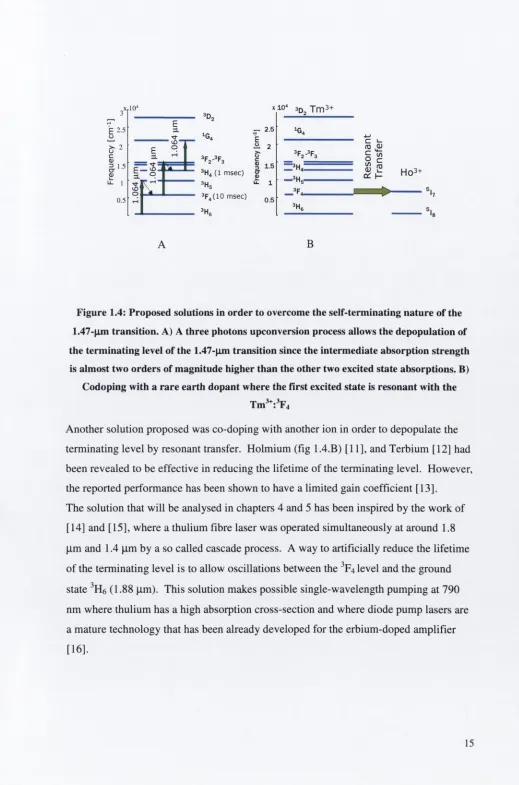
fluorescence centred at 1.47 |J.m as show n in fig 1.3, appear to be a p ossib le solution the active fibre in am plifiers w hich work in the S and telecom m unication bands. S om e o f these am plifiers have already been reported and have show n high efficien cy [8, 9]. L ifetim e m easurem ents o f the tw o levels involved in the am plification process have revealed that the upper lev el o f the am plifying transition has a shorter lifetim e than the terminating level; this leads to rather poor performances [3]. In recent years, several attempts were m ade to reduce the impact o f the self-term inating nature o f the 1.47-)j,m transition in a thulium zirconium based fibre amplifier. A sim ple and elegant m ethod o f solving this is to pump one o f the ^p4 excited state absorption bands as depicted in fig.
1.4 A. An excited state absorption transition is located at 1.05 |J,m [8] and it is
o > • 2
ID O 0.5
"D, " 6 4
^H4 (1 msec)
^F4(10 msec)
^0,
" 2-5 E i i 2
§
1.5 CT 4) u: 10.5
A B
Figure 1.4: Proposed solutions in order to overcome the self-terminating nature of the 1.47-^jn transition. A) A three photons upconversion process allows the depopulation of the terminating level of the 1.47-^m transition since the intermediate absorption strength is almost two orders of magnitude higher than the other two excited state absorptions. B)
Codoping with a rare earth dopant where the first excited state is resonant with the
Tm^*:^F4
A nother solution proposed was co-doping with another ion in order to depopulate the terminating lev el by resonant transfer. H olm ium (fig 1.4.B ) [11], and Terbium [12] had been revealed to be effectiv e in reducing the lifetim e o f the terminating lev el. H ow ever, the reported perform ance has been show n to have a lim ited gain co efficien t [13],
[image:17.535.11.530.29.814.2]1.2Thesis synopsis
The present work is concentrated on the potential that praseodymium and thulium doped fluoride fibres have for the construction of optical amplifiers around 1.3 |0.m and 1.47 |0,m.
Praseodymium was studied while a thulium codopant was present in the fibre as a pump absorber, this gave an alternative to Pr^"^ direct pumping but required a non-radiative energy transfer between Tm^"^ and Pr^"^. In fact, the large cross-section of thulium ions at 790 nm effectively absorbs the optical energy. A t this pump wavelength most of the thulium ions population is confined in the lower energy excited levels and no efficiently evidence has been found of a large energy exchange between the two ions.
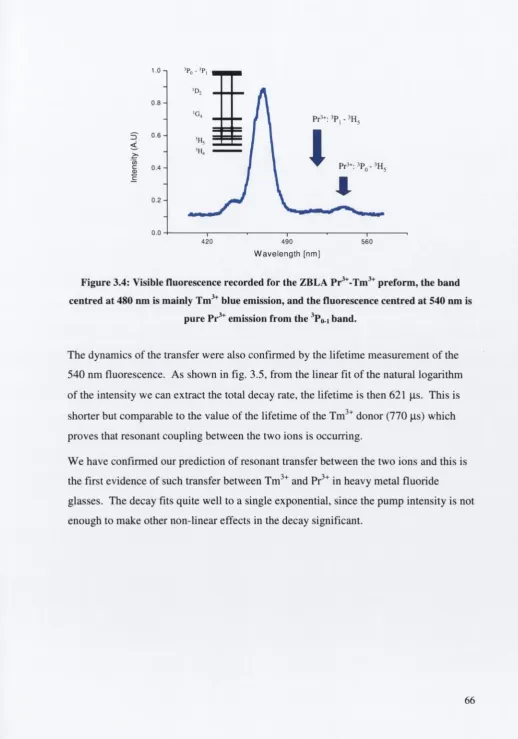
Visible spectroscopy measurements, however, showed that appreciable energy transfers were possible between the higher excited levels. W ith Tm^^ and Pr^'^, concentrations (3000 ppm and 500 ppm) were selected to maximise the absorption and energy transfer while minimising self-quenching. At higher pump powers, upper states are also
populated and the blue-green fluorescence emission peaking at 480 nm is clear evidence of appreciable energy transfer between the two ion species. The characterisation of the dynamics of the energy transfer was further explored by standard lifetime and frequency domain lifetime techniques, confirming the presence and allowing the measurement of the strength of the energy transfer.
Thulium in fluoride fibres showed low gain near 1.47 )j,m due to the lifetime of the excited levels involved in the pumping process. The terminating level of the transition has a longer lifetime than the upper level; this creates a serious difficulty in extracting a large gain. In order to directly measure the gain of the amplifier, a diode laser with a wavelength at 1.49 |im w ill be used; therefore we modelled the amplification at 1.49 |im for a thulium amplifier working cooperatively with a laser at 1.88 [i,m in order to have a direct comparison. The simulation shows a gain enhancement above the threshold for
1.3Structure of the Thesis
The thesis is structured as follows:Chapter 2
The chapter will provide an introduction to the structure of rare earth energy levels, a description o f the properties of fluoride fibres and such relevant effects as energy transfer, concentration quenching and upconversion will be described mainly from a phenomenological point of view. An approximate model is presented for the lower energy levels of thulium ions, furthermore the determination of absorption and
stimulated emissions; lifetime measurements, and excited state absorptions are reported.
Chapter 3
This chapter describes the detected resonant transfer in the Pr^'^-Tm^'*' codoped fibre, and the characterization of the dynamics of the resonant transfer by standard and frequency domain lifetime techniques.
Chapter 4
This chapter is dedicated to the numerical model of the amplifier. The starting point is the guiding property of the fluoride fibres, which are essential for the determination of some of the parameters in the model. Then the description of the rate equations and the numerical integrations for the differential equations is reported.
Chapter 5
This chapter describes the ring fibre, thulium doped amplifier, its construction and the experimental results obtained, together with the comparison of the numerical model developed in chapter 4.
Chapter 6
In this chapter, the second prototype o f the thulium amplifier where the optical pumping has been achieved by lasers at 800 nm and 1060 nm is presented. Its characterization and theoretical optimisation for power amplification will also be presented.
1.4 References
[1] F. P. Kapron, D. B. Keck, and R. D. Maurer, "Radiation losses in glass optical waveguides," App/. Phys. Lett., vol. 17, pp. 423-425, 1970.
[3] G. M ahlke and P. G ossing, F ib er O ptics C ab les. Munich: C om ing Cable S ystem , 2001.
[4] E. Snitzer and R. W oodcock, 6, 1965, p.45, "Yb -Er glass laser," A ppl. Phys. Lett, vol. 6, pp. 45-57.
[5] D . N. Payne and L. R eekie, "Rare-earth-doped fibre lasers and amplifiers," presented at Optical Com m unication, 1988. ECOC 88. Fourteenth European C onference on (Conf. Publ. N o .292), 1988.
[6] M. Poulain, J. Lucas, and P. Brun, "Fluoride fibres from zirconium fluoride; optical properties o f a fibre doped with Nd^"^," M a teria ls R esearch B ulletin, vol.
10, p p . 24 3-24 6, 1975.
[7] R. Caspary, U. B. Unrau, and W . K ow alsky, "Recent progress on S-band fiber amplifiers," presented at Transparent Optical N etw orks, 2003. Proceedings o f 2003 5th International C onference on, 2003.
[8] T. Komukai, T. Yam am oto, T. Sugaw a, and Y. M iyajim a, "1.47 )j.m band Tm^^ doped fluoride fibre am plifier using a 1.064 )im upconversion pum ping
scheme," E lectron ics L etters, vol. 29, pp. 110, 1993.
[9] J. Y. A llain, M. M onerie, and H. Poignant, "Tunable CW lasing around 0 .82, 1.48, 1.88 and 2.35 jim in thulium -doped fluorozirconate fibre," E lectro n ics L etters, vol. 25, pp. 1660-1662, 1989.
[10] B. Bourliaguet, F. Emond, S. M ohrdiek, A .-C . Jacob-Poulin, P.-Y . Cortes, and J. Lauzon, "Thulium-doped fibre am plifier using 1055 nm laser diode pum ping configuration," E lectron ics L etters, vol. 38, pp. 4 4 7 -4 4 8 , 2002.
[11] R. M . Percival, D. Szebesta, S. T. D avey, N. A. Sw ain, and T. A. K ing,
"Thulium sensitised holm ium -doped C W fluoride fibre laser o f high efficiency," E lectron ics L etters, vol. 28, pp. 2 2 3 1 -2 2 3 2 , 1992.
[12] T. Sakam oto, M. Shim izu, M. Yamada, T. Kanamori, Y. O hishi, Y . Terunuma, and S. Sudo, "35-dB gain Tm -doped Z B L Y A N fiber am plifier operating at 1.65 p,m," P h oton ics T echnology Letters, IEEE, vol. 8, pp. 3 4 9-35 1, 1996.
[13] T. Sakam oto, M. Shim izu, T. Kanamori, Y. Terunuma, Y. O hishi, M. Yamada, and S. S u d o ," 1.4-)im -band gain characteristics o f a T m -H o-doped Z B L Y A N fiber am plifier pumped in the 0.8-[im band," P h o to n ics T echn ology L etters, IEEE, vol. 7, pp. 9 8 3 -9 85 , 1995.
[15] R. M. Percival, D. Szebesta, S. T. D avey, N. A. Sw ain, and T. A . King, "High effcien t cw cascade operation o f 1.47 )0,m and 1.82 p,m transition in Tm^'^ doped fluoride fibre," E lectron ics L etters, vol. 28, pp. 2 0 6 3 -2 0 6 5 , 1992.
Chapter 2
Optical Properties of Rare Earth Ions
2.1 Introduction
The rare earth atoms can be divided in two series; the first called the Lanthanides goes from the atomic number 58 (Cerium) to number 71 (Lutetium). The other series is called the Actinides, usually they are unstable and radioactive and therefore rarely studied in optical spectroscopy. The Lanthanides possesses the same electronic outer
2 6 2
structure configuration: filled shells 5p 5p 6s as shown in fig. 2.1.
lanthanum cerium prasaodym ium neodym ium p rom ethium sam arium europium gadolinium terbium dysprosium holm lum ertlum thulium yttertHum !?« ■02 3 (/Iff 3** m '2 mS
F
-< 3 (Xel6s25<j [Xel(6s24(5d) IXel(6s24|3) IXe)(es24f4) [Xel(e»24f5) IXel(6s24fe> lXel(6SiI4t/) (Xel(6»24|75d) (Xel<6a24f9) [Xel(6s24f'0) (Xel (6*24(11) IXe)(6s24(i2) (Xel(6«24(13) (Xel(e«24ti«) [image:22.534.14.527.18.604.2]lu tetlu m
Figure 2.1: The 15 rare-earth elements showing the atomic number and electronic conflguration. [Xe] stand for the electronic conflguration of the noble gas Xenon.
Reproduced from [1].
how ever lea v es the outer 5s and 5p shells intact. The shielding effect provided by the outer filled sh ells is associated with the unique properties that rare-earth ions, have in respect to transitions m etals for instance.
T he optical electrons are exp osed to a reduced electric field created by the h o st’s ions and the rather w eak interaction with the host material, making them behave like an isolated ion. Therefore 4f-transitions absorb and em it as sharp lines in many visib le and IR w avelengths com patible with the transparency o f the host material itself. In the past, rare-earth spectroscopy measurements have been performed primarily in crystals [2], m ostly on host-based alkaline fluorides like Cap2. T hese m easurem ents sh ow ed the p ossib ility o f establishing laser oscillations in large numbers o f 4f-transitions spanned across the visib le and IR w avelengths. During the early 196 0’s a series o f experim ents sh ow ed the p ossib ility o f achieving pulse laser oscillation in rare-earth doped crystals fluorides and C aW0 4 in the mid infrared regions at liquid nitrogen temperature [3]. Lately vitreous hosts have been also doped with rare-earth ions. This research has led to low loss m ultim ode silica fibres and recently, single-m od e doped silica fibres.
The low sym m etry o f host sites in glass usually causes Stark splitting in the absorption and em ission fluorescence. The degeneracy that exists in the energy lev els is rem oved and the hyperfine structure is often visible. The broadening m echanism o f the optical transition in rare-earth doped glass is com plicated by m ultiple broadening effects, and m oreover is glass dependant so m ost o f the con clu sions are essentially em pirical. The broadening is due to tw o distinct causes: hom ogenous bro aden in g, is related to the distribution o f the energy o f the phonons which take part in the absorption or em ission processes; for this reason it is also know n as phonon broadening. The second cause is referred to as inhom ogeneous broaden ing and it is due to the unique crystal field that each ion experiences in a random distributed lattice.
The distribution o f available host sites in glass results in much broader fluorescence spectra in the glass com pared with crystalline materials. M oreover the light
The usefulness of silica fibres was limited by the high phonon energy of the glass, which reduces the lifetime of the metastable levels and thus their fluorescence efficiency by non-radiative relaxation. New glasses based on zirconium fluoride showed reduced phonon energy and a wider transmission band allowing more efficient laser oscillation across the visible and IR regions.
The aim of this chapter is to introduce the electronic proprieties of the general rare-earth ion, and the theory that describes the interaction with an external electromagnetic field. The rest o f the chapter is allocated to the presentation of a thulium analytical model and some spectroscopic measurements.
2.2 Electronic Properties
The familiar Schrodinger equation can be solved for hydrogen-like atoms. The atomic potential in such Hamiltonians is symmetric for rotations, and the angular momentum commutes with the Hamiltonian. This provides a natural basis in order to obtain the eigenvalues of the Hamiltonian.
The general case for an atom with many electrons is rather more complicated: the Schrodinger equation' includes a repulsive Coulomb potential and the spin-orbit interaction (L-S) for an atom of atomic number Z and N electrons as:
(2.1)
t . 2 N N 7 _ 2 N ^ 2
2m, r. r.j y/{r) = Elixir) ,
where r.. = and r = are respectively the distance between two electrons and the distance of the j-electron to the nucleus.
The repulsive Coulomb term cannot be treated as a perturbation, so in the Schrodinger
angular momentum J. The labelling of the levels is expressed with the Russell-Sanders
The problem is now reduced to taking into account the residual Coulomb effect due to the mutual interaction between 4f-electrons and the spin-orbit interaction. The former partially lifts the degeneracy presented in the central field approximation and the energy states show a dependency on both L and S.
Next in the hierarchy is the spin-orbit coupling that lifts the degeneracy in the total angular momentum and splits the LS terms into J levels which can be solved using an intermediate coupling calculation by simultaneously diagonalising the spin-orbit and the electrostatic interaction.
In this way it is possible to calculate the energy of the excited state levels of rare-earth ions, moreover if i f are the reduced matrix found by simultaneously diagonalising the electrostatic and the spin-orbit interaction between two state characterized by the set of the quantum numbers a and b, then:
These values are almost independent of the host and they are tabulated in [5]. Section 2.4 will report how to take into account the host effect by introducing three
phenomenological parameters with the aid of the Judd-Ofelt analysis.
2.3 Optical Properties of Rare-Earth Ions
The 4f-electrons can interact with an incoming electromagnetic field. If the frequency of the electromagnetic field is comparable with the frequency spacing between the ground state and an excited state, then a photon can be absorbed. It is useful to define
the oscillator strength of a general transition between the two multiplets a and b
given by the expectation value of the dipole operator D:
where the summation is over all the multiplet components. Electric dipole operator transitions are usually more intense than magnetic, nevertheless magnetic components are in some cases presented. The dipole operator has an odd parity while the energy states have all the same parity, so this seems in contradiction with the selection rules, however, the mixed L-S levels are not completely pure, as previously specified. This scheme like using for L the equivalent spectroscopic letter (s,p,d,f,....).
(2.2)
fact can be attributed to the low degree of symmetry associated with the rare-earth site in the glass medium and therefore the total oscillator strength is usually approximated with the electric dipole oscillator strength.
The spontaneous emission rates from a level a to a level b can be calculated from the Poynting vector which in the classical limit is proportional to the oscillator strength [6]:
(2 4) A - r S
3/ic’(27 + l) "
where J is the quantum number of the total angular momentum of the initial state a, Sa~* is the electric oscillator strength and the electric local field correction factor is
Zed ~ + 1)V9 where n is the refractive index.
For an energy level a the spontaneous emission lifetime is define as the inverse of the sum of all the radiative spontaneous emission rates originated from the considerate energy level, i.e.;
J The branching ratio is therefore define as:
4
f > _ - A
H a ^ h ~ 4 ~ ’ j
and gives the relative probability of spontaneous decay for a particular transition a ^ b .
The transition cross-section a specifies the character of the interaction of the atom with the radiation, its integral (in m -Hz) is proportional to oscillator strength defined in the eq. 2.3;
(2.5) S ^ ^ , o c \ a i v ) d v .
Usually it is more convenient to work with a dimensionless quantity;
(2-6) 3 ^ Z e d ^ a ^ b ’
^TUmV
3hc\2J^+\y
It is possible to connect in an em pirical way the absorption oscillation strength to the reduced m atrix elem ents o f the equation 2.1 as:
this m ethod is called Judd [7] -Ofelt analysis [8]. In practice, the three em pirical
param eters ^ 2, ^ 4, ^ 6, are obtain by perform ing a least-squares fit to the integrated absorption bands from the m easured absorption spectrum . O nce the param eters are obtained it is possible to determ ine the strength o f any radiative transition for the specific dopant-host com bination.
Me C um ber theory stated that the relationship betw een the em ission and the absorption spectra [9] w hen the tim e required to obtain therm al distribution is short com pared to the lifetim e o f the level is:
w hich m eans that the stim ulated em ission cross-sections <7^ and the absorption
cross-sections <7^ ,are scaled w ith respect to each other by a tem perature-dependent param eter
e , which is the net free energy required to excite one ion in the transition involved at the tem perature T [10].
2.4 Homogeneous and Inhomogeneous Broadening
T he effects o f line broadening m echanism s in glasses when com pared to crystals are evident form figure 2.2. If the crystal and glass have sim ilar chem ical com position, the oscillator strength o f optical transitions is sim ilar and so the integral o f the cross-section for the glass and crystal should be sim ilar too. The difference is that the cross-sections have low er peak values but larger widths for rare-earths in glass as opposed to the case o f crystals.
H om ogenous broadening (or phonon broadening) takes place because energy exchange in a transition betw een the two energy levels may include the creation or annihilation of a phonon. It has a L orentzian type profile therefore, it is clear that this type of
broadening is due to the finite lifetim e of the m etastable state: (2.8)
(= 2 ,4,6
(2.10) (7 = ^
^ ( v - v ) " + r
where veg is the frequency o f the oscillating dipole and F is the full width at half maximum of the resonance.
YAG
> -t CO z UJ H Z
1020 1040 1060 1080 1100 1120 1140
[image:28.534.11.525.26.641.2]WAVELENGTH (nm )
Figure 2.2: Comparison of the emission spectra for Nd^*-doped YAG and Nd^-doped silicate glass, reproduced from [11]
The inhomogeneous broadening is due to the variation in the host field that each ion in a site glass experiences. The absorption lineshape is Gaussian:
(2.11) 1 I
2 A e
similarly to the previous case A is the transition linewidth centred at the frequency The observed lineshape is usually complex and cannot be fitted to any of the two broadening types. Observed lineshape in glasses will be a convolution o f homogenous and inhomogenous broadening.
However it is not possible to directly measure cross sections, usually a spectrometer
measures intensity per unit wavelength so it is more convenient to define the effective
line width as:
So the lineshape function can be rewritten as:
The important Fuchtbauer-Landenberg equations connect the emission lineshape with
the stimulated emission cross sections and are derived directly from Einstein’s A and B
coefficients [12]:
so it is possible to scale the emitted fluorescence to the value of the cross-section while
the relative magnitude of the cross-section detuned from its peak value is taken into
account by a normalized lineshape function.
The equivalent analysis for the absorption lineshape is less useful since, as will be
shown, absolute absorption cross-sections can be directly measured.
2.5 Energy T ransfer
Interaction can occur between ions of the same species for a monodoped fibre or
between atoms of different species in case of a codoped or multidoped fibre. At low
concentrations, ions could be thought to be isolated and with the increase in
concentration the two ions become close enough to allow a sharing of energy. Dexter
[13] originally proposed the theory for the energy transfer: the interaction between the
two ions is described by an interaction operator which decreases with the interionic
distance R according to 1/R^ (s is an integer) and the short range exchange exp(-R/Rb)
where Rb is Bohr radius. The electric and magnetic dipole varies as 1/R^ and they
dominate at large ion separations in the multipolar expansion. The transition probability
is calculated with Fermi’s golden rule and is proportional to the square of the
A i
1(A)
Hamiltonian matrix elements; this means that the transition probability decreases as
1/ l f. However even if the interaction mechanism is usually known, it is not possible to calculate accurately the dynamics o f the transfer, therefore a semi empirical treatment is
usually employed.
When energy transfer takes place between two ions, the type o f ion that is optically
excited is referred to as the donor and the one that receives the excitation is called the
acceptor. The donor absorbs the photon of the optical pump and transfers its energy to a
nearby acceptor (fig 2.3 a), this process is usually used for sensitising materials as in
case of Er^"^, Yb^"^ where poor absorption cross-section of Er^"^ at 800nm is enhanced by
the Yb^"^ strong absorption in order to obtain amplification at 1550 nm [14].
( a )
I on A
E n e r g y T r a n s f e r
( b )
E
[ Ion A I
I on B
C r o s s
R e l a x a t i o n
( c )
H
5
[image:30.535.12.524.22.585.2]C o o p e r a t i v e
U p c o n v e r s i o n
Figure 2.3: The possible resonant transfer mechanisms between ions in a rare earth flbre.
Inokuti and Hirayama [15] modelled the decay with time of the donor fluorescence after
a laser pulse as a function of the distance dependence o f the transfer rate between
centres. In the case o f multipolar interaction between donors and acceptors when both
fluoresce, the ratio of the donor fluorescence to the total fluorescence intensity is given
by:
w here the Id ( Ia) is the integrated intensity o f the donor (acceptor) fluorescence and W is the m ean transfer rate. The exponent y takes into account the order o f the m ultipolar expansion involved.
O ther ion-ion interactions, w hich happen according to selection rules, can be divided
into tw o classes o f categories: C ross-relaxation and C ooperative U pconversion. C ross
relaxation is the process in w hich an ion in the excited state transfers part o f its
excitation to a neighbouring ion as show n in fig.2.3 (b).
C ooperative upconversion can be thought o f as the inverse o f cross relaxation in this
case both ions are in an excited state (fig. 2.3, (c)).
A n exam ple o f interaction betw een ions o f the sam e species is the degradation o f the
lifetim e o f the excited levels with the increase o f the doping concentration. In
Pr^^doped fibres, for instance, this is a w ell-know n and im portant effect that usually
fixes the upper lim it o f concentration at 500 ppm . The quenching in the lifetim e is
plotted in fig. 2.4 versus the concentration o f the praseodym ium in ZB LA N glass.
1 2 0 -1 -1
0-1 0 0 -9 0 -U 0>
(/>
A 8 0 -^ 7 0 -2 6 0 -5 0 -4 0 -3 0 -20
0.1 1
[image:31.534.7.526.24.600.2]Pr^* C o n c e n tra tio n (wt. % )
Figure 2.4: The quenching of lifetime starts at 200 ppm however until 500 ppm it does not strongly influence the lifetime. From reference [16]
The em pirical form ula that relates the observed lifetim e to the ion concentration
w here is the hfetim e in the Umit o f zero concentration and Q is the quenching
concentration, an em pirical param eter determ ined from fitting the experim ental data.
The exponent p represents the dom inant relaxation m echanism , in the case o f cross
relaxation its value is 2.
2.6 F lu o rid e Fibre
Fluoride glass is based on tetravalent, trivalent and bivalent fluorides, usually know n as
heavy m etal fluorides. T he m ore com m on glasses for telecom m unications devices are
often m ade from heavy m etal Zirconium (Zr) tetravalent fluoride salt, the glass is called
Z B I A N after the acronym o f the constituent ions (Zrp4 - B a p2 -L aF s -AIF3 -N a F ). A
key difference betw een silica fibre and fluoride fibre is in the phonon energy. In the
silica fibre, the phonon energy is on the order o f 1 1 0 0 cm ‘ while in the fluoride fibre,
the phonon energy is around 580 cm ’. This shifts the absorption edge to w avelengths
up to 5 ^im in the fluoride glasses. W ith low er phonon energy, these types o f glasses
have a reduced non-radiative decay com pared with silica glass. The probability for the
non-radiative decay is;
W N R = B e “ ^ ,
w here AE is the energy gap separating the tw o levels involved in the decay and the two
phenom enological param eters B and a are used to take into account the host properties
and are independent o f the active ions added. In a low er phonon energy m aterial, the
AE is usually bigger than in silica glass and the non-radiative decay rate is then smaller.
This gives stronger radiative em issions and a longer lifetim e for the ions. The tw o
Table 2.1: Composition and physical properties of the ZBLA glass used in this thesis.
C om position (m olar fraction) ZrF4 (57), BaFz (34), LaFs (5), A IF3 (4)
G lass Transition Tem p. 300 “C
M elting Tem p. 550 "C
L inear expansion coefficient 16 10 '’ K ‘
Refractive Index 1.519
Spectral W indow (T=90% , 2m m thick) 0.25-6.5 )J.m
Fluoride glasses belong to the general fam ily o f halide glasses, the binding force o f the
m olecules are m ostly ionic, in contrast for instance w ith silicate glass w hich are
covalently bonded. This has the effect that dopants in fluoride usually em it and absorb
at shorter w avelengths than for the sam e dopant in covalent glasses. M oreover in the
Judd-analysis is correlated with the degree o f covalency in the glass, fluorides have a
tendency to have 0 .2 sm aller than silicates.
In conventional laser glass, a high concentration o f non-bridging oxygen groups allow
an easier incorporation o f rare-earth ions. H ow ever in silica based optical fibres, a rigid
structure exists and there is a lack o f non-bridging Si-O" groups w hich gives a low
num ber o f netw orks m odifiers that can be replaced by rare-earth ions. This m akes the
coordination o f rare-earth ions difficult and it contributes to a lack o f solubility, w hich
usually leads to clustering in the glass. C lustering is particularly harm ful since it
contributes to local concentration quenching and to w orking with a low doping
concentration [18]. A lternatively, fluoride allow s a higher concentration due to the
ionic nature o f its lattice netw ork; the rare-earths ions usually substitute for LaFs,
greatly reducing the previously m entioned clustering effect.
The m ethods currently used for the fabrication o f rare-earth doped fibres can be divided
into three m ain groups. The first two m ethods, called vapour phase and liquid phase
concern rare-earth doped fibres based on silica glass [19], while the third m ethod
concerns fluoride glasses and consists o f a liquid phase, m elting/casting process. The
m ethods used for silica are inadequate for fluoride based fibre due to a relative high
viscosity near the m elting point [20]. This creates the necessity to prevent the form ation
o f crystallites because the viscosity decreases rapidly above the transition tem perature
temperatures □ 90® C ). There are several methods [21, 22] which allows the
preparation of a preform from which a fibre can be drawn; a common feature is that
they start from melted fluoride powder and cast the preform in an inert crucible and
atmosphere ( refractive index modifier is added to the core or the cladding) at
temperature of the order of 7 0 0 - 800° C . Then the fibre is drawn from the preform in a
temperature and speed controlled fibre drawing furnace. The composition and the
physical properties of the glass used in the fabrication of the fibres studied in this thesis
are reported in table 2.1. However the differences in the final fluoride fibre composition
are not particularly relevant in this context. The mechanical properties can be altered by
changing the final composition of the glass (see reference for more details [23]) but the
optical behaviour of the doped ions are not particularly altered due to the shielding
effect described in the section 2.3.
There are several disadvantages in working with fluoride fibres. Fluoride fibres are
rather more brittle than silica and more sophisticated technology is needed to handle
them. They are also more expensive due to the higher cost of the materials involved in
the fabrication. Fluoride fibres are usually coiled around a bobbin, therefore the surface
experiences a tensile stress which is generally more severe than for silica fibres.
Furthermore, fluoride fibres are subjected to moisture damage, these effects normally
have a contribution in reducing the lifetime of fluoride fibre devices [24],
2.7 Introduction to Spectroscopy in Rare-Earth Doped Fibre
Even if many parameters measured for crystalline material are very close to those of
heavy metal fluoride glass from which our fibres are made, there is a substantial
difference in spectroscopic measurements. The guided nature of the light in glass fibre
material substantially alters the spectra. Usually in doped fibre production, preforms are
made before the fibre itself is drawn, therefore spectroscopic measurements are carried
out mainly on preforms because they are easier to manipulate.
However sometimes it is not possible to have a preform, so the measurements must be
conducted directly in the fibre. Due to the guiding nature of the light in the fibre,
observations are rather different from crystals or preforms where there is no
confinement. Moreover, the fluorescence emitted is also guided and due to its
The fractional part of the fluorescence that is guided in the fibre is proportional to the
capture angle AQ defined as:
where is the core refractive index and is the cladding refractive index.
It is common to specify the fibre with the value of its numerical aperture NA, a
terminology borrowed from lens design which represents the maximum acceptance
angle of the fibre and it describes the capability of the fibre in gathering the light as:
The fluorescence itself can also be subjected to re-absorption and stimulated
amplification, making fundamental fluorescence measurements rather more
complicated.
Some limits have to be considered in order to define the possible spectroscopy
measurements that can be carried out and the relative accuracy that can be expected.
Doping levels in a fibre are naturally lower than in a crystal, especially for fibre
designed in order to be used as an amplification medium. Many dopants such as Pr^”^
have a low doping threshold where non-radiative relaxation starts to reduce the lifetime
of the excited level, making the doped fibre a rather dilute system. If the fibre is short,
stimulated amplification of the fluorescence and re-absorption are consequentially low
so they can be neglected, however this leads to very low fluorescence power so a high
sensitivity spectrometer is needed. The fluorescence power detected is usually
proportional to the acceptance angle (eq. 2.16) and it is quadratic with respect to the
NA, and is also proportional to the mode volume which decreases with the NA. A
method of checking if the system is short enough is to reflect back the fluorescence into
the fibre; if it is twice the power of that detected from a single pass then the system can
be considered thin. A 10 cm fibre length is usually so short that most of the excitation
radiation is not absorbed and the fluorescence lineshape is not affected by the
confinement.
(2.14) AQ. = n:
(2.15)
The eq. 2.14 can be rewritten in terms of NA as:
(2.16) AQ. = 7T
Another important consideration is that a fibre is purely single m ode on ly above a
certain w avelength, b elo w this w avelength higher m odes are supported. Therefore, the
fibre exhibits a m ultim ode nature and so absorption lengths are affected by the
distribution o f the m ultim ode nature o f the electric fields. The m easurements reported
in this chapter are performed in fibres w hich have been recorded at w avelengths where
the fibre supports a sin g le m ode, w hich m eans that they can be scaled to the true value,
usually by a constant factor. The constant factor is com m on ly referred to as the
confinem ent factor and represents the fraction o f the guided light w hich is propagated in
the core w ith respect to the total pow er that propagates either in the core or in the
cladding.
In this chapter, a m ethod o f measuring the thulium stimulated em ission cross-section
around 1.47 |im and the absorption cross-section s for three o f the IR transitions w ill be
demonstrated. T hese values are fundamental in the developm ent o f a phenom enological
m odel used in the rest o f the thesis. S in ce thulium has a central role in this thesis the
sp ectroscopic analysis in Z B L A in the region betw een 800 nm up to 1.7 |0.m w ill be
presented.
2 . 8 T h u l i u m
T he energy lev el diagram o f Tm^"*^ is show n in fig. 2.5. The calculation o f the thulium
energy lev els is more problem atic with respect to lighter rare-earth ions. A s the atom ic
number increases, the contribution o f spin-orbit coupling increases more rapidly than
the electrostatic interaction betw een 4f-electrons givin g a more significant LS m ixing.
In the first attempt lev els ^p4 and ^H4 were reversed, since the spin-orbit contribution
w as underestimated. R ecent calculations, how ever, proved that the correct labelling is
the one reported figure 2.5 [25]. A lthough recent literature reports the correct labelling
system , it is not infrequent to find the reversed one in older books or articles. Thulium
sp ectroscopy in fluoride glasses is w ell described in the literature; the transition betw een
^p4—>^H6 peaks at 1.850 )J,m with a broad strong em ission band and a m easured lifetim e
o f the lev el b etw een 9 .8 m s and 10.2 ms.
T he transition to ^H4 has an absorption peak at 7 9 0 nm and a strong absorption
cross-section ideal for optical pum ping with G aAs diode lasers or solid-state titanium-
sapphire lasers. Transitions to the low er lev el are largely dom inated by the radiative
peaking at 1.47 [im with 1% decaying to the level that em its a fluorescence at 2.3
jxm. The lifetim e o f w hich transition has been measured to be around 1.6 ms.
The transition at 1.47 |i,m is located at w avelengths that are important for optical fibre
com m unication, how ever efficien t am plification is prevented by the longer lifetim e o f
the terminating lev el with respect to the upper level o f the transition. C olloquially, this
situation is expressed as the “bottleneck effect” w hich suggests the idea that under the
steady state conditions, a large part o f the electron population is lying in the terminating
level o f the 1.47 [i,m transition and only at high pump rates is a small population
inversion appreciable. This topic w ill be further d iscussed in chapter 4, 5 and 6 where
tw o different solutions in order to overcom e the problem w ill be presented.
Another effect in rare-earth doped fibres is called upconversion; in the presence o f a
populated excited state with a rather long lifetim e, a second photon can be absorbed
from the excitation (E xcited State Absorption or A SE ). A three-photon upconversion
process is also p o ssib le and this has an important role as a pum ping m echanism in a
thulium doped am plifier as w ill be presented in chapter 6.
U pconversion processes related to a single w avelength has the effect o f producing
fluorescence c lo se to the double o f the frequency o f the pump radiation, usually in the
visib le with blue-green fluorescence that glow s from the fibre.
T he radiative lifetim e for the 'G4-transitions is o f the order o f 0 .6 8 -0 .7 8 m s and the
main decay channel is to the ground state (46% ) with fluorescence at 4 8 0 nm. This
transition is responsible for the weak blue fluorescence that can be seen in single
pum ped 7 9 0 nm thulium doped fibre. The E S A centred at 7 8 0 nm is w eak and usually
' Dj [55 ns»c]
[630 ^s*c]
[1.6 msec]
(11 ms*c]
Figure 2.5: Thulium energy levels and their energy in cm''. A possible transition
wavelength can be calculated from the difference in energy between the two levels
involved. All the wavelengths are express in nm.
2.9 Praseodymium
Praseodym ium received much attention as a prom ising candidate for an am plifier at 1.3
|im in the zero dispersion telecom m unication w indow , the energy lev el is show n in fig.
2.6. M oreover, due to a large number o f v isib le transitions it has been considered a
good dopant for visib le lasers.
T he main drawbacks are due to the low absorption at 1 [j,m (^H4- ‘G4 transition) and the
concentration quenching that appears at low doping levels. The decay 'G4
produces flu orescen ce around 1.3 )J,m. T his transition, in contrast to the neodym ium 1.3
)im -transition, is free from excited state absorption at 1.3 }im, so theoretically a high
gain can be achieved.
T he high energy m ultiplet (^Po, ^Pi, 'le ) decays at several w avelengths: 6 1 0 , 6 3 5, 695,
7 1 5 , 885 and 9 1 0 nm [26], 4 9 0 , 5 2 0 540n m [27]. Many o f these transitions are suitable
for laser oscillation s, and make Pr^"^ doped fluoride fibre an interesting host for this type
o f application. A s sh ow n in the previous section, concentration quenching appears with
long cavity, moreover the possible absorption transition is located at around 1 |im where
pump diode lasers have generally low power and is a relatively weak transition.
Pr^"^ is notorious for the inconsistency between the radiative transition probabilities
obtained by use o f Judd-Ofelt theory and the experimental values. The fluorescence in
1 1 3 3 1
the measured lifetimes o f transitions from levels G4, D2 and the Pq, Pi, multiple!,
are different from those calculated due to the two additional possible relaxation
channels: multiphonons relaxation and cross-relaxation between pairs o f ions.
The ^Po.^Pi, 'l6 system is subject to energy migration due to the thermalisation and is
•5
characterised by the lifetime o f the Pq which is the longest lived state (50 ^ts) [28].
3p 'e
835
695 715
635 605 520 540
490
1300
10 1 0
i
'G^ [137ns*c]
[image:39.533.14.525.22.694.2]^ 6
Figure 2.6: Energy levels of Pr^^ in fluoride fibre, the upconversion-pumping process and
the m ost important visible laser transitions are shown. All the wavelengths are expressed
in nm.
2.10 Introduction to Fibre Lasers and Amplifiers
The basic idea underpinning an optical fibre laser and an amplifier is relatively simple.
A diode laser provides the optical power in order to excite the rare-earth ions, the cavity
is usually made by two mirrors coated in order to obtain high reflection at the lasing
wavelength, which confines the light and provides the optical feedback necessary in
w avelength, w hich is filtered out after the m irror output coupler, the layout is show n in
figure 2.7 A. O ther solutions that have been im plem ented are based on fibre Bragg -
gratings [29] and fibre loops [30], instead o f mirrors.
D oped Fibre
A
MM"
Lens
Laser Dkxle (Pump) Mirror O utput C oupler Mirror
B
L aser DkxJe (Pump)
D oped Fibre
Figure 2.7: Upper, diagram A shows a Fabry-Perot fibre laser while diagram B is a fibre
amplifier.
In a rare-earth doped fibre am plifier the m irrors are rem oved, and the pum p is needed to
establish population inversion in the fibre active medium. The dopant usually em its
fluorescence at w avelengths w hich are located in the telecom m unication band betw een
1.3 |0,m up to 1.6 ^im; an incom ing signal can be am plified by stim ulated em ission
w ithin the am plification bandwidth. This guarantees the coherence o f the photons
em itted w ith the signal. U sually, isolators are placed at the end o f the active fibre,
reducing the im pact o f back reflection. Low loss-connectors (FC type) are anchored on
the front end in order to allow connection w ith optical cables for the input and the
output o f the signal (fig. 2.7 B).
T he gain in the am plifier is defined as [31]:
w here P,„ and Pout are the am plifier input and output signal pow er and Pase is the noise
pow er generated by the am plifier, w hich lies w ithin the optical bandw idth o f the
m easurem ents. In m ost cases, Pase is very low com pared to the signal and can be
(2.18) G ,,= 1 0 1 o g
^ p ^
oul P \ m y
Predicting the gain is complicated by the local changes in power and signal that can
affect the population of the excited states. At any given point in the fibre, it is possible
to define the so-called gain coefficient as:
(2.19) g iz ) = (7^,N^-cT^N,,
where the is the stimulated emission crosssection and cr^ is the absorption cross
-section experienced by the amplifying signal whilst the Nu and N j are respectively the
density of ions in the upper and lower levels involved in a transition.
The net gain G can be integrated if the explicit relation of the density with the fibre
length is known, as:
(
2
.20
)or:
(2.21)
G = e°
I
G j g = 4 3 j g i z ) d z .
2.11
A nalytical M odel
The behaviour of rare earth ions in doped fibre lasers and amplifiers can be modelled by
a phenomenological model which takes into account measured parameters of the
transitions involved as: cross-sections and decay rates. The time dependent population
densities of the excited state are subject to a set o f differential equations called
rate-equations. If the dynamics of the system are not under investigation it is usually
possible to calculate directly the steady state value of the population densities without
having to integrate a time dependent system of first order differential equations. It is
clear that when the system is in the steady state, the rate o f change of the population is
zero and the rate-equations are reduced to a linear equations system. M oreover the
system has to include the conservation law:
(2.22)
N,,,=Y^N;,
i
where Ni are the population densities of each j-excited level and N,ot is the total doping
![Figure 1.2: Dispersion of a standard silica single mode fibre. Reproduced from [3]](https://thumb-us.123doks.com/thumbv2/123dok_us/8799465.913329/14.537.11.534.40.790/figure-dispersion-standard-silica-single-mode-fibre-reproduced.webp)