Three-Step Iterative Method for Solving
Nonlinear Equations
I.A. Al-Subaihi
Department of Mathematics, Faculty of Science, Taibah University, Saudi Arabia [email protected]
Abstract
In this paper, a published algorithm is investigated that proposes a three-step iterative method for solving nonlinear equations. This method is con-sidered to be efficient with third order of convergence and an improvement to previous methods. This paper proves that the order of convergence of the previous scheme is two, and the efficiency index is less than the corresponding Newton’s method. In addition, the three-step iterative method of the scheme is imple-mented, and the previously published numerical results are found to be incorrect. Furthermore, this paper presents a new three-step iterative method with third order of convergence for solving nonlinear equations. The same numerical examples previously presented in literature are used in this study to correct those results and to illustrate the efficiency and performance of the new method.Keywords
Newton’s method, Iterative methods, Nonlinear equations, Efficiency index, Order of conver-gence1
Introduction
Finding zeros of nonlinear equations is a common scientific activity capable of answering questions about real-word phenomena. In recent years, many researchers have attempted to develop several iterative methods for solving nonlinear equations. Abbasbandy [1] and Chun [5] have proposed and studied several one-step and two-step iterative methods with higher orders of convergence using the Adomian decomposition method [2]. Noor and Noor [8] have considered another decom-position technique which does not involve derivatives of the Adomian polynomials; they used this decompo-sition to construct one-step, two-step and three-step iterative methods. J. Yun [10] proposed a three-step iterative method, which is a significant improvement of the method proposed by Noor and Noor [8]. Siyyam [9] derived and analyzed a new fourth-step iterative method with fifth order of convergence. Al-Subaihi and Alqarni [3] developed optimal three-step methods with eighth order of convergence. Al-Subaihi and Siyyam
[4] derived optimal iterative methods with eighth and sixteenth orders of convergence for solving nonlinear equations.
In Section 2, the main ideas of the decomposition tech-nique by V. Daftardar-Gejji and H. Jafari [6] are out-lined, and a new three-step iterative method for solving nonlinear equations is developed. The convergence anal-ysis of the proposed method and the three-step iterative method proposed by Noor and Noor [8] are presented in Section 3. The same numerical examples presented in [8] are considered in Section 4 to show the performance and efficiency of the newly proposed scheme. Moreover, corrections to the results of [8] are also presented in this section. Conclusions and remarks are offered in Section 5.
2
Iterative Algorithms
Consider the nonlinear equation
f(x) = 0, (1)
assume that f(x) has a simple root at α, and γ is an initial guess sufficiently close toα. Rewrite equation (1) using the Taylor series as
f(x) =f(γ) + (x−γ)f0(γ) +(x−γ) 2
2 f
00(γ) = 0, (2)
where γis the initial approximation for a zero of (1). Equation (1) can then be rewritten in the following equivalent form:
x=c+N(x), (3)
where
c=γ− f(γ)
f0(γ), (4)
and
N(x) =−(x−γ) 2
2f0(γ) f
00(γ). (5)
Using the decomposition scheme of Daftardar-Gejji and Jafari [6], the solution of equation (3) ) is assumed to have the series form:
x= ∞
X
i=0
xi (6)
Copyright © 2015 Horizon Research Publishing All rights reserved. Universal Journal of Applied Mathematics 3(2): 29-33, 2015
The nonlinear operatorN(x) can be decomposed as
N( ∞
X
i=0
xi) =N(x0) + ∞
X
i=1 (N(
i
X
j=0
xj)−(N(
i−1
X
j=0
xj))) (7)
Combining Equations (3), (6) and (7),
x =
∞
X
i=0
xi
= c+N(x0) + ∞
X
i=1 (N(
i
X
j=0
xj)−(N(
i−1
X
j=0
xj)))(8)
Thus, the following scheme is determined:
x0 = c,
x1 = N(x0),
x2 = N(x0+x1)−N(x0), ..
.
xn+1 = N(x0+x1+...+xn)
−N(x0+x1+...+xn−1), n= 0,1,2, ...(9)
Therefore,
Xn =x0+x1+x2+...+xn,∀n= 0,1,2, ...,
denotes the (n+ 1)-term approximation ofx, and hence,
xis approximated by
x≈Xn=x0+x1+...+xn, (10)
forn= 0,
x≈X0=x0=c=γ−
f(γ)
f0(γ). (11)
This suggests the following one-step iterative method for solving the the nonlinear equation (1).
Algorithm 1For a givenx0, compute the approximate solutionxn+1by the iterative scheme:
xn+1=xn− f(xn) f0(xn), f
0(x
n)6= 0, n= 0,1,2, .... (12)
This algorithm is well-known as Newton’s method which has a second order of convergence.
From Equations (5), (9) and (10) withn= 1,
x ≈ X1=x0+x1=c+N(x0)
= γ− f(γ)
f0(γ)−
(x0−γ)2 2f0(γ) f
00(γ). (13)
Using this relation, the following two-step iterative method for solving nonlinear equation (1) is suggested. Algorithm 2For a givenx0, compute the approximate solutionxn+1by the iterative scheme:
yn =xn− f(xn) f0(xn), f
0(x
n)6= 0.
xn+1=yn−
(yn−xn)2 2f0(x
n)
f00(xn),∀n= 0,1,2, .... (14)
This algorithm is called the two-step iterative method for solving nonlinear equation (1). It is worth mention-ing that the above algorithm was obtained by Noor and Noor [8], and by Abbasbandy [1] using the Adomian de-composition method.
Again from Equations (5), (9) and (10) with n= 2,
x ≈ X2=x0+x1+x2=c+N(x0+x1)
= γ− f(γ)
f0(γ)−
(x0+x1−γ)2 2f0(γ) f
00(γ).
Using this relation, the following three-step iterative method for solving the nonlinear equation (1) is sug-gested.
Algorithm 3For a givenx0, compute the approximate solutionxn+1 by the iterative scheme:
Predictor Steps:
yn=xn− f(xn) f0(xn), f
0(x
n)6= 0 (15)
zn=−(yn−xn) 2
2f0(xn) f
00(xn), (16)
Corrector Step:
xn+1 = xn− f(xn) f0(xn)−
(zn+yn−xn)2
2f0(xn) f 00(x
n)
= yn−(zn+yn−xn) 2
2f0(xn) f
00(xn). (17)
Noor and Noor [8] derived a three-step iterative method for solving nonlinear equation (1), but the algo-rithm was quite different than algoalgo-rithm 3 and is given as follows:
Algorithm 4For a givenx0, compute the approximate solutionxn+1 by the iterative scheme:
Predictor Steps:
yn=xn− f(xn)
f0(x
n)
, f0(xn)6= 0 (18)
zn=−
(yn−xn)2 2f0(xn) f
00(x
n), (19)
Corrector Step:
xn+1 = xn−
f(xn)
f0(x
n)
−(yn−xn) 2
2f0(x
n)
f00(xn)
−(zn+yn−xn) 2
2f0(xn) f 00(x
n)
= yn+zn−(zn+yn−xn) 2
2f0(xn) f
00(xn). (20)
In the next section, algorithm 3 is shown with a cubic order of convergence while the Noor and Noor algorithm, Algorithm 4, has a quadratic convergence.
3
Convergence Analysis
Theorem 1Letα∈Ibe a simple zero of a sufficiently differentiable functionf :I⊆R→Rfor an open inter-valI. Ifx0 is sufficiently close toα, then method (17), Algorithm 3, has a third order of convergence.
Proof Letαbe a simple zero of (1) and xn =α+en. By the Taylor expansion,
f(xn) =f0(α)(en+c2en2+c3e3n) +O(e4n), (21)
f0(xn) =f0(α)(1 + 2c2en+ 3c3e2n) +O(e
3
n), (22)
f00(xn) =f0(α)(2c2+ 6c3en) +O(e2n), (23)
whereck= f(k)(α)
k!f0(α), k= 2,3, . . .. Dividing (21) by (22), yields
f(xn)
f0(x
n)
=en−c2e2n+ 2(c
2
2−c3)e3n+O(e
4
n). (24)
From (15) and (24),
yn=α+c2e2n+ 2(c3−c2)e3n+O(e
4
n). (25)
Then,
(yn−xn)2=e2n−2c2e3n+O(e
4
n). (26)
From (22) and (23),
f00(xn)
2f0(xn) = c2+ (3c3−2c 2
2)en+ (6c4−9c2c3+ 4c32)
×e2n+ (10c5−16c2c4−9c23+ 24c3c22 −8c42)e3n+O(e4n). (27)
Substituting (26) and(27) into (16) and simplifying pro-duces
zn=−c2e2n+ (4c
2
2−3c3)e3n+O(e
4
n). (28)
Now from (25) and (28),
zn+yn=α+ (2c22−c3)e3n+O(e
4
n). (29)
Then,
(zn+yn−xn)2=e2n+O(e4n). (30)
Substituting (25),(27) and (30) in (17) and simplify-ing finds that
en+1 = xn+1−α
= −c3e3n+O(e
4
n). (31)
This indicates that the order of convergence of the method defined by (17) is at least three. This completes the proof.
Theorem 2Letα∈Ibe a simple zero of a sufficiently differentiable functionf :I⊆R→Rfor an open inter-val I. If x0 is sufficiently close toα, then the method (20), Algorithm 4, has second order of convergence. ProofLetαbe a simple zero offandxn=α+en. Sub-stituting (25),(27),(28) and (30) in (20) and simplifying to get
en+1 = xn+1−α
= −c2e2n+O(e
3
n). (32)
Which indicates that the method defined by (20) is of second-order. This completes the proof.
4
Numerical examples
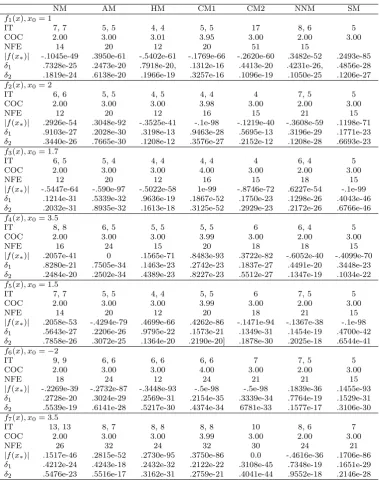
In this section, the obtained theoretical results are confirmed by numerical experiments. Numerical test re-sults are presented for the third-order method by com-parison with famous iterative methods of different or-ders. The test functions and their roots, found up to the 17th decimal places, are as follows:
f1(x) = sin2x−x2+ 1, α1= 1.40449164821534123,
f2(x) = x2−ex−3x+ 2,
α2= 0.25753028543986076,
f3(x) = cosx−x, α3= 0.73908513321516064,
f4(x) = (x−1)3−1, α4= 2.0,
f5(x) = x3−10, α5= 2.15443469003188372,
f6(x) = xex
2
−sin2x+ 3 cosx+ 5, α6=−1.20764782713091893,
f7(x) = ex
2+7x
−e30, α7= 3.0.
Some numerical test results are also presented for var-ious iterative schemes in Table 1 and are compared with the Newton method (NM) and the method of Abbas-bandy [1] (AM) defined by
xn+1=yn−
f2(xn)f00(xn) 2f0(x
n)
−f
3(xn)f000(xn)
6f04(x
n)
, (33)
the method of Homeier [7] (HM) defined by
xn+1=xn− f(xn)
2 (
1
f0(xn)+ 1
f0(yn)), (34)
the methods of Chun [5] (CM1) and (CM2) defined by
xn+1=yn−2
f(yn) f0(x) +
f(yn)f0(yn)
f02(xn) , (35)
and
xn+1=yn−
f(yn)
f0(x), (36)
the method of Noor and Noor [8], (20) (NNM), and the new method, (17) (SM). All of the above methods have been implemented in this study.
All computations were completed using MATLAB 7 by using 100 digit floating arithmetic (VPA=100). The criteria
|xn+1−xn|< δ1,|f(xn+1)|< δ2,
are used for stopping the computer program. Table 1 displays the number of iterations (IT), where the sec-ond number is the (IT) of [8]. Furthermore, the number of function evaluations (NFE) are required such that the stopping criteria δ1 and δ2 are less than 10−15 and the value of |f(x∗)|is sufficient after the required itera-tions. Moreover, the computational order of convergence (COC) are displayed and approximated using formula [11]
ρ=ln|(xn+1−α)/(xn−α)| ln|(xn−α)/(xn−1−α)|
Table 1. Comparison of the various iterative schemes and the Newton method.
NM AM HM CM1 CM2 NNM SM
f1(x), x0= 1
IT 7, 7 5, 5 4, 4 5, 5 17 8, 6 5
COC 2.00 3.00 3.01 3.95 3.00 2.00 3.00
NFE 14 20 12 20 51 15
|f(x∗)| -.1045e-49 .3950e-61 -.5402e-61 -.1769e-66 -.2620e-60 .3482e-52 .2493e-85
δ1 .7328e-25 .2473e-20 .7918e-20, .1312e-16 .4413e-20 .4231e-26, .4856e-28
δ2 .1819e-24 .6138e-20 .1966e-19 .3257e-16 .1096e-19 .1050e-25 .1206e-27
f2(x), x0= 2
IT 6, 6 5, 5 4, 5 4, 4 4 7, 5 5
COC 2.00 3.00 3.00 3.98 3.00 2.00 3.00
NFE 12 20 12 16 15 21 15
|f(x∗)| .2926e-54 .3048e-92 -.3525e-41 -.1e-98 -.1219e-40 -.3608e-59 .1198e-71
δ1 .9103e-27 .2028e-30 .3198e-13 .9463e-28 .5695e-13 .3196e-29 .1771e-23
δ2 .3440e-26 .7665e-30 .1208e-12 .3576e-27 .2152e-12 .1208e-28 .6693e-23
f3(x), x0= 1.7
IT 6, 5 5, 4 4, 4 4, 4 4 6, 4 5
COC 2.00 3.00 3.00 4.00 3.00 2.00 3.00
NFE 12 20 12 16 15 18 15
|f(x∗)| -.5447e-64 -.590e-97 -.5022e-58 1e-99 -.8746e-72 .6227e-54 -.1e-99
δ1 .1214e-31 .5339e-32 .9636e-19 .1867e-52 .1750e-23 .1298e-26 .4043e-46
δ2 .2032e-31 .8935e-32 .1613e-18 .3125e-52 .2929e-23 .2172e-26 .6766e-46
f4(x), x0= 3.5
IT 8, 8 6, 5 5, 5 5, 5 6 6, 4 5
COC 2.00 3.00 3.00 3.99 3.00 2.00 3.00
NFE 16 24 15 20 18 18 15
|f(x∗)| .2057e-41 0 .1565e-71 .8483e-93 .3722e-82 -.6052e-40 -.4099e-70
δ1 .8280e-21 .7505e-34 .1463e-23 .2742e-23 .1837e-27 .4491e-20 .3448e-23
δ2 .2484e-20 .2502e-34 .4389e-23 .8227e-23 .5512e-27 .1347e-19 .1034e-22
f5(x), x0= 1.5
IT 7, 7 5, 5 4, 4 5, 5 6 7, 5 5
COC 2.00 3.00 3.00 3.99 3.00 2.00 3.00
NFE 14 20 12 20 18 21 15
|f(x∗)| .2058e-53 -.4294e-79 .4699e-66 .4262e-86 -.1471e-94 -.1367e-38 -.1e-98
δ1 .5643e-27 .2206e-26 .9795e-22 .1573e-21 .1349e-31 .1454e-19 .4700e-42
δ2 .7858e-26 .3072e-25 .1364e-20 .2190e-20] .1878e-30 .2025e-18 .6544e-41
f6(x), x0=−2
IT 9, 9 6, 6 6, 6 6, 6 7 7, 5 5
COC 2.00 3.00 3.00 4.00 3.00 2.00 3.00
NFE 18 24 12 24 21 21 15
|f(x∗)| -.2269e-39 -.2732e-87 -.3448e-93 -.5e-98 -.5e-98 .1839e-36 .1455e-93
δ1 .2728e-20 .3024e-29 .2569e-31 .2154e-35 .3339e-34 .7764e-19 .1529e-31
δ2 .5539e-19 .6141e-28 .5217e-30 .4374e-34 6781e-33 .1577e-17 .3106e-30
f7(x), x0= 3.5
IT 13, 13 8, 7 8, 8 8, 8 10 8, 6 7
COC 2.00 3.00 3.00 3.99 3.00 2.00 3.00
NFE 26 32 24 32 30 24 21
|f(x∗)| .1517e-46 .2815e-52 .2730e-95 .3750e-86 0.0 -.4616e-36 .1706e-86
δ1 .4212e-24 .4243e-18 .2432e-32 .2122e-22 .3108e-45 .7348e-19 .1651e-29
δ2 .5476e-23 .5516e-17 .3162e-31 .2759e-21 .4041e-44 .9552e-18 .2146e-28
Per iteration (IT), the method of (17) (SM) requires a single evaluation of the function and one evaluation of the first and second derivatives, d= 3. It has been proved in the last section and shown in Table 1 that the method of (17) (SM) is of the third order,p= 3. Thus, the informational efficiency E = 1, and the efficiency indexI= 1.442, whereE is defined [1] as
E=p
d,
andI is defined as
I=p1d.
5
Conclusions
In this paper, a three-step iterative method for solv-ing nonlinear equations (SM) has been developed. It has been proved that the method is of the third order of convergence. Moreover, it has also been proved that the order of convergence of the three-step iterative method proposed by Noor and Noor [8] is two. Based on cal-culations, the proposed method is also compared with various other iterative methods of the same order of con-vergence. The performance of the new method can be seen in Table 1. Furthermore, the results of the algo-rithm by Noor and Noor [8] are corrected. From Table 2, it can easily be seen that the new method of (17) (SM) is better than the method of Noor and Noor (20) in the order of convergence. The informational efficiency,E of (17), (SM) is greater than the Abbasbandy (33) (AM) and (20) the Noor and Noor (NNM). The efficiency in-dex of the method of (SM) is equal to that of Homeier (34) (HM) and Chun (36) (CM2), and it is greater than
Table 2. Comparison of the various iterative schemes and the Newton method.
NM AM HM CM1 CM2 NNM SM
p 2 3 3 4 3 2 3 d 2 4 3 4 3 3 3 E 1 0.75 1 1 1 0.67 1 I 1.414 1.316 1.442 1.414 1.442 1.260 1.442
the other methods considered here. Furthermore, the method of Noor and Noor (20) has the smallest infor-mational efficiency valueE and efficiency indexI value between all methods considered, which implies that their method is less efficient than the above methods.
REFERENCES
[1] S. Abbasbandy. Improving NewtonRaphson method for nonlinear equations by modified Adomian decomposi-tion method, Appl. Math. Comput., 145, 887-893, 2003.
[2] G. Adomian. Nonlinear Stochastic Systems and Appli-cations to Physics, Kluwer Academic Publishers, Dor-drecht, 1989.
[3] I. A. Al-subaihi, A. J. Alqarni. Higher-Order Iterative Methods for Solving Nonlinear Equations, Life Science Journal, 11, 12, 85-91, 2014.
[4] I. A. Al-subaihi, H. I. Siyyam. Efficient Techniques for Constructing Optimal Iterative Methods with Eighth and Sixteenth Order of Convergence for Solving Non-linear Equations, SYLWAN journal, 158, Issue. 5, 2014.
[5] C. Chun. Iterative method improving Newton’s method by decomposition methods, Comput. Math. Appl., 50, 1559-1568, 2005.
[6] V. Daftardar-Gejji, H. Jafari. An iterative method for solving nonlinear functional equations, J. Math. Anal. Appl., 316, 753-763, 2006.
[7] H. H. H. Homeier. On Newton-type methods with cu-bic convergence, J. Comput. Appl. Math., 176, 425432, 2005.
[8] M. A. Noor, K. I. Noor. Improved iterative methods for solving nonlinear equations, Appl. Math. Comput., 184, 270-275, 2007.
[9] H.I. Siyyam. An Iterative Method with Fifth-Order Convergence for Nonlinear Equations, Journal of Ap-plied Mathematical Sciences, Vol. 3, No. 41, 2041-2053, 2009.
[10] J. H. Yun. A note on three-step iterative method for nonlinear equations, Appl. Math. Comput., 202, 401-405, 2008.