MULTIPLE SOURCES OF EVIDENCE USING A CASE STUDY
METHODOLOGY
1.2 Noralfishah Sulaiman, =David Baldry and 2Leslie Ruddock
1University Tun Hussein Onn Malaysia (UTHM), Beg Berkunci 101,86400 Parit Raja Batu Pahat Johor, Malaysia
ZResearch Institute for the Built & Human Environment (BuHu), University of Salford, Salford Greater Manchester, M5 4WT,
UK
E-mail: [email protected]@pnr.salford.ac.uk, d,baldrv@salford,ac,uk , [email protected]
ABSTRACT: 'Methodology' means the science of methods (method+logy, the latter being a Greek word which can literally be translated to mean the 'science of'). It contains the strategy, plan of action, process or design lying behind the choice and use of particular methods and the linking of the choice and use of method to the desired outcomes. A case study is understood as an umbrella term for a family of research methods. A reliable case study will therefore desire to use as many sources as possible that can be called "multiple sources of evidence". This paper therefore seeks to present a discussion on the appropriateness of the use of multiple sources of evidence and their techniques. In particular this will be applied to the gathering of comparative data on strategic, tactical and operational practices for the provision of residential care homes for the elderly in both UK and Malaysia. For this reason,'a triangulation approach has been designed to undertake a piece of qualitative empirical enquiry entitled 'Opportunities for the Transfer of United Kingdom (UK) Best Practices for the Provision of Residential Care Homes for the Elderly'. The discussion will elaborate upon the application of this triangulation method, consisting of content analysis, visual methods, participant obselvation and interviews, as means to respond to the developed research questions. The strength and weaknesses of the methodology and its methods will also be identified.
Keywords
-
Case Study, Methodology, Methods1.0
INTRODUCTION
"Methodology can only brings us reflective understanding of the means which have demonstrated their value in practice by raising them to the level of explicit consciousness; it is no more the precondition of fruitful intellectual work than the knowledge of anatomy is the precondition for correct walking..". (Weber in Kaplan, 1964). In other words, it can be said that methodology is the important part of the research process which if properly designed, will unblock the roads of inquiry by employing the reliable methods. Also, the purpose of methodology is to show the appropriateness of the techniques used to gather data and the methodological approaches employed (Hart, 2005). It contains the strategy, plan of action, process or design lying behind the choice and use of particular methods and the linking of the choice and use of method to the desired outcomes (Gray, 2004). According to Sulaiman et, all (2008b), in producing a good piece of research work researchers have to use a methodology in a new topic where it has not been applied before and therefore make manifest its strengths in giving new knowledge and theoretical insights, then the new contribution to the knowledge can be developed. Hence, this paper is trying to elucidate the background of the research and discuss on the application of case study as a research methodology in order to obtain the strategic, tactical and operational practice data on care practice for the provision of Residential Care Homes for the Elderly (RCHE) as public sector property. Then, the strategy for the development of research questions will be explained based on a case study strategy used by Yin (2003). This exploratory study has been designed to apply the Multiple Cases vs Embedded and employed four methods known as content analysis, visual method, participant observation and interview. The rationale of the selection of case study with qualitative approach and its design will be discussed thoroughly. After that, how the sampling strategies were made including its strengths and weaknesses will also be justified.
2.0
BACKGROUND OF RESEARCH
defined FM as "a profession that encompasses multiple disciplines to ensure functionality of the built environment by integrating people, place, process and technology". The Facilities Journal academically summarized FM as "a hybrid management discipline that combines people, property and process management expertise, to provide vital services in support of the organisation. It is interested in all areas relating to briefing, design, construction and use of facilities and in the emerging technologies that support organizational functions at the workplace" (Emerald, 2007). This FM approach is practically applied within the public and private sector organisations.
Within the FM context, organisation strategy is considered as a policy framework which provides the context for decision making within the facilities department through the interaction between strategic, tactical and operational FM. FM corporate goals are usually about the core business task and the FM's aim is to synergistically balance current strategic, tactical and operational level of FM function with the needs of the future (Langston and Kristensen, 2002). Barrett and Baldry (2003) stated that paramount in the strategic FM process is the ability to establish, monitor and update strategic practice. Langston and Kristensen (2002) stated that strategic FM represents higher order activities involved in the alignment of facilities with corporate goals. This includes a measure of anticipation and forward planning and demands access to boardroom-level discussions andlor effective communication between senior personnel. It is distinct from tactical and operational activities that have progressively reduced scope and corporate impact. To be effective, all parts of the organisation must be coordinated so that a common purpose is maintained. This is accomplished through a clearly articulated set of corporate goals and a team approach, particularly among upper management. Accordingly, tactical FM activities are essentially about the monitoring and management of facilities performance. The performance is based on the achievement of change agents practice in an FM ecosystem which consists of people, place and process in delivering organisation corporate goals. In the process of managing RCHE, the tactical activities may involve the development of good practice guidance & documents, the identification of a code of practice at the RCHE, the legislations and regulations, standards development and reviews, the development of national minimum standards, assessment and audits, process controls, recognition from internall external experts etc. They differ from strategies activities, in that the direct link to corporate goals is absent, although the overall objective of improving quality, reducing cost and minimising risk remains. Tactical activities are often smaller and tightly defined, and are akin to sub-projects within the greater business context (Langston and Kristensen, 2002). In addition to this, the operational FM activities are activities which are more routine and are often viewed as janitorial. They involves protective activities, watching over and safeguarding of the practice delivered at least at the minimum practice achievement as monitored by the tactical level of FM function. Featherstone and Baldry (2000) concluded there must be a strategic FM foundation around which to build and mould the day-to-day routines. An absence of this strategic foundation will result in a displacement of the tactical as well as operational interface between the facilities provider and facilities service users leading to user dissatisfactions while receiving the services promised.
Report; the establishment of related Acts such as National Assistance Act 1948; the establishment of NHS; the Hospital Plan by year 1975; the Registered Home Act 1984; the Griffith Report in 1986; the White Paper: Caring for People; the Community Care Act 1993; a series of Green and White Papers, plans, strategies and National Service Frameworks (NSF) for the Elderly in mid 1990s; the establishment of National Commission to progress, assess standards and develop social care; an attempt to establish a Toined up approach' under the Better Government for Older People Programme (BGOP) in year 1998 and the development of the Health Act 1999; and many more monitoring policies until today. With over a hundreds years of policy development, political and government interventions, appropriate changes and amendments legislations, coordination and modification of social, health and housing policies, and continuously introduced government documents plans and strategies, these have made the UK practices in managing RCHE far better, whether provided by the local authorities, the NHS or private providers.
In contrast to these long experiences, in the Asian population, living in alternative arrangement, RCHE is not applied as in the UK. Certainly, the provision of RCHE was viewed as a more residual provision with the fact that wherever in Asian, most of the elderly wish to continue to live in their own homes and do not require formalized long-term care. As evidence, in Asian, Martin (1989) found that approximately three quarters of the elderly population live with their adult children. Similarly, in Malaysia, Martin (1989) and Da Vanzo and Chan (1994), found that more than two-thirds of Malaysians age 60 or over co-reside with an adult child. However, in recent years, the reality has been gradually changing since the traditional values of familism and filial pity have been being supplanted by Western values of individualism in Asian families as well as in Malaysia. Though people in Asian societies still, on the whole, pay high respect to the elderly, there is no doubt that this value is fast fading and can no longer be taken for granted (Chow,2006). Similarly, in Malaysia, Abdul Jalil (2005) revealed that "We are certainly not going back to the period when we had a very youthful population that took care of an elderly population". Further, the Eighth Malaysia Plan (2001-2005) identified that the concurrent phenomena of decreasing family size and increasing number of older persons, as well as other demographic and social factors affecting the family structure, such as the role of the extended family, will require the establishment of formal institutions to take over the traditional responsibilities of families. Syed Mustafa e t a/, (2005) also stated that Malaysia is similar to other developed countries which have shown an increment in the percentage of homes being developed in order to cater for the needs of the elderly people to reside and to be taken care of. Malaysians still place great emphasis on the preservation of the family and its value, and many Malaysians are still consistent with a firm stand on the traditional definition of taking care of their parents. However, institutional care has progressively overtaken family care for the elderly. In fact, the expectation of institutional care for older people is becoming the norm to the Malaysian.
While the UK has normally adapted and adopted institutional care as the alternative living arrangement for its golden age population, Malaysia has still at the early stage of the transition of its institutional elderly living arrangement. Despite the fact that traditional value and familism criteria are being eradicated in Malaysian society, there are many other plus factors which may affect future living arrangement of the elderly in Malaysia. Evidently, Sulaiman et a1 (2006a, 2006b and 2006c) revealed that the factors such as poor and inadequate support of housing condition; declining extended family; family size is decreasing; it is expected that more elderly people living alone in the urban and rural areas; more elderly living longer; declining birth rate; increasing dual income households of their adult children; growing number of unmarried population; migrations of working adults; greater number of divorces; housing needs for the elderly is increasing; growing level of female labour participation; people have less time for carrying out care duties for taking. care of the parents; increasing demand for entering the RCHE; and the most important: it is alarming the nation that action should be taken as the nation is facing the increasing number of elderly people requiring a proper place as well as an appropriate care (or nursing care) respectively. Obviously, these factors signal that moving into RCHE will becoming normal in a few years ahead in Malaysia. Though older people are wishing to stay in their homes independently for as long as possible, the truth is the infrastructure needed to support this choice is often inadequate and not practically applicable (Sulaiman et a/, 2006a and 2006b) due to their housing needs become increasingly entwined with health and care needs when they become older (Boaz et a/., 1999). Even though more than two thirds of Malaysians age 60 or older co-reside with an adult child, in the next decade, institutional care which provides formal care to the elderly may no longer be considered unacceptable for the elderly and society but is seen as an alternative for families to take care of their golden age member as in developed country such as the
The UK has evolved longer in managing the provision of RCHE, and Malaysia should endeavour to learn and discover from the UK in certain aspects of the practices such as strategies and experiences; knowledge development; the enforcement of rules and regulations; the implementation of national polices and the way of monitoring performance; management skills; tactics and techniques as well as the formation of national standards and the code of best practices. Undeniably, reflections on the past history of social care practices, institutions, as well as the management of RCHE at the strategic, tactical and operational level, tell a great deal about how the UK present day culture and nature of ageing society has evolved. In the same way, as recommended by Lauren (2004) who stated that "In companies where exemplary processes have been in place for 20 years, you need to ask people why they do what they do and how. Consider your depth of knowledge of the practice, and then ask your self, 'What's the potential gain of applying this practice in another unit? How will it take to start getting equal or better results in the recipient unit?" Novelli (2005) then ernphasised and suggested that, "We have to look across borders and around the world for good ideas and practices. The more we share our experiences, the better strategies we will develop and the more we will succeed at making market forces and public policies more responsive to investment in liveable communities".
Considering the status of RCHE as a residual provision of living arrangement, there has been a lack of research done on housing for the elderly generally and RCHE specifically in Malaysia (Sulaiman et al, 2006~). An analysis of papers published in the Welfare Journal by DSW revealed only five papers had been written on the elderly since 1991 (Muhamad & Kamis, 2006). Poi et a1 (2004) added that there was no vision of change for treating and caring for older people, or directing programmes of home or community base care, or pursuing research in geriatrics in Malaysia. Muhamad & Kamis (2006) exposed that older groups command less than favourable interest in the academic and economic arena in Malaysia. In fact, Poi et. al, (2004) suggested "as Malaysia develops a system for caring for older people, it needs to learn from the mistakes of other healthcare systems (not repeat them) and seek advice of visionary leaders of the specialty. Sulaiman et. al, (2006a, 2006b) also suggested that it would be very advantageous if Malaysia could adapt and adopt the provision structure and identify best practices from the providers of RCHE in the UK. From this point of view, research is very important because through this older people and the RCHE providers can express and continuously develop their knowledge and views on housing and residential issues of the elderly; especially in research relating to their needs and aspirations to live in. As FM is a profession that encompasses multiple disciplines to ensure the effective functionality of the built environment by integrating people, place, process and technology, transferring best practice is one of the management tools which is important for the enhancement of FM practice in any organisation. Importantly, Payne and Rees (1999) and Heavisides (2000) stated that FM itself can act as a change agent between people, place and process. Hence, this statement led the effort and interest for undertaking research for the continuous improvement of the provision of RCHE in Malaysia. The aim is to seek the "Opportunities for the Transfer of United Kingdom (UK) Best Practices for the Provision of Residential Care Homes for the Elderly in Malaysia to Meet Emerging and Changing Social Needs".
3.0
RESEARCH QUESTIONS AND RESEARCH OBJECTIVES
Whilst conducting a case study, the heart of the protocol is a set of substantive questions reflecting the researcher's actual line of inquiry. Yin (2003) placed the research strategies in case study research as in Table
1. Each strategy, peculiar advantages and disadvantages, depends on three conditions:
(1)'The type of research question;
(2) The control an investigator has over actual behavioural events and; (3) The focus on contemporary as opposed to historical phenomena.
According to Yin (2003), a basic categorisation of research questions is the familiar series: "who", "what", "where", "how" and "why". In this research it is believed that the developed research questions will answer the inductive reasoning qualitative inquiries through the multiple sources of converging evidence consisting of content analysis, visual (photographical analysis), participant observation and interviews. Based on Table 1, this
Source: Yin (2003)
1 many, how much?
Hlstory I How, why?
Case study 1 How, why?
For all the questions, the research is considered as an exploratory case study as mentioned by Yin (2003) if research questions focus mainly on "what" questions, either two possibilities arise. First, some types of "what" questions are exploratory and the second type of "what" research questions actually form a "how many" or "how much" line of inquiry in the research strategy. Within the specific boundaries the lines of inquiry are as below:
(1) Which strategic, tactical and operational practices within the context of public sector Facilities Management (FM) are applied in the provision of RCHE in the United Kingdom?
Note: Whatquestlons, when asked as part of an exploratory study, peltaln to all flve strategles No
No
(2) What are the current strategic, tactical and operational practices within the context of public sector FM currently being delivered in the provision of RCHE in Malaysia?
No Yes
(3) To what extent has a best practice approach at strategic, tactical and operational public sector FM functions been established and empirically emerged in the context of United Kingdom?
(4) To what extent has a best practice approach at strategic, tactical and operational public sector FM functions been established and empirically emerged in the context of Malaysia?
(5) Which enablers, barriers and benefits will Malaysia face if the Best Practice Transfer Process takes place?
(6) What lessons could be learned for the improvement of the provision of RCHE in Malaysia?
(7) What are the transferable strategic, tactical and operational practices needed for the provision of RCHE to be transferred to Malaysia?
Locke, Spirduso and Silverman (2000) stated that research objectives are the purpose statements which indicate "why you want to do to the study and what you intend to accomplish". Creswell (2003) cited the use of word such as "purpose", "intent" or "objective" to signal attention to this statement as the central controlling idea in a study. This "purpose statement" then conveys the overall intention of a proposed study. Thus, based on the research aim, the specific objectives of the study are created as below:
(1) To review and understand the provision of RCHE in the United Kingdom and Malaysia;
(2) To identify the best practices strategically, tactically and operationally from the view of public sector FM in the provision of RCHE in United Kingdom and Malaysia;
(3) To review and understand the Best Practice Transfer Model;
(4) To compare the practices between Malaysia and United Kingdom in the provision of RCHE;
4.0
A CASE STUDY METHODOLOGY: WHY IS IT BEING EMPLOYED?
Yin (2003) defined case studies in two ways of technical definition as the following;
(1) Empirical inquiry that investigates a contemporary phenomenon within its life context, especially when the boundaries between phenomenon and context are not clearly evident and;
(2) Case study inquiry which copes with the technically distinctive situation in which there will be many more variables of interest than data points, as one result relies on multiple sources of evidence, with data needing to converge in triangulation fashion, and as another result benefits from prior development of theoretical propositions to guide data collection and analysis.
Bell (1993) in Remenyi et. al (2002) stated "the case study approach is an umbrella term for a family of research methods having in common decision to focus on an enquiry around specific instance or event". Yin (2003) stated a case study's unique strength is ",.its ability to deal with a full variety of evidence such as documents, artefacts, interviews and observation.."
.
"...
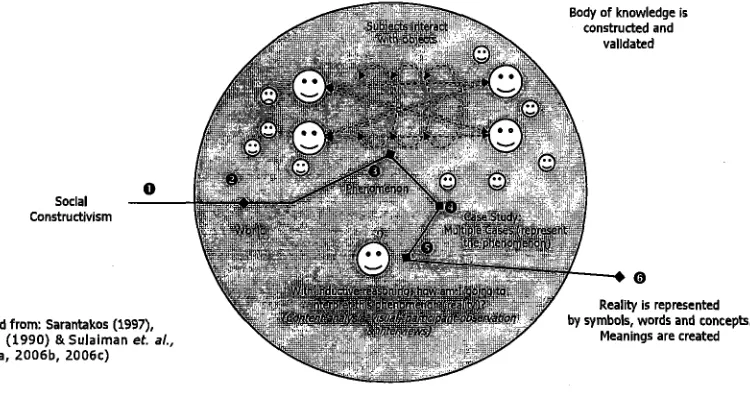
a good case study will therefore want to use as many sources as possible..".Figure 1 shows the relationship between philosophical background and case study methodology conducted in this research.
0
Soclal
-
Constructivism
Adopted from: Sarantakos (1997), Patton (1990) & Sulaiman el. a/.,
(2006a, 2006b, 2006c)
[image:6.601.138.513.309.509.2]Body of knowledge is constructed and
Figure 1: Relationships between philosophical background and case study methodology
As this research follows the interpretivisim epistemology, there are several reasons why the case study methodology is believed as the best methodology as in the list below.
(1) Passionately seeking understanding of the worldlsocial life, reality is subjective, problematic, holistic, and socially constructed;
(2) Case study would have to cover both the phenomenon of interest and its context yielding a large number of potentially relevant variables;
(4) Investigates a contemporary phenomenon within its life context, especially when the boundaries between phenomenon (within the selected case studies either analytical or conceptual generalisation);
(5) Desiring to understand contemporary, complex and real life social phenomena;
(6) Allowing the researcher to retain the holistic (studies on whole units) and meaningful characteristics of real life events;
(7) Obtaining a wide range of different sources of evidencelmultiple sources of evidencelfull variety of evidence (using the case study techniques consisting of content analysis, visual method, participant observation and interviews);
(8) There are no predefined dependent and independent variables (involves qualitative inquiries in a dynamic systems-process and change);
(9) Involving inductive analysis and no strict rules for the interpretations;
(10) Cases will be conducted within a specific time and context specific;
(11) Gathering qualitative data and description through content analysis, visual method, participant observation and interviews
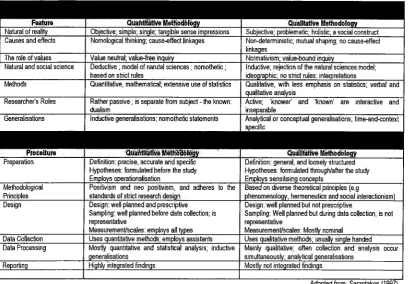
Considering this, as an exploratory case study, it is also significant to differentiate between the quantitative and qualitative methodological approach as in Table 2 below. Base on Table 2 it can be seen that this research will
[image:7.595.96.507.406.690.2]only emphasised on the qualitative methodological approach. Comparatively, the features and procedures within these two approaches can be understood as these criteria have helped in guiding the whole of the research process while employing the case study methodology.
Table 2: Perceived differences and comparison between quantitative and qualitative methodology
Feature Natural of real~ty Causes and effects
The role of values Natural and social science
QuahtlfitIVe MethoUbligy Objectwe, s~mple, slngle, tang~ble sense lmpresslons Nomolog~cal thlnklng, causeeffect llnkages
Methods
Researcher's Roles
Generalisations
Principles
I
standards of strict research designI
phenomenology, hermeneutids and soc/al~nteractionism) DesignI
Design: well planned and prescriptive I Design: well planned bul not prescriptiveQualltatlve Methodology Subject~ve, problemat~c, hollstlc, a soc~al construct Nondetermln~st~c, mutual shaplng, no cause-effect
Value neutral; value-free inquiry
Deductive ; model of narutal sciences : nomothetic ;
I I spec~f~c
linkages
Normativism; value-bound inquiry
Inductive: reiection of the natural sciences model: based on strict rules
Quantitative, mathematical; extens~ve use of statistics
Rather passive ; is separate from subject -the known: dualism
Inductive generalisations; nomothelic statements
Procelllre Preparat~on
Methodolog~cal
I I I I
Adopted from. Sarantakos (1997)
7
ideographic;'no strict rules: ~nterpretations
Qualitative, with less emphasis on statistics; verbal and qualitative analysis
Active; 'knower' and 'known' are ~nteractive and inseparable
Analytical or conceptual generalisations; time-and-context
Data Collection Data Processing
Reporllng
Q~afit~tIve~McithaBbIii'gy
Defin~t~on preclse, accurate and spec~fic Hypotheses formulated before the study Employs operat~onal~sat~on
Pos~t~v~sm and neo pos~tw~sm, and adheres to the
Qudlltative M&odology Definlt~on general, and loosely structured Hypotheses formulated throughlafler the study Employs sensltlslng concepts
Based on d~verse theoret~cal pnnc~ples (e.q
sampling: well planned before data collection; is representative
Measurementlscales: employs all types Uses quantitative methods; employs assistants Mostly quant~tative and statistical analysis; inductive generalisations
Highly integrated f~ndings
sampling: well planned but during data collection; is not representative
MeasuremenVscales- Mostly nom~nal Uses qualitative methods; usually single handed Mainly qualitative; oflen collection and analysis occur simultaneously; analytical general~sations
6.0
CASE STUDY MATRIX DESIGN: MULTIPLE CASES VS EMBEDDED
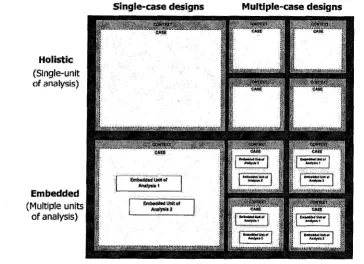
In order to apply a case study methodology, the case study itself has a specific design to be formed. This process is important before the whole case study processes can be carried out and the methods of research can be selected. In this case, using the case study matrix, Multiple Cases Vs Embedded has been chosen to be used. After looking at the general background of the case study design, especially the developed research questions, its objectives and aim, it is significantly important to develop the case study matrix to portray every type of design included the contextual conditions in relation to the case and its boundaries within the developed research questions. The matrix then shows that single and multiple-case studies reflect different design situations and that within these two variants, there also can be a unitary unit or multiple unit of analysis.
Single-case designs Multiple-case designs
Halistlc
(Single-unit
af analysis)
Em bedded (Multipk units
[image:8.602.105.469.202.466.2]of analysis)
Figure 2: Basic Types of Designs for Case Studies
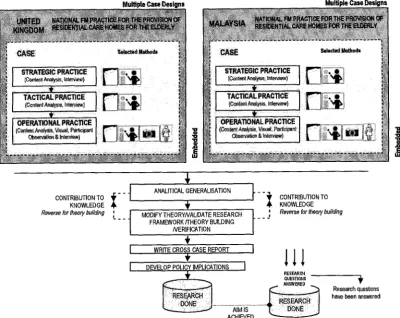
Based on the developed research questions and identified unit of analysis, this research occupied the Multiple Cases vs. Embedded type of case study matrix. The rationales for this type of case study matrix are stated as the following:
(1) In this situation, these embedded units have been selected through theoretical sampling or cluster techniques. The convergence unit of analysis has been accumulated in a way to conclude with the analytical generalisation;
(2) There are subunits (object of studies) which can be identified when the relevant theory underlying the
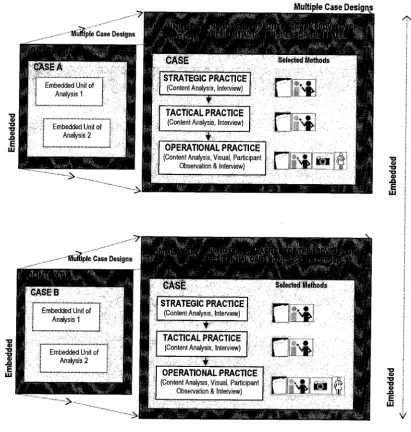
case study. In this case the subunits have been classified into three main categories. First is strategic practice, second is tactical practice and finally the operational practice in the provision of RCHE for both countries. No matter how the units are selected, the resulting design would be called an embedded case study design (Yin, 2003);
The unsuspected slippage can be avoided because the subunits have been clearly defined by its different specific methods;
The evidence from multiple cases is often considered more compelling, and the overall study is therefore regarded as being more robust;
Yin (2003) stated multiple cases in this sense should be considered like multiple experiments. Under these circumstances, the mode of generalisation is "analytic generalisation", in which previously developed theory is used as a template with which to compare the empirical result of the case study. If two or more cases are shown to support the same theory, replication may be claimed, in this case, the UK and Malaysia can be replicated to each other. Finally, the empirical results may be considered yet more potent if two or more cases support the same theory but not an equally plausible, rival theory;
Decision to take multiple-cases cannot be taken lightly. It requires extensive resources and time beyond the means of a single researcher. Every case should serve a specific purpose within the overall scope of inquiry in each country;
The logic underlying the use of multiple case studies is the same. Each case must be carefully selected so that it either (a,) predicts similar results or (b.) predicts contrasting results but for predictable reasons (a theoretical replication). A major insight is to consider multiple cases as one would consider multiple experiment-that is follow replication logic. Replication logic is analogous to that used in multiple experiments. The first experiment would be about the RCHE in the UK, then it followed by the Malaysia case;
This is far different from a mistaken analogy in the past, which incorrectly considered multiple cases to be similar to the multiple respondents in a survey (or to the multiple subjects within an experiment) that is followed a sampling logic;
Upon uncovering a significant finding from a single experiment, the immediate research goal would be to replicate this finding by conducting a second, third and even additional more experiments. Some of the replications might have attempted to duplicate the exact conditions of the original experiment. Other replications might have altered one or two experimental conditions considered irrelevant to the original finding, to see whether the finding could still be duplicated. Only with such replications would the original finding be considered robust and worthy of continued investigation or interpretation;
If all the cases turn out as predicted, in the aggregate, this would have provided compelling support for the initial set of propositions. If the cases are in some way contradictory, the initial proposition must be revised and retested with another set of cases. Again the logic is similar to the way scientists deal with contradictory experimental findings;
The simplest multiple case design would be the selection of two or more cases that are believed to be literal replications, such as a set of cases with exemplary outcomes in relation to some evaluation theory. Selecting such cases requires prior knowledge of the outcomes, with the multiple case inquiry focusing on how and why the exemplary outcomes might have occurred and hoping for literal (or direct) replications of the conditions from case to case;
The selected design would also be recognised as "two tail" design in which cases from both extremes (of some important theoretical condition, such as good and bad outcomes) have been deliberately chosen;
Based on these explanations, Figure 3 below illustrated how the two cases have been experimented to answer the developed research questions. Within its own context, each case owned the same methods of research. This replication and method triangulation will finally help to provide an analytic generalisation about the national FM practices for the provision of RCHE in each country. See Figure 3 and Figure 4. After finishing the analytical process, then the modification of theory about the practices in the provision of RCHE can be retrieved and the process of validating the research conceptual framework and the development of new theory can be developed. This would be the important output of the research which is a few grains of new knowledge can be added to already established theoretical propositions within the scope of research.
[image:10.599.89.500.198.629.2]M"3
... '.';... ple Case Designs
...
STRATEGIC PRACTICE
(Content Analysis, Interview)
(Content Analys~s. Interv~ew) ( [
rn
(Content Analys~s, V~sual, Partlc~pant
'1 Observat~on & Interv~ew)
*Notes: Credible Research Methods
= h t e n t n n a w
... L I
i*.
.
i,p
'9,
" 1""""-. . -- .
Multida Care Dcrnilmr
CASE
STRATEGIC PRACTICE [Conlent A n a l p , t n f e W )
*
TACTICAL PRACTICE
(CenlantAnalyss. I h a * )
*
OPERAMNAL PRACTICE
(Cantan4 Am&%s, V f l d . Pdapent
Chrv&n&fnfmeur) : l j
f
ANALITICAL GENERALISATIONCONTRIBUTION TO
t
; O N T OKNOWLEDGE
Reverse for theory building Reverse for t h q buiIdng
;
- -
MODIFY THEORYNALIDATE RESEARCH -- -
,
FRAMEWORK rrHEORY BUILDING NERlFlCATlON
+
I
WRITE CROSS CASE REPORTI
+
I l l
I
DEVELOP POLICY IMPLICATIONS1
4 4 4
RESEARCH
OUESTIONS .$
Research questions AIM IS DONE
[image:11.608.107.507.92.410.2]ACHIEVED
Figure 4: Case Study Matrix for Design for the United Kingdom and Malaysia
7.0
RESEARCH METHODS: THE MULTIPLE SOURCES OF EVIDENCE
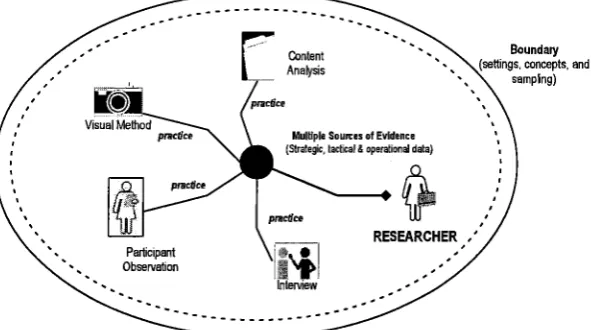
interviews. In this figure the multiple sources of evidence applied where these methods are trying to gather the data on strategic, tactical and operational practice for the provision of RCHE in both UK and Malaysia. Before the photograph can be shot, participant observation can be started and interviews can be commenced, an Inform Consent has to be agreed and sign by both the researcher and the research participant. The importance of inform consent are to obtain an ofticia1 permission from the research participants, giving brief explanation on the research aim and objectives, to notify the privacy and confidentiality of the data to be collected, the benefit of the research project, contribution of the research participants to the production of new and potentially illuminating knowledge about the sector in which there are working and finally the section to enable the research participants to sign for their consent to be a participant in the presence of the researcher (Sulaiman et, all 2008a). After it has been signed then these methods were permitted to be used at the research settings. The application of these methods can be explained as follows:
r#c> \ Multlple Sourrer of Evidence .I \
/ ,' (Slraleg~c, lacl1cal1 operatlond data)
pmcuce
i .... RESEARCHER,.
Partic~pant
.
, Observat~on [image:12.595.163.459.210.375.2]\
.--
InterviewFigure 5: Convergence of Case Study Methods
(1)
Content Analysis
(2)
VisualMethod
This method is specifically chosen to gather the data on operational care practice at the RCHE. In the first place, time-based sampling was used in which 3 hours were allocated for each care home to engage the participant observation. While conducting the participant observation, the photographs on care practice delivery and the condition of RCHE were being taken at the same time. Altogether, about 18 hours were spent for taking photographs at the 6 RCHE both in UK and Malaysia along with the tour of the building for participant observation. Mainly, the shooting script and the UK's National Minimum Standard for the Care Home for the Elderly were used as a guideline to capture the photos driven by the developed research questions and of course were framed by the theoretical framework. This conceptually-driven sequential sampling is also known as theoretical sampling where it is associated with theory and also known as theory-driven 'up-front' sampling (Miles & Huberman, 1997). It is selective, not representative (Payne and Payne, 2004). Simply, in total, 150 photos were captured in Malaysia and the same quantities of sampling frame were shot in the UK respectively. The total 300 photos have been documented and then reasonably reduced for the categorising process. Then, 50 photographs were selected to represent each residential care home. At the end of the process, only 10 representative and significant photographs were chosen for each care home for the elderly totalling 30 photographs each country. Considering this method as a support method, this sample was sufficient to represent the achievement and analytical generalisation for the method to understand the standard of care homes for the elderly ranging from choice of home, health and personal care, daily life and social activities, complaints and protection, environment, staffing and management and administration visually. Interestingly, there were also certain events which took place during the researcher's visit. So, the senses of event, culture and social value were also recorded during the visit.
(3)
Participant Observation
Montaigne a great humanist, over 400 years ago said 'Saying is one thing; doing is another' (in Robson, 2004). With regards to practice, in a way to ensure the social phenomena are being well delivered, hence it should be observed systematically. Fielding et, a1 (2005) reported that "a research on the effectiveness of practices focuses on what is observable". Then, a participant observation method is employed to obtain the social reality particularly on the operational care practice being delivered at the RCHE in both countries. According to Mack et. all (2005), using the participant observation, researcher can understand the physical, social, cultural and economic contexts in which study participants live; the relationships among and between people, contexts, ideas, norms and events; and people's behaviours and activities-what they do, how frequently, and with whom. In this case, researcher played the role as an "Observer as Participant", which means the researcher activities were made publicly known at the outsetlsetting (not keep under wraps). Interestingly, the purpose of participant observation is partly to confirm what researcher already know (or think researcher know) but is mostly to discover unanticipated truths during the fieldwork. It is an exercise of "discovery" (Mack et. a/, 2005). In terms of the number of research setting, King et, a1 (2004)) suggested that studying more than one case or setting almost always strengthen the causal conclusions and make findings more generable. Then, in order to strengthen the results, 6 RCHEs have been selected. Three RCHE in the UK and three more in Malaysia have been selected as the same settings which the photographs were being shot. All together 18 hours were allocated for the whole process of participant observation, which means 3 hours of field notes writing has been spent for each RCHE. At the end of the participant observation fieldwork, 18 field notes had to be transcribed. The main purpose of this method is more than just an onlooker, but rather comes to the scene with a set of target concepts, definitions, and criteria of describing events. The narrative recording technique was used because it was able to record as much as possible what happens within the focus of the observation at the research settings. Though this technique is time consuming to both record and interpret, it has been chosen because of the advantages of being open ended and flexible, and can provide a wealth of information about research settings and operational care practice delivery at the RCHE.
(4) Interview
the discussion point, (3) Core discussion and, finally, (4) Summarisation and recommendation. The strategic personnel were asked the questions as in the Set A, the tactical practitioners were asked the questions as in the Set B and finally Set C was specifically prepared for the operational practitioners which contained the questions for the care homes managers. These semi-structured and open ended interview schedules were aimed to attain the information base on the three levels of FM function delivered in the provision of RCHE in each country. Set A tried to obtain the qualitative data on higher order activities involved in the alignment of FM with the service provider goals particularly the strategic, long-term and national policies of the public provider, as the service provider of the RCHE. The respondents were the experts and high ranked senior officers involved in strategic planning for the provision of RCHE in the UK as well as in Malaysia. Set B was essentially trying to identify how the providers monitor, assess and manage the performance of the RCHE. This set particularly asked about the tactical skills and the way of improving quality, and reducing cost of the particular phenomenon of the operational practice delivered at the RCHE. The respondents were people from the councilllocal authorities, health department and welfare officers. Set C of the interview schedule was predominantly trying to obtain data regarding the routine activities which were often viewed as custodial. In order to obtain the data, 6 RCHE managers/matrons were asked about how they perform their responsibilities as a manager and deal with day to day operation at the RCHE such as the identification of how the elderlylsewice users make the choice of care home; health and personal care of the service users; daily life and social activities arrangement, complaints procedure and protection of the service users; environment and surrounding area; staffing; and management and administration at the RCHE. Of all the set of interview schedules, this set was the most important to be considered as a fundamental source of obtaining data for this research because it was directly involved with the service users at the RCHE. The ultimate stage of care practices and services were delivered at this stage.
8.0 SUMMARY
approach using multiple sources of evidence has been designed suitably, consisting of content analysis, visual methods, participant observation and interviews, as means to respond to the developed research questions.
REFERENCES
ABDUL JALIL, S (2005), Ageing with Dignity: Rights of Older Persons. SUHAKAM-[Suruhanjaya Hak Asasi Manusia] Human Rights Commission of Malaysia. Kuala Lumpur.
BARRETT, P AND BALDRY, D (2003) Facilities Management: Towards Best Practice. Wiley Blackwell; 2nd Edition. London.
BOAZ, A, HAYDEN, C & BENARD, M (1999). Attitudes and Aspirations of Older People: A Review of the Literature. Department of Social Security. Leeds.
CHOW, N (2006), Ageing Issues and the National Agenda, Asia Population Studies Series. No.141. Chapter 5. Hong Kong.
CRESWELL, J.W (2003), Research Design: Qualitative and Quantitative Approaches. Thousand Oaks, CA: Sage.
DA VANZO, J & CHAN, A (1994), Living Arrangements of Older Malaysians: Who Core sides with their Adult Children. Demography. Vo1.31, No.1, 1994, pp 95-1 13.
FEATHERSTONE, P AND BALDRY, D (2000), Public Sector Facilities Management Strategy. The Royal Institution of Chartered Surveyors, Construction and Building Research Conference (COBRA), Greenwich. UK.
FIELDING, M, BRAGG, S, CRAIG, J, CUNNINGHAM, I, ERAUT, M, GILLINSON, S, HORNE, M, ROBINSON, C and THORP, J (2005), Factors Influencing the Transfer of Good Practice, Department for Education and Skills. University of Sussex. UK.
GRAY, D.E (2004) Doing Research in Real World. London. Sage Publication.
HARRIOT, SAND MATHHEWS, L (2004), Introducing Social Housing. Chartered Institute of Housing. Coventry. United Kingdom.
HART, C (2005), Doing Your Masters Dissertation. Sage Publication. London.
HEAVISIDES, R (2000), NHS FM-Meeting the New Health Challenges. HEFMA Reference Books. London. IFMA (2007), IFMA-Facility Management Forecast. Exploring the Current Trends and Future Outlook for
Facilities Management Professionals. Houston, USA.
KAPLAN, A (1964)) The Conduct of Inquiry: Methodology for Behavioural Science. Chandler Publishing Company. New York. USA.
KELLEHEAR, A (1993), The Unobtrusive Researcher. A Guide to Methods. Allen & Unwin. Australia.
LANGSTON, C AND KRISTENSEN, R.L (2002), Strategic Management o f Built Facilities. Butterworth Heinemann. Oxford. UK
LAUREN, K.J. (2004), Improving Best Practice Transfer. Havard Management Update. Havard Business School Publishing Corporation. Pp 3-4.
LOCKE, L. F., SPIRDUSO, W. W., & SILVERMAN, S. J. (2000). Proposals that work: A Guide for Planning Dissertations and Grant Proposals (4'h ed.). Thousand Oaks, CA: Sage.
MACK, N, WOODSONG, C, MAC QUEEN, K.M, GUEST, G AND EMILY N (2005), Qualitative Research Methods: A Data Collector's Field Guide. Family Health International. North Carolina, USA.
MARTIN, L.G (1989), Living Arrangements of the Elderly in Fiji, Korea, Malaysia, and the Philiphines. Demography, Vo1.26, No.4, 1989, pp 627-643.
MILES, M.B AND HUBERMAN, A.M (1994), Qualitative Data Analysis. Sage Publications. London
MUHAMAD, M & KAMIS, M (2006), Policy and Learning Program for the Malaysian Elderly: An Analysis. Universiti Putra Malaysia. Kuala Lumpur.
NOVELLI, W.D (2005), Liveable Communities as an Association o f American Retired Person (AARP) Priority, Universal Village: Liveable Communities in the
2ISt
Centuries Conference Proceeding. Global Aging Program. June 15, Washington DC.PAYNE, G AND PAYNE, J (2004), Key Concepts in Social Research. Sage Publication. London.
PAYNE, T AND REES, D (1999), NHS Facilities Management: A Prescription for Change. Facilities. Vol 17, Issue 718, pp 217
-
221.REMENYI, D, WILLIAMS, B, MONEY, A AND SWARTZ E (2002), Doing Research in Business and Management: An Introduction to Process and Method. Sage Publication. London.
ROBSON, C (2004), Real World Research. Blackwell Publishing 2nd Edition. Oxford.
ROSE, G (2007), Visual Methodologies: An lntroduction to the Interpretation of Visual Materials. Sage Publication. London.
SARANTAKOS, S (1997) Social Research. Palgrave Publishers Ltd. New York.
SULAIMAN, N, MAT RADZUAN, I, BALDRY, D & RUDDOCK, L (2006a). Issues and Challenges on the Provision of Housing for the Elderly in Malaysia. Proceedings of the ASEAN Healthy City Conference. March 28, 2006, Putrajaya, Malaysia.
SULAIMAN, N, BALDRY, D & RUDDOCK, L (2006b). Issues Concerning Housing for the Elderly in Malaysia. Proceedings of the 6" lnternational Postgraduate Research Conference. April 6-7, 2006, Delft University of Technology. The Netherlands.
SULAIMAN, N, BALDRY, D & RUDDOCK, L (2006~). Relationship between Housing and Social Policy in Malaysia. Provision to the Elderly. Proceeding of the European Real Estate Society (ERES) Conference 2006. June 7-10. Bauhaus Universitat, Weimar, Germany.
SULAIMAN, N, BALDRY, D & RUDDOCK, L (2006d). Research Methodology for Transferring Best Practice: Care Homes in Malaysia. Proceeding of the European Real Estate Society (ERES) Conference 2006. June 7-10. Bauhaus Universitat, Weimar, Germany.
SULAIMAN, N, BALDRY, D & RUDDOCK, L (2008a), The Application of Visual Method Using CADCAS: NVivo 7.0. BUHU 8th lnternational Postgraduate Research Conference 2008. June 26- 27. The Czech Technical University of Prague (CVUT).
SYED MUSTAFA, S.A.H, ABD KADIR, A.A & HUSAIN, N (2005), Designing and Elderly Housing-Adopting An Appropriate Concept. 8th lnternational Conference of the Asian Planning Schools Association. September, 11-14,2005. Penang, Malaysia.
UN-HABITAT (2002) Housing Rights Legislation. Review of lnternational and Legal Instruments. UN-HABITAT. Nairobi, Kenya.
YIN, R.K (2003)) Case Study Research. Sage Publication. London.
WEBPAGES
BIFM (2007), British Institute for Facilities Management Facilities Management lntroduction [Internet]. Available from: http:llwww.bifm.org.uklbifmlaboutlfacilities [23 September 20071
EMERALD (2007), Emerald Insight. Facilities: About the Journal. [Internet]. Available from http:llwww.emeraldinsight.comlinfoljournalslfljourinfo.jsp [23 September 20071
NlELSENlNET RATINGS (2007), The Top 10 UK National Print Newspapers Online [Internet]. Available from: http:llwww.nielsen-netratings.comlprlpr-07 I I U K p d f [20 October 20071