DEVELOPMENT OF KNOWLEDGE MANAGEMENT SYSTEM: A PRELIMINARY STUDY ON FACILITIES MANAGEMENT IN MALAYSIA
Muhammmad Najib Razali Zaharah Manaf Burhaida Burhan
Faculty of Technology Management
Kolej Universiti Teknologi Tun Hussein Onn (KUiTTHO) 86400, Parit Raja
Batu Pahat, Johor Darul Takzim
[email protected], [email protected], [email protected]
Abstract:
This paper describes the nature of facilities management and explores the implementation of knowledge management system in this area. Facilities Management is the practice of coordinating the physical workplace with the people and work of an organization; it integrates the principles of business administration, architecture, behavioural and engineering. Information and Communication Technology (ICT), continues to sit ‘out on a limb’ and is less well integrated into the facilities management domain compared to others. For instance, IT has been used to support the knowledge creation phase. We defined knowledge management as the deployment of a comprehensive system that enhances the growth of an organization’s knowledge. Knowledge management concept has been implemented in many areas. However, no study has been done in facilities management area. One of the issues to be solved in the implementation of the knowledge management concept is the development of knowledge management system itself. The main objective of this paper is to explore knowledge management systems that will be used as a basis guideline to be implemented in facilities management in Malaysia. This system consists of five key elements; contents, technology, people, process and context that are related to each other and needed for the development of knowledge management systems.
1.0 INTRODUCTION
This paper presents the initial stage of research of the potential implementing
knowledge management system in facilities management in Malaysia. The subject of
the research is the organizations which provide or manage facilities or assets. Today,
knowledge is identified as the crucial asset in organization and added competitive
advantage compared to before (Muhammad Najib Razali & Zaharah Manaf, 2004).
Yet, it is the basis of wealth but not always recognized as an asset at all. Knowledge
is the result of sifting, reviewing, disseminating, sharing and discussing information.
Traditionally, companies have been valued according to their tangible assets, such as
property and equipment. But the intangible assets such as knowledge, brand and
relationship with customer are coming into their own. Thus, new concept in
organization which is knowledge management will lead the organization towards
learning organization. In this case, human capital is also included in knowledge
management. In order to be successful in this venture, we must seek a high standard
by finding and deploying a set of human capital metrics that actually predict future
organization result.
Facilities management (FM) is often seen as the management of cost-
efficiency rather than as a method of achieving the multi- dimensional enhancement
of business competitiveness. If the role of FM is to be recognized for the literally
facilitating strategic mechanism that it represents, organizational structures must be
constructed in an enabling rather than a disabling form (Micheal Pitt, 2001). For this
research, some organizations are recognized as involved in facilities management
even though some of them do not named themselves as facilities management
companies or division. But their businesses are partly related to manage an asset or
facilities. Organizations involved in this research such as local authorities, government
related companies (GLC) which are appointed to manage government asset and real
estate companies which run facilities management business. In Malaysia, the role
play of facilities management is civil engineer, architect and property manager.
However, this paper will not focusing on facilities management issues although many
issues can be discussed such as what constitutes FM?, What is a facilities manager?
How can the FM professionalism be enhanced? (Linda Tay and Joseph T.L Ooi,
2.0 Preliminary Study
From the observation in some of the facilities management organization in
Malaysia, it is clear that there is a lack of integrating knowledge sharing for
considering the likely impact and implication of organization management trends and
strategic management decisions on the provision and subsequent ongoing
management. In order to implement knowledge management concept in
organizations, we must see the organizational structure whether it can support
knowledge management. In the case of management facilities or assets, the
organization’s strategic intent must clearly reflect the facilities dimensions in its
strategic business plans. Integrating knowledge sharing in organization must be built
on creating a continuous dialogue between strategic management of core
organizational development and operational management of organizational resources.
The relationship between business management and the supporting role of
operational property is often not properly defined at the strategic level. This often
resulted in operational policies that do not clearly reflect the contribution of property
assets of facilities in terms of the organization’s overall performance, measures in
terms if improved profitability, productivity and customer satisfaction (Danny Shiem-
Shien Tien, 1999). The effectiveness of FM relies on the regular flow of information:
localised information: localised information built up from the bottom of the operational
structure, and organization information brought down from the core business end of
the organization (Danny Shiem-Shin Then, 1999).
Some of the organizations have well equipped IT systems. However, the issue
is how to deploy all the equipments. If the systems can be utilized to knowledge
management systems, company policy and procedure manuals can be replaced by
on-line documents that can easily be maintained and updated. According to Paul
Carder (1995), a key role in the new knowledge-based FM organization will be the
‘informed interface’. Taking the tasks of analyst, adviser and educator of customer,
this interface role is increasingly needed between the customer and operational
management and delivery service. The interface role will be required to understand
and use both business and facilities information, combine to create organization-
3.0 Knowledge Management Strategy
Knowledge management in organization is always referred to as organizational
learning. In this case, facilities management organization can suites all knowledge
management strategies. From the literature review, knowledge management
strategies fall into three categories which are:-
1. Knowledge acquisition
2. Knowledge retention
3. Knowledge exploitation
(Alain J. Beckett et. All, 2000)
According to Alain J. Backett, Charles E.R Wainwright and David Vance from
Cranfield University and Domino UK Ltd (2000), knowledge acquisition can be
required into two general ways:-
1. Obtained from outside the organization, by purchasing it, hiring experts or
license patents.
2. Created inside the organization by formal research activities, and by expertise
acquired through experience.
From the observation, the most suitable is no.2. It is because it can increase the value
of human capital. However, the first way can be done at first stage for transferring
knowledge. A few knowledge management products, such as business intelligence,
and data mining systems are specially aimed at knowledge acquisition. Other systems
serve the same purpose but are long establish, and so have not attracted the “new
label” of knowledge management.
Alain et. all (2000) also described, the aim of knowledge retention strategy is to
maintain the knowledge base of the organization. This knowledge is vital to the
present performance of the organization and so must be maintained at the point of
exploitation. Nonaka (1995) had described, large difference between tacit and explicit
knowledge arise when examining the ease of access of this knowledge, the ability to
challenge it, or the requirements for keeping it within the bounds of the organization.
competitive advantage, because the exploitation of knowledge gained is the economic
justification for the existence of any organization.
The most important strategy in creating knowledge management strategy in
facilities management organization is to identify the knowledge that will be managed
in a systematic way especially of high value knowledge in the company. Knowledge
that is not directly related to the core competency of the organization can be
outsourced. Example; in local authorities organization, they can propose a systematic
way to manage all facilities provided and at the end of the day they can make a high
revenue. According to Mark W. Salisbury (2003), the first step of planning the
knowledge management strategy implementation is to perform knowledge analysis.
Knowledge analysis is the process of breaking large bodies of subject matter into
smaller and instructionally useful units. Next step is developing knowledge network
and it will become a basis for underlying architecture of the resulting knowledge
management system. In general, each of the general content areas from the
knowledge analysis are decomposed into smaller content and if needed, these
smaller content areas are further decomposed into still smaller content areas that
described same content but a more detailed level. Next step is associating resources
with each content area. This complete the high level preliminary design for the
resulting knowledge management system by defining what resources end-users will
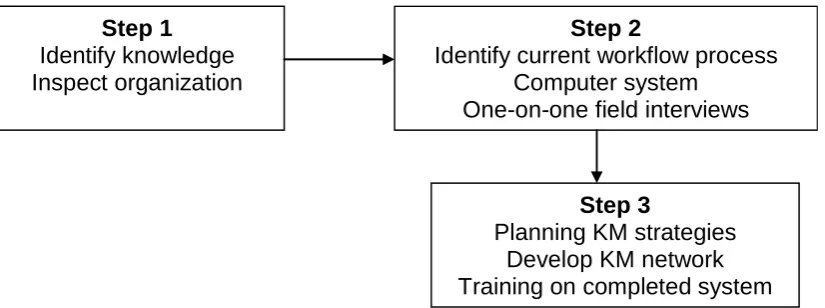
be able to access at any given point in the system. Figure 1.0 shows a diagram
process on the development of knowledge management strategy.
Step 1
Identify knowledge Inspect organization
Step 2
Identify current workflow process Computer system
One-on-one field interviews
Step 3
[image:5.595.91.504.547.701.2]Planning KM strategies Develop KM network Training on completed system
Above of all, top managers should convey simple management and demonstrate
that sharing knowledge is a critical requirement in day-to-day jobs. Creating new
knowledge is a common responsibility for each department or group of experts to
organization turn into knowledge – creating organization. According to James et al,
1995, there are three levels of management:-
I. First- line managers, who are only responsible for operating employees
because they are the lowest level in the managerial hierarchy.
II. Middle managers, who are in charge of other managers, including, some
operating employees, but they must report to senior managers.
III. Top managers, who are the highest on the managerial hierarchy and who set
the policies of the company and guide its interaction with the environment.
There, in facilities management organization, we must identify each level of
management in the process to develop knowledge management strategy. In order to
match the perceptions of all employees in different positions, the goals and the plan
that are committed by all levels of employees for the knowledge management system
becomes more critical issues in implementation. From the preliminary study, the
critical aspect that must be seen is organization culture which focuses on two parts;
knowledge sharing and the fear of innovation. Microsoft Corporation (1999)
highlighted that in order for employees to be knowledgeable, they must be allowed to
experiment in order to learn from failures. Employees should not be afraid of
committing mistakes, and should be encourage sharing the lessons learned so that
the same mistakes will not be repeated.
4.0 Knowledge Management System (KMS)
In the new millennium, we will always be reminded the important of information
and communication technology (ICT). However, Fawzy Soliman & Keri Spooner
(2000) believes that the successful implementation of new technologies is dependent
on many factors including efficient management of human resources. Thus,
knowledge management system is considering all aspects “happened” in the
organization. He also reported that some firms have invested heavily in technology
infrastructure to support and deliver the required knowledge capability. Nilmini
Wickramasinghe (2003) described, knowledge management system refer to the
information system adopted and designed, which efficiently and effectively leverage
the collective experience and knowledge of employees to support information
processing needs, as well as enabling and facilitating sense-making activities of
knowledge workers; i.e. systems that actualize the knowledge architecture. She
added, in practice, knowledge management has been fuelled by the rapid
development of technologies; in fact the emergence of Web-based technologies has
enabled and fuelled the widespread awareness and adoption of KMS in much the
same way as it has had an impact on e-commerce. It is believe that KMS will also
give an impact to facilities management and will create e-facilities.
In knowledge management system (KMS), Cunningham (2001), noted it is
consist of three integrated components namely enterprise resource planning (ERP),
supply chain management (SCM) and customer relationship management (CRM).
This system will make facilities management companies become globally knowledged
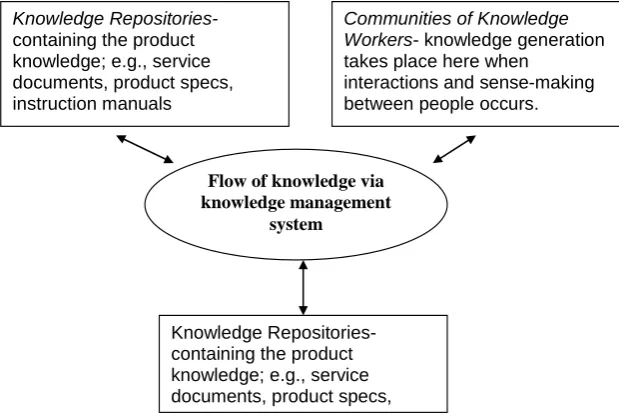
but locally learning. Nilmini Wickramsinghe (2003), had illustrated a diagram of
knowledge architecture interface KMS (figure 1.1). The knowledge architecture is
defining a KMS that supports both objective and subjective attributes of knowledge.
The pivotal function underlined by the knowledge architecture is the flow of
knowledge. The flow of knowledge is fundamentally enables by the KMS.
Knowledge
Repositories-containing the product knowledge; e.g., service documents, product specs, instruction manuals
Communities of Knowledge Workers- knowledge generation takes place here when
interactions and sense-making between people occurs.
Knowledge Repositories- containing the product knowledge; e.g., service documents, product specs,
Flow of knowledge via knowledge management
system
[image:7.595.151.461.499.709.2]Source: Adapted from Borghoff and Pareschi (1998)
Knowledge management system acts as repositories, storing both tacit and
explicit knowledge and even goes so far as to support knowledge spiral (Nonaka,
1991). However, these systems do not support the subjective component of
knowledge. These systems essentially function as an organizational memory
transition to Web-based technologies faster and easier. Maier and Lehner (2000),
mentioned, in practice KMS trying to cope with the following three changes in the
organization:-
I. An increasing complexity, dynamics, fragmentation and decentralization of
knowledge or knowledge development
II. An increasing complexity or organizational structures and the permanent need
to change these structures and
III. An increasing amount on non- traditional data to be manages
To develop knowledge management system, we must first create a model of
knowledge management system. There are several techniques used to model
knowledge. In Europe, the most common are commonKADS and Protégé 2000, the
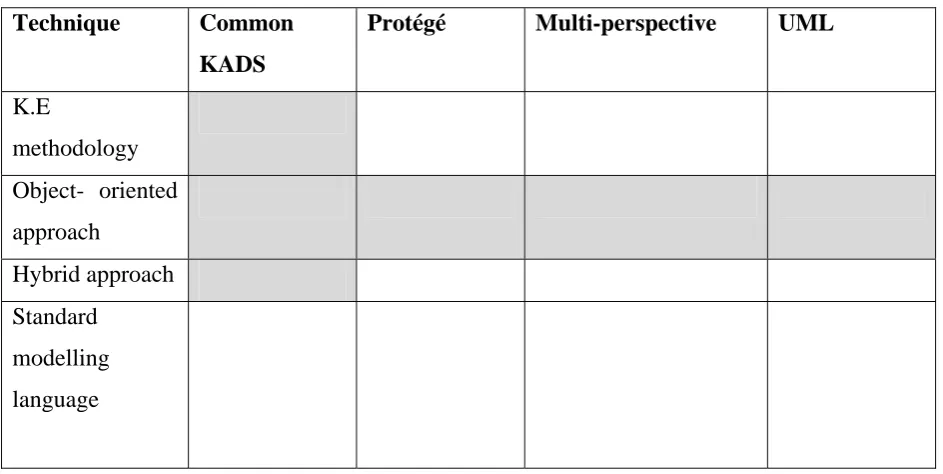
Unified Modelling Language (UML) and Multi- perspective modelling. Mohd. Syazwan
Abdullah et all (2004),have described the modelling techniques and their features as
[image:8.595.87.559.530.767.2]listed below.
Table 1: Modelling techniques and features
Technique Common
KADS
Protégé Multi-perspective UML
K.E
methodology
Object- oriented
approach
Hybrid approach
Standard
modelling
Documentation
Evolving
Domain Medical, legal,
engineering,
business & up
to social
sciences
Medical, legal,
engineering,
business & up
to social
sciences
Medical, legal,
engineering, business
& up to social sciences
Medical, legal,
engineering,
business & up
to social
sciences
Models are widely used in developing software systems including knowledge
management systems. Each of above techniques is currently complementing each
other in one way or another to develop better models of knowledge.
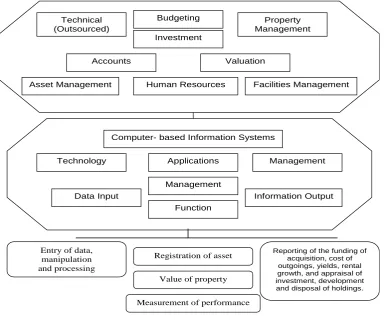
In facilities management organization in Malaysia, the models have to consider all
major businesses or organizations which managing facilities or assets. Figure 1.2
illustrated a framework of initial stage of knowledge management system base on
[image:9.595.105.490.420.742.2]model develop by Mark Deakin (1998).
Figure 1.1: Basic model for KMS in facilities management organization Budgeting Technical (Outsourced) Investment Property Management Accounts Human Resources
Asset Management Facilities Management
Valuation
Computer- based Information Systems
Technology Applications Management
Management Data Input
Function
Information Output
Entry of data, manipulation and processing
Registration of asset Reporting of the funding of acquisition, cost of outgoings, yields, rental growth, and appraisal of investment, development and disposal of holdings. Value of property
Figure 1.1 illustrates computer based information system which can be expanding to
knowledge management system if the model is integrated with other department’s
system model. This model fits into the budgeting of expenditure, the accounts, the
departments it serves and how the technology in question is applied to the
management function. Mark Deakin (1998) also described, in extending the logic of
the previous diagram, it draws attention to the IT applications that assist the
management of facilities or assets. It draws particular attention to the data input
needs for the entry, manipulation and processing of material through the registration
of assets, valuation of property and measurement of performance. It also have the
information which forms the output of the data entry, manipulation and processing.
Computer based information system can be represented as a register of asset
classifications, a set of bases, methods of property valuation and performance
measurement techniques and be it through the form of an electronic filing cabinet,
automated valuation of property, asset management system or performance
measurement.
5.0 Implications
Knowledge management can be as a movement for organizations to change.
This includes organizations involved in facilities management. KMS concepts can be
very complex depending on organization and community of practice. Members of
community of practice can be heterogeneous or homogeneous. Solving an
organizational problem in the case of heterogeneous community of practice, use of
KMS may need some modification of the general KMS commonly used ( Halimah Che
Hassan, 2005). Knowledge management system in facilities management
organization might strengthen the revenue of organization by optimization uses of
facilities or asset and modifies the industries. At the beginning, the most suitable part
in facilities management to implement knowledge management system is in
maintenance part. In Malaysia, as we know maintenance culture is very weak and this
Gary L. Adams and Bruce T. Lamont (2003), described the role of KMS are as
follows:-
I. The accessing of external technology, information and knowledge streams that
the organization can utilize in the development of absorptive capacity to
recombine existing resources into the new core and distinctive competencies.
II. The coordination of internal technology, information and knowledge to aid in
the development of transformative capacity, again in the effort to recombine
existing resources into new core and distinctive competencies
III. The maintenance of core and distinctive competencies.
KMS can facilitate organizational learning and innovation process. In facilities
management organization, the main aspects needs to focus are service to customer,
maintenance on asset and facilities and culture change in organization. Thus, this
research will attempt to get an overview of the importance on knowledge
management system in facilities management organization. It is believed and argued
that management in general, and facilities management even more is only in
beginning to understand the need for effective collaboration to extract the best from
available knowledge.
6.0 Conclusions
This research is still in preliminary study stage. Thus, it only discussed a survey
from various literature surveys to suite in facilities management organization. It is
believed, many organizations involved in facilities management have already applied
some form of knowledge management in their operations and management. What
need to be done further is to look on how managing the organizations in an integrated
manner can be done. This paper seeks to highlight the opportunities of implementing
knowledge management system in order to see the full benefits to the organizations in
the long run. Knowledge management system already implemented in various types
of field thus in facilities management it should also be done. The combination of
knowledge management, information and communication technology and facilities
management should result in improving productivity, enhancing the organizations
References
Adams, G.L, and Lamont,BT., (2003), Knowledge Management System an Developing
Sustainable Competitive Advantage, Journal of Knowledge Management, Vol. 7, No.2,
142- 154.
Beckett, A.J., Wainwright,CER., and Bance,D., (2000), Knowledge Management : Strategy or
Software, Management Decision, No 38/9, 601- 606.
Borghofff, U and Pareschi,R (1998), Information Technology for Knowledge Management,
Springer- verlag, Berlin.
Carder, P.(1995), Knowledge-based FM : Managing Performance at the Workplace Interface,
Facilities, Volume 13, Number 12, 7- 11.
Che Hasan, H (2005), A Facility Planning Framework in Collaborative Environment: An
Application of Knowledge Management System, International Conference on Knowledge
Management, Kuala Lumpur, Malaysia, July 2005, 13- 17.
Deakin. M (1998), The Development of Computer- Based Information Systems for Local
Authorities Property Management, Property Management, Volume 16, Number 2, 61- 82.
James, A.F, Stoner, R, Freeman E. Daniel, R. and Gilbert.J, (1995) Management, 6th ed.
Prentice Hall, Englewood Cliffs, New Jersey.
Jeffrey R. Puddy, Price,I., Smith,L., (2001), FM Policies and Standards as a Knowledge
Management System, Facilities, Volume 19, Number 13/14, 504- 514.
Lin,C., and Tseng,SM., (2005), The Implementation Gaps for the Knowledge Management
System, Industrial Management & Data Systems, Vol.105, No. 2, 208- 222.
Razali,M.N.,,Manaf,Z., (2005), Development of Knowledge Management System : A
Preliminary Study on Property Management Companies in Malaysia, 5th IBIMA
Conference, Cairo Egypt, December 2005, 12-14.
Soliman,F., Spooner,K., (2000), Strategies for Implementing Knowledge Management: Role
of Human Resources Management, Journal of Knowledge Management, Volume 4
Number 4, 337- 345.
Shiem, D., and Then,S., (1999), An Integrated Resource Management View of Facilities
Management, Facilities, Volume 17, Number 12/13, 462- 469.
Tay, L. and Ooi,JTL., (2001), Facilities Management : a “Jack of All Trades”?, Facilities,
Volume 19, Number 10: 2001, 357- 362.
Wickramsinghe, N., (2003), Do We Practice What We Preach? Are Knowledge Management
Systems in Practice Truly Reflective of Knowledge Management Systems in Theory?
Business Process Management Journal, Vol.9, No.3, 295- 316.