Strain-induced isosymmetric phase transition in BiFeO
3Alison J. Hatt and Nicola A. Spaldin
Materials Department, University of California, Santa Barbara, California 93106, USA
Claude Ederer
School of Physics, Trinity College, Dublin 2, Ireland
共Received 30 September 2009; revised manuscript received 1 December 2009; published 17 February 2010兲
We calculate the effect of epitaxial strain on the structure and properties of multiferroic bismuth ferrite, BiFeO3, using first-principles density-functional theory. We investigate epitaxial strain corresponding to an
共001兲-oriented substrate and find that, while small strain causes only quantitative changes in behavior from the bulk material, compressive strains of greater than 4% induce an isosymmetric phase transition accompanied by a dramatic change in structure. In striking contrast to the bulk rhombohedral perovskite, the highly strained structure has ac/aratio of⬃1.3 and five-coordinated Fe atoms. We predict a rotation of polarization from
关111兴 共bulk兲to nearly 关001兴, accompanied by an increase in magnitude of ⬃50%, and a suppression of the magnetic ordering temperature. Our calculations indicate critical strain values at which the two phases might be expected to coexist and shed light on recent experimental observation of a morphotropic phase boundary in strained BiFeO3.
DOI:10.1103/PhysRevB.81.054109 PACS number共s兲: 77.84.⫺s, 75.40.Mg, 75.70.Ak
I. INTRODUCTION
BiFeO3 共BFO兲 has been widely studied for its room-temperature multiferroic properties, in which the electric po-larization is coupled to antiferromagnetic order, allowing for manipulation of magnetism by applied electric fields and vice versa.1–5In its bulk form, BFO occurs in theR3cspace
group6but it is often studied in the form of thin films where
it is subject to an epitaxial constraint. Such constraints im-pose coherency and strain that, in general, distort the bulk structure and/or stabilize phases not present in the bulk material.7–9 Indeed, several groups have reported
stabiliza-tion of a nearly tetragonal phase in highly strained BFO films grown on LaAlO3 substrates with a giant c/a ratio close to 1.3.10,11A similar result was found by earlier theoretical
stud-ies that constrained BFO to tetragonalP4mmsymmetry, thus preventing the rotational distortions found in the R3c bulk phase.12,13Within this constraint, the theoretical ground state
of BFO has a massively reduced in-plane lattice parameter of 3.67 Å and a “supertetragonal” unit cell with c/a= 1.27. ThisP4mm-constrained structure has an enhanced polariza-tion roughly 1.5 times that of the bulk single crystal, a re-markable increase that has also been reported experimentally, though not widely reproduced.14 Lisenkov et al. recently
used model calculations to suggest that theP4mmphase can also be stabilized by electric fields, and they identified an additional phase intermediate to the strained-bulk phase and P4mminduced by application of a关001¯兴electric field.15The
most recent experimental results, from Béaet al.and Zeches et al., have resoundingly confirmed the existence of a second phase with giant c/a in BFO thin films grown on 共001兲 LaAlO3 but suggest a monoclinically distorted space group
Cc.10,11In contrast to earlier experimental studies, Béaet al.
only found a modest enhancement of the polarization. In-triguingly, Zeches et al. observed the coexistence of the high-strain supertetragonal phase and a low-strain bulklike phase with defect-free and dislocation-free interfaces
be-tween phase domains, in spite of a large difference in out-of-plane lattice parameters.
In this work, we use ab initio calculations to investigate the effect of epitaxial strain on BFO without the additional imposed symmetry constraints used in earlier first-principles studies. We address the most widely used共001兲-oriented cu-bic substrates and cover a range of strains encompassing all experimentally accessible states. Our calculations reveal a strain-induced phase transition at⬃4.5% compressive strain, consistent with recent experimental reports10,11 and in
addi-tion show that the transiaddi-tion is isosymmetric. We reported these basic results in Ref. 11, and in the present work we provide the complete theoretical background and analysis. Our analysis of the isosymmetric behavior in the transition region suggests an explanation for several experimental re-sults reported in Ref.11; namely, the coexistence of bulklike and supertetragonal phases in films grown on LaAlO3 sub-strates, and the reversible movement of domain walls in these same films by electric field. In addition, our calcula-tions of the magnetic properties of the supertetragonal phase point to magnetic behavior that is distinct from the rhombo-hedral phase. Finally, in the low-strain regime, we confirm that epitaxial strain has only a small quantitative effect on the properties of rhombohedral BFO.12
II. COMPUTATIONAL METHOD
We perform density-functional calculations using the lo-cal spin-density approximation共LSDA兲plus HubbardU ap-proach as implemented in the software package VASP.16 We
use an effectiveUof 2 eV, which has been shown to give a good description of bulk properties of BFO.1 We use the
projector-augmented wave method,17the defaultVASP
poten-tials 共Bi_d, Fe_pv, O兲, a 5⫻5⫻5 Monkhorst-Pack k-point mesh, and a 500 eV energy cutoff. Spin-orbit coupling is not included in these calculations and unless otherwise noted we impose the bulk G-type antiferromagnetic order. Electric
larization is calculated using the Berry phase method.18,19
To address the effect of epitaxial strain, we use a ten-atom unit cell with lattice vectors aជ1=共a,a, 0兲, aជ2=共⌬,a+⌬,c兲, andaជ3=共a+⌬,⌬,c兲. This unit cell can accommodate the al-ternating rotations of the FeO6 octahedra found in the bulk
R3cstructure while enforcing the formation of a square lat-tice within thex-yplane, corresponding to the epitaxial con-straint imposed by a 共001兲-oriented cubic substrate with in-plane lattice constanta. Furthermore, it allows us to relax the out-of-plane lattice parameter c and a possible monoclinic tilt  of the pseudocubic 共PS兲 perovskite unit cell 共tan =c/⌬兲. For a=c= 3.89 Å and⌬= 0, one obtains the lattice vectors of the relaxedR3cstructure of bulk BFO, albeit with the rhombohedral angle fixed to 60°. Note that since the relaxed value of this angle forUeff= 2 eV is 59.99°共see Ref. 1兲 this is barely a constraint. For computational simplicity, we first consider the case⌬= 0, i.e., no monoclinic distortion of the perovskite unit cell共= 90°兲; this constraint is relaxed later.
III. RESULTS AND DISCUSSION
A. Energetics and structure
We start by examining how the energy varies with out-of-plane lattice parameter for strained BFO. For in-out-of-plane lattice parameters corresponding to compressive strains up to 6.2%, we vary c/a and for each c/a value, we relax all internal coordinates until the Hellman-Feynman forces are no larger than 1 meV/Å on any atom. The internal coordinates are initialized according to the relaxed bulkR3cstructure, result-ing in space-group symmetry Cc. Figure1 共left兲 shows the resulting total energy as a function ofc/afor three represen-tative cases. For a= 3.81 Å, corresponding to a moderate compressive strain of 2.06% relative to the LSDA bulk value 共3.89 Å兲, a single energy minimum is observed at c/a ⬃1.05, i.e., relatively close to unity. For a= 3.65 Å, i.e., 6.17% compressive strain, we again find a single energy minimum but this time at a very largec/a of almost 1.3. In contrast, for an intermediate value of a= 3.71 Å 共4.63% compressive strain兲, the energy curve is almost flat between c/a⬃1.1 and 1.3. Our calculations indicate the presence of
two minima at this intermediatea, a global minimum at large c/a⬇1.25, and a local minimum at smallerc/a⬇1.15. Fur-ther calculations would be required to fully resolve the en-ergy curve in this region.
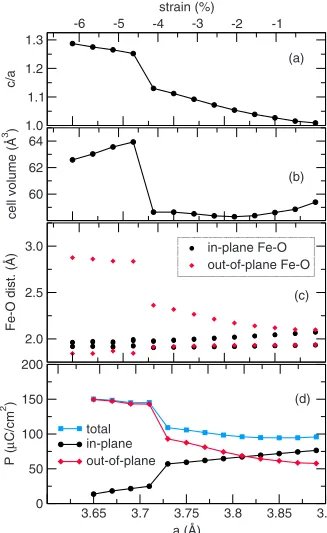
We then use polynomial fits to extract the value of c/a that minimizes the total energy for fixed a, and relax all atoms again at the obtained c/a ratio, still maintaining  = 90°. The total energy of the resulting structures is shown in Fig.1共right兲, relative to the energy of bulkR3c. The corre-sponding evolution of various structural parameters共c/a ra-tio, unit-cell volume, Fe-O distances兲and of the electric po-larization as a function of strain is shown in Fig. 2. All of these quantities exhibit a sharp discontinuity between a = 3.71 Å anda= 3.73 Å, i.e., 4 – 4.5 % strain, where also the total energy depicted in Fig. 1 共right兲 has a kink, indicative of a first-order phase transition.
Finally, we perform additional total-energy calculations for ⫽90°, determine the optimal  for each value of a from a polynomial fit, and again relax atom positions within this new unit cell. For a⬍3.72 Å, we find a monoclinic distortion of the unit cell of⬃1 ° – 2° that reduces the energy by 10 meV/f.u. compared to= 90°, as shown in Fig.1. The resulting atomic configuration represents only a minor struc-tural change from the = 90° case and we thus neglect this distortion in all further calculations, only reporting results for
= 90°.
We start our discussion by first characterizing the struc-tures for two extreme cases representative of the small and 1 1.1 1.2 1.3
c/a -36
-35.6 -35.2
E
(eV)
a = 3.65 a = 3.71 a = 3.81
3.65 3.7 3.75 3.8 3.85 3.9 a (Å)
0 0.05 0.1 0.15
E
(eV)
6 5 4 3 2 1 strain (%)
P4mm Cc,β=90 Cc,βrelaxed
[image:2.609.353.517.68.335.2](a) (b)
FIG. 1. 共Color online兲Left: total energy per formula unit as a function of c/a ratio for three constrained a parameters. Right: energy per formula unit relative to bulk BFO for the ground-state structures as a function ofaforP4mm, unrelaxed monoclinic angle
共= 90°兲, and relaxed monoclinic angle.
60 62 64
cell
volume
(Å
3 )
2.0 2.5 3.0
Fe-O
dist.
(Å)
in-plane Fe-O out-of-plane Fe-O
3.65 3.7 3.75 3.8 3.85 3.9 a (Å)
0 50 100 150 200
P(
µ
C/cm
2)
total in-plane out-of-plane 1.0
1.1 1.2 1.3
c/a
-6 -5 -4 -3 -2 -1 strain (%)
(a)
(b)
(c)
(d)
FIG. 2. 共Color online兲Structural parameters as functions of lat-tice parameter/strain relative to the bulk LSDA+Ulattice param-eter.共a兲 c/aof the pseudocubic cell;共b兲 volume per formula unit;
[image:2.609.53.293.71.190.2]large strain regimes, a= 3.85 Å and a= 3.65 Å, ⬃1% and 6% compressive strain, respectively. At 1% strain, the re-laxed structure closely resembles the rhombohedralR3cbulk phase but the epitaxial constraint causes a monoclinic distor-tion that lowers the symmetry from R3c to Cc. The corre-sponding structure is depicted in Fig.3共right兲. Following the notation introduced in Ref.11, we call this the “R” phase to emphasize its similarity to the rhombohedral parent phase. The internal structure remains similar to the unstrained bulk, with octahedrally coordinated Fe, a ferroelectric distortion consisting of ionic displacements along the PS 关111兴 axis, and antiferrodistortive rotations of the FeO6 octahedra around关111兴PS. The 关001兴PScomponent of the antiferrodis-tortive rotation increases and the 关110兴PS component de-creases as we shrink the in-plane lattice constant but no qualitative change occurs for compressive strains up to 4%. The electric polarization, constrained by symmetry to lie within the monoclinic glide plane, is almost entirely along 关111兴PS, rotating slightly toward 关001兴PS as compressive strain is increased关see Fig. 2共d兲兴. Our results are consistent with the growing body of literature on BFO under moderate compressive strain.11,20,21
At 6% strain, the ground state resembles theP4mm struc-ture described previously for tetragonally constrained BFO.22
Using the notation from Zecheset al.,11we refer to the
high-strain structure as the “T” phase for its similarity to tetrago-nalP4mm. The Fe undergoes large displacement toward one of the apical oxygens关see Fig.2共c兲兴, resulting in a supertet-ragonal structure with five-coordinated Fe, similar to the co-ordination of the transition metals in perovskites PbVO3and BiCoO3共Refs. 23and24兲 共see Fig.3兲.P4mmsymmetry is broken by antiferrodistortive tilting of the square-pyramidal oxygen cages 共analogous to octahedral tilt兲 around 关110兴PS by 5.1°. Interestingly, the T phase does not exhibit the 关001兴PSrotations that have been associated with compressive strain in other perovskites.25,26This is likely associated with the change in Fe coordination, which encourages displace-ment along 关001兴PS in response to decreased lattice param-eter rather than rotation of the oxygen cages.
As can be seen in Fig. 1 共right兲, the T phase is signifi-cantly lower in energy than P4mm. Furthermore, it follows from Fig. 1 that at about 5% strain, the energy reduction obtained by allowing the tiltings共going fromP4mmtoCcat
= 90°兲 is even larger than the subsequent reduction from
relaxing . These results indicate that the formation of a tetragonalP4mmphase in BFO films grown on SrTiO3 sub-strates, as reported, e.g., in Ref. 14, is highly unlikely.
The polarization vector is within the glide plane, as in the low-strain regime but is now strongly rotated to be almost entirely out of plane, along关001兴PS 关Fig.2共d兲兴. In addition, the magnitude 共relative to a Pm¯m3 reference structure兲 in-creases from 96 C/cm2 in the unstrained bulk to 150 C/cm2. This is in contrast to the modest enhancement reported in Ref. 10, where a remnant polarization of 75 C/cm2is reported for Mn-doped films on LaAlO3 sub-strates, compared to 60 C/cm2 in bulk.27The discrepancy
in enhancement might be a result of the 5% Mn doping used to reduce current leakage but it could also indicate incom-plete switching of the polarization. This is reasonable, as we expect the large distortion accompanying the polarization to be associated with a large coercivity. Reorientation of the out-of-plane polarization would require a significant change in bonding for the five-coordinated structure and it is pos-sible that the nature of switching is quite different in the supertetragonal phase than in the bulk.
We observe that the total polarizationPជ is nearly constant within the low-strain regime 共1 – 2 %兲 but that the out-of-plane projection grows at the expense of the in-out-of-plane projec-tion 关Fig.2共d兲兴. This is in part associated with the growing c/a but when we correct for that we find that Pជ is rotated toward the关001兴direction by several degrees at −1% strain. This rotation in the low-strain regime is qualitatively similar to that reported in Ref.28, although we find a much smaller enhancement of the total polarization. The rotation across the transition fromRtoTis much larger: ata= 3.73 Å the angle betweenPជ and关001兴is 31.52°; ata= 3.71 Å it is 9.90°. We suspect that this dramatic rotation is responsible for the re-cently demonstrated ability to shift the phase boundary with an electric field in BFO films with mixedT andR phases.11
An electric field applied along 关001兴 will favor an out-of-plane polarization, thus growing theT phase at the expense ofR. The properties that are responsible for the side-by-side coexistence ofTandRdomains, and for the reversible nature of this domain shifting, are addressed later.
B. Octahedral modes
To further quantify the phase transition, we decompose the structural distortion relative to a P4/mmm reference structure into symmetry irreducible modes using the
ISODIS-PLACEsoftware.29We find the largest changes as a function
of strain in the antiferrodistortive A4− and A5− modes 共see Fig. 4兲. These modes correspond to alternating rotations of the FeO6 octahedra around the 关001兴PS and 关110兴PS axes, respectively, and are therefore a measure of the octahedral rotations and tilts, similar to the analysis presented in previ-ous work.25,26 In fact, the dependence of rotation and tilt
angles 共using the terms as defined in Ref.25兲 on lattice pa-rameter are qualitatively identical to those of the correspond-ing symmetry adapted modes. As can be seen from Fig. 4, the transition betweenT andR phases can be characterized by the evolution of the A4− and A5− modes as a function of lattice parameter, which again exhibit pronounced disconti-FIG. 3. 共Color online兲 Isosymmetric phases ofCc BFO: Left:
[image:3.609.53.293.67.205.2]nuities around a= 3.71 Å. In particular, the A4− mode van-ishes in the T phase. This suggests that the isosymmetric phase transition is related to the stability of the correspond-ing phonon mode, which is unstable for larger in-plane lat-tice parameters whereas it becomes stable for large compres-sive in-plane strain. The phase transition thus seems to be of similar microscopic origin as conventional soft-mode transi-tions, albeit with no resulting change in space-group symme-try.
C. Magnetic coupling
Finally, we calculate the relative energies of likely mag-netic orderings in the T phase. We double the unit cell to allow A-type and C-type orderings and rerelax the atom po-sitions for each fixed magnetic order. We do not optimize the volume for the different configurations but maintain that of the G-type unit cell. For the R phase, G-type antiferromag-netic ordering is the most stable magantiferromag-netic configuration across the whole strain range, consistent with bulk. In con-trast, we find that in the T phase, G type and C type are nearly degenerate, with C type being slightly lower in en-ergy; for example, at 6% strain, the difference is 6 meV/f.u.30
In both G type and C type, neighboring Fe moments within 共001兲PSare antiferromagnetically aligned but whereas for G type, neighboring moments are also antialigned in the out-of-plane direction, they are ferromagnetically aligned for C type. A-type ordering with parallel orientation of all mag-netic moments within the same共001兲PSplane but alternating order in the perpendicular direction is strongly unfavorable.
To further quantify this, we map the calculated total ener-gies onto a nearest-neighbor Heisenberg model where E= −12⌺ijJijSiSj, and calculate the magnetic coupling constants Jij for Si=⫾
5
2. We distinguish between in-plane coupling,
Jin, and out-of-plane coupling Jout. For the T phase at 6% strain, we find Jin= −10 meV and Jout= 0.48 meV whereas for the R phase at 1% strain, Jin= −9.8 meV and Jout= −7.6 meV. This shows that the increased distance between Fe atoms along 关001兴PS in the high-strain regime strongly reduces the magnetic coupling strength in that direction, leading to the very similar energies of C-type and G-type magnetic order. The weak magnetic coupling between adja-cent共001兲PSplanes is likely to significantly reduce the
mag-netic ordering temperature, in spite of the strong coupling within individual共001兲PSplanes.
IV. SUMMARY AND DISCUSSION
In summary, our calculations of the effect of strain on BFO reveal two distinct structures in the high- and low-strain regime with a discontinuous first-order transition between them at⬃4.5% compressive strain. We note that, as a result of the constraints imposed by coherence and epitaxy, both phases have the same space-group symmetry; such phase transitions are known are isosymmetric and are necessarily first order.31Isosymmetric transitions have also been
demon-strated in pressure-induced transitions, as in Fe0.47NbS2 and
␣-PbF2,32,33or by temperature changes, as in-YbV4O8and the fulleride Sm2.75C60.34,35Large volume changes appear to be characteristic. For example, the pressure-induced spin-state transition in cerium is accompanied by a 16.5% volume change. Similarly, BFO undergoes a 9% change in volume at the strain-induced isosymmetric transition fromRtoTphase 关see Fig.2共b兲兴. The recent work by Lisenkovet al.15showed
that isosymmetric phase transitions in BiFeO3films may also be induced by electric fields.
While such isosymmetry might enable the coexistence of the two phases recently reported in strained thin films,11we
suggest that the low barrier between R and T phases, as shown in Fig.1, is likely also a requirement. AnR-phase film with large compressive strain near the transition region can lower its energy significantly by relaxing to a slightly larger lattice parameter. This lattice expansion would normally cre-ate massive dislocations within the crystal but because of the unusually flat energy surface near the transition region, it can be accommodated by the simultaneous development ofT do-mains with decreased lattice parameter, incurring a relatively small energy penalty. This model for coexistence in BFO thin films can provide guidelines for identifying other sys-tems with coexisting phases, namely, the presence of an iso-symmetric transition with a low-energy barrier between phases. We also suggest that the isosymmetric nature of the transition facilitates the reversible movement of the bound-ary between R and T phases with an electric field,11 as it
obviates the need to change symmetry at the transition. The practical and technological implications of phase coexistence and morphotropic phase boundarylike behavior are being ac-tively explored and we hope that the criteria suggested by our calculations will provide direction for future studies.
ACKNOWLEDGMENTS
We gratefully acknowledge support from the following: NSF Awards No. DMR-0820404 and No. NIRT-0609377 共N.A.S. and A.J.H.兲and Science Foundation Ireland through Contract No. SFI-07/YI2/I1051 共C.E.兲. Travel support was provided by the International Center for Materials Research through the IMI Program of the NSF under Award No. DMR04-09848 共A.J.H.兲. Computational resources used in-clude the SGI Altix关Cobalt兴system and the TeraGrid Linux Cluster关Mercury兴at the National Center for Supercomputing Applications under Grant No. DMR-0940420; CNSI
Com-3.65 3.70 3.75 3.80 3.85 3.90 a (Å)
0 0.2 0.4 0.6 0.8
norma
lize
d
mo
d
e
amp
litu
d
e 6 5 4 3 2 1
strain (%)
A4-
[image:4.609.88.256.71.191.2]puter Facilities at UC Santa Barbara under NSF Grant No. CHE-0321368; and facilities provided by the Trinity Centre for High Performance Computing. We thank R. J. Zeches, M.
D. Rossell, L. W. Martin, and R. Ramesh for helpful discus-sions.
1J. B. Neaton, C. Ederer, U. V. Waghmare, N. A. Spaldin, and K.
M. Rabe, Phys. Rev. B 71, 014113共2005兲.
2C. Ederer and N. A. Spaldin, Phys. Rev. B 71, 060401共R兲
共2005兲.
3J. Wang, J. B. Neaton, H. Zheng, V. Nagarajan, S. B. Ogale, B.
Liu, D. Viehland, V. Vaithyanathan, D. G. Schlom, U. V. Wagh-mare, N. A. Spaldin, K. M. Rabe, M. Wuttig, and R. Ramesh, Science 299, 1719共2003兲.
4T. Zhao, A. Scholl, F. Zavaliche, K. Lee, M. Barry, A. Doran, M.
P. Cruz, Y. H. Chu, C. Ederer, N. A. Spaldin, R. R. Das, D. M. Kim, S. H. Baek, C. B. Eom, and R. Ramesh, Nature Mater. 5, 823共2006兲.
5D. Lebeugle, D. Colson, A. Forget, M. Viret, A. M. Bataille, and
A. Gukasov, Phys. Rev. Lett. 100, 227602共2008兲.
6F. Kubel and H. Schmid, Acta Crystallogr., Sect. B: Struct. Sci.
46, 698共1990兲.
7A. Biswas, M. Rajeswari, R. C. Srivastava, T. Venkatesan, R. L.
Greene, Q. Lu, A. L. de Lozanne, and A. J. Millis, Phys. Rev. B
63, 184424共2001兲.
8D. G. Schlom, L. Q. Chen, C. B. Eom, K. M. Rabe, S. K.
Stre-iffer, and J. M. Triscone, Annu. Rev. Mater. Res. 37, 589
共2007兲.
9K. R. Balasubramaniam, S. Havelia, P. A. Salvador, H. Zheng,
and J. F. Mitchell, Appl. Phys. Lett. 91, 232901共2007兲. 10H. Béa, B. Dupé, S. Fusil, R. Mattana, E. Jacquet, B.
Warot-Fonrose, F. Wilhelm, A. Rogalev, S. Petit, V. Cros, A. Anane, F. Petroff, K. Bouzehouane, G. Geneste, B. Dkhil, S. Lisenkov, I. Ponomareva, L. Bellaiche, M. Bibes, and A. Barthélémy, Phys. Rev. Lett. 102, 217603共2009兲.
11R. J. Zeches, M. D. Rossell, J. X. Zhang, A. J. Hatt, Q. He, C.-H.
Yang, A. Kumar, C. H. Wang, A. Melville, C. Adamo, G. Sheng, Y.-H. Chu, J. F. Ihlefeld, R. Erni, C. Ederer, V. Gopalan, L. Q. Chen, D. G. Schlom, N. A. Spaldin, L. W. Martin, and R. Ramesh, Science 326, 977共2009兲.
12C. Ederer and N. A. Spaldin, Phys. Rev. Lett. 95, 257601
共2005兲.
13D. Ricinschi, K.-Y. Yun, and M. Okuyama, J. Phys.: Condens.
Matter 18, L97共2006兲.
14K. Y. Yun, D. Ricinschi, T. Kanashima, and M. Okuyama, Appl.
Phys. Lett. 89, 192902共2006兲.
15S. Lisenkov, D. Rahmedov, and L. Bellaiche, Phys. Rev. Lett.
103, 047204共2009兲.
16G. Kresse and J. Furthmüller, Phys. Rev. B 54, 11169共1996兲.
17G. Kresse and D. Joubert, Phys. Rev. B 59, 1758共1999兲.
18R. D. King-Smith and D. Vanderbilt, Phys. Rev. B 47, 1651
共1993兲.
19D. Vanderbilt and R. D. King-Smith, Phys. Rev. B 48, 4442
共1993兲.
20D. H. Kim, H. N. Lee, M. D. Biegalski, and H. M. Christen,
Appl. Phys. Lett. 92, 012911共2008兲.
21C. Daumont, S. Farokhipoor, A. Ferri, J. Wojdeł, J. Íñiguez, B.
Kooi, and B. Noheda, arXiv:0911.4502共unpublished兲. 22C. Ederer and N. A. Spaldin, Phys. Rev. B 71, 224103共2005兲.
23A. A. Belik, M. Azuma, T. Saito, Y. Shimakawa, and M. Takano,
Chem. Mater. 17, 269共2005兲.
24A. A. Belik, S. Iikubo, K. Kodama, N. Igawa, S.-i. Shamoto, S.
Niitaka, M. Azuma, Y. Shimakawa, M. Takano, F. Izumi, and E. Takayama-Muromachi, Chem. Mater. 18, 798共2006兲.
25A. T. Zayak, X. Huang, J. B. Neaton, and K. M. Rabe, Phys.
Rev. B 74, 094104共2006兲.
26A. J. Hatt and N. A. Spaldin, Eur. Phys. J. B 71, 435共2009兲.
27D. Lebeugle, D. Colson, A. Forget, and M. Viret, Appl. Phys.
Lett. 91, 022907共2007兲.
28H. W. Jang, S. H. Baek, D. Ortiz, C. M. Folkman, R. R. Das, Y.
H. Chu, P. Shafer, J. X. Zhang, S. Choudhury, V. Vaithyanathan, Y. B. Chen, D. A. Felker, M. D. Biegalski, M. S. Rzchowski, X. Q. Pan, D. G. Schlom, L. Q. Chen, R. Ramesh, and C. B. Eom, Phys. Rev. Lett. 101, 107602共2008兲.
29B. Campbell, H. Stokes, D. Tanner, and D. Hatch, J. Appl.
Crys-tallogr. 39, 607共2006兲.
30This is in apparent contradiction to Ref. 10, where
room-temperature G-type AFM order is reported for BFO films on LaAlO3 substrates. However, the strain in the experiment is roughly 4%, and we therefore do not expect exact agreement with predictions for the 6% strain case.
31A. G. Christy, Acta Crystallogr., Sect. B: Struct. Sci. 51, 753
共1995兲.
32L. Ehm, K. Knorr, L. Peters, S. Rath, and W. Depmeier, J. Alloys
Compd. 429, 82共2007兲.
33J. Haines, J. M. Léger, and O. Schulte, Phys. Rev. B 57, 7551
共1998兲.
34J. Arvanitidis, K. Papagelis, S. Margadonna, K. Prassides, and A.
N. Fitch, Nature共London兲 425, 599共2003兲.
35K. Friese, Y. Kanke, A. N. Fitch, and A. Grzechnik, Chem.