Localized Knowledge Diffusion, Social Interaction
Vehicles, Adoption and Uses of Internet in Cameroon
Georges D. Mbondo
Research Group in Theoretical and Applied Economics (GRETA), University of Douala, Cameroon
Copyright©2017 by authors, all rights reserved. Authors agree that this article remains permanently open access under the terms of the Creative Commons Attribution License 4.0 International License
Abstract
The objective of this article is to show that, since the potential for localized diffusion of knowledge is not the same in Social Interactions Vehicles (SIV), peer effects occurring there cannot play the same role on adoption and use decisions of Internet by households. To do this, we use data from a survey of 2266 individual households carried out in 2015 in the major cities of Cameroon, where we choose Cultural Associations and Tontines (Rotating Organization of savings and credit association, ROSCA) as SIV, to which we apply a probit regression with instrumental variables. Results show that, in Cultural Associations by socio-professional categories where there is a localized diffusion of knowledge, peer effects play a positive role on the likelihood of adoption and use of Internet in Cameroon; In Tontines by these same categories, this role is uncertain. These results contrast with the one commonly known, that ROSCA's frameworks play a positive role on the adoption and use of new technologies. So, it is important for public policies that could use SIV's frameworks for ICT equipment and training policies in general and Internet in particular, convinced by the fact that their appropriation is a source of endogenous growth.Keywords
Localized Knowledge Diffusion,Technological Adoption and Use, Internet, Sub-Saharan Africa, Cameroon
1. Introduction
In the analysis of the determinants of adoption and use of new technologies, localized knowledge diffusion occupies a central place (Bocquet and Brossard [1], Breschi and Lissoni [2], Zucher et al. [3]. As a proximity effect between Science and Industry Grossetti and Bès [4]), it is captured by variables that are much more based on geographical proximity, where agglomeration effects play a leading role. Yet proximity is not only physical, it is also relational, in particular in localized knowledge diffusion concern. In this
respect, Social Interactions Vehicles (SIV), little evoked in socioeconomic literature seems to us more indicated to be used as framework of analysis.
Indeed, one can understand by SIV, Clubs, Associations and, no doubt, Social networks offline and/or online, in brief, any institutional devices or mechanisms that put in motion interactions between individuals. It can be noticed that such mechanisms dominate social organization in sub-Saharan Africa, where life revolves around small groups within towns and villages, depending on the sector of activity and even socio-professional categories (SPC). These vehicles constitute frameworks for dissemination or diffusion of formal and informal knowledge which, because of social interactions occurring there, create social multipliers of behaviors favorable or unfavorable to the adoption and use of new technologies. Tontines are a type of these SIVs that appeared in the literature as having a positive role on the adoption and use of new technologies, in particular contraceptives and agricultural technologies in sub Saharan Africa (Bandiera & Rasul [5], Etang, Fieldings and Knowles [6], Oster & Thornton [7], Foster & Rosenzweig [8], Conley & Udry [9]). It is therefore important to know, as defined above, whether SIVs favor knowledge diffusion in the same way on all kinds of technology, and how to capture the proximity effects through which this diffusion passes in order to influence adoption and use decisions of the Internet by Households in Cameroon?
statistical properties; Section 4 presents the methodology for estimating peer effects in the context of localized knowledge diffusion; Section 5 presents the results and their interpretation and Section 6 concludes the study.
2. Hypotheses on Adoption and Use
Decisions of Internet in the Context of
Localized Knowledge Diffusion in SIV
Almost ignored in the microeconomic literature of the decision, SIVs appear as interesting frameworks for the localized knowledge diffusion, sufficiently conducive to highlighting proximity effects in the analysis of adoption factors and the use of Internet by households. This argument arises from the work of Arthur [10], and Walliser [11] who situates individual decision in a complex of social interactions and/or social embedding as in Granovetter [12], Bourdieu [13] and David [14]. Indeed, at the altar of works on Information Systems, the individual adoption and use decision of technologies is affected by two dimensions associated with the diffusion dynamics (Venkatesh et al. [15], Miranda et al. [16]): the global dimension, linked to the global reach of networks access and their contents, and the local dimension, linked to the immediate environment of adopters. The study of the last dimension makes it possible to identify factors leading to an adequate use of the services of Internet technology, and subjects its diffusion dynamics to a conjunction of pecuniary and non-pecuniary externalities (Pénard and Poussing [17], Pénard and Suire [18], Bakehe et al. [19]). However, these externalities are well defined by SIVs which offer a physical and relational proximity and contribute to a diffusion of knowledge on the quality of the equipment and means of access of Internet users, the degree of autonomy in use, the level of technical competence and online navigation to interesting sites, but also the social support network.
In sub-Saharan Africa, one aspect of these SIV is Cultural Associations and Tontines (Rotating Organization of Savings and Credit Associations). They constitute environments in which these pecuniary and non-pecuniary externalities, which are primarily aimed at members, make them closed clubs (Buchanan [20]) and circumscribe the
geographic and relational proximities. The logic of belonging that animates these vehicles leads to highlight the interactions between members sharing the same routines, while the similarity logic designates the fact of the interactions between members sharing the same systems of representations or beliefs (Torre and Rallet, [21]), Bocquet and Bossard [22], Bocquet and Bossard [1]). This naturally leads to the hypothesis that two sets of factors determine the adoption and uses of the Internet. The first group consists of idiosyncratic factors characterizing the adopting household. The second group concerns SIVs as a source of inspiration and a space for culture of individual action.
We denote AD, adoption decisions, and UD, usage decisions. Factors of idiosyncratic type are given by traditional socio-economic variables: the level of education (in the survey educ1 for primary education level and educ2 for secondary education level), the initial learning of computers (learnfor) and especially informal learning, the age of the future Adopting (Age), income (rev1 for the revenue below the median in Cameroon and rev2 for the one on top of the median) informational externalities of social network expressed in the form of knowledge abroad (Abroad). SIV are Ass, cultural associations, Ton, tontines, and we may also have family, neighbors, neighborhood and social network support. The uses retained in the study are: interpersonal communications (e-mails and instant messengers) and information retrieval.
Since it is established that the nature of the property rights in the equipment determines the adoption and use behavior, we also consider that access to the Internet can be achieved by acquiring the technology or by leasing (Tamokwe [23], Mukoko [24], Mbondo [25], Fambeu and Bakehe [26]).
3. Survey Data and Descriptive Statistics
of Variables
The data used are from the second edition of the ICT surveys carried out first in 2008 and then in 2015 on a sample of 2266 individuals distributed among five major cities in Cameroon. The SIV retained, namely cultural Associations and Tontines, reveal the statistics in Table 1.
Table 1. Descriptive Statistics of SIV
SIV Number Frequency of population in% Maximum Minimum
Cultural Associations / SPC 5 74 150 10
Tontines/SPC 5 66 300 10
Table 2. Frequencies of responses concerning the practice of activities on the net
Internet related activities Frequencies Maximum Minimum Standard deviation
Advice for the uses of the
Internet 62,9 2500 50 67,02
Advice for choosing the
place of access 44,5 2450 45 50,01
Advice on supplier choice 52,6 2150 50 70,2
[image:3.595.62.549.206.374.2]Source: construction of the author based on data from the 2015 survey
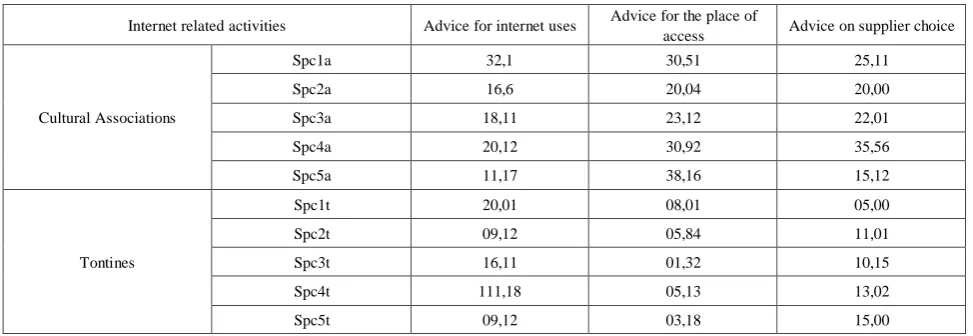
Table 3. Frequencies of the practice of net activities of participants in at least one association by SPC
Internet related activities Advice for internet uses Advice for the place of
access Advice on supplier choice
Cultural Associations
Spc1a 32,1 30,51 25,11
Spc2a 16,6 20,04 20,00
Spc3a 18,11 23,12 22,01
Spc4a 20,12 30,92 35,56
Spc5a 11,17 38,16 15,12
Tontines
Spc1t 20,01 08,01 05,00
Spc2t 09,12 05,84 11,01
Spc3t 16,11 01,32 10,15
Spc4t 111,18 05,13 13,02
Spc5t 09,12 03,18 15,00
Source: developed from data from the 2015 survey
Statistics on knowledge dissemination activities retained in the survey are summarized in Table 2.
These two tables show the importance of the SIV but also the activities of dissemination of knowledge on Internet technology. By crossing them with the SPCs, we obtain Table 3.
Thus, considering the five socio-professional categories within the cultural Associations and five Tontines, in which at least one member is active in disseminating knowledge on the Internet, we seek to highlight the fact that the effects of Peers amplify this diffusion and boost the decisions of adoption and/or use of the Internet. To do this, it is necessary to check whether the behaviors within the groups are homogeneous, that is to say that the intra group variance is less than the total variance of the population.
SIVs containing knowledge dissemination activities (Table 3), the peer effects that occur therein, induce a localized dissemination of knowledge that influences the likelihood of Internet adoption and use.
4. Methodology for Estimating Peer
Effects in the Context of Localized
Knowledge Diffusion by a Probit
Model with Instrumental Variables
The adoption and use decisions (AD and UD) having a dichotomous character, the probit model is retained in its instrumental variable version to achieve the identification of
the effects of peers. Let’s recall that the problem of identifying peer effects is to distinguish three types of effects that may impact on individual decision-making in a group: contextual effect, endogenous effect, and correlated effect. By following Manski [27] and Graham and Hahn [28], a mean relation allows modeling the decision in the following way:
ri r ri r r ri
y
=
α
+
λ
x
+
β
y
+
δ
x
+
ε
(1)Where 𝑦𝑟𝑖 represents the adoption decision or household use i within the VIS r, 𝑥𝑟𝑖 is the vector of idiosyncratic explanatory variables of the household i within the SIV r,
𝑦�𝑟the average adoption or use decision in the VIS r, the one devoted to the trend of the group; 𝑥̅𝑟 the mean level of the explanatory variables of the group and 𝜀𝑟𝑖, the error. αr represents unobservable factors common to group members. Under these conditions, β represents the endogenous peer effect assumed to be less than 1 in absolute value, hence (|𝛽| < 1). The social multiplier located in this group is calculated by making the ratio: 1/(1-β) A detailed account of the questions of identification and deduction of social multipliers is given by Bellemare et al. [29].
The adoption or use decision is 𝑌𝑟𝑖, a dichotomous dependent variable expressing whether or not the household adopts the Internet takes values 1 if it adopts and 0 otherwise. This can be mathematically written:
𝑌𝑟𝑖 =�1 𝑖𝑓𝑎𝑑𝑜𝑝𝑡𝑖𝑜𝑛𝑜𝑟𝑢𝑠𝑒0 𝑜𝑡ℎ𝑒𝑟𝑤𝑖𝑠𝑒
Moreover, in a Probit model with instrumental variables, we have:
( )
ri ri r i r i
y = Φ
λ
x +β
y − +δ
x− (2) Where Ф(...) is an application whose values are necessarily in the interval 0 and 1. The choice of the Probit model means that Ф(...) represents the distribution function of a normal distribution that we have:2
1
(
)
exp
2
2
ri r i r i x y x
ri r i r i
z
x
y
x
dz
λ β δ
λ
β
δ
− −+ +
− −
−∞
Φ
+
+
=
−
Π
∫
(3)( ri 1) Pr( ri r i r i ri ri) Pr( ri ri ( ri r i r i)
P y = =
λ
x +β
y− +δ
x− +µ
≥y =µ
≥y −λ
x +β
y− +δ
x− (4) And(
ri0)
Pr(
ri r i r i ri ri)
Pr(
ri ri(
ri r i r i)
P y
= =
λ
x
+
β
y
−+
δ
x
−+
µ
≤
y
=
µ
≤
y
−
λ
x
+
β
y
−+
δ
x
− (5) The relevance of the analysis is based on the similarity of behavior within the groups as shown in Table 4.Table 4. Intra group variance
Group definition Number of groups Adoption Interpersonal Communication Search of information
Total Sample 1 36,50 26,50 26,50
Associations (by Spc) 5 6,50 7,5 8,5
Tontines (by Spc) 5 7,5 9,5 9,5
Source: construction of the author based on data from the 2015 survey
5. Results and Interpretation
5.1. Knowledge Diffusion and Effects on the Adoption Decision
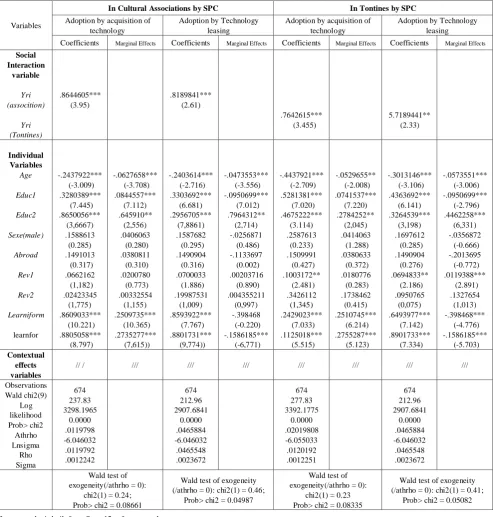
Table 5. Results of Estimates of Adoption Decisions in Associations and Tontines where there is at least one member engaged in a knowledge-disseminating activity
Variables
In Cultural Associations by SPC In Tontines by SPC
Adoption by acquisition of technology
Adoption by Technology leasing
Adoption by acquisition of technology
Adoption by Technology leasing
Coefficients Marginal Effects Coefficients Marginal Effects Coefficients Marginal Effects Coefficients Marginal Effects
Social Interaction variable Yri (assocition) Yri (Tontines) .8644605*** (3.95) .8189841*** (2.61) .7642615*** (3.455) 5.7189441** (2.33) Individual Variables Age Educ1 Educ2 Sexe(male) Abroad Rev1 Rev2 Learniform learnfor -.2437922*** (-3.009) .3280389*** (7.445) .8650056*** (3,6667) .1588613 (0.285) .1491013 (0.317) .0662162 (1,182) .02423345 (1,775) .8609033*** (10.221) .8805058*** (8.797) -.0627658*** (-3.708) .0844557*** (7.112) .645910** (2,556) .0406063 (0.280) .0380811 (0.310) .0200780 (0.773) .00332554 (1,155) .2509735*** (10.365) .2735277*** (7,615)) -.2403614*** (-2.716) .3303692*** (6.681) .2956705*** (7,8861) .1587682 (0.295) .1490904 (0.316) .0700033 (1.886) .19987531 (1,009) .8593922*** (7.767) .8801731*** (9,774)) -.0473553*** (-3.556) -.0950699*** (7.012) .7964312** (2,714) -.0256871 (0.486) -.1133697 (0.002) .00203716 (0.890) .004355211 (0,997) -.398468 (-0.220) -.1586185*** (-6,771) -.4437921*** (-2.709) .5281381*** (7.020) .4675222*** (3.114) .2587613 (0.233) .1509991 (0.427) .1003172** (2.481) .3426112 (1,345) .2429023*** (7.033) .1125018*** (5.515) -.0529655** (-2.008) .0741537*** (7.220) .2784252** (2,045) .0414063 (1.288) .0380633 (0.372) .0180776 (0.283) .1738462 (0.415) .2510745*** (6.214) .2755287*** (5.123) -.3013146*** (-3.106) .4363692*** (6.141) .3264539*** (3,198) .1697612 (0.285) .1490904 (0.276) .0694833** (2.186) .0950765 (0,075) .6493977*** (7.142) .8901733*** (7.334) -.0573551*** (-3.006) -.0950699*** (-2.796) .4462258*** (6,331) -.0356872 (-0.666) -.2013695 (-0.772) .0119388*** (2.891) .1327654 (1,013) -.398468*** (-4.776) -.1586185*** (-5.703) Contextual effects variables // / /// /// /// /// /// /// /// Observations Wald chi2(9) Log likelihood Prob> chi2 Athrho Lnsigma Rho Sigma 674 237.83 3298.1965 0.0000 .0119798 -6.046032 .0119792 .0012242 674 212.96 2907.6841 0.0000 .0465884 -6.046032 .0465548 .0023672 674 277.83 3392.1775 0.0000 .02019808 -6.055033 .0120192 .0012251 674 212.96 2907.6841 0.0000 .0465884 -6.046032 .0465548 .0023672
Wald test of exogeneity(/athrho = 0):
chi2(1) = 0.24; Prob> chi2 = 0.08661
Wald test of exogeneity (/athrho = 0): chi2(1) = 0.46;
Prob> chi2 = 0.04987
Wald test of exogeneity(/athrho = 0):
chi2(1) = 0.23 Prob> chi2 = 0.08335
Wald test of exogeneity (/athrho = 0): chi2(1) = 0.41;
Prob> chi2 = 0.05082
Source: author's built from Stata 12 software.results
[image:5.595.58.552.100.618.2]From Table 5, we identify the value of the peer effects used to calculate the social multipliers of behaviors and presented in Table 6.
Table 6. Synthesis of social peer and multiplier effects of household adoption decisions in Cameroon
Elements Cultural Associations/SPC Tontines/SPC
Adoption by acquisition Adoption by leasing Adoption by acquisition Adoption by leasing
EndogenouspeerEffectsβ 0,864 0,818 0,464 5,818
Social Multipliers 1
1−𝛽 7,352 5,494 1,865 ///////
[image:5.595.63.549.676.737.2]This table shows that within the Cultural Associations, the value of the effect of endogenous peers is 0.864 for adoption by acquisition of Internet equipment and 0.818 for adoption by lease. This result testifies to the potential of knowledge diffusion within this SIV likely to generate social multipliers of a value of 7,352 and 5,494 respectively, to say belonging to this SIV where knowledge are diffused on the Internet technology increases the likelihood of Internet adoption of 7,352 for those who have Internet equipment and 5,494 for those uses the Internet per rental. On the other hand, this probability increases only by 1.865 for households with equipment in Tontines.
Table 7. Results of estimates of use decisions in associations and Tontines where there is at least one member involved in a knowledge disseminatio n activity
Variables
In Cultural Associations by SPC In Tontines by SPC
Instant communication Search of Information Instant Communication Search of Information
Coefficients Marginal Effects Coefficients Marginal Effects Coefficients Marginal
Effects Coefficients Marginal Effects
Social Interaction Variables Yri (Association) Yri (Tontines) .764215*** (3.455) .776982*** (4.1515) .1041615 (1.425) .3321982 (0.1515) Individual Variables Age Educ1 Educ2 Sexe(homme) Abroad Rev1 Rev2 Learniform learnfor -.253191*** (-7,452) .417183*** (12,333) .523642*** (14,654) -.355623*** (-15,461) .249121*** (7,858) .06997065 (0.181) .13002653 (0,236) .761822*** (7.484)) .741841*** (14,420) -.026277*** (-32,846) .045445*** (44,616) .052063*** (13,991) -.051060*** (-9.282) .0671081*** (11,252) .02923077 (0.183) 0.2325079 (0,444) .1159765*** (27,405) .1345245*** (17,221) -.181314** (-2,611) -.11058*** (-13,753) .085632*** (12,978) .158768** (2.285) .149090*** (7.316) .0694833 (0.186) .12042152 (0,222) .795939*** (14,312) .779987*** (15,413) -.03624*** (-5,441) -.07495*** (-11,301) .009865*** (11,241) -.02568*** (-5.486) .013369*** (-12.002) .0019378 (0.890) .00242313 (0,714) -.40398*** (-13,982) -.20184*** (-14,227) -.24379*** (-12,119) .328038*** (23.111) .443567*** (12,876) .158863*** (7.285) .149101*** (6.317) .070216*** (7.181) .0998756 (0,125) .860903*** (23.111) .880505*** (22.243) -.0625*** (-12.008) .08557*** (17.817) .12341*** (10,775) .04063*** (6.280) .03801*** (0.310) .01806*** (6.183) .0098712 (1,367) .25735*** (22.991) .25277*** (22.878) -.24036*** (-2.106) .330362*** (21.112) .451831*** (7,441) .158682*** (7.285) .141904*** (4.322) .022433*** (6.177) .0945123 (0,414) .859392*** (21.141) .88017*** (23.107) -.04735*** (-16.206) -.09506*** (-21.113) .04452*** (7,165) -.02568*** (9.486) -.11337*** (5.002) .00208*** (3.890) .00775813 (1,761) -.3984*** (0.000) -.15861*** (23.703) Contextual Variables effects Sex Abroad .865000*** (7.203) 3.180816** (2.273) .0801778*** (21.820) -0.36962*** (-34,548) .211170*** (27,124) .2101987** (2,780) .076978*** (20.819) -0.3596*** (-18,215) .489700*** (7.837) -.1010912* (-2.006) 01669*** (5.520) .0177057* (2.018) .040994*** (17.107) -.032575** (2.312) 2.0316*** (17.499) -.7589868* (-2.009) Observations Wald chi2(9) Log likelihood Prob> chi2 Athrho Lnsigma Rho Sigma 674 274.85 3298.1965 0.0000 .0120098 -6.462032 .01208012 .00130012 674 215.06 3107.6832 0.0000 .0490884 -6.546532 .04670015 .00240680 674 237.83 3298.1965 0.0000 .0119798 -6.046032 .0119792 .0012242 674 212.96 2907.6841 0.0000 .0465884 -6.046032 .0465548 .0023672
Wald test of exogeneity(/athrho = 0): chi2(1) = 0.43 Prob> chi2 = 0.0841
Wald test of exogeneity (/athrho = 0): chi2(1) = 0.46
Prob> chi2 = 0.05087
Wald test of exogeneity(/athrho = 0):
chi2(1) = 0.43 Prob> chi2 = 0.0862
Wald test of exogeneity (/athrho = 0): chi2(1) = 0.46
Prob> chi2 = 0.0497
Table 8. Synthesis of Social Peer and Multiplier Effects of Household Internet Use Decisions in Cameroon
Elements Associations/SPC Tontines/SPC
Use By acquisition Use By leasing Use by acquisition Use by leasing
Endogenouus Peer Effectsβ 0,7642 0,7769 0,1041 0.3321
Social Multipliers1−𝛽1 4,2408 4,4822 /////// ///////
Source: based on the results of Table 7.
5.2. Knowledge Diffusion and Effects on the Use Decision of the Internet
Table 7 presents the results of the estimates for Internet use decisions by households belonging to Cultural Associations and Tontines where knowledge is disseminated on this technology. Here the contextual variables sex and relations abroad (Abroad) were significant. Thus, the estimated and presented models are without restriction of exclusion of these contextual variables. The precision diagnosis, the same as in the case of adoption, led almost to the same results. The significance of the coefficients is marked by asterisks in the result tables and the marginal effects display the same level of significance as the estimated coefficients.
This table also made it possible to calculate the social multipliers of behaviors in Table 8.
Table 8 shows that within the associations, the value of the endogenous peer effect is 0.7642 for interpersonal communication and 0.7769 for the search for information on the Internet. This leads to social multipliers of the order of 4.2408 and 4.4822 for these two uses. In other words, belonging to an association with knowledge about Internet technology increases the likelihood of using interpersonal communications of 4.2408 and 4.4822 for information retrieval. For Tontines the coefficients of endogenous peer effects are 0.1041 and 0.3321 for messaging and research respectively, however these estimates are not significant. Consequently, tontine membership has no effect on the individual decision to adopt or use the Internet.
6. Conclusions
At the end of this analysis, it is found that social organization in Sub-Saharan Africa and Cameroon in particular is built around small groupings constituting vehicles of social interactions with a decisive impact on individual decisions. By designing the latter vehicles as closed clubs, networks of alliances characterized by belonging, stability and self-maintenance, they allow a delimitation of the physical and relational proximities of their members. The members of the offline social network constituted by cultural associations and tontines perceive them as privileged supports for the diffusion of information externalities, the lighting of the opportunities, the revelation of the ex-ante benefits and the reduction of the costs of learning, In short, the diffusion of knowledge, all other things being equal. Being educated and having a dense social
network of users of technology around oneself (local externalities) but also beyond (global externalities) may reinforce the likelihood of adoption and individual use by these peer effects. The results obtained through probit regression with instrumental variables show that peer effects favorably or adversely affect adoption and use decisions depending on the nature of the vehicle of social interactions.
REFERENCES
[1] Bocquet R, Brossard O, "Adoption des Tic, Proximité et Diffusion Localisée des Connaissances", Revue d’Économie Régionale & Urbaine » , pp 411-446, 2008.
[2] Breschi S., Lissoni F., (2001), "Knowledge Spillovers and Local Innovation Systems: A Critical Survey", Industrial and Corporate Change, vol. 10, no. 4, pp. 975-1005, December 2001.
[3] Zucher L., Darby M., Armstrong J., « Geographically Localized Knowledge: Spillovers or Markets?», Economic Inquiry, vol. 36, pp. 65-86, 1998.
[4] Grossetti M., Bès M-P. Proximité spatiale et relation Science-Industrie: Savoirs tacites ou encastrement social (Polanyi ou Polanyi ?), 2002
[5] Bandiera, O, Rasul, I, "Social networks and Technology Adoption in Northern Mozambique", Working Paper, LSE, 2004.
[6] Etang, A, Fieldings D, Knowles S, "Survey trust, Experimental Trust and ROSCA Membership in Rural Cameroon", University of Otago, Economics Discussion Papers No. 0713., 2007.
[7] Oster E, Thornton R, Determinants of Technology Adoption: Private Value and Peer Effects in Menstrual Cup Take-Up, WP no. 14828 March 19, 2009
[8] Foster A. D., Rosenzweig M. R., "Microeconomics of Technology Adoption", Annual Review of Economics, Vol. 2: 395-424, 2010.
[9] Conley T, G., Udry C, R, Learning about a New Technology: Pineapple in Ghana, The American Economic Review, Vol. 100, No. 1, pp. 35-69, 2010.
[10] Arthur, W.B., Path Dependence, Self reinforcement and Human Learning, in Increasing Returns and Path Dependence in the Economy, Michigan: Michigan University Press, pp. 133-158. 1994
[11] Walliser B, L'économie cognitive, Odile Jacob, Paris, 2000.
Problem of Embeddedness”, American Journal of Sociology
91: pp. 481-510, 1985
[13]Bourdieu P, Distinction, London: Routledge, 1984.
[14]David P, A, "The dynamo and the Computer: An Historical Perspective of the Modern Productivity Paradox", The American Economic Review, Vol. 80 (2): pp. 355-361, 1990. [15]Venkatesh V, Morris M G, Davis G B, Davis F D, User
acceptance of information technology: toward a unified view, MIS Quarterly, Vol. 27, pp. 425–478, 2003.
[16]Miranda M Q, Farias J S, Schwartz C de A, Lemos de Almeida J P, Technology adoption in diffusion of innovations perspective: introduction of an ERP system in a non-profit organization, RAI Revista de Administração e Inovação, Vol. 13, Issue 1; pp. 48–57, 2016.
[17]Pénard T., Poussing N., « Usage de l’internet et investissement en capital social », Recherche Économique de Louvain, 72, pp. 413-446., 2006.
[18]Pénard T., Suire R., « Economie de l’internet : une économie d’interactions sociales », Revue Française d’économie, no.3/Vol XXII, 2007.
[19]Bakehe N P, Fambeu A H, Tamokwe Piaptie G B, Les fractures numériques diminuent-elles au Cameroun? Réseaux no. 201, pp 27 – 62, 2017
[20]Buchanan James M., "An Economic Theory of Clubs"
Economica, volume 32, pp.1-14, 1965.
[21]Torre A., Rallet A., "Proximity and Localization", Regional Studies, vol. 39, no. 1, pp. 47-59, 2005.
[22]Bocquet R., Brossard O., "The Variety of ICT Adopters in the
Intra-Firm Diffusion Process: Theoretical Arguments and Empirical Evidence", Structural Change and Economic Dynamics, vol. 18, no. 4, pp. 409-437, 2007.
[23] Tamokwe Piaptie G.B. “Complementarity or substitutability between the different modes of Internet access: a property rights-based analysis on cybercafés offerings with data from Cameroon”, The Electronic Journal on Information Systems in Developing Countries (EJIDC) 55, 5, pp. 1-14, 2012.
[24] Mukoko B., “Determinants of Computer and Internet Adoption and Use in Cameroon", African Review of Economics and Finance, Vol. 3, No. 2, pp. 96-703, 2012. [25] Mbondo G. D. “Social Learning through Social Networks and
Technological Appropriation: The Role of Peer Effects in the Adoption and Use of the Internet in Cameroonian Tontines”, 2013, International Journal of Economic Behavior and Organization, Vol. 1, No. 5, pp. 39-49.
[26] Fambeu, A., H., Bakehe, N., P., Interaction sociale et usages de l’internet au Cameroun, L'Actualité Economique, Vol. 91 (4): pp. 1-33, 2015.
[27] Manski C, "Identification of Endogenous Social Effects: The Reflection Problem", Review of Economic Studies, Vol. 60: pp. 531-542, 1993.
[28] Graham B. S. Hahn J. “Identification and Estimation of the Linear-in-means Model of Social Interactions,” Economics Letters, 88, 1–6, 2005