Institutional Design Under
Asymmetric Information
Madhav Shrihari Aney
Dissertation submitted for the degree of
Doctor of Philosophy in Economics at
The London School of Economics and Political Science
UMI Number: U61595B
All rights reserved
INFORMATION TO ALL USERS
The quality of this reproduction is dependent upon the quality of the copy submitted.
In the unlikely event that the author did not send a complete manuscript
and there are missing pages, these will be noted. Also, if material had to be removed,
a note will indicate the deletion.
Dissertation Publishing
UMI U615953
Published by ProQuest LLC 2014. Copyright in the Dissertation held by the Author.
Microform Edition © ProQuest LLC.
All rights reserved. This work is protected against
unauthorized copying under Title 17, United States Code.
ProQuest LLC
789 East Eisenhower Parkway
P.O. Box 1346
i
Declaration
I certify that the thesis I have presented for exam ination for the PhD degree
o f the London School o f Econom ics and Political Science is solely my own
w ork other than where I have clearly indicated that it is the w ork o f others.
T he third chapter draws on work that is part o f an ongoing project carried
out jointly with M aitreesh Ghatak and M assim o M orelli. However the draft
version that is included as part o f this thesis is mostly my own work.
T he copyright o f this thesis rests w ith the author. Q uotation from it is
perm itted, provided that full acknowledgement is made. This thesis may not
be reproduced without the prior written consent o f the author.
I warrant that this authorization does not, to the best o f my belief, infringe
the rights o f any third party.
Abstract
This thesis contributes to the literature that seeks to understand institutions. In
particular the aim of this thesis is to shed light on how certain institutions arise
in society as a result o f collective choice, how in turn they shape behaviour
of agents, and finally w hat their w elfare properties are. These questions
are tackled using the m ethodology o f m icroeconom ic theory w here agent
preferences, the state o f technology, and the inform ational environm ent are
taken as exogenous. In particular it is argued that the existence o f different
constraints on the informational environment can give rise to a rich theory of
institutions that can explain why inefficient and seemingly inefficient institutions
arise in a second best world. The first chapter o f this thesis is concerned
w ith the incidence o f costly dispute resolution in society. The question o f
why agents fail to revolve disputes costlessly is tackled. This contributes
to the positive theory o f individual behaviour given the existence o f certain
institutions. The second chapter o f this thesis tackles the question o f why
the judiciary is characterised by certain inherently costly attributes. This
contributes to the norm ative theory o f institutional choice. The last chapter
deals with the positive question of how institutions are chosen. A m odel
is presented where the political alignm ents in a society are endogenously
generated and the effect o f varying the inform ational environm ent on these
alignm ents is analysed. These three chapters collectively contribute to the
incipient theory of institutions that comprises o f two elements; first where the
existence o f institutional structure arises as an equilibrium interplay between
individual choices and technological and informational constraints, and second
w here conversely, individual gam es are shaped by the structure o f existing
Acknowledgments
I thank M aitreesh Ghatak for his innate goodness and for the w isdom o f his
approach to supervision. I remain indebted to him for helping m e construct
my identity as a researcher. I thank my friend Giovanni Ko whose com pany
fueled my interest in pursuing a quiet, contemplative career in the academia,
and for his help in shaping my ideas about economics and much else. I thank
my friends in STICERD for making my time here enjoyable and fulfilling. In
particular I thank Konrad Burchardi for being an adm irable juggling partner
and Stefan Penczynski for being a noble squash adversary. F rom tim e to
tim e they even gave m e significant feedback on my research. I thank all the
faculty in the D epartm ent with whom I have discussed my research over the
years. I thank Jayant Deshpande for introducing m e to the baroque pleasure
of mathematics.
I dedicate this thesis to Aii and Baba for their love, and for supplying an
Contents
Preface
8
1 Why do People Litigate?
10
1.1 In tro d u c tio n ... 10
1.1.1 First and Second Generation L ite r a tu r e ... 11
1.1.2 Litigation and Full D is c lo s u r e ... 12
1.1.3 Litigation and M echanism D e s i g n ... 13
1.1.4 Alternative Explanation for L itig a tio n ... 14
1.2 M o d e l ... 14
1.2.1 L itig a tio n ... 17
1.2.2 L itig a tio n -P ro o fh e ss... 18
1.2.3 Incentive-Com patibility Constraints for a Separating E q u ilib riu m ... 22
1.3 R e s u lts ... 24
1.3.1 Litigation under N o n -C o n tra c ta b ility ... 24
1.3.2 Full Waiver o f the R ight to L itig a te ... 31
1.3.3 Litigation Under Partial W a i v e r ... 32
1.4 Extension: Committing N ot to Trade E x -P o s t... 34
1.5 A p p lic atio n s... 35
1.5.1 Patent L i t i g a t i o n ... 36
1.5.2 W a r ... 36
1.6 C o n c l u s i o n ... 38
2 Should Courts Enforce Waiver of Remedial Rights?
40
2.1 In tro d u c tio n ... 402.2 M o d e l ... 42
2.2.1 L itig a tio n ... 43
2.2.2 N e g o ti a ti o n s ... 44
2.2.3 D i s p u t e ... 46
2.3 E q u ilib riu m ... 47
2.4.1 Full W a iv e r ... 47
2.4.2 No W a i v e r ... 48
2.5 R e s u l t ... 48
2.6 D isc u ssio n ... 51
2.6.1 Role o f Inform ational E n v ir o n m e n t... 51
2.6.2 In e ffic ie n c ie s ... 52
2.7 C o n c l u s i o n ... 53
3 Can Market Failure Cause Political Failure?
54
3.1 I n tro d u c tio n ... 543.2 M o d e l ... 57
3.2.1 T e c h n o lo g y ... 57
3.2.2 P r e fe re n c e s ... 57
3.2.3 E n d o w m e n ts ... 58
3.2.4 Inform ational and Institutional F r i c t i o n s ... 58
3.2.5 Occupational C h o i c e ... 58
3.2.6 M a r k e ts ... 59
3.3 C redit C o n tra c ts ... 59
3.3.1 First B e s t ... 59
3.3.2 Second Best ... 60
3.4 E q u ilib riu m ... 65
3.4.1 Equilibrium in the Credit M a r k e t ... 65
3.4.2 Equilibrium in the Labour M a rk e t... 70
3.5 C redit M arket I n s t i t u t i o n s ... 71
3.5.1 Institutions in the First B est W o r l d ... 72
3.5.2 Institutions in the Second Best W o r ld ... 73
3.6 C o n c l u s i o n ... 79
A p p e n d i x ... 79
List of Figures
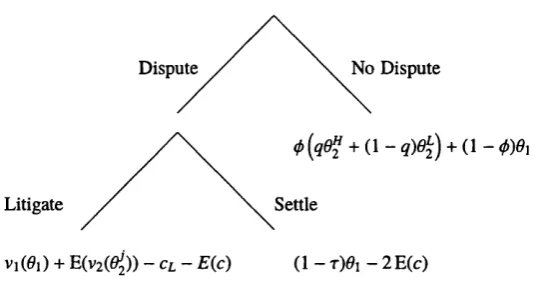
2.1 Social Planner’s P r o b le m ... 50
Preface
The aim o f this thesis is to contribute to the normative and positive questions
surrounding institutional design under asym m etric inform ation. The first
chapter asks the question o f why agents engage in costly dispute resolution
such as litigation and arbitration when costless settlem ent is available. It has
been argued that parties are asymmetrically inform ed about facts and the law
surrounding a dispute. This causes the expected payoff from litigation for an
agent to be unobservable to her opponent. This unobservability can lead to
the break down o f pre-trial bargaining. This approach leaves two fundamental
questions unanswered: How does inform ational asym m etry betw een parties
survive given the incentives for full disclosure o f certifiable inform ation?
Does efficient settlem ent ensue if parties com m unicate in form s richer than
bargaining? To address the first question I argue that pre-trial inform ational
asymmetry could arise from inherently non-certifiable information, in particular
through private valuation o f the subject matter in dispute. The second question
is tackled by adopting a m echanism design fram ew ork to show conditions
under which the only possible equilibrium is one where agents litigate. This
result arises when parties at the pre-trial stage, lack the ability to fully contract
away their right to litigate. This in effect induces agents to exaggerate their
true willingness to litigate in order to increase the settlem ent their opponents
are w illing to offer. Consequently the credibility o f statem ents m ade in p re
trial negotiations is destroyed and costly dispute resolution em erges as an
equilibrium phenom enon.
The first chapter supplies a positive analysis o f the existence o f costly
conflict in equilibrium. It shows that if courts do not enforce contracts where
agents com m it not to go to court, then litigation em erges. Consequently the
question of why court do not enforce waivers emerges as a puzzle. The second
chapter shows that once the incidence o f disputes is endogenised this puzzle
disappears. The follow ing trade-off is highlighted: conditional on a dispute
arising, it is efficient to enforce com m itm ents not to litigate. However, by
choosing not enforce such commitments, courts can increase surplus since the
The final chapter, w hich draws on w ork th a t is being jointly carried out
with Maitreesh Ghatak and M assimo Morelli, explores the issue o f how market
failure interacts with the choice o f institutional reform made by an electorate.
T his issue is studied in an occupational choice framework, where agents are
endowed heterogeneously with wealth and talent. In our model, market failure
due to unobservability o f talent endogenously creates a class structure that
affects voting on institutional reform . W e find that the preferences o f these
classes are often aligned in ways that creates a tension between institutional
reform s that are grow th m axim ising and those that are politically feasible.
This is in contrast to the w orld w ithout m arket failure w here the electorate
unanimously votes in favour o f surplus m axim ising institutional reform . W e
conclude that inefficiencies o f m arket failure m ay be further am plified by
Chapter 1
Why do People Litigate?
1.1 Introduction
U nderpinning m uch o f the architecture o f neo-classical econom ics lies the
assum ption o f an om niscient judiciary. This ju d iciary is so efficient that
it deters undesirable behavior by its very existence. F rom A rrow -D ebreu
contingent com m odities to incentive contracts, agents perform their legal
obligations in the knowledge that if they do not, they w ill be punished.
Although invoking the court is costly, this does not lead to an inefficiency
since even in the unlikely event o f a dispute, there is instantaneous resolution
through bargaining as both parties are aware that taking the dispute to court
is costly.
This logic creates the paradox of litigation: Why do we observe litigation at
all when parties are aware o f its costliness and costless settlement is available?
This is the question that is addressed here. I argue th at parties have private
valuation o f the subject m atter in dispute. This causes the expected payoff
from litigation to become unobservable to the opponent. At the pre-trial stage
parties attempt to negotiate a costless resolution o f the dispute in the presence
o f this inform ational asym m etry. T he outside option to negotiations is the
expected payoff from litigation which is increasing in the agent’s valuation of
the surplus. This creates an incentive for agents to overstate their valuation
since high valuation agents receive greater settlement offers during negotiations.
The incentive to exaggerate ones valuation creates a lack o f credibility about
statements made during pre-trial negotiations and consequently causes parties
to litigate.
In environments where agents are limited in their ability to contract away
their right to litigate, low valuation agents are wary o f revealing their type
truthfully. This is because truthful revelation weakens their position as their
consequently get larger shares o f the surplus. In section 1.3.2 I show how
litigation is prevented if agents can fully contract away their right to litigate
at the pre-trial stage. In section 1.5.2 I argue that this explanation for the
existence o f litigation generalises to some other forms conflict as well.
This chapter contributes in two ways to the literature on conflict in general
and litigation in particular. Firstly it shows the existence o f costly dispute
resolution in equilibrium in a m echanism design fram ew ork rather than is
a m ore lim ited bargaining fram ework, a point discussed in section 1.1.3.
Secondly, the use o f non-certifiable inform ation to generate inform ational
asym m etry imm unises this m odel to the full disclosure critique that has
plagued the literature on litigation. This point is discussed in greater detail in
section 1.1.2.
1.1.1 First and Second Generation Literature
The large literature that has arisen in response to the question o f why people
litigate is now two generations old. The first generation literature started with
Landes (1971) who argued that litigation arises w hen its expected benefit is
greater than the expected costs for the parties. P arties do n o t strategically
interact in the pre-trial stage and litigation is avoided when the expected benefit
o f litigating is lower than the expected cost.
In this literature out o f court settlement occurs when parties have sim ilar
expectations about the outcom e o f the trial. It is w orth explaining this point.
U ncertainty about the outcom e o f a trial on its ow n cannot be the cause
of litigation. W ith uncertainty, both parties would form expectations about
what would happen in court. If the probabilities both associate with winning
add up to one, they would settle outside thereby saving them selves the cost
of litigation. Litigation arises for instance if both parties overestim ate their
chances of winning in court. Though this literature acknowledges the role o f
such overestimation in generating litigation, it stops short o f m odelling both
how this overestimation arises and m ore im portantly the strategic behaviour
o f parties when they overestimate the expected payolf from litigation.1
In response to this unresolved issue, a second generation literature has
arisen starting with P ’ng (1983) and Bebchuk (1984). In Bebchuk (1984) the
defendant knows the probability o f winning whereas the plaintiff only knows
the distribution over the probability of winning. The plaintiff makes an offer
of settlement which the defendant can accept or reject. If the offer is rejected
the case goes to court. Since this bargaining gam e is played out between
the parties in an environm ent o f incom plete inform ation, the inefficiency of
litigation arises.2
This is a reflection o f the broader theoretical insight that full efficiency is
not guaranteed with bargaining under incomplete information. In the next two
subsections the two problem s w ith the second generation literature that this
chapter seeks to address are explained.
1.1.2 Litigation and Full Disclosure
The first problem concerns the relationship betw een private inform ation o f
parties and the unobservability o f opponent’s payoff from litigation. The
justification given in this literature for private information leading to litigation
payoffs being unobservable is that a party to a dispute may be in possession of
information that once revealed in court increases its probability o f w inning.3
It is quite plausible that parties would have such inform ation. A defendant in
a law suit for negligence is likely to have more inform ation than the plaintiff
about whether she exercised due care. The plaintiff on the other hand is likely
to have private information about the exact am ount o f dam age he has suffered.
However if parties possess inform ation that is assum ed to be certifiable
in court, parties can choose to reveal it to each other outside co u rt at the
pre-trial stage. I f parties choose to disclose their private inform ation, they
find themselves symmetrically informed and consequently litigation is avoided
through bargaining. The question that arises at this point is; do parties have
an incentive to reveal their private inform ation before trial? T he answ er to
this question is yes even under very weak conditions.
Grossman (1981) shows that when private inform ation is certifiable, there
are very strong incentives to reveal it. The intuition for this is that when an
agent has inform ation that is favourable to him self, he w ould always w ant
to reveal it since this leads to better offers from his opponent. This leads
to an unravelling in the sense that the agent w ho chooses not to reveal his
inform ation ends up signalling that he has unfavourable inform ation4. The
2This result has been generalised in different ways. Schweizer (1989) allows for both parties to be in possession private information. Nalebuff (1987) allows for the informed agent to make the settlement offer, thereby considering the signalling im plications o f the size o f the offer and its rejection. Spier (1992) considers more stages to bargaining. Friedman and Wittman (2006) explore pre-trial settlement when parties employ the Chatterjee and Sam uelson (1983) protocol for bargaining. Although, as noted in Daughety and Reinganum (1994), the predictions o f these models vary in terms o f equilibrium allocations for plaintiff and defendant, a non zero probability o f litigation em erges as a robust phenom enon. In fact Spier (1994), using a mechanism design approach, shows that litigation w ould arise even w hen parties bargain u sin g the m ost efficient extensive form. See Cooter and Rubinfeld (1989) and Hay and Spier (1 9 9 8 ) for surveys o f this literature.
3Though the literature has focused on this channel, there are other channels through w hich private information can generate unobservability o f the payoff from litigation. For example even i f parties have the sam e priors but have private valuation o f the subject matter in dispute, this is sufficient for bargaining to b e inefficient. What is required is that the expected payoff from litigation be private information. Overestimating the probability o f winning in court is only one o f the ways this can happen.
existence o f litigation in equilibrium in this literature disappears as soon as
parties can com m unicate in form s that are richer than bargaining. This is
because parties would divulge their certifiable inform ation and then bargain
efficiently in the environm ent o f com plete information.
I propose a different approach by assum ing that the asym m etry between
parties is about inform ation that is inherently non-certifiable. In my m odel
the valuation that parties place on the subject m atter in dispute is private
information. This valuation determines the amount o f effort an agent is willing
to exert in court, which in turn determines the probability o f winning. Hence
the diverging expectations that parties have about the payoff from litigation are
endogenously generated here. In contrast to private inform ation on evidence
which can be certified by the inform ed agent, declarations o f valuation are
essentially cheap talk; all types would declare that they have high valuation
since this increases the settlem ent offer they are likely to receive. Unlike
evidence that is certifiable, there may not exist an efficient way to credibly
display high valuation. High valuation may be credibly revealed only through
a costly action, like spending more in a trial, that an agent with lower valuation
will not find optimal.
1.1.3 Litigation and Mechanism Design
The second problem with the literature on litigation is its focus on bargaining
as a means of resolving disputes outside court. Focusing attention singularly on
bargaining implies that parties com m unicate only through offers and counter
offers. This assum ption about the nature o f pre-trial negotiation is very
restrictive since com m unication between parties is not lim ited to a sequence
o f offers and counter offers. C om m unication betw een parties can include a
sequence o f m essages exchanged in a rich language that could in principle
m itigate the inform ational asym m etry that exists between parties. Hence by
restricting the form o f pre-trial negotiation to be o f the bargaining variety, it
is possible to miss out on equilibria in which parties settle out o f court.
T he m odel presented here is the first to attem pt the resolution o f this
problem using a mechanism design approach. The seminal paper by Myerson
(1982) shows that an equilibrium o f any Bayesian gam e can be replicated
through a direct mechanism. This result is known as the revelation principle.
U sing this insight, the result presented here will show that litigation may
arise even when no restrictions are made about the nature o f com m unication
between parties during pre-trial negotiation. Since bargaining under incomplete
inform ation is only one o f the ways parties could com m unicate, this is
subsumed in the m odel presented here.
1.1.4 Alternative Explanation for Litigation
The Bebchuk (1984) fram ew ork has been the m ost widely accepted one for
explaining the existence o f litigation. H owever there are other explanations.
A possible explanation that has received some attention is one based on the
existence o f com m unication costs. If the costs o f com m unication betw een
parties are high, then parties would prefer to simply take the m atter to court
rather than settle it betw een them selves. In fact even if the costs are very
low, as long as both parties need to pay the costs non-cooperatively to start
communication, Anderlini and Felli (2001) show that there would always exists
an equilibrium w here com m unication w ill not take place. This explanation
may fit a certain class o f litigation. For example it may explain divorce battles
between spouses w here the prospect o f com m unicating w ith the opponent is
so odious that costly litigation is preferred.
In a sim ilar vein Robson and Skaperdas (2008) construct a m odel where
parties need to pay costs non-coperatively before they can enter the stage o f
pre-trial settlement. These costs influence the probability o f winning the case
and hence influence the outcom e o f pre-trial bargaining. The idea is that
parties by com m itting to litigate may reduce total costs if a substantial part
of these costs is paid ex-ante before bargaining takes place. This happens
because com mitting not to settle dampens the incentive to make costly effort
ex-ante. However, ju s t like in A nderlini and Felli (2001), once parties are
allowed to meet before these costs are incurred the result disappears. Since the
existence o f ex-ante costs is the crucial ingredient here, it is difficult to extend
this explanation to all litigation unless a micro foundation for the existence of
these costs is supplied.
The model presented here synthesizes the two m ain approaches used for
analysing litigation. T he literature on pre-trial negotiations treats the court
process as exogenous.5 In contrast the literature on conflict treats the failure o f
pre-trial negotiation as exogenous and models the court process as a complete
inform ation contest betw een two parties w here the probability o f w inning
is endogenously determ ined by the effort exerted by parties.6 This chapter
combines these two approaches by modeling the court process as a contest in
an environm ent o f incom plete inform ation, w ith a m echanism design stage
preceding litigation where parties can negotiate to avoid costly litigation.
5 See for example Bebchuk (1984) and Spier (1994)
1.2 Model
There are two agents w ho find them selves in a dispute. T he subject m atter
o f the dispute is characterised as surplus o f size 1 over w hich agents have
com peting claim s. B oth agent have positive valuation o f the surplus w hich
is their type. A gent 1 ’s valuation is 6\ w hich is observable w here as agent
2’s valuation is unobservable and can be 8% with probability q H and 6% with
probability qL - qH .7
if Agents are aware o f their own type before the game begins. The model
can be easily generalised to the case where the inform ational asym m etry is
two-sided, but uncertainty over the type o f one agent is sufficient to generate
litigation in equilibrium. I assum e that
6i > 6% > 6 2 .
The assumption that valuation o f a party is unobservable is the key driver
o f litigation in this m odel. It is w orthw hile to see som e exam ples w here
litigation can be interpreted as a dispute over surplus. These exam ples have
been chosen to illustrate how the model may apply to a large range o f situations.
Examples include:
• D ispute over property: A party has private valuation over a piece o f
property and it is unclear as to who has title over it. The property could
be tangible such as land o r intangible such as an invention.
• Suits for specific perform ance: There may be a dispute as to w hether
an agent has perform ed its contractual obligation. T he plaintiff may
have private valuation over the benefit accruing from the action or the
defendant may have private valuation over the costs o f perform ing the
action.
• Custody battle over children: W hen a couple separates, the spouses may
have private valuations over the custody o f their children.
Private valuation o f the subject m atter in dispute is plausible w hen the
dispute involves som ething m ore than ju st m onetary com pensation. The
model can be extended to cases involving only monetary com pensation if the
assum ption o f utility functions being linear in m oney is relaxed. However
the analysis presented here excludes these cases since the m echanism design
problem becomes less tractable if the utility o f parties is nonlinear in transfers.
T im eline:
S tage 1: Agent 2 realises his private valuation o f the surplus.
S tag e 2: A dispute arises between the 2 parties.
S tage 3: Parties to dispute start pre-trial negotiation w hich is a gam e that may
help them avoid taking the m atter to court.
S tag e 4: Parties play the game from stage 2 and receive the equilibrium allocation.
S tage 5: Parties non-cooperatively choose betw een the equilibrium allocation
from stage 2 and approaching the court.
S tage 6: If either agent has approached the court, then both non co-operatively
choose their effort levels.
S tag e 7: Court observes the effort o f each agent and m akes a final decision.
It is helpful at this point to preview how the resu lt o f litigation in equi
librium is established. A t stage 3 in the m odel agents undertake pre-trial
negotiations w hich form ally is a gam e that w ill help them avoid litigation.
This game yields some equilibrium in stage 4. Due to the revelation principle
it is possible to characterise the existence o f litigation in this equilibrium
without specifying the actual gam e in stage 3. This is because the revelation
principle allows for the replication o f any equilibrium o f a Bayesian through
a direct m echanism . I w ill first prove the non-existence o f a separating and
semi-separating equilibrium. In particular I will show that when agents cannot
contract away their rig h t to litigate at stage 3, an incentive to lie for a low
valuation agent 2 arises. This is because he anticipates that if his declare their
types truthfully, their opponent w ould force him to re negotiate the alloca
tion from stage 4 w ith a credible threat o f litigation. This im plies that the
only possible equilibrium is the pooling equilibrium where all agents declare
themselves to have a high valuation. I w ill show th at in this equilibrium
litigation arises since agent 1 has a higher expected payoff from litigation than
the settlem ent payoff from stage 4 under certain conditions. In section 1.3.2
I show how litigation disappears in equilibrium w hen the ability to contract
away the right to litigate is introduced.
This m odel can be solved starting backwards. In the next subsection a
stylized m odel o f litigation is presented. This is m eant to crudely capture
what happens in court. Since parties know w hat would happen in court, the
equilibrium allocations from the game they play in stage 3 must at least make
parties indifferent between litigating and not litigating in stage 4. I call this a
litigation-proofness constraint. This constraint is derived in section 1.2.2 for
incentive-compatibility constraints for different equilibria are derived. Finally
in section 1.3 I present the result that shows the existence o f litigation in
equilibrium.
1.2.1 Litigation
In line with the large literature on the question o f why conflict occurs, the
court process is modeled as a static contest where the probability o f winning
is determined by the effort x exerted by parties.8 Following are the objective
functions o f the two agents.
Q\ P(jci, X2) - x \ and 0^(1 - P(jci, JC2)) — X2 j € {L, H}
where 6\ is the valuation o f agent 1 and 0^ is the valuation o f agent 2. Note
that henceforth j refers to the type o f agent 2. This form ulation assum es
that the payoff o f parties is linear in m oney (effort). It is assum ed that the
probability o f winning is increasing in ones own effort and decreasing in the
effort o f the opponent.
Effort can be thought o f as fees of the lawyer hired by an agent If lawyers
are paid in proportion to their marginal product then it must be the case that
the heterogeneity in the fees lawyers charge can be explained by the degree of
persuasiveness they have in court. A part from the sensitivity o f the judicial
process to the skills o f a lawyer, it is also possible to have an interpretation
o f effort in term s o f how m uch m oney is paid off to a corrupt ju diciary to
secure a favourable decision9.
If the valuation o f agent 2 was observable, then this would be a game of
com plete inform ation w here we could com pute the N ash equilibrium effort
levels o f the agents. Here, since his valuation is private inform ation, agent 1
instead plays a Bayesian gam e where the optim al effort level o f agent 1 is:
*1 (0i) = argmax 0i
V
qj P (* i, x1{6j1))■t> - ° V /ef H,L)
- Xj. (1.1)
Having computed the Bayesian Nash equilibrium effort levels agent 1, we can
work out the expected payoff from litigation for agent 1. This is
8 See Skaperdas (2006) for surveys o f this literature.
vi(0j) = 0\ - X l(0i). (1.2)
Since agent 1 ’s valuation is observable, agent 2 ’s equilibrium effort level is
x2(eJ2) = aig m a x9 ]2P (x i(d i),X 2 (eJ2) ) - X 2 j e { H , L ) . (1.3) *2^0
Plugging these effort levels back into the objective function, w e get the
expected payoff from litigation for agent 2 which is
v j(^ ) = ^ P ( jt! ( » i) ,J 2 ( ^ ) ) - ii( e { ) j e { H , L ) . (1.4)
Inspecting equation (1.2) we can already see how private information can
lead to agent 1 overestimating her probability o f winning in court. This could
happen w hen agent 2 has high valuation. B ut agent 1, taking expectations
over the type o f agent 2, would believe him to have an average valuation. The
value function can be re-written as
vj(0i) = 0i (P (jci(0i) ,jc2(6^))) - * i(0i).
It can be seen that the sum o f the expectation over the probability o f winning
for agent 1 and the that of a high valuation agent 2 can be greater than 1.
This is not the only feature that makes the payoff o f one agent unobservable
to the other. In addition to affecting the probability, the type also enter the
payoff function directly as the value placed on the surplus, and indirectly
through the equilibrium effort o f the agent. The inability o f agent 1 to observe
agent 2 ’s expected payoff from litigation, generates the existence o f litigation
in equilibrium . If this contest was played in an environm ent o f com plete
information, then expected payoffs from litigation would be common knowledge.
This would allow parties to bargain around costly litigation since the opponent’s
outside option to bargaining would be observable. The unobservability o f types
causes the outside option to bargaining being unobservable and consequently,
as shown by Schw eizer (1989), full efficiency is no longer attainable with
bargaining.
At this point one may naturally ask why parties should restrict themselves
to bargaining as a pre-trial mechanism to avoid litigating? W hy can they not
design any other mechanism that will allow agent 2 to reveal his valuation? I
1.2.2 Litigation-Proofness
Before resorting to costly litigation parties can play any Bayesian game such
that the type o f agent 2 will stand revealed. This problem o f a general game
form is tractable using the revelation principle since any equilibrium in a
Bayesian game can be replicated by the use o f a direct m echanism where the
parties reveal their types truthfully to a m ediator. To see w hether litigation
can be avoided, we need to check whether a more efficient allocation that does
not require external financing is im plem entable10.
The equilibrium allocation that is replicated using a direct m echanism
needs to be litigation-proof. This m eans that the payoff from the equilibrium
should be weakly greater than the payoff from litigation. The expected payoff
from litigation depends on the nature o f equilibrium we try to implement using
the direct mechanism. This problem can be tackled by considering different
kinds o f equilibria separately.
Separating Equilibrium
In a separating equilibrium the valuations of the agent 2 would stand revealed
in stage 4. Consequently parties w ould find them selves in an environm ent
o f com plete inform ation. A t this stage parties should prefer the allocations
that have been prescribed by the m echanism to litigation. I f parties choose
to litigate at this stage, their payoffs w ould be the N ash equilibrium payoff
from litigation under com plete inform ation. T he N ash equilibrium levels o f
effort that would be played w hen an agent 1 meets an agent 2 o f type j can
be com puted. Let these be xj and x*2:
x{ = argmax 6i P (x i, x£) - xi and x*2 = argmax 0^( 1 - P(x{, X2)) ~
*2-* 1 > 0 X 2 > 0
These may not be unique.11 Using these optimal effort levels we can calculate
vj, the expected payoff from litigation when agent 1 confronts a type j agent
2.
Vj = 61 P(x{, x j) - x{ vj = flj(l - P (xj, x j)) - x j (1.5)
A lthough parties would never actually litigate in an environm ent o f com
plete information, vi and V2 becom e credible threat points that parties would
10It is reasonable to im p ose the restriction o f no external financing sin ce parties in the real world cannot expect outside subsidies for settlem ent o f private disputes. If budget balance is not im posed then the problem w ould disappear since a Groves m echanism would always ensure incentive-com patibility. See Groves (1973).
use to force the renegotiation o f allocations ex-post. In other words, bar
gaining would ensue in states o f the world w here parties find that they are
guaranteed a higher expected payoff by litigating rather than accepting the
allocations specified by the m echanism . W hile being com pletely agnostic
about the extensive form that such bargaining would take, w e know that vi
and V2 will be the outside options to such bargaining. I f parties anticipate that
such bargaining will take place ex-post, this destroys existence o f a separating
equilibrium unless the allocations are designed to ensure that parties cannot
credibly threaten litigation in stage 5. H ence to avoid a credible threat o f
litigation the transfers from the m echanism m ust satisfy litigation-proofness
constraints. These are
01 (1.6)
for j € {H, L} w here is the net transfer paid by agent 1 to type j agent 2
in the event the m echanism allocates the surplus to agent 1. Sim ilarly is
the net transfer paid by type j agent 2 to agent 1 in the event the mechanism
allocates the surplus to agent 2. The constraints state that the payoff from
negotiations should be greater than the payoff from litigating. This should be
true for both the agents regardless o f w ho receives the surplus, and for all
realisations o f agent 2 ’s type.
Pooling Equilibrium
In a pooling equilibrium the agent 1 learns nothing about the type o f agent 2
at stage 4. Hence their expected payoff from litigation rem ains the Bayesian
Nash equilibrium payoff v i(0i) and V2(0£) defined in equations (1.2) and (1.4).
L et the n \ and fj.2 be the transfer m ade by agents 1 and 2 respectively to
their opponent when the surplus is allocated to them. The litigation-proofness
constraints are
01 - vi(0 ,) > n \ > v2(0}2) (1.7)
9J2- v2(0}2) > f i2 > vi(0i)
W hat defines a pooling equilibrium is that the declaration o f agent 2
conveys no inform ation about his type. Consequently there is no change in
agent l ’s prior about the type o f agent 2. Note that in terms o f the declarations
that agent 2 makes, there are various ways in which a pooling equilibrium can
arise. It arises when agent 2 makes the same declaration regardless o f his type.
More generally, it arises whenever agent 2 has the same probability distribution
constraints defined in (1.7) are unaffected by w hich pooling equilibrium we
consider. This is because the payoff from litigation v2(0^), which is the outside
option to fj.2, rem ains constant.
Semi-Separating Equilibrium
Just like in the case o f pooling equilibria, there are infinitely many semi-
separating equilibria that can arise. A semi-separating equilibrium is defined
by the fact that there is som e inform ation conveyed to agent 1 through the
declaration o f agent 2. Hence the payoff from litigation thereafter is modified
since agent 1 uses updated probabilities when deciding his optimal effort level
in court. Let the optim al effort of agent 1 and 2 be Jci and Jt2 where
The value o f y e (0 ,1 ) is determ ined by the posterior probability that agent
1 associates w ith agent 2 being a low type. N ote that y is a short hand for
the amount o f information that is revealed to agent 1 by agent 2 ’s declaration.
If the declaration reveals nothing then y = \ and we are back in a pooling
equilibrium. W hen y = 0 agent 1 knows the that agent 2 is a high type with
certainty and we are in a separating equilibrium. Similarly y = 1 implies that
we are in a separating equilibrium where agent 2 has been revealed to be a
low type. The interm ediate value o f y strictly between 0 and 1 but not equal
to one half are ones that would arise in a semi-separating equilibrium.
Using the sem i-separating equilibrium effort levels calculated above we
can back out the litigation value functions for agent 1 and 2. These are vi,
and Vj respectively. xi = argmax 0i
x i> 0 \
(1.8)
x% = argmax 0^(1 - P (* i,x 2)) - *2, (1.9)
X2>0
and
= argmax 0^(1 - P(Jfi, x2)) - x2. (1.10)
*2 > 0
P(JE
,.4))-*,.
(1.11)
(1.12) v f = e%( l - P ( x i,x % ) ) - x % ,
and
We care now ready to characterise the litigation-proofness constraints in a
sem i-separating equilibrium. These are
61 - V] > fa > v{ (1.14)
$2 ~ vJ2 > f a > vi
where fa and f a are the transfers made to the opponent when the surplus is
allocated to agent 1 and 2 respectively.
1.2.3 Incentive-Compatibility Constraints for a Separating
Equilibrium
Consider a direct mechanism where agent 2 declares a type j where j € {H,L}.
If the declarations o f agent 2 6J2, then agent 1 is allocated the surplus with
probability 6* and agent 2 is allocated allocated the surplus with probability
1 - 6j . Following are the incentive-com patibility constraints for agent 2 in a
separating equilibrium.
H2 : + (1 - - t ” ) > 6Lt \ + (1 - 6l)(0%- %) (1.15)
fa : SLt\ + (1 - 6l)(6% - % ) > + (1 ~ 6H)(e% - # )
The exercise here is to find an allocation composed of transfers fj, ^ along
with probability that satisfies incentive-compatibility and litigation-proofness
for all j . I f such an allocation exists then parties would reveal their types
truthfully know ing that for any possible realisation o f types, the allocation
guarantees that the opponent cannot credibly threaten litigation ex-post.
Since 6j can be less than one, there w ill be states w hen the surplus is
allocated to agent 2 even though agent 1 always has greater valuation o f the
surplus than agent 2. If this happens both agents could voluntarily renegotiate
and allocate the surplus to agent 1 in exchange o f a transfer for agent 2. Since
agents are aware that this will happen in all states when the surplus is allocated
to the agent with the higher valuation, this has to be taken into account while
im plementing the separating equilibrium allocation.
L em m a 1.1. The non-existence o f transfers satisfying litigation-proofness and
incentive-compatibility fo r 6j = 1 is sufficient fo r proving the non existence o f
transfers fo r any € [0,1] i f agents are allowed to trade the surplus once it
is allocated.
P ro o f In a separating equilibrium , the type o f agent 2 corresponds to his
agents would find it profitable to allocate the surplus to agent 1 in exchange
of a transfer to agent 2. Let this transfer be r[. The condition
0 ] - ^ > f J > 0 ^ - t ( (1.16)
(1.16) must be satisfied for agents to voluntarily agree on trade of the surplus
for transfer f7. Using (1.16) and the litigation-proofness constraints from (1.6)
we have
f[ > 9^ — > v2.
0i - v7 > 0i - ^ ^ *?•
This implies that if no t[ exists that satisfies
01 - v7 > fj > v7
then there cannot exist a that satisfies (1.16). Note that this larger range for
is the same as the one im posed on t[ by (1.6).
In a state where the declaration o f 2 is j , the term in the incentive-
compatibility constraint for agent 2 modifies to
6Jt{ + (1 - 6^ - r7) = 6Jt{ + (1 - 5 %
which can be replaced w ith t[ w ithout loss o f generality since 6\ + 6^ = 1
and the range for both transfers is the same. Therefore the non existence o f
fj7 that satisfies incentive-compatibility and litigation-proofness for 8l{ = 1, is
sufficient for proving the non existence o f t\], t1^ for any <J'7 € [0,1]. □
Lem m a 1 tells us that given agents w ill voluntarily trade the surplus
when it is allocated to the agent with the lower valuation. W e can therefore,
w ithout loss o f generality, focus our attention on the direct m echanism that
always allocates the surplus to the agent with the higher valuation. Applying
Lemma 1.16 to Case 1 where the distribution of valuations do not intersect, we
have 6^ H = 6^ L = 8\ L = 6\ H = 1. This sim plifies th e incentive-cm patibility
constraints o f agent 2 to
= (1 1 7 )
The intuition for this condition is the following. Since agent 2 knows that
finally the surplus w ill always go to agent 1, he has an incentive to m ake
the declaration that guarantees him the maximum possible transfer. The only
way to incentivize him to tell the truth is to m ake the transfer independent
the range o f transfers may be inconsistent with the range for transfers in the
litigation-proofness constraints derived in section 1.2.2.
The ability to trade surplus ex-post simplifies the analysis by allowing us
to focus on efficient allocations, that is allocations where surplus goes to the
agent 1. The introduction o f trade however is is not the driver o f the results o f
the model, it merely simplifies the analysis. It will be seen that what creates
litigation is the inability of parties to fully contract away their right to litigate.
In the extension, I show that even if parties can commit not to trade, litigation
may still arise as long as certain conditions are satisfied.
1.3 Results
In this section main result regarding the existence o f litigation in equilibrium
is proven. In the next two subsections the existence o f litigation in two
extreme cases of full commitment and complete non-contractability is discussed.
Thereafter the implications o f partial contractibility on existence o f litigation
are analysed.
1.3.1 Litigation under Non-Contractability
It is difficult to proceed further w ithout pinning down a functional form for
the contest function. This allows for a com putation o f the value function vi
and V2. The contest function that is used here is
P (*1,
s2) = - T
■
^ a e ( 0, l ) . ( 1. 18)ax'l
+ (1 -
a)x$
Skaperdas (1996) provides the axiomatic foundations o f this contest func
tion for the case o f a equal to Clark and Riis (1998) generalise this to the
case where a takes any value between zero and one. This contest function
is unique in that the winning probability depends on the ratio o f equilibrium
efforts12 It differs from the exponential contest function w here the w inning
probability depends on the difference o f the efforts exerted by parties. This
function is easily param eterised, and allows a closed form characterisation
o f the value functions for both agents. X less than 1 im plies concavity and
ensures the uniqueness of equilibrium.
The primary parameter that characterises the function is X. This captures
how sensitive the probability is to the effort exerted by parties. A higher
A im plies a greater sensitivity of the ju d icial process to the persuasiveness
o f lawyers. A judicial process com pletely insensitive to the skill o f lawyers
implies a A equal to 0. Alternatively a high responsiveness o f the probability
o f w inning to effort could simply m ean that it is cheap and easy to bribe
judges. In this interpretation A can be thought o f as a param eter capturing
how corrupt the ju diciary is. In this interpretation A equal to 0 im plies an
incorruptible judiciary since the decision o f the court is insensitive to bribes.
The point o f departure from Skaperdas (1996) for this contest function is
the presence o f the additional param eter a w hich captures how strong agent
l ’s case is ex-ante relative to agent 2. This param eter is introduced to capture
the fact that legal disputes may be skewed towards one side. It is rarely the
case that both sides to a dispute have equally strong legal positions.
A n a equal to 1 im plies that agent 1 is certain to w in the case; that the
case is ‘open and shut’. Similarly a equal to 0 implies that agent 2 is certain
to win. Note that in these two corner cases the efforts o f parties will not play
a role as the probability o f winning would be insensitive to effort. Note that
if a is either 0 or 1 there would never be any litigation since one o f the two
parties regardless o f its valuation would have an observable payoff o f 0 from
litigation and hence would always settle for 0 outside. For intermediate values
o f a , the effort o f parties would influence the probability o f winning. A n a
equal to one half implies that if both agents were to exert the same effort, the
outcome o f the case is equiprobable.
a is a reduced form catchall param eter that captures both the legal char
acteristics and the facts o f the dispute. T he follow ing exam ples illustrate
this.
• In a custody battle, the laws of most countries usually favour the mother.
I f this is the case then a would be greater than one h alf w hen agent
1 is the m other. The value a w ould depend on the specific laws on
custody of children o f the country in which the dispute takes place. The
value o f a would also depend on the facts o f the particular case. If for
example, agent 1 is known to have a history o f drug problem s then a
would be lower.
• In a battle over intellectual property agent 2, the alleged infringer, may
o r may not have the right to contest the validity o f the patent. For
exam ple, in the U K a patent can be challenged only once in a court
o f law. I f it is upheld, agent 1 the holder o f th e patent, is granted
a certificate o f contested validity w hich protects it from any further
challenges. Hence the question o f whether the law allows more than one
challenge to the patent, along w ith the factual position o f w hether or
affect a.
• In a suit for specific performance if the provisions o f the contract make
a clear case in favour o f the plaintiff then this brings a closer to 1. On
the other hand if it can be shown that the contract is in violation o f
public policy then the contract would be set aside and the defendant
would not be called upon to perform his contractual obligations. This
would push a closer to zero.
Follow ing the discussion on disclosure in the introduction, even if facts o f
the case are private information to begin with, as long as they are certifiable,
they would be revealed before litigation takes place and w ould influence a.
H ence a like X is com m on knowledge. In a world w here given a set o f
facts there is no room for disagreem ent about the application o f the law, and
consequently the outcom e o f the case is certain, a w ould always either be
0 or 1. However this is never the case since the interpretation o f the law is
often contentious. Even if the interpretation o f the individual laws is clear,
there may be ambiguity about which law is to be applied to the case at hand.
In addition to the fact that the application o f the law is inherently uncertain
due to com plexity o f the specific case to w hich it is applied, there could be
perverse incentives in judicial systems th at increases this uncertainty even
further. Levy (2005) argues that career concerns could induce judges to
contradict previous decisions consequently creating uncertainty about the law.
This creates a role for lawyer’s skill since courts are open to persuasion.
A part from the lawyer’s skill in persuading the co u rt on points o f law,
there is also often room for persuasion on points o f fact. W hat truly happened
at a point in the past is often unobservable and exists only as a probability
distribution for the court. A lawyer’s skill could therefore play a role in
influencing what the court believes to be true about an event. All this creates
uncertainty about the outcom e o f the case w hich can lead to a realisation of
a that is not 0 or 1.
Using this contest function it is possible to solve out for the Nash equilib
rium effort levels when agent 1 confronts a type j agent 2.
( d i d r f a i l - a ) X , .. { O ^ Y a iX - a)X jcj =01
The corresponding value functions are:
and
(SO-1 + (fiiY M e i Y + a - a M W )
Inspecting these value functions confirms certain desirable properties.
T he effort an agent exerts in court is increasing in h er ow n type. This is
intuitive since a greater valuation makes an agent m ore active in court since
there’s more at stake for her. Conversely the payoff o f an agent is decreasing
in the opponent’s valuation.
The expected payoff from litigation is monotonically increasing in own valua
tion and decreasing in the valuation o f the opponent. This is a consequence
o f the property in (1.21).
As the agent’s valuation goes to 0, so does her payoff from litigation. On the
other hand an agent’s litigation payoff goes to her valuation as the valuation
of the opponent goes to zero. This is the case since facing an opponent with
low valuation implies that even a small effort is sufficient for securing a high
probability o f winning.
N on-E xistence o f a S e p a ra tin g E q u ilib riu m
U sing the value functions defined above it is now possible to prove the non
existence of a separating equilibrium. Litigation-proofness constraints impose
restrictions on the transfer o f the m echanism that parties design for pre-trial
settlem ent o f dispute. The following result shows that these restrictions may
be inconsistent with the restrictions im posed by incentive-compatibility.
P ro p o sitio n 1.1. Assum ing that P(jcj , JC2) in equation (1.18) is the contest
function that characterises litigation; a separating equilibrium does not exist
i f 0% — 0% is greater than some threshold A.
Proof. We have
(1.21)
dvi
T < 0 . (1.22)
lim vi = 0 and
<^-»o lim v{ =
6\ .
from equation (1.6). Using this together with (1.23) we get
lim rf = 0.
From (1.17) we have t \ = And from (1.6) we have > v%. Since > 0
from equation (1.20), when 6% > 0. Given the m onotonicity property in
equation (1.22), there m ust exist a threshold A such th at for 6% - 6% > A,
r[ = cannot be satisfied. Hence a separating equilibrium does not exist. □
The intuition for this result is straightforward. If the m inimum transfer that
a high type agent 2 receives from agent 1 is large enough, then the incentive
for a low type agent 2 to tell the truth is destroyed. W ith the contest function
specified in (1.18), this happens as 6£ goes to zero. This is because the effort
levels depend on the ratio of the valuations. A s 6% goes to zero the payoff
from litigation for a low type agent 2 also goes to zero and the likelihood that
agent 1 wins in court goes to 1. This in turn restricts the transfers a low type
agent 2 can expect from the mechanism. Once 6^ is sufficiently far apart from
0%, that is w hen the difference between the two valuations is large enough,
it becom es m ore attractive for a low type agent 2 to declare h im self to be a
high type.
T h e E xistence o f L itigation in th e Pooling E q u ilib riu m
Proposition 1.1 shows that a separating equilibrium cannot exist when 0 % -6% >
A. This leaves open the possibility of the existence o f a pooling and a semi-
separating equilibrium . In this sub-section, it w ill be shown that a litigation
free pooling equilibrium cannot exist. For litigation to exist, agent 1 should
prefer litigating when offered the alternative o f allowing agent 2 to pool across
his types. The next result shows that this is indeed the case w hen qL the
probability o f agent 2 being a low type is greater than som e threshold.
P ro p o sitio n 1.2. There exists a threshold qL* such that fo r any c f f < q \ < 1
agent 1 chooses to litigate rather than accept the p a y o ff fro m a p o oling
equilibrium.
P ro o f In a pooling equilibrium , the optim al effort for agent 1 w hen she
litigates is:
Note that the objective function is concave in x\ since it is a sum o f two concave
functions. H ence the first order condition yields the optim um . P lugging in
the optimal effort levels we get the expected payoff from litigation for agent 1: jci(0i) = argmaxfli
ir. S A
v i(0 i) - 0\
Now note that:
y
^2—,M h ! l) a x \ (01 y
1
+(1
- a ) x1{ e ]1Y Jlim JC2(0^) = 0. ^-*0
This is true because if the lim it o f X2(0%) is a positive constant then the
expected payoff from litigation for the agent w ould be negative. This is a
contradiction o f X2(0f) being an optimum since the agent could reduce X2 and
increase his payoff to 0.
lim vi(0i) = 0i
The m inim um transfer that an agent 2 w ith a high declaration is guaranteed
to accept from an agent 1 as settlement outside court is V2(0%). Since agent 2
would always declare him self to be a high type, the payoff for agent 1 from
playing the mechanism and accepting its allocation is 0i - V2(0%) < 6\ .
Note that the first order condition for the Bayesian game converges to the
first order condition o f the game with com plete inform ation where agent 2 is
a low type:
lim V ; 0 ! ( l - a ) x ^ ~ 1x 2(9J2)A 1 <*(1 - a i ) x \ - x(x%)x __
, ^ f L) q (a x f + (1 - a ) x2(0 }2) A) 2 + 0 - <*)(x%)A) 2 M i '
This implies that the optimal effort in the game with incomplete information
converges to the optim al effort in the gam e w ith com plete inform ation as
qL -» 1. Since the expected payoff from litigation goes to 0i as qL —* 1 and
6% —* 0 there m ust exist a threshold for qL* such that:
4 z
\ M H , L &x\ (0i y*<r
---
- * l ( 0 l ) = 01 - v f.U(wi}
+ (1 -
<*)x2 (.o}2) a,
T his defines q !f. N ote that for any 1 > q% > q%* litigation has a higher
expected payoff for agent 1 when agent 2 always declares him self to be a high
type. □
Given that a low type agent 2 is sure to declare h im self to be a high
type, agent 1 has two options; she can either accept the pooling equilibrium
allocation from the negotiations or she can litigate. I f the likelihood that
the opponent she faces is a low type is high enough, she w ill always prefer
to litigate as her payoff from litigation goes to 0i w hereas her payoff from
T h e E xistence o f L itigation in a S em i-S eperating E q u ilib riu m
I will now show that the logic that creates the existence o f litigation in
a pooling equilibrium generalises to create the existence o f litigation in a
sem i-separating equilibrium.
P ro p o sitio n 1.3. When the conditions o f proposition 1.1 are satisfied, a
semi-separating equilibrium cannot exist.
Proof. Note that in a semi-separating equilibrium the transfer to agent 2 must
be independent o f his declaration. If not the agent would have an incentive
make the declaration that gets him the higher transfer. This transfer is p i
and it must satisfy the litigation-proofness constraints defined in (1.14). This
implies
01
- P i > v iand
P i > v ” > v £ .
qH(i-y)+qi.y
objective function for agent 1
Let = 1 - y. In the lim it as 6% —► 0 this yields the following
or agent 1:
s i n c e
lim jc£ = 0. 0£->O
The corresponding value function for a high type agent 2 is
2 a x] + (1 - a )x ] 2
for a high type agent 2. Solving for the optim al effort levels and plugging
them back into the objective function o f agent 2 we get
Ud -
m y +wy
w d -
m y
+ o -
aye"yy
Note that v~ = v ? for y = 0, where v ? is the separating equilibrium litigation
payoff for a high type agent 2 defined in (1.20). F urtherm ore since
f <0.
Keeping ji\ > v% > v% > 0 there exists a threshold q^L such that for
q \ > 0*2 a8ent 1 would prefer to litigate than to settle with a transfer o f jl\ to
agent 2. This is true since v\ -» 0\ as q \ -* 1 H ence the m axim um transfer
needed to satisfy the litigation-proofness constraint o f a high type agent 2 and
litigation arises in equilibrium. □
T he intuition for this result is sim ilar to the previous result. In a semi-
separating equilibrium agent 2 m ust receive a transfer independent o f his
declaration. This transfer must be greater than the minimum transfer required
for keeping a high type agent 2 indifferent between litigation and settlement.
However, as the likelihood o f agent 2 being a low type increases, agent 1
prefers to litigate and ‘take his chances’ rather than pay out a high settlement.
Propositions 1.1, 1.3, and 1.2 taken together establish the existence o f
litigation in equilibrium. In a nutshell Proposition 1.1 shows that under certain
conditions agent 2 would always lie about his type in any negotiation for
pre-trial settlement. Hence it would not be possible for agents to resolve their
inform ational asymmetry. Propositions 1.2 and 1.3 show that since agent 1
knows about this, she would prefer litigation to settling outside court. The
results hold when the difference between 6% and 0 2 is large and the value o f
is high enough. If these conditions are satisfied, agents have no option but
to litigate.
1.3.2 Full Waiver of the Right to Litigate
As we would expect, if parties can contract away th eir rig h t to litigate then
this turns out to be sufficient to avoid litigation.
P ro p o sitio n 1.4. There always exists an unsubsidised and incentive compatible
allocation that Pareto dominates the equilibrium allocation under litigation.
Proof. Litigation is a Bayesian gam e, w here the allocation is com posed o f
the probabilities of the surplus being transferred to the two agents for the two
possible types o f agent 2 and the corresponding transfers. Using the revelation
principle, any equil