The London School of Economics and
Political Science
When Knowledge Meets Practice: Learning
Communities and the EU’s Common Security
and Defence Policy
Giovanni Faleg
I certify that the thesis I have presented for examination for the MPhil/PhD degree of the London School of Economics and Political Science is solely my own work other than where I have clearly indicated that it is the work of others (in which case the extent of any work carried out jointly by me and any other person is clearly identified in it).
The copyright of this thesis rests with the author. Quotation from it is permitted, provided that full acknowledgement is made. This thesis may not be reproduced without my prior written consent.
I warrant that this authorisation does not, to the best of my belief, infringe the rights of any third party.
This thesis explores the role of learning communities in the evolution of the EU’s Common Security and Defence Policy (CSDP). It engages the academic debate on institutional learning and the “practice turn” in IR to shed light on the factors leading the EU to learn by policy failure, as well as by ten years of practice in crisis management. Specifically, the work investigates the role of the knowledge and practice-based communities that shaped the consensus towards the comprehensive approach, with a strong emphasis on civilian means.
Ideational factors, as opposed to material ones, are critical in understanding why the EU has developed a “soft” provider of security, in spite of the St Malo commitment to develop hard security capabilities. In the absence of a direct threat, EU member states’ preferences towards CSDP were driven by a set of new ideas, which in turn resulted from an emerging international agenda advocating the development of non-military crisis management approaches and tools. Through a critical appraisal of the “practice turn” and its application to the study of EU security and defence, the thesis sheds additional light on the overlap between knowledge and practice, which bears relevance for the research agenda on learning communities and norm diffusion.
This thesis is dedicated
Abstract 3
Acknowledgments 4
Table of Contents 5
List of Tables and Figures 7
List of Abbreviations 9
Chapter 1 Introduction
14
Chapter 2
The theoretical framework
34
Chapter 3
A paradigmatic shift in security:
CSDP and the EU’s comprehensive approach
86
Chapter 4
The Common Security and Defence Policy: structures, actors, networks
117
Chapter 5
Introduction to the case studies: the EU frameworks for Security Sector Reform and Civilian Crisis Management
139
Chapter 6
Learning communities and the CSDP: Security Sector Reform 176
Chapter 7
Chapter 9
Conclusions 309
References 333
Chapter 2
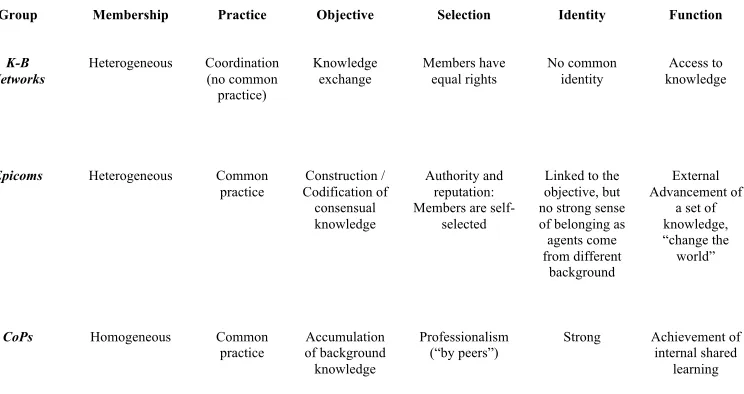
Table 2.1: Differences between networks and communities
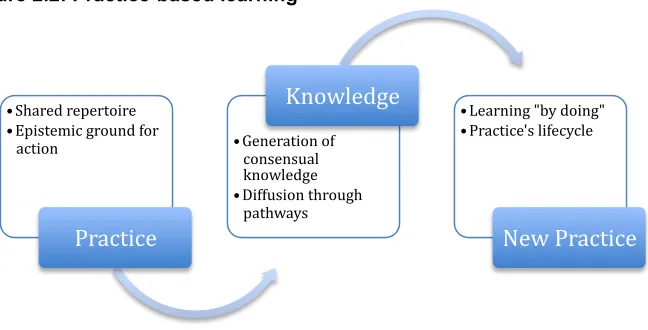
Figure 2.2: Practice-based learning
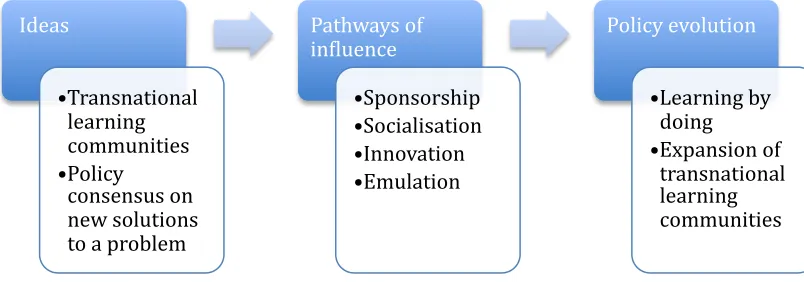
Figure 2.3: Policy evolution
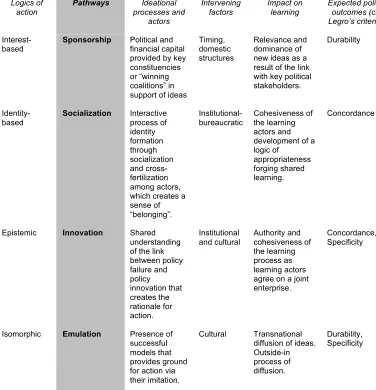
Table 2.4: Pathways of influence
Figure 2.5: The core argument of the thesis
Figure 2.6: Intervening factors
Figure 2.7: Criteria for measuring institutional learning
Figure 2.8: Norm robustness
Table 2.9: Attributes of CoPs and epicoms
58
63
65
66
70
72
74
75
81
Chapter 3
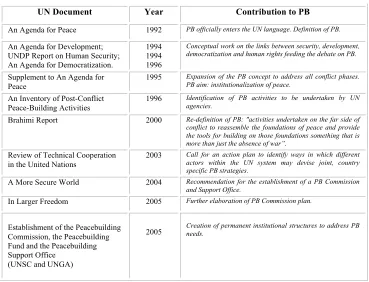
Table 3.1: Institutionalisation of peacebuilding (UN)
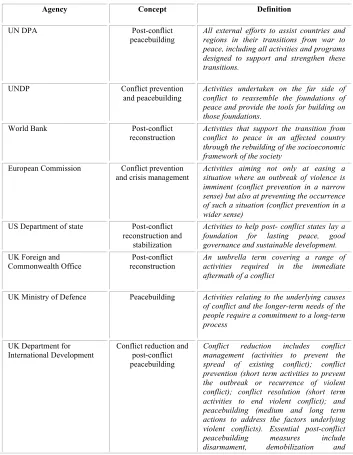
Table 3.2: Definitions of peacebuilding
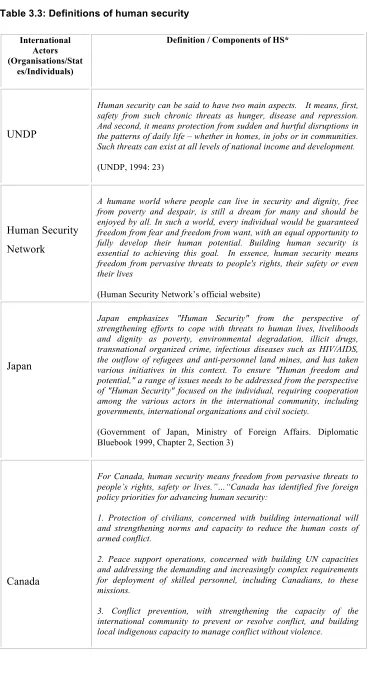
Table 3.3: Definitions of human security
92
95
101
Chapter 4
Figure 4.1: Institutional structures in CFSP/CSDP
Figure 4.2: Bureaucratic actors in CSDP and levels of governance
Table 4.3: CSDP levels of actorness
125
125
137
Chapter 5
Table 5.1: Levels of analysis in EU crisis management
Figure 5.2: Main actors in SSR and SSG
140
tasks”
Table 5.4: Non-military crisis management tools available in EU member states in the field of civilian police (1999)
167
Chapter 6
Table 6.1: SSR conferences 2005-2007
Table 6.2: SSR epistemic communities
Table 6.3: Timeline for SSR conceptual development
Table 6.4: SSR operational experience, main lessons and challenges
188
191
204
217
Chapter 7
Table 7.1: List of member states holding the rotating Presidency of the European Council (1999-2003)
Table 7.2: Learning Communities (expertise and practice-based) of EU CCM, overview of the main national and transnational actors involved (1999-2002)
Table 7.3: CCM, the knowledge community in Sweden
Table 7.4: EU civilian crisis management, learning from others
Table 7.5: Overview of the main lessons learned in civilian crisis management
230
235
251
257
263
Chapter 8
Table 8.1: Mill's method of difference: comparison between
CCM and SSR norm diffusion 295
List of Abbreviations
ASPR Austrian Study Centre for Peace and Conflict Resolution
ASSET Association for Security Sector Reform Education and Training
ASSN African Security Sector Network
AU African Union
BASIC British American Security Information Council
CA Comprehensive Approach (EU)
CCM Civilian Crisis Management (EU)
CFSP Common Foreign and Security Policy (EU)
CHAD Conflict and Humanitarian Affairs Department (UK)
CHG Civilian Headline Goal (EU)
CiLMA Civilian Lessons Management Application (EU)
CIVCOM Committee for Civilian Aspects of Crisis Management (EU)
CMB Crisis Management Board (EU)
CMC Crisis Management Center
CMPD Crisis Management and Planning Directorate (EU)
COREU Correspondence Européenne Network (EU)
COREPER Committee of Permanent Representatives (EU)
CPCC Civilian Planning and Conduct Capability (EU)
CPDC Conflict Prevention and Development Cooperation Network (OECD)
CRCT Crisis Response Coordination Team (EU)
CRT Civilian Response Team (EU)
CSDP Common Security and Defence Policy (EU)
CoP Community of Practice
DAC Development Assistance Committee (OECD)
DCAF Geneva Centre for the Democratic Control of Armed Forces
DDR Disarmament, Demobilisation and Reintegration
DEVCO European Commission’s Directorate-General for Development Cooperation - EuropeAid
DFID Department for International Development (UK)
DOD Department of Defense (US)
DOS Department of State (US)
DRC Democratic Republic of Congo
EC European Commission
ECHO European Commission’s Humanitarian Aid and Civil Protection Department
ECOWAS Economic Community of West African States
EDA European Defence Agency
EEAS European External Action Service (EU)
EGT European Group on Training (EU)
ELMA European Lessons Management Application (EU)
EMU Economic and Monetary Union (EU)
ENP European Neighbourhood Policy (EU)
ENTRi Europe’s New Training Initiative for Civilian Crisis Management (EU)
EP European Parliament
EPC European Political Cooperation
EPLO European Peace-building Liaison Office
ESDC European Security and Defence College (EU)
EU European Union
EUBAM European Union Border Assistance Mission
EUFOR European Union Force
EU ISS European Union Institute for Security Studies
EULEX European Union Rule of Law Mission
EUMC European Union Military Committee
EUMM European Union Monitoring Mission
EUMS European Union Military Staff
EUPM / EUPOL European Union Police Mission
EUSR European Union Special Representatives
EUSSR European Union Security Sector Reform Mission
EUTM European Union Training Mission
FBA Folke Bernadotte Academy
FCO Foreign and Commonwealth Office (UK)
FYROM Former Yugoslav Republic of Macedonia
GFN-SSR Global Facilitation Network for Security Sector Reform
HQ Headquarter
HR/VP High Representative of the Union for Foreign Affairs and Security Policy and Vice President of the Commission (EU)
IGC Inter-governmental Conference (EU)
IMF International Monetary Fund
INCAF International Network on Conflict and Fragility (OECD)
IO International Organisation
IR International Relations
ISSAT International Security Sector Advisory Team
KFOR Kosovo Force (NATO)
MFA Ministry of Foreign Affairs
MoD Ministry of Defence
MS Member States (EU)
NGO Non-governmental Organisation
ODI Overseas Development Institute
OECD Organisation for Economic Cooperation and Development
OHQ Operational Headquarters
OMIK OSCE Mission in Kosovo
OPCEN Operation Centre (EU)
OSCE Organization for Security Cooperation in Europe
PMG Politico Military Group (EU)
PSC Political and Security Committee (EU)
RELEX European Commission’s Directorate General for External Relations
RFSI Swedish Council for Peace and Security Initiative
SHAPE Supreme Headquarters Allied Powers Europe (NATO)
SIDA Swedish International Development Cooperation Agency
SSG Security Sector Governance
SSR Security Sector Reform
SWG Security Working Group (EU)
TEU Treaty on European Union (Maastricht Treaty)
UK United Kingdom
UN United Nations
UNDAC United Nations Disaster Assessment and Coordination
UNDP United Nations Development Programme
UNMIK United Nations Interim Administration Mission in Kosovo
US United States of America
WEU Western European Union
ZIF Zentrum für Internationale Friedenseinsätze
Chapter 1
Introduction
The study of the European Union (EU), and namely of its Common Security
and Defence Policy (CSDP), has until now failed to spot the processes through
which new ideas affect policy evolution. It is well known that ideas change the
world. In more academic words, they produce new patterns of cooperation
among states, impinging on the formal and informal institutions that were
created to foster such cooperation. What is most problematic is to determine
how ideational factors bear impact on actors’ decisions, particularly those
leading to the adoption of common policy frameworks. What is also unclear is
how these frameworks then result in observable policy outcomes.
Drawing from the academic debate on institutional learning (Etheredge, 1985;
Nye, 1987; Haas E.B., 1990; Haas P.M., 1990; Breslauer and Tetlock, 1991;
Hall, 1993; Levy, 1994; Zito, 2009; Radaelli, 2009), policy evolution (Adler
and Haas, 1992) and the recent “practice turn” in IR (Adler and Pouliot, 2011a,
2011b), this research specifies the conditions under which international
organisations learn, and how security policies evolve as a consequence of these
lessons learned. It is argued that specific ideas had impact on EU security
policies because new knowledge was bound up in the execution of the security
associated with performance did not generate policy transformation, as
intersubjective, consensual knowledge struggled to expand. Therefore, the
objective of this work is to test the avenues of learning affecting CSDP and its
“learning by doing” evolution. Under what conditions does learning matter and
what is the relationship between knowledge, practice and power? Can the
comprehensive approach to CSDP, and in particular the development of
non-military crisis management tools be explained from a practice perspective, or
does evolution stem from the role of expertise or knowledge-based networks,
as other authors have suggested (Cross, 2011)?
The empirical findings demonstrate that institutional learning has policy impact
when the consensus on the lessons learned from the past is underpinned by a
common set of normative and principled beliefs - which fits the definition of
episteme in accordance with Haas’ theory of institutional change; at the same
time, it shows that policy impact turns into observable policy evolution and
shapes broader socio-political processes (e.g. the design of CSDP as a
“civilian” or “soft” provider of security) when the knowledge is embedded in
communities of practice that structure experience and define the way actors
socialise and learn.
In the case of the CSDP, common practices defined the way EU actors learned.
The nexus between new knowledge and practice is what made CSDP learning
by doing possible. My contribution demonstrates the academic advantage of
analysing the CSDP as an environment in which transnational learning,
policy-making. Investigating the role of “learning communities” in CSDP also help
detecting which one of the several communities discussed by the IR literature
(Adler, 2008: 199; Cohendet et al., 2011: 306) is more suitable, in analytical
terms, to account for security cooperation within the EU framework. In fact,
there is a strong need in IR theory “to clarify the main characteristics of diverse
communities” (Créplet et al., 2003: 44), how they contribute to knowledge
creation and what are the implications in policy terms.
In this regard, it is important to observe that the CSDP environment includes
sectors where practice – and learning by doing – struggled to emerge, despite
the evidence of knowledge-based policy innovation. Reappraising the concept
of epistemic communities helps us assessing the exact extent to which
impactful learning depends on the overlap between knowledge and practice,
something that the academic literature has not clarified. As long as EU security
and defence is a new policy field in which outside-in diffusion processes have
repeatedly occurred, it can be argued that there can be new knowledge without
a common practice, but a fully-fledged process of institutional learning cannot
be achieved without common practice.
This approach is also applied in an empirical field – security – traditionally
considered as a hard case for the role of ideas and identities in shaping
decisions. In this regard, this work suggests that interests are present across the
whole trajectory of norm diffusion. The conceptual bases of learning
communities point out the notions of “joint enterprise”, shared beliefs (Haas
the emergence of a dominant view of a social reality across different
backgrounds, as in the case of epistemic communities (Haas P.M., 1992); or
the existence of like-mindedness as the condition for the development, sharing
and maintenance of common practices leading to collective learning (Adler and
Pouliot, 2011; Bicchi, 2011).
Dominance is power-based. The presence of interest-based constituencies (e.g.,
support from one or more member states) backing the formation of consensual
views determines the ability of the communities to gain access to and influence
politics. Accordingly, I seek to demonstrate through my empirical analysis that
the creation of a policy consensus (McNamara, 1998) on new forms of security
cooperation leads to policy change when ideas are supported by interests and
can rely on pre-existing practices.
These factors can largely account for the variation in impact of new norms or
security prescriptions. Not all ideas, in fact, are equally successful in
influencing policy-making. Some of them lead to the creation of new
institutions, bureaucracies, or entail profound changes in actors’ behaviour.
Other may be diffused, but are discarded or do not manage to persist
(Risse-Kappen, 1994). Some norms shaped the activities, perceptions and the
institutional design of the CSDP in the first ten years of existence (1999-2009).
Others had a much more limited impact. Accounting for such variation is a
1.1 The argument
Learning has obviously to do with change. What is less obvious is the
definition of what type of change occurs as an international organisation learns,
whether it is simple adaptation or more complex belief change (Zito, 2009).
This thesis defines learning as “the process by which consensual knowledge is
used to specify causal relationships in new ways so that the results affect the
content of public policy” (Haas P.M., 1990: 23). This approach proves
particularly useful for the institutionalisation of security and defence
cooperation within the EU over the past fifteen years.
In fact, the Common Foreign and Security Policy (CFSP) of the EU has been
marked by unprecedented developments in the field of security and defence.
Prompted by the December 1998 Franco-British St Malo Declaration, the
CSDP was officially launched at the Cologne European Council on June 1999.
In the wake of the Yugoslav Wars, the initiative was to provide the European
Union with the military force the frappe to support the critical mass of the until
then inconclusive CFSP. It was also a response to major changes in the
structure of the post-Cold War international system, which urged European
states to enhance their power projection capability and decrease their reliance
vis-à-vis the United States (Jones, 2007; Howorth, 2007).
The evolution “by doing” (Grevi et al., 2009) of the CSDP in the past decade
affected activities, institutional structures and procedures. It can be understood
up of institutions and the consequent process of institutional reform, leading to
the implementation of existing structures, and the creation of new pivotal ones.
Second, the emergence of a European strategic debate, resulting in the adoption
of the 2003 European Security Strategy (updated in 2008). Third, the
operational experience gained by CSDP missions from 2003 onward (Grevi et
al., 2009). In March 2003, in fact, the EU launched its first military operation
(EUFOR Concordia, in the Former Yugoslav Republic of Macedonia) using
NATO assets under the “Berlin Plus agreement”, while the first autonomous
CSDP military deployment came about only a few months later, in May 2003,
with the launch of Operation Artemis in the Democratic Republic of the Congo
(RDC). Since then, the EU engaged in more than 27 operations, thus becoming
a significant actor in crisis management in many regions of the world (Western
Balkans, Africa, Middle East, Caucasus, Asia).
Such evolution of the CSDP by practice has led some analysts to qualify the
evolutionary process as learning “by doing” (Juncos, 2006: Grevi et al., 2009).
The research interest of this thesis, as well as the empirical contribution to the
debate, does not lie in the rise and development of the CSDP per se, nor in its
impressive institutional growth alone. My puzzle centres on the specific design
the CSDP has evolved into, through the acquisition of new knowledge and its
application it “by doing”.
Seen from an institutionalist perspective, the shaping of the CSDP appears as a
history of endogenous institutional change producing unintended consequences
nature of past errors (e.g. policy failure in the Balkans) and the lessons learned
concerned the absence of military means, the solution has rather gone in the
opposite direction. In empirical, operational terms the CSDP has developed
mostly on the civilian side of the crisis management spectrum (Drent, 2011).
The comprehensive approach (CA) and civil-military coordination have
dominated the political, strategic and institutional dynamics. Concerned with
clearing up why the EU had started engaging in crisis management, where and
with what implications on the Brussels-based bureaucratic machinery, the
academic literature has failed to explain why something that was supposed to
have a military outlook and outreach, ended up being overwhelmingly civilian
or civil-military. Alternative explanations of the EU security architecture, as
the next chapter will show, are indefinite as to why actors learned and
socialised in a specific manner, and how their common understanding of the
CSDP as non-military was constructed.
By engaging the debate, the theoretical starting point of this work lies in the
institutionalist approach quoted above. CSDP institutions evolved as a result of
endogenous change impacting on states’ cooperative attitude. At the same time,
my research challenges institutionalism on two grounds: the processes and the
outcomes of institutional change. Concerning processes, my work reframes the
study of socialisation within CSDP (Meyer, 2006; Juncos and Pomorska, 2006;
Juncos and Reynolds, 2007; Cross, 2010) so as to focus on the conditions for
persuasiveness defining how socialising forces matter. By doing so, it identifies
and agency, as well as between interests and ideas, and ultimately leading to
learning. The EU has become a comprehensive security provider because
transnational expertise and practice-based communities pushed forward a new
security thinking changing the traditional – military – understanding of crisis
management. Curiously enough, the academic literature has overlooked the
nexus between the profound re-conceptualisation of security resulting from the
changing nature of post-Cold War crises, on the one hand, and the new
activities developed by international organisations, including the EU, on the
other. The impact of the paradigmatic shift in security on new norms
influencing the security agenda, and hence on the content of cooperation trough
CSDP, has hardly been inquired into. Nonetheless, a link exists between the
generation of new security norms at the international level and the
development of the EU comprehensive approach, including all the sub-policies
that fall under this label. CSDP’s adaptation to systemic pressures was then
characterised by an emerging consensus on the importance of non-military
crisis management and on the value of civilian and integrated capabilities.
These ideas diffused and trickled down the EU decision-making by means of
social interaction. They ultimately affected the way states preferences are
shaped and gained salience in the CSDP setting because practice helped
constructing and consolidating social interaction.
This thesis shows how the practice of security enabled the EU to learn and
evolve. In that respect, it fills a lacuna in the institutionalist literature, which
effect (Menon, 2011; Barnett and Finnemore, 1999). A convergence on a
comprehensive vision of the CSDP, in fact, does not automatically translate
into the CSDP implementing comprehensive policies. My work follows the
causal chain of events to reconstruct how specific concepts within the EU
comprehensive approach framework turned into policies, and why specific
ideas produced policy evolution by means of experiential learning while others
did not. The framework develops four pathways of influence, which describe
the conditions under which ideas turn into policies. These include the presence
of a power constituency supporting the diffusion and institutionalisation of the
new ideas; the formation of cohesiveness and a “sense of belonging” among
practitioners, facilitated by a common identity; a shared epistemic enterprise
aimed at producing policy innovation; and the emulation of a successful model
of cooperation or policy implementation.
1.2 The research design
The hypotheses are tested on two case studies: security sector reform (SSR)
and civilian crisis management (CCM). The choice of these two case studies
was based on the following criteria.
Cases should, first of all, represent new or emerging policy fields in CSDP.
They should also be relevant for the EU comprehensive approach, in terms of
civilian or holistic contribution to crisis management concepts/procedures.
clearly defined policy framework with at least one CSDP operation carried out
between 2003 and 2009 (SSR and CCM missions). Finally, selection was
influenced by the degree of comparability between the processes of norm
diffusion, variation in policy outcomes/evolution and availability of sources.
Both SSR and CCM provide sound empirical evidence of the presence of the
communities of practice and/or experts promoting the diffusion of new norms
that originate in the post-Cold War security environment. These communities
act within a dense networked governance system (Mérand et al., 2010)
composed of a variety of units: bureaucratic actors, national desks officers,
NGOs, diplomats, military staff etc. In each one of the two case studies, a
questionnaire inspired from social network analysis was used to structure
interview questions. Namely, it helped locating the relevant communities and
their membership, so as to facilitate the task of detecting the inner working
processes, practices and knowledge flows. Despite the relatively poor academic
attention to the EU SSR and CCM developments, these two policy areas
occupy a central position in the EU’s comprehensive provision of crisis
management. Both are key examples of policy innovation, hence useful cases
to explain how policy consensus emerges, diffuses, gets institutionalised and
evolves. At the same time, differences in policy outcomes – especially
institutional developments and operational outreach – make a comparative
analysis between SSR and CCM suitable for testing the conditions under which
Besides exploring the genesis of the comprehensive approach as a process of
learning, my work seeks to answer the following questions: why did CCM
have more impact in shaping the CSDP in terms of policy outcomes? Was a
policy consensus on SSR more difficult to muster, or to turn into
implementation, and if so, why? Starting from similar conditions of policy
failure, followed by policy innovation, the relative success of CCM and poor
evolution of SSR tell us that even if they are “grabbed” by policy-makers and
enter the institutional arena, norms may still fail or struggle to survive in
practice. Even the presence of national constituencies (e.g. backing from the
United Kingdom, in the case of SSR) are alone not sufficient to cope with the
intricacies of multilateral cooperation. The connection between ideas and
interests needs to be complemented by the one between knowledge and
practice.
Finally, the choice of SSR and CCM was functional to the feasibility of this
research. Whereas the notion of comprehensiveness would have been too broad
to analyse, SSR and CCM fit the empirical targets of this study, as they allow a
narrow focus and an in-depth inquiry into specific policy areas at the heart of
the paradigmatic shift in security.
The comparison between SSR and CCM builds on Mill’s method of difference
and a qualitative, semi-structured interviews-based research design in order to
test the hypotheses that cohesiveness and overlapping practices/epistemes are
used to gather empirical evidence, although structured questions have been
slightly adjusted to the different contexts.
To facilitate comparison between empirical findings (cf. chapter 8), the case
study chapters have symmetrical structures. In both cases, research findings are
presented according to three dimensions: (1) the types of learning
communities, namely their composition and cohesiveness, which define the
cognitive architecture of the policy area under study; (2) the diffusion process
of ideas, according to an assessment of the pathways of influence and
intervening factors; (3) the analysis of policy outcomes, and whether evolution
as learning by doing has occurred or not.
1.3 Significance
Kenneth Waltz wrote “elegance in social science theories means that
explanation and prediction will be general” (Waltz, 1979). Although this study
aims at achieving as much elegance as my academic experience allow, the
undertaking may prove to be vain as studies on the European Union are in
general difficult to generalise. This is mostly due to the sui generis nature of
the EU integration process, including in the “less than supranational but more
than intergovernmental” security and defence policy (Howorth, 2011).
The theoretical scope of this work might therefore be somewhat narrower, but
nonetheless worth the effort to address the CSDP’s continuous process of
realist emphasis on exogenous processes of change, but also engages the
current “inward looking” analyses of institutional dynamics and social rules
within the Brussels-based bureaucratic machinery (aka Brusselsisation) that
has been gaining ground since the mid-2000s. The thesis merges elements of
sociological institutionalism (March and Olsen, 1989; Christiansen et al., 1999;
Checkel, 2005), networked governance (Mérand et al., 2011) and
epistemic/communitarian approaches to International Relations (Ruggie, 1975;
Haas E.B., 1990; Haas P.M., 1990; Verdun, 1999; Cross, 2011; Adler, 2005),
including the most recent “practice turn” (Adler, 2008; Adler and Pouliot,
2011; Lachmann, 2010). The sociological source of inspiration resides in the
works of Foucault (1970) and Bourdieu (1990) and their conceptualisation of
epistemes and background knowledge. The concept of learning communities
(Adler, 2008), seeks to bring ideas back into the debate on European security
cooperation, while at the same time making clear that ideational forces and
socialisation matter but do not operate independently from power.
The empirical scope on the CSDP has three focal points: the structure of
learning communities interacting in the CSDP environment; the ensuing
dynamics of norm diffusion; and the impact in terms of policy outcomes.
Concerning structural aspects and the problem of “cohesiveness”, the original
contribution of this research is to visualise learning communities beyond
formal institutional structures or committees, and to picture them as “islands of
knowledge and practice”, transcending states and international organisations’
communities’ internal cohesiveness explains external persuasiveness is
reformulated so as to include a more nuanced definition of the content (what is
agreed or not agreed upon), the domestic setting (culture, institutional barriers
to the formation of consensus) and, most importantly, the linkage with
professionalism and practice.
Another innovative feature of this analysis is that it explores the extent to
which previous experiences in a given policy field (e.g. civilian police) and the
existence of networks of practitioners support the formation of new knowledge,
and hence boost learning. In terms of norm diffusion, the empirical case studies
test the applicability of the policy evolution model (Adler and Haas, 1992;
McNamara, 1998) to security policies. By going through the steps of failure,
innovation and norm diffusion, important indications can be derived in order to
understand how international organisations dealing with security and crisis
management adapt their policy objectives and institutional setting to face
changing circumstances.
Concerning the outcomes, the value added for studies on the CSDP is to put
learning by doing (Juncos, 2006), previously looked at as an isolated concept,
into the broader context of institutional learning. According to my model, in
fact, policy evolution should produce learning by doing, understood as the
refinement of new policy tools out of the first waves of operational experiences
leading to feedback loops. The absence of lessons learned is, in this regard, a
symptom that a convergence on the policy consensus has struggled to turn into
All in all, while being careful on the “elegance”, the nub of my argument is to
follow the norm, rather than the money or the institutional structures, and
connect it with the relevant pre-existing or emerging practices.
1.4 The structure of the thesis
The remaining chapters of this thesis identify the emerging consensus on
non-military and civil-non-military approaches to crisis management as the foremost
achievement of the CSDP since its creation in the late-1990s. The consensus
came out as an adaptive response to changing international conditions leading
states to no longer view purely military interventions as viable means to solve
conflicts and to design security cooperation within the EU accordingly. This
consensus, supported by key constituencies of member states, allowed the
CSDP to find its “niche” in the European security landscape by investing in the
comprehensive dimension of crisis management and hence differentiating itself
from other international organisations dealing with security (e.g. NATO). The
learning process, however, resulted in some norms being more influential than
other and, as a consequence, in different patterns of policy evolutions across
areas of cooperation. The limit of learning is that the policy consensus does not
necessarily turn into a good practice, or effective cooperative outcomes.
The CSDP empirical record demonstrates that ideational factors can drive
cooperation, but also that such cooperation does not automatically turn into
comprehensive approach, by SSR and CCM means, can therefore illuminate
integrative efforts in other sectors. Namely, it can shed light on the interaction
between material and ideational factors, as well as on the link between rhetoric
and practice of cooperation.
In chapter 2, the argument of the thesis is developed. I start from a review the
literature on the rise of European security cooperation. I argue that the
academic debate has acknowledged the importance of transnational
communities as driver of learning and institutionalisation (Cross, 2011) but
failed to account for the permanence of some practices and the fading of others.
Furthermore, the formative interactions leading to the formation of knowledge
have not been sufficiently studied. Therefore, the chapter discusses the way my
analytical framework fills this gap in the literature, and how the concepts of
epistemic communities and communities of practice are operationalised to
explain the current shape of the CSDP. I hypothesize that policy evolution
occurs if practice and knowledge overlap, and elaborate on the pathways of
influence and intervening factors through which new ideas turn into policies.
The methodology section discusses how the learning process is assessed and
expounds the qualitative methods used to trace learning communities. In
particular, it specifies how the triangulation between semi-structured
interviews, process-tracing and document analysis made it possible to detect
the attributes and types of communities, the process of knowledge formation,
its subsequent integration into the CSDP framework and the emergence of
Chapter 3 and 4 pave the way for the empirical analysis. They introduce the
paradigmatic shift in security that occurred since the end of the Cold War, as
well as the structures, actors and networks that construct the CSDP, with an
emphasis on their “comprehensive” nature. Overall, these are two
complementary chapters, whose principal aim is to introduce the
“comprehensive approach” the EU’s crisis management tools are embedded
into.
Chapter 3 does that by focusing on the origins of comprehensiveness. It
connects the re-conceptualisation of the definition of security resulting from
the new nature of crisis management to international responses – namely
human security and peacebuilding. By doing so, it explains how the idea of
comprehensiveness and its implementation through the EU comprehensive
approach are rooted in a broader paradigmatic shift affecting the global
security agenda. Therefore, the chapter seeks to link global norm generation to
the rise of the EU’s specificity in comprehensive crisis management.
Chapter 4 examines how the comprehensive approach shaped the CSDP
institutional design. Special emphasis is placed on the “culture of coordination”
and the institutional interface connecting military and non-military, civilian
structures. It is argued that the governance process is made of three
dimensions: structures, actors and networks. Accordingly, the chapter seeks to
provide an exhaustive explanation of the CSDP system by examining the
interplay between the three dimensions. Conclusions show that the CSDP
communities that structure relationships between actors and structures.
Moreover, they show that those networks are manifold and multi-level, thus
extending beyond the formal institutional setting where intergovernmental
negotiations occur: network’s configurations vary depending on the sector
analysed.
Moving on to the analysis of the case studies, chapters 5, 6 and 7 constitute the
empirical bulk of the thesis. The framework for learning and policy evolution
is applied to the emergence of SSR and CCM within the EU security
architecture.
Chapter 5 introduces the two policy frameworks and makes clear how they fit
into the CSDP, particularly as regards their contribution to shaping an
integrated or comprehensive vision of security cooperation. The purpose of this
introductory chapter is to help the reader understanding the levels of the
analysis and gathering background information on the case studies before
embarking upon the empirical investigation. Accordingly, it contains both an
overview of the relevant academic literature as well as a state-of-the-art
description of the scope, structures, procedures and practices related to the
implementation of SSR and CCM.
Chapter 6 investigates the case of SSR. It addresses the questions of why and
how SSR principles were institutionalised by EU member states, what
influenced EU policy-makers’ choices and, finally, what have been the
outcomes of the policy consensus on the EU approach to SSR. Through a
the dynamics of norm diffusion, this first case study concludes that
convergence was driven by a confluence of ideational factors and state
interests. Empirical evidence shows the role of national constituencies (the
United Kingdom in particular) in supporting the diffusion of SSR’s knowledge.
At the same time, conclusions highlight the failure of SSR framework to turn
into a real convergence in policy outcomes and evolution. As a result, SSR’s
overall impact on the shape and activities of CSDP has been limited.
Chapter 7 analyses the development of CCM in the EU through the lenses of
conceptual evolution, and the resulting diffusion of ideas and practices across
EU member states. By asking similar questions to the ones raised in the case of
SSR, and with similar starting conditions (experience of policy failure and
policy innovation), the chapter illustrates a different picture of learning.
Knowledge is, in the CCM case, rooted in shared practices, born out of EU
member states’ previous experiences in civilian missions (e.g. police) with
other international organisations. The genesis of a CCM policy framework and
the so-called “EU way to civilian crisis management” (Nowak, 2006) are hence
practice-driven, and strongly supported by the constituency of Nordic EU
member states - Sweden and Finland in particular. Conclusions to this chapter
emphasise, in stark contrast with the previous case study, the much stronger
impact of CCM in defining the CSDP, and the greater amount of policy
evolution through learning by doing.
Chapter 8 explains such variation and uncovers the causal link between
from the case studies. It summarises and compares the empirical, then
discusses the theoretical implications. By linking the case studies findings to
the broader thesis’ argument, this chapter answers the question of why some
ideas turn into policy evolution while others do not.
The thesis concludes with chapter 9, where the theoretical and policy relevance
of this work, as well as some recommendations for future research are mused
Chapter 2
The theoretical framework
Introduction: explanans and explanandum
This thesis challenges the conventional wisdom that the soft or civilian focus of
the CSDP results from the lack of a consensus among member states on the
degree of military integration in the EU (Santopinto and Price, 2013). Quite the
contrary, the development of an overwhelmingly civilian CSDP is the end
product of a growing transnational consensus on non-military approaches to
crisis management. This explanation shows the limits of IR theories
emphasising inter-state bargains and balancing/bandwagoing behaviour, and
stresses the importance of ideational factors in shaping security policy-making.
New ideas can affect security policies, but different channels for diffusion may
lead to different outcomes in policy terms. The channels under study are
transnational communities of experts and practitioners, who act as carriers of
knowledge into policy-making structures. Understanding how ideas turn into
policies through these channels may help explaining the reason why some
ideas produce change while others do not; and, as a result, what type of
cooperation stems from what ideational factors and under what conditions.
Questions about how actors learn, what lessons they draw, how knowledge
science and IR debates over the past thirty years. These questions have also
been relevant for the study of the European Union (Zito, 2001, 2009; Zito and
Schout, 2009; Radaelli, 1995, 2009). As the other policy areas studied in the
literature, learning also took place in EU security and defence, an area of
cooperation that was created in the late-1990s and has grown substantially ever
since. Therefore, the theoretical question worth asking is whether the
transnational communities performing the learning process matter in EU
security policy-making, which ones do, and how?
By way of introduction, let us briefly consider the historical and international
context first. Since the end of the Cold War, security has become a complex
and multidimensional concept, owing to the decline of traditional inter-state
wars and the rise of new challenges such as intra-state conflicts, asymmetric
and unconventional warfare, terrorism, civil wars, or threats related to failing
or failed states. The international provision of security and multilateral defence
cooperation, have evolved accordingly. Multilateral institutions have become
increasingly absorbed in the management of security crises. Despite
operational distress and budgetary constraints, crisis management has become
a term of art in the post-1989 security discourse, and translated into a diffused
international practice. Collective security organisations started to engage in
complex peacekeeping, crisis management or nation-building tasks whose
nature was not essentially military. Responding to momentous changes in
polarity as well as in the nature of armed conflicts, comprehensive forms of
actors decide upon and implement their responses to crises. These “new
trajectories” for crisis management involved the conceptualisation of different
and longer phases of action, joining short-term combat responses with broad
conflict prevention, post-conflict reconstruction long-term programmes.
The most immediate implication of these transformations for security and
defence cooperation has been the increased value of civilians and civilian
capabilities in what was previously considered a domaine réservé for the
military. New scenarios opened up in the field of international security, with
experts and practitioners gradually moving towards a consensus on the critical
importance of civilian, and “civilian-military” work to the success of crisis
management operations (Chivvis, 2010: 1).
Both states and international organisations refined their crisis management
goals, means, and instruments according to new systemic priorities. However,
the way these actors responded to structural stimuli varies from case to case.
There is no universal doctrine or model for civil-military crisis management,
since each actor develops different instruments, sets out different goals, or uses
different terms according to contextual or historical considerations (Wendling,
2010: 10). As a result, understanding “how” single actors respond to structural
pressures is crucial in explaining "why" change takes place in the international
security environment.
The “how” question is a theoretical one, and implies the presence of some
intervening factors between agency and structure, which alter the way these
structural constraints, such as changes in the distribution of natural resources or
an alteration of the balance of power, in order to guarantee their
self-preservation in an anarchic international system. States, and international
organisations alike, learn by diffusing and assimilating new knowledge:
endogenous factors, such as ideas, identity, expertise or the social interaction
with other actors, affect the way preferences are shaped. From a theoretical
standpoint, asserting that international organisations learn entails embracing a
pragmatic approach merging some elements of social constructivism and
institutionalism. To what extent does this pragmatic approach apply to the
evolutionary dynamics of the EU's CSDP? The new approaches to global
security and crisis management that originated in the post-Cold War
international system have affected the EU and other security institutions (UN,
NATO, OSCE) in a similar way, but with different outcomes.
What generated change in CSDP is the overarching question of this research.
From a theoretical standpoint, the evolution of the CSDP into the
comprehensive approach, with a critical focus on civilian means, constitutes
the explanandum. The outcomes that this thesis seeks to explain are the
institutional structures sustaining CSDP; the operational outreach; the means at
its disposal; the holistic procedures for crisis response. The analysis of the
practice, knowledge and power, which generally define the process of learning
and, in the case of the CSDP, was operationalised as learning by doing.1
The claim that the EU has learned to be a security actor “by doing” suggests
the importance of an international practices approach to understand the
determinants of the learning process (Adler and Pouliot, 2011a: 16). This thesis
tests such claim by assessing the extent to which evolution in CSDP could not
be, instead, explained through the lenses of other learning approaches. The
theoretical framework considers different pathways by which ideas turn into
policy. While elaborating on the pathways, I deemed it necessary not to limit
my ontological choice to the concept of communities of practice, but to
include, as useful competing explanations, knowledge-based, epistemic
communities (Haas E.B., 1990) as well. Hence the question arises as to
whether practice-based communities, as opposed to other communities, played
a determinant role in producing evolution.
The hypotheses presented in this chapter suggest that, in European security,
learning by doing has occurred in those sector areas in which practitioners have
endowed their joint enterprise with political validity, epistemic ground for
action, and intersubjective meaning. In other words, practices helped
constructing, or reconstructing from past experiences, the common knowledge
as well as a common understanding of a political reality. By contrast, in other
sector areas, common practices have struggled to emerge, although new
1 In the words of the EU Institute for Security Studies’ former Director Alvaro de Vasconcelos,
epistemes (ideas and cognitive content) have nonetheless had an effect on
policies and decision-making events.
Acknowledging the importance of international practices and their contribution
to the understanding of world politics, this research tests the applicability of a
learning framework to the understanding of CSDP evolution. The research
design looks at two sectors of EU security cooperation that display variation in
the outcomes of policy evolution. One is CCM, which has expanded and
significantly impacted on the CSDP activities. The other is SSR, which, on the
contrary, has failed to become a fully-fledged practice and occupies a marginal
role in the EU security framework. The presence of a community of practice in
the case of CCM, and its absence in the epistemic-driven emergence of SSR,
explain the failure of the latter, the successful evolution of the former and its
impact on the overall strategic posture of the CSDP.
2.1 The rise and evolution of European security cooperation
The academic debate on European security cooperation has largely ignored
these factors. Namely, it has failed to account for the EU response to the
changing nature of international security. Scholarship on European security has
not produced a comprehensive framework that could explain – theoretically –
the rearrangement of EU security policies, structures and capabilities
(institutional reform) or the creation of new institutions from scratch, as well as
This section briefly reviews the alternative explanations for the emergence of
CSDP, in order to show the original contribution of this thesis. It is divided in
two parts: genesis and evolution. The first part focuses on the explanations for
the “rise” of the CSDP, while the second addresses its advancement through
institutional and operational development.
2.1.1 CSDP genesis: exogenous and endogenous drivers
The academic debate on CSDP has its origins in the causes and remedies to the
EU’s diplomatic échec in the Balkans (Pond, 1999; Forster and Wallace,
2000).2 It pertained to the redefinition of the European security architecture
according to the transformations in the post-1989 international system, namely
vis-à-vis the US and NATO (Kupchan, 2003). In this regard, the EU’s inaction
in the Yugoslav tragedy not only reflected a fundamental split in the interests
of the three larger member states (France, Germany and the UK), but was also
the logical consequence of the lack of a military underpinning characterising a
European diplomacy “without teeth” (Jopp and Diedrichs, 2009: 100). In his
formulation of the “capabilities-expectations gap”, Hill (1993) pioneered the
conceptualisation of European foreign and security policy, based on the notions
of actorness and presence (Hill, 1993: 308), which showed the gap between
what the EU was talked up to and what was able to deliver (Hill, 1993: 306).
2 As Fraser Cameron put it, “the lessons of the Yugoslav conflict were never far from the
The first attempts to account for the launch of the CSDP at the December 1998
St Malo Summit, and its official establishment six months later at the Cologne
Summit, described the initiative mainly as a reaction to exogenous stimuli
affecting European security (Pond, 2002; Duke, 1999; Cornish and Edwards,
2005).
Accordingly, structural realist perspectives have explained the evolution of
CSDP as a European attempt to balance against the United States (Posen,
2009). The main problem with this approach is that the “hard balancing” thesis
– a robust military build up to rebalance the transatlantic relationship – has
failed to materialise. Instead, the EU’s crisis management machinery has been
soft-security intensive. Variants of realism have sought to address this point.
The idea of “soft balancing”, developed by Pape (2005), contends that
Europeans are instead more likely to balance the United States through
“international institutions, economic statecraft, and strict interpretations of
neutrality” (Pape, 2005: 17).
Engaging realist scholars, Howorth (2007) contends that structural change is
not the only factor that spurred European security cooperation. Two sets of
combined explanatory variables (exogenous and endogenous factors) account
for the EU’s move towards a global security commitment. He identifies four
underlying drivers behind CSDP: a) exogenous forces deriving from the end of
the Cold War, most notably the lessening strategic importance of Europe for
the United States; b) new tasks and concept entered the IR lexicon in the
with the multilateral internationalism of most of the EU’s activities; c) the
reappearance of military conflict in the European continent (Western Balkans);
d) the development of a European defence industry (Howorth, 2007: 52).
Andrew Moravcsik (1998) also stresses the importance of endogenous sources
such as the convergence of member states interests and interstate bargains or
the pressure from domestic groups having an interest in areas such as the
production of weapons, economic sanctions and the creation of joint military
forces. Without denying the primary role of power and interest in shaping
interstate relations, Moravcsik’s neoliberal theory of European cooperation
maintains that the preferences of domestic actors and political processes in the
domestic policy shape an institutional setting whose inner functioning abides
by the rules of intergovernmentalism.
More recently, Gross and Juncos (2011) have studied the relationship between
changes in the international security environment and EU operational
approaches. They focused on the impact of EU crisis management capabilities
on the EU’s role and self-perception as a security actor.
None of these accounts of the genesis of the CSDP, however, answer the
underlying question of this thesis as to why some security concepts (and not
others) become embedded in discourse and practice (Koenig, 2012: 131), and
2.1.2 CSDP evolution
Works on CSDP implementation have been manifold and largely dominated
the “second wave of CSDP theorising” (Kurowska and Breuer, 2012: 2). As a
result of the first of operational experiences (2003-2009), studies on the
evaluation of EU missions (Merlingen and Otrauskaite, 2008; Emerson and
Gross, 2007; Grevi et al., 2009; Pirozzi and Sandawi, 2009) and related
institutional learning (Juncos and Pomorska, 2006; Ioannides, 2006; Adebahr,
2009) emerged in the literature. Academic writings have been particularly
concerned with the functioning of Brussels-based institutions and the process
of Brusselsisation (Duke, 2005). Scholars belonging to this strand see CSDP as
an institutional context within which “actors’ identities and interests develop
and change through interaction” (Checkel, 1999: 550). Theories on
socialisation and organisational learning have provided some additional insight
on the process of identity construction and rearticulating of interests as
significant change-inducing factors in an institutionalised and
socialisation-prone setting (Juncos and Pomorska, 2006; Adebahr, 2009). However, a
question remains open as to what extent CSDP has created dynamics of
path-dependency (Kay, 2005), constraining member states behaviour (Pierson,
1996) and letting security cooperation enter a path of unintended consequences
(Hall and Taylor, 1996).
CSDP’s influence on states behaviour has been looked at through the lenses of
patterns of adaptation of national cultures to the emerging EU strategic culture.
Meyer (2006) compared the evolution of public and élite opinion in selected
countries to find areas of shared consensus and norm compatibility fostering
the convergence of national interests. Gross (2009) analysed British, French
and German policies with respect to CFSP/CSDP in two specific crises
(FYROM and Afghanistan) in order to determine whether Europeanisation of
national foreign security policies occurred or whether other considerations
(such as the influence of the transatlantic alliance) were more pertinent to
explain national preferences.
Several authors have also emphasised fierce tensions among member states as
determinants of CSDP (Menon, 1994, 2006; Howorth, 2007, 2011). According
to Menon (2011) cleavages that have emerged across several dimensions
(civilian vs military instruments; Atlanticists vs Europeanists; territorial
defence vs force projection)3 exerted pressure on institutional structures,
producing incremental institutional change.
More recently, academic research has moved to a collegial outlook over the
social networks (Mérand et al., 2011) and the role of expertise as “epistemic”
shaper of policy change (Cross, 2011). Mérand has looked at processes of
socialisation within institutional settings. The CSDP is a “social field”,
comprised of policy-makers seeking to make sense of the world which in turn
leaves them “open to new ways (rules, power structures, and symbolic
representations) of structuring” the CSDP (Mérand, 2010: 372). All in all, the
analysis of networks and epistemic communities marked a rapprochement of
sociological institutionalism to power, as it became clear that socialisation and
ideational forces matter but could not float or operate freely (Risse-Kappen,
1994). It is at this specific juncture, at this critical moment of research on the
dynamics of EU security cooperation, that my thesis engages the academic
debate.
2.2 Learning and CSDP: conceptual and ontological choices
According to Jopp and Diedrichs, the EU is an organisation involved in a kind
of “lifelong institutional learning”, trying to incrementally improve its own set
of procedures and instruments for better coping with external crises and
problems (Jopp and Diedrichs, 2009: 106). Ginsberg, too, acknowledges the
importance of institutional learning in EU foreign and security policy
developments in the early twenty-first century (Ginsberg, 2007: 43).
This thesis re-frames the role of learning as a driving force behind the
evolution of CSDP. Namely, it looks at the CSDP as a social field,
characterised by the presence of a multitude learning communities. These
communities produce change by mediating between structure and agency, and
between exogenous and endogenous factors. Communities do not simply
exchange knowledge, as networks do. They construct and diffuse cognitive
On that account, the present thesis seeks to fill a theoretical gap in the
literature. What drove the specific orientation of CSDP towards the soft
provision of security (Drent, 2011), with an institutional and operational
emphasis on the comprehensive approach, which largely rests on civilian
means?
It is argued that new norms, ideas and shared beliefs, arising from policy
failure and gradually turning into “consensual knowledge”, have shaped the
rise and evolution of non-military CSDP by activating processes of policy and
institutional evolution as learning. Accordingly, my work investigates the
policy consensus that produced EU cooperation in crisis management, thus
shedding light on the causal force of ideas in driving CSDP. It aims to go down
the causal chain to reconstruct how specific concepts turned into policies, why
other were discarded and what crucial factors influenced the emergence and
diffusion of consensual knowledge. Finally, it accounts for the lag between
policy change and policy outcomes, hence explaining why specific ideas
produced evolution as experiential learning and others did not.
This section presents the conceptual choices of the thesis and defines learning
in relation to the actors, or communities, performing it. Drawing from the
academic literature on learning, it appraises the evolution from the notion of
epistemic communities (epicoms) to the practice turn in IR and the growing use
of communities of practice (CoPs) as the conceptual focus of research.
Assessing the distinction between epicoms and CoPs is important. In fact,
of expertise in shaping EU decisions (Cross, 2011), the latter have gained
ground to conceptualise the EU as a set of practices (Bicchi, 2011) that
constitute, and not result from, knowledge. Clarifying whether the carriers of
learning are expertise or practice-based is hence crucial to determine who are
the agents of the learning process and under what conditions the latter results in
policy evolution.
2.2.1 What does “an international organisation learns” mean?
The notion of learning is, to use Jack Levy’s famous expression, a “conceptual
minefield (…) difficult to define, isolate, measure, and apply empirically”
(Levy, 1994: 280).4
A fundamental distinction is between individual (Levy, 1994; Stein, 1994;
Argyris and Schon, 1978) and collective learning (March and Olsen, 1988;
Etheredge, 1985; Downie, 1998; Breslauer and Tetlock, 1991; Haas E.B.,
1990; Nye, 1987). Levy gives a basic definition of individual learning as “a
change of beliefs (or the degree of confidence in one’s beliefs) or the
development of new beliefs, skills, or procedures as a result of the observation
and interpretation of experience” (Levy, 1994: 286). On the contrary, collective
learning implies the possibility that a group of individuals (a government, an
4 Each one of the major paradigms in IR Theory has coped with the problem posed by learning
organisation, an institution) could learn in much the same way as single
individuals do, thus having their distinctive (but shared) goals, beliefs, and
memories. Collective learning is commonly classified into two similar, but not
identical categories: organisational learning and institutional learning.5
The literature also distinguishes between two levels of learning, determined by
the degree of complexity and the effects of learning on the actors’ behaviour.
The distinction is between simple adaptation, involving simple instrumental
change, and complex learning, involving belief change (Zito, 2009; Argyris
and Schon, 1996; Haas E.B., 1990), although the same notions have been given
different labels by scholars.6 Haas defines adaptation as the process by which
“behaviour changes as actors add new activities (or drop old ones), thus
altering the means of actions, but not the ends of the organisation”. Instead,
learning occurs when “the ultimate purpose of the organisation is redefined as
means as well as ends are questioned and new ends are devised on the basis of
consensual knowledge that has become available” (Haas E.B., 1990: 3). As a
result, “true” learning involves a reassessment of fundamental beliefs and
values. It entails a reconsidering of how policy-makers approach a major
problem, hence referring to a situation in which the policy-makers’
comprehension moves towards a more complex and integrated understanding
of an issue accompanied by a new formulation of the problem-solving.
5 Organisational learning is commonly used in sociology, whereas political scientists give
preference to the term “institutional learning” so as to encompass the broader definition of “institutions” covering organisations, rules, norms and regimes. That being said, the two terms have been often used interchangeably.
6 Adaptation is also known as single-loop (Argyris and Schon, 1978) structural adjustment