Munich Personal RePEc Archive
International Migration and Human
Development in Turkey
Içduygu, Ahmet
Migration Research Program at Koç University (MiReKoc)
1 October 2009
Human Development
Research Paper
2009/52
International Migration
and Human Development
in Turkey
United Nations Development Programme
Human Development Reports
Research Paper
October 2009
U
nited Nations Development Programme
Human Development Reports
Research Paper 2009/52
October 2009
International Migration and Human
Development in Turkey
Ahmet İçduygu
Ahmet İçduygu is Professor in the Department of International Relations and Director of the Migration Research Program at Koç University (MiReKoc). E-mail: [email protected].
Abstract
As often argued, a negative perception of immigration, or even emigration, prevails public opinions and governments in most countries. It is argued that caused by economic hardship or political hardship or political unrest in countries of origin, it would threaten well-being and identity in countries of destination, and sometimes endanger political security. However, on the other hand, social scientists recognize that, being a part of the global circulation and global integration, human mobility bears a tremendous potential for human progress. This view is increasingly shared by several actors for which adequate policies could make migration a genuine instrument for economic and social development. Therefore, the conditions under which, and the mechanisms through which, migration can transform individual benefits into an aggregated one, for the greater society, are to be studied. From this perspective, Turkey provides us with an interesting case study; firstly because of its multiple migration roles as a country of emigration, immigration and transit, over time; secondly because, this ongoing flows of emigration and immigration involve various stages of a migration cycle; thirdly because, this migration cycle reflects, both explicitly and implicitly, some gains, and occasionally loses, both for the country and its people, migrants and non-migrants; and finally because of Turkey’s long -established EU-membership process which highlights various types of migration issues. This report provides us with an overview of some aspects of migration-development nexus in the case of Turkey.
Keywords: Development, emigration, immigration, remittances, migration cycle, Turkey, European Union.
INTRODUCTION
It is common to perceive international migration as a “problem”, a “negative issue” or a “complexity” that necessitates a struggle to be fought against at the public opinion and the
governmental levels of most countries (Fargues et al. 2004). Yet, despite the concept‟s negative connotation, there are certain and undeniable values that the phenomenon contributes
both to the sending and receiving countries. Social scientists recognize that, being a part of the global circulation and global integration, human mobility bears a tremendous potential for
human progress (Castles & Wise 2008, Castles & Miller 1997, Massey 1988). More specifically, international migration has increasingly been treated by the academia and even by the international organizations as a genuine instrument for economic and social development. Therefore, the conditions under which, and the mechanisms through which, international migration can transform individual benefits into an aggregated one for the greater society are to be studied.
There has been a transformation within the studies on migration from those conventional studies that focus on the impact of international migration on development via country-based or societal level analyses to those more recent ones that pay attention to individual level of
analyses, referring to, for instance, the notion of “human development” (Castles & Wise 2008, de Haas 2003). Human development refers to economic, social, political, and cultural changes that enlarge people‟s choices and their life chances (for a detailed study see Fukuda-Parr & Kumar 2004). From this perspective, Turkey, as a country of emigration as well as of immigration and transit migration, provides us with an interesting case study to illustrate the linkage between human development and migration predominantly because of its high rate of international migration movements over time.
types of economic, social, political, and cultural opportunities are provided to the individual citizens in Turkey through emigration and immigration flows in the country.
After summarizing the history of emigration, immigration, and transit migration flows in Turkey, this essay will elaborate the economic consequences of these flows for the human development in the country. The second analytical part of the essay will focus on the social,
political, and cultural consequences of international migration for the human development in Turkey. In the third analytical part, there will be a discussion on how the question of
international migration is debated in the context of Turkey‟s EU membership affairs, which also partly comes to the fore as an issue of human development question. Finally, this essay concludes that for the last five decades international migration has been one of the most powerful vehicles of human development in Turkey.
INTERNATIONAL MIGRATION AND TURKEY: A COUNTRY OF EMIGRATION, IMMIGRATION AND TRANSIT
Turkey currently occupies a prime place in international migratory regimes in the Eastern Mediterranean basin and is at the confluence of two migratory systems of great influence: the major reception zone of Europe and the emerging source regions of emigrants of Asia, Africa,
and the Middle East. The geostrategic location of Turkey partly explains the country‟s status
as a sending country vis-à-vis Europe and receiving/transit country vis-à-vis the neighboring regions. The same spatial coordinates that connect the country to the transnational spaces in
its near geographies also construe the basic tenet of Turkey‟s character in the international migratory regime (İçduygu& Kirişci 2009).
The prominent view in attempts to explain the dynamics of international migration is, without a doubt, based on the fact that people migrate in pursuit of higher incomes and a better quality of life, from less developed countries (regions) to developed countries (regions), parallel with the difference of development between national economies. Political turmoil and wars are
further factors that accelerate such movements. A country‟s demographic structure and
relevant processes, to the extent that they relate particularly to the labor market, are also added to the equation as important variables in the context of emergence and continuation of
attributes shall provide us with a starting point that gives a clue as to the potential migratory movements between these countries. Such a comparison would also serve to help foresee the
“push” factors in the source country and “pull” factors in the receiving countries, revealing
the migration potential. For instance, in 1969 when the Turkish labor migration to western Europe was in its initial period, GDP per head was USD 398 in Turkey, while it was USD 1,933 in Italy and USD 2,520 in Germany.1 Today, while Turkey is still a source country of
emigration to Germany, GDP based purchasing standard in Germany is 108, whereas this figure in Turkey is 28.5. Similarly, as Turkey has transformed into a country of immigration,
the development gap between Turkey and the countries of origin of those migrants arriving in Turkey is also very remarkable. To illustrate, based on the figures provided by the UNDP's Human Development Report for the years 2007/2008, while GDP per capita was USD 8,407 in Turkey, it was USD 2,100 in Moldova and USD 2,307 in Pakistan.
Although sharp economic differences are often perceived to be satisfactory theoretical explanations for migratory movements, one should be well aware that basic determinants of actual migratory processes are much more complex. Different countries having different economic, social and demographic indicators in the sense referred to here does not necessarily mean that migratory waves have emerged between these countries only because of these factors. These differences might have caused migratory waves between Turkey and other countries only with contribution from much more complex economic, political, social and demographic processes.
Turkey as a Country of Emigration: 1960 Onwards
Turkey is among the world‟s leading migrant-sending countries, with about six per cent of its population abroad. Turkey was not a sending country up until the 1960s though there had
been the mass emigration of the non-Muslim populations due to the nation-building process within the country in the early years of its foundation which was in 19232.
The country‟s Muslims' emigration, however, awaited the 1960s and operated in the specific
form of a contractual labor export. After the making of the 1961 constitution, the First Five-year Development Plan (1962-1967) in Turkey delineated the “export of surplus labor power”
1
These figures cited here were compiled from various reports of the United Nations.
2
as an ingredient of development strategy concerning the prospective flows of remittances and reduction in unemployment. To promote this policy, Turkey first signed a bilateral labor recruitment agreement with the Federal Republic of Germany in 1961. Similar bilateral agreements, specifying the general conditions of recruitment, employment and wages, were signed with other governments (in 1964 with Austria, the Netherlands, and Belgium, in 1965 with France, and in 1967 with Sweden and Australia). Less comprehensive agreements were
signed with the United Kingdom in 1961, with Switzerland in 1971, with Denmark in 1973 and with Norway in 1981 (Franz 1994). By 1970, Turkey became one of the largest suppliers
of workers in various labor importing countries (Paine 1974, İçduygu 1991). These
agreements shaped the initial stages of migratory flows to a wide extent, but starting with the early 1970s migratory flows from Turkey gained their own dynamics and mechanisms, which were quite independent from the previously structured measures of the bilateral migration agreements.
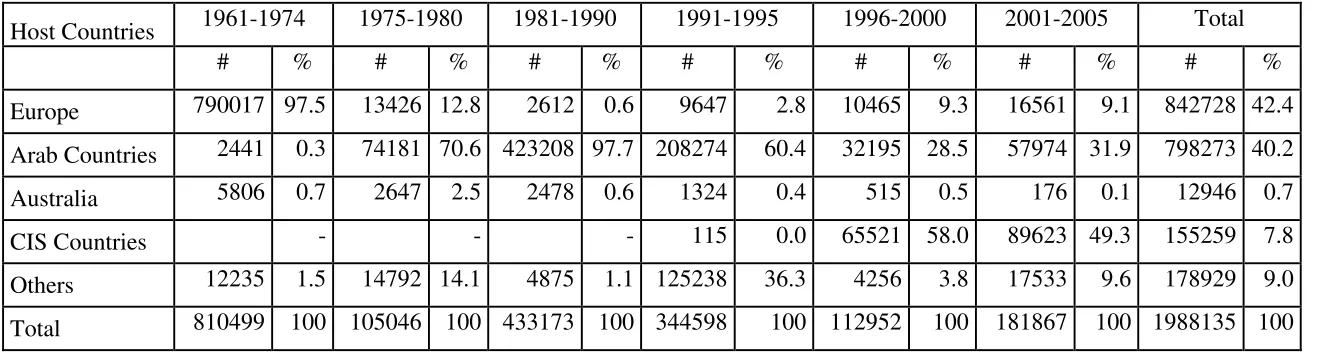
The emigration starting in the 1960s were predominantly of economic nature influenced by macro-economic factors both at the global and national levels. The movement of migrant workers over the period of 1961-1975, which was a period of mass emigration when more than 100,000 workers left Turkey annually up until the stagnation of 1974, fluctuated as a consequence of changes in the European migration market (see Table 1). The number of workers going to Europe increased immediately after 1961, and peaked at 66,000 departures in 1964. In the later periods, the recession of 1966-67 caused a rapid decline in these numbers. In 1967, only 9,000 workers were sent by the Turkish Employment Service (TES), while over 900,000 were on the waiting list to go abroad (İçduygu 1991). When recession was over, the number of emigrants increased sharply the following year. The consequent economic stagnation in 1974 in almost every Western European country resulted in a dramatic decline of the number of labor emigrants, making a total of only 17,000 departures in that
year. The year 1975 marks the end of large-scale Turkish labor migration to Europe. According to the official records in Turkey, a total of nearly 800,000 workers went to Europe
through the TES between 1961 and 1974 (İçduygu 1991, Akgündüz 2008). 649,000 of these
immigrants settled in West Germany, 56,000 in France, 37,000 in Austria and 25,000 in the
Netherlands (İçduygu 2006a: 63). As evidenced by these figures, the biggest movement occurred to West Germany and France.
forms such as family reunion, refugee movement, and irregular labor migration (Böcker 1995,
İçduygu 1996a). The Turkish government pressured by the growing unemployment statistics searched for new job markets, i.e., new countries of destination, for its unemployed masses in the late 1960s. Indeed, the Turkish emigration to Australia and to the countries of Middle East and North Africa (MENA) started as a result of this policy (see Table 1). In the period of 1968-1974, more than 5,000 Turkish workers arrived in Australia (see Table 1). Overall, there
were nearly 12,000 Turkish workers and their dependents that arrived in the country between 1967 and 1975. Since 1975, the level of emigration to Australia has shifted from 200 to 500
settlers, who migrate via family reunifications and marriages, annually (İçduygu 1991).
In the 1980s, Turkey maintained a high level of male labor migration to the MENA countries, Saudi Arabia, Libya and Iraq, as Turkey's search for new labor receiving countries
corresponded with the demand for labor force in these countries (İçduygu & Sirkeci 1998).3 As stated by Appleyard (1995), the dramatic upsurge of oil prices after 1973, and the accompanying increase in the income levels of the oil-exporting MENA states with very small populations, boosted demand for labor. The result was a large influx of contract workers from the developing countries. Migration from Turkey to the MENA countries occurred within this broader context. More than 75,000 workers had gone to the oil-exporting countries in the period of 1975-1980. The total number of migrant workers who had an experience of selling their labor power in the MENA countries was over 700,000 from the 1970s to the mid-1990s (see Table 1). However, by the mid-mid-1990s, partly due to the completion of large scale infrastructural projects in the oil-exporting countries, and partly due to the increasing costs of Turkish labor in comparison with the costs of other labor migration coming from Asia (India, Bangladesh, Philippines, etc.), the number of Turkish workers in the MENA countries began to decline. Indeed, it fell by more than 100,000 from a figure of 250,000 in the late 1980s to 140,000 in the early 1990s and to 120,000 in the late 1990s. In the early 2000s, the number of
Turkish workers in the MENA countries was less than 100,000.
With the collapse of the communist regimes in the 1990s, Turkish emigration continued with the flows of workers to the CIS countries yet within relatively small numbers (see Table 1).
3
As emphasized by Gökdere (1994), after the collapse of the former Soviet Union, some of the newly emerging states in the region launched reconstruction programs. The active involvement of various Turkish firms in these programs attracted a crucial level of project-tied and job-specific migration. The importance of the emigration to the CIS countries was overwhelmingly clear in terms of its impact on the continuity of emigration from Turkey: in a period, when a downturn of migratory flows to the labor-receiving MENA countries occurred
following the Gulf Crisis in 1990, the migratory movement to the CIS countries came as a remedy for the emigration pressure in Turkey. The level of Turkish labor migration to these
states started to increase steadily: from 8,000 workers in 1992 to over 20,000 in 1993, and later to over 40,000 in 1994. It declined to 26,000 in 1996. In 2005, there were more than 70,000 Turkish workers employed in the CIS countries. Overall, in the period of 1990-2005 there were over 150,000 workers who left Turkey to work in the CIS countries.
Despite new and alternative destination routes, Europe remained a long-standing receiving area for an increasing number of newcomers from Turkey mostly due to family reunions in the 1980s and 1990s. Apart from the continuing family reunification flows, many of the immigrants arrived in the receiving countries via marriages that took place between those immigrants already living in Europe who would often choose a spouse from Turkey: marriage migration became a new form of family reunification. After the 1980s, the number of these marriage migrants increased due to emerging transnational networks. Meanwhile, the number of second and third generation migrants reached significant levels. The number of people in Europe from Turkey increased continuously from 600,000 in 1972 to almost 2,000,000 in the early 1980s and to 2,900,000 in the mid-1990s. In the mid 2000s, the total number was over 2,500,000.
Asylum-seeking was also another important dynamic of the migration flow to Europe.
with an annual figure of 25,000 in the late 1990s.
All in all, the population size of the Turkish communities in Europe grew over time. One can identify three main reasons behind this phenomenon. First, Turkish workers were staying for
longer periods than originally planned, and were bringing in their spouses and children.
Secondly, as experienced since the early 1980s, there was an increasing flow of asylum
seekers from Turkey. Thirdly, as more spouses were reunited, the birth rate of the Turkish population rose and large numbers of Turkish children were born in Europe. In fact, while the
actual number of Turkish workers in Europe showed a relatively small increase in the period of 1985-1995, there was a considerable increase in the number of their dependents.
As an outcome of the five decade history of Turkish emigration, today there are several sizeable Turkish diaspora communities mostly in several European countries. Given the fact that in our globalized world, diaspora communities have increasingly become more and more connected to the origin country through the transnational networks, the crucial question is this: how do the diaspora communities impact on human development in the country of origin? Beyond those Turkish emigrants who return home and those remittances which were sent by these emigrants, a variety of influences of Turkish diaspora communities on various aspects of economic, social, and political spheres in Turkey was obvious: these influences range from the emerging ethnic business ties between Turkey and the host countries through various industries such as food and clothing to the increasing massive tourism between Turkey and the receiving countries, from the emergence of new TV channels broadcasting to the European countries to the establishment of several disapora-based music and dance studios, rock and hip-hop mobiles, music schools, graffiti workshops, libraries, and alternative cafés and clubs in some big cities in Turkey, from the formation of diaspora-related civil society activities to the creation of academic institutions working on issues related to Turkish
diasporas.
Turkey as a Country of Immigration and Transit: 1980 Onwards
Although Turkey‟s noted distinct position in the international migration regimes that include
Turkey is a “country of emigration,” based on the number of workers in West European
countries, intense migratory movements headed towards the country in recent years has
the country existed since the early years of the Republic. International migratory movements towards Turkey during the process of nation-state building comprised mostly migrants of Turkish ethnicity, living in neighboring countries. Turkey attracted ethnic Turks of Hanefi-Sunni sect from the Balkans and the Caucasia, which contributed to Turkey‟s religious homogenization. However, especially since the 1980s, migratory practices of the early years of the Republic have followed a course that is substantially different from the migratory
practices of recent times both in terms of nature and scale.
Turkey has received flows of migrant groups (transit migrants, irregular workers, professionals, retirees, asylum seekers and refugees) from diverse ethnic and religious backgrounds migrating for various purposes, turning Turkey into a country of destination as
well as transit. These migratory movements towards Turkey are closely related to Turkey‟s
geographical location. Economic, political and security problems arising in neighboring countries are among the main reasons that drive their citizens to migrate to Turkey. Due to
Turkey‟s position as a bridge between Asia, Europe and Africa, and its important sea routes,
many migrants use Turkey as a transit country for migrating to their destinations in the developed countries of the West. The recent immigration into Turkey can be examined under
two categories: (1) “regular”, i.e., those migratory movements that take place “legally”, and
(2) “irregular” migration, referring to “illegal” or “unregistered” migratory movements. Irregular migration consists of transit migration of people from the Middle East, Asia and Africa, and irregular labor migration of people from the CIS countries. Regular migration, which is registered, covers those of professionals and retirees from the West.
Regarding irregular migration, one might note that the figures have substantially accelerated
from the mid 1990‟s to the late 2000‟s. Although some senior officials4 claim the presence of
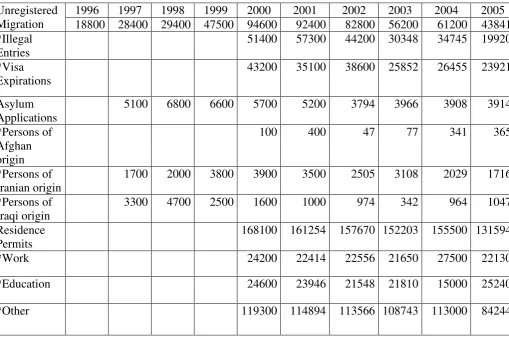
around „one million illegal foreign workers‟ in Turkey, there is no direct and reliable data on undocumented immigration. However some indicative numbers are available. The Bureau for Foreigners, Borders, and Asylum at the Directorate of General Security of the Ministry of Interior reports that there were nearly 95,000 reported cases of irregular migration in 2000. Data on the numbers of irregular migrants who have been apprehended indicate a considerable decline in these numbers from 2000 to 2005. Whereas 19,000 irregular migrants
4
For instance, Yasar Okuyan, the Minister of Labour in the 1999–2002 government often cited the figure of
were detained in 1996, this figure reached 47,500 in 1999, and by 2000 it became 94,600 (see Table 3). Starting from 2001, a decrease is observed in the number of irregular migrants detained: this figure, which was 83,000 in 2002, dropped below 50,000 in the year 2005. In 2006, there was a slight increase in the numbers of irregular migrants apprehended in Turkey, rising to nearly 52,000 in 2006. A total of 64,290 irregular migrants were apprehended in 2007, indicating an upward trend in irregular flows to Turkey since 2003. When it is
considered that these figures represent only detained irregular migrants, it is clear that the scale of irregular migration through Turkey is greater than these figures. In reference to the
relevant literature, it should be fair to say that the true picture would be at least two or three times the number of migrants detained. When the magnitude of such a figure is taken into consideration, it can be stated that the scale of the irregular migratory wave Turkey has received in recent years is comparable to many other countries of the world, which receive intense migration.
When the countries from which irregular migrants originate are considered, it can be seen that almost all of the migrants that come from Iran, Iraq, Pakistan, Bangladesh and some African countries choose Turkey as a bridge to reach their destination countries in the West. Considering the data available on migrants detained by security forces, it can be assumed that in the beginning of the 2000s, more than 50,000 migrants used Turkey as a transit country annually, while this figure has dropped below 25,000 today. Most of these transit migrants enter Turkey illegally with the help of human smugglers, and leave or attempt to leave Turkey
using similar ways (İçduygu 2008).
Without a doubt, the political irregularities, problems and turmoil in the periphery makes
Turkey‟s borders more open to asylum seekers. A great majority of these asylum seekers
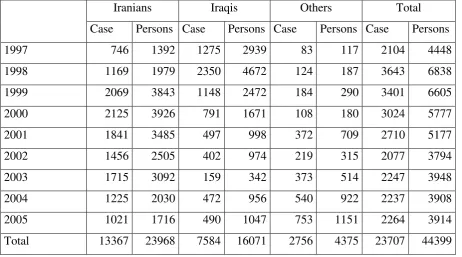
comprise migrants of Asian and African origin. Between the years 1997 and 2005, Turkey
dropped to below 4,000. The migratory movements of asylum seekers, refugees, and transit irregular migrants sometimes intermingle. This is particularly related to the fact that the majority of persons in both groups enter the country illegally. Asylum seekers, after being denied asylum, continuing to stay or working illegally in Turkey or attempting to transit to a third country through illegal border crossings, rather than returning to their countries, are examples of intermingling of irregular migration and asylum seeker movements.
Based on its ongoing geographical limitation in the 1951 Geneva Convention Turkey still
does not accept non-European refugees on de jure basis, but it is a de facto situation that the country receives numerous asylum seekers from neighboring non-European countries. The fact that Turkey does not accept non-Europeans as asylum seekers and refugees has several implications for irregular migration (İçduygu 2003; Kirişçi 2002). Most asylum seekers and illegal transit migrants, mainly from Iran and Iraq, make illegal border-crossings to Turkey with the help of smugglers and traffickers. Some irregular migrants apply for asylum although they have no grounds to do so. By limiting the application of the Geneva Convention 1951 to certain geographical areas, Turkey hopes to be immune to the flows of politically or economically deprived people coming from poor and unstable countries in Asia and Africa. In reality, however, the opposite seems to be the case: the country has been faced with increasing flows of people from these regions, including the Middle East. Turkish authorities have long feared that the abolishment of the geographical limitation would bring even greater numbers of asylum seekers to Turkey, or increase the numbers of foreigners settling in the country,
which would have repercussions for Turkey‟s definition of national identity and even national
security (Kirişçi 2005: 355-7).
Apart from asylum seeking and refugee movements directed at Turkey, the country serves as a destination to migrants coming from countries like Moldova, Ukraine, Russia, Georgia and
to have reached 50,000, a figure that has presumably dropped below an annual level of 25,000 today.
It is possible to explain the change in numbers of both transit migrants and aliens laboring in Turkey in the context of shuttle migration with several reasons. The relevant authorities in Turkey have implemented solid measures for regulating irregular migration in the context of
procedures for harmonizing with the EU legislation, the penalties for human trafficking and smuggling have been increased and the issue of protecting borders is now dealt with more
seriously. The EU process introduced a new perception and new law management of immigration and asylum flow in Turkey. It seems clear that in the last five years the idea of
European integration has already made a significant impact on Turkey‟s policies and
practices. Accordingly, Turkey has demonstrated strong political will to tackle asylum, irregular migration, and human trafficking and smuggling, as well as their labor consequences. In fact, all these changes had direct implications for the human development aspects of the international migration. There were four legislative developments that
constituted direct steps toward harmonization with international standards, and particularly with the EU legislation and implementations (İçduygu 2004, pp. 93-4).
The first development was to fulfill the provisions of the UN Conventions against
Transnational Organized Crime and its Additional Protocols. A draft law on additional
articles to the Penal Code and amendments to the Law on Combating Benefits-Oriented
Criminal Organizations was prepared by the Ministry of Justice and adopted by the
Parliament on 3 August 2002. Through this legal arrangement, the Law No. 4771 added Articles 201/a and 201/b to the Turkish Penal Code to follow Article 2015. These changes
conform to the Palermo Protocol against Trafficking in Persons, which introduces a
definition of trafficking in human beings into the Turkish legal system and criminalizes the
act of trafficking as such. The law prescribes severe penalties for traffickers: five to ten years‟
imprisonment. A further provision was adopted by the Parliament on the same day to criminalize migrant smuggling, conforming to the Palermo Protocol against Migrant Smuggling. These two separate but related crimes have now been fully addressed by the Penal Code.
5For a detailed elaboration of these new Articles, see İçduygu (2003, pp.77
The second important legislative decision was related to the UN Convention against
Transnational Organized Crime and its two Additional Protocols including „The Protocol to
Prevent, Suppress and Punish Trafficking, Especially Women and Children‟ and „The
Protocol against the Smuggling of Migrants by Land, Sea, and Air‟. Turkey was among the initial signatories. This Convention and its additional protocols were approved by the Turkish Parliament on 31 January 2003 and put into force on 4 February 2003. Again this new legal
arrangement was a significant step in developing tools to combat trafficking, smuggling, and irregular migration.
The approval of the draft Law on Work Permits for Foreigners (Law No. 4817, dated 27 February 2003) was the third remarkable change in legislation pertaining to irregular migration and its labor outcomes. Although the Law was published in the Official Gazette on 6 March 2003, it became effective six months after its publication (on 6 September 2003). The Turkish Parliament enacted the Law in order to concentrate the administration of permits in one authority thus enabling foreigners to work in Turkey more easily. The Law aims to ensure that the work permit process in Turkey meets international standards, in particular those of the EU. One important aspect of this Law is to prevent the illegal employment of foreigners by issuing fines. In addition, it allows foreign workers to practice all professions. According to the previous legal arrangement, foreigners were not able to engage in domestic work. This resulted in the exploitation of thousands of Moldavian women working in the domestic sector in Turkey. The new Law on Work Permits for Foreigners and its
accompanying Regulations6 (the Regulation for the Application of the Law on Work Permits
for Foreigners, number 25214 and dated 29 August 2003, and the Regulation for the
Employment of Foreign Nationals in Direct Foreign Investments, number 25214 and dated 29
August 2003) are the instruments which regulate the employment of foreign nationals in Turkey. The procedure for acquiring a work permit has been simplified: work permits are
given by a central authority, the Ministry of Labor and Social Security (the Law, Article 3), and are linked to residence permits, which are administered by the Ministry of the Interior (the Law, Articles 5 and 12). Regulations for foreigners working without work permits are an important aspect of the new Law on Work Permits for Foreigners. It is required that
„independently working foreigners are obliged to inform the Ministry of the situation within at
most fifteen days, from the date they have started working and from the end of the work‟
6
(Article 18a), and that „employers that employ foreigners are obliged to inform the Ministry within at most fifteen days from the end of the said date and from the date when the service
contract was terminated for any reason, in the case that the foreign employee does not start
working within thirty days from the date when the work permit was given,‟ (Article 18b ). The
Law includes penalties for foreigners who work without permits. For instance, an
„independently working foreigner and the employer employing foreigners, who do not fulfill
their obligation of notification according to Article 18 within due time, are fined with an administrative penalty of two hundred and fifty million liras, for each foreigner‟ (Article 21).
In addition to this, „the foreigner that works independently without a work permit is fined with an administrative penalty of five hundred million liras‟ and „an administrative penalty of two billion five hundred million liras is administered to the employer or employer representative
that employs a foreigner who does not have a work permit‟ (Article 21). It is also required that an „administrative penalty of one billion liras (be) administered to the foreigner who works
independently without having a work permit given in accordance with this Law‟ (Article 21).
Finally, an amendment to Article 5 of the Citizenship Law (Law No. 403, dated 11 February
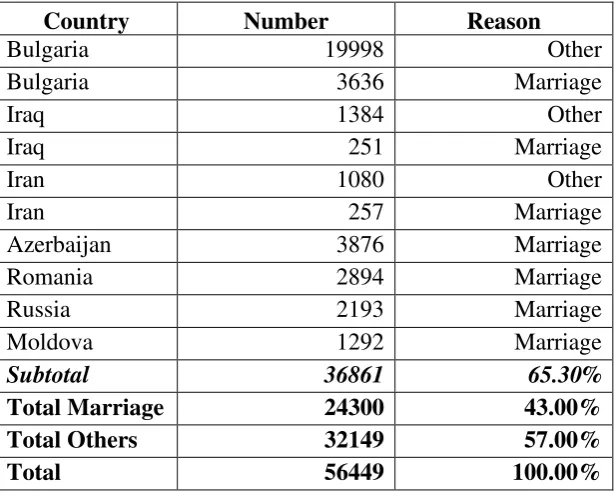
1964) which was made on 4 June 2003, had implications for fighting against irregular migration and protecting immigrants rights. Previously, foreigners (women) could acquire Turkish citizenship immediately by marrying a Turkish national. Under new legislation adopted by the Turkish Parliament, foreigners who are married to Turkish citizens will be able to become citizens of the Turkish Republic three years after their marriage. Citizenship is conditional on the continuity of the marriage over three years. Previously, under Turkish law, it was much harder for male foreigners to obtain Turkish citizenship through marriage. This has now been standardized. In addition, under the new law, children of mixed parents (one
Turkish, one foreigner) are granted Turkish citizenship. The new legislation „foreseeing that married couples from different nationalities must live together for three years after their
wedding to obtain Turkish citizenship‟ was enacted to discourage arranged marriages. Under
the previous legislation, many irregular women migrants obtained their residence and work permits via arranged marriages.
Regarding regular migration, specifically those of professionals and retirees from the West, in the past twenty years, an increasing number of foreign nationals arrive in Turkey for work or education. Officials from the Ministry of Interior and the Ministry of Labor and Social
Considering official data for the early 2000s, approximately 160,000 foreign nationals received residence permits in Turkey (Table 3). For instance, in 2001, the number of foreign nationals in Turkey with residence permits was approximately 160,000, of which 23,000 were staying in Turkey on basis of work permits; around 24,000 on student visas; and the rest (some of whom comprise family members of these working or studying persons) on residence permits but do not currently work or study. The data for 2005, however, indicates the number
of foreign nationals with residence permits to be around 132,000; 22,000 of whom stay on basis of work permits, whereas 25,000 reside on student visas. The remaining 84,000 of
residents are mainly comprised of two groups – family members, retired and unemployed persons.7 Thousands of EU citizens are arriving, settling and working in Turkey in the past ten years at an ever increasing rate, which is indicative that the vibrancy of Turkish economy has increased in a manner enabling it to attract foreign labor and migrants (Kaiser 2003, Kaiser &
İçduygu 2005).
In recent times, another type of regular migratory waves that target Turkey in increasing
levels is the “retirement migration”. Retirement migration generally demonstrates a circular
characteristic, in other words migrants spend only an important portion of the year at the place of migration. In the context of this migratory wave, many tourist resorts, prominently Alanya and other districts and towns of Antalya, Bodrum, Marmaris and Didim and surrounding areas, host a substantial number of retired European migrants. Although reliable statistics are not forthcoming, studies so far and residence permit statistics indicate that only in Alanya around 6,000 European migrants reside, comprising mostly Germans. Although we still need more statistical data and academic research, the number of retired Europeans in all of Turkey may be estimated to have neared 20,000 (Unutulmaz 2006).
INTERNATIONAL MIGRATION AND HUMAN DEVELOPMENT: ECONOMIC REFLECTIONS
In investigating the linkages between international migration and human development, three questions appear to be pivotal: first, what are the main consequences of emigration for
development; second, how these manifest themselves; and third, what means they were
brought about? These are not easily known. Most research on the consequences of
7
international migration for human development has been addressed primarily by looking at the economic aspects, as it could be anticipated from both the unquestioned importance of these conditions and the relative ease with which they can be measured.
Emigration and Its Economic Consequences for Human Development
As discussed earlier, organized mass flows of emigrants from Turkey began with bilateral agreements. Accordingly, from 1961 to 1974, the recruitment of migrants was carried out by
the Turkish Employment Service (TES), the official delegations of the receiving governments, and employer associations. According to this procedure, to be able to go abroad as a worker, an individual had to apply to a local TES office, which would prepare a waiting list, containing the names of candidates for foreign employment. The demands for migrant labor made by migrant-demanding countries to the TES were of two kinds: “Nominative call”, which was a request by an employer for a particular person by name. In this case, there was no need to be on the waiting list. Hence, the TES had no influence on the process except providing a tax-free worker‟s passport. In the second kind, the “anonymous demand”, an employer or the government of the migrant-demanding country requested a category of workers to fill a particular employment vacancy. When the vacancy arose, the TES offered it to the relevant candidate on the waiting list (İçduygu 1991: 47).8
Neither in the early phase of Turkish emigration, which was mainly attached to the European labor immigration, nor in the later phases, in which labor flows were mostly to the countries of MENA and CIS regions, government emigration policies in Turkey did not go beyond the negotiations over the bilateral agreements with the governments of migrant-receiving countries. Apart from negotiating over some additional social security agreements with the migrant-receiving countries, and providing migrant workers with some special worker
passport, the governments in Turkey did not play any role in any type of activities related to the pre-departure phases of emigration: no pre-departure training, no visa facilitation, and no other supports were provided by TES, who was the main and only government institution involved in the process (Akgündüz, 2008).
8 In the peak periods of emigration in 1960s and 1970s, there had been some rumors over the problems of
When the Turkish government promoted labor emigration as a tool of economic development in the early 1960s, the basic idea was to reduce the pressure of unemployment, to gain foreign currency through remittances, and to provide some direct or indirect development strategies for underdeveloped regions of the country. Related to the last point, the government gave priority and facilitated emigration of those emigrants who were from the relatively poor regions of the country; who were members of Village Development Cooperatives in these
poor regions ─they were encouraged to invest their savings from abroad to these cooperatives, the cases to be discussed later in this section; and who were from the regions of natural
disasters (Abadan-Unat 2006: 140).
Referring to a study on the relationship between socioeconomic development and emigration in Turkey (Day & İçduygu 1997), it is possible to argue that there is a bell shaped relationship between the two: emigration increases as the regions get poorer, but when the level of socioeconomic development reaches a certain low level, emigration rates start decreasing as well. It is within this context that while some relatively poor cities of 1960s and 1970s such as Denizli, Afyon, and Yozgat in the relatively developed regions of the country have been the main source of emigrants from Turkey to Europe, some poorest cities in the relatively less developed eastern regions have never become significant departure areas of emigrants (Ayhan et al. 2000). Consequently, different regions of Turkey have been affected by emigration flows at different levels. Today, it is possible to argue that economies of many emigration regions in Turkey are better, stronger, or more efficient as a consequence of emigration: Denizli and Afyon are good examples of this process, while Yozgat seems to be benefiting less from emigration - mainly due to the poor infra-structural facilities in the latter one (Ayhan et al. 2000).
Since from the beginning, Turkish emigrants have appeared to keep in touch with family and
friends in the homeland. Many of them have visited Turkey occasionally on holidays, to attend weddings, or in response to the sickness or death of a relative. They have sent remittances, bought homes and lands, and made investments. Some of them have returned for good. At the very least, one could expect this combination of massive emigration and the maintenance of a high level of contact with homeland to be an important factor of change in
Turkey‟s economic and social life. Naturally, return migration and remittances were highly
central to this change (Atalık & Beeley 1993: 167, Keleş 1985: 63, Martin 1991: 38). Based
workers plus their family members altogether) have returned home since the beginning of migratory flows in 1961.
There is lack of substantial and contemporary data on the Turkish citizens‟ return migration. Since emigration from Turkey had started mainly under the so-called guest worker or contract labor scheme, return migration was an inevitable consequence of the whole process. Return
migration increased after the oil price shock of 1973, when many West European countries stopped recruiting migrant workers and began to encourage return migration. According to
Gitmez (1983), some 190,000 returned between the years 1974 and 1977, and another 200,000 returned between 1978 and 1983. Another study indicates that about 1,000,000 Turkish emigrants returned home up in the period of 1960-1990 (Martin 1991).
With the 1980s, the patterns of migration and settlement of Turkish immigrants in Western Europe have changed from a temporary stay to an unintended settlement. Still, return migration has often been a dynamic element of the whole migration picture. It seems that in the early 1980s, the “Return Acts and Bonuses” of the host governments encouraged substantial return migration to Turkey (Ayhan et al. 2000). For instance, under certain conditions Turkish immigrants in Germany were granted up to 10,000 German Marks in the early 1980s if they accepted to return home with their families. There were some 310,000 returnees from Germany in the period of 1983-85, and some 10,000 returnees from the Netherlands in the period of 1985-86. However, in the late 1980s, the levels of return migration from Germany declined sharply to 37,000 and from the Netherlands to 3,000 persons annually. These figures suggest that there has been a steady number of return
migrants over the last two decades, stabilized at around 20,000 in recent years (İçduygu
2005).
However, the return migration of 1990s and 2000s is quite different from the return migration of 1970s and 1980s. In fact, return today is mostly a movement of a floating population of emigrants between the host and home countries. Many Turkish emigrants who had previously settled in various European countries are returning to Turkey, but not all of them permanently. Many of the first generation migrants who migrated in the 1960s and 1970s and later got retired have started living six months in Turkey and six months in Europe. They prefer the health services and pension systems in Europe; often do not wish to give up their houses, and
2005).
One of the most obvious implications of return migration was on the Turkish labor market. Some of the return migrants directly become employment-seekers as they return with skills and work experience for which the labor market in Turkey has limited demand. There is a widespread conclusion in the literature that most returned Turkish workers buy a taxi or delivery truck, build rental housing, or set up a small business and become part of the service
economy, which are investments with few employment multipliers. It is hard to determine where exactly the migrants settle after they return, but it is generally agreed that they often
prefer urban centers and metropolitan areas rather than their rural home (Eraydın 1981: 245,
Gitmez 1984: 116, Wilpert 1984: 107). One hypothesis is that this process contributes to rural-urban imbalances and regional disparities as funds transferred by the migrants are often invested in urban areas that are already developed to a certain extent.
Another fascinating issue is the incoming workers‟ remittances which serve the interests of the country‟s economy as well as the welfare of migrant households. As noted by Martin (1991: 33), Turkey, as a developing country, faces perennial shortages of foreign funds to pay for imported goods and services, and often needs external capital to support development
projects. From this perspective, workers‟ remittances greatly contribute to the country‟s
economy. Although it is argued that the amount of emigrant remittances Turkey has been receiving is somehow insignificant in comparison with the total saving potential of these migrants, the scale of remittances attributable to labor migration to Europe is large enough and has been the most important source of foreign exchange earnings (Kumcu 1989, Köksal & Liebig 2005). Since the onset of mass labor migration from Turkey in the early 1960s, remittances have become an important element of the Turkish economy, an important source
of foreign exchange, and a major contribution to offsetting the country‟s trade deficits (see
Table 5). Over USD 75 billion has been remitted in Turkey since the early 1960s, giving the average annual figure of USD 1.9 billion (İçduygu 2005). Workers‟ remittances increased
from a modest USD 93 million in 1967 to a peak USD 1.4 billion in 1974 and then declined to USD 893 million in 1978. Turkey had a more or less consistent level of annual remittance receipts of around USD 1.5 - 2.0 billion between 1979 and 1988. In this period, almost a
quarter of Turkey‟s annual total import bill was financed by the remittance receipts. In the
During the late 1980s and early 1990s, the country had annual remittance receipts of about USD 3.0 billion which increased to USD 3.4 billion in 1995, and then peaked to over USD 5.0 billion in 1998. In the 1990s, remittances were equivalent to more than one third of the trade deficit. The percentage declined throughout the late 1990s and the early 2000s. Today in the late 2000s, it makes only around two per cent of the deficit. It seems that, as the Turkish
economy becomes integrated into the world economy through liberalization, the relative size of remittances has begun to decline, but still pay for a large portion of the trade deficits: in
1999, remittances accounted for more than 43 per cent of the trade deficit and over 2 per cent of the GNP. In 2000, the contribution of remittances to the trade deficit was considerably less than in 1999, but its contribution to GNP was almost the same.
In 2001, there was a notable decline in remittances, which continued to fall in the early 2000s, indicating lowest levels of remittances to the country in the last 25 years. This was reflected by the proportions of the total trade deficit, exports, and GNP. The nature of this decline is not so clear, which is partly due to the raising tendency towards permanent settlements in the host countries, partly because of the increasing informal channels of remittances, and partly due to the changing calculations of remittances in the accounting of the national budget, particularly since 2003.9 According to the official statistics, a very sharp decline has been observed in the amount of remittances to Turkey in 2004, which was a more than 80 per cent decrease compared to 2000, indicating the figure of USD 804 million, the lowest figure seen since the early period of migration from Turkey.10
The flows of remittances are naturally sensitive to the changing characteristics of the three actors of migratory process, namely the sending-country, the receiving-country, and the
migrants themselves. For instance, according to Neyaptı, Metin-Özcan and Aydaş (2004), black market premium, interest rate differential, inflation rate, growth, home and host country income levels, and periods of military administration in Turkey have significant effects on the flows. Among them, the negatively significant effects of the black market premium, inflation,
9
Personal communication with Serdar Sayan (Department of Economics, TOBB University, Ankara).
10
and a dummy for periods of military administration point at the importance of sound exchange rate policies and economic and political stability in attracting remittance flows. In addition, both investment and consumption-smoothing motives are observed, although the former appears to be more prevalent after the 1980s.
The money coming from abroad often finds its way into the maintenance of the family left
behind or is spent as an investment in property, or possibly as part of the migrant‟s attempt to set himself up in a trade or other new enterprise (Atalık & Beeley 1993: 170). According to
Koç and Onan (2004), remittances have a positive impact on household welfare, as the households receiving remittance are found to be better off than non-remitting households. Although some argue that remittances are not mostly spent on “productive investments” that would contribute to long-term development, “productive use” of remittances may be served in a variety of other ways such as investment in human capital in the form of expenses on certain consumption items, education, and health (Taylor 1999, Glytsos 1996). Findings from a survey conducted in Turkey in the late 1990s indicate that 12 per cent of the households that receive some kind of remittances in Turkey spend about 80 per cent of the remitted money on improving their standard of living, i.e., for daily household expenses, buying household items, and house renovation (Ayhan et al. 2000). When return migrants choose to settle somewhere different than their point of origin in Turkey, much of the remitted money is spent on consumables for the new home. Thus, although remittances do not directly help to reduce imbalances between regions in the country, they clearly make specific improvements possible
in the lives of migrant households (Keleş 1985: 74).
In order to channel remittance savings into employment-generating activities, Turkish
authorities installed three unique development programs in the 1970s (Keleş 1985: 65, Martin
1991: 35). First, they supported the establishment of Workers’ Joint Stock Companies that
would invest in the less developed areas rather than the developed regions of the country.11 These companies were open through the remittances and the contribution of non-migrant households in the migrant sending regions; and if it is required, the State was able to provide co-financing through a public bank, Agricultural Bank (Ziraat Bankası), maximum up to one
11
third of the total investment. Such investments would generate job opportunities to the returning migrants and serve as a tool for the economical use of their savings. Regarded as an
efficient way of industrializing the regions of origin, more than 600 workers‟ companies had
been created with varying degrees of capital and number of shareholders. The workers‟
companies were aiming at achieving a social goal of developing the backward regions, but their role in fostering development has been rather minimal. They were unable to get away
from the economic considerations related to the productive operation of the enterprises and have run into various problems such as project identification, financial and technical planning
and management, and inadequacy of communications.12
Secondly, Village Development Cooperatives were founded, mostly in the poor regions of the
country, as a part of the official policy of reintegrating the migrants‟ and return migrants‟
savings into the local economies. These Cooperatives were not design ed solely as a means of
to reinvest migrants‟ remittances, but rather remittances were only one of the main sources of financing these Cooperatives. As many of them sought to secure jobs for their members rather than to realize productive investments in the villages through remittances, most of the co-operatives were really used as a vehicle to facilitate more migration. Despite their shortcomings, they still had a considerable impact over the development of various migrant-sending communities. As an indirect indicator of their impact, their number increased remarkably: from over 2,000 in 1971, to more than 4,500 in 1973, and nearly 6,000 in 1974. The number of their members was nearly one million in 1974 (Abadan-Unat 2006: 145). One of the main contributions of these cooperatives was the mechanization of agriculture from
1960s to 1970s. To illustrate, in Boğazlıyan, a town of Yozgat province that is the origin of
many migrants to Europe, the number of agricultural machineries had increased from 300 in 1966 to 1,500 in 1975, mainly through the investments made by emigrants (Abadan-Unat et al. 1976: 232).
Thirdly, State Industry and Workers’ Investment Bank was founded in 1975 to attract the savings of the migrants. The main reason behind the establishment of this Bank was not only to attract the remittances, but also to channel the flows of remittances to the establishment and development of various industries around Turkey. The bank advocated mixed enterprises
organized by the state and private capital, including workers‟ remittances. However, this
12
effort has been unsuccessful both in overall enterprises and in channeling the investment resources into less developed regions.13
Emigration has obviously helped to reduce unemployment pressures in Turkey, but its effect is not easy to quantify since both emigration and employment are difficult to measure
precisely. Turkey‟s first Five-Year Plan in 1963 reported that “the export of excess, unskilled labor to Western Europe represents one of the possibilities for alleviating unemployment” (Abadan-Unat 1986: 330). It is generally agreed that since the early 1960s, around 10 per cent
of the workforce in Turkey has been unemployed and another 15 per cent underemployed. Thus, reduction in unemployment and underemployment is of paramount importance. Meanwhile, several studies point out the potential growth-slowing effects of Turkish emigration because of the emigration of skilled workers (Pennix 1982: 793). While Turkey has a long history of emigration of a certain level of skilled labor, the nature of this movement has changed over time: as far as the early guest-worker movement was concerned, nearly one-third of emigrants were skilled workers such as masons, carpenters, and plumbers (Akgündüz 2008: 156). However, the proportion of skilled workers (such as workers in car industry and construction sector who had earned certain training or developed a certain expertise and developed know-how in the job s/he had been performing) declined dramatically in later periods. Moreover, particularly since 1980s, there is a growing trend of brain-drain from Turkey. Many university graduates has migrated to the traditional migrant receiving countries of the United States, Canada, and Australia (Akçapar 2009). This group of immigrants refer to young and talented people with high social capital who continue their education abroad and continue working in the same host country instead of returning to Turkey. Similarly, Turkey has also become a source country of mass student migration: while some of these students tend to return home after their graduation, many prefer to stay in the countries where they study. Akçapar‟s study (2009) indicates that more than half of the Turkish university students
in the United States intend to stay abroad after their graduation. On the other hand, development of private universities in the country serves an interesting case of return of highly skilled Turkish emigrants: since mid-1980s, private universities in the country with their very competitive facilities have attracted many Turkish scholars, scientists, and university graduates living abroad, back to the country.
13
Immigration and Its Economic Consequences for Human Development
As noted earlier, the new immigration flows to Turkey have been historically atypical for the country, consisting largely of transit migrants, irregular laborers, asylum seekers, and refugees who began to arrive first in small numbers, and subsequently in an ever rising tide that has reached sizable figures in recent decades. The nature of national immigration policies and
practices in Turkey has been very much affected by the European Union‟s promotion of the notion of “migration management” in the process of European integration, transforming the qualities and conditions of migration and asylum policies and practices in the country.
It is within this context that, as noted earlier, the new Law on the Work Permits of the
Foreigners and its accompanying Regulations indicate an important step in legislation
pertaining to immigration and its labor outcomes. The Law can be regarded as an indicator of the official “unintended acceptance” of the fact that Turkey is on the way of becoming a country of immigration. It centralizes the administration of work permits in a single authority to ease the permit process for foreigners, matching international standards, particularly the EU ones. One important aspect of this Law is to prevent illegal employment of foreigners through issuing of fines. In addition, unlike the previous legal arrangement that banned foreigners to engage in certain employment sectors, the new law allows foreign workers to practice all professions. One such sector was domestic work, which had resulted in, for instance, exploitation of thousands of Moldavian women working in the domestic sector in the country.
Among different types of immigration flows to Turkey, circular type of irregular migration has the most direct economic implications. Circular, or shuttle, migration refers to the mobility of persons making multiple trips to Turkey in search of economic opportunities. In this type of irregular migration, entry into Turkey is typically legal, but these visitors may
overstay their visas. An important type of shuttle migration is suitcase trade, which is also known as shuttle trade, trader tourism, or shopping tourism. This is a legal form of trade-based mobility and people carry goods in the luggage that they carry during transportation.
Suitcase trade is an effort to take advantage of the demand for and supply of various
concomitant removal of travel restrictions, entries by suitcase traders from the Eastern European and CIS countries skyrocketed to more than one million per year and remained so throughout the 1990s.14
In recent decades, the suitcase trade has been a central component of the trade balance in Turkey. Revenue from the suitcase trade, particularly from the former communist countries
in the neighboring regions, is highly significant compared to the total remittance income. For the period 1996–2003, the amount gained from the former was always higher than the amount
gained from the latter (see Table 6). In 2005, the amount of revenues from suitcase trade was nearly USD 3.5 billion, four times higher than the revenues from remittances of the same year. In 2006, the amount of revenues from the suitcase trade was more than USD 6.4 billion, indicating nearly 85 per cent increase compared to the previous year, and six times higher than revenues from remittances of the same year. In 2007, suitcase trade was around USD 6.0 billion, five times more than the remittances of the same year. Turkey‟s long established
flexible visa regime, which is particularly open to the citizens of country‟s close geographies,
has been very helpful for the movement of the citizens of the Eastern European and CIS countries. However, as part of Turkey's recent policies of combating irregular migration, there have been some attempts of changing the visa regime towards a more restrictive one.
Another significant type of irregular circular migration is the mobility of people who come to Turkey in search of informal jobs. These irregular labor migrantsare poorer people mostly
from the CIS and some Eastern European countries who arrive in Turkey on tourist visas to work informally as domestic laborers, sex workers, construction workers, or sweatshop workers. The majority of them appear to be women, and hail from places such as Moldavia, Bulgaria, the Ukraine, Transcaucasian Republics and Central Asia.15
The economic contribution of irregular circular migration to certain sectors of the economy in
14
Although exact figures are unavailable, suitcase trade exports from Turkey to FSU countries were estimated to be around 9 billion dollars in 1996 and fell sharply after the Russian financial crisis in 1998 and have not recovered from a low point of 2 billion dollars per year since the early 2000s, partly as a result of the transformation of the nature of international trade between Turkey and Russia and other FSU countries. For a detailed account of shuttle trade from the FSU, see Yenal (2000) and Yükseker (2003).
15
Turkey is obvious: domestic care, construction, textile, entertainment, tourism, food, and restaurant sectors largely benefit from these migratory flows. These migrants are attracted to these sectors not only because they provide “cheap and skilled” labor that is needed, but also as it will be discussed later, they have a culture of good work, which is very much appreciated by the receiving communities and individual employers. Still, immigration movements to Turkey have been highly irregular in nature and maintaining a legal presence in Turkey for all
migrants is very difficult due to limitations on residence and working permits or in the Turkish Citizenship Law. This status of irregularity often disadvantages migrant worker in
the labor market, pushing them often to work in the 3-D jobs (difficult, dangerous, and dirty) with low payments (İçduygu & Akçapar 2006, İçduygu & Biehl 2008).
INTERNATIONAL MIGRATION AND HUMAN DEVELOPMENT: SOCIAL, POLITICAL, AND CULTURAL REFLECTIONS
The academic literature on the linkages between international migration and development is very much preoccupied by the economic aspects, largely overlooking the impact of international mobility on the social, political, and cultural spheres. This section will focus on these latter aspects and relate them both to emigration and immigration in Turkey as they are often directly associated with human development.
Emigration and Its Social, Political, and Cultural Implications for Human Development
International migration has a great potential to bring about a variety of social mobility to the migrants as well as to their relatives, friends and their communities at large. For instance, there is ample evidence that emigration has greatly affected the employment status of Turkish migrants in the receiving countries, and in Turkey upon their return. Women are particular examples: migration enabled many of them to participate in labor force for the first time in their lives, or took them from agricultural sector to manufacturing and service sectors. Such changes in emigrants' employment status increased their economic well-being, which raised their social status, removed their burden of debt, or opened up opportunities for schooling, training, or entrepreneurship (Day & İçduygu 1997).
The experience of emigration also affects the migrants‟ perceived social status. While in
standing in Turkey improves markedly both in rural and urban communities. Returnees are usually among the wealthiest people in their villages of origin, or emigration facilitate return migrants to relocate in urban areas. Furthermore, as noted earlier, remittances are most often spent on building a modern house, buying land, and farm machinery, and purchasing urban apartments, cars and trucks, or electrical appliances (Abadan-Unat et al. 1976). Return migrants in villages with cars and appliances noted frequently that their non-migrant
neighbors also made such purchases during the 1970s and 1980s, but they were often among the first with new consumer goods and usually had more of them. This suggests that in many
ways, emigration provided the remittances and perhaps the desire for such purchases, and sped up changes that would have occurred in any event. Abadan-Unat (1986: 364) emphasizes the conspicuous consumption of returnees, noting that some displayed electrical appliances as a symbol of their affluence even before their village had received electricity. On the other hand, it appears that social and economic inequalities have been prone to the negative impact of emigration: some studies indicate that socio-economic status of non-migrant households worsens compared to their migrant counterparts' (Day & İçduygu 1997, 1998, 1999). While migrant households accumulate wealth through remittances, this change in migrant-sending communities causes the gap between the socio-economic status of these households and that of non-migrant households widen. The related price inflation of properties has also an enormous negative impact over these non-migrant households.
Turkish workers often return home with changed attitudes and behaviors: in fact, the label of
“Almanyalı”, which literally implies “Turk from Germany” as the local non-migrant people call the Turkish migrants in Europe with this expression, is a product of these perceived
changes in attitudes and behaviors (Atalık & Beeley 1993: 169). There are also changes in
generational and gender relationships within migrants‟ more immediate personal-social environment; perhaps the most important being the changing status of women (Abadan-Unat
1975 (Abadan-Unat 2006: 165).
According to Akgündüz (2008: 152), there are numerous evidence that some Turkish migrant women made deliberate efforts to join the mainstream social life in Europe: “…young female workers living in München developed a custom of getting together at weekends and going dancing”. Given the fact that in 1960s, dance was still something alien for many women in
Turkey, the modernizing effect of emigration is very obvious for the individuals and their families. Likewise, findings from a survey of Turkish migrants in Germany in the early 1960s
also indicate the transformation to a European life style: 20 per cent of the respondents ate pig meat, 38 per cent saw observing Ramadan incompatible with modern life, and only 23 per cent fully fasted during Ramadan (Abadan-Unat 1964).
Upon their return to Turkey many migrant women have wanted to settle in urban areas, and they have often tended to acquire more authority within the family. For the men, traditional symbols of status that are based on age, kinship, devoutness, or ownership of land were replaced by modern indicators such as income, qualifications, skills, and perhaps knowledge of a Western European language. The roles and relationships of parents and children have also changed as a result of migration experience, which was perceived rather negatively by the parents, fathers in particular, as they began to lose their traditional authority over children. In short, emigration was one of the factors that pressurized the extended family and traditional familial relationships.
There are other rather unintended social consequences of emigration such as cultural-revivalist tendencies among the Turkish migrants abroad, problems related to return migration and second-generation returnees (Sayarı 1986: 95). The cultural-revivalist trends are associated with the growth of Muslim fundamentalism as well as the troubles with Kurdish