http://dx.doi.org/10.4236/opj.2016.68B006
Evaluation of the Coherent Combining
Lasers Array by the Power in the
Bucket of the Main Lobe Method
Yang Liu, Xi Zhang, Debao Zhang, Wenqin Huang, Chang’an Qiao, Bo Wang
Wuhan Mechanical Technology College, Wuhan, China
Received 25 April 2016; accepted 19 August 2016; published 25 August 2016
Abstract
Coherent combination of laser beam is an important and challenging area of high power laser science. And how to evaluate the high power laser by coherent beam combination is a new re-search spot. Formulas for the radiated intensity distributions of coherent combined Gaussian beam array are derived via Fraunhofer scalar diffraction model by utilizing representations of the cross-spectral density of the far field. Effects of beam array numbers and separate distances etc. on far field radiated profiles are shown and analyzed. A new conception named power in the bucket of the main lobe (PIBm) is advanced to measure the beam quality of combined beams. This
evaluation method is useful for efficiently determining the peak irradiance and power in the bucket for single emitting apertures of general shape.
Keywords
Coherent Combination, Beam Shape, Fill Factor, Power in the Bucket
1. Introduction
Achieving high optical power and high brightness has always been the major goals in the development of laser technologies. A natural means of increasing the power and especially the brightness should be to combine many individual lasers into arrays. In recent years, coherent and incoherent combinations of laser beams have been in-tensively studied theoretically and experimentally due to their wide applications in long-range energy delivering, etc. Since then, beam quality and divergence angle of laser arrays in the far field have also been investigated, and how to evaluate the high power laser by coherent beam combination is a new research hotspot [1] [2].
In this paper, based on the representations of the cross-spectral density of the far field, the radiated intensity distributions of coherent and incoherent combined Gaussian laser arrays are formulated and depicted. Effects of beam array numbers and separate distances between each source element on far-field radiated profiles are illu-strated by numerical examples.
(PIBm) at the far field target. The PIBm is defined as
( )
, 2 2( )
,m
x y
PIB I x y circ dS I x y dS
R + =∫∫ ⋅ ∫∫ (1) m
PIB is the ratio of the power in the main lobe to the total power of the array in the far filed intensity distri-bution. On this basis, a new conception is advanced to measure the beam quality of combined beams.
2. Theory Model
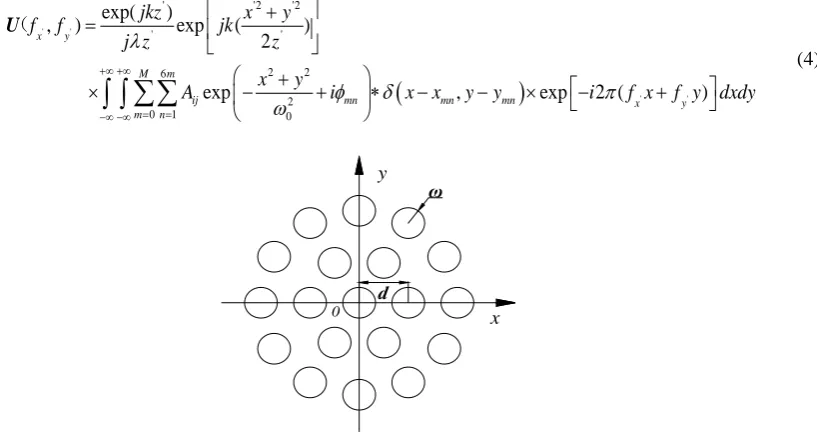
According to Fraunhofer diffraction theory, the diffraction field that collimated beam passing through lens can be calculated by Fraunhofer diffraction formula. In this paper, we established a laser combination array of sev-eral individual Gaussian beams with a near-field intensity profile arranged of a hexagonally packed group of emitters on a circle in a “bolt-hole” beam pattern as shown in Figure 1, and the far field beam profile calculation is based on scalar diffraction theory. The far field complex amplitude distribution is sensitive to near field beam relative phase relationship; array areal fill factor and array number [3]-[5]. We assume that every beam in the array has same intensity distribution with different beam center positions, and every beam waist width is equal
as ω0, the distance between nearest beams is d, the total number of the laser array is N,
1
1 Mm 6
N= +
∑
= m,m is the circle number of the array.The coordinate location of each beam can be referred as (xmn, ymn),
(
)
2cos 1
6 mn
x md n
m π = ⋅ − ,
(
)
2 sin 1 6 mny md n
m
π
= ⋅ −
(2)
The intensity of the laser array in the near field pattern can be written as
(3)
where, Amn, φmn is the complex amplitude and initial phase of each beam respectively. The far field profile is the spatial Fourier transform of the near field pattern, and the far field complex amplitude of coherent combined Gaussian laser array can be expressed as
[image:2.595.128.537.488.704.2](4)
Figure 1. Arrangement of array beams.
(
)
2 2
6
2
0 1 0
2 2
6
2
0 1 0
( ) ( )
( , ) exp
exp , M m mn mn mn mn m n M m
mn mn mn mn
m n
x x y y
x y A i
x y
A i x x y y
φ
ω
φ
δ
ω
= = = = − + − = − + + = − + ∗ − − ∑∑
∑∑
U(
)
' ' ' '' '2 '2
' '
2 2
6
2
0 1 0
exp( )
, ) exp ( )
2
exp , exp 2 ( )
x y
M m
ij mn mn mn x y
m n
jkz x y
f f jk
j z z
x y
A i x x y y i f x f y dxdy
λ
φ
δ
π
The far field cross-spectral intensity distribution pattern is the square of the complex amplitude model. For simplicity, we neglected the constant items, and the far field intensity distribution pattern of the array is easy to get as
(
)
6{
(
)
}
2 2 2(
)
2 2
0
0 1
, exp exp
2 M m
x y mn mn x mn y mn x y
m n
k
I
θ θ
A i k xθ
yθ
φ
ω
θ
θ
= =
∝ + − × −
∑ ∑
+ (5)where θx y, =mλ/d,and we will see that the far field cross-spectral intensity distribution pattern is the product of the intensity of the laser array in the near field pattern with a single Gaussian beam. We induce a spatial co-herence degree factor γ which is defined as a fuzzy function of phase difference, complex amplitude, and po-larization etc. Note that, the value of the coherence degree factor γ is ranged from 0 to 1. When γ =1, it re-fers that the array is completely coherent combined and when
γ
=0, the array is completely incoherent com-bined. In this paper, what we consider is the relative distribution of light intensity on far field, so we investigated the sensitive factors of array arrangement, coherence degree factor and the laser beam number which may influ-ence the far field intensity distribution pattern. According to the above Formulas (2)-(5), we can simulate the far field distributions of the laser array and present the concept of PIBm to evaluate the coherent combining sys-tem’s performances.3. The Far Filed Characters upon Sensitive Factors
According to Fraunhofer diffraction theory, the diffraction field that collimated beam passing through lens can be calculated by Formula (5), where i is imaginary unit, k is wave number (xmn,ymn) is the incident field coordi-nates, (
θ θ
x, y) is the angle away from the normal, N is the total number of wavelets, d is the diameter of circular beams. For convenience, we demonstrate every sensitive factor assuming the other factors are constant.3.1. The Array Arrangement
In this section, we study the performance of the array arrangement to the far field distribution. Suppose that there are only static phase distortions due to the laser path length differences between the different channels. Numerical calculations will be carried out to correct those phase distortions by finite number of iterations. We will consider hexagonal distributed laser arrays containing seven lasers as an example. We suppose that each fiber laser beam has a single Gaussian mode output. The beam waist of each laser is ω0, and lasers are arranged in an array with the nearest neighbor separated by a distance d. Vacancy factor f =(2ω0/ )d can be used to describe the compactness of the array. A smaller f corresponds to a more compact array. The nu-merical calculation of the far field distribution with variable f =1.0, 0.85, 0.5, 0.25 is shown in Figure 2.
From results it is found that, for coherent combination of Gaussian laser array, its intensity distributions would turn out to be occupy many rough lobes around the a central lobe. For example, when f =1.0, the far field distribution is the Gaussian type. With f increases, more side-lobes appear which are induced by ef-fects of interference of many separate source elements. While the vacancy factor decreased, the number of circle fringes increased but the radius of the central far-field lobe also decreased. What is most important is that the power in the bucket of the main lobe made the same corresponding changes. For certain f, the radius of the central far-field lobe can be calculated and the power in the bucket of the main lobe is the integration of such radius in the power domain.
3.2. The Coherence Degree
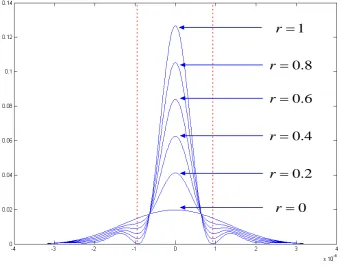
We induce a spatial coherence degree factor γ which is defined as a fuzzy function of phase difference, com-plex amplitude, and polarization etc. [6]. From the Formula (5), it is easy to know that the factor γ has no con-tributions to the far filed distribution pattern, but it is sensitive to the on axis density and the power of the main lobe. Assuming laser arrays containing seven lasers and its vacancy factor f =0.8, the numerical calculation of the far field transverse plane distribution with variable γ value is shown in Figure 3.
Figure 2. Far field distribution with various f: (a) f = 1.0 (b) f = 0.8 (c) f = 0.5 (d) f = 0.25.
Figure 3. Far field distribution with various γ.
0
=
r
2
.
0
=
r
4
.
0
=
r
6
.
0
=
r
8
.
0
=
r
1
=
[image:4.595.142.486.439.705.2]may be the most important character is that, the fringe visibility at the far field does depend on the coherence degree but that dependence varies strongly with the array arrangement and the number of laser beams in the ar-ray.
3.3. The Number of Array Beams
The equations are an exception to the prescribed specifications of this template. You will need to determine whether or not your equation should be typed using either the Times New Roman or the Symbol font (please no other font). Equations should be edited by Mathtype, not in text or graphic versions. You are suggested to use Mathtype 6.0 (or above version).
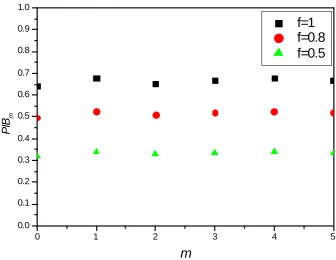
From the Formula (5) of the theory model, total number of wavelets of the combination array does some ef-fect to the far field intensity [7]. In this section, we computed the power of the main lobe versus the variable number of beams at a certain value of f. Figure 4 shows the calculated PIBm versus m when f = 1.0, 0.8 and 0.5 independently.
In the graph, m is the circle number of the array arrangement and the total number of the array is
1
1 Mm 6
N= +
∑
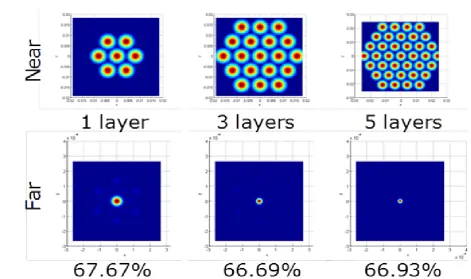
= m. For example, if m = 0, the total array number is 1, if m = 5, the total number is 91. It is clear that, the effect to the PIBm by m is very small, and the PIBm is fluctuating high and low irregularly with the variation of m. The fluctuating range is so limited that it even can be ignored compared with the effect of the ar-ray arrangement. Figure 5 gives the near and far field intensity distribution of arar-ray arrangement and the calcu-lated PIBm value when m = 1, 3, 5. For rough evaluation of coherent laser array combination, the computedm
PIB seems to have little difference within 0.5%.
4. Power in the Bucket of the Main Lobe
[image:5.595.145.482.439.699.2]In this section we discuss the way how to rough evaluate the coherent beam combination by the method of pow-er in the main lobe of the array’s far field distribution. From the above analysis in Section 2 and Section 3, we know that for a given laser array, its far filed intensity distribution is determined by the factors of f, ,γ m. For the far field intensity distribution shape, the main lobe almost consistent if the f is arranged. The PIBm of the array is the ratio of the power in the main lobe to the total power of the array in the far filed intensity distribution.
Figure 4. PIBm versus various m at certain f.
0 1 2 3 4 5
0.0 0.1 0.2 0.3 0.4 0.5 0.6 0.7 0.8 0.9 1.0
P
IB
mm
Figure 5. Near and far filed distribution and the PIBm value when m = 1, 3, 5.
By the Formulas (4) and (5), we can calculate the PIBm in the ideal coherent combination state, and then take trap-hole method to measure the actual power in the bucket, the ratio of the actual power to the ideal calculated power is useful to evaluate the coherent combination effect of the sub lasers [8] [9]. A higher ration corresponds to a good coherent combination array. Laser’s coherent combining is focused in high-energy laser field because of its increasing focal spot power density in evidence. Traditional evaluation criterion of beam quality can't represent predominance of coherent combining over incoherent combining. According to character of coherent combining, this PIBm method we presented for evaluation system of beam quality is constructed. This new evaluation system can represent significant predominance of coherent combining and improvement of laser's coherent combining system's performance.
5. Conclusion
In this paper, we have presented formulas for the radiated intensity distributions of coherent combined Gaussian beam array via Fraunhofer scalar diffraction model. We then deduced a set of formulae useful for efficiently de-termining the peak irradiance and power in the bucket for single emitting apertures of hexagonal distributed la-ser arrays. The far-field intensity distribution for coherent combination is numerically calculated and the sensi-tive factors are discussed in detail. A new conception named power in the bucket of the main lobe (PIBm) is proposed to measure the beam quality of combined beams. This evaluation method is useful for efficiently de-termining the peak irradiance and power in the bucket for single emitting apertures of general shape. Compared with other beam quality parameters, PIBm has many advantages on physical concept, feasibility and measure-ment in the project.
References
[1] Fan, T.Y. (2005) Laser Beam Combining for High-Power High Radiance Sources. IEEE J. Quantum. Electron., 11, 567-577. http://dx.doi.org/10.1109/JSTQE.2005.850241
[2] Li, Y.Z., Qian, L.J., Lu, D.Q., Fan, D.Y., Wen, S.C. (2007) Coherent and Incoherent Combining of Fiber Array with Hexagonal Ring Distribution. Opt Laser Tech, 39, 957-63. http://dx.doi.org/10.1016/j.optlastec.2006.06.010
[4] Evans, G.A. and Hammer, J.M. (1993) Surface Emitting Semiconductor Lasers And Arrays. Academic Press, New York.
[5] Nabors, C.D. (1994) Effects of Phase Errors on Coherent Emitter Arrays. Appl Opt, 33, 2284-2289. http://dx.doi.org/10.1364/AO.33.002284
[6] Renwick, S.P. (2005) What Makes a Coherence Curve Change? Proc. of SPIE, 5754, 1537-1547. http://dx.doi.org/10.1117/12.598939
[7] Li, J., Chen, Y.R., Xu, S.X., et al. (2009) Far-Field Radiation of Coherent and Incoherent Combined Lorentz-Gaussian Laser Array. Proc. of SPIE, 7749, 1-6
[8] Smith, I.W. (2011) Beam Shape of Coherently-Combined Optical Arrays. Proc. of SPIE, 8052, 1-15. http://dx.doi.org/10.1117/12.883402
[9] Tan, Y. and Li, X.Y. (2012) Numerical Analysis of Beam Quality Factor β on Coherent. Proc. of SPIE, 8551, 85511-1-9.