1\ Y I j
i' I &
Neither the EURA.TOM Commission, its contractors nor: any person acting on their behalf:
1 o - Make any warranty or represei;itation, express or implied, with respect to the accuracy, completeness, or usefulness of the information contained in this document, or that the use of any information, apparatus, method, or process disclosed in this document may not infringe privately owned rights; or
Dieser Sonderdruck ist fur eine beschr iinkte V erteilung bestimmt. Die Wiedergabe des vorliegenden in ,,NUCLEAR INSTROME!'{TS AND METHODS", Vol. 26, Nr. 2 - 1964, 301-304 erschienenen Aufsatzes erfolgt mit freundlicher Genehmigung des Herausgebers. Bestellungen weiterer Exemplare sind an North-Holland Publishing Company - P.O. Box 103, Amsterdam (Netherlands), zu richten.
Ce tire-a-part est exclusivement destine
a
une diffusion restreinte. llreprend, avec l'aimable autorisation de l'editeur, un article publie dans «NUCLEAR INSTRUMENTS AND METHODS~. Vol. 26, N° 2 - 1964, 301-304. Tout autre exemplaire de cet article doit 2tre demande
a
North-Holland Publishing Company - P.O. Box 103, Amsterdam (Netherlands).Questo estratto e- destinato esclusivamente ad una dif fusione limitata. Esso
e
fitato riprodotto, per gentile concessione dell'Editure, da •NUCLEAR INSTRUMENTS AND METHODS~, Vol. 26, N° 2 -1964, 301-304. Ulteriori copie dell'articolo debbono essere richieste a North-Holland Publishing Company - P.O. Box 103, Amsterdam (Netherlands).UC LEAR INSTRUMENTS AND METHODS
26 (1964) 301-304;
©NORTH-HOLLAND PUBLISHING CO.A NEW METHOD FOR PREPARING RADIOACTIVE SOURCES*
E. FUSCHINI, C. MARONI, C. PORCEDDU and P. VERONESI
Istituto di Fisica delta Universita, Bologna
lstituto Nazionale di Fisica Nucleare, Sezione di Bologna
Received 7 August 1963
le describe a new technique for preparing thin and uniform 1dioactive sources. The method is based: (1) on the spraying of a >lution, containing the radioactive nuclide, by using a mechan-al nebulizer; (2) on the use of a high electric field applied :tween the nozzle of the nebulizer and the collecting surface .
. Introduction
The preparation of uniform and thin sources is of reat interest for many researches in radioactivity. everal authors dealt with this problem and proposed uious and original solutions. A complete and detailed :view of the different methods proposed was made by
arker et a/.1). These authors examined all the
sug-!sted and applied procedures up to 1959 and reported a ide bibliography of the published papers. Later, other :searches were performed and interesting results
ap-eared on this subject2 -s).
L___
g. 1. The principle of the original apparatus, proposed by Carswell and Milsted.
One of the more recently proposed method is Bruninx 1d Rudstam's which improves the method firstly
sug-:sted by Carswell and Milsted9
) in 1957. Essentially, the
rocess consists of the electro-spraying of a solution mtaining the active nuclide. The principle of the 1ethod is shown in fig. 1. By applying a d.c. voltage of Jout 5000 to 10000 V, between the positive electrode 1mersed into the liquid and the metallic foil, the liquid
This work was supported by Euratom-CNEN contract.
This process is very simple and can be widely used. The yield of the deposition ranges between 50% and 70% but can even be higher than this last value. The deposition results uniform and compact.
is forced out of the capillary and dispersed as extremely small droplets. The detailed study of this method, per-formed by Bruninx and Rudstam, has shown:
1. The salt containing the active nuclide must be
soluble in a solvent of high vapor pressure and low sur-face tension;
2. The selection of the more convenient diameters of the capillaries and wires is difficult, it requires a large disponibility of samples among which to select, tentati-vely, the better ones; such tests are to made preliminarily with non active solutions;
3. The growing of air bubbles into the capillary dam-ages the spraying; the quenching of the bubbles is not easy to obtain ;
4. The deposit turns out very uniform and fine-grained ( of the order of a micron);
5. By heating the metallic (aluminum) thin plate col-lector at 600° C, it is possible to obtain a very sticking deposit;
6. The spraying of 50 µliter, requires times ranging from some minutes to about half an hour; this fact implies fairly long times for spraying greater quantities when this is necessary.
We attempted this method for preparing a source of
I) W. Parker, M. De Croes and K. Sevier, Nucl. Instr. and Meth.
7 (1960) 22.
2) E. Bruninx and G. Rudstam, Nucl. Instr. and Meth. 13 (1961) 131.
3) W. Parker, M. De Croes and K. Sevier, Nucl. Instr. and Meth.
7 (1960) 163.
4) L.B. Warner, Nucl. Instr. and Meth. 14 (1961) 315.
5) V. A. Gorodyskii, Y. F. Romanov, A. V. Sorokina and M. I.
Yakunin, Prib. Tekh. Exp. 5 (1959) 128, (Quoted by 6). 6) D. Michelson and H. 0. V. Richardson, Nucl. Instr. and Meth.
21 (1963) 355.
7) W. Parker and Y. Grunditz, Nucl. Instr. and Meth. 22 (1963) 73.
8) M. Mladenovic and Ali El Farash, Nucl. Instr. and Meth. 23 (1963) 175.
9) D. J. Carswell and J. Milsted, J. Nuclear Energy 4 (1957) 51.
302 E. FUSCHINI et al.
Ca47 for an experiment on
p -
y - y angularcorrela-tions10). Our tests evidenced two troubles, very hard to eliminate:
1. For selected wires and capillaries, in repeating the trials, sometimes took place an intermittent breakdown of corona discharge in air, without the deposition of the solution; the µA-meter, controlling the rate of deposition, indicated current flow but the spraying was absent;
2. In supposed good conditions, the behaviour of the
apparatus was not always reliable; sometimes a spraying of large droplets occurred, which damaged the deposit already made.
The reason of these difficulties lies, probably, in the mechanism of the nebulization of the solution by the electric field.
2. The Present Method
We thought that these troubles could be avoided by dividing the electrospraying into two distinct steps: mechanical nebulization of the solution and use of an electric field for collecting the cloud on the deposition surface.
The first purpose was carried out by using commercial nebulizers, commonly employed in the aerosol therapy. The air jet produces a cloud of very fine droplets and transports them.
The electric field was applied between the nozzle of the nebulizer and the thin metallic plate, heated at a tempe-rature of the order of 500° C.
rf
iB
I
Fig. 2. The principle of the present method: C, pulsed air com-pressor; V, pin valve; S, nebulizer (very enlarged in the sketch);
B, metallic rod on which is set up a cover of aluminum working as collecting sheet; D, detail of the positive electrode.
The principle of the set up is sketched in fig. 2. C is a pulsed air compressor, V a pin valve, S the nebulizer (very enlarged in the sketch) and Ba metallic rod heated by a flame. On the rod there is set up, very sticking, a
10) E. Fuschini, V. Gadjokov, C. Maroni and P. Veronesi,
Nuovo Cimento 29 (1963) 310.
little cover of aluminum, which works as collecti11 surface. D shows, enlarged, the positive electrode. Th is formed by a nickel-chromium wire of 0.3 mm in di: meter placed at the nozzle of the nebulizer. Our resul have shown that the best working conditions are tl following:
1. Diameter of the efflux tube: 5 mm;
2. Length of the positive electrode wire: I cm;
3. Distance wire-collecting sheet: 2 cm; 4. Electric field: 10 kV.
In these conditions, the absolute yield is higher tha
50% on a collecting surface of I cm2 and higher tha
70% on a surface of2 cm2• The measurements have bee
made with solutions having a concentration of3 mg/cm: the yields were determined by weighing the deposite
salt with a sensitive balance (0.1 mg). The precision of 01
measurements was better than 10% for high yields , deposition and of the order of 50% for lower yields.
For the sake of good deposition, the followin
cautions are to be held in account: the sheet must
t
heated at about 500° C; the solution of the active salt
sprayed in a volume of 2 -:- 4 cm3
; for the purpose c
washing the nebulizer, sprayings of ethanol are to
t
made; it is convenient to repeat at least four times ever spraying lasting 6 -:- 8 minutes; preliminary trials wit non active solutions are to be performed; this caution of course banal, but undoubtedly useful.
At the end we call attention to the necessity of workin in conditions of safety in order to protect ourselves fro1 the radioactive cloud which is not collected.
3. Influence of the Different Parameters
We studied the influence of the different parameters o the processes of nebulization and deposition; in tb present paragraph we refer on the experiments perforrr ed and on the results obtained.
3.1. NEBULIZER
In general the process does not depend upon tb nebulizer; the only condition that must be satisfied . that the cloud results "dry", that is made by very fin droplets. We performed numerous experiments with tb more different types of "dry" nebulizer, either found i the market or built "ad hoe". The results were sati: factory.
3.2. SOLVENT
[image:4.518.50.269.451.575.2]PREPARING RADIOACTIVE SOURCES 303
.3.
EFFLUX VELOCITY AND DISTANCE BETWEEN WIRE AND COLLECTING SURFACEThese two parameters strictly depend on the optimum fthe nebulization. In other words, the amount ofairin-:cted into the nebulizer, by regulating valve V con-eniently, must ensure the making of a very fine and uni-)rm cloud. However this amount should not be much igher than the quantity needed to have this situation. uch a condition is to be fixed disregarding the other ammeters. As a consequence, the efflux velocity is !gulated by the diameter of the nozzle. We made several :sts to study the influence of the efflux diameter on the roplets stream. The results we obtained, with efflux dia-1eters of 3, 4, 5, 6, 8 and 10 mm, do not suggest to use ozzles of diameter smaller than 4 mm. In fact, as a good ebulization requires a consistent injection of air into the ebulizer, the stream gains velocity if the efflux dia-1eter is reduced. Small diameters, that is high efflux elocity, allow a satisfactory uniform deposition only if
1e distance between wire and collecting plate is
in-reased. This would reduce the effect of the electric field
nd very high tensions (> IOkV) would be necessary.
ummarizing the distance appears to be a parameter :rictly dependent on the efflux velocity, that is on the ozzle diameter. ~7.0 ·[o.s o,0.6 ~0.4 ~Q2 .... ~---",1s~~~-'-c,2"=-o~·~ spraying ve/oc,ty
(arbitrary units)
Fig. 3. Yield as a function of the spraying velocity.
Fig. 3 shows the influence of the efflux velocity on the ield. In ordinate are reported the relative yields and in )scissae the graduations of the regulating valve; they re, therefore, arbitrary units of efflux velocity. The gure clearly shows the existence of a range of velocities here the yield reaches an optimum. For small velocities 1e yield is low because of the poor nebulization, for igh velocities the strong conveying movement desperses 1e cloud, forbidding a good deposition.
4. ELECTRIC FIELD
It has a very important role in this method. The higher
1e field, the higher the yield; the field, therefore, is to be laced at the highest value. If a sufficiently high voltage !nerator is not available, it is necessary to decrease the tstance between the end of the wire and the collecting 1eet. To keep the optimum distance between nozzle and
~
wt
~06
;:D..;
:::0.2
'"
toe[
l... o
6 8
/a.,
applied vo/lage (kV}
Fig. 4. Yield as a function of the applied voltage between wire and collecting sheet.
sheet, the wire must be lengthened. However, its length should not be more than 2 cm.
Fig. 4 shows the behaviour of the relative yield as a function of the field. The curve was obtained in the con-ditions 1, 2 and 3 of the previous section, changing only the voltage applied to the electrodes. The strong in-fluence of the electric field on the yield clearly appears.
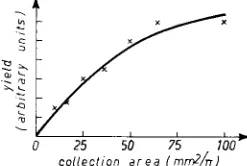
3.5. COLLECTING SURFACE
In the conditions 1 to 4 above stated, the yield
depends upon the area of the collecting surface as fig. 5 shows.
0 25 50 75 100
co//ection area ( mm2/rr}
Fig. 5. Yield as a function of the collecting area .
4. Uniformity of Deposition
Our results have shown a good uniformity of deposi-tion, very good in the central part of the deposit; fig. 6 shows the behaviour of the thickness as a function of the distance from the center. The tests have been performed
by spraying Sr90 (/Jmax ~ 545 keV) and Y90 (/3,nax ~
2270 ke V) on a thin circular aluminum sheet' of 20 mm
•
" " 0 u 7.2 0.8 0.5 0.4 0.2-7 0 -8 -6 -.; -2 0 2 ~ 6 8 I 0
Distance from center of the source along a diameter (mm)
[image:5.520.297.418.77.167.2] [image:5.520.295.419.356.439.2] [image:5.520.58.171.396.481.2] [image:5.520.281.429.557.700.2]304 E. FUSCHINI et al.
in diameter. The sheet did not turn during the deposi-tion. We have assumed that the thickness of the deposit was proportional to the number of electrons emitted per unit area. The counting has been made with an anthra-cene scintillation counter, shielded by a lead collimator having a hole of 1 mm in diameter, and an electronic chain consisting of a linear amplifier, an integral discri-minator and a scaler. The measurements were performed
on various diameters of the deposit. As fig. 6 shows, w have a very satisfactory uniformity in a central region o
about 4 mm in radius; a thinning of the order of 25 ~
appears at the extreme edges. The results reported ar
averaged on measurements performed on several dia meters which resulted in good agreement among them
selves. It is evident, thus, a quite marked circular sym