Munich Personal RePEc Archive
Does Distance Affect the Performance of
Foreign Banks? Evidence from
Multinational Banking in Developing
Countries
Wu, Ji and Jeon, Bang Nam and Luca, Alina C.
Penn State Harrisburg, Drexel University, International Monetary
Fund
1 July 2010
Online at
https://mpra.ub.uni-muenchen.de/37083/
1
Does Distance Affect the Performance of Foreign Banks?
Evidence from Multinational Banking in Developing Countries
Ji Wu
Penn State University at Harrisburg
Bang Nam Jeon∗
Drexel University, Philadelphia, PA
Alina C. Luca
International Monetary Fund, Washington, D.C.
Abstract
This paper examines whether the geographic distance between subsidiaries of multinational banks and their headquarters is an important factor in determining the performance of the
subsidiaries. Using various performance indicators of 340 subsidiaries in 54 emerging and
developing economies from 69 global banks during the years 1994-2008, we find evidence that first, the distance constraint adversely affects loan growth, profitability and performance of foreign bank subsidiaries, and second, the unfavorable information asymmetry faced by foreign banks, due to the distance constraint, in financing foreign clients cannot be fully overcome by establishing their presence abroad such as setting up their foreign subsidiaries. We further examine if the effect of distance is symmetric across different banks and countries, and find the following various economic, financial and institutional factors to affect the strength of distance constraints in the multinational banking activities: the entry mode of foreign banks, the history of presence in local markets, the existence of credit information institutions, the cultural similarity between the home and host markets, financial depth, financial crisis periods, the stock market development, the banking market structure in host markets, and the hierarchy of the subsidiary in the multinational banking
conglomerate.
JEL code: F34, G14, G21
Keywords: Multinational banking, distance, information asymmetry, foreign bank penetration
___________________________________________
∗ Corresponding author. Professor of Economics and International Business, Bennett S. LeBow College
of Business, Drexel University, Philadelphia PA 19104, U.S.A. Tel: (215) 895-2125, E-mail:
[email protected]. The views expressed herein are those of the authors and should not be attributed
to the IMF, its Executive Board, or its management. We thank Suk-Joong Kim,the Guest Editor of the
2
1. INTRODUCTION
This paper examines the economic implications of distance in the realm of multinational
banking, particularly the effect of the geographical distance between foreign bank subsidiaries
and their headquarters on the performance of the foreign bank subsidiaries in emerging and
developing countries. In the gravity model literature of international trade, it has been intensively
studied and supported by numerous empirical studies that, after controlling for other factors, the
exporter-importer distance imposes an important adverse effect on the bilateral trade links. In
international finance, there have been several studies examining how the cross-border lending and
portfolio investment activities are affected by geographical distance. For example, empirical
papers, such as Portes et al. (2001), Portes and Rey (2005) and Buch (2005), found evidence that
a longer distance in international banking have an adverse effect on cross-border lending or
foreign asset holding, which is ascribed to higher informational costs as distance increases.
Banks depend on information to identify good borrowers and determine their loan supply.
Credible information is especially essential to provide larger loans (Degryse and Ongena (2005)).
However, banks’ access to information (or ability to assess information) varies, thus affecting
banks’ performance. Compared to domestic banks, foreign banks especially face more adverse
information constraints when they provide cross-border credit, since they might be thousands
miles away from their customers. The constraints faced by foreign banks include higher costs to
either identify potentially good borrowers or monitor borrowers. Banks can only obtain less
precise information for more distant loan applicants (e.g. Almanza (2002), Hauswald and
Marquez (2006) and Carling and Lundberg (2007)). The information disadvantages become more
conspicuous and challenging in multinational banking operations.
Since the early 1990s, multinational banks have established a large number of subsidiaries
outside their border. Foreign ownership in the banking system has increased significantly in a
number of emerging economies. For example, as of end-2007, the share of foreign bank assets in
banking sector total assets has reached 80 percent in Mexico, and exceeded the 90 percent level in
several Central and Eastern European countries, such as Estonia, Romania, and the Czech Republic.
(See BIS 2009, p.85) If a longer distance between the lender and the borrower really captures an
adverse effect of information asymmetry associated with screening and monitoring, it is natural to
ask if this “distance constraint” will stay the same or lose its edge when cross-border credit is
substituted with local claims. In other words, we ask whether or not foreign banks are able to
fully overcome the constraints of information asymmetry by shortening the geographical distance
3
literature, however, only very few studies have examined if distance still plays any significant
role in determining foreign banks’ performance in terms of lending, pricing and their profits in
host markets. To our best knowledge, our study is the first to examine a role of distance in
multinational banking using bank-level data of headquarters and their foreign subsidiaries and the
geographical and cultural distance between the two.
This paper addresses how the distance constraints faced by foreign banks affect their
banking performance, and examines under what conditions the distance constraints may be
alleviated or amplified. We specifically study whether and how foreign banks’ performance is
affected by the distance between the host market where subsidiaries are located and the home
market where their headquarters are located.Note that, in the research at the domestic level,
distance is conventionally defined as the closeness between a loan officer and his borrowers (for
example, Peterson and Rajan (2002)). The definition of distance and its implications in our paper
are very different one from this conventional one. Although foreign banks can substitute
cross-border claims by local claims, it is far from certain that information barriers could be removed
fully by a closer domestic vicinity to clients. Compared with domestic peers, foreign banks still
likely face disadvantages in collecting information (especially “soft information”1
Following Mian (2006), “distance constraints” in our paper reflect the extent of the
difficulties with which foreign banks can overcome disadvantages of asymmetric information in
host markets, caused by distance from their headquarters in the home country. Since a farther
distance in multinational banking reflects a higher level of difficulty to know their clients and
markets, one would expect that the negative effect of distance on the banking performance tends
to be stronger for more distant foreign banks. How distance may constrain foreign banks’
activities, if any, have important policy implications for countries which liberalize their financial
sectors by allowing more foreign banks to enter the host banking markets.
) and
identifying prime borrowers. As a result, foreign banks may still incur higher informational costs
in their operation than domestic banks. The informational problem may disappear only after
foreign banks have acquired the same pool of information as domestic banks, through many years
of interaction with their clients in local markets.
Our paper extends the extant literature in the following directions: First, using a new data set
of distance between multinational bank subsidiaries and their headquarters at the individual bank
level, we examine the impact of distance constraints to international banking operations. If
multinational banks could overcome the informational barriers by setting up local presence, the
4
performance. Otherwise, a negative association between distance and banking performance can
be explained as consistent evidence that foreign banks are still at the disadvantages of information
asymmetry. Second, we focus our analysis on foreign banks in emerging and developing
economies, where economic growth is pursued by opening up their financial sectors, as a result,
witnessing an increase in the foreign bank presence. Since we use the samples from more than
fifty emerging and developing countries, our results are more representative for developing
countries in general. Third, we identify what are the specific amplifying or mitigating factors for
the impact of distance in the multinational banking. These factors range from some characteristics
of foreign bank subsidiaries, its hierarchical level in the conglomerate, the entry mode of foreign
banks, and certain macroeconomic and financial conditions of the host countries.
The main findings of this paper can be summarized as follows: First, we find evidence that
distance constraints, in deed, adversely affect the performance of foreign banks. This finding
suggests that foreign banks cannot fully overcome information asymmetry simply by establishing
a local presence in the host banking market. As the distance from their headquarters increases, a
foreign bank tends to lend its loans only at a lower growth rate. A longer distance also impedes
foreign banks to obtain higher profit, which may reduce their capacity and incentive to supply
credit over a long run. Corresponding to their lower growth rate of loans and profits, foreign
banks also increase the share of non-lending assets in their portfolio, leading to inefficiency in
capital allocation. Second, although in general a longer distance negatively affects foreign banks’
performance, its effect is not symmetric. The following factors are found to be able to alleviate
the strength of distance constraints: the entry of foreign banks through the mergers and
acquisitions (M&A) mode, a longer history of presence in host markets, the existence of credit
information institutions, the same language and region of host and home countries, higher
financial deepening of host banking markets and highly developed stock market, a higher
concentration level in the host banking market, and a higher hierarchy in its conglomerate. We
also find that the effect of distance constraints becomes strong during crises than tranquil periods.
Our results provide some useful policy implications for policy-makers in the host country of
multinational banking.
The rest of the paper is organized as follows. Section 2 reviews relevant literature. Section 3
introduces the regression model. Section 4 describes our dataset, and Section 5 reports the
benchmark results. Section 6 examines various factors that may alleviate or aggravate the effects
5
2. LITERATURE REVIEW: DISTANCE IN MULTINATIONAL BANKING
In general, the availability and quality of information on borrowers play an important role in
determining banks’ credit (Stiglitz and Weiss (1981)). When banks have more accurate
information about their borrowers, they tend to lend more loans. Pagano and Jappelli (1993)
argue that the information exchange among banks enables them to find good borrowers and may
increase their lending. Jappelli and Pagano (2002) and Djankov et al. (2007) show that the
countries in which lenders exchange information through credit information sharing institutions
(public credit registries or private credit bureaus) are associated with a higher ratio of credit to
GDP. Brown et al. (2009) find that information sharing improves the availability of loans at lower
costs to firms, especially for opaque firms. In addition to increasing the volume of loans,
improved information availability also affects banks’ performance by reducing debtors’ default
rates (Klein (1992), Vercammen (1995), Padilla and Pagano (2000)), increases the competition in
banking markets and hence lowering interest rates (Pagano and Jappelli (1993), Padilla and
Pagano (1997)), and reduces firms’ incentive to over-borrow from multiple banks (Bennardo et al.
(2008)).
Banks are believed to have different abilities to collect and assess borrowers’ information.
For example, large banks may be able to take the advantage of economies of scale from large
information technology networks and hence are better at assessing “hard information”. By
contrast, small banks may be better at collecting and assessing “soft information” through loan
officers by personal interactions. Stein (2002) suggests that large, hierarchical banks would have
comparative disadvantages in assessing soft information relative to small banks. Consistent with
his argument, Cole et al. (1999) show that large banks tend to employ standard criteria obtained
from financial statements in the loan decision process, but small banks deviate from these criteria
by relying to a larger extent on the soft information such as the character of the borrower.
Moreover, young banks may be less effective to distinguish good borrowers from bad ones
because of their short history of presence and less often interaction with potential clients. Archaya
et al. (2002) find that a bank’s monitoring effectiveness is dampened when the bank expand to
newly-entered industries.
Distance is a practically useful proxy for the difficulties to acquire and communicate
information, especially soft information (Hauswald and Marquez (2000), Berger et al. (2001),
Petersen and Rajan (2002), Mian (2006), and Agarwal and Hauswald (2007)). A longer distance
between banks and borrowers would make information collection and monitoring more costly and
6
more on local knowledge and personnel contacts. Almanza (2002) suggests that the resources
spent by banks on monitoring increases with the distance between the bank and its debtors. He
also finds that banks with higher capital are more willing to lend to distant borrowers.
How distance affects the price of loans could be ambiguous. On one hand, more distant
borrowers would cost banks more resources to assess and monitor, hence banks would pass on
this cost into the interest rate on loans. On the other hand, banks would extract rents from closer
borrowers by charging higher rates since otherwise the borrowers would have to switch to more
distant competing banks and pay higher interest rates. Degryse and Ongena (2005) find that loan
interest rates tend to decrease with the distance between firms and lenders and increase with the
distance between the firm and competing banks. The reason is explained as that more distant
banks have only weaker market power and hence will charge borrowers lower interest rates.
Agarwal and Hauswald (2007) find results in line with Degryse and Ongena (2005), and suggest
the physical distance between bank and borrowers is actually a proxy for bank’s different degree
of information asymmetry. Mistrulli and Casolaro (2008) find that the interest rates on loans are
negatively correlated with the distance between the bank headquarters and the borrower.
Huaswald and Marquez (2006) derive a negative relationship between loan rates and the distance
of borrowers to relationship banks, but a positive relationship between the rates and the distance
to transactional banks.
In other research (e.g. Berger and DeYoung (2001)), distance is also used as a proxy for the
agency problem when a subsidiary is located far away from senior managers, hence with an
increasing distance to the final decision makers, the subsidiaries may have less lending and lower
profit efficiency. This strand of argument is consistent with Stein (2002). There is substantial
evidence that information asymmetry would cause biases in the investment of market participants,
for example, the literature on the well known “home bias” in assets holding (e.g. French and
Poterba (1991), Gehrig (1993), Tesar and Werner (1995), Kang and Stulz (1997), Lewis (1999),
Coval and Moskowitz (1999, 2001)). Portes and Rey (2005) provide an excellent survey on the
literature of this issue.
It is only recent when a few empirical studies investigate the effects of distance on
determining various specific types of international financial transactions. Most of these works
find that distance is an important determinant of cross-border assets holding or international bank
flows. Applying the gravity model methodology, Portes et al. (2001) and Portes and Rey (2005)
show that geographical distance is negatively associated with the volume of international
7
information friction and distance. Buch (2005) finds consistent evidence that banks hold
significantly lower assets in distant foreign markets, and the importance of distance for holding
assets abroad has not declined in European countries with technological progress over time. He
also finds that distance constraints have not changed in its impact on cross-border asset holdings
by the multinational banking sector over time during the period 1983-1999. Papaioannou (2005)
also uses geographical distance to proxy the transaction and information costs, and find it is
inversely associated with the cross-border bank flows. Herrero and Martinez Peria (2007) find
that the informational costs significantly affect the share of local claims (to total claims) of
foreign banks. Carey and Nini (2007) find that banks display home bias by providing more
syndicated loans to their domestic borrowers than to foreign ones.
Siregar and Choy (2009) studies the determinants of the loans from international banks from
OECD countries to East Asian countries, and find a negative relationship between the
source-recipient geographical proximity and the amount of loans. Similar results are also found in Wei
and Wu (2001), although they do not specifically address the relationship between distance and
cross-border bank lending. It is worthwhile to note that, although there is overwhelming evidence
that a farther distance between source and recipient countries would negatively affect investors or
banks’ decision to obtain foreign assets, there is likely a positive effect as well. The correlation of
business cycle may likely decline in distance, hence a financial investment in remote countries
might reward investors a higher return by portfolio diversification. If this is the case, the distance
between source and recipient countries may be found positively related with international capital
flows. Nevertheless, the extant empirical evidence seemingly suggests that this positive effect is
practically dominated by the negative effects from information asymmetry.
However, research is still scant on the effect of distance from their headquarters on the
performance of foreign bank subsidiaries which are located in host markets. If the geographical
distance captures most of the information barriers between a lender and its continents-away
borrowers, we expect that the distance constraints would not play any significant role if lenders
could successfully know about their borrowers by setting up a local presence and narrowing the
vicinity to their borrowers. So far, only a few papers have addressed the effects of the host-home
market distance on foreign banks’ local claims in the host country. Berger et al. (2001) find that
for small business in Argentina, foreign banks headquartered in South America tend to provide
more credit than foreign banks headquartered in other continents. Mian (2006) examines the
credit from foreign banks in Pakistan, and finds that a greater cultural and geographic distance
8
informationally opaque but fundamentally sound firms. Claessens and van Horsen (2009) find
that foreign banks from a home country geographically or culturally close to the host country
perform better than distant foreign banks.2
The interpretation of distance constraints as information asymmetry has been supported in
the literature. Several studies have also presented evidence that foreign banks may only serve the
sectors which are less subject to information asymmetry. Clarke et al. (1999) observe the banking
sector in Argentina and find that foreign banks concentrate their business in the industries that are
less information asymmetric. Martinez Peria and Mody (2004) find that in the case of Latin
American banks de novo foreign banks charge lower spreads than mergers & acquisitions foreign
banks, and interpret that de novo foreign banks with less information on the host banking markets
has to focus on the most transparent sector, which are more likely competitive sectors.
Accordingly, de novo foreign banks have to charge lower spreads than M&A foreign banks. The
results from these two works are consistent with the suggestion made by Dell’Ariccia and
Marquez (2004) that foreign banks will enter the sectors where their information disadvantages
are smaller.
3. MODEL
We set up the empirical model to examine how the distance from their headquarters affects
the performance of foreign bank subsidiaries in host markets. is the banking performance is
measured using four dimensions: (1) the growth rate of loans (in real terms); (2) the price charged
by banks, represented by net interest margin; (3) the holding of non-lending assets, measured by
the share of “other earning assets” to total bank assets; and (4) the profits of banks, proxied by the
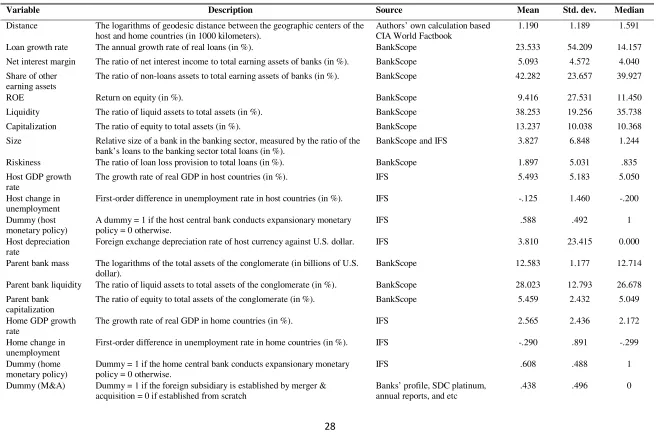
return on equity (ROE). We find that these four dimensions only modestly correlated. (Table A1)
We use the following benchmark model for the estimation of the role of distance constraints to
the banking performance of foreign bank subsidiaries:
, , , , , , ,
, , , , , ,
( ) ( )
( ) ( )
i j k l t j l i t j t
k t l t i j k l t
Y c distance bank characteristics host characteristics
parent characteristics home characteristics
α
β
δ
λ
γ
ε
= + ⋅ + ⋅ + ⋅
+ ⋅ + ⋅ + (1)
where the dependent variable Yi,j,k,l,t represents the banking performance of foreign bank
subsidiary i of conglomerate k of the home country l in host country j in year t . distancej,l is the
9
characteristics)i,t is a vector of subsidiary i’s bank characteristics, including its liquidity,
capitalization, size and riskiness. (host characteristics)j, t is a vector of macroeconomic variables
in host market j, including the growth rate of real GDP, the change in unemployment rate, foreign
exchange depreciation rate (against US dollar), and a dummy of (expansionary) monetary policy
with the value of 1 for an easy monetary policy and the value of 0 otherwise. (parent
characteristics)k, t includes the financial strength of the parent bank k, such as the mass of the
conglomerate, liquidity and capitalization. (home characteristics)l, t represents the macroeconomic
conditions in the home country l, including the growth rate of real GDP, the change in
unemployment rate and a dummy of monetary policy. εi,j,k,l,tis the idiosyncratic error. α, β, δ, λ
and γ are the coefficients to be estimated.
Among the coefficients which we will estimate, α is of special interest, which is expected to
reflect the sensitivity of foreign bank subsidiaries’ performance to the distance constraints that
they face. Distance is calculated as the geodesic distance between the geographic centers of the
host and the home countries by applying Vincenty formula. We take logarithms for distance,
since the marginal effect of the distance constraints may diminish as distance increases. If foreign
banks are subject to higher informational costs in their operation, it is expected that a longer
distance would be associated with a lower growth rate in loans. In addition, if the distance
constraint hinders foreign banks to find good business opportunities, we should expect that they
have to hold more non-lending assets, like deposits in other banks, securities, bonds and
government treasury bills; hence the share of other earning assets to total assets will be increasing
with the distance. Foreign subsidiaries’ higher holding of non-lending assets, compared to lending
assets, suggests a less efficient allocation of scarce financial resources in multinational banking.
How would the distance constraint affect the interest rate charged by foreign banks? The
answer is not straightforward. On one hand, if a longer distance captures a higher cost to identify
and monitor borrowers (or monitor managers), foreign banks may pass on this cost and charge a
higher interest rate. On the other hand, a longer distance would cause less information about the
host market and potential prime borrowers. This will drive foreign banks to concentrate their
lending in more transparent industries which are more likely competitive than other opaque
industries, and force banks to charge only a lower interest rate. Therefore, it seems how distance
would affect interest rate is left as an empirical question. If a longer distance creates the
informational disadvantage for foreign banks, we may reasonably expect that profits would
10
Following the standard practice, we include bank characteristics of foreign subsidiaries in
the explanatory variable set to control for various types of financial constraints on the subsidiaries.
It is likely that a longer distance from the headquarters actually represents a weaker financial
strength of the subsidiary, especially when the conglomerate establishes a “weaker” (say, smaller,
less liquid or less capitalized) subsidiary in a distant overseas market. This possibility can be
controlled by including the subsidiary-level bank characteristics in the explanatory variable set.
The correlation of distance and subsidiary characteristics are reported in Table A2, which
indicates that the correlations are very mild in magnitude. Another argument that may arise is that
a more distant foreign bank may have a lower growth rate of loans because of a lower demand
from the host market. To control for the demand effect at the bank level and the macroeconomy
level, we add a riskiness measure at the individual bank level and host country macroeconomic
variables. The former, measured by the ratio of loan loss provision to total loans of a subsidiary
controls for the heterogeneity across subsidiary banks’ clients, while the latter controls for the
heterogeneous demand factors across host countries. The variables of “bank characteristics” and
“host characteristics” are the “pull factors” in determining the behavior of foreign banks.
The liquidity of banks is measured by the ratio of liquid assets to total assets. A more liquid
bank tends to increase its credit more quickly. The capitalization of banks is proxied by the ratio
of equity over total assets. A better capitalized bank is expected to have faster growing in its loans.
The size of an individual bank measures the dominance of the bank in the host banking sector.
The relative size of a bank is obtained by using the ratio of the total loans of the bank to the total
domestic credit in the host economy. The riskiness faced by an individual bank is measured by
the ratio of loan loss provision to total loans for a bank. In order to address the possible
endogeneity problem of subsidiaries’ characteristic variables in our model, we use one-year
lagged values for those variables.
“Parent characteristics” and “home characteristics” are included to control for the “push
factors” of foreign banks’ performance in host markets. The former controls for the effects of the
financial strength of the conglomerate on the subsidiaries’ behavior,3 while the latter controls for
the force that may lead the parent banks to seek external lending (via the oversea subsidiaries) 4.
The liquidity and capitalization of the conglomerates are measured in the same way for those for
subsidiaries. The mass of a parent bank is proxied by the logarithm of its total assets in term of
U.S. dollars. The correlation between distance and parent bank characteristics are reported in
Table A3. The correlation between distance and parent bank mass is relative large (around 0.50),
11
farther than a small multinational bank. We present evidence shortly that after controlling for the
effect of conglomerate mass, distance is still a significant determinant of banks’ performance.
In order to test whether the effect of distance constraints is symmetric across banks and host
markets and to identify specific amplifying or mitigating factors for the strength of the distance
constraints, we extend the benchmark model by adding interaction terms:
, , , , , , ,
, , , , , , ,
( ) ( )
( ) ( ) ( )
i j k l t j l j l i t
j t k t l t i j k l t
Y c distance factor factor distance bank characteristics
host characteristics parent characteristics home characteristics
α ρ σ β
δ λ γ ε
= + ⋅ + ⋅ + ⋅ × + ⋅
+ ⋅ + ⋅ + ⋅ +
(2)
where factor represents an examined factor that may alleviate (or multiply) the effect of distance,
and factor × distancej,l is its interaction term with distance. We examine various factors
including: (1) the entry mode of foreign banks (de novo or M&As); (2) the length of presence in
host markets; (3) the existence of credit information institutions; (4) the same languages, legal
systems, and relegion in the host and home countries; (5) the level of financial deepening in the
host banking market; (6) the level of development of stock market; (7) the degree of
concentration in the host banking market, and (8) the hierarchy level of the subsidiary in its
conglomerate. More detailed discussion on each of the above factors will be made when we
discuss the empirical results in Section 6. A summary of all variables and their data sources is
provided in Table 1.
For the estimation, we apply the feasible generalized least squares (FGLS) estimator, which
allows for the AR(1) autocorrelation within banks and heteroskedasticity across banks. We
introduce country dummies and time-fixed effects in the estimation to control for other
unaccounted sources of the differences in the bank performance across countries and years.
4. DATA
We construct unbalanced panel dataset for the estimation by using bank-level annual
observations of balance sheet and income statements retrieved from Bureau van Dijk‘s
BankScope database. Our data cover 340 foreign subsidiaries of 69 multinational banks from 1994 to 2008. All selected multinational banks are universally regarded as large banks with total
assets of more than $521 billion on average.5 We include only commercial bank subsidiaries in
our dataset to reduce the possible bias due to the different nature and business scope of various
non-commercial banks. We focus our analysis on the foreign subsidiaries of multinational banks
12
banks and the distribution of their subsidiaries in the interested countries is provided in Appendix
Table A4.
A bank is defined as a foreign subsidiary if at least 50% of the entity’s assets are owned by
a multinational bank which is headquartered in another country.6
We use unconsolidated data for subsidiaries in principle and consolidated data are used
only when unconsolidated data are not available for that bank. In our dataset, only 6% of
observations are consolidated for subsidiaries. For parent banks, by contrast, we use consolidated
data to reflect the state of the conglomerate instead of the only holding company. Since all
selected subsidiaries are small compositions (in terms of their assets) in the conglomerate, using
consolidated data for the parent bank would not cause serious problem of endogeneity
We take the following steps to
track the affiliation of a subsidiary to its parent bank over the period of 1994-2008. First, we
check the subsidiary information of selected multinational banks recorded in BankScope, which
identifies the ownership for some banks in the most recent year of recording. Second, we check
the global presence of parent banks and their chronological history from their websites to pin
down the establishment of their subsidiaries in foreign countries. Third, we review the profile of
each individual subsidiary bank and its historical evolution from its website. In most cases, it is
highlighted in the bank’s profile about its incorporation and changes of its ownership. Fourth, we
depend on another comprehensive database, SDC Platinum, which records detailed information
on mergers and acquisitions. We collect data on when a bank in the host country was acquired by
or merged into the conglomerate of the parent bank in the home country. Finally, if we are still
unable to identify the ownership of the bank after going through these four steps, we resort to
various other information sources, such as banks’ annual reports, central bank publications, and
Internet news reports on changes in the bank ownership and affiliation.
7
We drop the outliers by applying the following steps: First we remove the observations if
the subsidiaries’ annual growth rate of total assets exceeds 300%, which could be the result of
mergers and acquisitions in the host country; second, we drop the data if the growth rate of loans
is higher than 400%, which could occur in the early years of the subsidiaries or in the financial
turmoil; third, we delete the observations when subsidiaries’ riskiness is larger than 100% or
lower than -100%. We lose quite a number of banks from the removal of the outliers and the
usage of one-year lags for subsidiary characteristics variables, but still have around 250 bank
observations for our regression.
.
We collect macroeconomic variables from International Financial Statistics (IFS). We
13
constraints. These variables and their sources are represented in Table 1, and will be further
explained in Section 6.
5. BENCHMARK RESULTS: DOES DISTANCE MATTER FOR THE PERFORMANCE OF FOREIGN BANK SUBSIDIARIES?
We first estimate the equation (1) and examine whether the distance between the host and
the home markets plays an important role for the performance of foreign bank subsidiaries
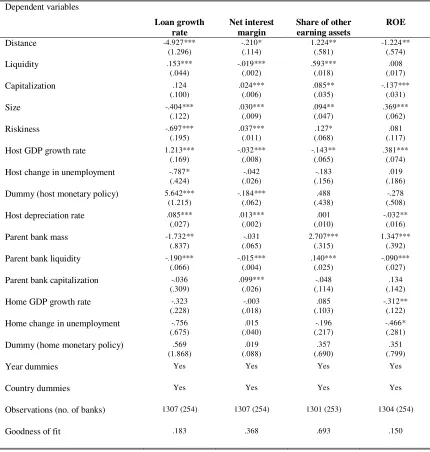
located in the host countries. The results are reported in Table 2.
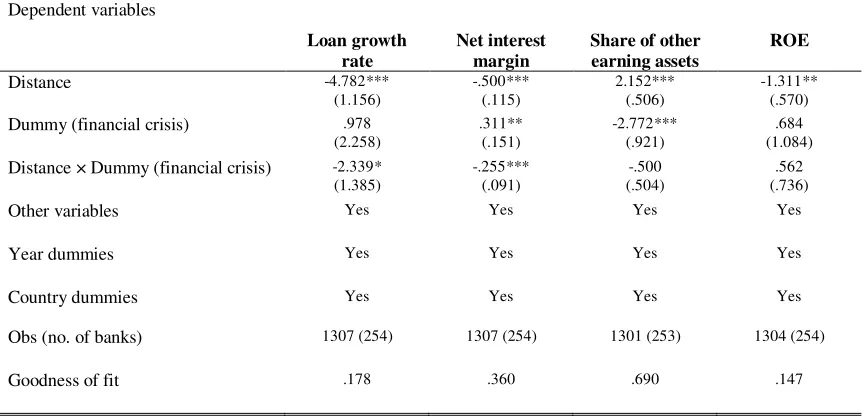
First of all, after controlling for all other factors affecting the bank performance, we find
distance is still an important determinant of banks’ behavior. The coefficient on the variable
distance is negative and statistically significant in all regressions. A more distant foreign subsidiary is shown to supply loans at only a lower growth rate. This finding is consistent with
the literature of “information asymmetry” in that higher informational costs to identify and
monitor borrowers would discourage banks from providing more credit. Consistent with the
findings in Petersen and Rajan (2002), Degryse and Ongena (2005) and Agarwal and Hauswald
(2007), distance is found negatively correlated with net interest margin, implying that a foreign
bank from a more distant home country charge borrowers lower interest rates. The reason can be
that a distant foreign bank is characterized with more disadvantageous informational possession
and consequently only lower market power, which prevents them from charging higher interest
rates to borrowers. Another explanation is that a more distant foreign subsidiary will be forced to
specialize only in the most transparent industries. These industries are more likely to be
competitive and hence banks have to charge only lower interest rates.
Since distant foreign banks own less information to find good business opportunities, they
may have to hold more non-lending assets such as deposits in other banks, securities, bonds and
treasury bills. This conjecture is supported by the positive coefficient of distance in the regression
of the share of other earning assets. Finally, distance is negatively associated with return on
equity, which suggests that a more distant foreign bank be less profitable than other closer foreign
banks. It is worthwhile to note that our results are essentially consistent with the insights of
“gravity model”. Multinational banks tend to allocate their loans to more proximate clients, as
represented as the “home bias” proposition in that they hold financial assets issued by closer (or
domestic) debtors over-proportionately.
Our finding suggests that information asymmetry cannot be completely overcome by
14
out using the case of the Pakistani banking, one of the policy implications is that foreign bank
participation in developing countries may face a significant challenge in advancing their financial
development by attracting multinational banks from abroad. Since foreign banks are constrained
by the asymmetric information, they may not be interested in serving some firms (for example,
the opaque small firms), which would negatively impact the economic growth in host countries.
A higher holding of non-lending assets by foreign banks may also result in a less efficient
allocation of scarce financial resources. Moreover, since a higher information barrier lowers
foreign banks’ profitability, it may undermine their incentive and capability to provide long-term
credit. A pool of financially healthy domestic banks equipped with better capacity for collecting
soft information for loan would compensate the disadvantage of foreign banks in assessing
information and work as a necessary complement in developing host banking markets.
We also find some other interesting results. For example, it is shown that higher liquidity
enables banks to increase credit at a higher growth rate and charge a lower interest spread, which
is consistent with prior works like Kashyap and Stein (2000) and Gambacorta (2005, 2008).
Capitalization is positively associated with net interest margin. This finding is consistent with
Demirguc-Kunt and Huizinga (1998), who find that higher-capitalized banks tend to get the lower
cost for funding. Larger and more risky banks tend to provide more stable credit, but charge
higher interest rate and possess a higher ratio of non-loan assets. Host macroeconomic conditions
affect banks’ loans as well. The coefficient on the growth rate of real GDP is positive and
statistically significant, suggesting a higher economic growth stimulate higher demand for bank
credit. The coefficient on the change in unemployment rate is negative, implying that aggregate
demand and hence the demand for credit would decrease when labor market is tight.
When the host central bank conducts an expansionary monetary policy, banks significantly
lend more credit at lower interest margin than when monetary policy turns tightened. Banks
increase their lending when domestic currency is depreciated, probably because values for foreign
banks’ assets denominated in local currency increase, and at the same time increase interest
spread, which reflects uncovered interest parity when foreign currencies are relatively
strengthened. We also find the financial strength of parent banks affect subsidiaries’ lending.
Banks from a large and highly liquid conglomerate increase loans at a lower rate. The result that
subsidiaries’ performance is affected by the financial strength of their parent banks is in line with
the literature of “internal capital market” like Gilbert (1991), Houston et al. (1997), and De Haas
15
affect subsidiaries’ behavior, hence foreign banks are not found to import fluctuations into host
countries.
6. FURTHER RESULTS: WHAT FACTORS MODIFY THE EFFECT OF DISTANCE CONSTRAINTS?
We next test if the adverse effect of distance on bank performance is symmetric across
banks and countries, or put differently, if there is any factor that may buffer or amplify the impact
of distance. We do that by adding the tested factor and also its interaction with distance. A
significant coefficient on the interaction term can be translated as the factor would affect banks’
performance through changing the effects of distance.8
6.1. Entry mode
Foreign banks can set up overseas subsidiaries through either de novo establishment or
mergers & acquisitions (M&A). Rather than gathering the information of markets and potential
borrowers from scratch, a foreign bank established through the M&A entry can inherit the pool of
information from its predecessor, hence largely overcome the barrier of information asymmetry.
We test the effect of entry mode on the distance constraints by introducing the interaction term
distance × dummy (M&A), where dummy (M&A) has a value of 1 if the foreign subsidiary is built through acquiring a local bank, and it has a value of 0 if the foreign subsidiary is built though de
novo establishment.
The results are reported in Table 3. We find the coefficient on distance × dummy (M&A) is
positive and statistically significant in the regressions of the loan growth rate and net interest
margin, but insignificant in the share of other earning assets and return on equity. These results
indicate that a foreign bank entered through the M&A mode is less constrained by asymmetric
information than a de novo foreign bank in providing loans and setting interest rates.
Van Tassel and Vishwasrao (2007) argue that foreign banks choose an M&A entry mode in
order to capture the information endowment of domestic banks. Lehner (2009) suggests that
foreign banks with superior screening technology would prefer an M&A entry to a greenfield
entry. On the other hand, Martinez Peria and Mody (2004) find that de novo foreign banks charge
lower spreads than mergers & acquisitions foreign banks in the Latin American banking sector.
They interpret the findings that de novo foreign banks possess only the least information about
the host markets and thus need to focus on the most transparent sectors, which are more likely
16
foreign banks. Our finding that foreign subsidiaries entered through an M&A mode are less
affected by distance than those entered through a de novo mode is consistent with the arguments
that foreign subsidiaries entered through M&As have better information on the host banking
market than those entered through greenfields, and are able to charge lower loan rates.
6.2. History of presence
Foreign banks can accumulate information about host markets and their clients in the
process of their operations; hence controlling for all else, a foreign bank which has already been
operating in the market for years would possess a richer pool of information than a bank newly
entered. We collect the data on banks’ history from their profiles and BankScope, and use the
number of years of operation in the host markets as the history of presence variable. For foreign
banks that were established by M&A, its length of history started back to the date when the
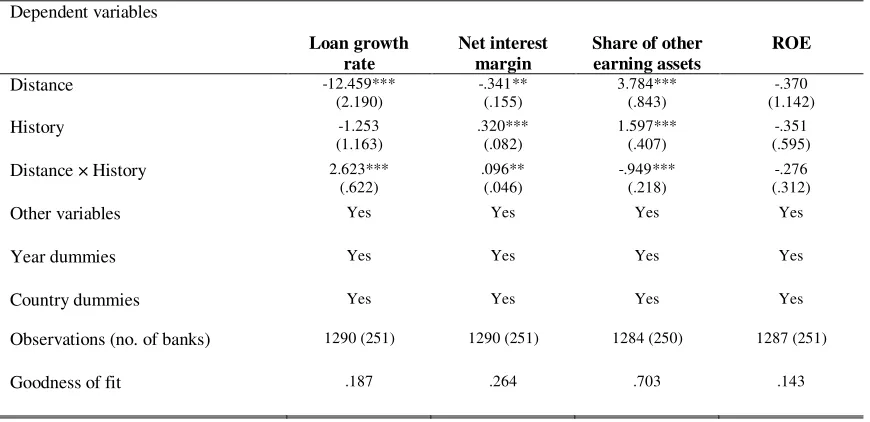
acquired bank was built. The effect of length of history is detected by adding the interaction term
distance × history, and the results are reported in Table 4.
As expected, the interaction distance × history is positive and statistically significant in
regressions of the loan growth rate and net interest margin, and negative in the share of other
earning assets. A foreign bank with a longer operation history in the host market is shown to be
less affected by distance, and accordingly lends more loans, sets higher interest margin and holds
less non-loan assets. These results are consistent with our conjecture that “senior” banks know the
market better than their “junior” counterparts.
6.3. Information institutions
Credit information institutions can help banks to have better access to the information on
potential borrowers and overcome the adverse selection caused by information asymmetry.
Djankov et al. (2007) find evidence that the existence of credit information institutions boosts
more private credit in their sample of 129 countries. Brown et al. (2009) find that the information
sharing provided by credit information institutions improves the availability and lower cost of
credit, especially to opaque firms.
In practice, credit information institutions include public credit registries and private credit
bureaus. Good examples of the former institutions include databases managed by a government
agency (usually the central bank) that collects information on the standing of borrowers in the
financial market and make it available to actual and potential lenders. The latter institutions
include private firms or non-profit organizations that maintain databases on the standing of
17
construct three dummy variables--dummy (information institution), dummy (public credit registry)
and dummy (private credit bureau)--to capture, respectively, the existence of either public credit registries or private credit bureaus, public credit registries only, or private credit bureaus only.
The main data source for the credit information institutions, public and private, is the World Bank
Doing Business database.
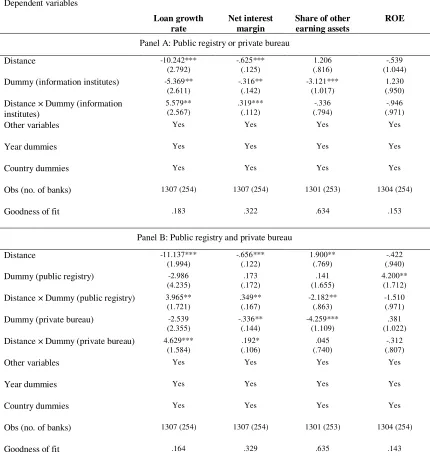
First, we only include dummy (information institution) and its interaction with distance in
regression (Table 4. panel A). We find the existence of the information institutions dampens the
adverse effects of distance on the loan growth rate and net interest margin. A same distant foreign
bank located in a host country with either a public credit registry or a private credit bureau
provide more loan and can charge higher interest spread than its counterparts in host countries
without credit information institutions. Next, we test the separate effects of public credit registry
and private bureau in affecting the role of distance constraints. We add both dummy (public credit
registry) and dummy (private credit bureau) and their interactions with distance in regression (Table 4. panel B). We find both types of information institutions contribute to lowering the
effects of distance on the loan growth rate and the interest spread. Public credit registry may also
help foreign subsidiaries to hold less non-lending assets. These results are consistent with the idea
that foreign banks can retrieve information from credit information institutions and use them in
evaluating the loan applications. Our findings suggest that the construction of credit information
institutions seems to be a valuable component for the policy of financial liberalization in
developing countries.
6.4. Language, legal system and region
Intuitively, if a multinational bank expands its subsidiaries into a host market which is
culturally more similar to its own home market, it may incur lower informational costs. In order
to test the proposition, we use three dimensions to measure the cultural similarity between host
and home countries: the (same) language and legal system in the host and home countries, and the
(same) region where host and home countries are located.9 In the extant literature, the impact, on
multinational banking, of whether the borrower and the bank are located in the same region as a
proxy of the cultural distance have been examined (see Mian (2006) and Claessens and van
Horen (2009).) However, the examination that whether these national features can weaken or
aggravate the negative effects of distance on foreign subsidiaries behavior is still scant. We
construct three dummy variables, dummy (same language), dummy (same legal system) and
18
official languages, the same legal origins, and are geographically in the same region.10
We add these three dummies and their interaction with distance respectively in regressions.
The results are reported in Table 6. The coefficient on dummy (same language) is statistically
significant in the regressions of the loan growth rate and the share of other earning assets,
supporting the idea that the same language used in both host and home countries reduces the
effects of distance in credit provision and assets allocation. This result implies that foreign banks
would possess and communicate more precise information about their clients by avoiding extra
costs from inter-lingual translation. The coefficient on dummy (same region) is statistically
significant and shows an expected sign in determining net interest margin and ROE. That is,
compared to its same distant counterparts, a foreign bank can own more market power, charge
higher interest margin, and earn higher profits if its headquarters is located in the same region of
the host market. However, the coefficient on dummy (same legal system) is not statistically
significant in any regression, providing little evidence that same legal systems may strengthen or
dampen the impact of distance constraints.
The main
data sources are CIA World Factbook and La Porta et al. (1998).
11
6.5. Financial deepening
Banks and other financial institutions arise to ameliorate the problems created by
asymmetric information; hence the information of potential borrowers will be more transparent in
a more developed financial market. We test if foreign banks face less severe or more strict
distance constraints when they are operating in financially more developed host markets.
The degree of financial development is measured using the ratio of private credit by
depository banks to GDP, which are collected from the financial structure database provided by
Beck (2009). The results are reported in Table 7. We find that the coefficient on the interaction
term of distance with host financial deepening is statistically significant in determining the
growth of loans, net interest margin and ROE, suggesting that a higher financial development
plays a buffering role to the adverse effects of distance. In a host country with higher financial
depth, a foreign bank increases its credit at higher growth rate, have a larger interest spread and
hence higher profits, compare to other distant foreign banks. Our finding implies that, as the host
financial sector develops, foreign banks would encounter declining information asymmetry and
provide more financing in host countries.
Why foreign banks are subject to less adverse distance constraints in a more developed
19
banks to finance their investment. The more firms are dependent on banks, the more actively they
provide verifiable evidence for their creditworthiness, hence the less adverse the informational
asymmetry is.
6.6. Crisis
Banks may encounter worse informational problem when the economy falls in crisis, which
can greatly deteriorate firms’ operation outcomes and obscure their business prospects. Mishkin
(1990) describes the nature of financial crisis as a disruption of markets in which the asymmetric
information problems of adverse selection and moral hazard become much worse. We test
whether or not crises would deteriorate the effects of distance constraints.
A dummy veriable, dummy (financial crisis), is constructed equal to 1 if the host country
experiences a systematic banking crisis, using the data in Caprio and Klingebiel (2003) and
Laeven and Valencia (2008). The results are reported in Table 8.
The coefficient on the interaction term distance × dummy (financial crisis) is found negative
and statistically significant in regressions of loan growth and net interest margin, which is
consistent with our expectation that information asymmetry becomes deteriorated during crisis
periods. Given the same distance, foreign banks in host crises are more hesitant to expand their
credit, and have only narrowed the interest spread. To avoid confusion, note that our result does
not contradict with the conventional observations that in crisis banks charge higher interest rate to
borrowers. The individual term dummy (financial crisis) is shown to have a positive and
statistically significant coefficient, indicating that interest rates are higher during the crisis
periods. However, a negative and statistically significant coefficient on distance × dummy
(financial crisis) only suggests that the adverse effect of distance on interest spread is strengthened by crises, probably because the increase in the loan interest rate is offset by an
increase in the cost of funding.
6.7. Stock markets
The development of stock market may influence the capacity of collecting information on
borrowers by banks. The intuition is that a more developed stock market will have firms’
financial information more transparent and easier to access by banks, especially for those publicly
listed companies. In this section, we test how the stock market development influences the effects
of distance on foreign banks’ performance.
We use three variables to measure the development in stock market: namely, number of
20
stock market capitalization as the value of listed shares divided by GDP, and stock market turnover rate as the ratio of the value of total shares traded to market capitalization. We collect the data from the structure database provided by Beck (2009).We add these three variables and
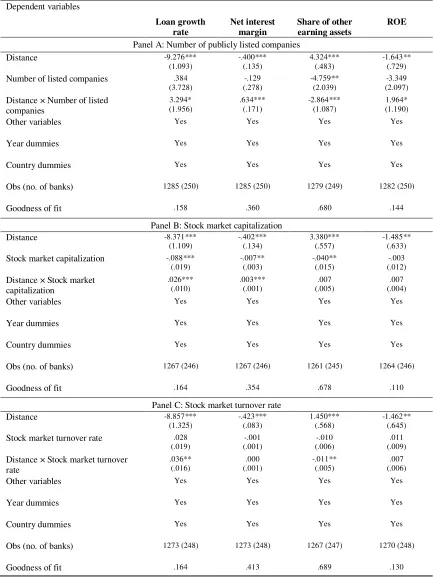
their interactions with distance in our regressions. The results are reported in Table 9.
We find the coefficient on number of listed companies is statistically significant in all
regressions and show the expected sign, supporting a proposition that an increase in the number
of listed companies improves the informational problem (Table 9 panel A). Given same distance
as its peers, a foreign bank subsidiary in a host country where there are more publicly listed
companies tends to provide more lending, be able to charge higher interest rates, hold less
non-lending assets, and earn higher profits. The coefficients on stock market capitalization is positive
in regressions of loan growth and net interest margin (Table 9 panel B), while the coefficient on
stock market turnover rate is statistically significant in regressions of loan growth and the share of other earning assets (Table 9 panel C). Both results are in line with the proposition that foreign
banks incur lower informational costs in the host country where stock markets are well developed.
Our results also shed some light on the specialization of foreign banks in serving domestic
clients. Since publicly listed companies are usually large companies in an economy, the finding
that the effects of informational problem on foreign banks’ behaviors can be improved by the
development of stock market suggests that foreign banks may lend more credit to large
companies, and may exclude small firms whose information is limited because the financial
information on those firms are not publically available in stock markets.
6.8. Concentration
The dependence of banks on the quality of information on borrowers may be affected by the
competition level in the financial market. Empirical evidence on this proposition is still far from
conclusive. (See Archaya et al. (2002), Boot and Thakor (2002), Huaswald and Marquez (2006),
Mistrulli and Casolaro (2008) and Zarutski (2008))
We test the effects of competition on how distance influence foreign subsidiaries’ lending.
We use the level of banking concentration as a proxy for the competition in host banking markets.
It is widely accepted that the more concentrated the banking sector is, the less competitive it is.
Concentration is defined as the share of total assets owned by the largest three banks in total
assets of banking sector. The data is selected from the financial structure database provided by
21
The results are reported in Table 10. The coefficient on the interaction variable, distance ×
concentration, is found to be positive and statistically significant in regressions for loan growth rate and interest rate, and negative in regression for the share of other earning assets. These
results suggest that the adverse distance effects are less pronounced in a more concentrated (less
competitive) banking sector. A same distant foreign subsidiary tends to increase its loans at a
higher rate, charges higher interest rate, and holds less non-loan assets in a more concentrated
market. Archaya et al. (2002) argue that a bank’s monitoring effectiveness is dampened when the
bank expand to more competitive sectors, results in lower quality of loans. Huaswald and
Marquez (2006) suggest that banks tend to decrease their investment to acquire borrowers’
information when competition is intensified. Our results are in line with this finding.
6.9. Hierarchy
Stein (2002) shows that loan officers in hierarchically complex conglomerates will have a
lower incentive to collect information about borrowers. This is because they do not generally
have decision making authority, and instead they have to report that information to their
supervisors. Based on this argument, we may expect that, a subsidiary with higher hierarchy in
the conglomerate will be less separate from the ultimate decision makers, more likely influence
CEO’s decisions, and hence have stronger incentive to identify potential prime borrowers.
Therefore, a subsidiary with a higher hierarchy might be less affected by the distance constraint
than a peer with a lower hierarchy.
We use the relative size of bank assets of the subsidiary in the conglomerate to proxy its
hierarchy, that is, the ratio of the subsidiary’s total assets to the total assets of the conglomerate.
When a subsidiary manages more assets in the conglomerate, it implies that it is standing on a
higher hierarchy.
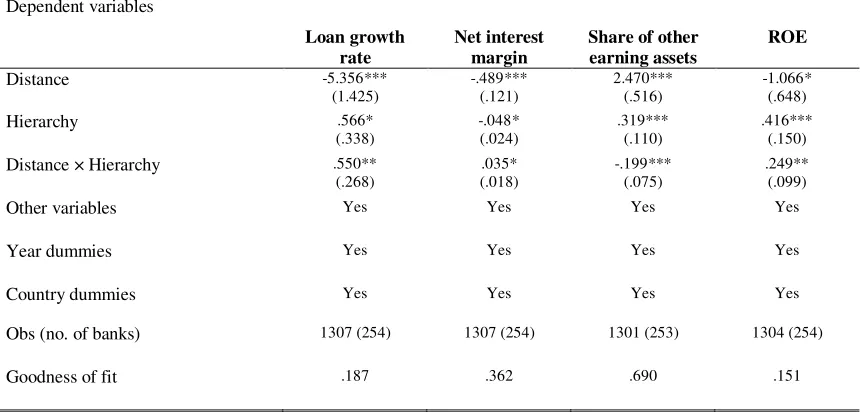
The results are reported in Table 11. The coefficient on the interaction term, distance ×
hierarchy, shows an expected sign and is statistically significant in all bank performance dimensions. Compared to same distant peers, a higher hierarchical subsidiary tends to provide
more loans, charge higher interest rate, hold less other earning assets, and earn higher profits.
These results suggest that a higher standing in the conglomerate may help banks less constrained
by information asymmetries. This provides consistent evidence that the managers of higher
hierarchical subsidiaries have stronger incentive and capacity to collect the information on
borrowers, and implies that parent banks may “export” their superior expertise to higher
22 6.10. Robustness tests
It can be reasonably argued that the above-discussed factors may be correlated to each
other and hence they actually capture something alike. In this section we test the robustness of
our finding by add all significant factors in regression. For instance, we exclude the insignificant
factors and add only dummy (M&A), history, dummy (information institutions), dummy (same
language), host financial deepening, dummy (financial crisis), number of listed companies, stock
market capitalization, stock market turnover rate, concentration and hierarchy and their
interaction with distance into the regression of the loan growth rate.
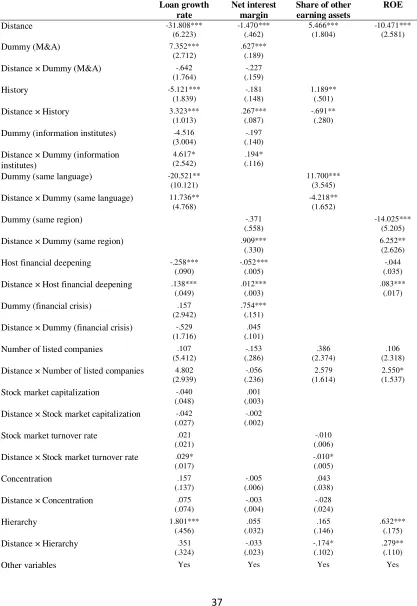
The results are reported in Table 12. To no surprise, some factors lose their significance
since multicollinearity can be hardly avoided in this regression. Even though we cannot simply
rule out the importance of those variables just because they are not statistically significant in
these augmented regressions, we find stronger evidence for some factors since their significance
remains. It is confirmed that there are many factors which mitigate or multiply the role of
distance constraints in the loan performance of foreign subsidiaries in multinational banking.
They include the loan growth rate, the history of presence, the existence of credit information
institutions, the same language in host and home markets, and the financial development. For net
interest margin, we find robust support for the force of the history of presence, the same region
where host and home countries are located, and the financial development level. For the share of
other earning assets, the history of presence, the same language, the turnover rate in stock market,
and the hierarchy hold on their significance. For ROE, all added factors are shown to be
statistically significant, namely, the same region, the financial development, the number of listed
companies and the hierarchy of the subsidiary.
We also conduct a robustness test to check if there have been any systematic shifts over
years in the role of distance constraints on the performance of foreign subsidiary banks.
According to the estimation results, we are not able to get statistically significant evidence for the
system shift over time in our sample observations. This finding is consistent with Bush (2005)
which reports that the importance of distance for the foreign assets holdings of banks has not
changed for commercial banks from G-5 countries doing business in 50 host countries for the
period 1983-1999. However, we expect that the role of distance on the performance of foreign
banks in the emerging and developing host countries diminishes over the long run due to the
advancement of information technology, communication infrastructure, and globalization of the
23
7. Conclusion
This paper addresses the significance of the host-home distance in affecting the
performance of foreign subsidiaries in host country markets. Our results suggest that, first, the
distance constraint adversely affects loan growth, profitability and performance of foreign bank
subsidiaries, and second, the unfavorable information asymmetry faced by foreign banks, due to
the distance constraint, in financing foreign clients cannot be smoothed out simply by establishing
their presence abroad such as setting up their foreign subsidiaries. Foreign banks still need to
have years of operation to learn the markets and accumulate more precise information pool for
potential borrowers.
The effect of distance is not symmetric across banks and countries. We identify various
factors, affecting the role of distance in multinational banking. They are associated with bank
characteristics (entry mode and history of presence), national features (existence of credit
information institutions, cultural similarity with home countries, financial development, crises,
stock market development, and the level banking market concentration) and the conglomerate
structure (hierarchy). We find evidence that they play an effective role in determining the strength
of distance on foreign subsidiaries’ behavior and performance. Our results imply that, given the
same distance from their home markets and other controlled variables, foreign banks would show
heterogeneity in their performance, depending on where they are located.
Our findings in this paper have some important policy implications. A policy that
discourages mergers & acquisitions of foreign banks to domestic banks but encourage de novo
establishment may produce less optimal outcome, since de novo foreign banks face more adverse
distance constraints and information asymmetry in identifying their potential clients. Entry
permission is shown not to be sufficient for good performance of foreign banks in host markets.
The governments in host countries need to proactively establish and develop credit information
institutions as a complement of the financial liberalization policy. Another important policy
implication is that the policy-makers in developing countries should not ignore the financial
health and development of domestic banks, since foreign banks are subject to the informational
problem and may cause inefficient allocation of scarce financial resources in the host countries.
The financial development cannot be achieved only by allowing the entry of foreign banks. A
pool of strong domestic banks, with informational advantages, can compensate the disadvantage
of foreign banks with distance constraints and information asymmetry, and act as an indispensible
24
References
Agarwal, Sumit and R. Hauswald, 2007, “Distance and Information Asymmetries in Lending Decisions,” Federal Researve Bank of Chicago Proceedings, Iss. May, pp. 183-204.
Almanza, Andres, 2002, “A Model of Competition in Banking: Bank Capital vs Expertise,” Journal of Financial Intermediation, Vol. 11, pp. 87-121.
Archaya, Viral, I. Hasan, and A. Saunders, 2002, “The Effects of Focus and Diversification on Bank Risk and Return: Evidence from Individual Bank Loan Portfolios,” BIS Working Paper No. 118.
Ashcraft, Adam, 2008, “Are Bank Holding Companies a Source of Strength to Their Banking Subsidiaries?” Journal of Money, Credit and Banking, Vol. 40, pp. 273-294.
Bank for International Settlement (BIS), 2009, “Capital Flows and Emerging Market Economies,” CGFS Papers No. 33, January.
Beck, Thorsten, A. Demirguc-Kunt and R. Levine, 2003, “Law and Finance: Why Does Legal Origin Matter,” Journal of Comparative Economics, Vol. 31, Iss. 4, pp. 653-675.
Beck, Thorsten, A. Demirguc-Kunt, and R. Levine, 1998, “A New Database on Financial Development and Structure,” World Bank Policy Research Working Paper 2146.
Beck, Thorsten and A. Demirguc-Kunt, 2009, “Financial Institutions and Markets across Countries and over Time – Data and Analysis,” World Bank Working Paper.
Bennardo, Alberto, M. Pagano and S. Piccolo, 2008, “Multiple-Bank Lending, Creditor Rights and Information Sharing,” CSEF Working Paper 211.
Berger, Allen and R. DeYoung, 2001, “The Effects of Geographic Expansion on Bank Efficiency,” Journal of Financial Services Research, Vol. 19, Iss. 2, pp 163-184.
Berger, Allen, L. Klapper and G. Uddell, 2001, “The Ability of Banks to Lend Informationally Opaque Small Business,” Journal of Banking and Finance, Vol. 25, pp. 2127-2167.
Boot, Arnoud and A. Thakor, 2002, “Can Relationship Banking Survive Competition?” Journal of Finance, Vol. 55, Iss. 2, pp. 679 – 713.
Brown, Martin, T. Jappelli and M. Pagano, 2009, “Information Sharing and Credit: Firm-Level Evidence from Transition Countries,” Journal of Financial Intermediation, Vol. 18, Iss. 2, pp. 151-172.
Buch, Claudia, 2005, “Distance and International Banking,” Review of International Economics, Vol. 13, Iss. 4, pp. 787-804.
Carling, Kenneth and S. Lundberg, 2005, “Asymmetric Information and Distance: An Empirical
Assessment of Geographical Credit Rationing,” Journal of Economics and Business, Vol. 57, Iss. 1, pp. 39-59.
Campello, Murillo, 2002, “Internal Capital Markets in Financial Conglomerates: Evidence from Small Bank Responses to Monetary Policy,” Journal of Finance, Vol. 57, No. 6, pp. 2773-2805.
Caprio, Gerard and D. Klingebiel, 2003, “Episodes of Systematic and Borderline Financial Crises,” World Bank Research Working Paper.
Carey, Mark and G. Nini, 2007, “Is the Corporate Loan Market Globally Integrated? A Pricing Puzzle,”