Validation of the clinical tuberculosis screening
algorithm used in Nigerian national tuberculosis
control programme for screening people living
with HIV
Emmanuel N. Aguwa1*, Chika N. Onwasigwe1, Joseph N. Chukwu2, Daniel C. Oshi2, Charles C. Nwafor2, Babatunde I. Omotowo2, Anne C. Ndu1, Anthony O. Meka2, Osa-Eloka C. Ekwueme1, Nwachukwu C. Ugwunna1, Moses C. Anyim2
1
Department of Community Medicine, University of Nigeria, Nsukka, Nigeria; *Corresponding Author: [email protected]
2
German Leprosy and Tuberculosis Relief Association, Enugu, Nigeria
Received 25 July 2013; revised 25 August 2013; accepted 15 September 2013
Copyright © 2013 Emmanuel N. Aguwa et al. This is an open access article distributed under the Creative Commons Attribu- tion License, which permits unrestricted use, distribution, and reproduction in any medium, provided the original work is properly cited.
ABSTRACT
Background: In high HIV prevalence, tubercu- losis diagnosis is challenging. Some countries hence use clinical algorithms to screen for tu-berculosis in People Living with HIV (PLHIV). Objectives: The aim of the study was to validate the national algorithm for clinical tuberculosis screening of persons living with HIV who attend comprehensive HIV clinics. Methods: A cross- sectional study of PLHIV who presented with cough of at least 2 weeks duration between 2009 and 2011 at St Patrick’s Hospital, Ebonyi State, Nigeria. Sputum smear microscopy for acid fast bacilli was obtained from the participants. Re-sults: Three hundred and twelve PLHIV were studied: 146 (46.8%) males and 166 (53.2%) fe-males. Only 55 (17.6%) of the participants had smear positive pulmonary tuberculosis. Weight loss (2 = 2.33; P = 0.127), hemoptysis (2 = 0.03; P = 0.864), night sweats (2 = 1.52; P = 0.218), fever (2 = 3.49; P = 0.06), anorexia (2 = 0.49; P = 0.484), chest pain (2 = 2.48; P = 0.115), breath-lessness (2 = 0.63; P = 0.426) were not signifi-cant in PLHWA with/without pulmonary tuber-culosis. Cough, fever, night sweat and weight loss combined gave a sensitivity of 97.0%, specificity of 10.9%, negative predictive value (NPV) of 93.3% and positive predictive value (PPV) of 21.8%. Conclusion: Findings suggest that though national screening algorithm is a valid tool to screen for tuberculosis in PLHIV, it
will lead to many false positive results.
Keywords: HIV; Tuberculosis; PLHIV; Screening Tool Validation
1. INTRODUCTION
Since the onset of Human Immunodeficiency Virus (HIV), the incidence of tuberculosis (TB) has been in-creasing. Globally about 9 million new cases of active TB occur annually and most of these are in sub-Saharan Africa [1]. Indeed thirteen of the 15 countries with the highest incidence rates of TB per capita lie within this region [2]. The special relationship between TB and HIV has long been established: HIV infected persons are twenty times more likely to come down with active TB [3] and TB is the leading cause of death among HIV-in- fected persons [4]. However, although over 60% of new cases of pulmonary TB in some developing countries are co-infected with HIV [2], only fewer than 50% of these cases get diagnosed before death [5].
pulmonary TB patients are known to have false negative results on smear microscopy especially in the presence of the late stages of HIV, use of sputum smear microscopy remains the hallmark of diagnosis in resource-poor coun-tries. Several studies have therefore tried to establish clinical algorithms for diagnosis of pulmonary TB [11- 16].
Study objective: To validate the National Algorithm for Clinical TB Screening for People Living with HIV/ AIDS (PLHIV).
2. MATERIALS AND METHODS
The study area was St. Patrick’s Hospital (Mile 4) Abakiliki, the capital of Ebonyi State. Ebonyi State is one of the five states in South East Nigeria and according to 2006 National Population Census, has a population of 2,173,501 [17]. It started managing TB patients in 1969 and currently has 311 beds for treating TB. It is the larg-est tuberculosis centre in southern Nigeria and is one of the first to pilot TB/HIV collaborative interventions in National Tuberculosis and Leprosy Control Programme (NTBLCP).
The study was a descriptive cross-sectional study car-ried out between 1st quarter 2009 and 1st quarter 2011 at St. Patrick’s (Mile 4) Hospital. A calculated sample size of 312 PLHIV was used for the study. Institutional Re-view Board approval for the study was obtained from the Ethics Committee of University of Nigeria Teaching Hospital (UNTH) Enugu. All new PLHIV who reported for HIV treatment at St Patrick’s hospital and who gave their informed consent were enrolled in the study. Writ-ten informed consent was obtained from each participant. Participants were interviewed using a pre-tested inter-viewer-administered, semi-structured questionnaire. Data on presenting symptoms and signs were collected. The patients were taught on how to produce and collect spu-tum which was subsequently sent to a quality assured microbiology laboratory for Ziehl Neelson sputum smear microscopy. The reagents used were methylene blue, acid alcohol and strong Carbol Fuchsin obtained from Svizera Europe GCC Diagnostics Gailand Chemical Company Sandycroft Deeside UK Lot No. 1010. Three sputum samples were collected: spot, early morning and spot.
On the first day, participant provided an “on the spot” sputum sample under supervision. Then participant was given sputum container to take home for an “early mor- ning” sample the following morning. On the second day, participant produced and brought the “early morning sample” to the lab as the second sputum sample. Same day participant provided another “on the spot” sample under supervision. This became the third sputum sample. Where only one sputum sample out of the three samples was positive, three more sputum samples were collected.
Each patient’s sputum containers were labelled “real time” using his initials, date of collection and date of birth. This was to avoid mix up in the samples and also to ensure confidentiality. The laboratory was subjected to internal and external quality checks.
Data analysis
Sputum AFB grading was analyzed based on the WHO recommended grading: [18]
No AFB………..No AFB observed per 100 fields of the stained slide
Scanty…………1 to 9 AFB per 100 fields seen + ………..10 - 99 AFB per 100 fields seen ++ ………..1 - 10 AFB per 50 fields seen +++ ……….> 10 AFB per field in 20 fields seen
Interpretation of the results was based on the National guideline.
Patients were classified as smear-positive when two sputum specimens are positive for acid-fast bacilli (AFB). Where only one sputum specimen was positive, three more sputum examinations were carried out. Where one other was positive, the patient was classified as smear- positive TB. Data entry and Analysis: Data were entered and analyzed using Statistical Package for Social Sci-ences (SPSS) version 16. Discrete variables were tested for significance with Chi square. Regression of the vari-ables were then done to predict the outcome i.e. likeli-hood of clinical symptoms suggestive of pulmonary TB.
3. RESULTS
[image:2.595.310.537.579.737.2]A total of 312 PLHIV were studied: 146 (46.8%) were males while 166 (53.2%) were females. Most of the par-ticipants were married and had at least primary level of education. Most of the patients are within the age group of 21 - 40 years. Only 55 (17.6%) of the participants had smear positive pulmonary TB. There was no significant difference in the sex (P = 0.117) and age groups (P = 0.428) in PLHIV with/without TB (Table 1). In Table 2,
Table 1. Sex and age range of PLHIV with and without pul-monary tuberculosis.
Tuberculosis Diagnosis Variables
Positive (%) Negative (%) Sex
Male
Female Total
31 (56.4) 24 (43.6) 55 (100.0)
115 (44.7) 142 (55.3) 257 (100.0)
2 = 2.46, P = 0.117
Age range (years)
20 or less
21 - 40
41 - 60
61 and above
Total
2 (3.6) 40 (72.7) 11 (20.1) 2 (3.6) 55 (100.0)
19 (7.4) 165 (64.2)
68 (26.5) 5 (1.9) 257 (100.0)
2
previous history of TB or family history of TB did not significantly contribute to presence of TB in PLHIV (P = 0.292 and P = 0.493 respectively).
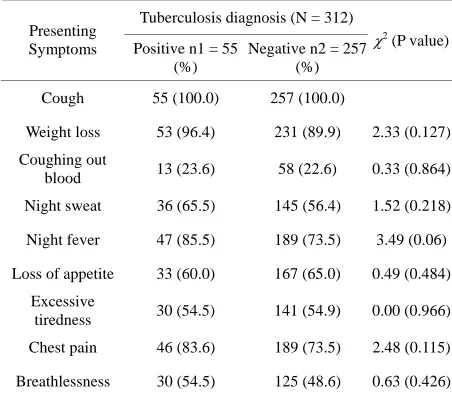
Similarly, all presenting symptoms in PLHIV with and without TB were similar (P > 0.05) Table 3. None of the symptoms individually was significantly more in PLHIV with TB and those without TB i.e. presence of each symptom alone did not indicate presence of TB in PLHIV. However, if symptoms like cough, fever, night sweats and weight loss are combined to make a diagnosis of TB in PLHIV, there was low specificity (10.9%) and high sensitivity (97.0%). It was also of high negative predictive value (NPV) (93.3%) but a low positive pre-dictive value (PPV) (21.8%) Table 4.
4. DISCUSSION
[image:3.595.310.538.111.184.2]Among the 312 persons living with HIV/AIDS studied, less than a quarter (17.6%) were found to have smear
Table 2. History of tuberculosis in PLHIV with or without current tuberculosis.
Tuberculosis diagnosis (N = 312)
Positive Negative
Previous history of TB in patient
Yes
No
Total
1 (1.8) 54 (98.2) 55 (100.0)
13 (5.1) 244 (94.9) 257 (100.0)
2 = 1.11, P = 0.292
Family history of TB
Yes
No
Total
3 (5.5) 52 (94.5) 55 (100.0)
21 (8.2) 236 (91.8) 257 (100.0)
2 = 0.47, P = 0.493
Table 3. Presenting symptoms in PLHIV with or without tuber- culosis.
Tuberculosis diagnosis (N = 312) Presenting
Symptoms Positive n1 = 55 (%)
Negative n2 = 257 (%)
2
(P value)
Cough 55 (100.0) 257 (100.0)
Weight loss 53 (96.4) 231 (89.9) 2.33 (0.127)
Coughing out
blood 13 (23.6) 58 (22.6) 0.33 (0.864)
Night sweat 36 (65.5) 145 (56.4) 1.52 (0.218)
Night fever 47 (85.5) 189 (73.5) 3.49 (0.06)
Loss of appetite 33 (60.0) 167 (65.0) 0.49 (0.484)
Excessive
tiredness 30 (54.5) 141 (54.9) 0.00 (0.966)
Chest pain 46 (83.6) 189 (73.5) 2.48 (0.115)
[image:3.595.58.286.346.500.2]Breathlessness 30 (54.5) 125 (48.6) 0.63 (0.426)
Table 4. Predictive value of the clinical algorithm of PLHIV for presence of pulmonary tuberculosis.
Symptoms
Present Specificity Sensitivity
Negative Predictive Value (NPV)
Positive Predictive Value (PPV)
Cough + fever + night sweats +
weight loss
10.9% 97.0% 93.3% 21.8%
positive tuberculosis. Similar prevalence of TB was ob- tained among PLHIV in some other Nigerian studies [19, 20]. The commonest symptom present in all the PLHIV with or without pulmonary tuberculosis is cough without blood. Other associated symptoms such as weight loss, night sweats, fever, loss of appetite, excessive tiredness, chest pain and breathlessness did not vary significantly (P > 0.05) between the PLHIV with or without TB co- infection.
The Word Health Organization recommends tubercu-losis screening at the time that HIV infection is diag-nosed, before the initiation of anti-retroviral therapy and isoniazid preventive therapy and regularly thereafter [21]. The presence of combination of cough, fever, night sweats and weight loss was found to be specific for tu-berculosis in 10.9% and sensitive in 97.0% of the cases. The high sensitivity of this clinical algorithm as found in this study means there is high true positive and low false negative results. This is particularly important for mak-ing further evaluation to confirm the presence or absence of tuberculosis since a missed opportunity in diagnosis of tuberculosis in a person with HIV infection can have serious implications and consequences in both the con-trol efforts and in the management of dually infected individuals i.e. failure to suspect or diagnose pulmonary TB or inadequately isolate the organism will result in disease transmission. This fact was earlier observed by Tattevin et al. [13] and that led to their advocating for improved interpretation of clinical and radiological data of patients on admission to improve adequacy of respi-ratory isolation and to reduce missed opportunity in di-agnosis of tuberculosis among dually infected individu-als. Similarly, World Health Organization and Center for Disease Control developed an algorithm for diagnosis of TB in PLHIV which included the presence of the fol-lowing symptoms: cough (regardless of duration), fever, night sweats and weight loss. Their findings, like that of present study had high sensitivity (79%) but low speci-ficity (56%) [22].
[image:3.595.58.284.537.736.2]to sputum microscopic examination for confirmation. A study of 1748 persons with HIV infection from eight outpatient clinics in Cambodia, Thailand and Vietnam to determine the algorithm for tuberculosis screening and diagnosis in people with HIV was conducted by Kevin et al. [19] The result similarly showed a high sensitivity of 93% and low specificity of 36% for tuberculosis for the presence of cough, fever and night sweats. Presence of cough alone had a sensitivity of 22% to 33% for detect-ing tuberculosis [21]. In the study by Tattevin et al., they proposed a predictive model based on the combination of medical history, social factors, symptoms and Chest X- ray pattern [13].
In present study, no significant difference (P > 0.05) was noted in the presence or absence of previous per-sonal and family history of tuberculosis among the PLHIV with or without tuberculosis. The high sensitivity (97%) and negative predictive value of 93.3% observed in this study are similar to many other studies where two or more symptoms were used to formulate a predictive model for active tuberculosis in PLHIV. A study con-ducted in Uganda to predict the presence of active tu-berculosis in a population of HIV-infected adults receiv-ing care before accessreceiv-ing ART used the presence of cough of greater than 3 weeks duration, fever of greater than 4 weeks duration, lymphadenopathy, or reduced body mass index (BMI). The result showed 99% sensi-tivity and 66% specificity with a NPV of 100% for pre-dicting active TB at the initial assessment for ART. For patients receiving ART for more than 3 months the pre- sence of either a cough of greater than 3 weeks or gen-eral weakness of greater than 2 weeks was 100% sen- sitive and 66% specific with a negative predictive value (NPV) of 100% for active TB diagnosis. The high NPV implies that the algorithm could be used to efficiently identify PLHIV who are unlikely to have active TB [14]. Furthermore, a study in South Africa observed that among patients with advanced HIV disease not taking anti-retroviral therapy, a screening instrument of two or more symptoms was 100% sensitive and 88% specific with an NPV of 100% [15]. Similar studies in Tanzania and Burundi showed that the combination of any two of four symptoms (cough greater than 3 weeks duration, chest pain greater than 15 days, absence of expectoration or absence of shortness of breath) among adults had a sensitivity of 85% and an NPV of 90% [16].
The findings in this study can be used to divide the population of persons living with HIV/AIDS clinically into two groups: those who do not have tuberculosis and those who need further evaluation to confirm the pres-ence or abspres-ence of tuberculosis in line with the goal of tuberculosis screening. The high sensitivity result ob-tained in this study is in line with the requirement that a good screening test be sensitive enough to avoid missed
diagnosis of tuberculosis in PLHIV with its attendant grave consequences in terms of disease transmission and increased morbidity and mortality. The high negative predictive value of the symptoms as also found in this study also assures that those screened out do not actually have the tuberculosis disease.
5. CONCLUSION AND
RECOMMENDATION
This study suggests that the algorithm of using pres-ence of cough, fever, night sweats and weight loss to screen for TB in PLHIV will pick up most PLHIV with active pulmonary TB. It will, however, also pick up a lot of false positive cases due to its low specificity. Hence, it is recommended that as presently directed, all PLHIV should be screened for TB using the screening algorithm.
REFERENCES
[1] World Health Organization (2011) Global tuberculosis
control. WHO Report 2011.
[2] Corbett, E.L., Watt, C.J., Walker, N., et al. (2003) The
growing burden of tuberculosis. Global trends and inter- actions with the HIV epidemic. Archives of Internal Me- dicine, 163, 1009-1021.
http://dx.doi.org/10.1001/archinte.163.9.1009
[3] Getahun, H., Gunneberg, C., Granich, R. and Nunn, P.
(2010) HIV infection-associated tuberculosis: The epide- miology and the response. Clinical Infectious Diseases,
50, S201-S207. http://dx.doi.org/10.1086/651492
[4] Harries, A.D., Hargreaves, N.J., Kemp, J., et al. (2001)
Deaths from tuberculosis in sub-Saharan African coun-
tries with a high prevalence of HIV-1. Lancet, 357, 1519-
1523. http://dx.doi.org/10.1016/S0140-6736(00)04639-0
[5] Rana, F.S., Hawken, M.P., Mwachari, C., et al. (2000)
Autopsy study of HIV-1-positive and HIV-1-negative adult medical patients in Nairobi, Kenya. Journal of Ac- quired Immune Deficiency Syndromes, 24, 23-29.
[6] World Bank (2012) Tuberculosis case detection rate (%,
all forms). The World Bank Data.
http://data.worldbank.org/indicator/SH.TBS.DTEC.ZS
[7] Sharma, S.K., Mohan, A. and Kadhiravan, T. (2005) HIV-
TB co-infection: Epidemiology, diagnosis & management. Indian Journal of Medical Research, 121, 550-567.
[8] Ha, D.T.M., Lan, N.T.N., Kiet, V.S., Wolbers, M., Hang,
H.T.T., Day, J., Hien, N.Q., Tien, N.A., et al. (2010) Di- agnosis of pulmonary tuberculosis in HIV-positive pa- tients by microscopic observation drug susceptibility as- say. Journal of Clinical Microbiology, 48, 4573-4579.
http://dx.doi.org/10.1128/JCM.00687-10
[9] Sterling, T.R., Pham, P.A. and Chaisson, R.E. (2010) HIV
infection-related tuberculosis: Clinical manifestations and treatment. Clinical Infectious Diseases, 50, S223-S230.
http://dx.doi.org/10.1086/651495
[10] Cain, K.P., Anekthanaon, T., Burapat, C., et al. (2009)
berculosis, Thailand. Emerging Infectious Diseases, 15,
258-264. http://dx.doi.org/10.3201/eid1502.080942
[11] Conde, M.B., Figueira, C.M., Moraes, R., Fonseca, L.S.,
DeRiemer, K. and Kritski, L.(1999) Predictive value of acid fast smear for detection of mycobacterium tubercu- losis in respiratory specimen in reference center of HIV/ AIDS in Rio de Jeneriro. Memorials do instituto Oswaldo Cruz On-Line, 94, 787-790.
[12] Weber, A.M., Areerat, P., Fischer, J.E., Thamthitiwat, S.,
Olsen, S.J. and Varma, J.K. (2008) Factors associated with diagnostic evaluation for tuberculosis adults hospi- talized with clinical pneumonia in Thailand. Infection Control and Hospital Epidemiology, 29, 648-657.
http://dx.doi.org/10.1086/588684
[13] Tattevin, P., Casalino, E., Fleury, L., Egmann, G., Ruel, M.
and Bouvet, E. (1999) The validity of medical history, clinical symptoms and chest radiography in predicting
pulmonary tuberculosis. Chest, 115, 1248-1253.
http://dx.doi.org/10.1378/chest.115.5.1248
[14] Were, W., Moore, D., Ekwaru, P., Mwima, G., Bunnell, R.,
Kaharuza, F., Rutherford, G. and Mermin, J. (2009) A simple screening tool for active tuberculosis in HIV-in- fected adults receiving antiretroviral treatment in Uganda. The International Journal of Tuberculosis and Lung Dis- ease, 13, 47-53.
[15] Mohammed, A., Ehrlich, R., Wood, R., Cilliers, F. and
Maartens G. (2003) Screening for tuberculosis in adults with advanced HIV disease prior to preventive therapy. The International Journal of Tuberculosis and Lung Dis- ease, 8, 792-795.
[16] Samb, B., Henzel, D., Daley, C.L., Mugusi, F., Niyon-
gabo, T., Mlika-Cabanne, N., Aubry, P., Mbaga, I., La- rouze, B. and Murray, J.F. (1997) Methods for diagnosing
tuberculosis among in-patients in eastern Africa whose sputum smears are negative. The International Journal of Tuberculosis and Lung Disease, 1, 25-30.
[17] Federal Republic of Nigeria (2006) Population census.
National Bureau of Statistics. www.nigeriastat.gov.ng
[18] Weyer, K., De Kantor, I.N., Kim, S.J. and Frieden, T.
(1998) Laboratory services in tuberculosis control. WHO, Geneva, 43.
[19] Olaniran, O., Hassan-Olajokun, R.E., Oyovwevotu, M.A.
and Agunlejika, R.A. (2011) Prevalence of tuberculosis among HIV/AIDS patients in Obafemi Awolowo Univer- sity Teaching Hospital Complex, ILE-IFE Nigeria. Inter- national Journal of Biological & Medical Research, 2, 874-877.
[20] Iliyasu, Z. and Babashani, M. (2009) Prevalence and
predictors of tuberculosis co-infection among HIV-sero- positive patients attending the Aminu Kano Teaching
Hospital, Northern Nigeria. Journal of Epidemiology, 19,
81-87. http://dx.doi.org/10.2188/jea.JE20080026
[21] Kevin, P.C., Kimberly, D.M., Charles, M.H., Patama, M.,
Theerawit, T. and Nong, K. (2010) An algorithm for TB screening and diagnosis in people with HIV. The New England Journal of Medicine, 362, 31-40.
[22] Getahun, H., Kittikraisak, W., Heilig, C.M., Corbett, E.L.,
Ayles, H., Cain, K.P., et al. (2011) Development of a stan- dardized screening rule for tuberculosis in people living with HIV in resource-constrained settings: Individual par- ticipant data meta-analysis of observational studies. PLoS Medicine, 8, e1000391.