©IJRASET 2015: All Rights are Reserved
197
A Novel Water Marking Scheme Using Feature
Selection technique using Particle of Swarm
Optimization
Vasimraj Siraj Tamboli#1, Abhijeet Dinkar Cholke*2, Ravindra Sundarlal Kakade #3
1,2,3
Computer Dept,Padmashri Dr.V.V.Patil Instt. of Tech. & Engg. (Polytechnic) Pravaranagar.
Abstract— Digital watermarking techniques play an important role in privacy protection and copyright protection for
multimedia data. In current research trend various watermarking technique are available such as spatial watermarking technique and frequency based watermarking technique. In frequency based watermarking technique used wavelet transform function and Fourier transforms function. The transform based watermarking techniques are very good in quality assessment of watermark image, but lacked from a problem of geometrical attack such as rotation attack translation attack and noise attack. The transformation of attack in watermark multimedia data compromised with the problem of privacy protection and copyright act. For the minimization of geometrical attack used various techniques such as feature selection based watermarking and support vector based multi-class coefficient selection technique. In feature selection based watermarking technique used wavelet transform function for feature extraction. The extracted feature selected by searching technique such as direct search and heuristic based searching technique. The searched coefficient of wavelet transform used for embedding process. In this dissertation proposed a support vector machine based watermarking technique. Support vector based watermarking technique used a classification of feature attribute of digital image. After the classification of feature attribute estimate the correlation coefficient of attribute and apply embedding process, the process of embedding done by person’s coefficient. Person’s coefficient selects a position of embedded water mark in host image. Our experimental result shows better result in compression of support vector based water marking technique. For the estimation of results used three standard parameter PSNR embedding time and number of correlation of feature of watermark image.
Keywords— PSNR, Wavelet, Spatial, Transform, Heuristic.
I. INTRODUCTION
Technology (IJRASET)
198
Transform), Spread Spectrum (CDMA – Code Division Multiple Access), the number of publications in the field of wavelet transform (DWT - Discrete Wavelet Transform) does not cease to increase. The DWT decomposes input image into four components namely LL, HL, LH and HH where the first letter corresponds to applying either a low pass frequency operation or high pass frequency operation to the rows, and the second letter refers to the filter applied to the columns.II. DIGITALIMAGEWATERMARKINGTECHNIQUE
There are different kinds of watermarking techniques are in place, which are differentiated on the basis of types of document, types of domain, etc.
Watermarking techniques are broadly divided into four types: According to working domain
According to types of document According to human perception According to application
These four categories are further classified as below According to types of document
Text watermarking Image watermarking Audio watermarking Video watermarking
According to human perception Visible watermarking
Invisible watermarking According to Application
Source based watermarking: This approach is used for the ownership authentication where unique watermark is embedded into all copies of data. Destination based watermarking: This approach is used in the application where the tracing of buyer is done for the purpose of illegal reselling. Here for each distributed copy a unique watermark is used.
According to working domain Spatial domain
[image:3.612.136.443.431.608.2]Frequency domain
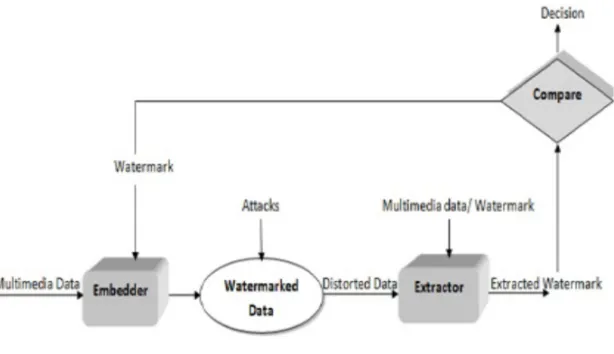
Fig. 1: A Typical Watermarking System.
199
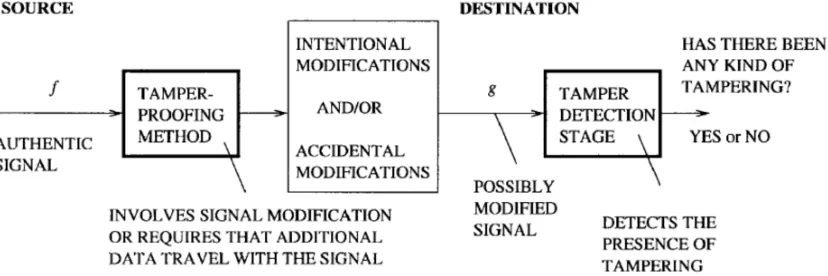
signature, image authentication code, and so forth. While the message increases the practical value of the image, the act of embedding inevitably introduces some amount of distortion. It is highly desirable that this distortion be as small as possible while meeting other requirements, such as minimal robustness and sufficient payload. Several of these applications relate to copyright notification and enforcement for audio, video, and images that are distributed in digital formats. In these cases, the embedded signal either notifies a recipient of any copyright or licensing restrictions or inhibits or deters unauthorized copying. For example, this embedded signal could be a digital “fingerprint” that uniquely identifies the original purchaser of the copyrighted work. If illicit copies of the work were made, all copies would carry this fingerprint, thus identifying the owner of the copy from which all illicit copies were made. Research in the area of digital watermarking has focused primarily on the design of robust techniques for the copyright protection of multimedia data. As a great deal of multimedia is stored in digital format, it has become easier to modify or forge information using widely available editing software. In fact, almost all published imagery is edited to some extent using computer based tools. A problem arises when the possibly tampered data are to be used as evidence; in such situations, the multimedia data must be credible. By “credible” we mean that the signal source is authentic and that the information content in the signal has not been modified in transit to its destination.Fig. 2: The traditional tamper-proofing problem.
The Digital Watermarking Approach Traditionally, digital watermarking has been used to embed author and copyright identification into a multimedia signal. The watermark must be retained in the signal even under intentional signal distortion attacks to remove it. In contrast, fragile watermarking refers to the process of marking a signal such that any modification causes the extracted mark to be different than the original which indicates that tampering has taken place.
III.LITERATURESURVEY
A. A Wavelet Based Image Watermarking Technique Using Image Sharing Method
In this paper Author discuss about a wavelet based image watermarking techniques and the details are, watermarking technique based on wavelet domain and sharing of an image with the motivation to maintain the quality of the image. The original image is diagonally shared and one of the shares is horizontally merged and watermarking process is employed in fusion image using wavelet. Further breakaway the pixels into normal share. Stack the two watermarked images in to single image. At the receiver end again shared and merged a watermarked share in horizontally and extracts a watermark Image. Simulation results indicate that the proposed watermarking scheme is highly robust and does not reduce the quality of watermark image. Many watermarking algorithms are specifically designed for digital images are proposed. Regarding watermarking authors is mainly preferred frequency domain than the spatial domain because the characteristics of the former are more robust invisible, and stable. In this domain, a watermark is inserted into coefficients obtained by using an image transform process. The common well-known transform methods are the discrete cosine transforms (DCT), Discrete Fourier Transform (DFT), and Discrete Wavelet Transform (DWT).
B. A Novel Digital Watermarking Technique For Video Copyright Protection
Technology (IJRASET)
©IJRASET 2015: All Rights are Reserved
200
C. A ROBUST DWT DIGITAL IMAGE WATERMARKING TECHNIQUE BASIS ON SCALING FACTOR
We will concentrate on imperceptible watermarks. The principal intention of digital watermarks is to provide copyright protection for intellectual property that is in digital format. Typical usage scenarios for watermarking are such as copyright protection and data authentication, we describe an imperceptible and a robust DWT digital Image Watermarking algorithm. The algorithm watermarks a given digital image using a Discrete Wavelet Transform. We proposed a watermarking scheme based on discrete wavelet transform that based on scaling factor. By using the block technology, watermarking signal is embedded into the high frequency band of wavelet transformation domain. The simulation results suggest that this watermarking system not only can keep the image quality well, but also can be robust against many common image processing operations of compression, salt and pepper noise, gaussion noise and so on. This algorithm has strong capability of embedding signal and anti-attack.
IV.METHODOLOGYANDARCHITECTURE
A. Feature Extraction Process
Feature extraction play an important role in digital water marking technique and also image processing. Basically color image and multimedia data have three features such as color features, texture features and dimensions features. The texture feature is very important feature for feature extraction for the purpose of image classification and image watermarking technique. For the texture feature extraction used Gabor wavelet transform function. Image processing there are two types of feature as local or global. When the features are extracted from the visual content of the entire image, then this type of features is called global features [3]. Generally global features are used successfully for image retrieval. The well known and popular example of global feature is the global color histogram. The main problem associated with the global features is that the resulting description cannot differentiate between different image parts like the object of interest and the background. Hence, such type of feature is usually not suitable for application like partial image matching and objects. Although in case of global features, it is necessary to extract only local features from regions of interest or objects in the image and use this information to solve problems that are above-mentioned. But one more problem with using local feature is that it required preprocessing, namely image segmentation to determine the regions of interest and this is not a simple task []. Mostly inaccurate segmentation is enough for the task of retrieving images in a general database. This kind of segmentation is much easier and faster to accomplish than accurate segmentation of regions. Another method can also be used as one can consider extracting features from patches around image pixels ending up with a set of local feature vectors, each of which describes the local characteristics around an image pixel. With the help of this approach, we can immediately observe that extracting local feature vectors around all image pixels is usually too expensive in the context of extraction time, storage and time needed for matching. The commonly used methods for texture feature description are statistical and transform-based methods. There are three principal approaches used to describe texture i.e. statistical, structural and spectral. Spectral techniques are based on properties of the Fourier spectrum and describe global periodicity of the grey levels of a surface by identifying high-energy peaks in the Fourier spectrum. Structural techniques characterize textures as being composed of simple primitive structures called “Texel”. These are arranged regularly on a surface according to some surface arrangement rules. Texture is a set of primitive Texel in some regular or repeated relationship. Texture is a quantitative measure of the arrangement of intensities in a region. This set of measurements is called a feature vector [3]. Typically, these properties are computed using: the grey level co-occurrence matrix of the surface, or the wavelet transformation of the surface. Texture is a quantitative measure of the arrangement of intensities in a region. This set of measurements is called a feature vector.
B. Gabor Wavelet Transform
Feature extraction technique is important phase of digital watermarking technique [31]. In watermark image basically three types of features are color, texture and dimensions. Feature extraction can be defined as the act of mapping the image from image space to the feature space. Now days, finding good features that effectively represent an image are still a difficult task [9]. In this section discuss a features are used for pattern generation using support vector machine. Features basically represent the visual content. Visual content can be further divided into general or domain specific. Here used Gabor filters for extraction process. Texture analyzers implemented using 2-D Gabor functions produce a strong correlation with texture data in color image [3]. Gabor functions are Gaussian modulated by complex sinusoids. In the two dimensions they take the form:
( , ) = 1
2 σ σ exp −
1
2 σ +σ + 2 … … … . (1)
©IJRASET 2015: All Rights are Reserved
201
x’=a-m(xcos θ + ysin θ), y’=(-xsin θ + ycos θ)……….. ....(2)where µ = n¼/K, K the number of orientations, S the number scales in the multi resolution, and a = (Uh/Ul)−1/S−1 with Ul and Uh the lower and upper center frequencies of interest. Compact representation needs to be derived for learning and classification purposes. Given an image I(x, y), its Gabor wavelet transform is then defined as:
( , ) = ( , ) ∗( − , − ) ………( )
Where* represents the complex conjugate. Mean μmn and the standard deviation ¾mn of the magnitude of the transform coefficients are used to represent the image.
= | ( , )|
And = ∬(| ( , )|− ) …..(4)
Then a feature vector is constructed using μmn and mn as feature components: f= [μ00 σ00 μ01 σ01 …. μmn σmn] ………..(5)
As result, we obtain a numerical vector of 30 dimensions for 6 orientations and 5 scales changes. Also note the texture feature is computed only for rectangular grid as it is difficult to compute the texture vector for one arbitrary region. The extracted texture feature generates a feature matrix for pattern generation.
V. SUPPORTVECTORMACHINE
Support Vector Machine is supervised Machine Learning technique. Support Vector Machine initially used for the prediction of statically prediction of economics. Support Vector Machines (SVMs) are a set of related supervised learning methods used for classification and regression [35]. They belong to a family of generalized linear classifiers. In another terms, Support Vector Machine (SVM) is a classification and regression prediction tool that uses Machine Learning theory to maximize predictive accuracy while automatically avoiding over-fit to the data. Support Vector machines can be defined as systems which use hypothesis space of a linear functions in a high dimensional feature space, trained with a learning algorithm from optimization theory that implements a learning bias derived from statistical learning theory. Support vector machine was initially popular with the Neural Information Processing Systems (NIPS) community and now is an active part of the Machine Learning research around the world. SVM becomes famous when, using pixel maps as input; it gives accuracy comparable to sophisticated neural networks with elaborated features in a handwriting recognition task. It is also being used for many applications, such as hand writing analysis, face analysis and so forth, especially for pattern classification and regression based applications. SVMs were developed to solve the classification problem, but recently they have been extended to solve regression problems.
Consider the training set is S = {(x1, y1), (x2, y2), (xN,yN)}. Let X Rn denote the possible input to the Support Vector Machine. Assume that a point x Є X is associated with one of two possible classes denoted by y = {+1-1}.
Consider w is the normal (perpendicular) to the hyper-plane and b is the bias. With a linear SVM, the task is simply to find a hyper-plane that separates the two classes. So, the linear function for SVM is given by,
f (x) = wT x + b
The correctly classified data can lie in the following conditions,
wT xi + b ≥ 1 if yi = +1
wT xi + b ≤ 1 if yi = -1 --- (1)
yi (wT xi + b) ≤ 1 for i = 1…N.
VI.PERSON’SCOEFFICIENT
The linear correlation coefficient measures the strength of the linear relationship between two feature variables x and y in a feature matrix. It is sometimes called a Pearson Correlation Coefficient. The formula for this statistic is as follows [38]:
y i n i x i s y y s x x n
r ( )( )
1 1 1
,Here, x and y are the means of x and y. Likewise,sx and syare the standard deviations of each variable the classified pattern
Technology (IJRASET)
©IJRASET 2015: All Rights are Reserved
202
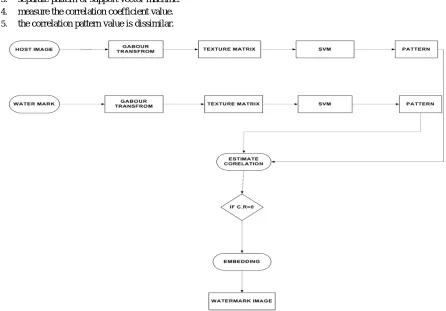
VII. PROPOSEDMETHODOLOGYIn this section discuss the proposed methodology of digital watermarking technique based on support vector machine and Gabor wavelet transform function, the feature of transform function passes through support vector machine. The support vector machine classified the data of feature extracted by transform function, the extracted feature of transform function. Here used an important function for estimate the correlation coefficient of both the pattern host image pattern and watermark symbol pattern. If the correlation coefficient factor estimate the value of correlation is zero then embedding process is done. The process of proposed model divide into three section first section deals with initially take host image and water mark image passes through gabour transform function for feature extraction after the feature extraction applied classification task done by support vector machine. Support vector machine generates the pattern of feature of host image and watermark image. Finally apply person’s coefficient correlation measure the strength of pattern for embedding process.
1. Step feature extraction:
a. input the host image and water mark symbol image
b. apply separately Gabor transform function for feature extraction
F(x)=I(x,y) is host image F1(x)=I1(x1,y1) is water mark image M(F)= F(x) ×G(x). The convolution is perform in host image through transform function here M (F) stored the texture feature matrix of host image.
Then a feature vector is constructed using μmn and mn as feature components: f= [μ00 σ00 μ01 σ01 …. μmn σmn] ………..(1)
We obtain a numerical vector of 60 dimensions for 10 orientations and 6 scales changes. This moment feature value stored in M (F) matrix. N (F) =F1(x) ×G(x) The convolution is perform in host image through transform function here (F) stored the texture feature matrix of host image. Then a feature vector is constructed using μ1mn and 1mn as feature components:
f= [μ100 σ100μ011 σ01 …. μ1mn σ1mn] ………..(2)
We obtain a numerical vector of 60 dimensions for 10 orientations and 6 scales changes. This moment feature value stored in N (F) matrix.
2. Both the feature matrix convent into feature vector and pass through support vector machine. 3. step two used here support vector machine for classification of pattern.
Transform data to the format of an SVM that is X is original data R is transform data such that Xi∈ d here d is dimension of data. Conduct scaling on the data α ═ ∑ ∑ ( , )⋰ ∗ here α is scaling factor and m is total data point and k is total number of instant and sim find close point of data.
Consider the RBF kernel K(x; y)
H(x) = exp((−( − )2∕( 2) this is kernel equation of plane. Use cross-validation to 2nd the best parameter C and
Use the best parameter C and to train the whole training set
Ro=α ∑ ( − ) where Ro is learning parameter of kernel function.
Generate pattern of similar and dissimilar pattern of both image.
4. Estimate the correlation coefficient of both patterns using person’s coefficient. Estimate the feature correlation attribute as
Rel(a, b) = ( , )
( )× ( ) Here a and b the pattern of host image and water mark image.
The estimated correlation coefficient data check the total value of MSE
x(t) = w0 + wjexp(−(total−xj)
σ )
Create the relative feature difference value
Rc = (hi−h)(eik−et)
if the relative pattern difference value is 0 5. watermark embedding process is done 6. calculate PSNR value of watermark image 7. calculate NC value of watermark image 8. Calculate embedding time of watermark image.
9. The water mark extraction process from a watermarked image are given below
203
2. find the texture feature of composite image.
3. separate pattern of support vector machine.
4. measure the correlation coefficient value.
[image:8.612.80.526.91.402.2] [image:8.612.78.389.529.675.2]5. the correlation pattern value is dissimilar.
Fig. 3: Shows that proposed model of water marking technique
VIII. EXPERIMENTALRESULT
The proposed watermarking algorithms are implemented using MATLAB. The imperceptibility and the robustness of the watermarked image are tested with PSNR and NC. Three BDC images of size 512x512 is selected as the cover image. Color image of size 64x64 local is selected as the watermark. The proposed watermarking algorithms are implemented using MATLAB. The imperceptibility and the robustness of the watermarked image are tested with PSNR and NC. Three BDC images of size512x512 is selected as the cover image. Color image of size 128x128 local is selected as the watermark. The PSNR of the watermarked image is calculated using the formula.
Where R is maximum fluctuation in the cover image=511
Technology (IJRASET)
204
The performance evaluation of the methods is done by measuring imperceptibility and robustness. The normalized correlation coefficient (NC) is used to measure the similarity between the cover image and the watermarked image. Peak Signal-to-Noise Ratio (PSNR) is used to measure the imperceptibility of the watermarked image. The robustness of the watermarked image is tested by attacks such as JPEG compression, cropping, median filtering, salt & pepper noise attack, and rotationIX.EXPERIMENTALANALYSIS
A. Dataset
Here we created a dataset which includes various images of BDC, BDC 1 and BDC 2 etc. Three BDC images of size 512x512 are selected as the cover image. Color image of size 64x64 local is selected as the watermark. The proposed watermarking algorithms are implemented using MATLAB. The imperceptibility and the robustness of the watermarked image are tested with PSNR and NC. Three BDC images of size 512x512 are selected as the cover image. Color image of size 128x128 local is selected as the watermark.
Digital Image Method of Watermarking Types of Attack
PSNR NC Recover time
BDC IMAGE
FEATURE BASED METHOD
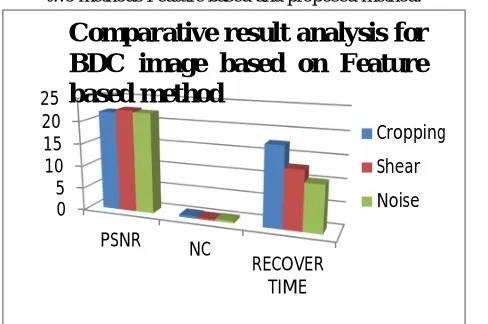
[image:9.612.123.490.287.389.2]Cropping 22.01 0.5593 17.58 Shear 22.60 0.4122 12.96 Noise 22.22 0.5190 10.38 PROPOSED METHOD Cropping 25.76 0.7682 3.697 Shear 26.05 0.6276 3.104 Noise 25.67 0.7406 3.666
Table 1: Shows the comparative PSNR, NC and Recover Time for BDC image for Digital image Watermarking on the basis of two methods Feature based and proposed method.
Fig.4: Shows that a comparative result analysis for BDC image based on the Feature based method. We find the value of PSNR, NC and Recover time. These all value find with the some feature such as Cropping, Shear and Noise.
X. CONCLUSION
In this dissertation proposed a feature selection based watermarking technique. The feature based watermarking technique for color image used wavelet transform function for feature extraction. The extracted features going through support vector machine classifier for classification of feature pattern. The classified feature pattern of host and watermark image, for the selection of coefficient used person coefficient selection method. The person coefficient selection is mathematical function that function estimate the correlation of two feature pattern one is host pattern and other is watermark symbol feature pattern. If the value of feature pattern difference 0 then watermark embedding process is done. In that fashion of watermarking technique the watermark image is stronger instead of DWT and another technique of water marking process. In the proposed method also consider the reduction of embedding time of watermark technique.
0 5 10 15 20 25
PSNR NC
RECOVER TIME
Comparative result analysis for
BDC image based on Feature
based method
[image:9.612.189.433.411.573.2]©IJRASET 2015: All Rights are Reserved
205
The proposed model is combination of wavelet transform function, support vector machine and persons coefficients. The proposed method provides a more security strength for geometrical attack for watermarking technique. The geometrical attack performs on digital watermarking measure the security strength. The strength of security is stronger in compression of DWT-Feature.Our empirical valuation of result analysis shows that better PSNR value and NC value for watermark image. The process of embedding time is also reduces. The reduces time increase diversity and flexibility of watermarking technique.
XI.SUGGESTIONSFORFUTUREWORK
The proposed method of digital watermarking technique provide great security of digital multimedia data, for the improvement of security strength measure the correlation coefficient of classified pattern using support vector machine. The measure coefficient value measure 0 then perform embedding process. The measuring of coefficient factor difference value loss some pattern in embedding process, the loss of support vector pattern used multi- resolution feature extraction transform function for feature extraction. In future used multi-resolution transform function for better feature extraction process.
REFERENCES
[1] B.Sridhar, C.Arun “A Wavelet based Image Watermarking Technique using Image Sharing Method” IEEE 2013. Pp 1-5.
[2] Qiao Baoming, Zhang Pulin, Kang Qiao “A Digital Watermarking Algorithm Based on Wavelet Packet Transform and BP Neural Network” Seventh International Conference on Computational Intelligence and Security, IEEE 2011. Pp 503-507.
[3] Hang SU, Chuqing LV, Yanbing JI, Yulin WANG “A Watermarking E-note Technique against Geometric Attacks” 2nd International Conference on Mechanical and Electronics Engineering ,IEEE 2010. Pp 446-450.
[4] Munesh Chandra, Shikha Pande, Rama Chaudhary “Digital Watermarking Technique for Protecting Digital Images” IEEE, 2010. Pp 226-234.
[5] Bin Zhang, Yang Xin, Xin-Xin Niu, Kai-Guo Yuan, Hui-Bai Jiang “A Near Reversible Image Watermarking Algorithm” Proceedings of the Ninth International Conference on Machine Learning and Cybernetics, 2010. Pp 2824-2829.
[6] Sun Jing, Yang Jing-yu “Quaternion Frequency Watermarking Algorithm for Color Images” IEEE, 2010. Pp 260-264.
[7] Poulami Ghosh, Rilok Ghosh,Souptik Sinha,Ujan Mukhopadhyay, Dipak kr. Kole, Aruna Chakroborty” A Novel Digital Watermarking Technique for Video Copyright Protection” CSCP 2012. Pp 601-610.
[8] Preeti Gupta “Cryptography based digital image watermarking algorithm to increase security of watermark data” International Journal of Scientific & Engineering Research, Volume 3, 2012. Pp 1-4.
[9] Heena Shaikh,Mohd.Imran Khan, Yashovardhan Kelkar”A Robust DWT Digital Image Watermarking Technique Basis On Scaling Factor” International Journal of Computer Science, Engineering and Applications, 2012. Pp 63-70.
[10] Manpreet Kaur ,Sonika Jindal ,Sunny Behal”A Study Of Digital Image Watermarking” IJREAS vol-2, 2012. Pp 126-137.